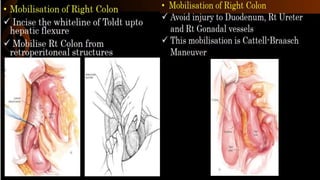
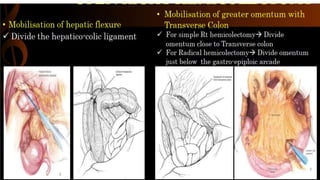
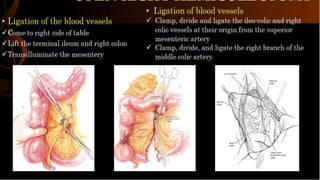
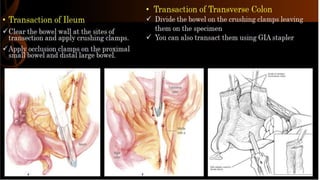
Right Hemicolectomy
Presenter- Dr Lalthlamuana
DNB Student General Surgery
Date:4/10/2023
Introduction
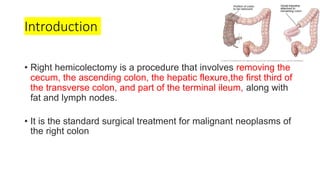
‱ Right hemicolectomy is a procedure that involves removing the
cecum, the ascending colon, the hepatic flexure,the first third of
the transverse colon, and part of the terminal ileum, along with
fat and lymph nodes.
‱ It is the standard surgical treatment for malignant neoplasms of
the right colon
Anatomy
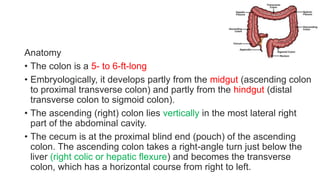
‱ The colon is a 5- to 6-ft-long
‱ Embryologically, it develops partly from the midgut (ascending colon
to proximal transverse colon) and partly from the hindgut (distal
transverse colon to sigmoid colon).
‱ The ascending (right) colon lies vertically in the most lateral right
part of the abdominal cavity.
‱ The cecum is at the proximal blind end (pouch) of the ascending
colon. The ascending colon takes a right-angle turn just below the
liver (right colic or hepatic flexure) and becomes the transverse
colon, which has a horizontal course from right to left.
Blood Supply
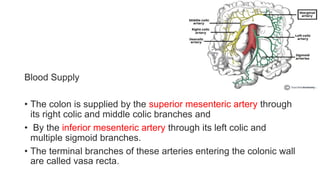
‱ The colon is supplied by the superior mesenteric artery through
its right colic and middle colic branches and
‱ By the inferior mesenteric artery through its left colic and
multiple sigmoid branches.
‱ The terminal branches of these arteries entering the colonic wall
are called vasa recta.
INDICATIONS
‱ Indications for open right hemicolectomy include numerous benign
and malignant conditions.
‱ The most common malignant condition is adenocarcinoma of the
right colon; other malignant indications are malignant tumors of the
appendix and cecum.
INDICATIONS
‱ The benign conditions include adenomatous polyps of the colon that
cannot be removed endoscopically,
‱ carcinoids,
‱ inflammatory bowel disease (Crohn disease and
sometimes ulcerative colitis),
‱ cecal volvulus,
‱ severe appendicitis with involvement of the cecum in the
inflammatory process, and isolated right-side colonic diverticular
disease (rare).
INDICATIONS
‱ Open right hemicolectomy is also performed as a conversion
from initial laparoscopic right hemicolectomy;
‱ As many as 20% of laparoscopic colectomies for cancer may
require conversion to the equivalent open procedures.
Contraindications
‱ The main contraindication for right hemicolectomy in patients
with malignancies is acute obstruction, for which a two-stage
right hemicolectomy is advisable.
‱ In cases of large intestinal obstruction with altered parameters
and vital signs, a bypass procedure is initially a better choice
than radical resection, which the patient is less likely to tolerate.
Contraindications
‱ Therefore, in the first stage, an ileotransverse anastomosis is
performed, and in the second, a right hemicolectomy is
performed.
‱ Other contraindications include significant cardiopulmonary
impairment and coagulopathy.
ANESTHESIA
‱ GA
‱ POSITION
Supine
‱ Diagnosis
Confirmed by colonoscopic biopsy
Staging by CECT
Informed consent- risks of surgery
 Anastomotic leak- 2%
 Hemorrhage- 1%
 Bowel obstruction- 2%
 Wound infection- 2 to 10%
 Injury to ureter and duodenum- 1%
Pre-op preparation
Adequate mechanical bowel preparation the day before surgery with
orthograde enema
 Prophylactic IV broad spectrum antibiotics
 VTE prophylaxis with LMWH and pneumatic stockings
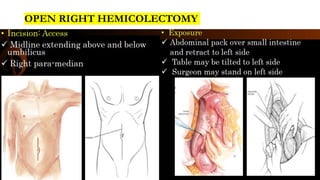
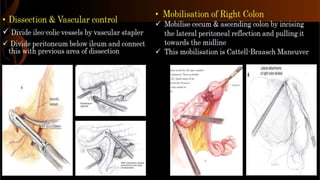
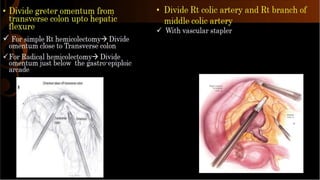
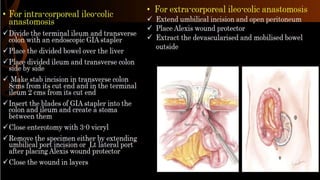
OPEN RIGHT HEMICOLECTOMY
THANK YOU

Right Hemicolectomy.pptx

  • 1.
    Right Hemicolectomy Presenter- DrLalthlamuana DNB Student General Surgery Date:4/10/2023
  • 2.
    Introduction ‱ Right hemicolectomyis a procedure that involves removing the cecum, the ascending colon, the hepatic flexure,the first third of the transverse colon, and part of the terminal ileum, along with fat and lymph nodes. ‱ It is the standard surgical treatment for malignant neoplasms of the right colon
  • 3.
    Anatomy ‱ The colonis a 5- to 6-ft-long ‱ Embryologically, it develops partly from the midgut (ascending colon to proximal transverse colon) and partly from the hindgut (distal transverse colon to sigmoid colon). ‱ The ascending (right) colon lies vertically in the most lateral right part of the abdominal cavity. ‱ The cecum is at the proximal blind end (pouch) of the ascending colon. The ascending colon takes a right-angle turn just below the liver (right colic or hepatic flexure) and becomes the transverse colon, which has a horizontal course from right to left.
  • 4.
    Blood Supply ‱ Thecolon is supplied by the superior mesenteric artery through its right colic and middle colic branches and ‱ By the inferior mesenteric artery through its left colic and multiple sigmoid branches. ‱ The terminal branches of these arteries entering the colonic wall are called vasa recta.
  • 5.
    INDICATIONS ‱ Indications foropen right hemicolectomy include numerous benign and malignant conditions. ‱ The most common malignant condition is adenocarcinoma of the right colon; other malignant indications are malignant tumors of the appendix and cecum.
  • 6.
    INDICATIONS ‱ The benignconditions include adenomatous polyps of the colon that cannot be removed endoscopically, ‱ carcinoids, ‱ inflammatory bowel disease (Crohn disease and sometimes ulcerative colitis), ‱ cecal volvulus, ‱ severe appendicitis with involvement of the cecum in the inflammatory process, and isolated right-side colonic diverticular disease (rare).
  • 7.
    INDICATIONS ‱ Open righthemicolectomy is also performed as a conversion from initial laparoscopic right hemicolectomy; ‱ As many as 20% of laparoscopic colectomies for cancer may require conversion to the equivalent open procedures.
  • 8.
    Contraindications ‱ The maincontraindication for right hemicolectomy in patients with malignancies is acute obstruction, for which a two-stage right hemicolectomy is advisable. ‱ In cases of large intestinal obstruction with altered parameters and vital signs, a bypass procedure is initially a better choice than radical resection, which the patient is less likely to tolerate.
  • 9.
    Contraindications ‱ Therefore, inthe first stage, an ileotransverse anastomosis is performed, and in the second, a right hemicolectomy is performed. ‱ Other contraindications include significant cardiopulmonary impairment and coagulopathy.
  • 10.
    ANESTHESIA ‱ GA ‱ POSITION Supine ‱Diagnosis Confirmed by colonoscopic biopsy Staging by CECT
  • 11.
    Informed consent- risksof surgery  Anastomotic leak- 2%  Hemorrhage- 1%  Bowel obstruction- 2%  Wound infection- 2 to 10%  Injury to ureter and duodenum- 1%
  • 12.
    Pre-op preparation Adequate mechanicalbowel preparation the day before surgery with orthograde enema  Prophylactic IV broad spectrum antibiotics  VTE prophylaxis with LMWH and pneumatic stockings
  • 13.
  • 31.