



Methods of Reconstruction after
Low Anterior Resection
Dr. Dhaval O. Mangukiya
GOAL of LAR
• Cure Disease locally
• Minimize the risk regarding sphincter loss
– Tumor Size
– Differentiation
– Location
• Preserve Bladder, Bowel and Sexual
dysfunction (Avoid nerve Injury)
• Tumor on posterior wall moves up 2-3 cm with
mobilsation
• Risk Factors for sphincter
– Male gender
– Low anterior tumor
– Previous pelvic surgery
– Poorly differentiated tumor
– Diverticulosis or Previous Left colectomy
– Poor resting and squeezing anal pressure
Margins
• Distal Mural Margin
– 2 cm without h/o preop chemoradiation
– 1 cm if responded to neoadjuvant treatment
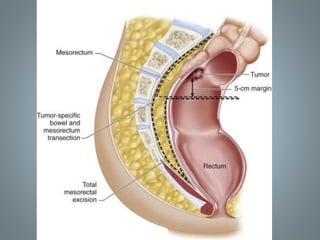
• Mesorectal Margin
– 5 cm distal to the edge of the tumor (TME)
• Lateral Margin
– Depend upon the extent of involvement
Reconsrtuction
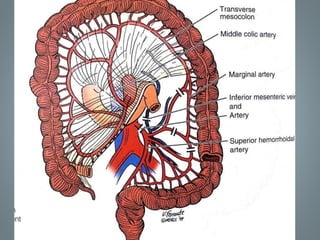
• Colon Mobilization
– Lifting of left colon from Gerota
– Ligation of IMV at the origin
– Division of transverse mesocolon from pancreas
• Divide ligament of Treitz if compressed by
mobilized colon or mesocolon after
reconstruction
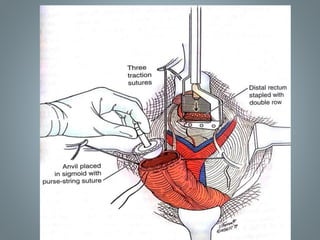
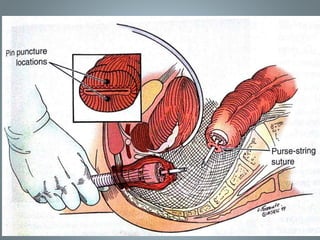
Straight Colorectal/Anal Anastomosis
• Double Stapled Technique
• Hand sewn Technique
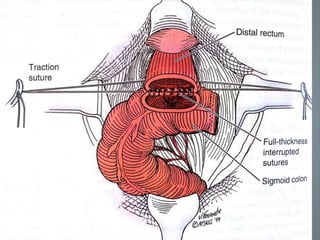
End to Side Colorectal Anastomosis
• Double stapled Technique
• Hand Sewn
Stapler Vs Hand Sewn
• 1 cm or more rectal wall remaining above
levator ani after having min 2 cm distal margin
• For less margin hand sewn if difficult to allow
stapler
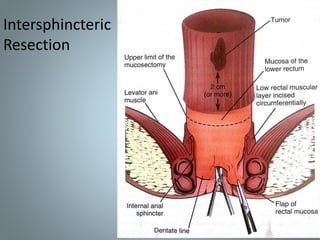
Intersphincteric
Resection
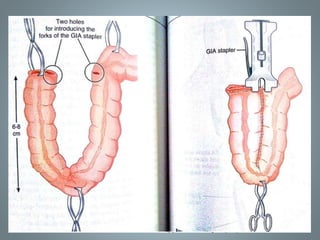
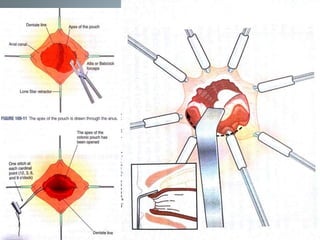
Colonic J Pouch Anastomosis
• Hand Sewn
• Circular stapler
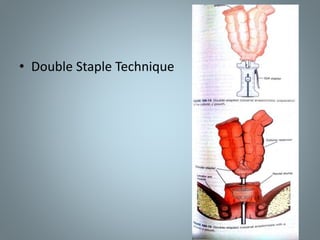
• Double Staple Technique
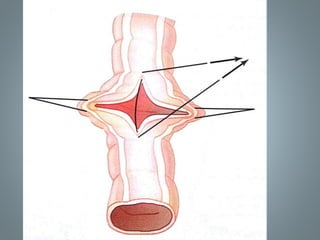
Transverse Coloplasty
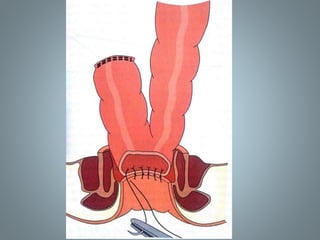
End to side ColoAnal Anastomosis
• Double Stapled
– 7 cm distal limb from the site of anastomosis
• Hand Sewn
• Meta-analysis of colonic reservoirs versus
straight coloanal anastomosis after anterior
resection
• Heriot A G, Tekkis P P, Constantinides V, Paraskevas P, Nicholls RJ, Darzi A,
Fazio V W
• British Journal of Surgery, 2006;93;19-32
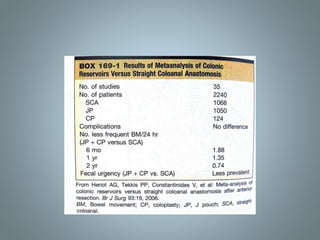
• Thirty-five studies (n=2,240) were included: 14
RCTs (n=789), 13 prospective CCTs (n=797)
and 8 retrospective studies (n=654).
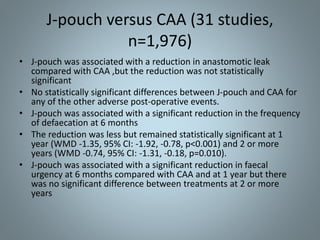
J-pouch versus CAA (31 studies,
n=1,976)
• J-pouch was associated with a reduction in anastomotic leak
compared with CAA ,but the reduction was not statistically
significant
• No statistically significant differences between J-pouch and CAA for
any of the other adverse post-operative events.
• J-pouch was associated with a significant reduction in the frequency
of defaecation at 6 months
• The reduction was less but remained statistically significant at 1
year (WMD -1.35, 95% CI: -1.92, -0.78, p<0.001) and 2 or more
years (WMD -0.74, 95% CI: -1.31, -0.18, p=0.010).
• J-pouch was associated with a significant reduction in faecal
urgency at 6 months compared with CAA and at 1 year but there
was no significant difference between treatments at 2 or more
years
Randomized Comparison of Straight and Colonic J
Pouch Anastomosis After Low Anterior Resection
ANNALS OF SURGERY, 1996;Vol. 224, No. 1, 58-65
Olof Hallbook et al.
Method
One hundred patients with rectal cancer in whom a sphincter-saving
procedure was appropriate were randomized to reconstruction with either
a straight or a colonic J pouch anastomosis.
Conclusion
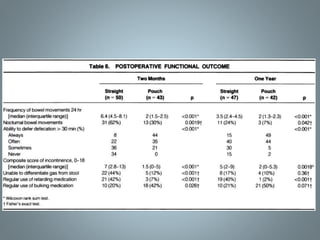
Reconstruction with a colonic J pouch was associated with a lower
incidence of anastomotic leakage and better clinical bowel function when
compared with the traditional straight anastomosis. Functional superiority
was especially evident during the first 2 months.
Similar outcome after colonic pouch and side-to-end
anastomosis in low anterior resection for rectal
cancer: randomized trial
Ann Surg 2003; 238: 214-220
Machado M, Nygren J, Goldman S, Ljungqvist O
Conclusion:
There were no significant differences in operative or
postoperative clinical outcomes in this trial that
included 100 procedures. The ability to evacuate the
bowel within 15 min was significantly better after six
months in the pouch group.
Reconstructive Techniques After Rectal
Resection for Rectal Cancer
Carl J Brown1,*, Darlene Fenech2, Robin S
McLeod3
Cochrane Colorectal Cancer Group
DOI: 10.1002/14651858.CD006040.pub2
Types of interventions
Randomization to one of at least two of the following coloanal
anastomosis techniques defined as:
1) Straight Coloanal Anastomosis (SCA)- The end of the colon is
anastomosed directly to distal rectum/anus after rectal
resection.
2) Side-to-End Anastomosis (STE) - This is a variation of the
straight coloanal anastomosis in which the anastomosis is
performed on the antimesenteric aspect of the colon just
proximal to the distal staple line.
3) Colonic J pouch (CJP)- A pouch of 5-8cm in size is created in
accordance with description by Lazorthes et al.
4) Transverse Coloplasty (TC) - A longitudinal colotomy is created
approximately 8cm in length and 3-4 cm proximal to distal end
of the colon. This colotomy is then closed transversely, and the
distal end of the colon is anastomosed to the anal complex.
Objectives
• Primary objective:
Best functional outcome
• Secondary objective:
To compare techniques in terms of
complications
Types of outcome measures
• Primary Outcome
Bowel function was defined by the following outcome measures:
1) Number of bowel movements per day.
2) Urgency, defined as the inability to defer defecation.
3) Fecal Incontinence, as measured by an appropriate fecal incontinence
measurement tool.
4) Incomplete evacuation, defined by the sensation of residual stool after
defecation.
5) Anti-diarrheal medication use, defined as continued dependence on
constipating medications.
• These outcomes were also defined by the time after gastrointestinal (GI)
continuity is restored that they are recorded. Thus, they are reported
under the following three time frames:
1) Early Outcomes: <8 months after GI continuity restored
2) Intermediate Outcomes: 8 to 18 months after GI continuity restored
3) Late Outcomes: >18 months after GI continuity restore
Secondary Outcomes
The following complications of the operation
were recorded:
1) Perioperative mortality, defined as death
within 30 days of surgery.
2) Anastomotic leak (subclassifications include
clinical and radiologic)
3) Wound infection
4) Chest infection or Pneumonia
DATA COLLECTION
• 16 trials included in this review
– Nine RCTs comparing SCA with CJP
– Four RCTs comparing STE with CJP
– three trials comparing CJP to TCP
• Seven trials were excluded
– Non randomized trials(2)
– Did not report bowel function results (3)
– Clearly overlapped results with already published research (2)
• There were no trials identified that compared all three
reconstructive techniques, nor were there any trials that directly
compared SCA, STE or TCP with one another.
Implications for practice
• Colonic J pouch leads to better bowel function
and similar rates of postoperative complications
compared to the straight coloanal anastomosis.
• Persist up to 2 years after gastrointestinal
continuity is reestablished, and thereafter similar
between the two procedures.
• Thus, the colonic J pouch should be the
procedure of choice after proctectomy for rectal
cancer.
• Limited literature comparing the transverse
coloplasty procedure to the colonic J pouch,
• Three small randomized trials suggest that
bowel function is similar in patients
reconstructed with either procedure
• Some evidence that the transverse coloplasty
procedure results in more anastomotic
dehiscences
Implications for practice
• The side-to-end anastomosis has similar
functional outcomes in three small
randomized trials.
• Further study is necessary before this
technique can be recommended.
• In patients whose anatomy is not amenable to
colonic J pouch reconstruction, the side-to-
end anastomotic technique should be
considered.
Implications for practice
Implications for research
• Further evaluation of the transverse coloplasty
and side-to-end anastomotic strategies as
alternatives to the colonic J pouch.
• Standard definitions of frequently used bowel
function outcomes should be established to
facilitate comparisons of anastomotic and
other bowel function interventions between
studies.
THANK YOU

Low Anterior Resection

  • 1.
    Methods of Reconstructionafter Low Anterior Resection Dr. Dhaval O. Mangukiya
  • 2.
    GOAL of LAR •Cure Disease locally • Minimize the risk regarding sphincter loss – Tumor Size – Differentiation – Location • Preserve Bladder, Bowel and Sexual dysfunction (Avoid nerve Injury)
  • 3.
    • Tumor onposterior wall moves up 2-3 cm with mobilsation • Risk Factors for sphincter – Male gender – Low anterior tumor – Previous pelvic surgery – Poorly differentiated tumor – Diverticulosis or Previous Left colectomy – Poor resting and squeezing anal pressure
  • 4.
    Margins • Distal MuralMargin – 2 cm without h/o preop chemoradiation – 1 cm if responded to neoadjuvant treatment • Mesorectal Margin – 5 cm distal to the edge of the tumor (TME) • Lateral Margin – Depend upon the extent of involvement
  • 6.
    Reconsrtuction • Colon Mobilization –Lifting of left colon from Gerota – Ligation of IMV at the origin – Division of transverse mesocolon from pancreas • Divide ligament of Treitz if compressed by mobilized colon or mesocolon after reconstruction
  • 8.
    Straight Colorectal/Anal Anastomosis •Double Stapled Technique • Hand sewn Technique
  • 11.
    End to SideColorectal Anastomosis • Double stapled Technique • Hand Sewn
  • 13.
    Stapler Vs HandSewn • 1 cm or more rectal wall remaining above levator ani after having min 2 cm distal margin • For less margin hand sewn if difficult to allow stapler
  • 14.
  • 15.
    Colonic J PouchAnastomosis • Hand Sewn • Circular stapler
  • 18.
  • 19.
  • 21.
    End to sideColoAnal Anastomosis • Double Stapled – 7 cm distal limb from the site of anastomosis • Hand Sewn
  • 23.
    • Meta-analysis ofcolonic reservoirs versus straight coloanal anastomosis after anterior resection • Heriot A G, Tekkis P P, Constantinides V, Paraskevas P, Nicholls RJ, Darzi A, Fazio V W • British Journal of Surgery, 2006;93;19-32
  • 24.
    • Thirty-five studies(n=2,240) were included: 14 RCTs (n=789), 13 prospective CCTs (n=797) and 8 retrospective studies (n=654).
  • 25.
    J-pouch versus CAA(31 studies, n=1,976) • J-pouch was associated with a reduction in anastomotic leak compared with CAA ,but the reduction was not statistically significant • No statistically significant differences between J-pouch and CAA for any of the other adverse post-operative events. • J-pouch was associated with a significant reduction in the frequency of defaecation at 6 months • The reduction was less but remained statistically significant at 1 year (WMD -1.35, 95% CI: -1.92, -0.78, p<0.001) and 2 or more years (WMD -0.74, 95% CI: -1.31, -0.18, p=0.010). • J-pouch was associated with a significant reduction in faecal urgency at 6 months compared with CAA and at 1 year but there was no significant difference between treatments at 2 or more years
  • 27.
    Randomized Comparison ofStraight and Colonic J Pouch Anastomosis After Low Anterior Resection ANNALS OF SURGERY, 1996;Vol. 224, No. 1, 58-65 Olof Hallbook et al. Method One hundred patients with rectal cancer in whom a sphincter-saving procedure was appropriate were randomized to reconstruction with either a straight or a colonic J pouch anastomosis. Conclusion Reconstruction with a colonic J pouch was associated with a lower incidence of anastomotic leakage and better clinical bowel function when compared with the traditional straight anastomosis. Functional superiority was especially evident during the first 2 months.
  • 29.
    Similar outcome aftercolonic pouch and side-to-end anastomosis in low anterior resection for rectal cancer: randomized trial Ann Surg 2003; 238: 214-220 Machado M, Nygren J, Goldman S, Ljungqvist O Conclusion: There were no significant differences in operative or postoperative clinical outcomes in this trial that included 100 procedures. The ability to evacuate the bowel within 15 min was significantly better after six months in the pouch group.
  • 30.
    Reconstructive Techniques AfterRectal Resection for Rectal Cancer Carl J Brown1,*, Darlene Fenech2, Robin S McLeod3 Cochrane Colorectal Cancer Group DOI: 10.1002/14651858.CD006040.pub2
  • 31.
    Types of interventions Randomizationto one of at least two of the following coloanal anastomosis techniques defined as: 1) Straight Coloanal Anastomosis (SCA)- The end of the colon is anastomosed directly to distal rectum/anus after rectal resection. 2) Side-to-End Anastomosis (STE) - This is a variation of the straight coloanal anastomosis in which the anastomosis is performed on the antimesenteric aspect of the colon just proximal to the distal staple line. 3) Colonic J pouch (CJP)- A pouch of 5-8cm in size is created in accordance with description by Lazorthes et al. 4) Transverse Coloplasty (TC) - A longitudinal colotomy is created approximately 8cm in length and 3-4 cm proximal to distal end of the colon. This colotomy is then closed transversely, and the distal end of the colon is anastomosed to the anal complex.
  • 32.
    Objectives • Primary objective: Bestfunctional outcome • Secondary objective: To compare techniques in terms of complications
  • 33.
    Types of outcomemeasures • Primary Outcome Bowel function was defined by the following outcome measures: 1) Number of bowel movements per day. 2) Urgency, defined as the inability to defer defecation. 3) Fecal Incontinence, as measured by an appropriate fecal incontinence measurement tool. 4) Incomplete evacuation, defined by the sensation of residual stool after defecation. 5) Anti-diarrheal medication use, defined as continued dependence on constipating medications. • These outcomes were also defined by the time after gastrointestinal (GI) continuity is restored that they are recorded. Thus, they are reported under the following three time frames: 1) Early Outcomes: <8 months after GI continuity restored 2) Intermediate Outcomes: 8 to 18 months after GI continuity restored 3) Late Outcomes: >18 months after GI continuity restore
  • 34.
    Secondary Outcomes The followingcomplications of the operation were recorded: 1) Perioperative mortality, defined as death within 30 days of surgery. 2) Anastomotic leak (subclassifications include clinical and radiologic) 3) Wound infection 4) Chest infection or Pneumonia
  • 35.
    DATA COLLECTION • 16trials included in this review – Nine RCTs comparing SCA with CJP – Four RCTs comparing STE with CJP – three trials comparing CJP to TCP • Seven trials were excluded – Non randomized trials(2) – Did not report bowel function results (3) – Clearly overlapped results with already published research (2) • There were no trials identified that compared all three reconstructive techniques, nor were there any trials that directly compared SCA, STE or TCP with one another.
  • 36.
    Implications for practice •Colonic J pouch leads to better bowel function and similar rates of postoperative complications compared to the straight coloanal anastomosis. • Persist up to 2 years after gastrointestinal continuity is reestablished, and thereafter similar between the two procedures. • Thus, the colonic J pouch should be the procedure of choice after proctectomy for rectal cancer.
  • 37.
    • Limited literaturecomparing the transverse coloplasty procedure to the colonic J pouch, • Three small randomized trials suggest that bowel function is similar in patients reconstructed with either procedure • Some evidence that the transverse coloplasty procedure results in more anastomotic dehiscences Implications for practice
  • 38.
    • The side-to-endanastomosis has similar functional outcomes in three small randomized trials. • Further study is necessary before this technique can be recommended. • In patients whose anatomy is not amenable to colonic J pouch reconstruction, the side-to- end anastomotic technique should be considered. Implications for practice
  • 39.
    Implications for research •Further evaluation of the transverse coloplasty and side-to-end anastomotic strategies as alternatives to the colonic J pouch. • Standard definitions of frequently used bowel function outcomes should be established to facilitate comparisons of anastomotic and other bowel function interventions between studies.
  • 40.