Language and Communication
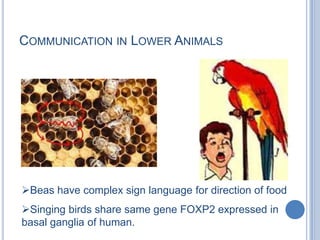
Communication in Lower AnimalsBeas have complex sign language for direction of food
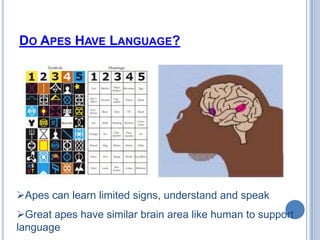
Singing birds share same gene FOXP2 expressed in basal ganglia of human.Do Apes Have Language?Apes can learn limited signs, understand and speak
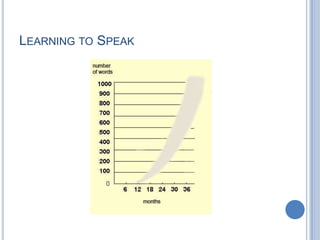
Great apes have similar brain area like human to support languageLearning to Speak
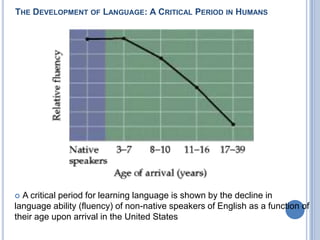
The Development of Language: A Critical Period in Humans A critical period for learning language is shown by the decline in language ability (fluency) of non-native speakers of English as a function of their age upon arrival in the United States
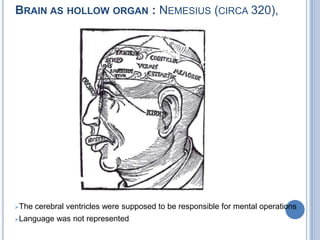
Brain as hollow organ : Nemesius (circa 320), The cerebral ventricles were supposed to be responsible for mental operations
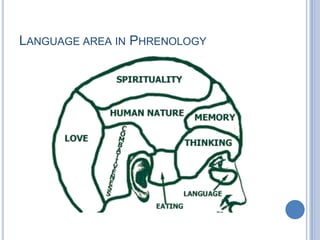
Language was not represented Language area in Phrenology
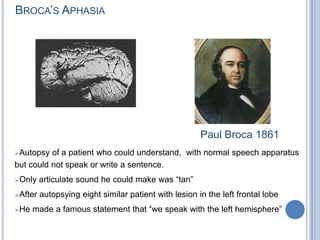
Broca’s AphasiaPaul Broca 1861Autopsy of a patient who could understand,  with normal speech apparatus but could not speak or write a sentence.
Only articulate sound he could make was “tan”
After autopsying eight similar patient with lesion in the left frontal lobe
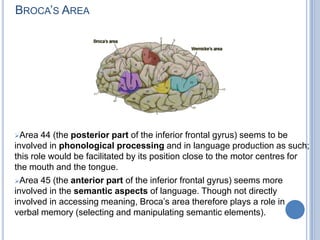
He made a famous statement that “we speak with the left hemisphere”Broca’s Area Area 44 (the posterior part of the inferior frontal gyrus) seems to be involved in phonological processing and in language production as such; this role would be facilitated by its position close to the motor centres for the mouth and the tongue.
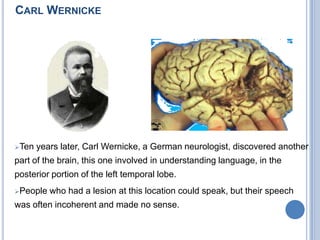
Area 45 (the anterior part of the inferior frontal gyrus) seems more involved in the semantic aspects of language. Though not directly involved in accessing meaning, Broca’s area therefore plays a role in verbal memory (selecting and manipulating semantic elements).Carl WernickeTen years later, Carl Wernicke, a German neurologist, discovered another part of the brain, this one involved in understanding language, in the posterior portion of the left temporal lobe.
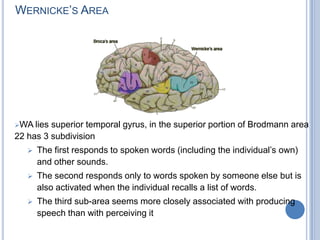
People who had a lesion at this location could speak, but their speech was often incoherent and made no sense.Wernicke’s Area WA lies superior temporal gyrus, in the superior portion of Brodmann area 22 has 3 subdivision
The first responds to spoken words (including the individual’s own) and other sounds.
The second responds only to words spoken by someone else but is also activated when the individual recalls a list of words.
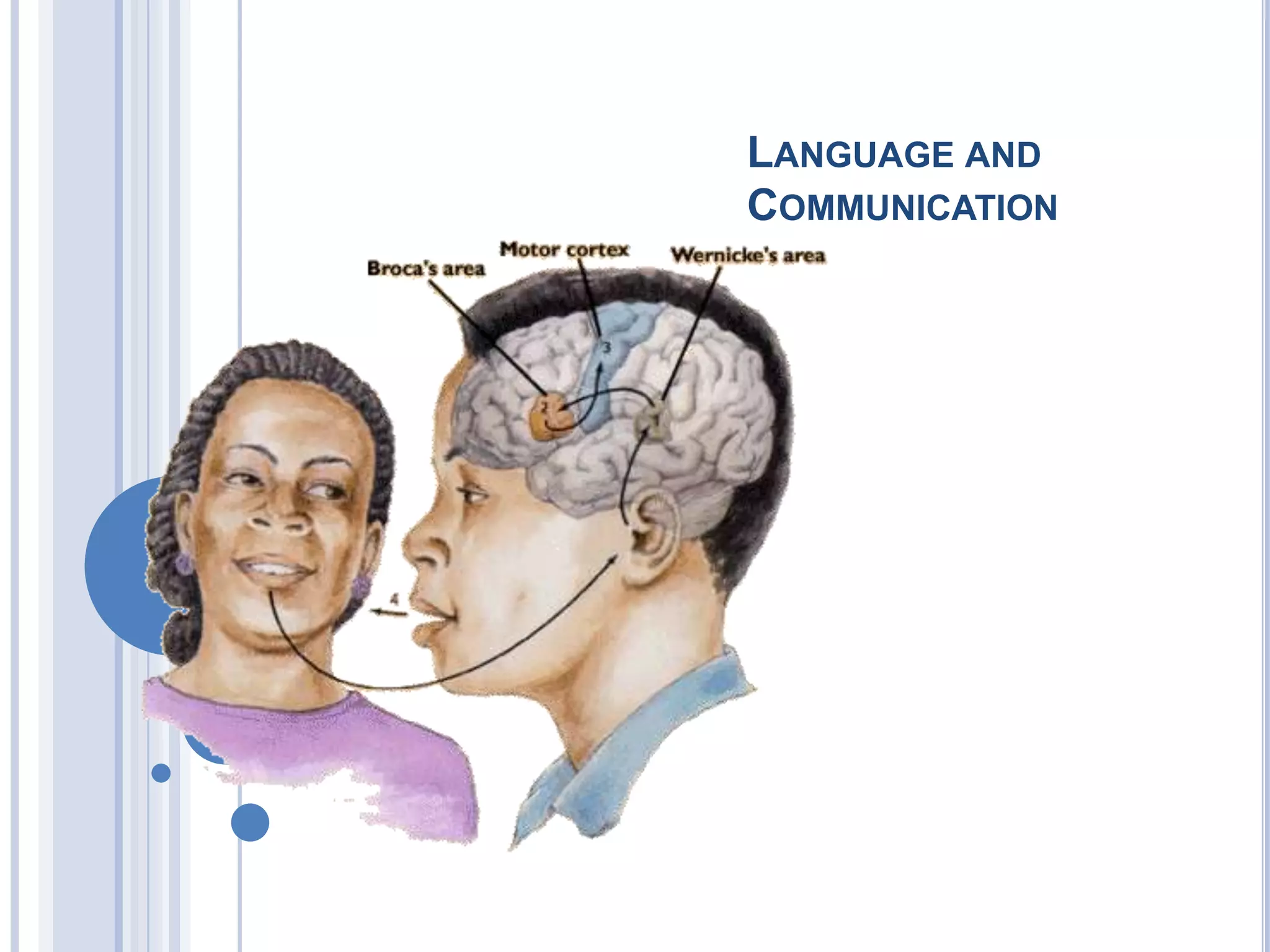
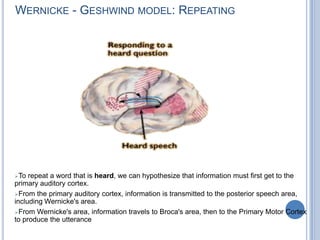
The third sub-area seems more closely associated with producing speech than with perceiving itWernicke - Geshwind model: Repeating To repeat a word that is heard, we can hypothesize that information must first get to the primary auditory cortex.
From the primary auditory cortex, information is transmitted to the posterior speech area, including Wernicke's area.
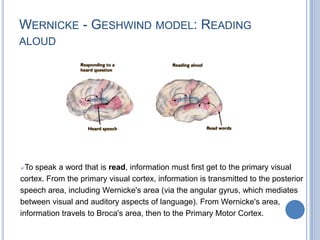
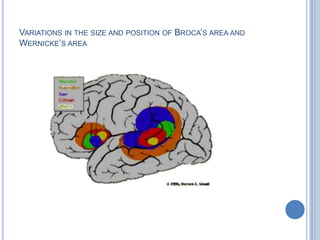
From Wernicke's area, information travels to Broca's area, then to the Primary Motor Cortex to produce the utteranceWernicke - Geshwind model: Reading aloudTo speak a word that is read, information must first get to the primary visual cortex. From the primary visual cortex, information is transmitted to the posterior speech area, including Wernicke's area (via the angular gyrus, which mediates between visual and auditory aspects of language). From Wernicke's area, information travels to Broca's area, then to the Primary Motor Cortex.Variations in the size and position of Broca’s area and Wernicke’s area
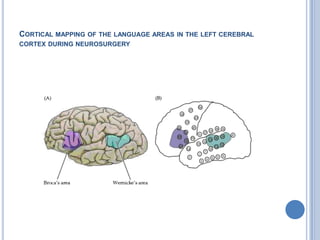
Cortical mapping of the language areas in the left cerebral cortex during neurosurgery
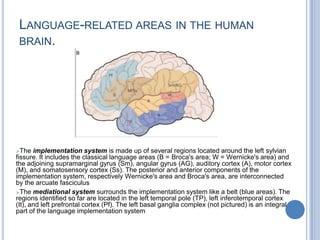
Language-related areas in the human brain.The implementation systemis made up of several regions located around the left sylvian fissure. It includes the classical language areas (B = Broca's area; W = Wernicke's area) and the adjoining supramarginalgyrus (Sm), angular gyrus (AG), auditory cortex (A), motor cortex (M), and somatosensory cortex (Ss). The posterior and anterior components of the implementation system, respectively Wernicke's area and Broca's area, are interconnected by the arcuate fasciculus
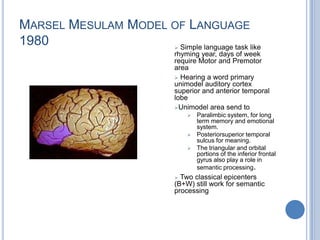
The mediational systemsurrounds the implementation system like a belt (blue areas). The regions identified so far are located in the left temporal pole (TP), left inferotemporal cortex (It), and left prefrontal cortex (Pf). The left basal ganglia complex (not pictured) is an integral part of the language implementation systemMarsel Mesulam Model of Language 1980 Simple language task like rhyming year, days of week require Motor and Premotor area
 Hearing a word primary unimodel auditory cortex superior and anterior temporal lobe
Unimodel area send to
Paralimbic system, for long term memory and emotional system.
Posteriorsuperior temporal sulcus for meaning.
The triangular and orbital portions of the inferior frontal gyrus also play a role in semantic processing.
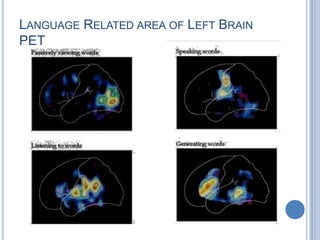
 Two classical epicenters (B+W) still work for semantic processingLanguage Related area of Left Brain PET
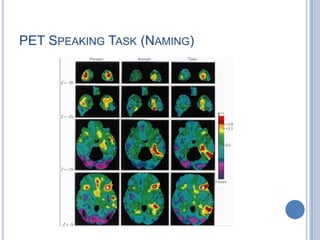
PET Speaking Task (Naming)
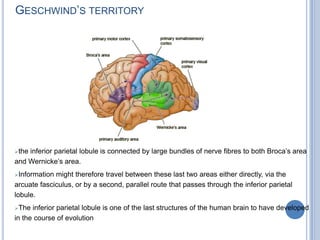
Geschwind’s territorythe inferior parietal lobule is connected by large bundles of nerve fibres to both Broca’s area and Wernicke’s area.
Information might therefore travel between these last two areas either directly, via the arcuate fasciculus, or by a second, parallel route that passes through the inferior parietal lobule.
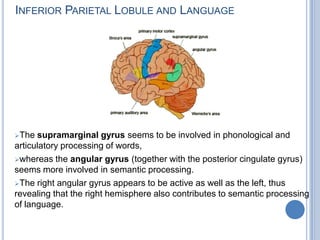
The inferior parietal lobule is one of the last structures of the human brain to have developed in the course of evolutionInferior Parietal Lobule and LanguageThe supramarginal gyrus seems to be involved in phonological and articulatory processing of words,
whereas the angular gyrus (together with the posterior cingulategyrus) seems more involved in semantic processing.
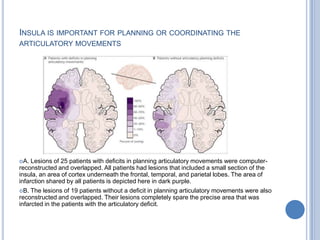
The right angular gyrus appears to be active as well as the left, thus revealing that the right hemisphere also contributes to semantic processing of language. Insula is important for planning or coordinating the articulatory movements A. Lesions of 25 patients with deficits in planning articulatory movements were computer-reconstructed and overlapped. All patients had lesions that included a small section of the insula, an area of cortex underneath the frontal, temporal, and parietal lobes. The area of infarction shared by all patients is depicted here in dark purple.B. The lesions of 19 patients without a deficit in planning articulatory movements were also reconstructed and overlapped. Their lesions completely spare the precise area that was infarcted in the patients with the articulatory deficit.
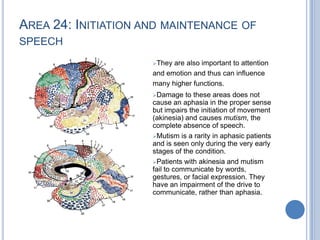
Area 24: Initiation and maintenance of speechThey are also important to attention and emotion and thus can influence many higher functions.
Damage to these areas does not cause an aphasia in the proper sense but impairs the initiation of movement (akinesia) and causes mutism, the complete absence of speech.
Mutism is a rarity in aphasic patients and is seen only during the very early stages of the condition.
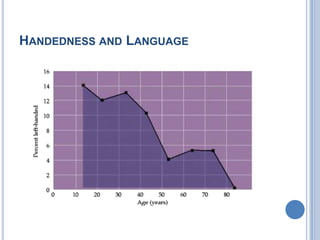
Patients with akinesia and mutism fail to communicate by words, gestures, or facial expression. They have an impairment of the drive to communicate, rather than aphasia.Handedness and Language
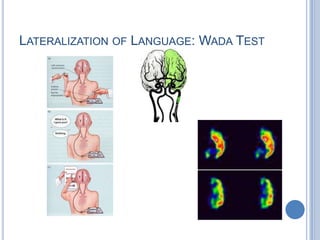
Lateralization of Language: Wada Test
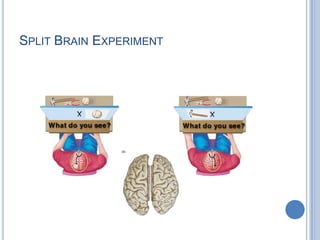
Split Brain Experiment
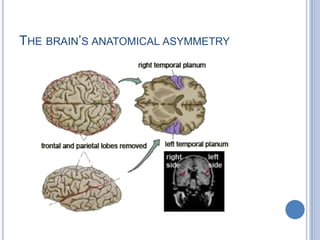
The brain’s anatomical asymmetry
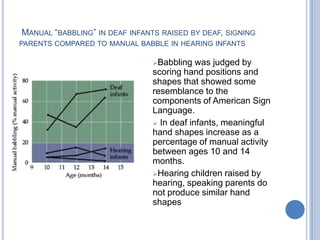
 Manual “babbling” in deaf infants raised by deaf, signing parents compared to manual babble in hearing infantsBabbling was judged by scoring hand positions and shapes that showed some resemblance to the components of American Sign Language.
 In deaf infants, meaningful hand shapes increase as a percentage of manual activity between ages 10 and 14 months.

Language and communication

  • 1.
  • 2.
    Communication in LowerAnimalsBeas have complex sign language for direction of food
  • 3.
    Singing birds sharesame gene FOXP2 expressed in basal ganglia of human.Do Apes Have Language?Apes can learn limited signs, understand and speak
  • 4.
    Great apes havesimilar brain area like human to support languageLearning to Speak
  • 5.
    The Development of Language: A Critical Period in Humans A criticalperiod for learning language is shown by the decline in language ability (fluency) of non-native speakers of English as a function of their age upon arrival in the United States
  • 6.
    Brain as holloworgan : Nemesius (circa 320), The cerebral ventricles were supposed to be responsible for mental operations
  • 7.
    Language was notrepresented Language area in Phrenology
  • 8.
    Broca’s AphasiaPaul Broca1861Autopsy of a patient who could understand, with normal speech apparatus but could not speak or write a sentence.
  • 9.
    Only articulate soundhe could make was “tan”
  • 10.
    After autopsying eightsimilar patient with lesion in the left frontal lobe
  • 11.
    He made afamous statement that “we speak with the left hemisphere”Broca’s Area Area 44 (the posterior part of the inferior frontal gyrus) seems to be involved in phonological processing and in language production as such; this role would be facilitated by its position close to the motor centres for the mouth and the tongue.
  • 12.
    Area 45 (the anteriorpart of the inferior frontal gyrus) seems more involved in the semantic aspects of language. Though not directly involved in accessing meaning, Broca’s area therefore plays a role in verbal memory (selecting and manipulating semantic elements).Carl WernickeTen years later, Carl Wernicke, a German neurologist, discovered another part of the brain, this one involved in understanding language, in the posterior portion of the left temporal lobe.
  • 13.
    People who hada lesion at this location could speak, but their speech was often incoherent and made no sense.Wernicke’s Area WA lies superior temporal gyrus, in the superior portion of Brodmann area 22 has 3 subdivision
  • 14.
    The first respondsto spoken words (including the individual’s own) and other sounds.
  • 15.
    The second respondsonly to words spoken by someone else but is also activated when the individual recalls a list of words.
  • 16.
    The third sub-areaseems more closely associated with producing speech than with perceiving itWernicke - Geshwind model: Repeating To repeat a word that is heard, we can hypothesize that information must first get to the primary auditory cortex.
  • 17.
    From the primaryauditory cortex, information is transmitted to the posterior speech area, including Wernicke's area.
  • 18.
    From Wernicke's area,information travels to Broca's area, then to the Primary Motor Cortex to produce the utteranceWernicke - Geshwind model: Reading aloudTo speak a word that is read, information must first get to the primary visual cortex. From the primary visual cortex, information is transmitted to the posterior speech area, including Wernicke's area (via the angular gyrus, which mediates between visual and auditory aspects of language). From Wernicke's area, information travels to Broca's area, then to the Primary Motor Cortex.Variations in the size and position of Broca’s area and Wernicke’s area
  • 19.
    Cortical mapping ofthe language areas in the left cerebral cortex during neurosurgery
  • 20.
    Language-related areas inthe human brain.The implementation systemis made up of several regions located around the left sylvian fissure. It includes the classical language areas (B = Broca's area; W = Wernicke's area) and the adjoining supramarginalgyrus (Sm), angular gyrus (AG), auditory cortex (A), motor cortex (M), and somatosensory cortex (Ss). The posterior and anterior components of the implementation system, respectively Wernicke's area and Broca's area, are interconnected by the arcuate fasciculus
  • 21.
    The mediational systemsurroundsthe implementation system like a belt (blue areas). The regions identified so far are located in the left temporal pole (TP), left inferotemporal cortex (It), and left prefrontal cortex (Pf). The left basal ganglia complex (not pictured) is an integral part of the language implementation systemMarsel Mesulam Model of Language 1980 Simple language task like rhyming year, days of week require Motor and Premotor area
  • 22.
    Hearing aword primary unimodel auditory cortex superior and anterior temporal lobe
  • 23.
  • 24.
    Paralimbic system, forlong term memory and emotional system.
  • 25.
  • 26.
    The triangular andorbital portions of the inferior frontal gyrus also play a role in semantic processing.
  • 27.
    Two classicalepicenters (B+W) still work for semantic processingLanguage Related area of Left Brain PET
  • 28.
  • 29.
    Geschwind’s territorythe inferiorparietal lobule is connected by large bundles of nerve fibres to both Broca’s area and Wernicke’s area.
  • 30.
    Information might thereforetravel between these last two areas either directly, via the arcuate fasciculus, or by a second, parallel route that passes through the inferior parietal lobule.
  • 31.
    The inferior parietallobule is one of the last structures of the human brain to have developed in the course of evolutionInferior Parietal Lobule and LanguageThe supramarginal gyrus seems to be involved in phonological and articulatory processing of words,
  • 32.
    whereas the angular gyrus (together withthe posterior cingulategyrus) seems more involved in semantic processing.
  • 33.
    The right angulargyrus appears to be active as well as the left, thus revealing that the right hemisphere also contributes to semantic processing of language. Insula is important for planning or coordinating the articulatory movements A. Lesions of 25 patients with deficits in planning articulatory movements were computer-reconstructed and overlapped. All patients had lesions that included a small section of the insula, an area of cortex underneath the frontal, temporal, and parietal lobes. The area of infarction shared by all patients is depicted here in dark purple.B. The lesions of 19 patients without a deficit in planning articulatory movements were also reconstructed and overlapped. Their lesions completely spare the precise area that was infarcted in the patients with the articulatory deficit.
  • 34.
    Area 24: Initiationand maintenance of speechThey are also important to attention and emotion and thus can influence many higher functions.
  • 35.
    Damage to theseareas does not cause an aphasia in the proper sense but impairs the initiation of movement (akinesia) and causes mutism, the complete absence of speech.
  • 36.
    Mutism is ararity in aphasic patients and is seen only during the very early stages of the condition.
  • 37.
    Patients with akinesiaand mutism fail to communicate by words, gestures, or facial expression. They have an impairment of the drive to communicate, rather than aphasia.Handedness and Language
  • 38.
  • 39.
  • 40.
  • 41.
     Manual “babbling” indeaf infants raised by deaf, signing parents compared to manual babble in hearing infantsBabbling was judged by scoring hand positions and shapes that showed some resemblance to the components of American Sign Language.
  • 42.
    In deafinfants, meaningful hand shapes increase as a percentage of manual activity between ages 10 and 14 months.