Language & The Brain
Name: Jordanae Lindsay #1223816
Course: Brain, Biology and Behavior
Date: March 15, 2019
Neurolinguistics
Neurolinguistics studies the relation of
language and communication to different
aspects of brain function, i.e. it tries to
explore how the brain understands and
produces language and communication.
Language and the Brain
Many people assume the physical basis of language
lies in the lips, the tongue, or the ear. But deaf and
mute people can also possess language fully. People
who have no capacity to use their vocal cords may
still be able to comprehend language and use its
written forms.
Language and the Brain
Language is brain stuff--not tongue, lip, ear, or hand stuff.
The language organ is the mind. More specifically, the
language faculty seems to be located in certain areas of the
left hemispheric cortex in most healthy adults. A special
branch of linguistics, called neurolinguistics, studies the
physical structure of the brain as it relates to language
production and comprehension.
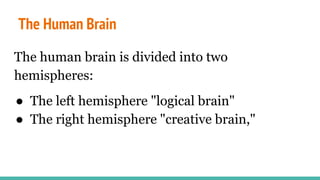
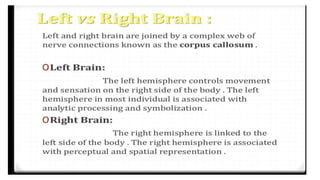
The Human Brain
The human brain is divided into two
hemispheres:
â—Ź The left hemisphere "logical brain"
â—Ź The right hemisphere "creative brain,"
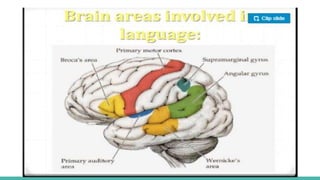
Language Areas in the Brain
â—Ź The auditory cortex
â—Ź Wernicke's area
â—Ź Broca's area
â—Ź The Arcuate Fasciculus
Language Areas in the Brain
The auditory cortex in the cerebral cortex
processes auditory information and as part of the
sensory system for hearing, performs both basic
and higher hearing functions.
Language Areas in the Brain
Wernicke's area is an area in the cerebral
cortex related to speech and is involved in both
spoken and written language. This area was
named after Carl Wernicke, a German neurologist
who discovered that the area is related to how
words and syllables are pronounced.
Language Areas in the Brain
Broca's area is an area in the frontal lobe of the
brain that is related to the production of speech.
The area is named after Pierre Paul Broca who
noticed an impaired ability to produce speech in
two patients who had sustained injury to the
region.
Language Areas in the Brain
The Arcuate Fasciculus is a part of the white matter of
the brain. It is an arched band of white fibers that acts as a
bridge between different sections of gray matter that are
not directly connected. It can pass along information from
one place to another, almost like a shortcut. bridge travels
around around a crack in the brain called the Sylvian
Fissure. It may connect two regions of the brain called
Broca's area and Wernicke's area.
Language Disorders
Language disorder is a communication disorder in which a
person has persistent difficulties in learning and using various
forms of language (i.e., spoken, written, sign language).
Individuals with language disorder have language abilities that
are significantly below those expected for their age, which limits
the ability to communicate or effectively participate in many
social, academic, or professional environments.
Language Disorders
â—Ź Aphasia is one kind of language disorder that results
from damage to the parts of the brain that contain
language.
â—Ź Aphasia occurs in various forms and degrees,
depending upon the situation, extent, and severity of
the cerebral lesions which is responsible.
Language Disorders
â—Ź Aphasias are inability to perceive, process, or produce language
due to physical damage to the brain.
● Broca’s aphasia results in an inability to produce sequences of
sounds in fluent speech; tendency to eliminate any functional
vocabulary.
● Wernicke’s aphasia results in inability to understand speech and
inability to speak meaningfully.
â—Ź Acquired dyslexia and Acquired dysgraphia due to angular gyrus
damage.
Cause of the Aphasia
â—Ź Aphasia is caused by damage to one or more of the language
areas of the brain.
â—Ź The cause of the brain injury is a stroke Other causes of
brain injury are severe blows to the head, brain tumors,
brain infections, and other conditions that affect the brain.
â—Ź Damage to the left side of the brain causes aphasia for most
right-handers and about half of left-handers.
Treatments for Aphasias
Community Aphasia Groups—treatment and support for
people with aphasia that can improve linguistic functioning
in a naturalistic setting (Elman & Bernstein-Ellis, 1999) and
enhance social networks (Vickers, 2010). Groups also offer
individuals and family members an opportunity to socialize,
converse, share ideas and feelings, receive support, and learn
more about aphasia and aphasia resources.
Treatments for Aphasias
Constraint-Induced Language Therapy (CILT): CILT is
an intensive treatment approach focused on increasing spoken
language output while discouraging (constraining) the use of
compensatory communication strategies (e.g., gesturing and
writing). In addition to “forced use” of verbal language, CILT
involves high-intensity training via massed practice
(PulvermĂĽller et al., 2001).
Treatments for Aphasias
MIT ( Melodic Intonation Therapy) uses the musical
elements of speech (i.e., melody, rhythm, and stress) to
improve expressive language. This approach capitalizes
on intact functioning (singing) while engaging areas of
the undamaged right hemisphere that are still capable of
language.
References
The American Speech-Language-Hearing Association. (2019). Aphasia: Treatment. Retrieved from
https://www.asha.org/PRPSpecificTopic.aspx?folderid=8589934663§ion=Treatment
Mandal, A. (2019, February 26). Language and the Human Brain|News-Medical.Net. Retrieved from https://www.news-
medical.net/health/Language-and-the-Human-Brain.aspx
Murtaqi, A. (2011, November 29). Presentation language and the brain| SlideShare. Retrieved from
https://www.slideshare.net/AhmadJauhari/presentation-language-and-the-brain
Psychology Today.com. (2018, February 15). Language Disorder. Retrieved from
https://www.psychologytoday.com/us/conditions/language-disorder
Reed, D. (2019). Arcuate Fasciculus: Definition & Function. Retrieved from https://study.com/academy/lesson/arcuate-fasciculus-
definition-function.html
Yaqoob, R. (2014, October 14). Language and the brain| SlideShare. Retrieved from https://www.slideshare.net/noviiummiy/language-
and-the-brain-40247158