LANGUAGE ACQUISITION
Before 5 five years, the child has already knows
most of the intricate language system.
Children controls: -Conjoining sentences
-asking questions
-using pronouns
-negate sentences
-forming relative clauses
-inflecting verbs and nouns.
Some considerations
No one teaches the gramar rules to the
children.
Their parents are not aware about
morphology, syntatic and semantic rules.
How do learners acquire a Second Language?
Making use of existing knowledge of the
native language
Using general learning strategies
Taking into account universal properties of
language to internalize knowledge of the
second language
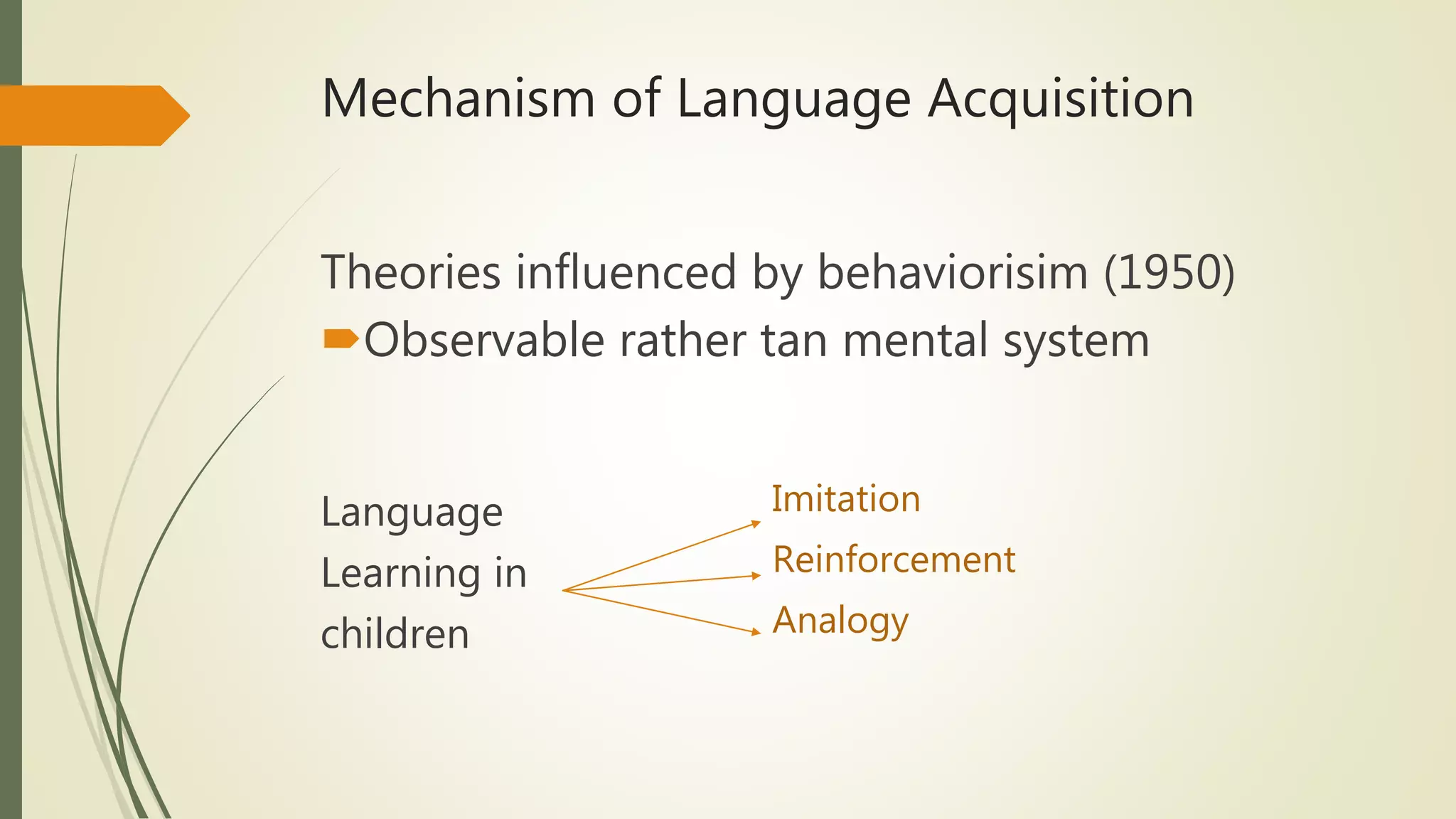
Mechanism of Language Acquisition
Theories influenced by behaviorisim (1950)
Observable rather tan mental system
Language
Learning in
children
Imitation
Reinforcement
Analogy
Chomsky repplied:
“Language is a complex cognitive system that
could not be acquired by behaviorist principles”
Children are not simply imitating adults speech
Do children learn by analogy?
Children put words together to form phrases by
analogy, by hearing a sentence and using it as a
model to form other sentences.
Connectionism (computer model) relies on
behaviourism
Repeated exposure
Do children learn through structured
input?
“motherese” Special way to speak to
infants.
Noam Chomsky:
Children always learn gramma
It is not relevant the enviroment, the child is
always going to learn the language and we do
not know why.
r
Children construct gramma
Language acquisitoin is a creative process.
Children have a capacity for creating new and
infinitive sentences.
Lingusitics believe that children have an innate
template for language. (UG Universal Gramma )
The innateness hypothesis
r
r
Universal stages in Language Acquisiton
Babbling stage (around six months)
Acquisition of first words (first year of life)
Put words together into sentences
(after one year)
The acquisiton of Phonology
Early stage includes the consonants: (b, m, d, k) due to
its frequency
First, the child recognize the sound of vowels.
First year: children figure out the sounds of targe
language
Second year: children learn how the sounds are used
Children early pronunciations are not haphazard.
The acquisiton of Word meaning
Intuitive way:
The children look at an object, the mother say a
word, and the child makes a connection
between the sound and the object. However,
there is a underextenstion case, in which a
lexical item is generalized.
The acquisiton of Morphology
Children acquired rules, although they
overgeneralize them.
Error by children point out that children do not
learn langugage by imitation.
Morphological rules emerged quite early .
The acquisiton of Syntax
The acquisiton of Pragmatics

Language acquisition

  • 1.
  • 2.
    Before 5 fiveyears, the child has already knows most of the intricate language system. Children controls: -Conjoining sentences -asking questions -using pronouns -negate sentences -forming relative clauses -inflecting verbs and nouns.
  • 3.
    Some considerations No oneteaches the gramar rules to the children. Their parents are not aware about morphology, syntatic and semantic rules.
  • 4.
    How do learnersacquire a Second Language? Making use of existing knowledge of the native language Using general learning strategies Taking into account universal properties of language to internalize knowledge of the second language
  • 5.
    Mechanism of LanguageAcquisition Theories influenced by behaviorisim (1950) Observable rather tan mental system Language Learning in children Imitation Reinforcement Analogy
  • 6.
    Chomsky repplied: “Language isa complex cognitive system that could not be acquired by behaviorist principles” Children are not simply imitating adults speech
  • 7.
    Do children learnby analogy? Children put words together to form phrases by analogy, by hearing a sentence and using it as a model to form other sentences. Connectionism (computer model) relies on behaviourism Repeated exposure
  • 8.
    Do children learnthrough structured input? “motherese” Special way to speak to infants. Noam Chomsky: Children always learn gramma It is not relevant the enviroment, the child is always going to learn the language and we do not know why. r
  • 9.
    Children construct gramma Languageacquisitoin is a creative process. Children have a capacity for creating new and infinitive sentences. Lingusitics believe that children have an innate template for language. (UG Universal Gramma ) The innateness hypothesis r r
  • 10.
    Universal stages inLanguage Acquisiton Babbling stage (around six months) Acquisition of first words (first year of life) Put words together into sentences (after one year)
  • 11.
    The acquisiton ofPhonology Early stage includes the consonants: (b, m, d, k) due to its frequency First, the child recognize the sound of vowels. First year: children figure out the sounds of targe language Second year: children learn how the sounds are used Children early pronunciations are not haphazard.
  • 12.
    The acquisiton ofWord meaning Intuitive way: The children look at an object, the mother say a word, and the child makes a connection between the sound and the object. However, there is a underextenstion case, in which a lexical item is generalized.
  • 13.
    The acquisiton ofMorphology Children acquired rules, although they overgeneralize them. Error by children point out that children do not learn langugage by imitation. Morphological rules emerged quite early .
  • 14.
  • 15.