Language Acquisition
Unit 4 Chapter 8
• Very young children (before the age of five) already
know most of the intricate system we have been calling
the grammar of a language.
• A lot of people go through life without learning to read
or write, but they can speak and understand a language.
• Children learn to construct and understand sentences,
most of which they have never produced or heard before.
• Then children must construct the rules that permit them
to use their language creatively.
Mechanisms of language
acquisition
Early theories of language acquisition were heavily
influenced by behaviorism, a school of psychology prevalent
in the 1950’s.
This school focused on people’s behaviors, which are
directly observable, rather than on the mental systems
underlying these behaviors.
Language was viewed as a kind of verbal behavior and
it was proposed that children learn language through
imitation, reinforcement, analogy and similar processes.
Do children learn through imitation?
• Imitation is involved to some extent, of course, but the
early words and sentences that children produce show
that they are not simply imitating adult speech.
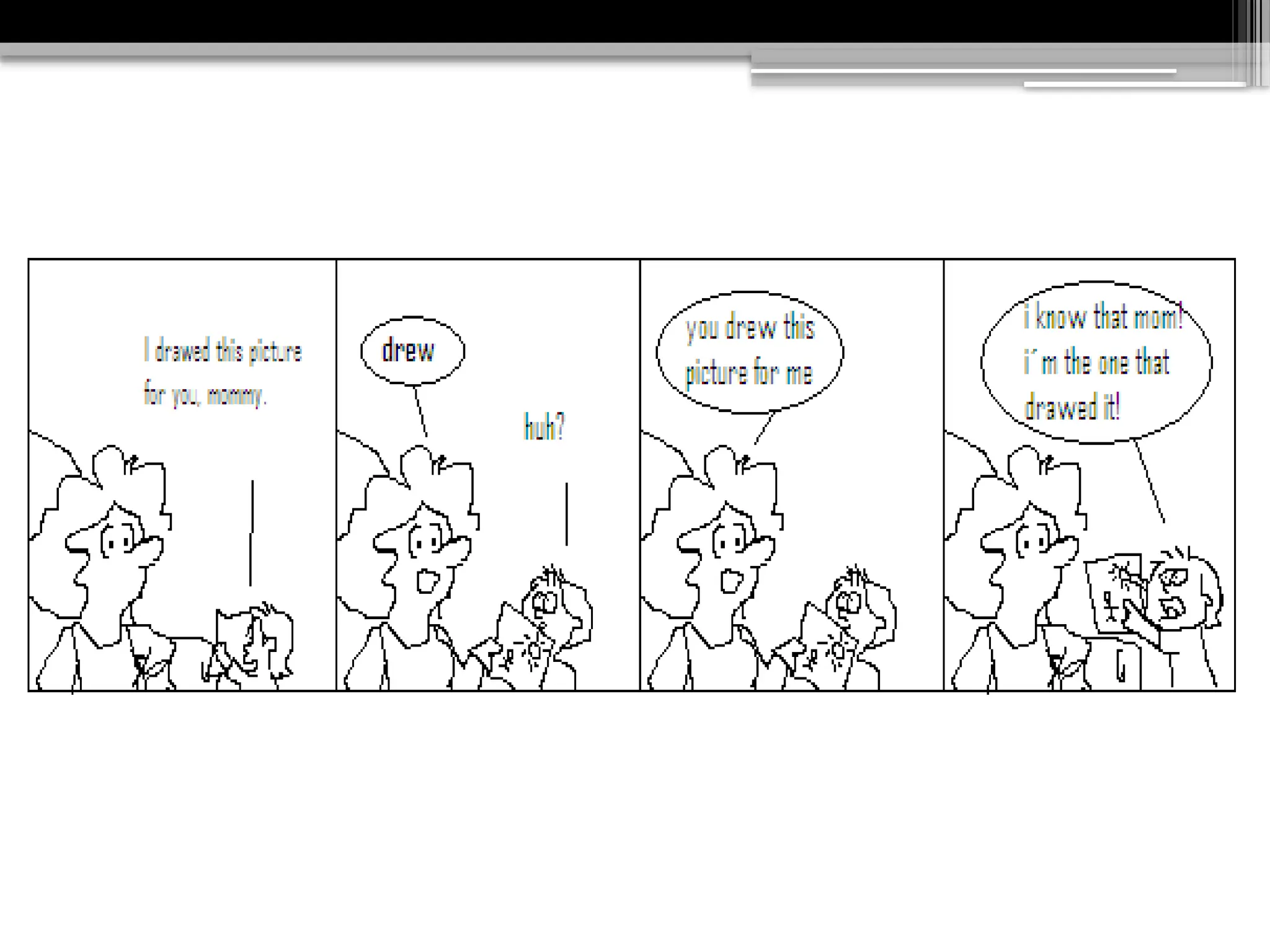
• Children do not hear words like holded or tooths or
sentences such as Cat stand up table.
• Imitation cannot account for another important
phenomenon: children who are unable to speak learn
the language spoken to them and understand it.
Do children learn through
reinforcement?
• Children learn to produce correct (grammatical)
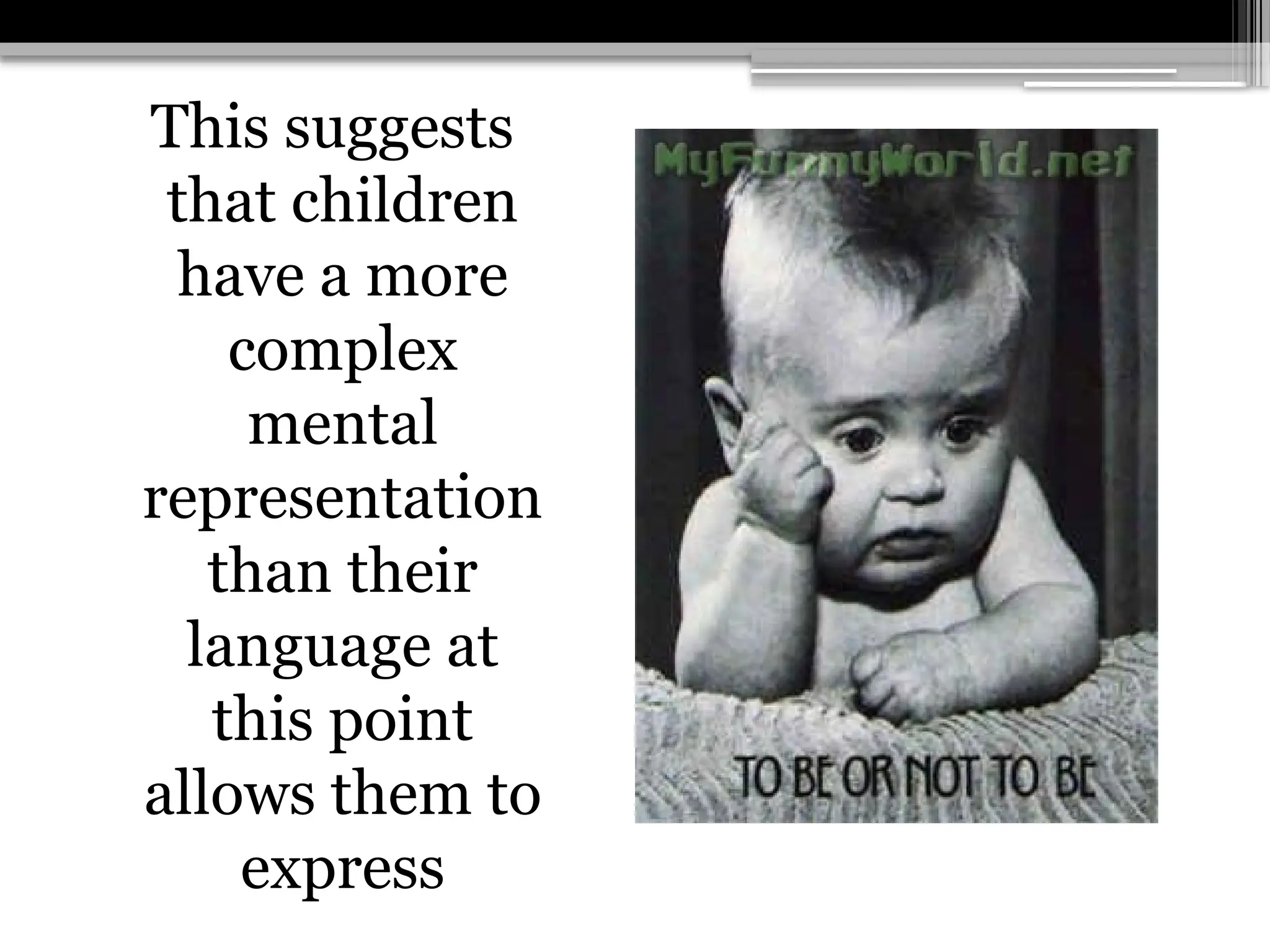
sentences because they are positively reinforced for
“good grammar” and negatively reinforced for “bad
grammar”.
• But attempts to correct a child’s language are
doomed to failure. Children do not know what they
are doing wrong and are unable to make corrections
even when they are pointed out.
Do children learn language through
analogy?
• Children put words together to form phrases and
sentences by analogy, by hearing a sentence and using it
as a sample to form other sentences.
• But sometimes this mechanism doesn’t work either,
because children could change the word’s order. For
example: “I painted a red barn”, by analogy, the child
can say “I painted a blue barn”…in addition to this you
might also hear “I painted a barn red”. So it looks as if
you take those last two words and switch their order.
• Connectionism: computer model of language
representation and acquisition that relies in part on
behaviorist learning principles such as analogy and
reinforcement.
• In the connectionist model no grammatical rules are
stored anywhere. Linguistic knowledge, such as
knowledge of the past tense, is represented by a set of
neuronlike connections between different
phonological forms.
• For example, on analogy to dance-danced, it will
convert prance to pranced; on analogy to drink-drank
it will convert sink to sank.
Do children learn through
structured input
• Children are able to learn language because
adults speaks to them in a special “simplified”
language sometimes called motherese, or
child directed speech (CDS) more
informally, baby talk.
• This theory of acquisition places a lot of
emphasis on the role of the environment in
facilitating language acquisition.
Motherese is not syctactlly simpler. It containts
a range o sentences types , inclunding
syntactically complex sentence such as
Questions: Do you want your juice now?
Embedded sentences: mommy thinks you
should sleep now
imperatives: pat the dog gently!
Negatives with tags questions: we don’t
want to hurt him, do we?
The exaggerated intonation and other
properties of motherese may be useful for
getting a child’s attention and holding it,
but it is not a driving force behind language
development.
Analogy, imitation and reinforcement
cannot account for language development
because they are based on the (implicit or
explicit) assumption that what the child
acquires is a set of sentences or forms
rather than a set of grammatical rules
Children construct grammars
• Language acquisition is a creative process.
Children are not given explicit information
about the rules, by either instruction or
correction. They must somehow extract the
rules of the grammar from the language they
hear around them, and their linguistics
environment does not need to be special in any
way for them to do this.
Observations of children acquiring different
languages under different cultural and social
circumstances reveal that the developmental
stages are similar, possibility universal.
These factors lead many linguistics to believe
that children are equipped with an innate
template or blueprint for language –
Universal Grammar (UG) - and this
blueprint aids the child in the task of
constructing a grammar for her language.
This is referred to as the innateness
hypothesis.
The innateness hypothesis receives its
strongest support from the observation that the
grammar a person ends up with is vastly
underdetermined by linguistic experience. In
other words, we end up knowing far more about
language than is exemplified in the language we
hear around us. This argument for the
innateness of UG is called the poverty of the
stimulus.
Although children hear many utterances, the
language they hear is incomplete, noisy and
unstructured.
These utterances include slips of the tongue,
false starts, ungrammatical and incomplete
sentence, and no information as to which
utterances are well formed. Most important,
children come to know aspects of the grammar
about which they receive no information. In this
sense, the data they are exposed to is
impoverished.
We noted that the rules children construct are
structure dependent.
The input they get is a sequence of sounds, not a
set of phrase structure trees.
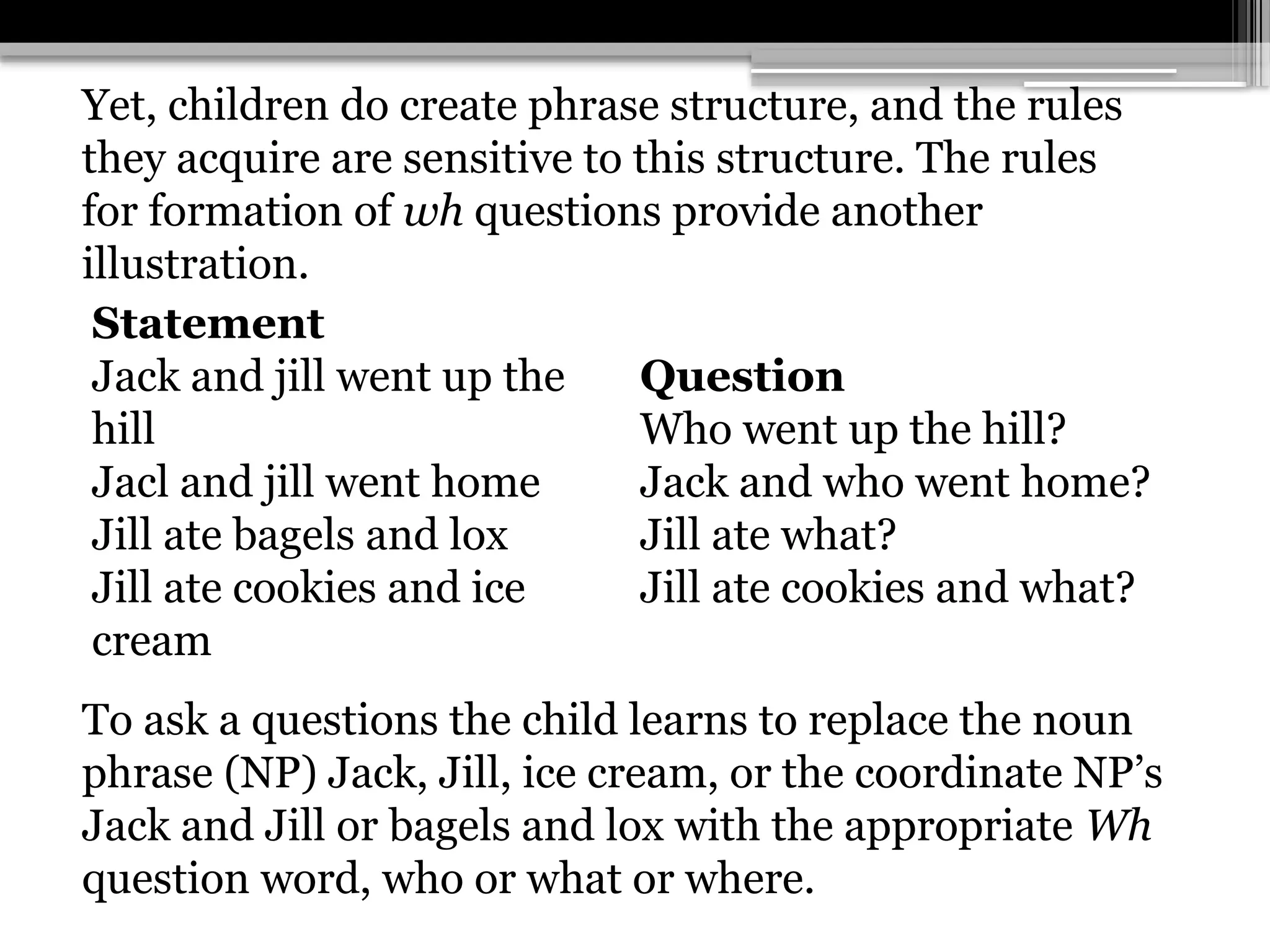
Yet, children do create phrase structure, and the rules
they acquire are sensitive to this structure. The rules
for formation of wh questions provide another
illustration.
Statement
Jack and jill went up the
hill
Jacl and jill went home
Jill ate bagels and lox
Jill ate cookies and ice
cream
Question
Who went up the hill?
Jack and who went home?
Jill ate what?
Jill ate cookies and what?
To ask a questions the child learns to replace the noun
phrase (NP) Jack, Jill, ice cream, or the coordinate NP’s
Jack and Jill or bagels and lox with the appropriate Wh
question word, who or what or where.
In all languages that linguistics have investigated, a
coordinate structure constraint is part of the grammar. It
prohibits the movement of a wh phrase out of a
coordinate structure.
Of course the child must also learn many aspects of
grammar from the specific linguistic environment. For
example, English-speaking children learn that the
subject comes first and that the verb precedes the object
inside the VP.
English-speaking children must learn that yes-no
questions are formed by moving constituents. In yes-no
questions the auxiliary moves from its original position
to the beginning of the sentence.
Stages in language acquisition
• Children don’t wake up one fine morning with a fully
formed grammar in their heads. Relative to the
complexity of the adult grammar that they eventually
attain, the process of language acquisition is fast, but
it is not instantaneous.
• From first words to virtual adult competence takes
three to four years, during which time children pass
through linguistic stages. They begin by babbling,
they then acquire first words, and in just a few
months they begin to put words together into
sentences.
• Child language is not just degenerate form of adult
language. At each stage of development the child’s
language conforms to a set of rules, a grammar.
• Although child grammars and adult grammar
differ in certain respects, they also share many
formal properties.
• The words and sentences the child produces
conform to the phonology, morphology, and
syntax that he has development to that point. This
maybe why children don’t respond to correction.
For example
• Nobody don’t like me
• Want ‘nother one spoon, daddy
• May contains errors from the perspective of
the adult grammar, but they aren’t errors from
the child’s point of view. They reflect his
current grammar
THE PERCEPTION AND
PRODUCTION OF SPEECH SOUNDS
The mind appears to
be attuned at birth to
receive certain
information
•Experiments have
shown that infants will
increase their sucking
rate when stimuli (visual
or auditory) presented
to them are varied, but
will decrease when the
same stimuli are
presented repeatedly.
• Controlled experiments show that adults find it
difficult to differentiate between the
allophones of one phoneme, but for infants it
comes naturally.
• Babies will not react, however, to distinctions
that never correspond to phonemic contrasts
in any human language, such as sounds spoken
more or less loudly or sounds that lie between
two phonemes.
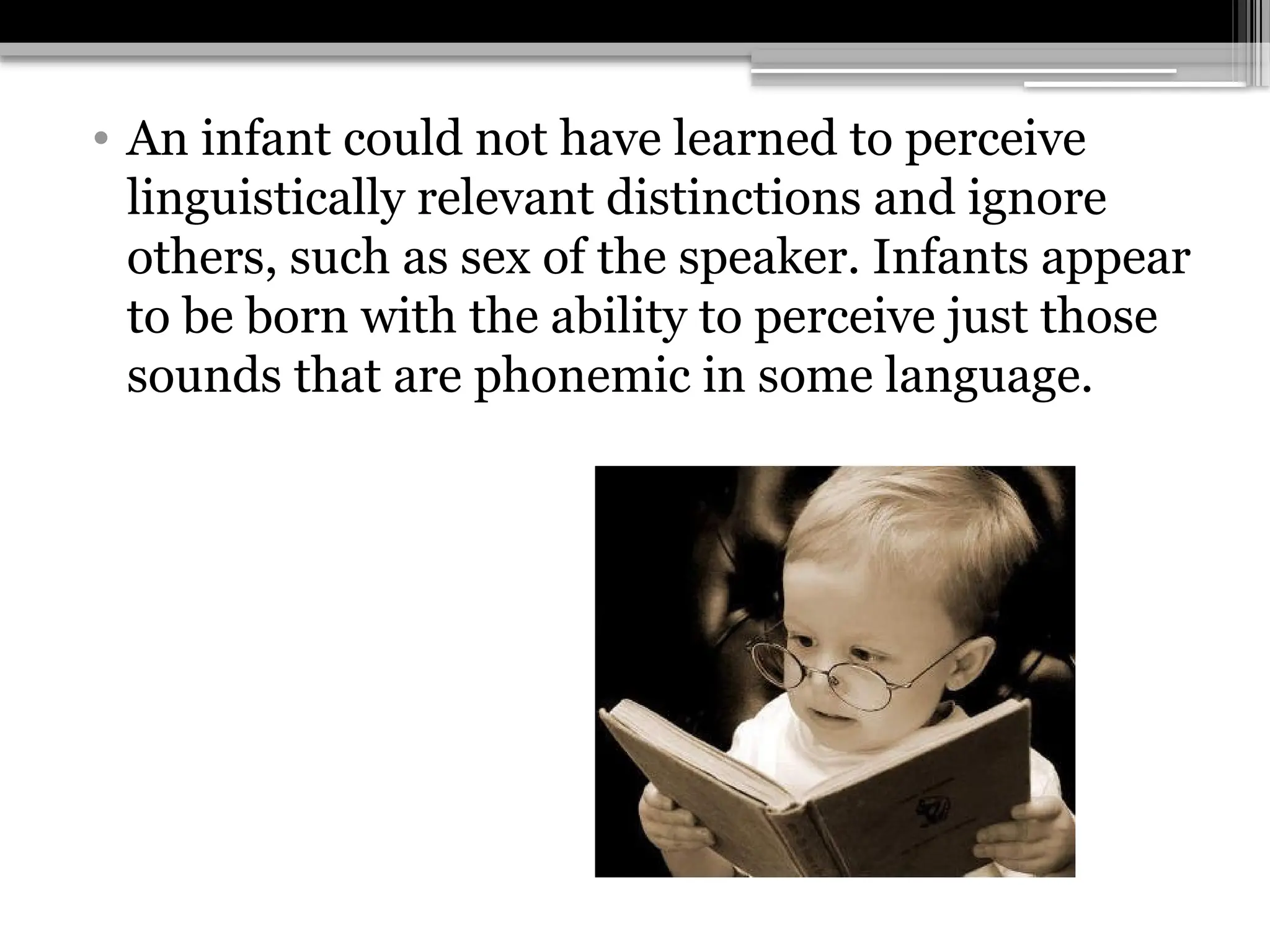
• An infant could not have learned to perceive
linguistically relevant distinctions and ignore
others, such as sex of the speaker. Infants appear
to be born with the ability to perceive just those
sounds that are phonemic in some language.
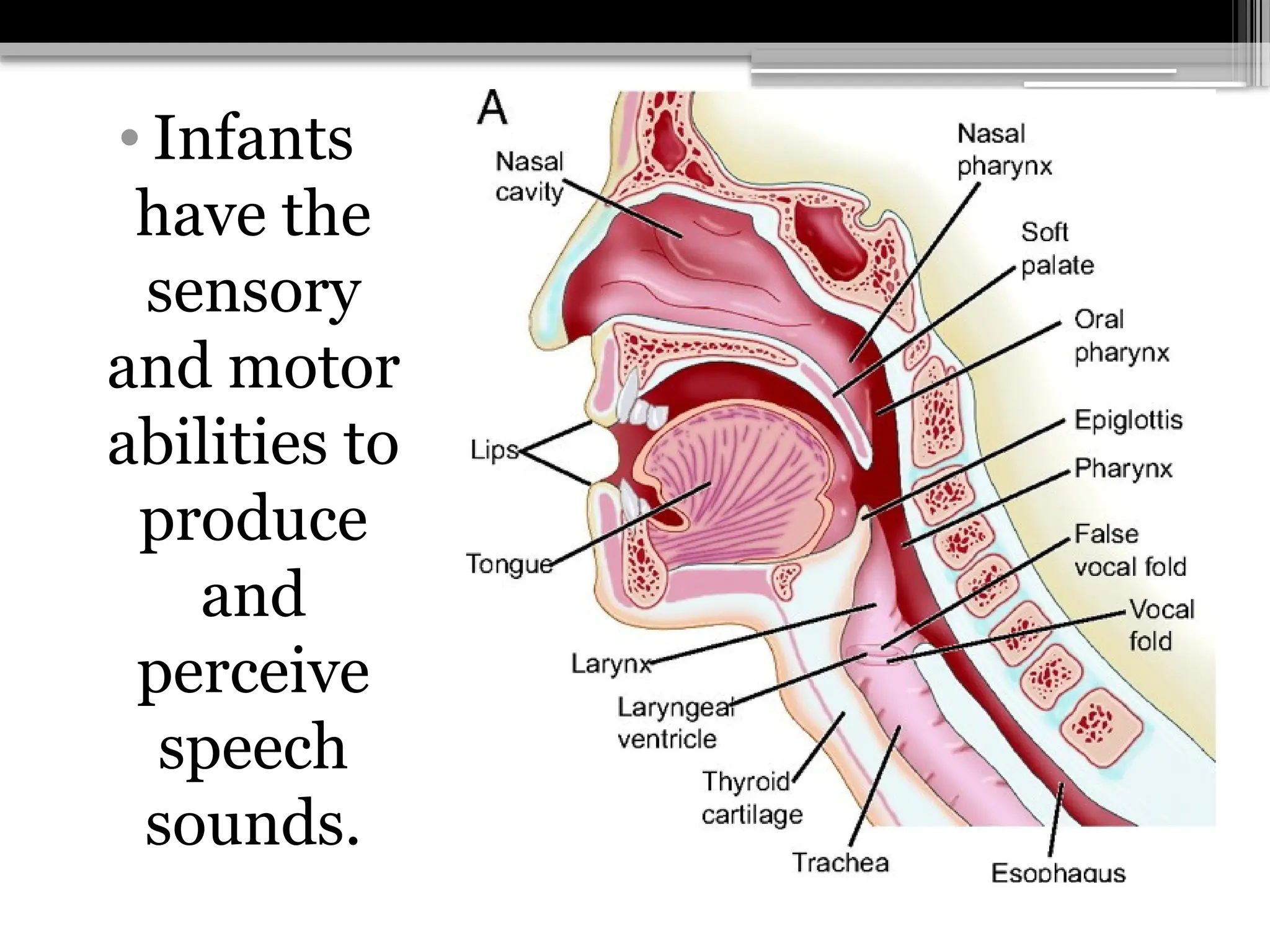
• Infants
have the
sensory
and motor
abilities to
produce
and
perceive
speech
sounds.
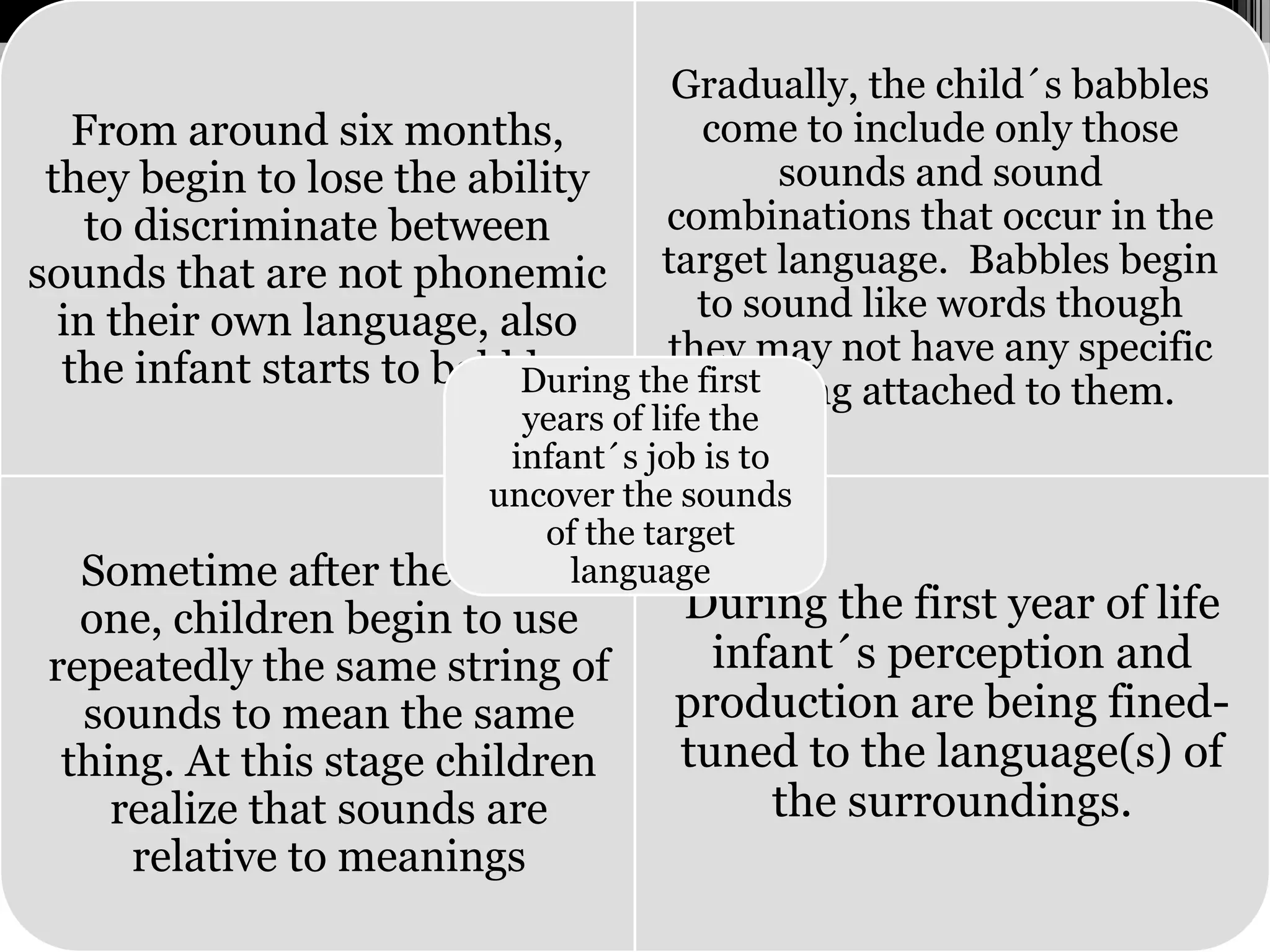
From around six months,
they begin to lose the ability
to discriminate between
sounds that are not phonemic
in their own language, also
the infant starts to babble.
Gradually, the child´s babbles
come to include only those
sounds and sound
combinations that occur in the
target language. Babbles begin
to sound like words though
they may not have any specific
meaning attached to them.
Sometime after the age of
one, children begin to use
repeatedly the same string of
sounds to mean the same
thing. At this stage children
realize that sounds are
relative to meanings
During the first year of life
infant´s perception and
production are being fined-
tuned to the language(s) of
the surroundings.
During the first
years of life the
infant´s job is to
uncover the sounds
of the target
language
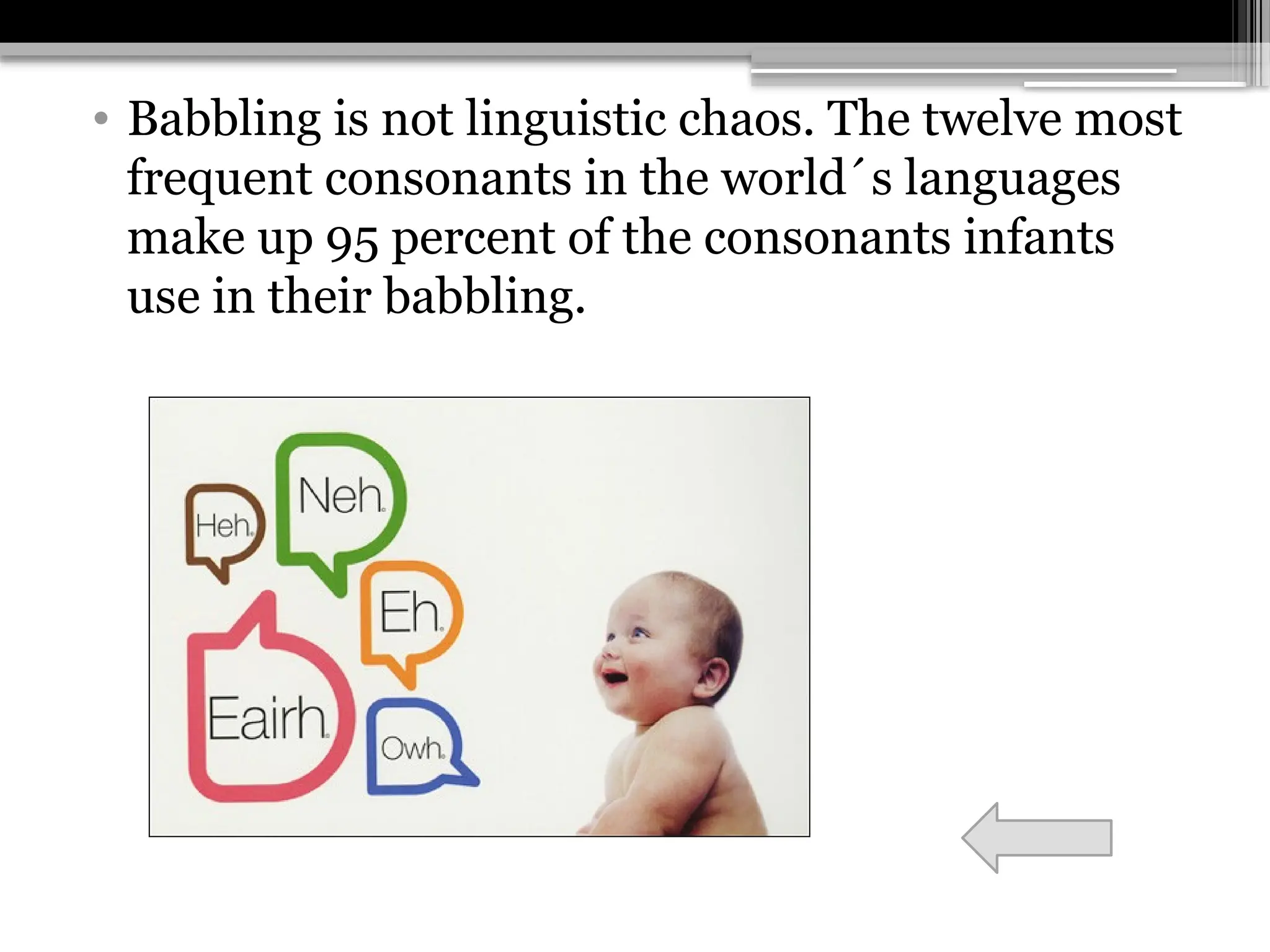
• Babbling is not linguistic chaos. The twelve most
frequent consonants in the world´s languages
make up 95 percent of the consonants infants
use in their babbling.
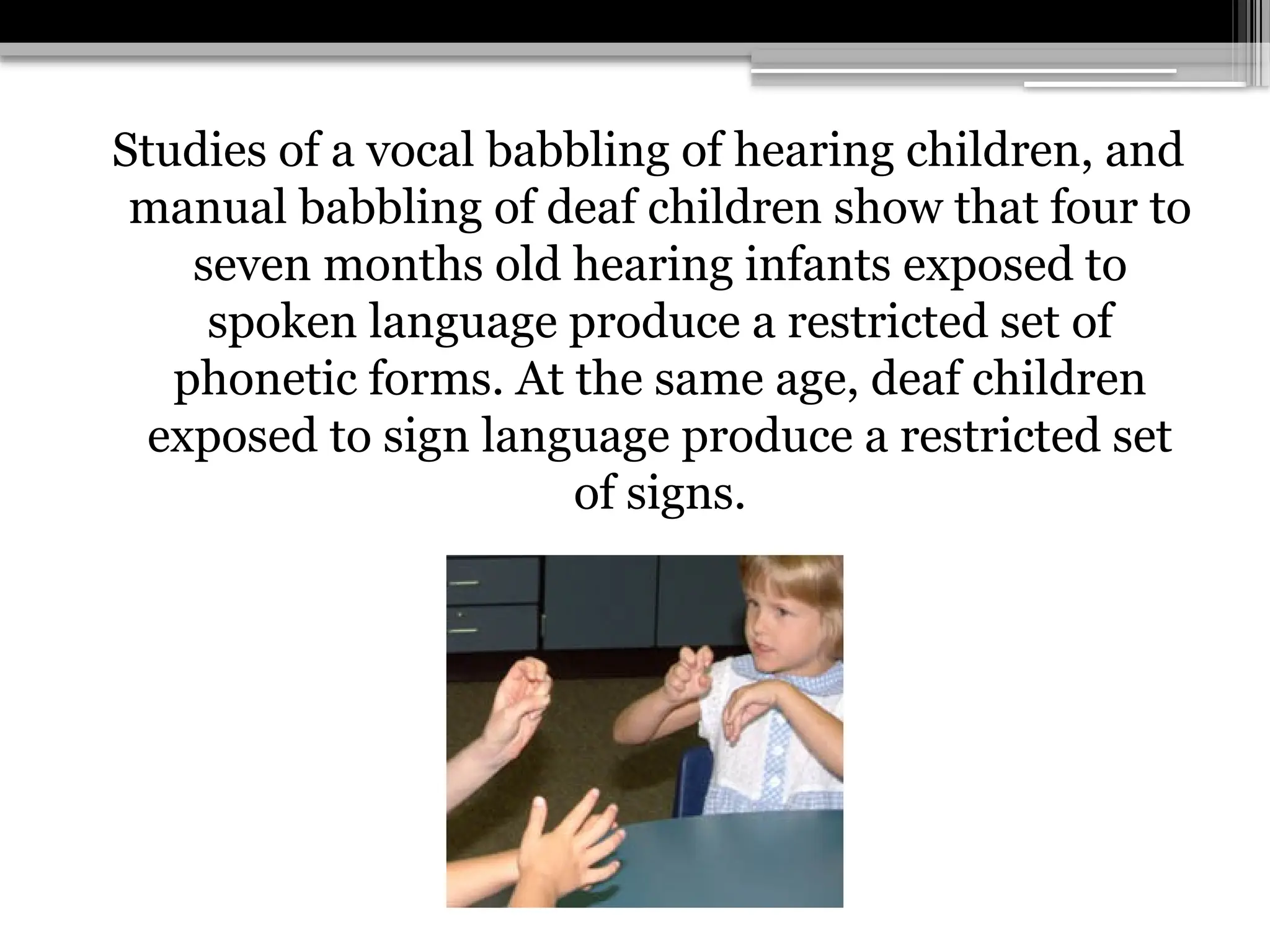
Studies of a vocal babbling of hearing children, and
manual babbling of deaf children show that four to
seven months old hearing infants exposed to
spoken language produce a restricted set of
phonetic forms. At the same age, deaf children
exposed to sign language produce a restricted set
of signs.
HUMANS ARE BORN WITH A
PREDISPOSITION TO DISCOVER
THE UNITS THAT SERVE TO
EXPRESS LINGUISTIC
MEANINGS, AND THAT AT A
GENETICALLY SPECIFIED
STAGE IN NEURAL
DEVELOPMENT, THE INFANT
WILL BEGIN TO PRODUCE
THESE UNITS.
FIRST WORDS
Sometime after the age
of one, children begin to
use repeatedly the same
string of sounds to mean
the same thing.
They have produced their
first TRUE WORDS.
This stage is the
holophrastic stage (from
holo, “complete” or
“undivided”, and phrase,
“phrase” or “sentence”)
because these one-word
utterances seem to convey a
more complex message.
This suggests
that children
have a more
complex
mental
representation
than their
language at
this point
allows them to
express
THE DEVELOPMENT OF GRAMMAR
Children are neurologically prepared
to acquire all aspects of grammar,
from phonetics to pragmatics.
ACQUISITION OF PHONOLOGY
The linguist Roman Jakobson
suggested that children first
acquire the small set of sounds
common to all languages of the
world, no matter what language
they hear, and in later stages a
child acquires the less common
sounds of his own language.
• In early language, children may not make
a linguistic distinction between voiced
and voiceless consonants, although they
can perceive the difference.
• When they first begin to contrast that set
– that is, when they learn that /p/ and
/b/ are distinct phonemes -- they also
begin to distinguish between /t/ and
/d/, /s/ and /z/, and all the other
voiceless-voiced phonemic pairs.
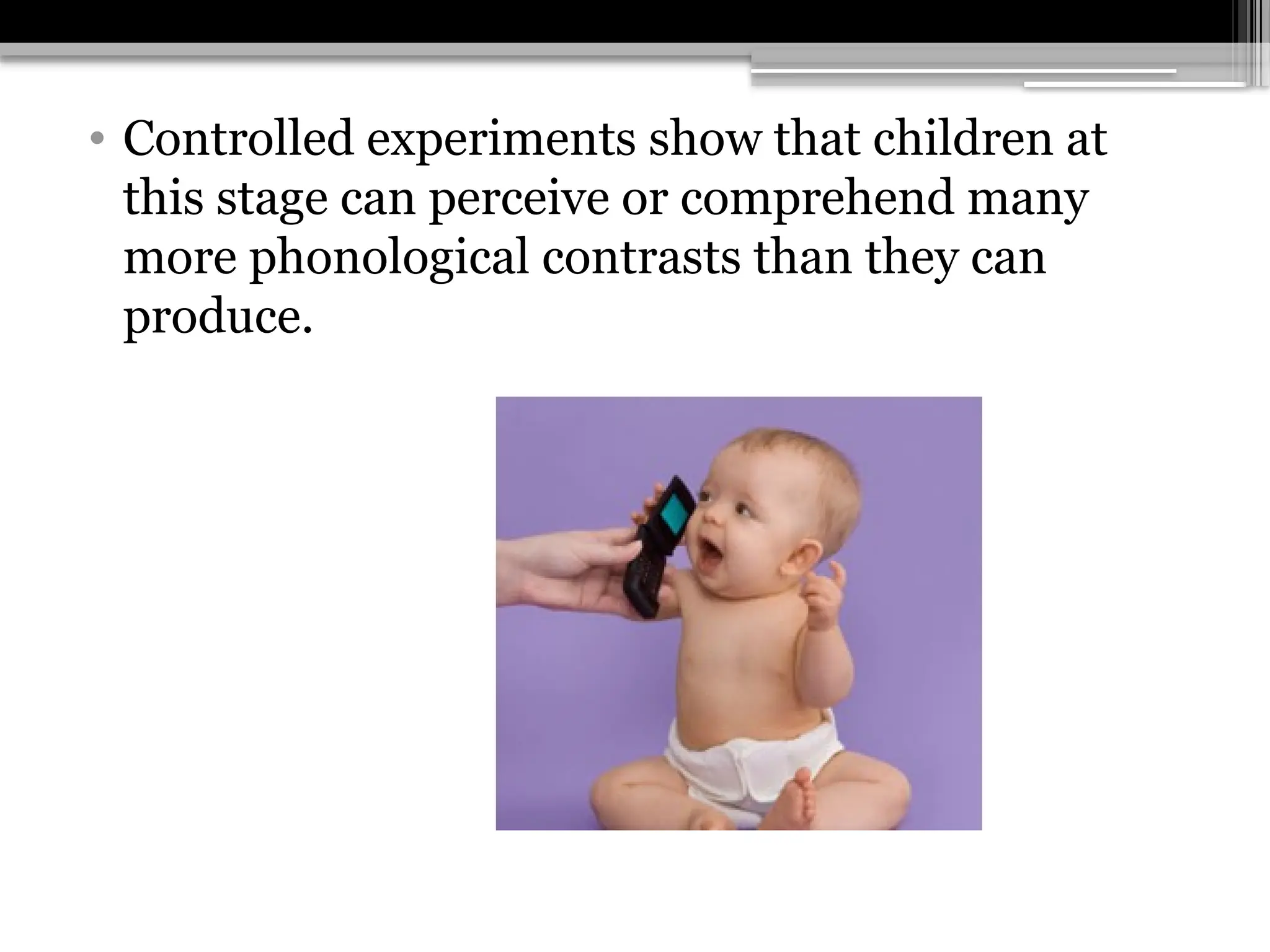
• Controlled experiments show that children at
this stage can perceive or comprehend many
more phonological contrasts than they can
produce.
The same child who say [waebit]
instead of rabbit, and who does
not seem to distinguish [w] and
[r], will not make mistakes on a
picture identification task in
which she must point to either a
ring or a wing.
• In addition, children sometimes
produce a sound in a way that
makes it indiscernible to adult
observers. Acoustic analyses of
children´s utterances show that
the child´s pronunciation of wing
and ring are physically different
sounds, though they may seem
the same to the adult ear.
The Acquisition of word meaning
The child’s early vocabulary provides insight into
how children use words and construct word
meaning.
• How do children learn the meanings of words?
Most people do not see this aspect of acquisition
as posing a great problem. The intuitive view is
that children look at an object, the mother says a
word, and the child connects the sounds with the
object.
To learn a word for a class of objects
such as “cat” or “dog”, children have
to figure out exactly what the word
refers to.
After the child has acquired his first
seventy-five to one hundred words, the
overextended meanings start to narrow
until they correspond to those of the other
speakers of the language.
We know that all children view the world in
a similar fashion and apply the same
general principles to help them determine
a word’s meaning.
Overextensions are usually based on physical
attributes such as size, shape, and texture.
However children will not make overextensions
based on color.
Children learn approximately 14 words a day for
the first six years of their lives. That averages to
about 5,000 words per year.
As children are learning the meaning of words,
they are also developing the syntax of the
language and the syntactic categories.
Children use their knowledge of syntax to learn
the syntactic category of the word: If the
word is a verb it has a meaning referring to
an action, if the word is a noun it refers to an
object of some kind.
This process is called syntactic bootstrapping.
The Acquisition of morphology
Children’s errors in morphology reveal that the
child acquires the regular rules of the grammar
and overgeneralizes them. This
overgeneralization manifests itself when
children treat irregular verbs and nouns as if
they were regular.
The child’s morphological rules emerge quite
early.
The children applied the regular plural
formation rule to words they had never heard.
More recently, studies of children acquiring
languages with more inflectional morphology than
English reveal that they learn agreement and case
morphology at a very early age.
Many languages have case morphology where nouns
have different forms depending on their grammatical
function: subject, object, possessor, and so on.
Children also show knowledge of the derivational
rules of their language and use these rules to create
novel words.
The Acquisition of syntax
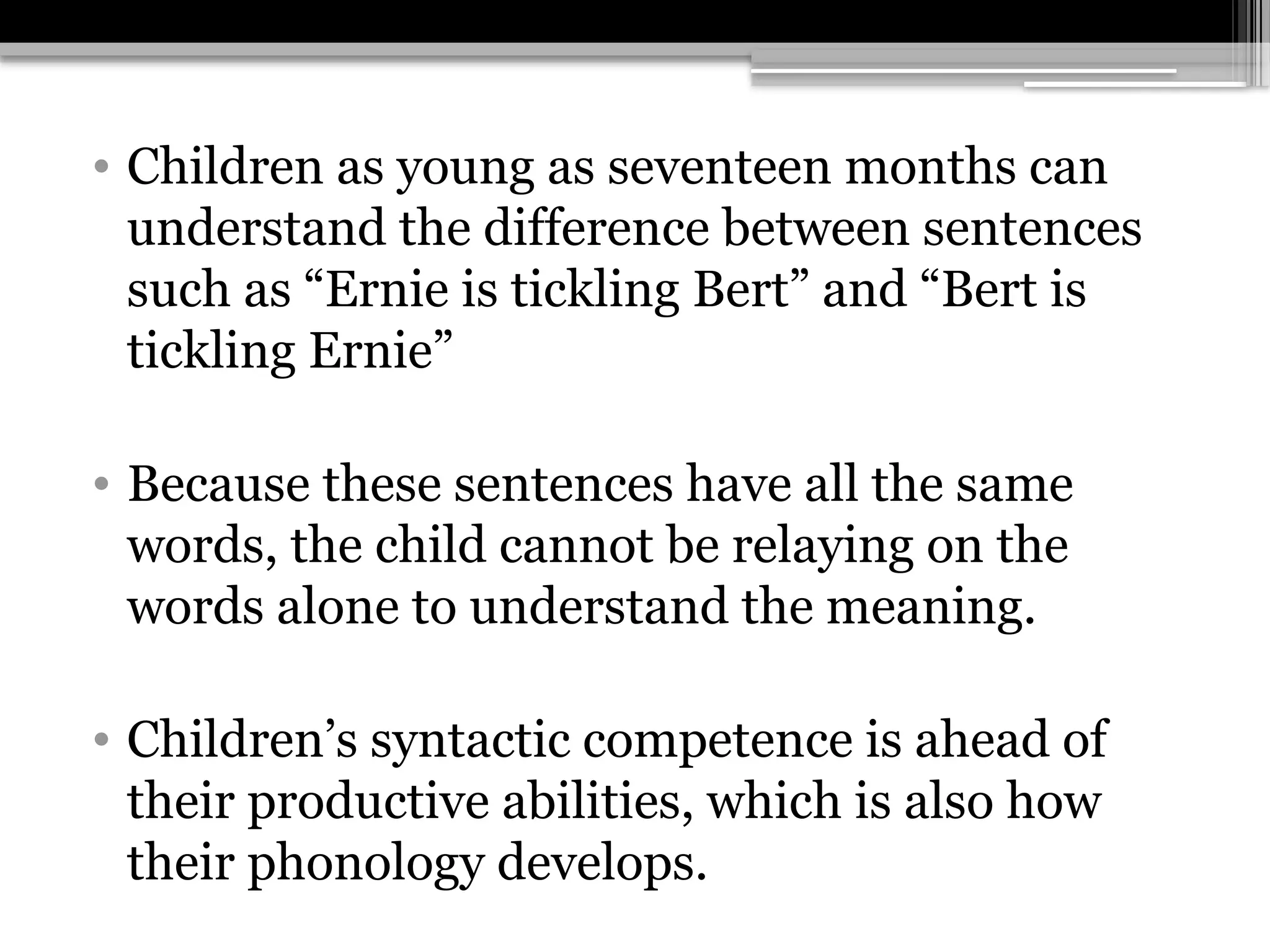
• New experimental techniques show that at
that stage childen have knowledge of some
syntax rule.
• Children as young as seventeen months can
understand the difference between sentences
such as “Ernie is tickling Bert” and “Bert is
tickling Ernie”
• Because these sentences have all the same
words, the child cannot be relaying on the
words alone to understand the meaning.
• Children’s syntactic competence is ahead of
their productive abilities, which is also how
their phonology develops.
• Around the time of their second birthday, children
begin to put words together.
• For example:
• These early utterances can express a variety of
semantic and syntactic relations:
▫ Noun+noun sentences such as Mommy suck can express
a subject+object relation.
▫ Two nouns can also be used to show a subject-locative
relation as in sweater chair.
Allgone sock
Byebye boat
More wet
Katherine sock
Hi Mommy
Allgone sticky
It ball
Dirty sock
• Chronological age is not a good measure of
a child’s language development.
• Researches use the child’s mean length of
utterances (MLU) to compare children’s
progress.
• MLU is the average length of the utterances
the child is producing at a particular point.
• In the earliest multiword utterances,
children are inconsistent in their use of
funtion words such aas TO and THE,
auxiliary verbs such as CAN and IS and
verbal inflection.
• During this stage children often sound as
if they reading a telegram, wich is why
such utterances are called telegraphic
speech.
A critical period for L2 Acquisition?
• Age is a significant factor in L2 acquisition.
• The younger a person is when exposed to a second
language, the more likely she is to achieve nativelike
competence.
• The test results depended heavily on the age at wich the
person had arrived in the U.S.
• Children(3-8) did as well as a native American
speakers.
• (8-15) didn’t perfome like native speakers.
• (17-31) had the lowest scores.
• Age is an important factor in achieving nativelike L2
competence.
Second language teaching methods
• Grammar-translation. The student memorizes words, inflected
words and syntatic rules and uses them to translate from English
to L2 and vice versa.
• Direct method. The native language is never used in the
classroom, and the structure of L2 language or how it differs from
the ative language is not discussed.
• An Audio-lingual language teaching method. Language is acquired
mainly through imitation, repetition, and reinforcement, an
assumption wich is very likely to be as wong for L2 acquisition as
it is for L1 acquisition.
• Most individual methods have serious limitations.

Language Acquisition: all about language acquisition

  • 1.
  • 2.
    • Very youngchildren (before the age of five) already know most of the intricate system we have been calling the grammar of a language. • A lot of people go through life without learning to read or write, but they can speak and understand a language. • Children learn to construct and understand sentences, most of which they have never produced or heard before. • Then children must construct the rules that permit them to use their language creatively.
  • 3.
    Mechanisms of language acquisition Earlytheories of language acquisition were heavily influenced by behaviorism, a school of psychology prevalent in the 1950’s. This school focused on people’s behaviors, which are directly observable, rather than on the mental systems underlying these behaviors. Language was viewed as a kind of verbal behavior and it was proposed that children learn language through imitation, reinforcement, analogy and similar processes.
  • 4.
    Do children learnthrough imitation? • Imitation is involved to some extent, of course, but the early words and sentences that children produce show that they are not simply imitating adult speech. • Children do not hear words like holded or tooths or sentences such as Cat stand up table. • Imitation cannot account for another important phenomenon: children who are unable to speak learn the language spoken to them and understand it.
  • 5.
    Do children learnthrough reinforcement? • Children learn to produce correct (grammatical) sentences because they are positively reinforced for “good grammar” and negatively reinforced for “bad grammar”. • But attempts to correct a child’s language are doomed to failure. Children do not know what they are doing wrong and are unable to make corrections even when they are pointed out.
  • 6.
    Do children learnlanguage through analogy? • Children put words together to form phrases and sentences by analogy, by hearing a sentence and using it as a sample to form other sentences. • But sometimes this mechanism doesn’t work either, because children could change the word’s order. For example: “I painted a red barn”, by analogy, the child can say “I painted a blue barn”…in addition to this you might also hear “I painted a barn red”. So it looks as if you take those last two words and switch their order.
  • 7.
    • Connectionism: computermodel of language representation and acquisition that relies in part on behaviorist learning principles such as analogy and reinforcement. • In the connectionist model no grammatical rules are stored anywhere. Linguistic knowledge, such as knowledge of the past tense, is represented by a set of neuronlike connections between different phonological forms. • For example, on analogy to dance-danced, it will convert prance to pranced; on analogy to drink-drank it will convert sink to sank.
  • 8.
    Do children learnthrough structured input
  • 9.
    • Children areable to learn language because adults speaks to them in a special “simplified” language sometimes called motherese, or child directed speech (CDS) more informally, baby talk. • This theory of acquisition places a lot of emphasis on the role of the environment in facilitating language acquisition.
  • 10.
    Motherese is notsyctactlly simpler. It containts a range o sentences types , inclunding syntactically complex sentence such as Questions: Do you want your juice now? Embedded sentences: mommy thinks you should sleep now imperatives: pat the dog gently! Negatives with tags questions: we don’t want to hurt him, do we?
  • 11.
    The exaggerated intonationand other properties of motherese may be useful for getting a child’s attention and holding it, but it is not a driving force behind language development. Analogy, imitation and reinforcement cannot account for language development because they are based on the (implicit or explicit) assumption that what the child acquires is a set of sentences or forms rather than a set of grammatical rules
  • 12.
    Children construct grammars •Language acquisition is a creative process. Children are not given explicit information about the rules, by either instruction or correction. They must somehow extract the rules of the grammar from the language they hear around them, and their linguistics environment does not need to be special in any way for them to do this.
  • 13.
    Observations of childrenacquiring different languages under different cultural and social circumstances reveal that the developmental stages are similar, possibility universal. These factors lead many linguistics to believe that children are equipped with an innate template or blueprint for language – Universal Grammar (UG) - and this blueprint aids the child in the task of constructing a grammar for her language. This is referred to as the innateness hypothesis.
  • 14.
    The innateness hypothesisreceives its strongest support from the observation that the grammar a person ends up with is vastly underdetermined by linguistic experience. In other words, we end up knowing far more about language than is exemplified in the language we hear around us. This argument for the innateness of UG is called the poverty of the stimulus. Although children hear many utterances, the language they hear is incomplete, noisy and unstructured.
  • 15.
    These utterances includeslips of the tongue, false starts, ungrammatical and incomplete sentence, and no information as to which utterances are well formed. Most important, children come to know aspects of the grammar about which they receive no information. In this sense, the data they are exposed to is impoverished. We noted that the rules children construct are structure dependent. The input they get is a sequence of sounds, not a set of phrase structure trees.
  • 16.
    Yet, children docreate phrase structure, and the rules they acquire are sensitive to this structure. The rules for formation of wh questions provide another illustration. Statement Jack and jill went up the hill Jacl and jill went home Jill ate bagels and lox Jill ate cookies and ice cream Question Who went up the hill? Jack and who went home? Jill ate what? Jill ate cookies and what? To ask a questions the child learns to replace the noun phrase (NP) Jack, Jill, ice cream, or the coordinate NP’s Jack and Jill or bagels and lox with the appropriate Wh question word, who or what or where.
  • 17.
    In all languagesthat linguistics have investigated, a coordinate structure constraint is part of the grammar. It prohibits the movement of a wh phrase out of a coordinate structure. Of course the child must also learn many aspects of grammar from the specific linguistic environment. For example, English-speaking children learn that the subject comes first and that the verb precedes the object inside the VP. English-speaking children must learn that yes-no questions are formed by moving constituents. In yes-no questions the auxiliary moves from its original position to the beginning of the sentence.
  • 18.
    Stages in languageacquisition • Children don’t wake up one fine morning with a fully formed grammar in their heads. Relative to the complexity of the adult grammar that they eventually attain, the process of language acquisition is fast, but it is not instantaneous. • From first words to virtual adult competence takes three to four years, during which time children pass through linguistic stages. They begin by babbling, they then acquire first words, and in just a few months they begin to put words together into sentences.
  • 19.
    • Child languageis not just degenerate form of adult language. At each stage of development the child’s language conforms to a set of rules, a grammar. • Although child grammars and adult grammar differ in certain respects, they also share many formal properties. • The words and sentences the child produces conform to the phonology, morphology, and syntax that he has development to that point. This maybe why children don’t respond to correction.
  • 20.
    For example • Nobodydon’t like me • Want ‘nother one spoon, daddy • May contains errors from the perspective of the adult grammar, but they aren’t errors from the child’s point of view. They reflect his current grammar
  • 21.
  • 22.
    The mind appearsto be attuned at birth to receive certain information
  • 23.
    •Experiments have shown thatinfants will increase their sucking rate when stimuli (visual or auditory) presented to them are varied, but will decrease when the same stimuli are presented repeatedly.
  • 24.
    • Controlled experimentsshow that adults find it difficult to differentiate between the allophones of one phoneme, but for infants it comes naturally. • Babies will not react, however, to distinctions that never correspond to phonemic contrasts in any human language, such as sounds spoken more or less loudly or sounds that lie between two phonemes.
  • 25.
    • An infantcould not have learned to perceive linguistically relevant distinctions and ignore others, such as sex of the speaker. Infants appear to be born with the ability to perceive just those sounds that are phonemic in some language.
  • 26.
    • Infants have the sensory andmotor abilities to produce and perceive speech sounds.
  • 27.
    From around sixmonths, they begin to lose the ability to discriminate between sounds that are not phonemic in their own language, also the infant starts to babble. Gradually, the child´s babbles come to include only those sounds and sound combinations that occur in the target language. Babbles begin to sound like words though they may not have any specific meaning attached to them. Sometime after the age of one, children begin to use repeatedly the same string of sounds to mean the same thing. At this stage children realize that sounds are relative to meanings During the first year of life infant´s perception and production are being fined- tuned to the language(s) of the surroundings. During the first years of life the infant´s job is to uncover the sounds of the target language
  • 28.
    • Babbling isnot linguistic chaos. The twelve most frequent consonants in the world´s languages make up 95 percent of the consonants infants use in their babbling.
  • 29.
    Studies of avocal babbling of hearing children, and manual babbling of deaf children show that four to seven months old hearing infants exposed to spoken language produce a restricted set of phonetic forms. At the same age, deaf children exposed to sign language produce a restricted set of signs.
  • 30.
    HUMANS ARE BORNWITH A PREDISPOSITION TO DISCOVER THE UNITS THAT SERVE TO EXPRESS LINGUISTIC MEANINGS, AND THAT AT A GENETICALLY SPECIFIED STAGE IN NEURAL DEVELOPMENT, THE INFANT WILL BEGIN TO PRODUCE THESE UNITS.
  • 31.
  • 32.
    Sometime after theage of one, children begin to use repeatedly the same string of sounds to mean the same thing. They have produced their first TRUE WORDS.
  • 33.
    This stage isthe holophrastic stage (from holo, “complete” or “undivided”, and phrase, “phrase” or “sentence”) because these one-word utterances seem to convey a more complex message.
  • 34.
    This suggests that children havea more complex mental representation than their language at this point allows them to express
  • 35.
    THE DEVELOPMENT OFGRAMMAR Children are neurologically prepared to acquire all aspects of grammar, from phonetics to pragmatics.
  • 36.
  • 37.
    The linguist RomanJakobson suggested that children first acquire the small set of sounds common to all languages of the world, no matter what language they hear, and in later stages a child acquires the less common sounds of his own language.
  • 38.
    • In earlylanguage, children may not make a linguistic distinction between voiced and voiceless consonants, although they can perceive the difference. • When they first begin to contrast that set – that is, when they learn that /p/ and /b/ are distinct phonemes -- they also begin to distinguish between /t/ and /d/, /s/ and /z/, and all the other voiceless-voiced phonemic pairs.
  • 40.
    • Controlled experimentsshow that children at this stage can perceive or comprehend many more phonological contrasts than they can produce.
  • 41.
    The same childwho say [waebit] instead of rabbit, and who does not seem to distinguish [w] and [r], will not make mistakes on a picture identification task in which she must point to either a ring or a wing.
  • 42.
    • In addition,children sometimes produce a sound in a way that makes it indiscernible to adult observers. Acoustic analyses of children´s utterances show that the child´s pronunciation of wing and ring are physically different sounds, though they may seem the same to the adult ear.
  • 43.
    The Acquisition ofword meaning
  • 44.
    The child’s earlyvocabulary provides insight into how children use words and construct word meaning. • How do children learn the meanings of words? Most people do not see this aspect of acquisition as posing a great problem. The intuitive view is that children look at an object, the mother says a word, and the child connects the sounds with the object.
  • 45.
    To learn aword for a class of objects such as “cat” or “dog”, children have to figure out exactly what the word refers to.
  • 46.
    After the childhas acquired his first seventy-five to one hundred words, the overextended meanings start to narrow until they correspond to those of the other speakers of the language. We know that all children view the world in a similar fashion and apply the same general principles to help them determine a word’s meaning.
  • 47.
    Overextensions are usuallybased on physical attributes such as size, shape, and texture. However children will not make overextensions based on color. Children learn approximately 14 words a day for the first six years of their lives. That averages to about 5,000 words per year. As children are learning the meaning of words, they are also developing the syntax of the language and the syntactic categories.
  • 48.
    Children use theirknowledge of syntax to learn the syntactic category of the word: If the word is a verb it has a meaning referring to an action, if the word is a noun it refers to an object of some kind. This process is called syntactic bootstrapping.
  • 49.
  • 50.
    Children’s errors inmorphology reveal that the child acquires the regular rules of the grammar and overgeneralizes them. This overgeneralization manifests itself when children treat irregular verbs and nouns as if they were regular. The child’s morphological rules emerge quite early. The children applied the regular plural formation rule to words they had never heard.
  • 51.
    More recently, studiesof children acquiring languages with more inflectional morphology than English reveal that they learn agreement and case morphology at a very early age. Many languages have case morphology where nouns have different forms depending on their grammatical function: subject, object, possessor, and so on. Children also show knowledge of the derivational rules of their language and use these rules to create novel words.
  • 52.
  • 53.
    • New experimentaltechniques show that at that stage childen have knowledge of some syntax rule.
  • 54.
    • Children asyoung as seventeen months can understand the difference between sentences such as “Ernie is tickling Bert” and “Bert is tickling Ernie” • Because these sentences have all the same words, the child cannot be relaying on the words alone to understand the meaning. • Children’s syntactic competence is ahead of their productive abilities, which is also how their phonology develops.
  • 55.
    • Around thetime of their second birthday, children begin to put words together. • For example: • These early utterances can express a variety of semantic and syntactic relations: ▫ Noun+noun sentences such as Mommy suck can express a subject+object relation. ▫ Two nouns can also be used to show a subject-locative relation as in sweater chair. Allgone sock Byebye boat More wet Katherine sock Hi Mommy Allgone sticky It ball Dirty sock
  • 56.
    • Chronological ageis not a good measure of a child’s language development. • Researches use the child’s mean length of utterances (MLU) to compare children’s progress. • MLU is the average length of the utterances the child is producing at a particular point.
  • 57.
    • In theearliest multiword utterances, children are inconsistent in their use of funtion words such aas TO and THE, auxiliary verbs such as CAN and IS and verbal inflection. • During this stage children often sound as if they reading a telegram, wich is why such utterances are called telegraphic speech.
  • 58.
    A critical periodfor L2 Acquisition? • Age is a significant factor in L2 acquisition. • The younger a person is when exposed to a second language, the more likely she is to achieve nativelike competence. • The test results depended heavily on the age at wich the person had arrived in the U.S. • Children(3-8) did as well as a native American speakers. • (8-15) didn’t perfome like native speakers. • (17-31) had the lowest scores. • Age is an important factor in achieving nativelike L2 competence.
  • 59.
    Second language teachingmethods • Grammar-translation. The student memorizes words, inflected words and syntatic rules and uses them to translate from English to L2 and vice versa. • Direct method. The native language is never used in the classroom, and the structure of L2 language or how it differs from the ative language is not discussed. • An Audio-lingual language teaching method. Language is acquired mainly through imitation, repetition, and reinforcement, an assumption wich is very likely to be as wong for L2 acquisition as it is for L1 acquisition. • Most individual methods have serious limitations.