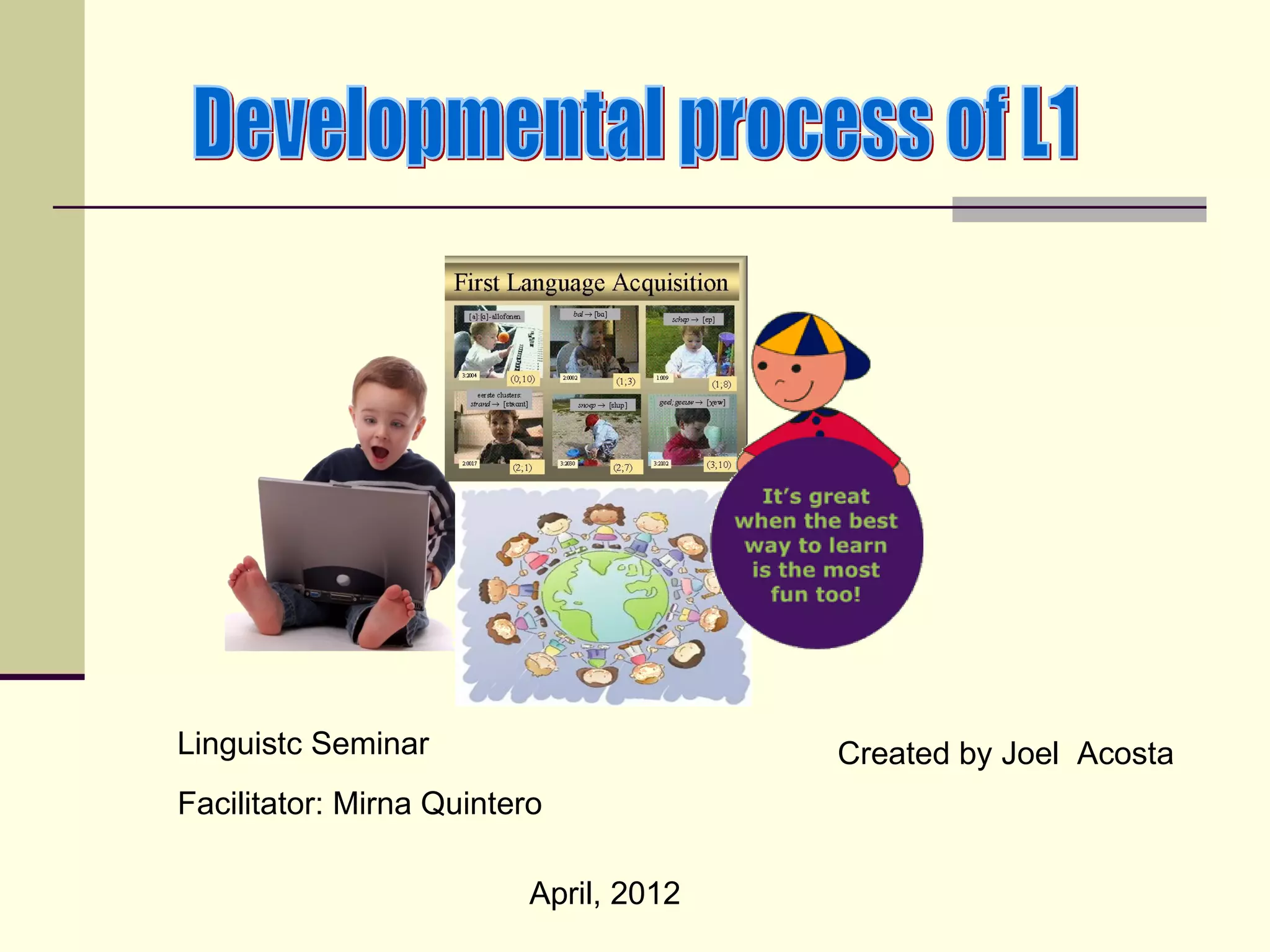

Linguistc Seminar                       Created by Joel Acosta
Facilitator: Mirna Quintero

                          April, 2012
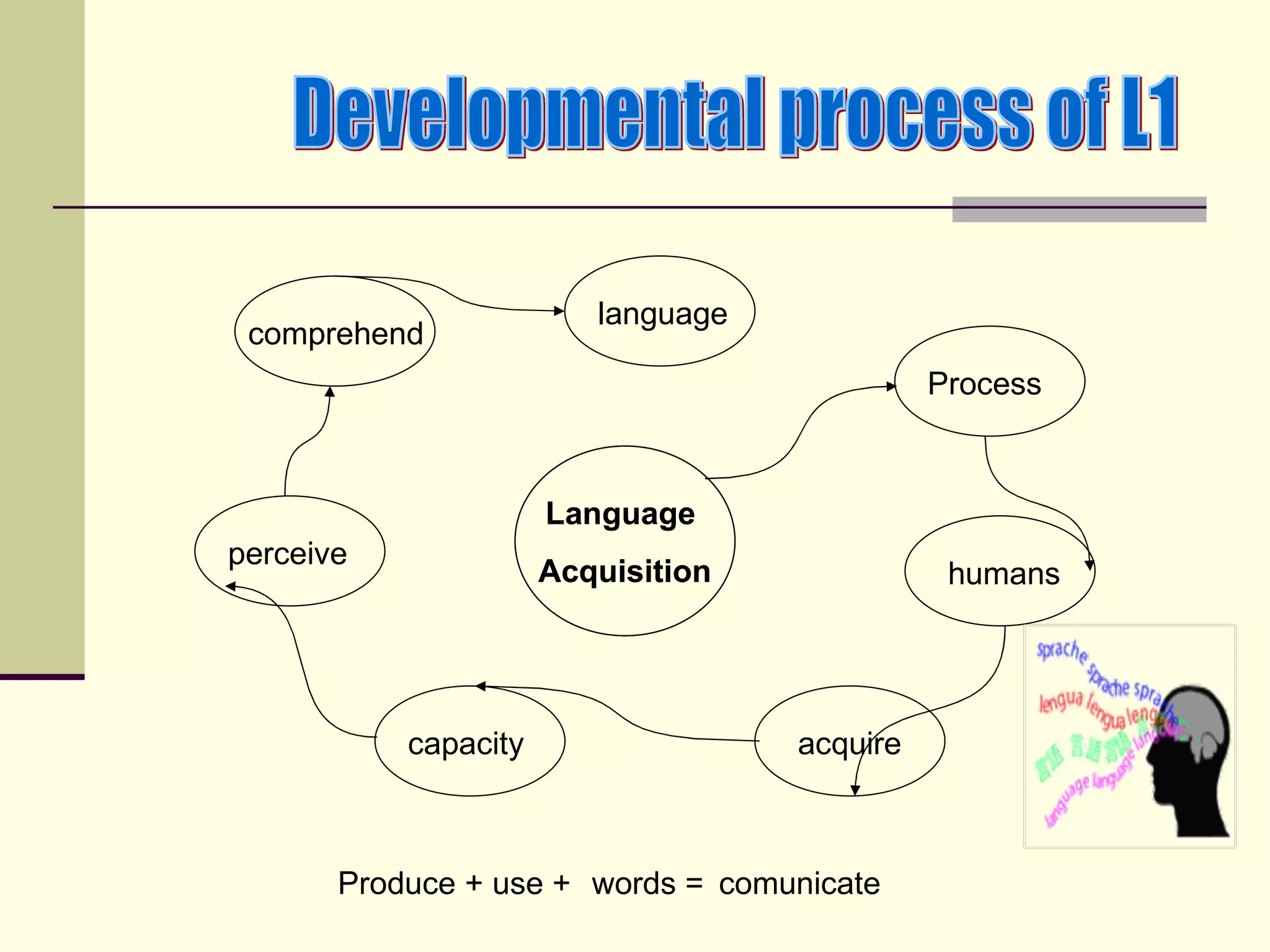
language
 comprehend
                                              Process


                      Language
perceive
                      Acquisition              humans


           capacity                 acquire


       Produce + use + words = comunicate
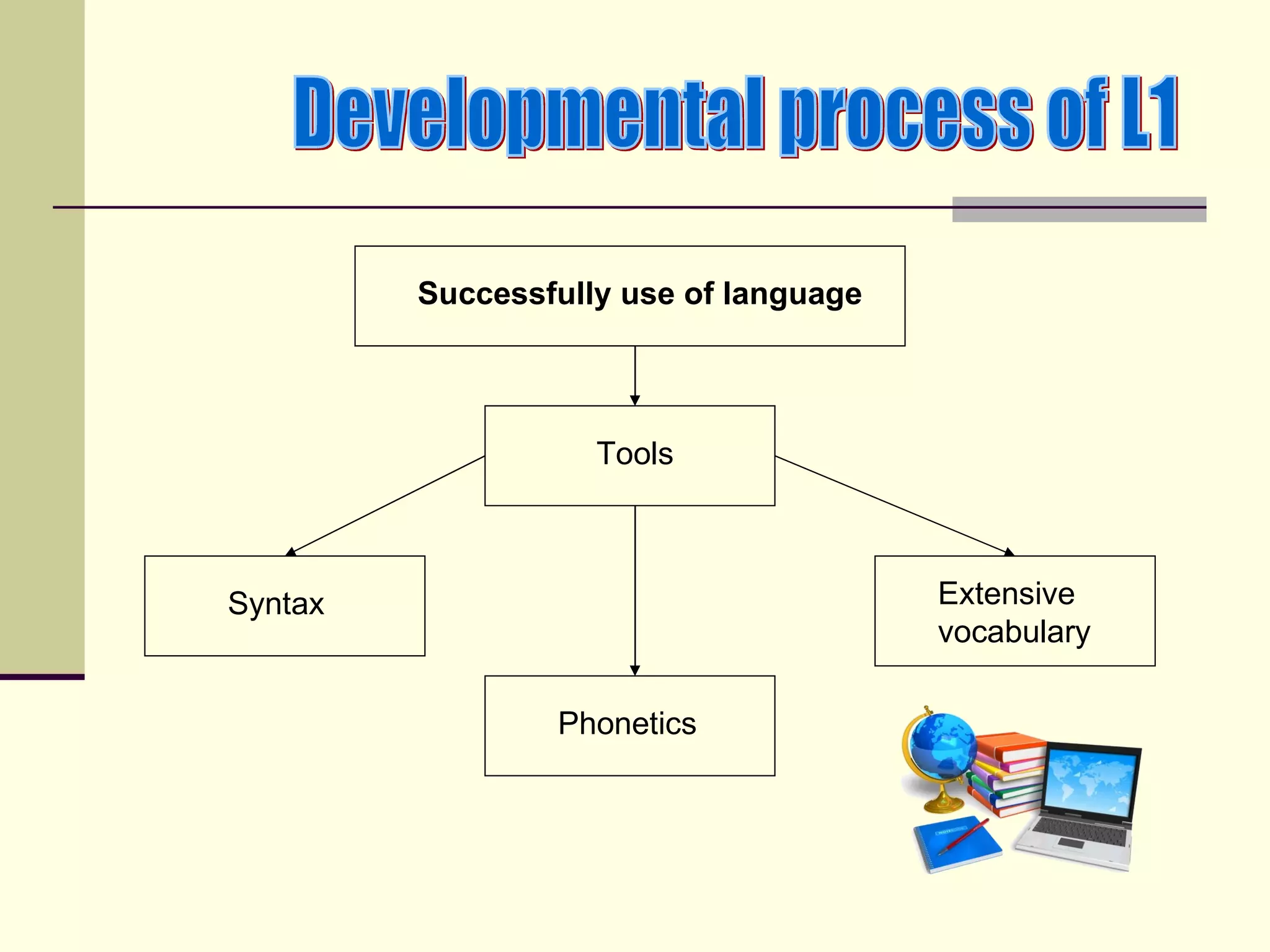
Successfully use of language


                    Tools


Syntax                                  Extensive
                                        vocabulary

                 Phonetics
Is the language acquisition process the same for all children?


   Game
   Rules
       Articulate words
       Put together the words to be acceptable and understand
      by people
Children do not use language like adults


                        Acquiring language is a gradual process


             ‘Errors'


Children will learn to speak the dialect(s) and language(s)
that are used around them


                                       Children follow their own rules
How do children develop?

   Children are individuals


   Children are learning how to function adequately in their environment


   Much of this learning takes place through language itself
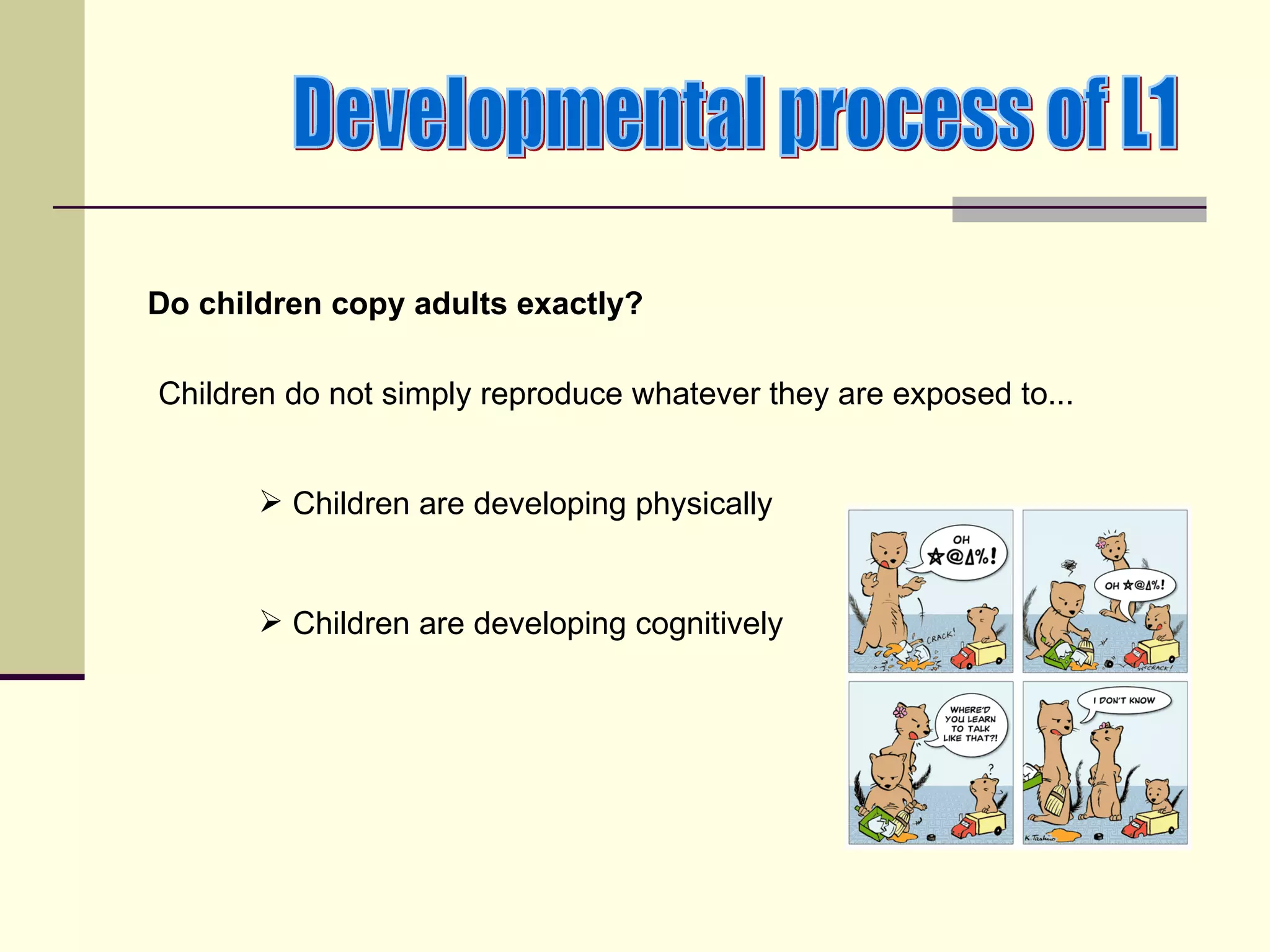
Do children copy adults exactly?

Children do not simply reproduce whatever they are exposed to...


        Children are developing physically


        Children are developing cognitively
How long does it take to acquire language?

       Language acquisition takes time, a long time


       Children learn language through natural interaction with caring
       people in everyday settings
Do all children learn at the same rate?


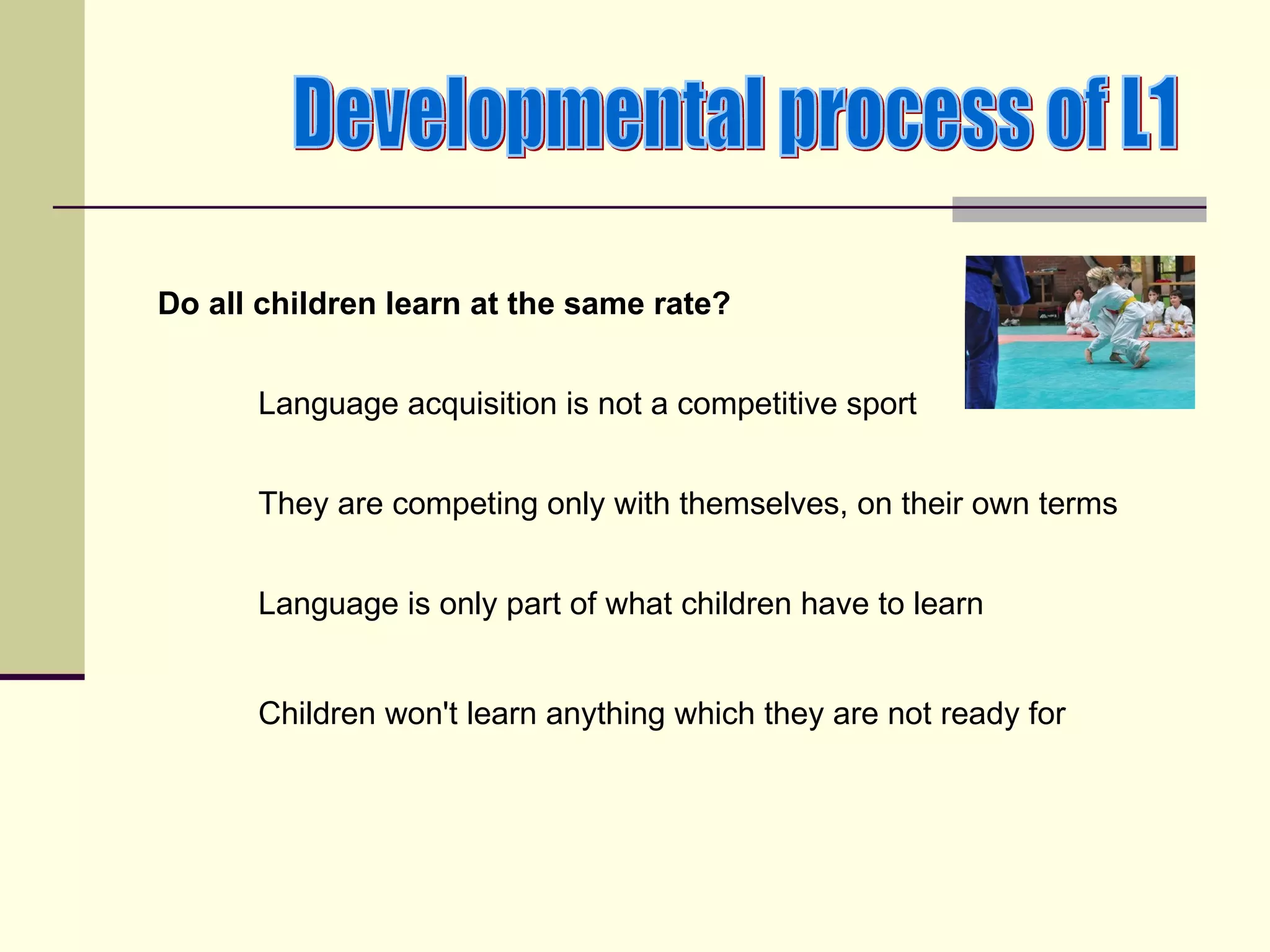
      Language acquisition is not a competitive sport


      They are competing only with themselves, on their own terms


      Language is only part of what children have to learn


      Children won't learn anything which they are not ready for
How do children handle the language acquisition process?


  Children will develop their own strategies for learning whatever they find
  relevant to learn around them, including language


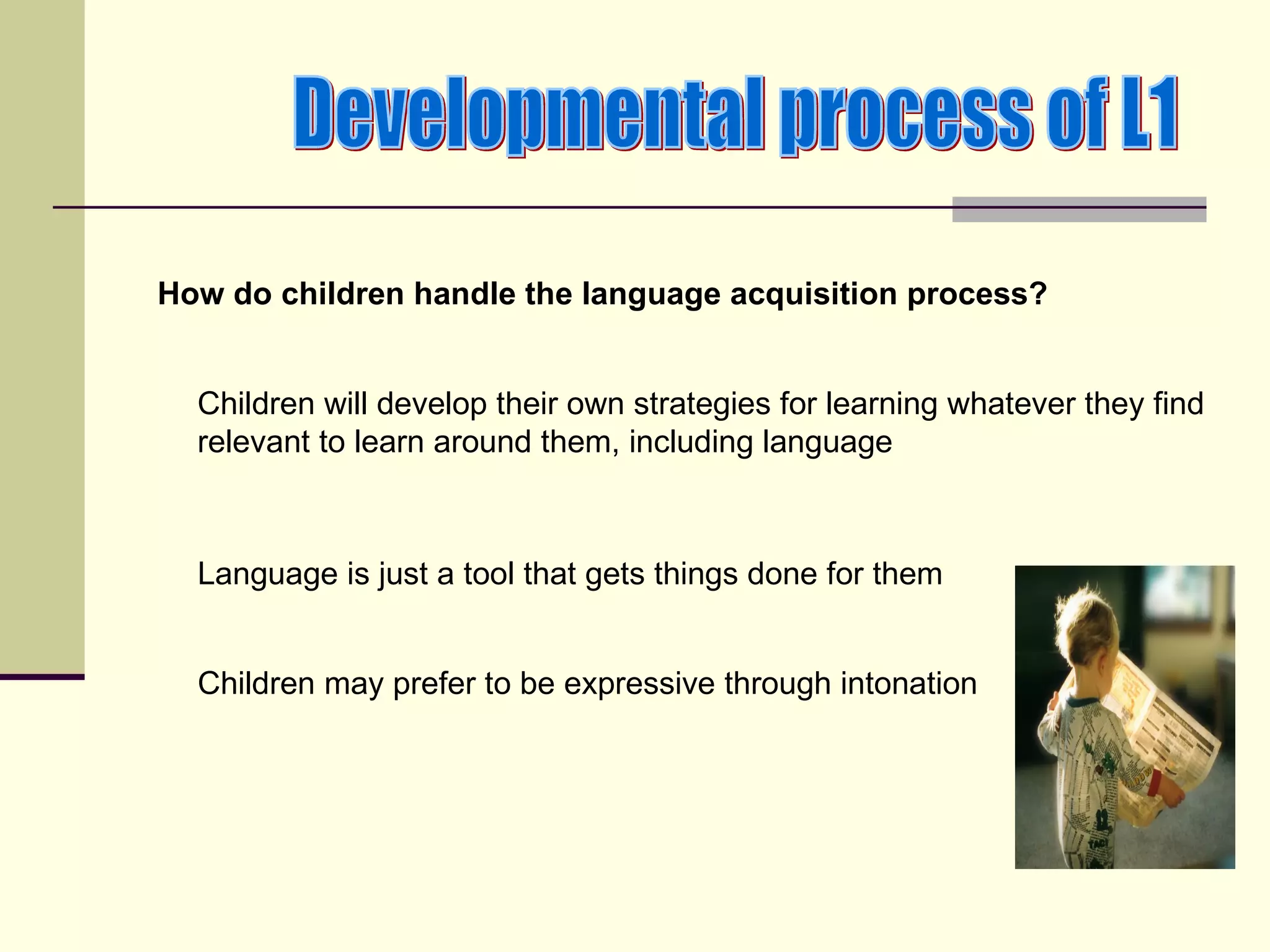
  Language is just a tool that gets things done for them


  Children may prefer to be expressive through intonation
What strategies do children use in learning language?

   Learning strategies:


           Physical ability             (Learn in stages)


           Intellectual ability    Generalize from past experience
How do children acquire pronunciation?

    Difficult sounds and easy sounds, and difficult and easy distinctions
    between sounds

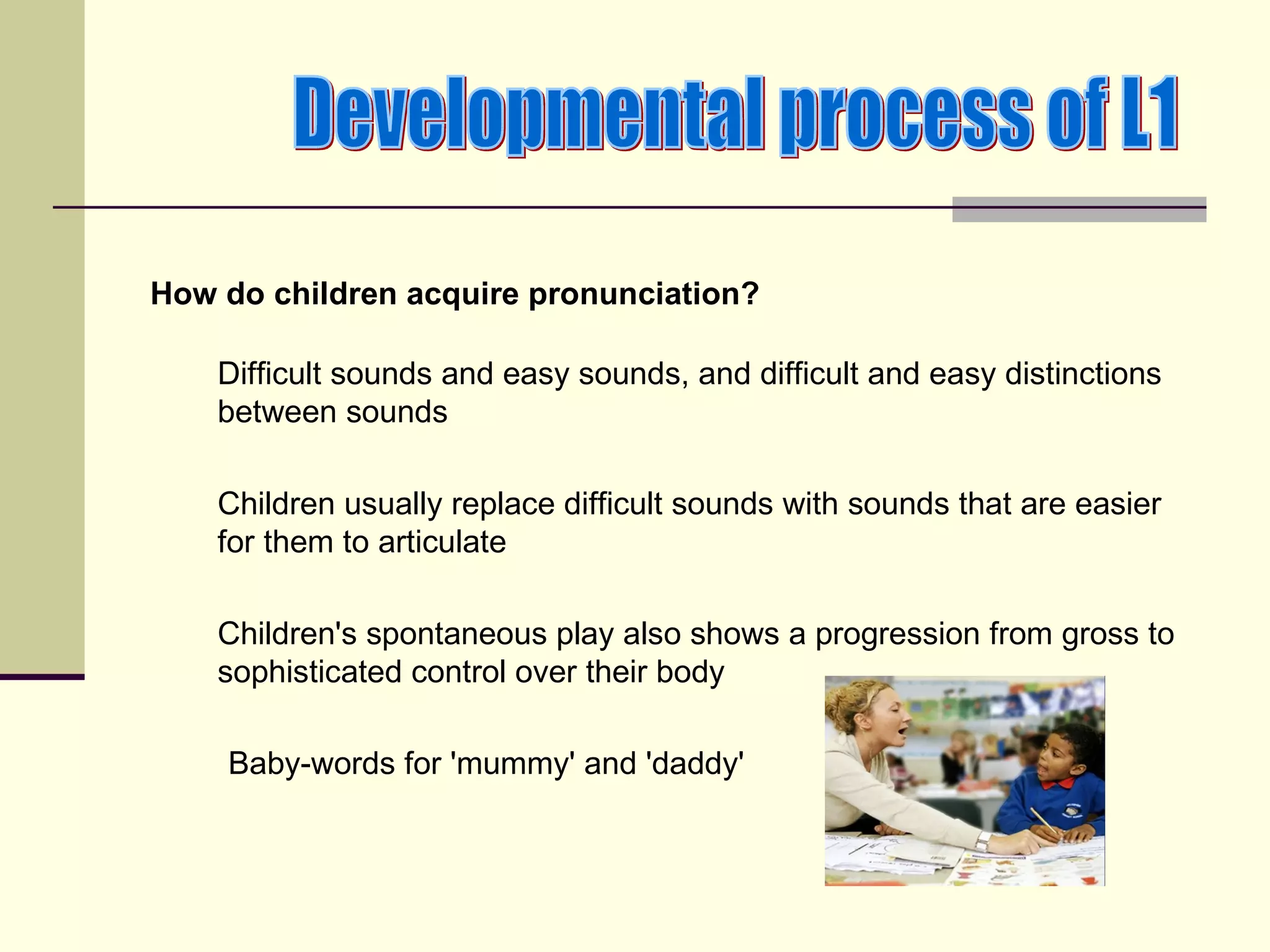
    Children usually replace difficult sounds with sounds that are easier
    for them to articulate

    Children's spontaneous play also shows a progression from gross to
    sophisticated control over their body

    Baby-words for 'mummy' and 'daddy'
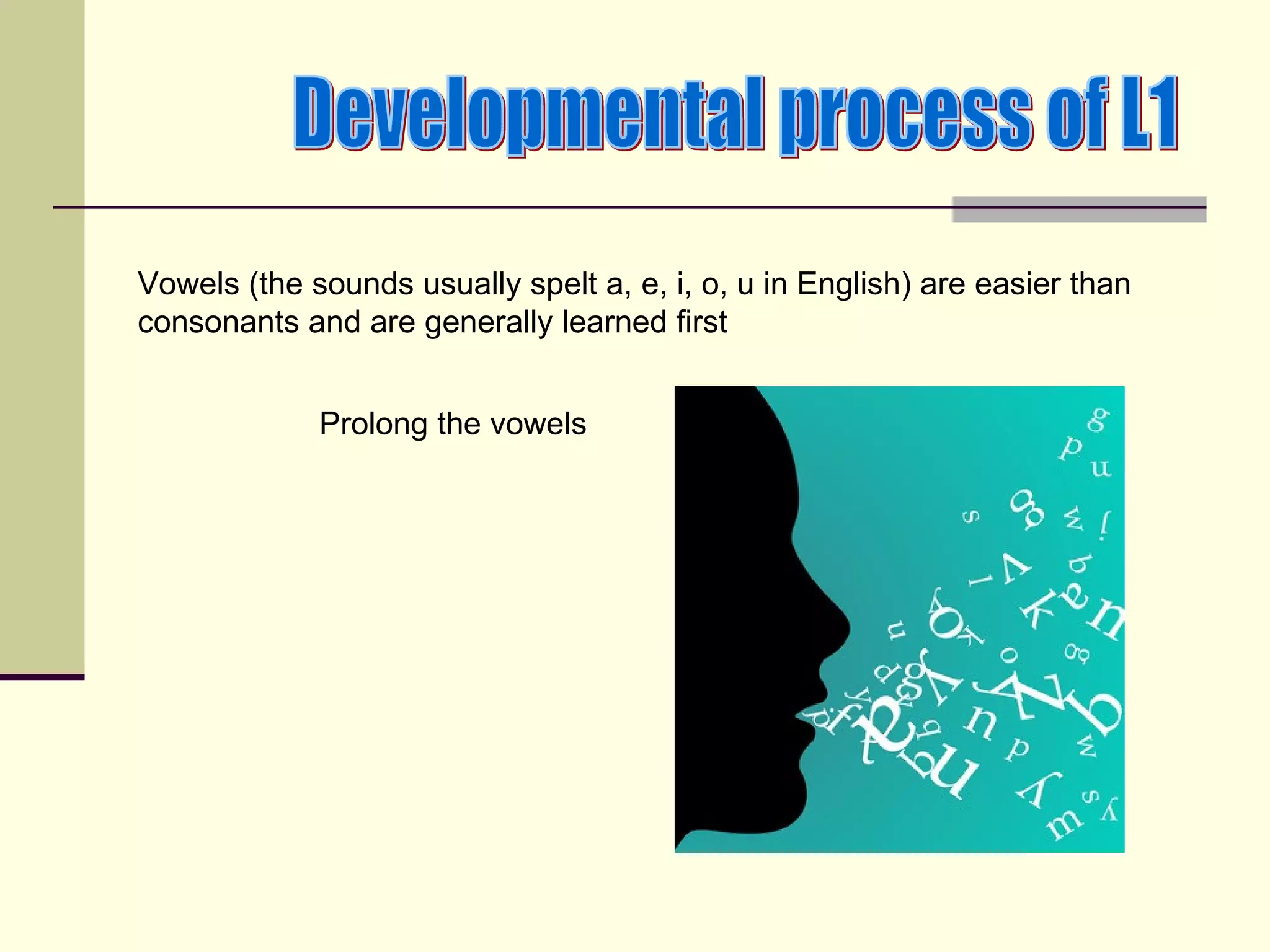
Vowels (the sounds usually spelt a, e, i, o, u in English) are easier than
consonants and are generally learned first


             Prolong the vowels
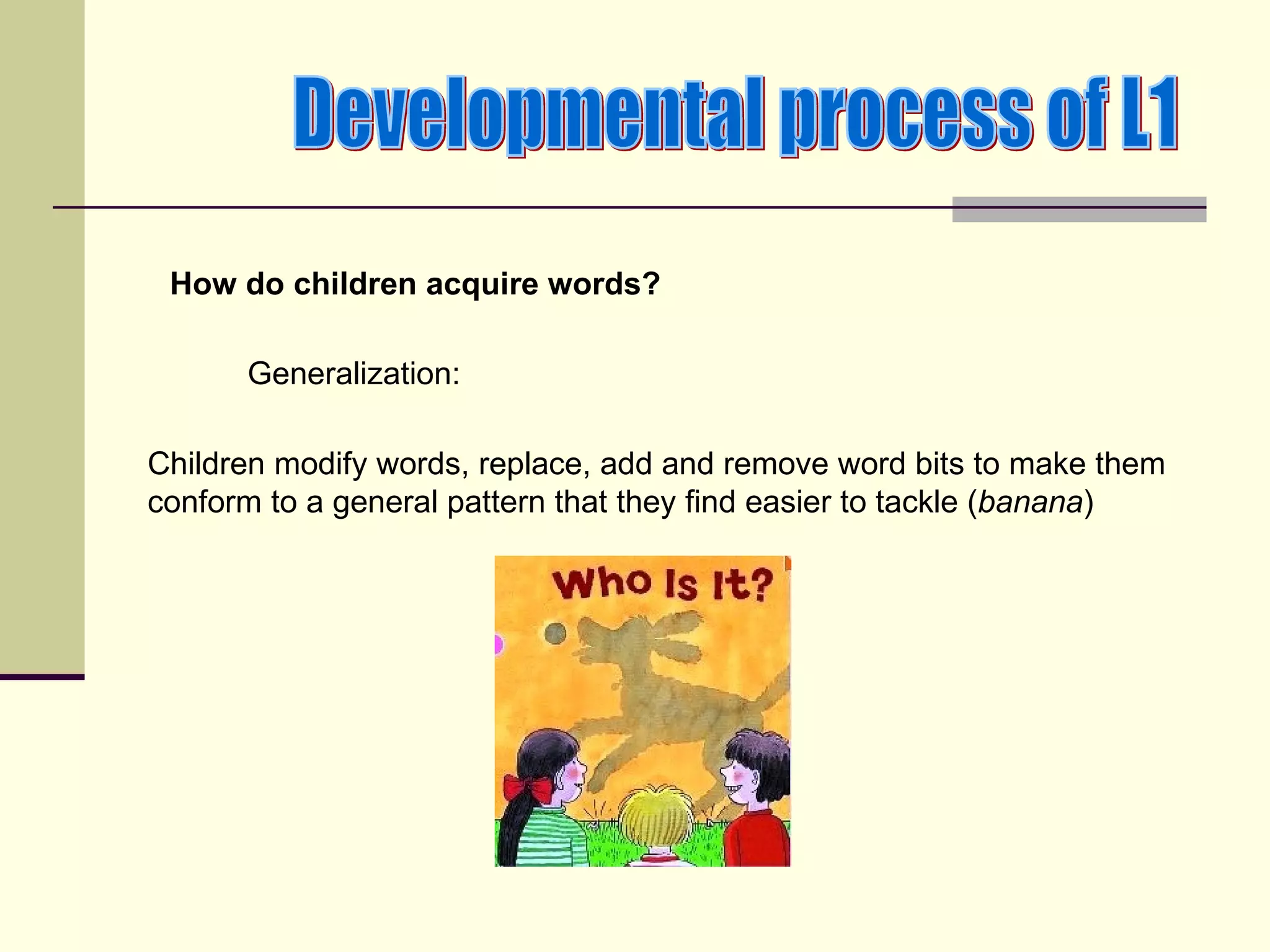
How do children acquire words?

      Generalization:

Children modify words, replace, add and remove word bits to make them
conform to a general pattern that they find easier to tackle (banana)
How do children acquire sentences?


An interesting fact of this learning is the hyperregularization inflections,

or use the same inflections of verbs regular and irregular, showing that

the child looks for patterns in language
Where can you learn more about language acquisition?


 David Crystal's book Listen to your Child: A Parent's Guide to Children's
Language (Penguin, 1989) offers a very accessible and very entertaining
account of what children do with their own language learning.

 Eve Clark's book First Language Acquisition (Cambridge University Press,
2003) is a comprehensive -- and more technical -- account of child language
development.

 The Learning Disabilities website lists typical milestones in cognitive,
linguistic and social development.
Sources

http://es.scribd.com/doc/16677606/La-adquision-del-lenguaje-en-los-ninos

Bloom, L. (1970) Language Development: Form and Function in Emerging
Grammars.

https://pantherfile.uwm.edu/iverson/www/pinker.html


http://www.universalteacher.org.uk/lang/acquisition.htm
Developmental

Developmental

  • 1.
    Linguistc Seminar Created by Joel Acosta Facilitator: Mirna Quintero April, 2012
  • 2.
    language comprehend Process Language perceive Acquisition humans capacity acquire Produce + use + words = comunicate
  • 3.
    Successfully use oflanguage Tools Syntax Extensive vocabulary Phonetics
  • 4.
    Is the languageacquisition process the same for all children?  Game  Rules  Articulate words  Put together the words to be acceptable and understand by people
  • 5.
    Children do notuse language like adults Acquiring language is a gradual process ‘Errors' Children will learn to speak the dialect(s) and language(s) that are used around them Children follow their own rules
  • 6.
    How do childrendevelop? Children are individuals Children are learning how to function adequately in their environment Much of this learning takes place through language itself
  • 7.
    Do children copyadults exactly? Children do not simply reproduce whatever they are exposed to...  Children are developing physically  Children are developing cognitively
  • 8.
    How long doesit take to acquire language? Language acquisition takes time, a long time Children learn language through natural interaction with caring people in everyday settings
  • 9.
    Do all childrenlearn at the same rate? Language acquisition is not a competitive sport They are competing only with themselves, on their own terms Language is only part of what children have to learn Children won't learn anything which they are not ready for
  • 10.
    How do childrenhandle the language acquisition process? Children will develop their own strategies for learning whatever they find relevant to learn around them, including language Language is just a tool that gets things done for them Children may prefer to be expressive through intonation
  • 11.
    What strategies dochildren use in learning language?  Learning strategies:  Physical ability (Learn in stages)  Intellectual ability Generalize from past experience
  • 12.
    How do childrenacquire pronunciation? Difficult sounds and easy sounds, and difficult and easy distinctions between sounds Children usually replace difficult sounds with sounds that are easier for them to articulate Children's spontaneous play also shows a progression from gross to sophisticated control over their body Baby-words for 'mummy' and 'daddy'
  • 13.
    Vowels (the soundsusually spelt a, e, i, o, u in English) are easier than consonants and are generally learned first Prolong the vowels
  • 14.
    How do childrenacquire words? Generalization: Children modify words, replace, add and remove word bits to make them conform to a general pattern that they find easier to tackle (banana)
  • 15.
    How do childrenacquire sentences? An interesting fact of this learning is the hyperregularization inflections, or use the same inflections of verbs regular and irregular, showing that the child looks for patterns in language
  • 16.
    Where can youlearn more about language acquisition?  David Crystal's book Listen to your Child: A Parent's Guide to Children's Language (Penguin, 1989) offers a very accessible and very entertaining account of what children do with their own language learning.  Eve Clark's book First Language Acquisition (Cambridge University Press, 2003) is a comprehensive -- and more technical -- account of child language development.  The Learning Disabilities website lists typical milestones in cognitive, linguistic and social development.
  • 17.
    Sources http://es.scribd.com/doc/16677606/La-adquision-del-lenguaje-en-los-ninos Bloom, L. (1970)Language Development: Form and Function in Emerging Grammars. https://pantherfile.uwm.edu/iverson/www/pinker.html http://www.universalteacher.org.uk/lang/acquisition.htm