Interference Between First and Second Languages pp pres
The document discusses language interference between a first and second language. It can occur any time someone has an imperfect command of a second language, as differences between the languages cause more interference. Adults systematically try to form rules from both languages when learning a second one, but interference from the first language is not the only factor. Adults and children both have the capacity to acquire a second language at any age. The document also examines implications for second language learning from first language acquisition research, including the importance of meaningful practice and input in appropriate contexts.
Explores interference between first and second languages, highlighting negative effects due to linguistic differences and imperfect command.
Examines how adults approach second language learning systematically, reflecting errors similar to children but not solely influenced by first language interference.
Challenges the myth that younger learners are superior; adults exhibit advanced competence despite challenges in verbalizing grammatical rules.
Discusses comprehension vs. production, cognitive factors affecting acquisition, Universal Grammar, and the interplay between language and thought.
Emphasizes the importance of meaningful practice and teacher input over mere frequency in the second language learning context.
Describes the Audio-lingual Method focusing on direct teaching of grammar without native language, emphasizing drills and pronunciation with minimal grammatical explanation.
Speakers apply knowledgefrom their native language. It can occur in any situation when someone does not have a native level command of a language, as when translating into a second language.Language Interference (Linguistic Interference, Cross-Linguistic Interference or Transfer)
3.
The grater thedifferences between the two languages, the more negative the effects of interference are likely to be.Interference It will inevitably occur in any situation where someone has an imperfect command of a second language.
4.
Interference in AdultsAdultsapproach the second language systematically; they attempt to formulate linguistic rules with the information they have:* from the native language *from the second language *from teachers and classmates
5.
Interference from thefirst language does not imply that interference is the most important factor n adult second language acquisition.Adults learning a second language manifest some of the same errors found in children learning their first language.
6.
Order of Acquisition “The younger the better” Myth We tend to believe that children are better at learning foreign languages; nevertheless, concerning literacy, vocabulary, pragmatics, schematic knowledge and syntax, adults are probed to be superior learners.
7.
Issues in FirstLanguage AcquisitionThere are a series of implications for second language learning:Competence and PerformanceAdults can make choices between two alternative forms and they are sometimes aware of grammar in a second language but they are not able to verbalize rules and paradigms consciously in their native language.
8.
b) Comprehension andProductionThere is a universal distinction between comprehension and production. Learning a second language usually means learning to speak it and to comprehend it.
9.
c) Nature orNurtureAdults and children have the capacity to acquire a second language at any age. What nature does is to rule out the acquisition of authentic accent. If an adult does not acquire a second language successfully it is probably because of cognitive or affective factors not to the absence of innate capacities.
10.
d) UniversalsUniversal Grammaris a theory in linguistics that suggests that there are properties that all possible natural human languages have.Some rules of grammar are hardwired into the brain and manifest without being thought.
11.
e) Systematicity andVariabilityLearners induce rules, generalize across a category, over generalize, and proceed in stages of development. The variability of second language acquisition is increased by a number of cognitive, affective, cultural, and contextual variables that sometimes are not applicable to a first language learning context.
12.
f) Language andThoughtLanguage helps shape thinking and thinking helps to shape language. The second language learner has the task to sort out new meanings from old, to distinguish thoughts and concepts in their first language that are similar in the second language, and to acquire a new system of conceptualization.
13.
g) PracticeThe frequencyof stimuli and the number of times spent practicing forms are not important when learning an item. What is important is meaningfulness, an appropriate contextualized, and meaningful communication in the second language is the best possible practice for the second language learner.
14.
i) InputIn thesecond language learning classroom, parental input is replaced by teacher input. Teachers must provide a meaningful communication to their students in appropriate contexts.
15.
In the Classroom:The Audio-lingual Method(also known as The Army Method) It is a style of teaching used in teaching foreign languages. It is based on behaviorist theories, which state that certain traits of living things and humans could be trained through a system of reinforcement.
16.
This method advisedthat students be taught a language directly, without using the students´native language to explain new words or grammar in the target language. It did not focus on teaching vocabulary; the teacher drilled students in the use of grammar.
17.
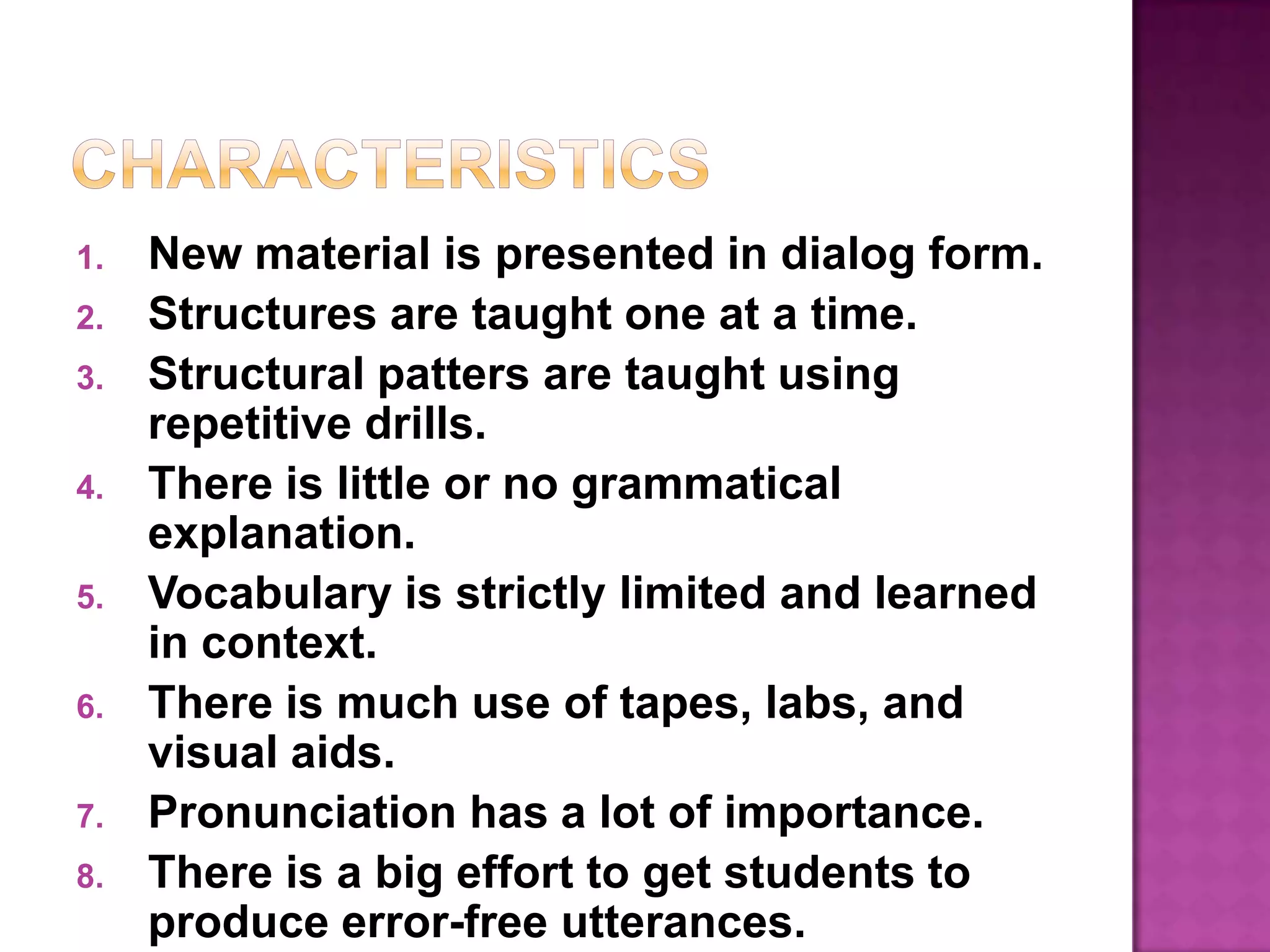
CharacteristicsNew material ispresented in dialog form.Structures are taught one at a time.Structural patters are taught using repetitive drills.There is little or no grammatical explanation.Vocabulary is strictly limited and learned in context.There is much use of tapes, labs, and visual aids.Pronunciation has a lot of importance.There is a big effort to get students to produce error-free utterances.There is a tendency to manipulate language and disregard content.