Universal GrammarUniversal Grammar
AndAnd
Second Language AcquisitionSecond Language Acquisition
Moulay Ismail University
Faculty of Arts and Humanities
Master program : Applied Linguistics
THE OUTLINETHE OUTLINE
I. Introduction.
II. What is Universal Grammar (UG)?
III.UG and Second Language Acquisition
i. The direct access model
ii. The indirect access model
iii. The no-access mode
iv. The Overall model
INTRODUCTION
The Behaviorists claim that children learn their mother
tongue by imitation; listening and repeating what adults
say.
Noam Chomsky: Language acquisition cannot be
reduced to the operation of response and stimulus,
every sentence we utter contains a new set of words or
a mixture of new words .
Language is regulated by a large number of rules
and principles
WHAT IS UG?
The system of principles, conditions, and rules that are
elements or properties of all human languages. The
essence of human language. (Chomsky, 1976)
Children are born with knowledge that are common to all
human languages. (Freeman, 2004)
All human beings share part of their knowledge of
language; UG is their common possession regardless of
which language they speak. ( Cook, 1996)
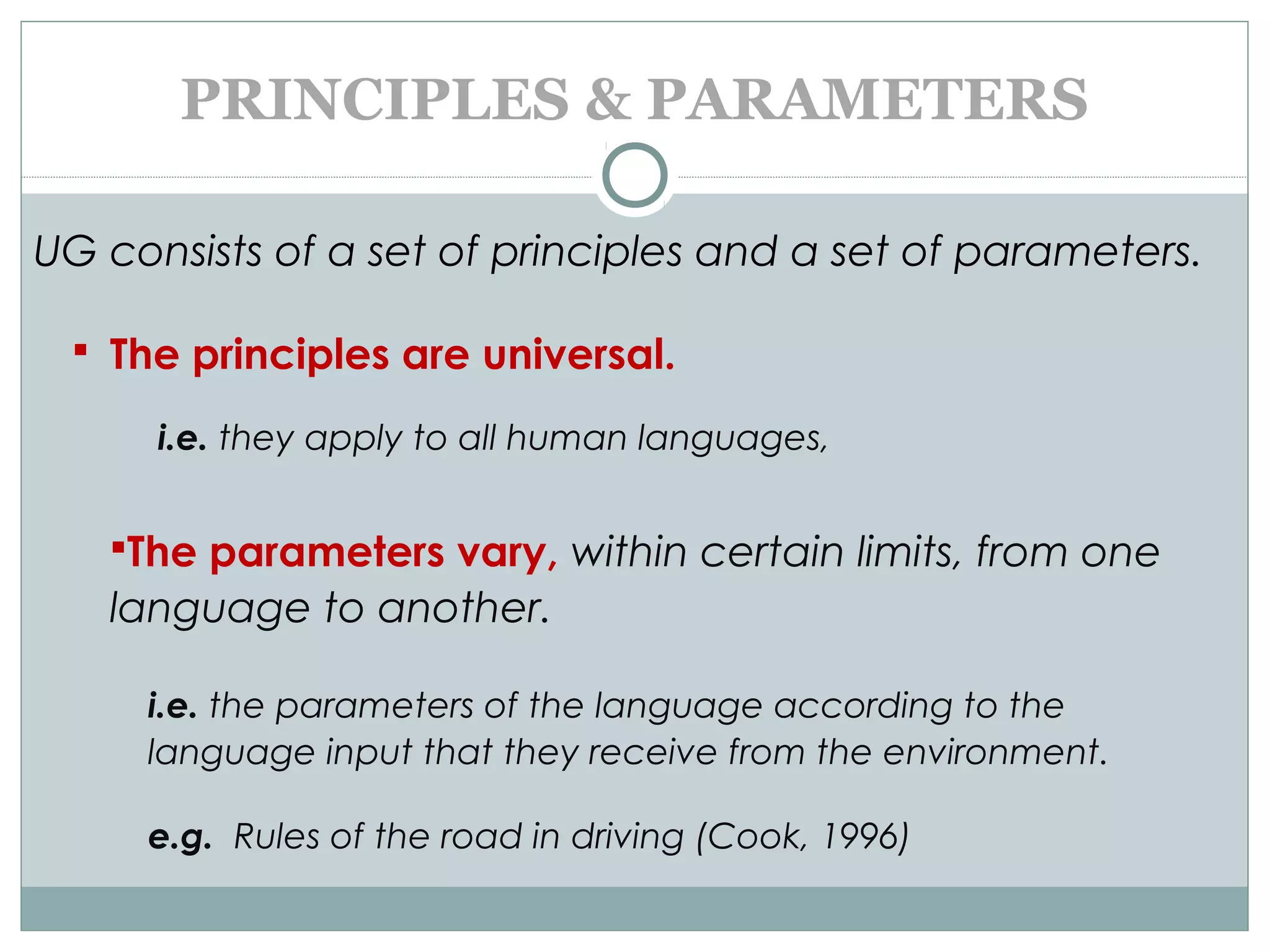
PRINCIPLES & PARAMETERS
UG consists of a set of principles and a set of parameters.
 The principles are universal.
i.e. they apply to all human languages,
The parameters vary, within certain limits, from one
language to another.
i.e. the parameters of the language according to the
language input that they receive from the environment.
e.g. Rules of the road in driving (Cook, 1996)
PRINCIPLES
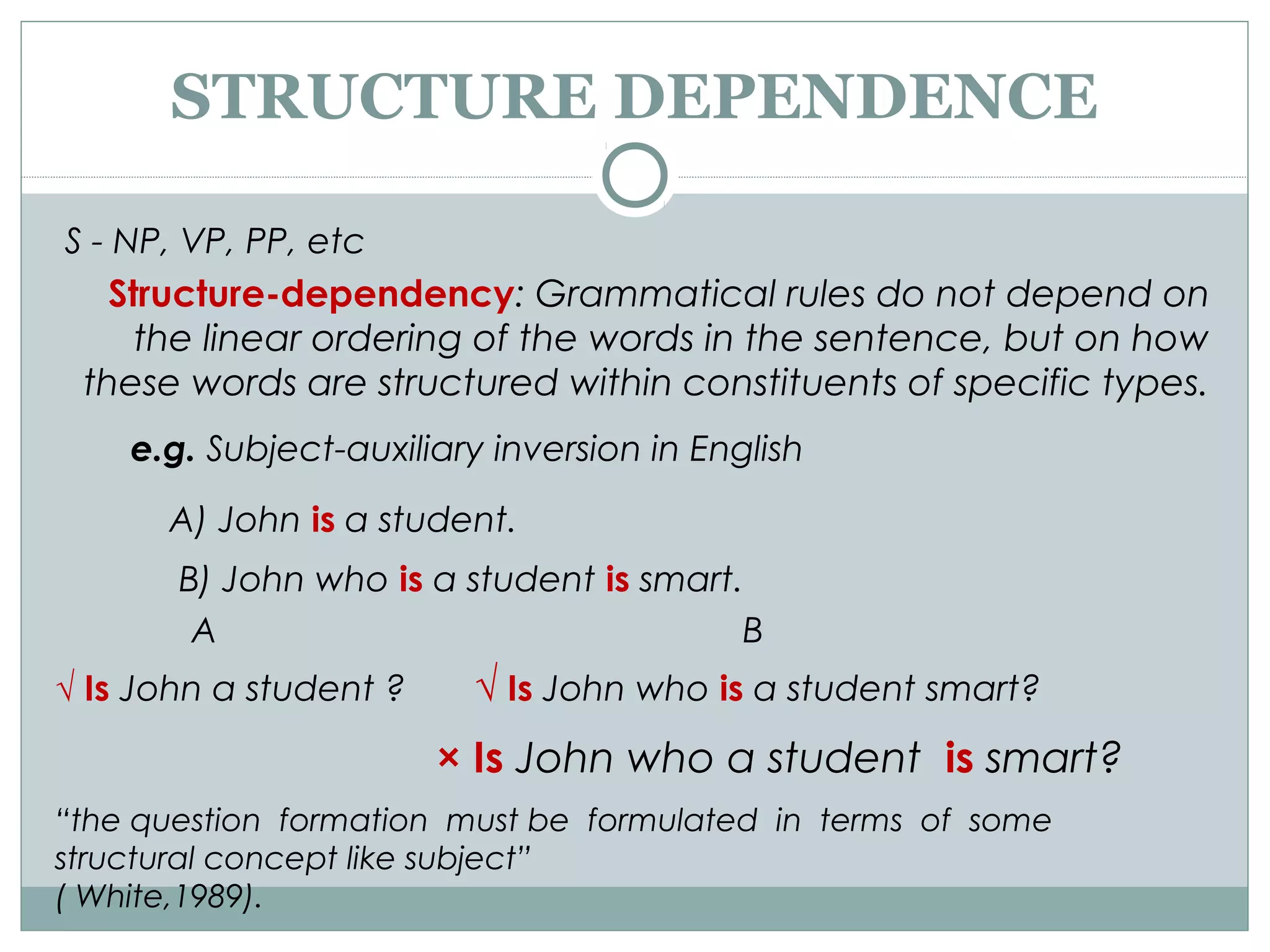
STRUCTURE DEPENDENCE
S - NP, VP, PP, etc
Structure-dependency: Grammatical rules do not depend on
the linear ordering of the words in the sentence, but on how
these words are structured within constituents of specific types.
e.g. Subject-auxiliary inversion in English
A) John is a student.
B) John who is a student is smart.
A B
√ Is John a student ? √ Is John who is a student smart?
× Is John who a student is smart?
“the question formation must be formulated in terms of some
structural concept like subject”
( White,1989).
PARAMETERS
XP: X(Head), Complement
Parameter
Head-initial (English)
Head-final (Japanese, Korean)
[read the book] [hon-o yonda] (book read)
VP VP
V(H) NP(C) NP(C) V(H)
read the book the book read
HEAD PARAMETERS
THE PRO-DROP PARAMETER
The Null (Ø) Subject Parameter: omitting subject or
the head of a sentence without violating the
meaning;
like Spanish and Italian and even Arabic
e.g.
 Parla francese . (Italian)
 yatakallamu alfaransiyyah. (Arabic)
× Speaks French (English)
OPPOSITION TO THE UG THEORY
“Language approach [i.e. a Chomskyan approach …]
sees language acquisition as a logical problem that can
be solved in principle without looking at the
development of actual children in detail.”
(Cook & Newson 1996, p. 78)
e.g. young English-speaking children frequently drop
subjects (in a [- Pro-drop] language!) …
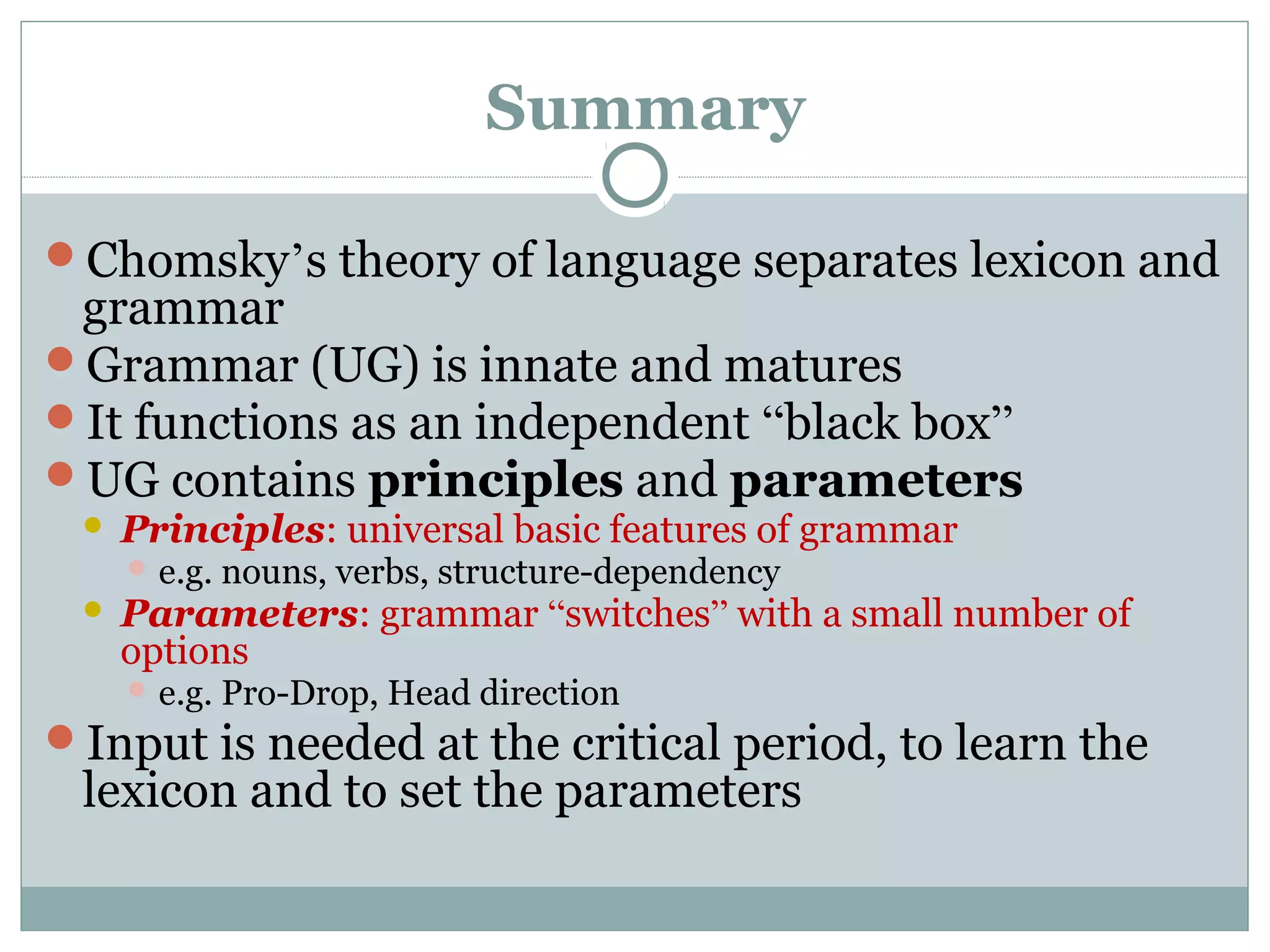
Summary
Chomsky’s theory of language separates lexicon and
grammar
Grammar (UG) is innate and matures
It functions as an independent “black box”
UG contains principles and parameters
 Principles: universal basic features of grammar
 e.g. nouns, verbs, structure-dependency
 Parameters: grammar “switches” with a small number of
options
 e.g. Pro-Drop, Head direction
Input is needed at the critical period, to learn the
lexicon and to set the parameters
Is UG accessible to SLA?
DIRECT ACCESS
 SLA is identical to L1 acquisition in
respect of the UG operation.
 Full-Access hypothesis, UG in its entirety
constrains L2 acquisition.
 UG is accessible in SLA for adults as well
as children; there is no critical period
after which UG ceases to operate
(Flynn, 1996)
INDIRECT ACCESS
 L2 learners have access to UG through their L1.
 Only L1-instantiated principles and L1-instantiated
parameter-values of UG are available to the learner.
 In white’s study, she compared between French and
Spanish learners who learn English as their L2, whereas
French is non-pro drop language just like English and
Spanish is a pro-drop language. The study showed that
Spanish learners produced sentences without subject
more than French learners especially at early stage of
learning.
Continue
 White’s (1989) two significant conclusions:
1) UG is inaccessible but any aspect (principle and
parameter) of it available in the L1 can be used in
L2.
2) Initially, L2 learners assume the L1 value of UG
parameters, but are still able to tape UG.
NO ACCESS
 No access (the Fundamental Difference
Hypothesis) (Bley-Vroman, 1989).
 L2 learners no longer have access to the
principles and parameters of UG.
 General learning principles replace UG.
COMPETITION MODEL
 L2 learners have access to UG but this is
partly blocked by the use of the
problem-solving-system (Felix, 1986).
Universal
Grammar
Universal
Grammar
Other mental
abilities
Other mental
abilities
L1
grammar
L1
grammar
L2
grammar
L2
grammar
Direct
access
Direct
access
No
access
No
access
Indirect
Access
Indirect
Access
UG & SLA
Conclusion
Thank you so much forThank you so much for
your attentionyour attention
REFERENCES
Chomsky, N. (1976). Language and Responsibility.
Brighton: Harvester Press.
Cook, V,J (1996). "Chomsky's Universal Grammar: An
Introduction". Blackwell Publishers.
Cook, V. J. (1993). Linguistics and Second Language
Acquisition. Basingstoke: Macmilan.
Cook, V. J. (1997). Inside Language. London: St. Martin's
Freeman, D., & Freeman, Y. (2004). Essential Linguistics.
Port smouth: Heinemann. Press.
White, L. (1989). Universal Grammar and Second
Language Acquisition.( 1989). Amsterdam: Benjamin.

Ug & sla

  • 1.
    Universal GrammarUniversal Grammar AndAnd SecondLanguage AcquisitionSecond Language Acquisition Moulay Ismail University Faculty of Arts and Humanities Master program : Applied Linguistics
  • 2.
    THE OUTLINETHE OUTLINE I.Introduction. II. What is Universal Grammar (UG)? III.UG and Second Language Acquisition i. The direct access model ii. The indirect access model iii. The no-access mode iv. The Overall model
  • 3.
    INTRODUCTION The Behaviorists claimthat children learn their mother tongue by imitation; listening and repeating what adults say. Noam Chomsky: Language acquisition cannot be reduced to the operation of response and stimulus, every sentence we utter contains a new set of words or a mixture of new words . Language is regulated by a large number of rules and principles
  • 4.
    WHAT IS UG? Thesystem of principles, conditions, and rules that are elements or properties of all human languages. The essence of human language. (Chomsky, 1976) Children are born with knowledge that are common to all human languages. (Freeman, 2004) All human beings share part of their knowledge of language; UG is their common possession regardless of which language they speak. ( Cook, 1996)
  • 5.
    PRINCIPLES & PARAMETERS UGconsists of a set of principles and a set of parameters.  The principles are universal. i.e. they apply to all human languages, The parameters vary, within certain limits, from one language to another. i.e. the parameters of the language according to the language input that they receive from the environment. e.g. Rules of the road in driving (Cook, 1996)
  • 6.
  • 7.
    STRUCTURE DEPENDENCE S -NP, VP, PP, etc Structure-dependency: Grammatical rules do not depend on the linear ordering of the words in the sentence, but on how these words are structured within constituents of specific types. e.g. Subject-auxiliary inversion in English A) John is a student. B) John who is a student is smart. A B √ Is John a student ? √ Is John who is a student smart? × Is John who a student is smart? “the question formation must be formulated in terms of some structural concept like subject” ( White,1989).
  • 8.
  • 9.
    XP: X(Head), Complement Parameter Head-initial(English) Head-final (Japanese, Korean) [read the book] [hon-o yonda] (book read) VP VP V(H) NP(C) NP(C) V(H) read the book the book read HEAD PARAMETERS
  • 10.
    THE PRO-DROP PARAMETER TheNull (Ø) Subject Parameter: omitting subject or the head of a sentence without violating the meaning; like Spanish and Italian and even Arabic e.g.  Parla francese . (Italian)  yatakallamu alfaransiyyah. (Arabic) × Speaks French (English)
  • 11.
    OPPOSITION TO THEUG THEORY “Language approach [i.e. a Chomskyan approach …] sees language acquisition as a logical problem that can be solved in principle without looking at the development of actual children in detail.” (Cook & Newson 1996, p. 78) e.g. young English-speaking children frequently drop subjects (in a [- Pro-drop] language!) …
  • 12.
    Summary Chomsky’s theory oflanguage separates lexicon and grammar Grammar (UG) is innate and matures It functions as an independent “black box” UG contains principles and parameters  Principles: universal basic features of grammar  e.g. nouns, verbs, structure-dependency  Parameters: grammar “switches” with a small number of options  e.g. Pro-Drop, Head direction Input is needed at the critical period, to learn the lexicon and to set the parameters
  • 13.
  • 14.
    DIRECT ACCESS  SLAis identical to L1 acquisition in respect of the UG operation.  Full-Access hypothesis, UG in its entirety constrains L2 acquisition.  UG is accessible in SLA for adults as well as children; there is no critical period after which UG ceases to operate (Flynn, 1996)
  • 15.
    INDIRECT ACCESS  L2learners have access to UG through their L1.  Only L1-instantiated principles and L1-instantiated parameter-values of UG are available to the learner.  In white’s study, she compared between French and Spanish learners who learn English as their L2, whereas French is non-pro drop language just like English and Spanish is a pro-drop language. The study showed that Spanish learners produced sentences without subject more than French learners especially at early stage of learning.
  • 16.
    Continue  White’s (1989)two significant conclusions: 1) UG is inaccessible but any aspect (principle and parameter) of it available in the L1 can be used in L2. 2) Initially, L2 learners assume the L1 value of UG parameters, but are still able to tape UG.
  • 17.
    NO ACCESS  Noaccess (the Fundamental Difference Hypothesis) (Bley-Vroman, 1989).  L2 learners no longer have access to the principles and parameters of UG.  General learning principles replace UG.
  • 18.
    COMPETITION MODEL  L2learners have access to UG but this is partly blocked by the use of the problem-solving-system (Felix, 1986).
  • 19.
  • 20.
  • 21.
    Thank you somuch forThank you so much for your attentionyour attention
  • 22.
    REFERENCES Chomsky, N. (1976).Language and Responsibility. Brighton: Harvester Press. Cook, V,J (1996). "Chomsky's Universal Grammar: An Introduction". Blackwell Publishers. Cook, V. J. (1993). Linguistics and Second Language Acquisition. Basingstoke: Macmilan. Cook, V. J. (1997). Inside Language. London: St. Martin's Freeman, D., & Freeman, Y. (2004). Essential Linguistics. Port smouth: Heinemann. Press. White, L. (1989). Universal Grammar and Second Language Acquisition.( 1989). Amsterdam: Benjamin.