THEORIES OF SECOND
LANGUAGE ACQUISITION
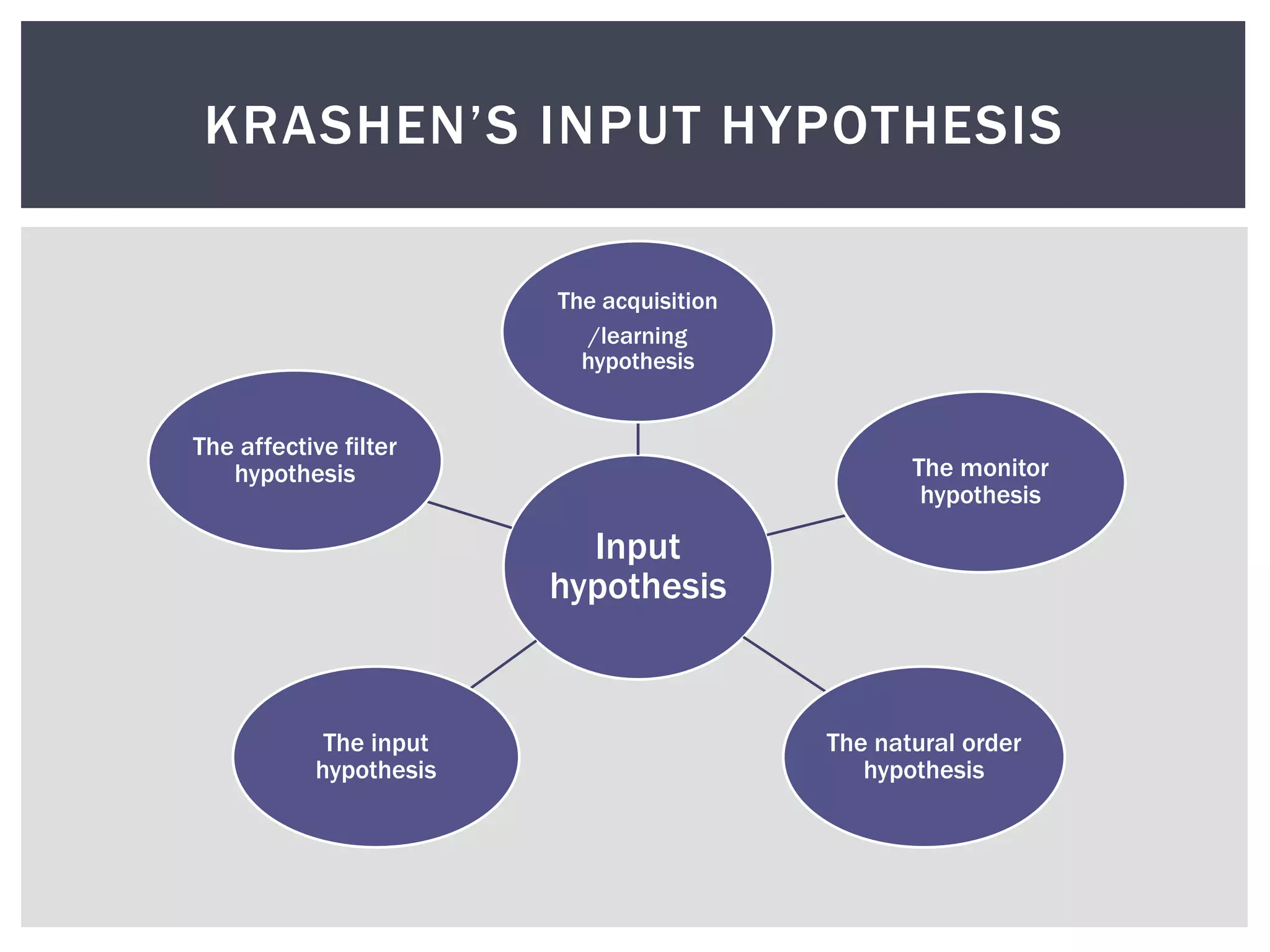
Input
hypothesis
The acquisition
/learning
hypothesis
The monitor
hypothesis
The natural order
hypothesis
The input
hypothesis
The affective filter
hypothesis
KRASHEN’S INPUT HYPOTHESIS
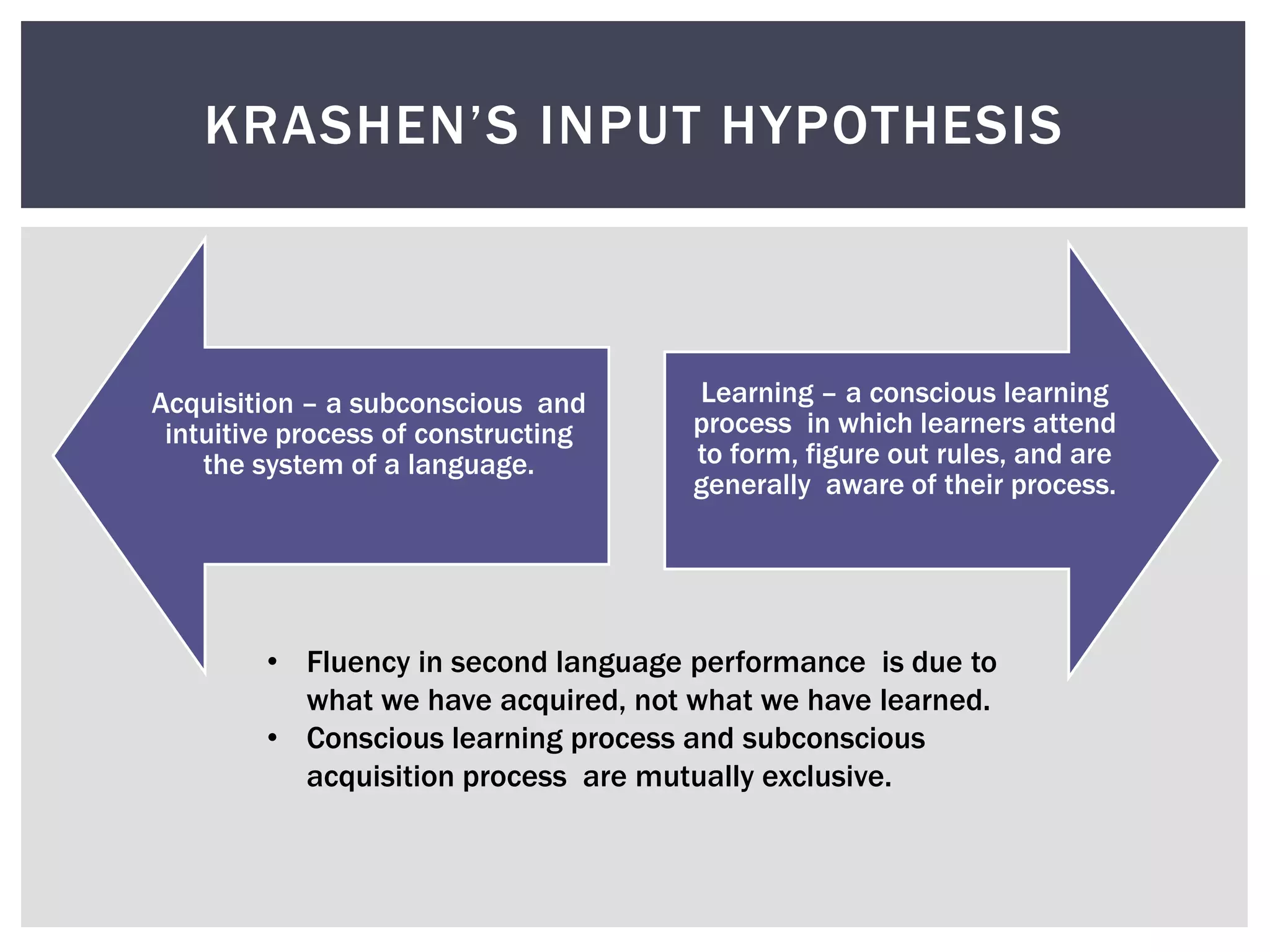
Acquisition – a subconscious and
intuitive process of constructing
the system of a language.
Learning – a conscious learning
process in which learners attend
to form, figure out rules, and are
generally aware of their process.
KRASHEN’S INPUT HYPOTHESIS
• Fluency in second language performance is due to
what we have acquired, not what we have learned.
• Conscious learning process and subconscious
acquisition process are mutually exclusive.
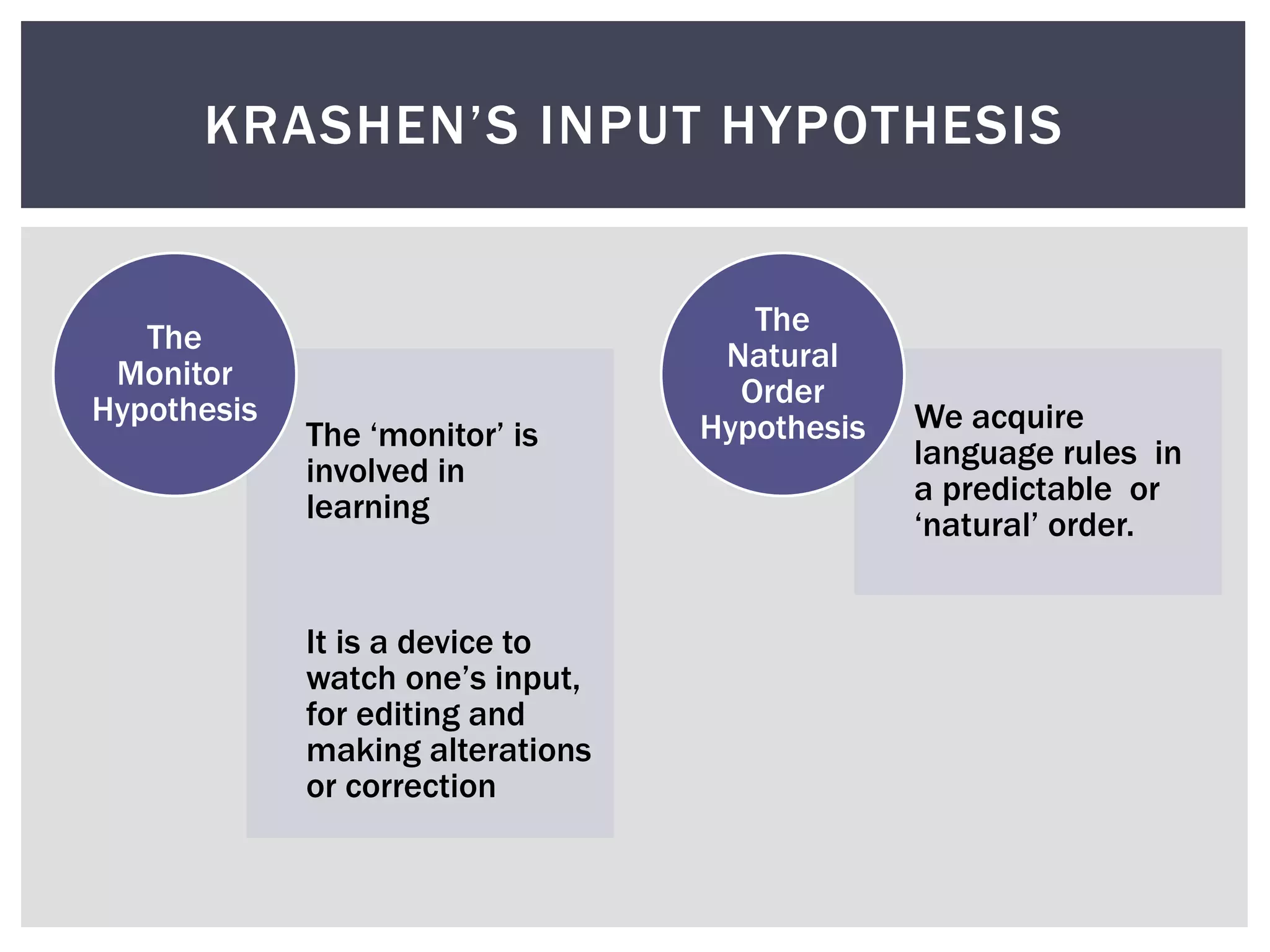
The ‘monitor’ is
involved in
learning
It is a device to
watch one’s input,
for editing and
making alterations
or correction
The
Monitor
Hypothesis We acquire
language rules in
a predictable or
‘natural’ order.
The
Natural
Order
Hypothesis
KRASHEN’S INPUT HYPOTHESIS
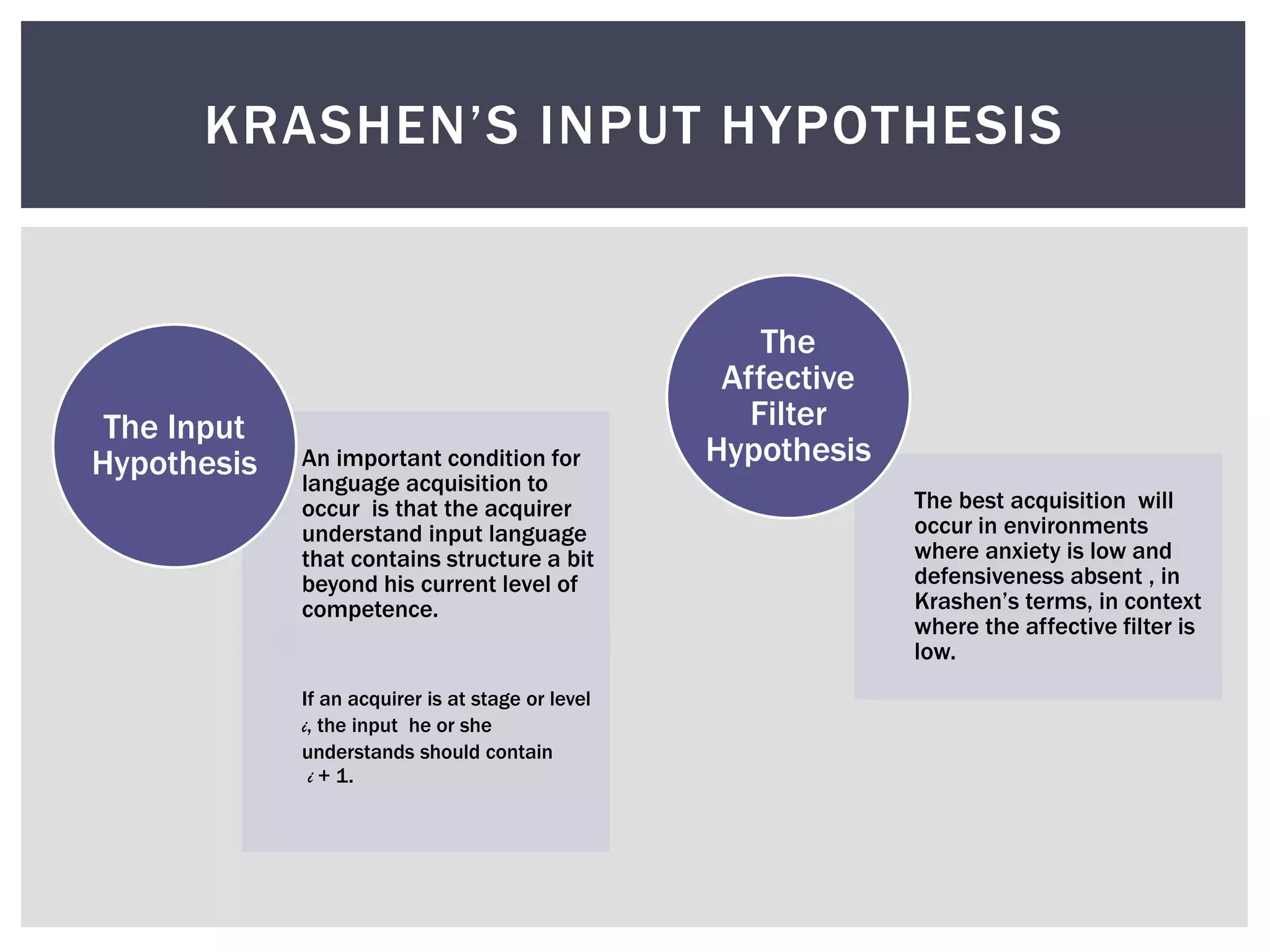
An important condition for
language acquisition to
occur is that the acquirer
understand input language
that contains structure a bit
beyond his current level of
competence.
If an acquirer is at stage or level
i, the input he or she
understands should contain
i + 1.
The Input
Hypothesis
The best acquisition will
occur in environments
where anxiety is low and
defensiveness absent , in
Krashen’s terms, in context
where the affective filter is
low.
The
Affective
Filter
Hypothesis
KRASHEN’S INPUT HYPOTHESIS
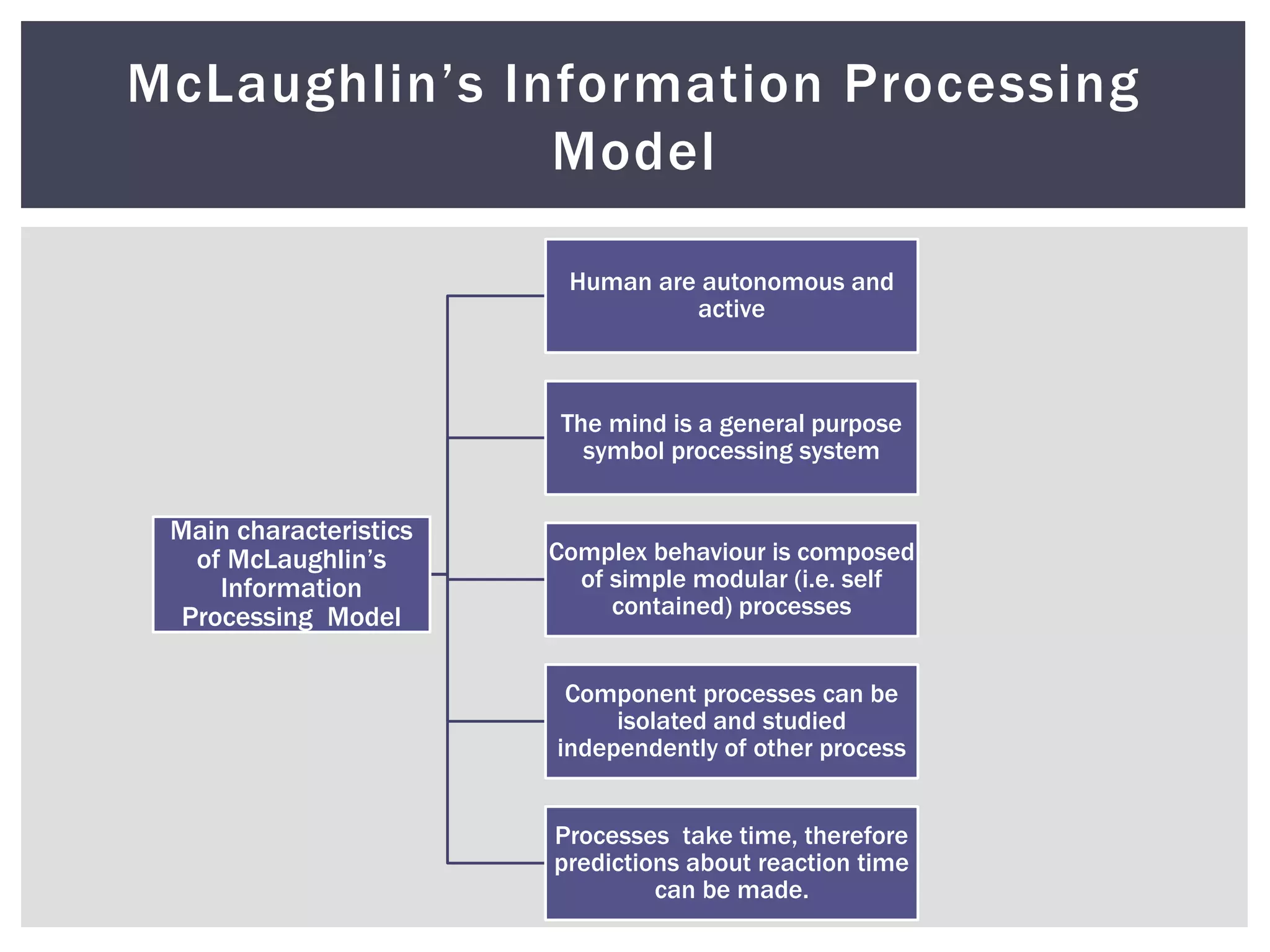
Main characteristics
of McLaughlin’s
Information
Processing Model
Human are autonomous and
active
The mind is a general purpose
symbol processing system
Complex behaviour is composed
of simple modular (i.e. self
contained) processes
Component processes can be
isolated and studied
independently of other process
Processes take time, therefore
predictions about reaction time
can be made.
McLaughlin’s Information Processing
Model
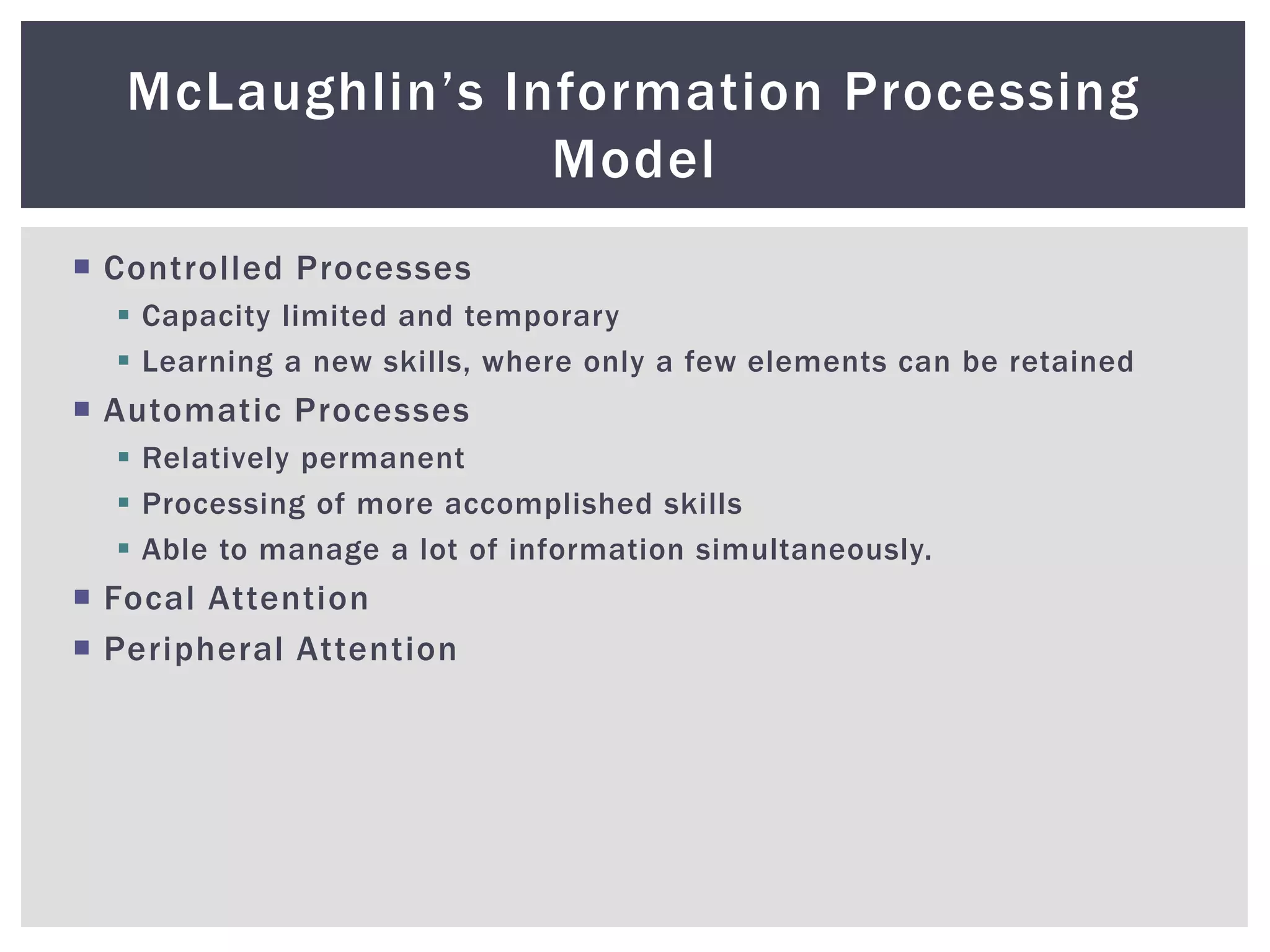
 Controlled Processes
 Capacity limited and temporary
 Learning a new skills, where only a few elements can be retained
 Automatic Processes
 Relatively permanent
 Processing of more accomplished skills
 Able to manage a lot of information simultaneously.
 Focal Attention
 Peripheral Attention
McLaughlin’s Information Processing
Model
THE SHIFT FROM CONTROLLED TO
AUTOMATIC PROCESSING IN SLA
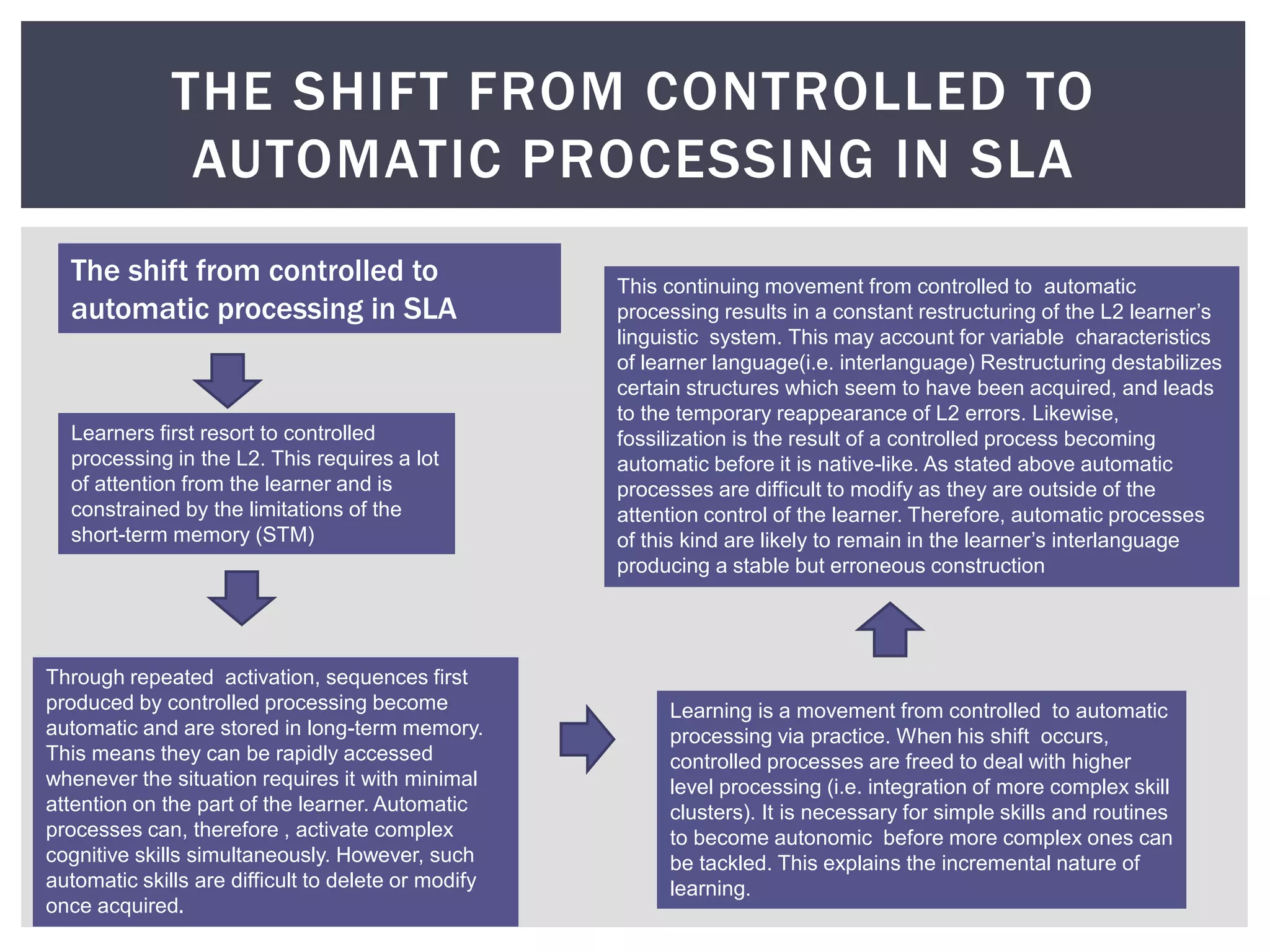
The shift from controlled to
automatic processing in SLA
Through repeated activation, sequences first
produced by controlled processing become
automatic and are stored in long-term memory.
This means they can be rapidly accessed
whenever the situation requires it with minimal
attention on the part of the learner. Automatic
processes can, therefore , activate complex
cognitive skills simultaneously. However, such
automatic skills are difficult to delete or modify
once acquired.
Learners first resort to controlled
processing in the L2. This requires a lot
of attention from the learner and is
constrained by the limitations of the
short-term memory (STM)
Learning is a movement from controlled to automatic
processing via practice. When his shift occurs,
controlled processes are freed to deal with higher
level processing (i.e. integration of more complex skill
clusters). It is necessary for simple skills and routines
to become autonomic before more complex ones can
be tackled. This explains the incremental nature of
learning.
This continuing movement from controlled to automatic
processing results in a constant restructuring of the L2 learner’s
linguistic system. This may account for variable characteristics
of learner language(i.e. interlanguage) Restructuring destabilizes
certain structures which seem to have been acquired, and leads
to the temporary reappearance of L2 errors. Likewise,
fossilization is the result of a controlled process becoming
automatic before it is native-like. As stated above automatic
processes are difficult to modify as they are outside of the
attention control of the learner. Therefore, automatic processes
of this kind are likely to remain in the learner’s interlanguage
producing a stable but erroneous construction
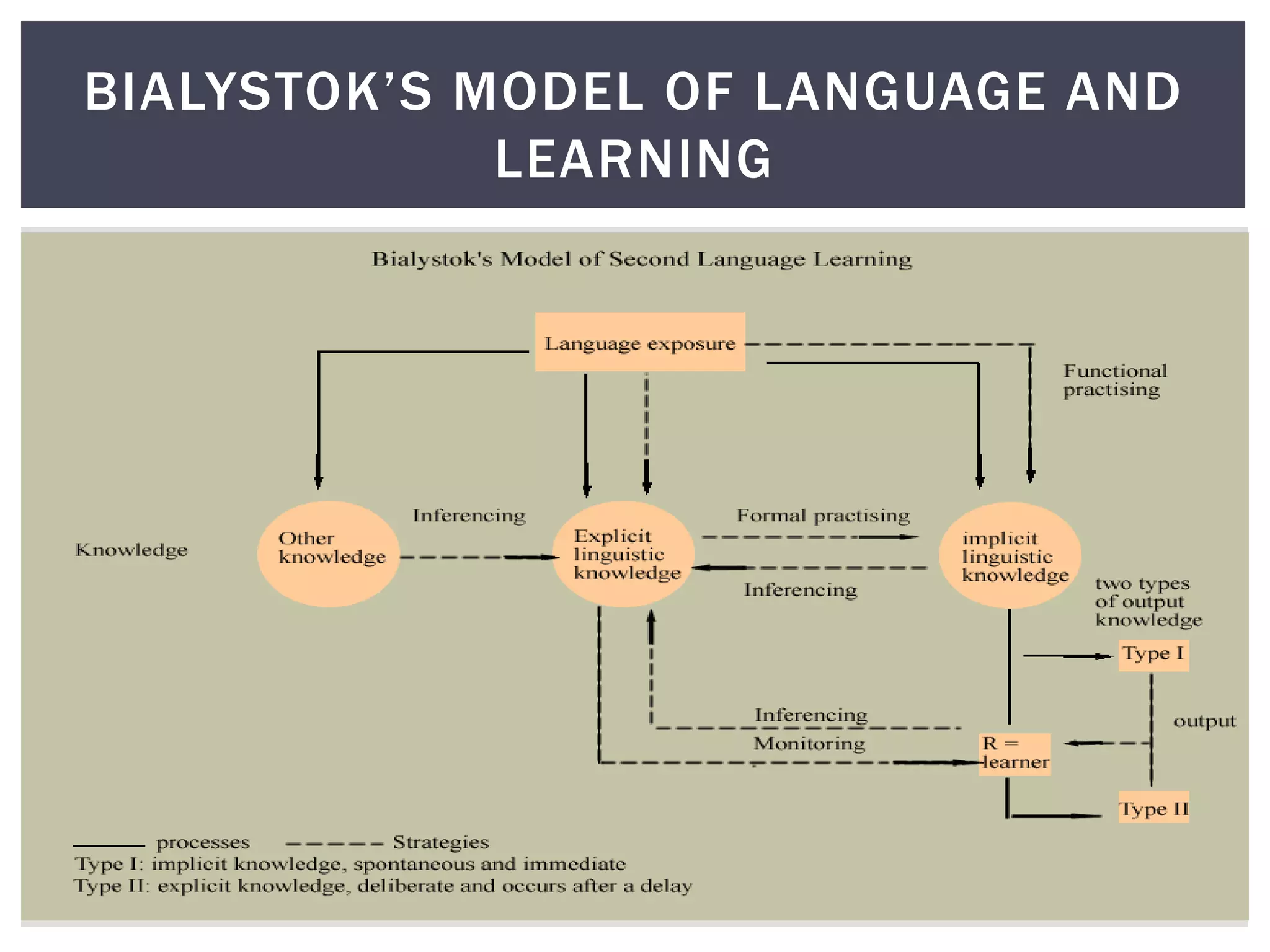
BIALYSTOK’S MODEL OF LANGUAGE AND
LEARNING
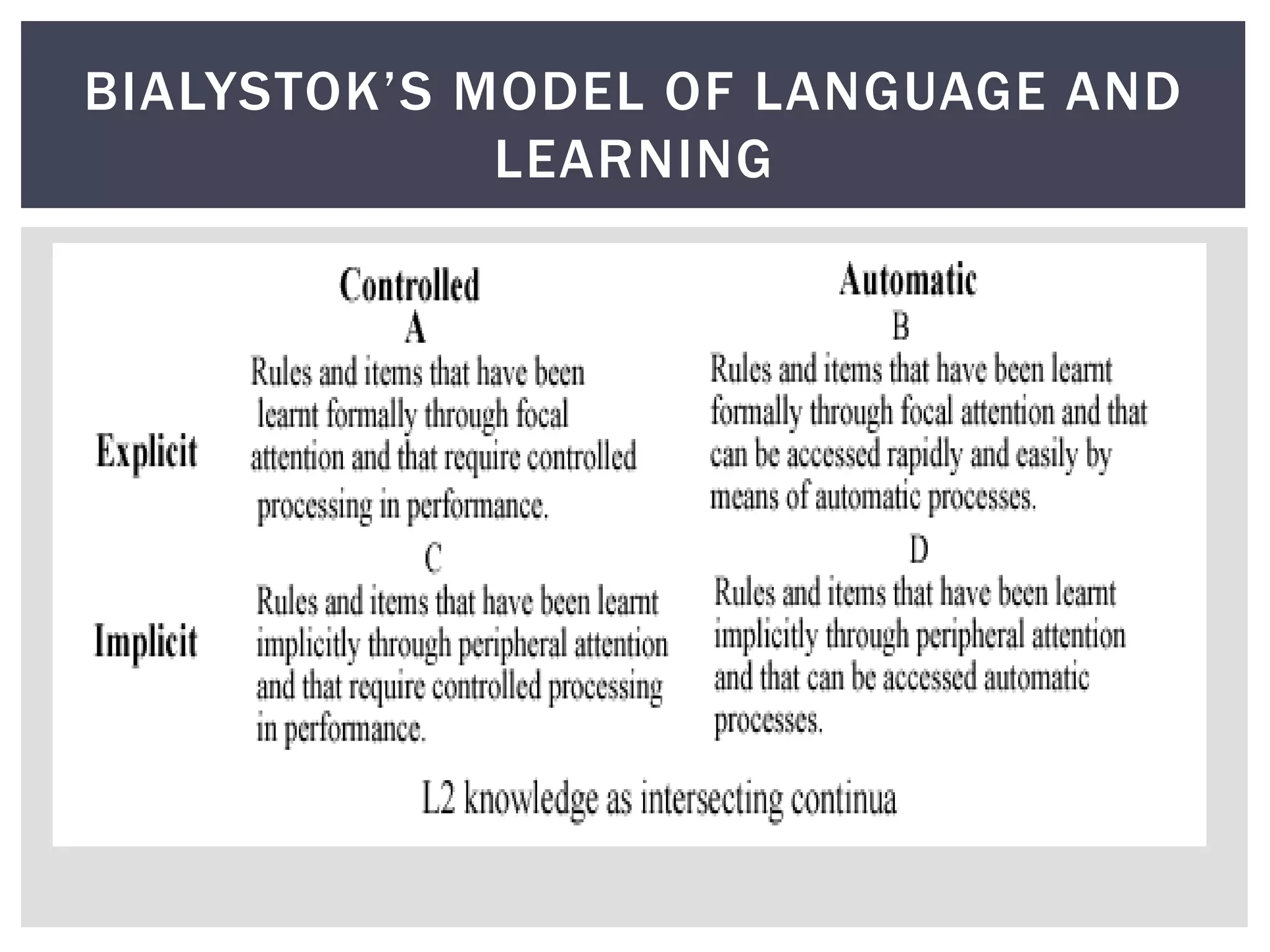
BIALYSTOK’S MODEL OF LANGUAGE AND
LEARNING
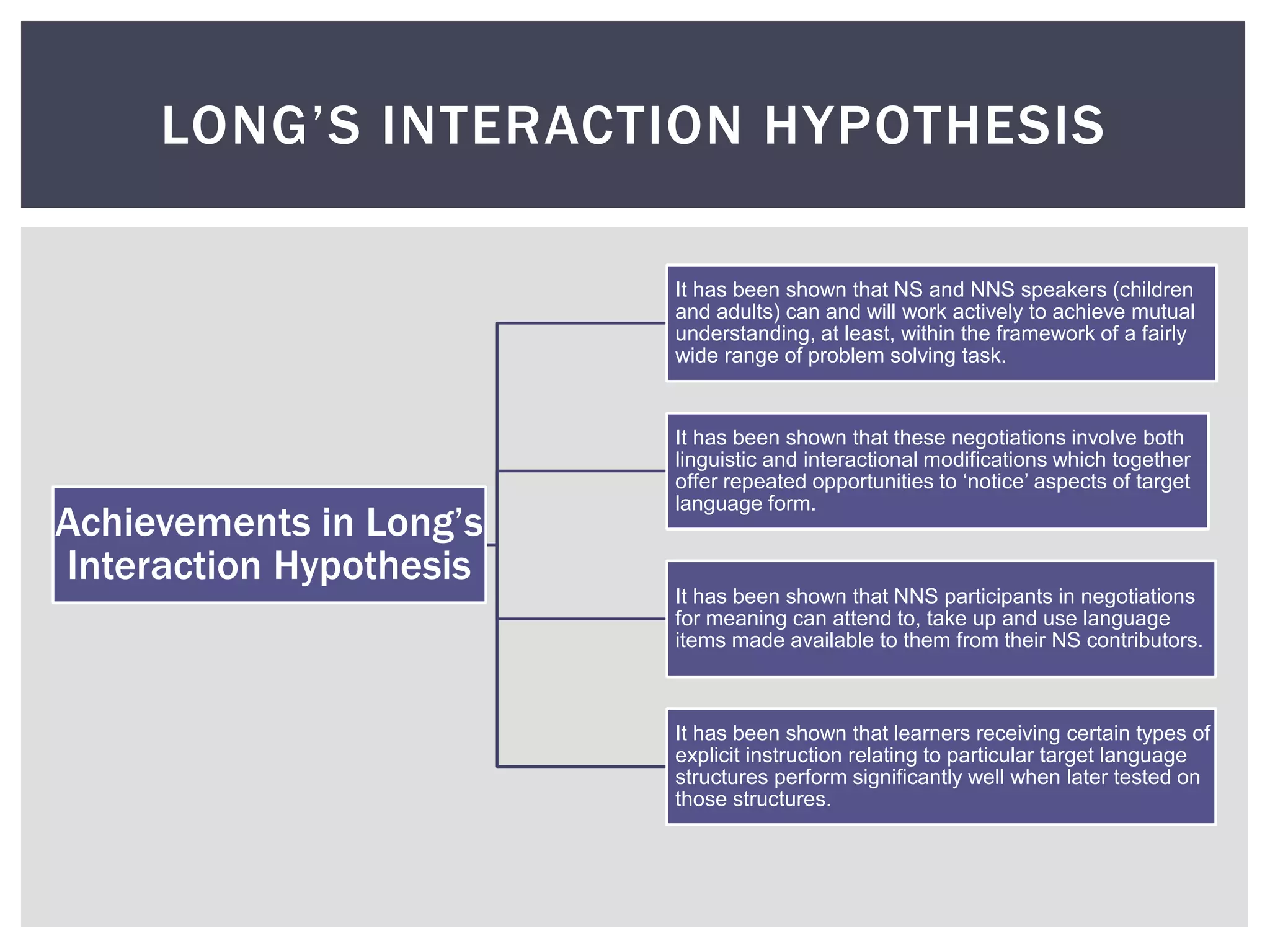
LONG’S INTERACTION HYPOTHESIS
Achievements in Long’s
Interaction Hypothesis
It has been shown that NS and NNS speakers (children
and adults) can and will work actively to achieve mutual
understanding, at least, within the framework of a fairly
wide range of problem solving task.
It has been shown that these negotiations involve both
linguistic and interactional modifications which together
offer repeated opportunities to ‘notice’ aspects of target
language form.
It has been shown that NNS participants in negotiations
for meaning can attend to, take up and use language
items made available to them from their NS contributors.
It has been shown that learners receiving certain types of
explicit instruction relating to particular target language
structures perform significantly well when later tested on
those structures.

Theories of second language acquisition

  • 1.
  • 2.
    Input hypothesis The acquisition /learning hypothesis The monitor hypothesis Thenatural order hypothesis The input hypothesis The affective filter hypothesis KRASHEN’S INPUT HYPOTHESIS
  • 3.
    Acquisition – asubconscious and intuitive process of constructing the system of a language. Learning – a conscious learning process in which learners attend to form, figure out rules, and are generally aware of their process. KRASHEN’S INPUT HYPOTHESIS • Fluency in second language performance is due to what we have acquired, not what we have learned. • Conscious learning process and subconscious acquisition process are mutually exclusive.
  • 4.
    The ‘monitor’ is involvedin learning It is a device to watch one’s input, for editing and making alterations or correction The Monitor Hypothesis We acquire language rules in a predictable or ‘natural’ order. The Natural Order Hypothesis KRASHEN’S INPUT HYPOTHESIS
  • 5.
    An important conditionfor language acquisition to occur is that the acquirer understand input language that contains structure a bit beyond his current level of competence. If an acquirer is at stage or level i, the input he or she understands should contain i + 1. The Input Hypothesis The best acquisition will occur in environments where anxiety is low and defensiveness absent , in Krashen’s terms, in context where the affective filter is low. The Affective Filter Hypothesis KRASHEN’S INPUT HYPOTHESIS
  • 6.
    Main characteristics of McLaughlin’s Information ProcessingModel Human are autonomous and active The mind is a general purpose symbol processing system Complex behaviour is composed of simple modular (i.e. self contained) processes Component processes can be isolated and studied independently of other process Processes take time, therefore predictions about reaction time can be made. McLaughlin’s Information Processing Model
  • 7.
     Controlled Processes Capacity limited and temporary  Learning a new skills, where only a few elements can be retained  Automatic Processes  Relatively permanent  Processing of more accomplished skills  Able to manage a lot of information simultaneously.  Focal Attention  Peripheral Attention McLaughlin’s Information Processing Model
  • 8.
    THE SHIFT FROMCONTROLLED TO AUTOMATIC PROCESSING IN SLA The shift from controlled to automatic processing in SLA Through repeated activation, sequences first produced by controlled processing become automatic and are stored in long-term memory. This means they can be rapidly accessed whenever the situation requires it with minimal attention on the part of the learner. Automatic processes can, therefore , activate complex cognitive skills simultaneously. However, such automatic skills are difficult to delete or modify once acquired. Learners first resort to controlled processing in the L2. This requires a lot of attention from the learner and is constrained by the limitations of the short-term memory (STM) Learning is a movement from controlled to automatic processing via practice. When his shift occurs, controlled processes are freed to deal with higher level processing (i.e. integration of more complex skill clusters). It is necessary for simple skills and routines to become autonomic before more complex ones can be tackled. This explains the incremental nature of learning. This continuing movement from controlled to automatic processing results in a constant restructuring of the L2 learner’s linguistic system. This may account for variable characteristics of learner language(i.e. interlanguage) Restructuring destabilizes certain structures which seem to have been acquired, and leads to the temporary reappearance of L2 errors. Likewise, fossilization is the result of a controlled process becoming automatic before it is native-like. As stated above automatic processes are difficult to modify as they are outside of the attention control of the learner. Therefore, automatic processes of this kind are likely to remain in the learner’s interlanguage producing a stable but erroneous construction
  • 9.
    BIALYSTOK’S MODEL OFLANGUAGE AND LEARNING
  • 10.
    BIALYSTOK’S MODEL OFLANGUAGE AND LEARNING
  • 11.
    LONG’S INTERACTION HYPOTHESIS Achievementsin Long’s Interaction Hypothesis It has been shown that NS and NNS speakers (children and adults) can and will work actively to achieve mutual understanding, at least, within the framework of a fairly wide range of problem solving task. It has been shown that these negotiations involve both linguistic and interactional modifications which together offer repeated opportunities to ‘notice’ aspects of target language form. It has been shown that NNS participants in negotiations for meaning can attend to, take up and use language items made available to them from their NS contributors. It has been shown that learners receiving certain types of explicit instruction relating to particular target language structures perform significantly well when later tested on those structures.