


First language acquisition
Presented by :
Athil mahmoudi
Siwar bdioui
09/02/2017 1
Higher Institute of
Applied Studies in
Humanities of Tunis
CONTENT
 Theories of first language
acquisition:
 The behaviorist theory
The innatist theory
The interactionist developmental
perspectives
Connectionism
09/02/2017 2
The Behaviorist theory
 Behaviorism is a theory emerged in 1940s and 1960s in
the United State. B.F Skinner was one of its proponent .
 Behaviorists view language acquisition as a building
process that results from interactions with the
environment.
 The quality and quantity of the language that the child
hears, as well as the consistency of the reinforcement
offered by others in the environment, would shape the
child’s language behavior.
09/02/2017 3
Examples of interactions :
Imitation Reinforcement
Practice Habit formation
09/02/2017 4
Children ’ s imitations are not random: Their imitation
is selective and based on what they are currently
learning. They choose to imitate something they have
already begun to understand, rather than simply
imitating what is available in the environment.
09/02/2017 5
Criticism of Behaviorism view
In 1959 Chomsky published a review of skinner’s
book The Verbal Behavior in which he criticizes
skinner’s view of language learning giving way to
cognitive science mentioning that:
*Children’s minds are not blank supposed to be filled by
imitating languages they hear from the environment.
*Language is too complex to be learned through imitation
only.
*all human language are fundamentally innate.
09/02/2017 6
They are born with a specific innate ability to
discover for themselves the underlying rules of a
language system on the basis of the samples of a
natural language they are exposed to.
Children are pre-equipped with UG what they have
to learn is the ways in which their own language make
use of these principles.
09/02/2017 7
The innatist theory
Innatist theory states that humans biologically obtain
the language acquisition device (LAD).
According to Chomsky children have an innate
knowledge of the basic grammatical structures
that is the basis to all language.
To acquire language a child only needs the
availability of people who speak to him. The child‘s
biological endowment will do the rest.
09/02/2017 8
09/02/2017 9
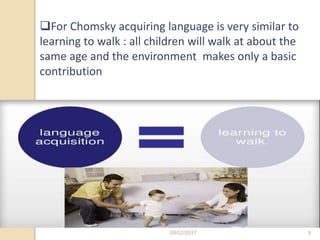
For Chomsky acquiring language is very similar to
learning to walk : all children will walk at about the
same age and the environment makes only a basic
contribution
Evidence used to support Chomsky's innastist position
is the fact that all children successfully acquire their
native language.
Language is somehow separate from other aspects of
cognitive development.
The biological basis for the innatist position: The
Critical Period Hypothesis (CPH) is a specific and
limited time period (i.e., “critical period”) for the LAD to
work successfully..
09/02/2017 10
The critical period hypothesis
The Critical Period Hypothesis states that an
individual must acquire a language by a critical
period otherwise it will be difficult to acquire a
language.
The main advantage to learning a language
when younger is that the individual is more
likely to acquire a native-like accent.
09/02/2017 11
In the 19th c the wild boy of Aveyron, Victor, who
managed to survive alone in the woods without
speaking until he was found at the age of 12, was
able to produce only the sound ‘Lait’.
 Thus, children can not speak at all if they
are not exposed to language.
Children who are born to deaf parents are likely to
be exposed to ASL ( American sign language) from
birth. They master the ASL then the deaf children who
are not born to deaf parents do.
09/02/2017 12
Criticism of the innatist
perspective :
Interctionists argue that the innatists placed too much
emphasis on the “final state” (i.e. the linguistic
competence of adult native speakers), but not enough on
the developmental aspects of language acquisition.
 Language acquisition is an example of children’s
ability to learn from experience.
09/02/2017 13
Interactionist developmental
perspectives
The ineractionists do recognize the existence of a
powerful learning mechanism in the humain brain but
they give much more importance to the environment
then the innatists do.
 Piaget : says that the developing cognitive
understanding is built on the interaction between the
child and the things which he can observe, touch, and
manipulate theme.
Language can be used to represent knowledge that
children have acquired through physical interaction with
the environment.
09/02/2017 14
Vygotsky (1978) : believes that language develops
from social interaction. This social intercations leads
to a higher level of knowledge and performance.
Metaphorically he referred to the space of
understanding which is just above the level of
understanding of a given individual as ZPD ( zone of
proximal development).
 He observed that the interaction among children
and also between children and adults is important in
the development of language.
09/02/2017 15
The importance of interaction
The interaction between a language-learning
child and a speaker who responds in some way
to the child is important.
 Exposure to impersonal sources of language
such as television or radio alone are not
sufficient for children to learn the structure of a
particular language.
09/02/2017 16
09/02/2017 17
 One-on-one interaction gives children access
to language that is adjusted to their level of
comprehension. Once children have acquired
some language, however, television can be a
source of language and cultural information.
Connectionism
Though both innatism and connectionism look at
the cognitive aspect of language acquisition, yet
they differ in the following:
 Connectionists hypothesize that language
acquisition does not require a separate “module
of the mind” but can be explained in terms of
learning in general.
09/02/2017 18
09/02/2017 19
Connectionists argue that what children need to
know is essentially available in the language they are
exposed to.
They attribute greater importance to the role of the
environment than to any innate knowledge in the
learner.
Language acquisition is not just a process of
associating words with elements of external reality. It
is also a process of associating words and phrases
with the other words and phrases that occur with
them, or words with grammatical morphemes that
09/02/2017 20
09/02/2017 21

First language acquisition

  • 1.
    First language acquisition Presentedby : Athil mahmoudi Siwar bdioui 09/02/2017 1 Higher Institute of Applied Studies in Humanities of Tunis
  • 2.
    CONTENT  Theories offirst language acquisition:  The behaviorist theory The innatist theory The interactionist developmental perspectives Connectionism 09/02/2017 2
  • 3.
    The Behaviorist theory Behaviorism is a theory emerged in 1940s and 1960s in the United State. B.F Skinner was one of its proponent .  Behaviorists view language acquisition as a building process that results from interactions with the environment.  The quality and quantity of the language that the child hears, as well as the consistency of the reinforcement offered by others in the environment, would shape the child’s language behavior. 09/02/2017 3
  • 4.
    Examples of interactions: Imitation Reinforcement Practice Habit formation 09/02/2017 4
  • 5.
    Children ’ simitations are not random: Their imitation is selective and based on what they are currently learning. They choose to imitate something they have already begun to understand, rather than simply imitating what is available in the environment. 09/02/2017 5
  • 6.
    Criticism of Behaviorismview In 1959 Chomsky published a review of skinner’s book The Verbal Behavior in which he criticizes skinner’s view of language learning giving way to cognitive science mentioning that: *Children’s minds are not blank supposed to be filled by imitating languages they hear from the environment. *Language is too complex to be learned through imitation only. *all human language are fundamentally innate. 09/02/2017 6
  • 7.
    They are bornwith a specific innate ability to discover for themselves the underlying rules of a language system on the basis of the samples of a natural language they are exposed to. Children are pre-equipped with UG what they have to learn is the ways in which their own language make use of these principles. 09/02/2017 7
  • 8.
    The innatist theory Innatisttheory states that humans biologically obtain the language acquisition device (LAD). According to Chomsky children have an innate knowledge of the basic grammatical structures that is the basis to all language. To acquire language a child only needs the availability of people who speak to him. The child‘s biological endowment will do the rest. 09/02/2017 8
  • 9.
    09/02/2017 9 For Chomskyacquiring language is very similar to learning to walk : all children will walk at about the same age and the environment makes only a basic contribution
  • 10.
    Evidence used tosupport Chomsky's innastist position is the fact that all children successfully acquire their native language. Language is somehow separate from other aspects of cognitive development. The biological basis for the innatist position: The Critical Period Hypothesis (CPH) is a specific and limited time period (i.e., “critical period”) for the LAD to work successfully.. 09/02/2017 10
  • 11.
    The critical periodhypothesis The Critical Period Hypothesis states that an individual must acquire a language by a critical period otherwise it will be difficult to acquire a language. The main advantage to learning a language when younger is that the individual is more likely to acquire a native-like accent. 09/02/2017 11
  • 12.
    In the 19thc the wild boy of Aveyron, Victor, who managed to survive alone in the woods without speaking until he was found at the age of 12, was able to produce only the sound ‘Lait’.  Thus, children can not speak at all if they are not exposed to language. Children who are born to deaf parents are likely to be exposed to ASL ( American sign language) from birth. They master the ASL then the deaf children who are not born to deaf parents do. 09/02/2017 12
  • 13.
    Criticism of theinnatist perspective : Interctionists argue that the innatists placed too much emphasis on the “final state” (i.e. the linguistic competence of adult native speakers), but not enough on the developmental aspects of language acquisition.  Language acquisition is an example of children’s ability to learn from experience. 09/02/2017 13
  • 14.
    Interactionist developmental perspectives The ineractionistsdo recognize the existence of a powerful learning mechanism in the humain brain but they give much more importance to the environment then the innatists do.  Piaget : says that the developing cognitive understanding is built on the interaction between the child and the things which he can observe, touch, and manipulate theme. Language can be used to represent knowledge that children have acquired through physical interaction with the environment. 09/02/2017 14
  • 15.
    Vygotsky (1978) :believes that language develops from social interaction. This social intercations leads to a higher level of knowledge and performance. Metaphorically he referred to the space of understanding which is just above the level of understanding of a given individual as ZPD ( zone of proximal development).  He observed that the interaction among children and also between children and adults is important in the development of language. 09/02/2017 15
  • 16.
    The importance ofinteraction The interaction between a language-learning child and a speaker who responds in some way to the child is important.  Exposure to impersonal sources of language such as television or radio alone are not sufficient for children to learn the structure of a particular language. 09/02/2017 16
  • 17.
    09/02/2017 17  One-on-oneinteraction gives children access to language that is adjusted to their level of comprehension. Once children have acquired some language, however, television can be a source of language and cultural information.
  • 18.
    Connectionism Though both innatismand connectionism look at the cognitive aspect of language acquisition, yet they differ in the following:  Connectionists hypothesize that language acquisition does not require a separate “module of the mind” but can be explained in terms of learning in general. 09/02/2017 18
  • 19.
    09/02/2017 19 Connectionists arguethat what children need to know is essentially available in the language they are exposed to. They attribute greater importance to the role of the environment than to any innate knowledge in the learner. Language acquisition is not just a process of associating words with elements of external reality. It is also a process of associating words and phrases with the other words and phrases that occur with them, or words with grammatical morphemes that
  • 20.
  • 21.