Erika Panganiban
BSED-ENG1221
• It is a “maturational time period during
which some crucial experience will have its
peak effect on development or learning,
resulting in normal behavior attuned to the
particular environment to which the
organism has been exposed.”
• “Biologically determined
period of life when
language can be acquired
more easily and beyond
which time language is
increasingly difficult to
acquire.”
Eric Lenneberg
“First language acquisition relies on brain plasticity
and can no longer be accomplished once hemispheric
development is complete. If language acquisition does not
occur by puberty, some aspects of language can be learnt but
full mastery cannot be achieved.”
“Brain lateralization at puberty is the mechanism
which closes down the brain’s ability to acquire language.”
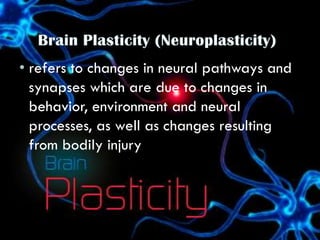
• refers to changes in neural pathways and
synapses which are due to changes in
behavior, environment and neural
processes, as well as changes resulting
from bodily injury
• The longitudinal fissure separates
the human brain into two distinct cerebral
hemispheres, connected by the corpus
callosum. The hemispheres exhibit strong,
but not complete, billateral symmetry in
both structure and function
• Lenneberg hypothesized in his
book Biological Foundations of
Language (1967) that:
* Language acquisition is a
biologically constrained learning
* Normally acquired during a
critical period (early life and
puberty)
* Outside this period, language
acquired through a different
learning process or with difficulty
His hypothesis was based on three
groups of people:
• People who had brain damage through
accidents or diseases before puberty
• Children with Down’s syndrome
• “Wild children”
Johnson and Newport (1989)
They performed a study on Chinese and Korean
immigrants.
 The subjects’ ages varied upon arrival in the US
and the immigrants had to be targeting English as
their second language.
“The results of testing show a clear and strong
relationship between age of acquisition and
performance on the test of English grammar.”
• Beginning from 4-6 years, there is a gradual decline in
language proficiency until it plateaus for adult learners
• Learners exposed to the language in adulthood show
lower performance than those who are exposed in early
childhood
• Critical period affects phonology, morphology and syntax,
and not the vocabulary and semantic processing.
Bialystok & Hakuta, 1999
“There is much more than
simple transfer from L1 to L2
going on and that indeed
there is some sort of
reenactment of the L1
acquisition process at work.”
SUPPORTIVE
STUDIES
Genie was a 13-year-old victim of lifelong child abuse. She
had been kept strapped to a potty chair and wearing diapers.
She appeared to be entirely without language when she was
found at her age of 13. Her father had judged her retarded at
birth and had chosen to isolate her, and so she had remained
until her discovery.
Isabelle, a girl who was incarcerated with her deaf-mute
mother until the age of six and a half (pre-pubescent). She
also had no language skill, but unlike Genie, she quickly
acquired normal language abilities through systematic
specialist training.
Critical Period
Hypothesis
Neurobiological
Considerations
Cognitive
Considerations
Affective
Considerations
Linguistic
Considerations
Hemispheric
Lateralization
 As the brain
matures, certain
functions are
assigned to either
left or right
hemisphere
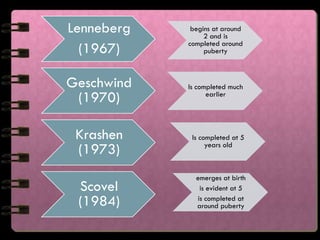
Lenneberg
(1967)
begins at around
2 and is
completed around
puberty
Geschwind
(1970)
Is completed much
earlier
Krashen
(1973)
Scovel
(1984)
Is completed at 5
years old
emerges at birth
is evident at 5
is completed at
around puberty
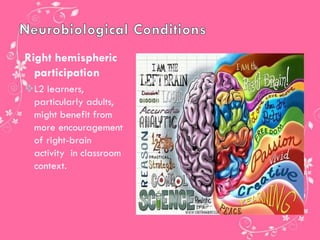
Right hemispheric
participation
L2 learners,
particularly adults,
might benefit from
more encouragement
of right-brain
activity in classroom
context.
• Egocentricity
• Attitudes
• Peer pressure
• Very young children are highly
egocentric, they see the world as
revolving around them.
• As they get older, they become
more aware of themselves as
separate entities from the world,
and they become more conscious of
themselves as they seek to define
and understand their self-identity.
• Gradually, they develop inhibitions
about this self-identity. They
become afraid of exposing their
self-doubt.
• Thinking only
of oneself,
without the
regards or
feelings of
others
• Negative attitudes can affect success in
language learning.
• Very young children are not developed
cognitively to have “attitudes’ towards
races, cultures, languages, ethnic groups,
etc. Thus, they have no problem learning a
second language. A study shows that
“children who are transported from
Montreal to Berlin will rapidly learn
German no matter what they think of the
Germans”.
• Peer pressure children encounter in
second language learning situations
is stronger than that experienced by
adults.
• Adults are more tolerant of errors in
speech, and thus are more easily
excused. This may encourage adult
learners to “get by’’ as long as they
are understood.
• Children are harsher critics of one
another’s actions and words, which
may push them to try harder in
perfecting their second language.
• Bilingualism
Code-switching
• Interference between L1 and L2
Solid foundation of L1
• Order of acquisition
Creative construction process
• http://cse.iitk.ac.in/users/hk/cs784/projects/indrani.pdf
• http://en.wikipedia.org/wiki/Critical_period_hypothesis
• http://ftp.iza.org/dp2575.pdf

Critical period hypothesis (2)

  • 1.
  • 2.
    • It isa “maturational time period during which some crucial experience will have its peak effect on development or learning, resulting in normal behavior attuned to the particular environment to which the organism has been exposed.”
  • 3.
    • “Biologically determined periodof life when language can be acquired more easily and beyond which time language is increasingly difficult to acquire.”
  • 5.
    Eric Lenneberg “First languageacquisition relies on brain plasticity and can no longer be accomplished once hemispheric development is complete. If language acquisition does not occur by puberty, some aspects of language can be learnt but full mastery cannot be achieved.” “Brain lateralization at puberty is the mechanism which closes down the brain’s ability to acquire language.”
  • 6.
    • refers tochanges in neural pathways and synapses which are due to changes in behavior, environment and neural processes, as well as changes resulting from bodily injury
  • 7.
    • The longitudinalfissure separates the human brain into two distinct cerebral hemispheres, connected by the corpus callosum. The hemispheres exhibit strong, but not complete, billateral symmetry in both structure and function
  • 8.
    • Lenneberg hypothesizedin his book Biological Foundations of Language (1967) that: * Language acquisition is a biologically constrained learning * Normally acquired during a critical period (early life and puberty) * Outside this period, language acquired through a different learning process or with difficulty
  • 9.
    His hypothesis wasbased on three groups of people: • People who had brain damage through accidents or diseases before puberty • Children with Down’s syndrome • “Wild children”
  • 10.
    Johnson and Newport(1989) They performed a study on Chinese and Korean immigrants.  The subjects’ ages varied upon arrival in the US and the immigrants had to be targeting English as their second language. “The results of testing show a clear and strong relationship between age of acquisition and performance on the test of English grammar.”
  • 12.
    • Beginning from4-6 years, there is a gradual decline in language proficiency until it plateaus for adult learners • Learners exposed to the language in adulthood show lower performance than those who are exposed in early childhood • Critical period affects phonology, morphology and syntax, and not the vocabulary and semantic processing.
  • 13.
    Bialystok & Hakuta,1999 “There is much more than simple transfer from L1 to L2 going on and that indeed there is some sort of reenactment of the L1 acquisition process at work.”
  • 14.
  • 15.
    Genie was a13-year-old victim of lifelong child abuse. She had been kept strapped to a potty chair and wearing diapers. She appeared to be entirely without language when she was found at her age of 13. Her father had judged her retarded at birth and had chosen to isolate her, and so she had remained until her discovery.
  • 16.
    Isabelle, a girlwho was incarcerated with her deaf-mute mother until the age of six and a half (pre-pubescent). She also had no language skill, but unlike Genie, she quickly acquired normal language abilities through systematic specialist training.
  • 17.
  • 18.
    Hemispheric Lateralization  As thebrain matures, certain functions are assigned to either left or right hemisphere
  • 19.
    Lenneberg (1967) begins at around 2and is completed around puberty Geschwind (1970) Is completed much earlier Krashen (1973) Scovel (1984) Is completed at 5 years old emerges at birth is evident at 5 is completed at around puberty
  • 20.
    Right hemispheric participation L2 learners, particularlyadults, might benefit from more encouragement of right-brain activity in classroom context.
  • 23.
  • 24.
    • Very youngchildren are highly egocentric, they see the world as revolving around them. • As they get older, they become more aware of themselves as separate entities from the world, and they become more conscious of themselves as they seek to define and understand their self-identity. • Gradually, they develop inhibitions about this self-identity. They become afraid of exposing their self-doubt.
  • 25.
    • Thinking only ofoneself, without the regards or feelings of others
  • 26.
    • Negative attitudescan affect success in language learning. • Very young children are not developed cognitively to have “attitudes’ towards races, cultures, languages, ethnic groups, etc. Thus, they have no problem learning a second language. A study shows that “children who are transported from Montreal to Berlin will rapidly learn German no matter what they think of the Germans”.
  • 27.
    • Peer pressurechildren encounter in second language learning situations is stronger than that experienced by adults. • Adults are more tolerant of errors in speech, and thus are more easily excused. This may encourage adult learners to “get by’’ as long as they are understood. • Children are harsher critics of one another’s actions and words, which may push them to try harder in perfecting their second language.
  • 29.
    • Bilingualism Code-switching • Interferencebetween L1 and L2 Solid foundation of L1 • Order of acquisition Creative construction process
  • 32.