1
Second Language Acquisition
Presented By:
Maleeha Afzal
Saima Perveen
Language Acquisition
 Language acquisition is the study of the processes
through which humans acquire language.
 By itself, language acquisition refers to first language
acquisition, which studies infants' acquisition of their
native language, when you are still in infinite 3, 4, or 5
years of age.
 whereas second language acquisition is referring to the
ability to quire a additional language beyond the first
language. It deals with acquisition of additional languages
in both children and adults.
3
Second language learning
 The distinction between
 ‘Foreign Language Learning’: “learning the
language that is not generally spoken in the
surrounding community.”

E.g. a Pakistani student learning Chinese in
Pakistan.
 ‘Second Language Learning’: “learning a
language that is spoken in the outside
community.”

E.g. a Pakistani student leaning Chinese in China
Acquisition &
Learning
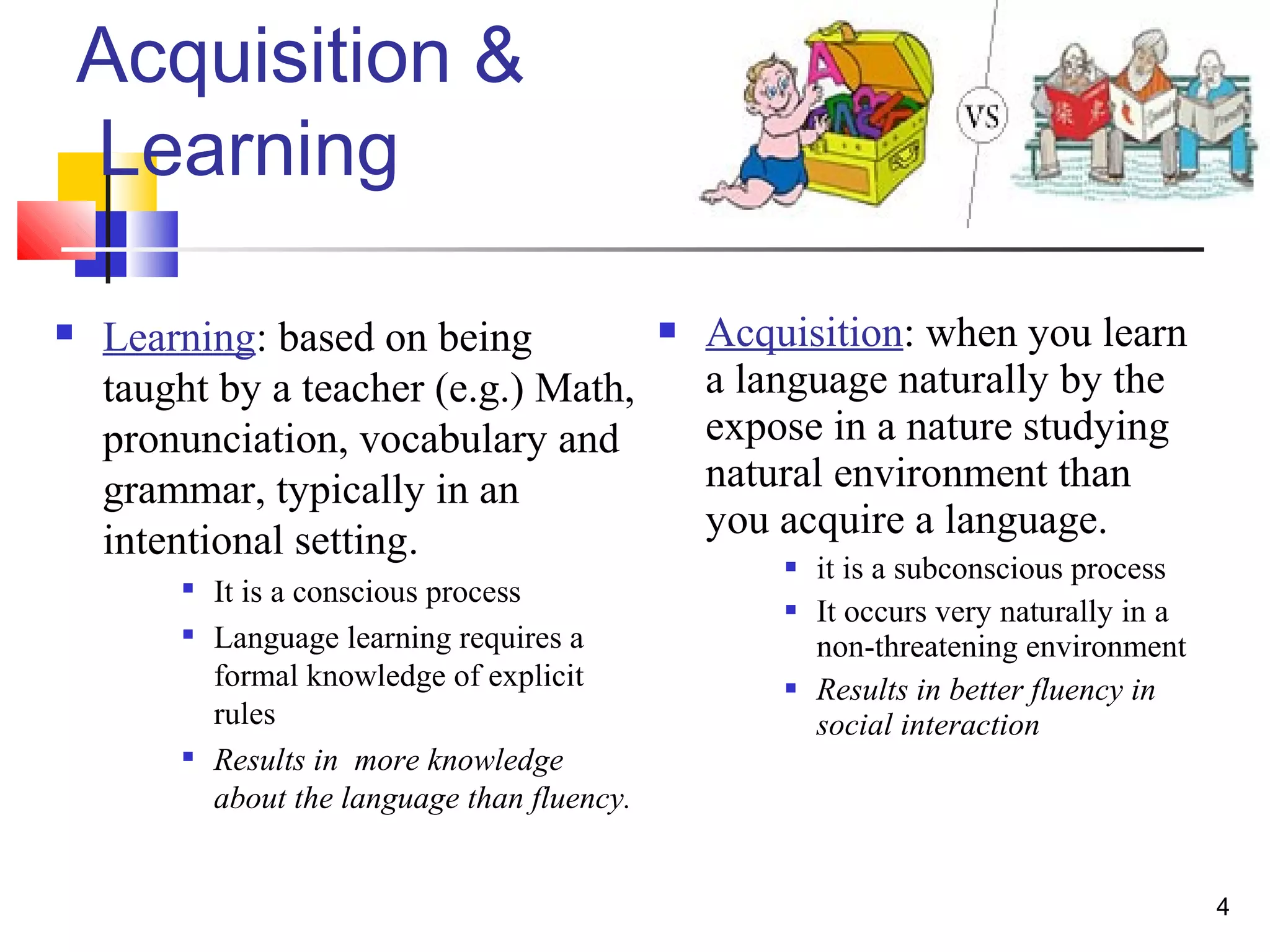
 Learning: based on being
taught by a teacher (e.g.) Math,
pronunciation, vocabulary and
grammar, typically in an
intentional setting.

It is a conscious process

Language learning requires a
formal knowledge of explicit
rules

Results in more knowledge
about the language than fluency.
4
 Acquisition: when you learn
a language naturally by the
expose in a nature studying
natural environment than
you acquire a language.
 it is a subconscious process
 It occurs very naturally in a
non-threatening environment
 Results in better fluency in
social interaction
5
Acquisition barriers
 Why learning L2 is fundamentally different than L1?
 Interaction not constant
 Already have a language for communication
 Many adult learners manage to learn L2 effectively- they
do not sound like native speakers

Joseph Conrad (1851-1924) in renaissance age who wrote
novels in English that became classics of English literature,
but whose English speech retained the strong Polish accent of
his L1
6
Affective factors
 There are other types of acquisition barriers
negative experience that might affect language
learning
 Embarrassment/ Unwillingness- e.g. being
ashamed of his/her accent
 Lack of empathy with the other culture.
 Dull textbooks, classrooms environment, etc.
 Children may overcome such factors quickly.
7
Focus on method
 Educational approaches to L2 learning- how
L2 might best be learned
 The grammar-translation method
 The audio-lingual method
 Communicative approaches
Focus On
Methods
8
The Grammar-Translation
Method
 Treating L2 as an academic subject.
 The most traditional approach
 Vocabulary lists and sets of grammar rules
 Memorization is encouraged
 Written rather than spoken language.
 Criticism: does not focus on how the
language is used in everyday conversation.
9
The Audio-lingual
Method
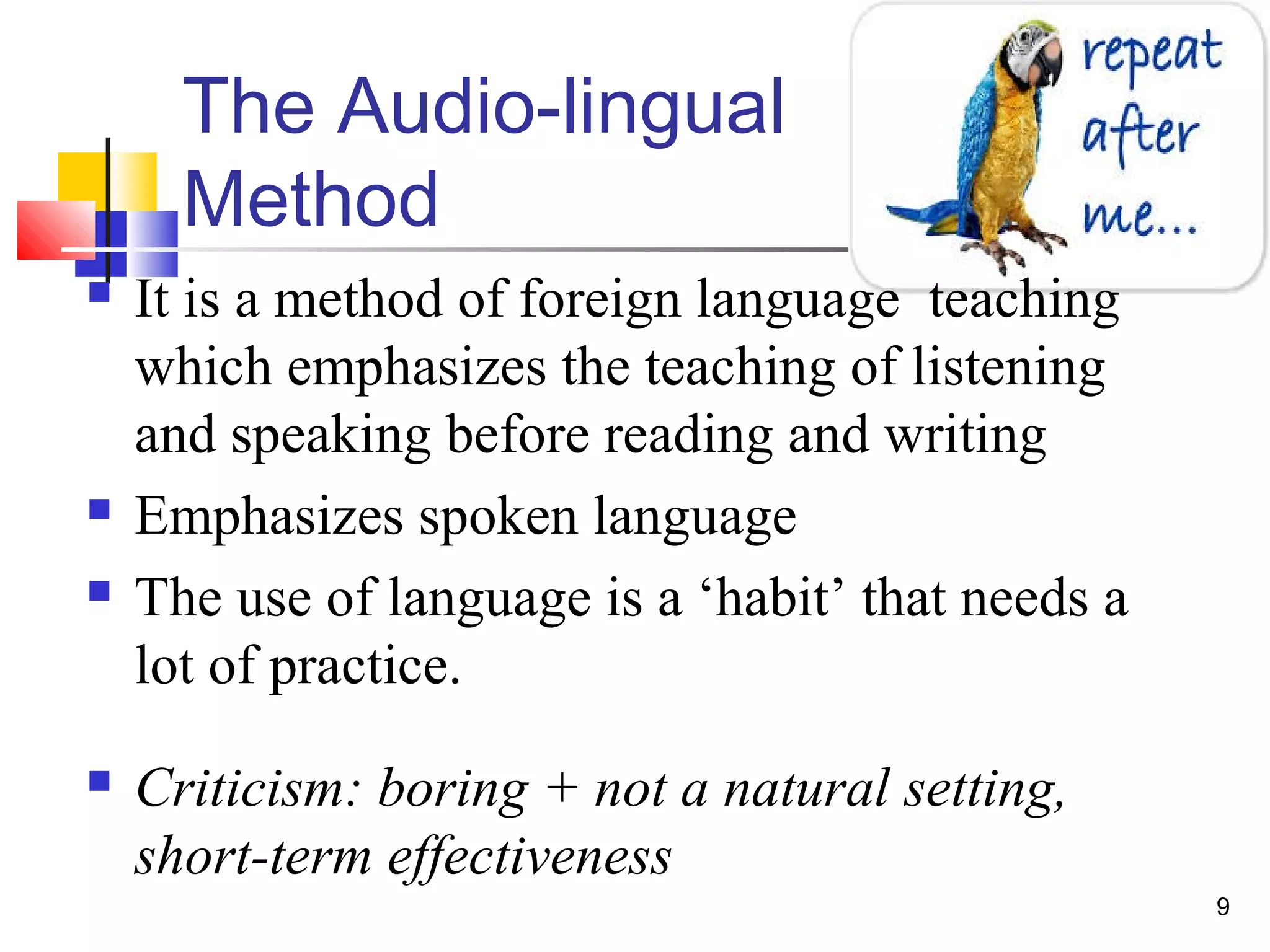
 It is a method of foreign language teaching
which emphasizes the teaching of listening
and speaking before reading and writing
 Emphasizes spoken language
 The use of language is a ‘habit’ that needs a
lot of practice.
 Criticism: boring + not a natural setting,
short-term effectiveness
10
Communicative
approaches
 Emphasizes the ability to communicate the
meaning of the message, instead of
concentrating on grammatical perfection.
 Learners encouraged to take risks
 Errors are inevitable, they are learning steps.
 Criticism: Lack of accuracy due to focus on
fluency
 More concerned with the learner and nature of
the acquisition process.
 Shifted to how L2 learning takes place-
examining the learners errors
 E.g. a Spanish person might say in the room there
are three womens

Indicates active learning progress in coping with the
new language
Focus on Learner
Language
Transfer
12
 Transfer typically refer to the learner trying to apply rules
and forms of the first language into second language.
 2 types:
 Positive Transfer
 Negative Transfer
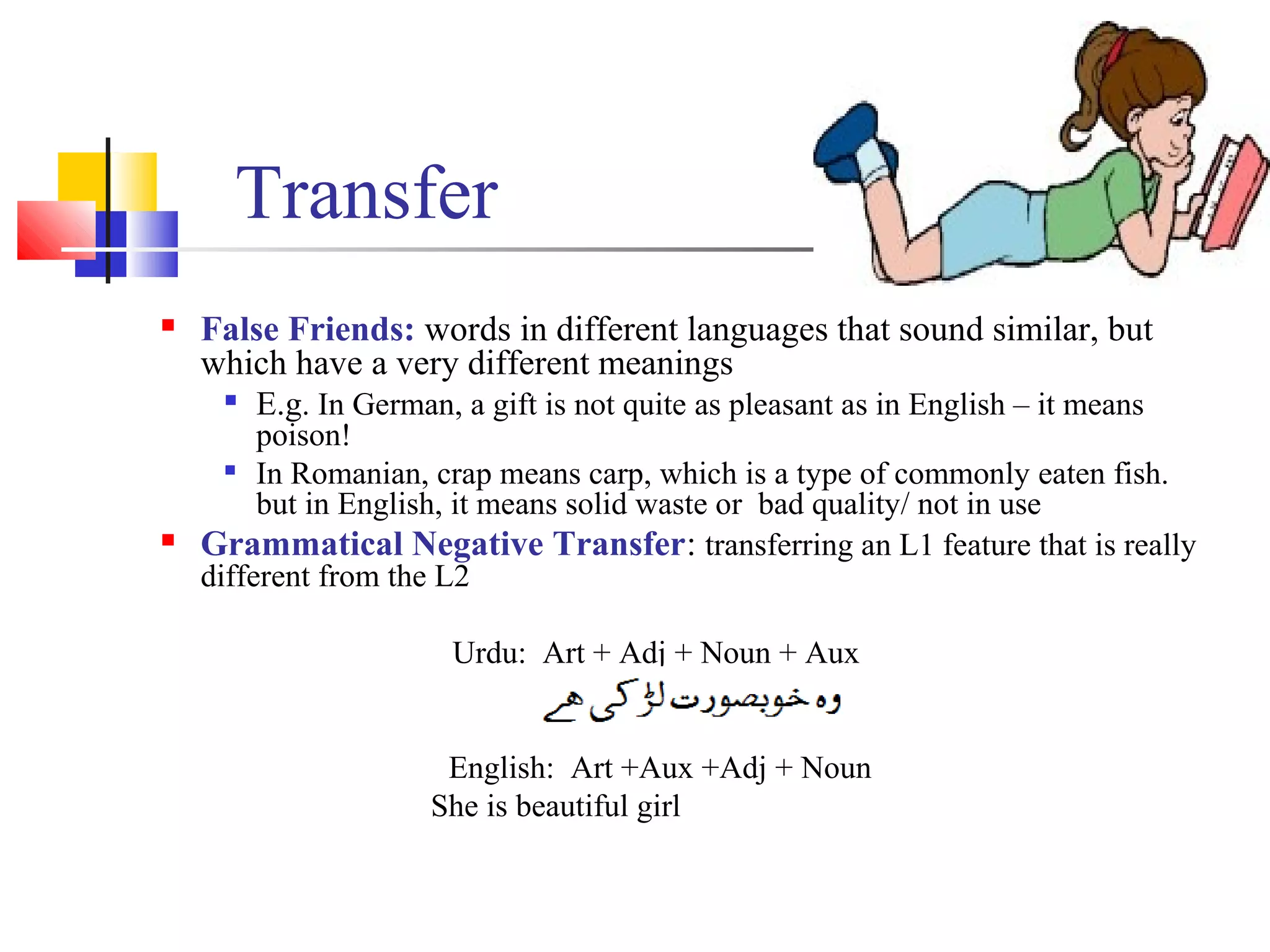
 Positive: the use of a feature from L1 that is similar to
the L2 performing in the L2
Urdu: Adj + Noun
English: Adj + Noun
Beautiful girl
Transfer
 False Friends: words in different languages that sound similar, but
which have a very different meanings

E.g. In German, a gift is not quite as pleasant as in English – it means
poison!

In Romanian, crap means carp, which is a type of commonly eaten fish.
but in English, it means solid waste or bad quality/ not in use
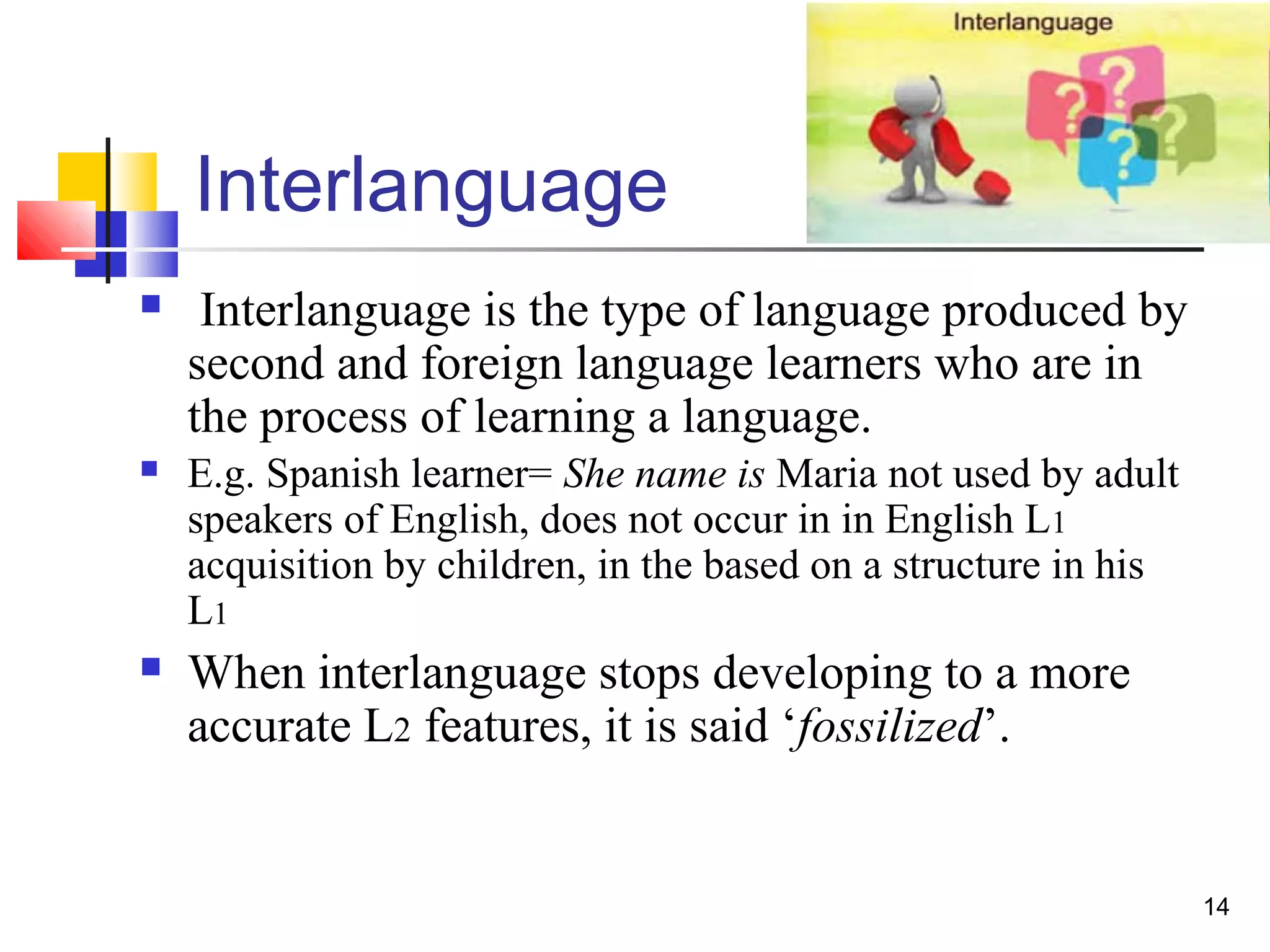
 Grammatical Negative Transfer: transferring an L1 feature that is really
different from the L2
Urdu: Art + Adj + Noun + Aux
English: Art +Aux +Adj + Noun
She is beautiful girl
Transfer
14
Interlanguage
 Interlanguage is the type of language produced by
second and foreign language learners who are in
the process of learning a language.
 E.g. Spanish learner= She name is Maria not used by adult
speakers of English, does not occur in in English L1
acquisition by children, in the based on a structure in his
L1
 When interlanguage stops developing to a more
accurate L2 features, it is said ‘fossilized’.
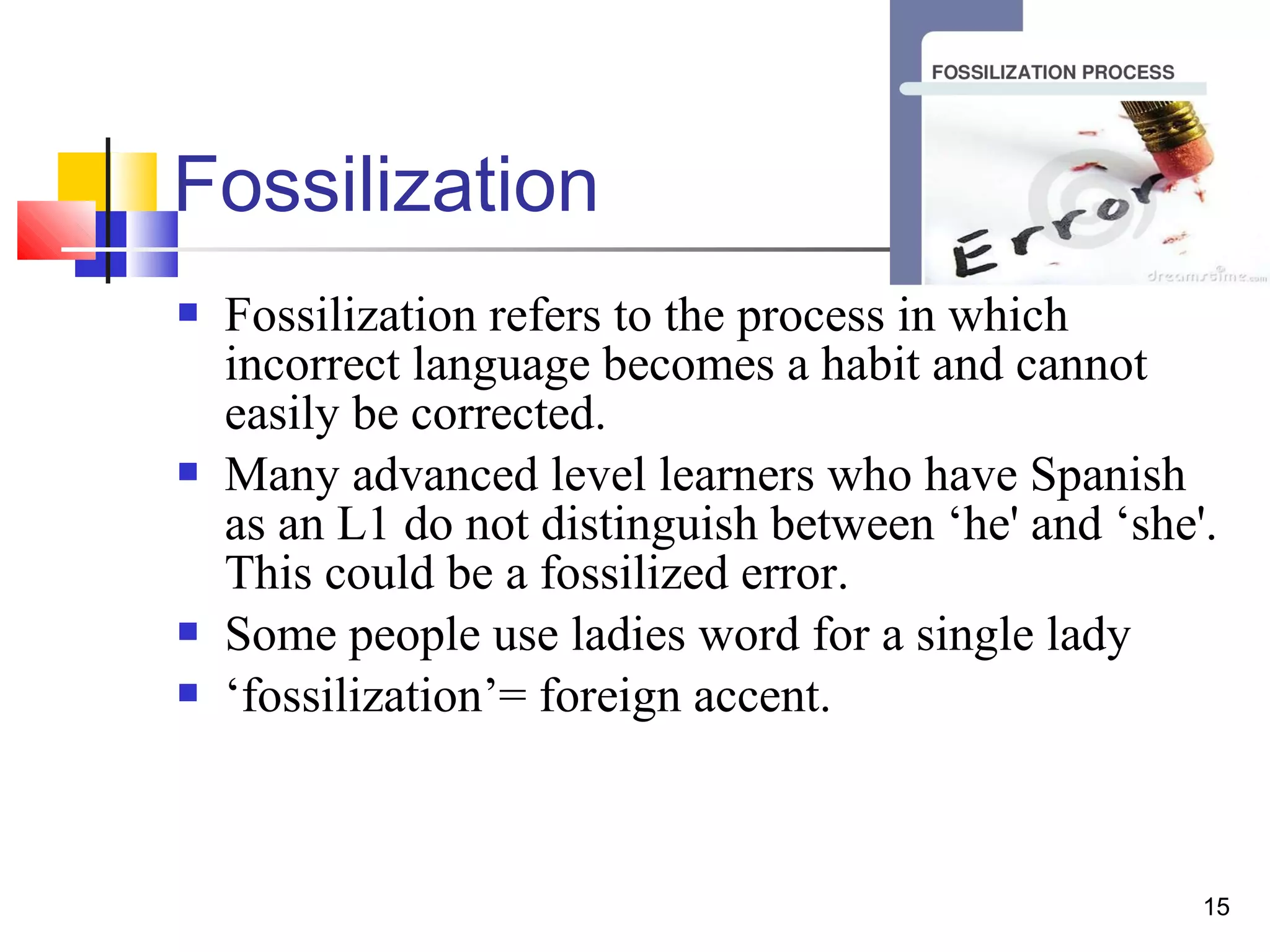
Fossilization
 Fossilization refers to the process in which
incorrect language becomes a habit and cannot
easily be corrected.
 Many advanced level learners who have Spanish
as an L1 do not distinguish between ‘he' and ‘she'.
This could be a fossilized error.
 Some people use ladies word for a single lady
 ‘fossilization’= foreign accent.
15
16
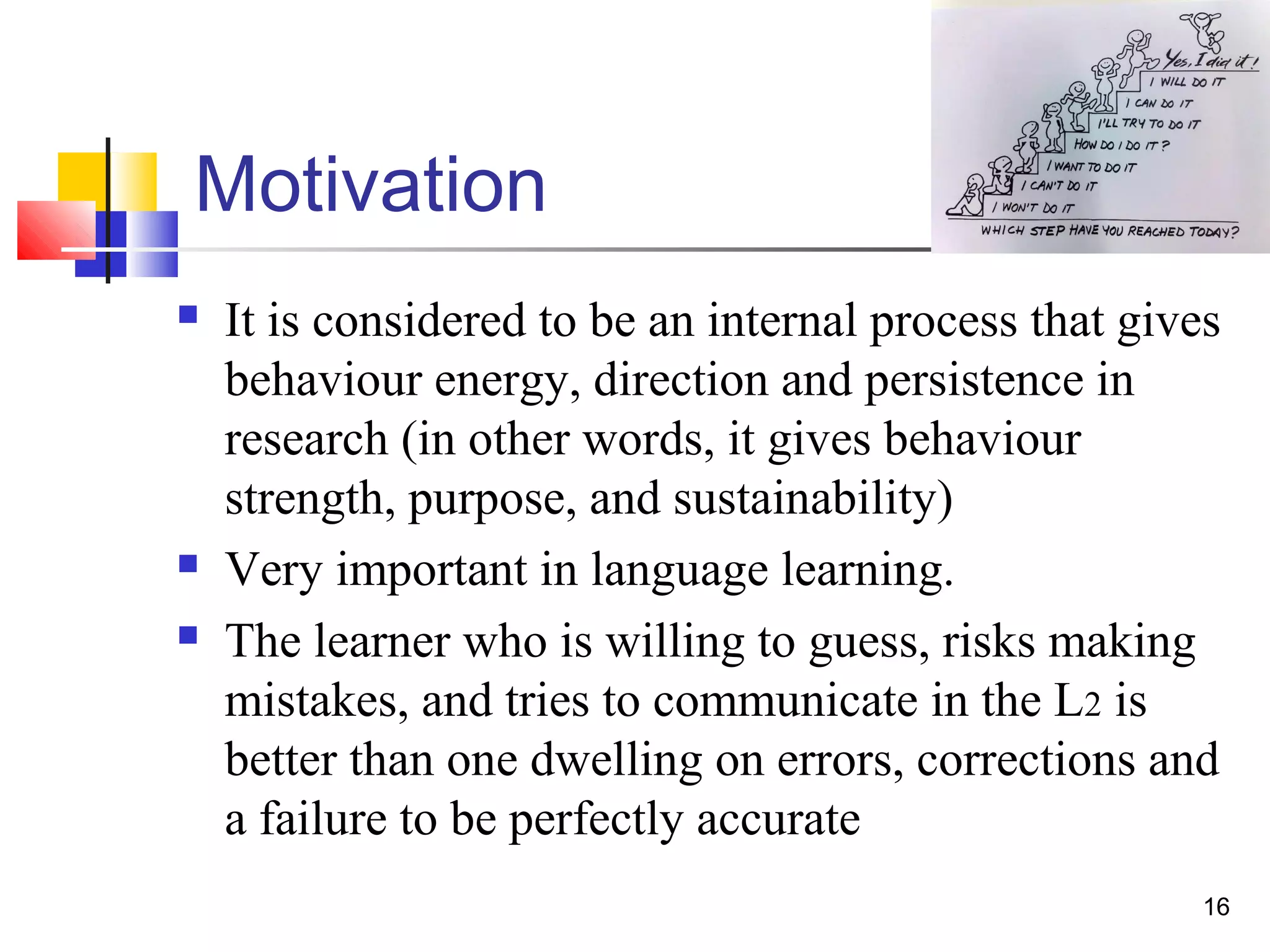
Motivation
 It is considered to be an internal process that gives
behaviour energy, direction and persistence in
research (in other words, it gives behaviour
strength, purpose, and sustainability)
 Very important in language learning.
 The learner who is willing to guess, risks making
mistakes, and tries to communicate in the L2 is
better than one dwelling on errors, corrections and
a failure to be perfectly accurate
Types of
Motivation
 Integrative
Learners want to learn L2 for social purposes; to
become accepted, to integrate and identify with
the target language
 E.g. To become an accepted member in a
community
 Instrumental
Learners wants to L2 to achieve a practical goals
 E.g. To join a graduate school / University
 Find a better job 17
Instrumental Integrative
18
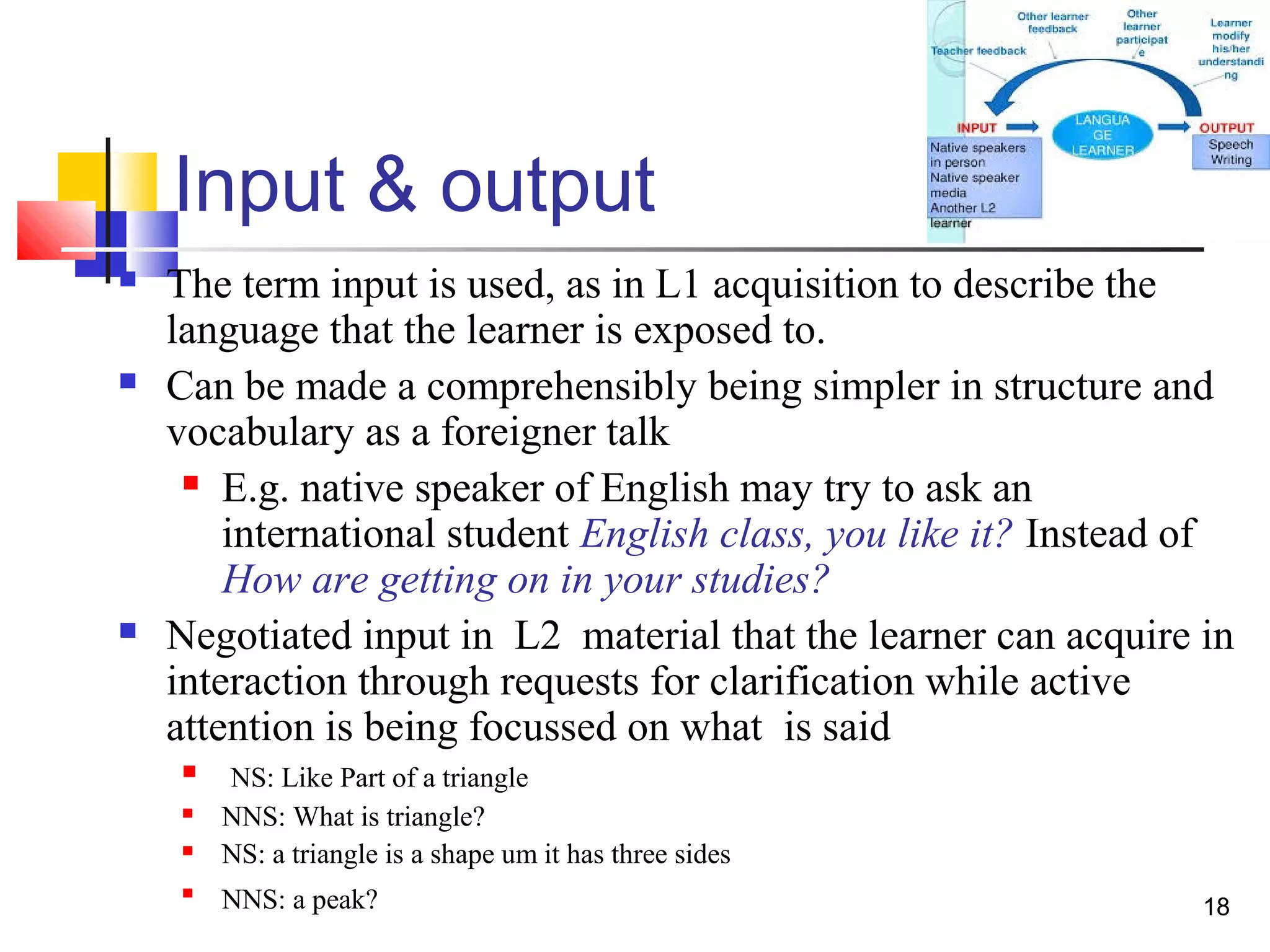
Input & output
 The term input is used, as in L1 acquisition to describe the
language that the learner is exposed to.
 Can be made a comprehensibly being simpler in structure and
vocabulary as a foreigner talk
 E.g. native speaker of English may try to ask an
international student English class, you like it? Instead of
How are getting on in your studies?
 Negotiated input in L2 material that the learner can acquire in
interaction through requests for clarification while active
attention is being focussed on what is said
 NS: Like Part of a triangle
 NNS: What is triangle?
 NS: a triangle is a shape um it has three sides

NNS: a peak?
Example of Input
& Output

NS: three straight sides

NNS: a peak?

NS: yes it does look like a mountain peak, yes

NNS: only line only line?

NS: okay two of them, right? one on each side? a line on each side?

NNS: yes

NS: little lines on each side?

NNS: yes

NS: like a mountain?

NNS: yes
 Output: The opportunity to produce comprehensible output
in meaningful interaction seems to be another important
elements in a learning development of L2 ability, yet it is
one of the most difficult thing o provide in large L2 class
19
20
Competence
 Competence= the general ability to use
language accurately, flexibly, and
appropriately
 Grammatical competence
 Sociolinguistic competence
 Strategic competence
Competence
Communicative
competence
 Grammatical competence
 ability to recognize and produce
the distinctive grammatical
structures of a language and to
use them effectively in
communication.
 how to use the grammar,
syntax, and vocabulary of a
language.
 What words do I use?
 How do I put them into
phrases and sentences?
 Sociolinguistic
competence
 how to use and respond to
language appropriately,
given the setting, the topic,
and the relationships
among the people
communicating.
 It enable learner to know
when to say can I have
some water? Verses give
me some water ! according
to the social context 21
Communicative
Competence
22
Communicative
competence
 Strategic competence
 This is the ability to organize a massage effectively to
compensate through strategies for any difficulties
 In L2 use, learners inevitably experience moments when there
is a gap between communicative intent and their ability to
express that intent
 Some learners may just stop talking (bad idea) where other will
try to express themselves using a communication strategy
(good idea)
 Duchess L1 speaker wanted to refer to een hoefijzer in English. But
did not know the English word. So, she use a communication
strategy. She referred to the things that horse wear under their feet,
the iron things and the listener understood what she meant
(Horseshoe).
Communicative
Competence
23
Applied Linguistics
 Investigate the complex nature of L2 learning, we
have to appeal to ideas not only from linguistic
analysis, but from other fields such as
communication studies, education, psychology
and sociology.
 Deals with all other practical issues (e.g. teaching
methods, designing lesson plan etc).
24
Thank
You

Second language acquisition

  • 1.
    1 Second Language Acquisition PresentedBy: Maleeha Afzal Saima Perveen
  • 2.
    Language Acquisition  Languageacquisition is the study of the processes through which humans acquire language.  By itself, language acquisition refers to first language acquisition, which studies infants' acquisition of their native language, when you are still in infinite 3, 4, or 5 years of age.  whereas second language acquisition is referring to the ability to quire a additional language beyond the first language. It deals with acquisition of additional languages in both children and adults.
  • 3.
    3 Second language learning The distinction between  ‘Foreign Language Learning’: “learning the language that is not generally spoken in the surrounding community.”  E.g. a Pakistani student learning Chinese in Pakistan.  ‘Second Language Learning’: “learning a language that is spoken in the outside community.”  E.g. a Pakistani student leaning Chinese in China
  • 4.
    Acquisition & Learning  Learning:based on being taught by a teacher (e.g.) Math, pronunciation, vocabulary and grammar, typically in an intentional setting.  It is a conscious process  Language learning requires a formal knowledge of explicit rules  Results in more knowledge about the language than fluency. 4  Acquisition: when you learn a language naturally by the expose in a nature studying natural environment than you acquire a language.  it is a subconscious process  It occurs very naturally in a non-threatening environment  Results in better fluency in social interaction
  • 5.
    5 Acquisition barriers  Whylearning L2 is fundamentally different than L1?  Interaction not constant  Already have a language for communication  Many adult learners manage to learn L2 effectively- they do not sound like native speakers  Joseph Conrad (1851-1924) in renaissance age who wrote novels in English that became classics of English literature, but whose English speech retained the strong Polish accent of his L1
  • 6.
    6 Affective factors  Thereare other types of acquisition barriers negative experience that might affect language learning  Embarrassment/ Unwillingness- e.g. being ashamed of his/her accent  Lack of empathy with the other culture.  Dull textbooks, classrooms environment, etc.  Children may overcome such factors quickly.
  • 7.
    7 Focus on method Educational approaches to L2 learning- how L2 might best be learned  The grammar-translation method  The audio-lingual method  Communicative approaches Focus On Methods
  • 8.
    8 The Grammar-Translation Method  TreatingL2 as an academic subject.  The most traditional approach  Vocabulary lists and sets of grammar rules  Memorization is encouraged  Written rather than spoken language.  Criticism: does not focus on how the language is used in everyday conversation.
  • 9.
    9 The Audio-lingual Method  Itis a method of foreign language teaching which emphasizes the teaching of listening and speaking before reading and writing  Emphasizes spoken language  The use of language is a ‘habit’ that needs a lot of practice.  Criticism: boring + not a natural setting, short-term effectiveness
  • 10.
    10 Communicative approaches  Emphasizes theability to communicate the meaning of the message, instead of concentrating on grammatical perfection.  Learners encouraged to take risks  Errors are inevitable, they are learning steps.  Criticism: Lack of accuracy due to focus on fluency
  • 11.
     More concernedwith the learner and nature of the acquisition process.  Shifted to how L2 learning takes place- examining the learners errors  E.g. a Spanish person might say in the room there are three womens  Indicates active learning progress in coping with the new language Focus on Learner
  • 12.
    Language Transfer 12  Transfer typicallyrefer to the learner trying to apply rules and forms of the first language into second language.  2 types:  Positive Transfer  Negative Transfer  Positive: the use of a feature from L1 that is similar to the L2 performing in the L2 Urdu: Adj + Noun English: Adj + Noun Beautiful girl Transfer
  • 13.
     False Friends:words in different languages that sound similar, but which have a very different meanings  E.g. In German, a gift is not quite as pleasant as in English – it means poison!  In Romanian, crap means carp, which is a type of commonly eaten fish. but in English, it means solid waste or bad quality/ not in use  Grammatical Negative Transfer: transferring an L1 feature that is really different from the L2 Urdu: Art + Adj + Noun + Aux English: Art +Aux +Adj + Noun She is beautiful girl Transfer
  • 14.
    14 Interlanguage  Interlanguage isthe type of language produced by second and foreign language learners who are in the process of learning a language.  E.g. Spanish learner= She name is Maria not used by adult speakers of English, does not occur in in English L1 acquisition by children, in the based on a structure in his L1  When interlanguage stops developing to a more accurate L2 features, it is said ‘fossilized’.
  • 15.
    Fossilization  Fossilization refersto the process in which incorrect language becomes a habit and cannot easily be corrected.  Many advanced level learners who have Spanish as an L1 do not distinguish between ‘he' and ‘she'. This could be a fossilized error.  Some people use ladies word for a single lady  ‘fossilization’= foreign accent. 15
  • 16.
    16 Motivation  It isconsidered to be an internal process that gives behaviour energy, direction and persistence in research (in other words, it gives behaviour strength, purpose, and sustainability)  Very important in language learning.  The learner who is willing to guess, risks making mistakes, and tries to communicate in the L2 is better than one dwelling on errors, corrections and a failure to be perfectly accurate
  • 17.
    Types of Motivation  Integrative Learnerswant to learn L2 for social purposes; to become accepted, to integrate and identify with the target language  E.g. To become an accepted member in a community  Instrumental Learners wants to L2 to achieve a practical goals  E.g. To join a graduate school / University  Find a better job 17 Instrumental Integrative
  • 18.
    18 Input & output The term input is used, as in L1 acquisition to describe the language that the learner is exposed to.  Can be made a comprehensibly being simpler in structure and vocabulary as a foreigner talk  E.g. native speaker of English may try to ask an international student English class, you like it? Instead of How are getting on in your studies?  Negotiated input in L2 material that the learner can acquire in interaction through requests for clarification while active attention is being focussed on what is said  NS: Like Part of a triangle  NNS: What is triangle?  NS: a triangle is a shape um it has three sides  NNS: a peak?
  • 19.
    Example of Input &Output  NS: three straight sides  NNS: a peak?  NS: yes it does look like a mountain peak, yes  NNS: only line only line?  NS: okay two of them, right? one on each side? a line on each side?  NNS: yes  NS: little lines on each side?  NNS: yes  NS: like a mountain?  NNS: yes  Output: The opportunity to produce comprehensible output in meaningful interaction seems to be another important elements in a learning development of L2 ability, yet it is one of the most difficult thing o provide in large L2 class 19
  • 20.
    20 Competence  Competence= thegeneral ability to use language accurately, flexibly, and appropriately  Grammatical competence  Sociolinguistic competence  Strategic competence Competence
  • 21.
    Communicative competence  Grammatical competence ability to recognize and produce the distinctive grammatical structures of a language and to use them effectively in communication.  how to use the grammar, syntax, and vocabulary of a language.  What words do I use?  How do I put them into phrases and sentences?  Sociolinguistic competence  how to use and respond to language appropriately, given the setting, the topic, and the relationships among the people communicating.  It enable learner to know when to say can I have some water? Verses give me some water ! according to the social context 21 Communicative Competence
  • 22.
    22 Communicative competence  Strategic competence This is the ability to organize a massage effectively to compensate through strategies for any difficulties  In L2 use, learners inevitably experience moments when there is a gap between communicative intent and their ability to express that intent  Some learners may just stop talking (bad idea) where other will try to express themselves using a communication strategy (good idea)  Duchess L1 speaker wanted to refer to een hoefijzer in English. But did not know the English word. So, she use a communication strategy. She referred to the things that horse wear under their feet, the iron things and the listener understood what she meant (Horseshoe). Communicative Competence
  • 23.
    23 Applied Linguistics  Investigatethe complex nature of L2 learning, we have to appeal to ideas not only from linguistic analysis, but from other fields such as communication studies, education, psychology and sociology.  Deals with all other practical issues (e.g. teaching methods, designing lesson plan etc).
  • 24.