Aulia Nisa Khusnia,M.A
Muhammadiyah University of
Purwokerto
 * Psycholinguistics is the study of the
language processing mechanisms.
Psycholinguistics deals with the mental
processes a person uses in producing and
understanding language.
It is concerned with the relationship
between language and the human mind,
for example, how word, sentence, and
discourse meaning are represented and
computed in the mind.
 General issues of psycholinguistics:
 language acquisition (how human beings
learn language)
 language production (how we create and
express meaning through language)
 language comprehension (how we
perceive and understand speech and
written language)
 The relationship between language and
thought
 Language acquisition refers to the learning and
development of a person’s language. The
learning of a native or first language is called
first language acquisition, and the learning of a
second or foreign language is called second
language acquisition.
 Overgeneralization/Overextension(the
extension of a rule beyond its proper limits)
 Undergeneralization/Underextension(a child
uses a word in a more limited way than adults
do )
Two basic notions in first language acquisition
Overgeneralization is a frequent phenomenon
in language development. It can be found not
only in syntactic usage but also in word
meanings.
moons: all round objects
cars: all vehicles
dogs: all four-legged animals
Examples of overgeneralization
Overgeneralization is a frequent phenomenon
in language development. It can be found not
only in syntactic usage but also in word
meanings.
moons: all round objects
cars: all vehicles
dogs: all four-legged animals
Examples of overgeneralization
 Children also undergeneralize. When a child
uses a word in a more limited way than adults
do (e.g. refusing to call a taxi a car), this
phenomenon is called undergeneralization or
underextension.
 Shoes only refers to his mother’s shoes.
 Hat only refers to his own hat.
Undergeneralization
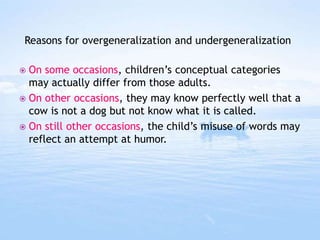
 On some occasions, children’s conceptual categories
may actually differ from those adults.
 On other occasions, they may know perfectly well that a
cow is not a dog but not know what it is called.
 On still other occasions, the child’s misuse of words may
reflect an attempt at humor.
Reasons for overgeneralization and undergeneralization
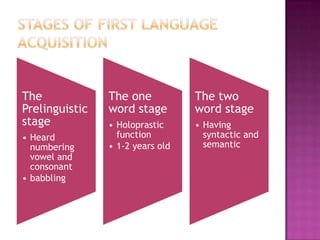
The
Prelinguistic
stage
• Heard
numbering
vowel and
consonant
• babbling
The one
word stage
• Holoprastic
function
• 1-2 years old
The two
word stage
• Having
syntactic and
semantic
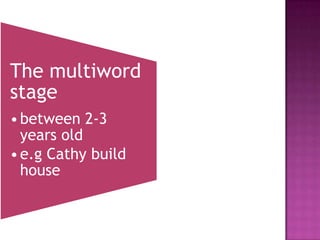
The multiword
stage
•between 2-3
years old
•e.g Cathy build
house
Are children are better than adults when
attempting to learn a second language?
Psychological
Social situation
Other psychological
variables
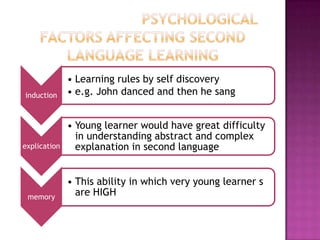
induction
• Learning rules by self discovery
• e.g. John danced and then he sang
explication
• Young learner would have great difficulty
in understanding abstract and complex
explanation in second language
memory
• This ability in which very young learner s
are HIGH
table
 A. The natural situation
a natural situation for second language
learning is one where the second language is
experienced in a situation that similar to
that which the native language is learned
e.g. 5 years old girl from New York goes to
Tokyo with her parents
1. Characteristic of the natural situation
2. Decline of beneficial social interaction with
age
3. With age, language is more essential for
social interaction
4. Older children can have problems
1. The classroom is isolated from other social
life
2. Everything is planned, little is spontaneous
3. Learning language as part of group and not
as individual

Introduction to psycholinguistics

  • 1.
    Aulia Nisa Khusnia,M.A MuhammadiyahUniversity of Purwokerto
  • 2.
     * Psycholinguisticsis the study of the language processing mechanisms. Psycholinguistics deals with the mental processes a person uses in producing and understanding language. It is concerned with the relationship between language and the human mind, for example, how word, sentence, and discourse meaning are represented and computed in the mind.
  • 3.
     General issuesof psycholinguistics:  language acquisition (how human beings learn language)  language production (how we create and express meaning through language)  language comprehension (how we perceive and understand speech and written language)  The relationship between language and thought
  • 4.
     Language acquisitionrefers to the learning and development of a person’s language. The learning of a native or first language is called first language acquisition, and the learning of a second or foreign language is called second language acquisition.
  • 5.
     Overgeneralization/Overextension(the extension ofa rule beyond its proper limits)  Undergeneralization/Underextension(a child uses a word in a more limited way than adults do ) Two basic notions in first language acquisition
  • 6.
    Overgeneralization is afrequent phenomenon in language development. It can be found not only in syntactic usage but also in word meanings. moons: all round objects cars: all vehicles dogs: all four-legged animals Examples of overgeneralization
  • 7.
    Overgeneralization is afrequent phenomenon in language development. It can be found not only in syntactic usage but also in word meanings. moons: all round objects cars: all vehicles dogs: all four-legged animals Examples of overgeneralization
  • 8.
     Children alsoundergeneralize. When a child uses a word in a more limited way than adults do (e.g. refusing to call a taxi a car), this phenomenon is called undergeneralization or underextension.  Shoes only refers to his mother’s shoes.  Hat only refers to his own hat. Undergeneralization
  • 9.
     On someoccasions, children’s conceptual categories may actually differ from those adults.  On other occasions, they may know perfectly well that a cow is not a dog but not know what it is called.  On still other occasions, the child’s misuse of words may reflect an attempt at humor. Reasons for overgeneralization and undergeneralization
  • 10.
    The Prelinguistic stage • Heard numbering vowel and consonant •babbling The one word stage • Holoprastic function • 1-2 years old The two word stage • Having syntactic and semantic
  • 11.
    The multiword stage •between 2-3 yearsold •e.g Cathy build house
  • 12.
    Are children arebetter than adults when attempting to learn a second language?
  • 13.
  • 14.
    induction • Learning rulesby self discovery • e.g. John danced and then he sang explication • Young learner would have great difficulty in understanding abstract and complex explanation in second language memory • This ability in which very young learner s are HIGH
  • 15.
  • 16.
     A. Thenatural situation a natural situation for second language learning is one where the second language is experienced in a situation that similar to that which the native language is learned e.g. 5 years old girl from New York goes to Tokyo with her parents
  • 17.
    1. Characteristic ofthe natural situation 2. Decline of beneficial social interaction with age 3. With age, language is more essential for social interaction 4. Older children can have problems
  • 18.
    1. The classroomis isolated from other social life 2. Everything is planned, little is spontaneous 3. Learning language as part of group and not as individual