AGE AND
ACQUISITION
INTRODUCTION




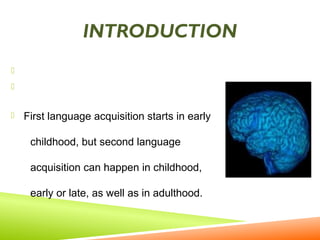
First language acquisition starts in early
childhood, but second language
acquisition can happen in childhood,
early or late, as well as in adulthood.
The critical hypothesis
 the critical period hypothesis states

that there is a biological calendar
for acquiring a language. Initially
the notion of critical period was
connected only to the first
language acquisition.
 the crucial stage of the second
language acquisition occurs
around puberty , beyond which
people seem to be relatively
incapable of acquiring a second
language.



RIGHT-HEMISPHERIC
PARTICIPATION
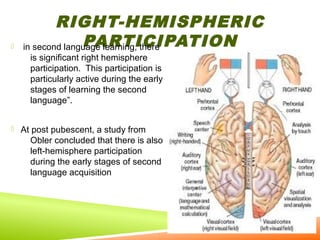
in second language learning, there
is significant right hemisphere
participation. This participation is
particularly active during the early
stages of learning the second
language”.

 At post pubescent, a study from

Obler concluded that there is also
left-hemisphere participation
during the early stages of second
language acquisition
THE SIGNIFICANCE OF
ACCENT
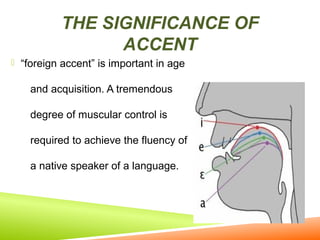
 “foreign accent” is important in age

and acquisition. A tremendous
degree of muscular control is
required to achieve the fluency of
a native speaker of a language.
THE SIGNIFICANCE OF
ACCENT


At birth the speech muscles are
developed only to the extent
that the larynx can control
sustained cries. These speech
muscles gradually develop,
and control some complex
sounds. Complete phonemic
control is present in virtually
all children before puberty.


Rote and meaningful learning
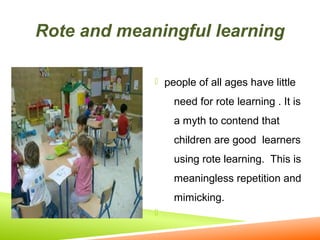
 people of all ages have little

need for rote learning . It is
a myth to contend that
children are good learners
using rote learning. This is
meaningless repetition and
mimicking.

INHIBITION


In preadolescence children develop
an acute consciousness of
themselves as separate and
identifiable entities. But they might
have insecurity and need
protection.

 At puberty these inhibitions are

heightened in the trauma of
undergoing critical physical,
cognitive, and emotional changes.
 Their egos are affected not only in

how they understand themselves,
also how they reach out beyond
themselves, how they relate to
others socially, and how they use
the communicative process to
bring on effective equilibrium.

LANGUAGE EGO

 For any monolingual person, the

language ego involves the interaction
of the native language and ego
development.
 The language ego may account for the
difficulties that adults have in learning
a second language.
 The child’s ego is dynamic and growing
and flexible through the age of
puberty.
 The simultaneous physical, emotional,
and cognitive changes of puberty
give rise to a defensive mechanism
in which the language ego become
protective and defensive.
INTERFERENCE BETWEEN FIRST
AND SECOND LANGUAGE
 A good deal of the research on

non-simultaneous

second

language acquisition, in both
children and adults, has focused
on the interfering effects of the
first and second languages.
Similar strategies and linguistic
features are present in both first
and second language learning in
Interference in adults
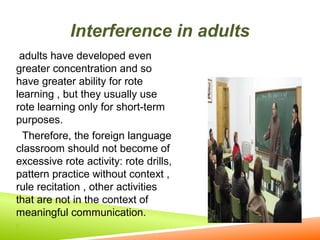
adults have developed even
greater concentration and so
have greater ability for rote
learning , but they usually use
rote learning only for short-term
purposes.
Therefore, the foreign language
classroom should not become of
excessive rote activity: rote drills,
pattern practice without context ,
rule recitation , other activities
that are not in the context of
meaningful communication.

Interference in adults

 Adults, more cognitively secure,

appear to operate from the solid
foundation of the first language
and thus manifest more
interference.

 In this case, the first language can

be a facilitating factor, and not
just and interfering factor.
bibliography
 Wikipedia.org/wiki/Language_acquisition

 http://www.education-blog.net/teaching-methods/lang

 http://www.bing.com/search?q=right+hemisphere+part

 http://www.bing.com/search?q=critical+hypothesis&src
 www.helium.com
 www.asha.org


Age and acquisition

Age and acquisition

  • 1.
  • 2.
    INTRODUCTION    First language acquisitionstarts in early childhood, but second language acquisition can happen in childhood, early or late, as well as in adulthood.
  • 3.
    The critical hypothesis the critical period hypothesis states that there is a biological calendar for acquiring a language. Initially the notion of critical period was connected only to the first language acquisition.  the crucial stage of the second language acquisition occurs around puberty , beyond which people seem to be relatively incapable of acquiring a second language. 
  • 4.
     RIGHT-HEMISPHERIC PARTICIPATION in second languagelearning, there is significant right hemisphere participation. This participation is particularly active during the early stages of learning the second language”.  At post pubescent, a study from Obler concluded that there is also left-hemisphere participation during the early stages of second language acquisition
  • 5.
    THE SIGNIFICANCE OF ACCENT “foreign accent” is important in age and acquisition. A tremendous degree of muscular control is required to achieve the fluency of a native speaker of a language.
  • 6.
    THE SIGNIFICANCE OF ACCENT  Atbirth the speech muscles are developed only to the extent that the larynx can control sustained cries. These speech muscles gradually develop, and control some complex sounds. Complete phonemic control is present in virtually all children before puberty. 
  • 7.
    Rote and meaningfullearning  people of all ages have little need for rote learning . It is a myth to contend that children are good learners using rote learning. This is meaningless repetition and mimicking. 
  • 8.
    INHIBITION  In preadolescence childrendevelop an acute consciousness of themselves as separate and identifiable entities. But they might have insecurity and need protection.  At puberty these inhibitions are heightened in the trauma of undergoing critical physical, cognitive, and emotional changes.  Their egos are affected not only in how they understand themselves, also how they reach out beyond themselves, how they relate to others socially, and how they use the communicative process to bring on effective equilibrium. 
  • 9.
    LANGUAGE EGO  Forany monolingual person, the language ego involves the interaction of the native language and ego development.  The language ego may account for the difficulties that adults have in learning a second language.  The child’s ego is dynamic and growing and flexible through the age of puberty.  The simultaneous physical, emotional, and cognitive changes of puberty give rise to a defensive mechanism in which the language ego become protective and defensive.
  • 10.
    INTERFERENCE BETWEEN FIRST ANDSECOND LANGUAGE  A good deal of the research on non-simultaneous second language acquisition, in both children and adults, has focused on the interfering effects of the first and second languages. Similar strategies and linguistic features are present in both first and second language learning in
  • 11.
    Interference in adults adultshave developed even greater concentration and so have greater ability for rote learning , but they usually use rote learning only for short-term purposes. Therefore, the foreign language classroom should not become of excessive rote activity: rote drills, pattern practice without context , rule recitation , other activities that are not in the context of meaningful communication. 
  • 12.
    Interference in adults  Adults, more cognitively secure, appear to operate from the solid foundation of the first language and thus manifest more interference.   In this case, the first language can be a facilitating factor, and not just and interfering factor.
  • 13.
    bibliography  Wikipedia.org/wiki/Language_acquisition  http://www.education-blog.net/teaching-methods/lang http://www.bing.com/search?q=right+hemisphere+part  http://www.bing.com/search?q=critical+hypothesis&src  www.helium.com  www.asha.org  