Synthetic Call
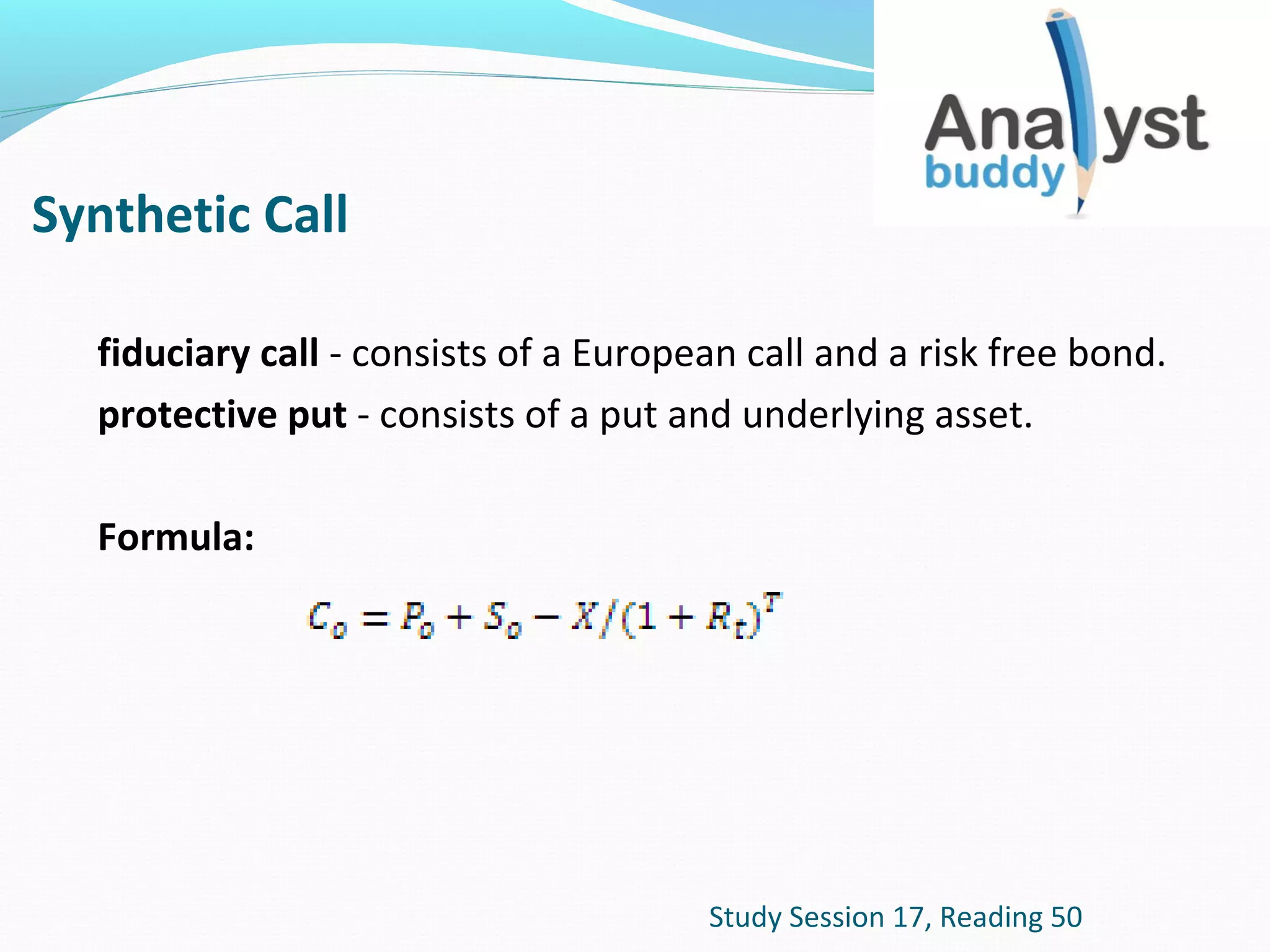
fiduciary call - consists of a European call and a risk free bond.
protective put - consists of a put and underlying asset.
Formula:

Study Session 17, Reading 50
Synthetic Put
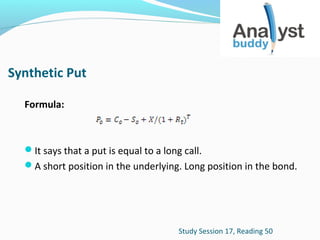
Formula:

It says that a put is equal to a long call.
A short position in the underlying. Long position in the bond.

Study Session 17, Reading 50
Synthetic Stock
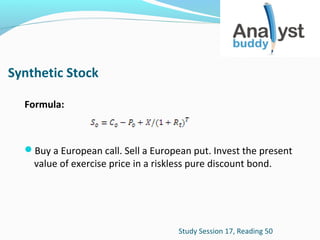
Formula:

Buy a European call. Sell a European put. Invest the present

value of exercise price in a riskless pure discount bond.

Study Session 17, Reading 50
Synthetic Bond
synthetic bond - a portfolio of financial instruments designed to
mimic the cash flow and risk profile of a bond.
A synthetic bond may contain financial instruments such as

bond puts, bond calls, bond futures, Treasuries, money market
securities, and CDS'.

Study Session 17, Reading 50
Binomial Model for Options on Assets
A binomial tree is built depicting different prices under

different probabilities.
If there is no risk involved, all assets will be priced to provide a
riskless rate of return.
Value:
P=1+r-d/u-d

Study Session 17, Reading 50
Binomial Interest Rate Option Pricing
Formula(s):
Expiration value of a caplet = max⦋0,{(1-yr-cap rate)×notional
principal}⦋/1+one year rate
Expiration value of a floorlet = max⦋0,{(floor rate-one year
rate)×notional principal}⦋/1+one year rate

Study Session 17, Reading 50
Assumptions Underlying
the Black-Scholes-Merton Model
Price of the underlying follows a lognormal distribution.
Lognormal variable has values which are normally distributed.
The value of the option has a minimum of zero.
The risk free rate is constant and known.
Interest rate volatility is important for determining the value

of bonds.

Study Session 17, Reading 50
Effect of Changes in Input Values
on Call Option Prices
Higher for higher underlying price
Higher for longer time to expiration
Higher for higher volatility
Higher for higher risk free rate
Higher for lower exercise price

Study Session 17, Reading 50
Effect of Changes in Input Values
on Put Option Prices
Higher prices for lower underlying prices
Higher prices for higher volatility
Higher prices for lower risk free rate
Higher prices for higher exercise price

Study Session 17, Reading 50
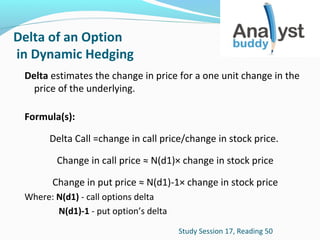
Delta of an Option
in Dynamic Hedging
Delta estimates the change in price for a one unit change in the
price of the underlying.
Formula(s):
Delta Call =change in call price/change in stock price.
Change in call price ≈ N(d1)× change in stock price
Change in put price ≈ N(d1)-1× change in stock price
Where: N(d1) - call options delta
N(d1)-1 - put option’s delta
Study Session 17, Reading 50
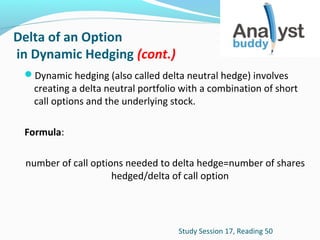
Delta of an Option
in Dynamic Hedging (cont.)
Dynamic hedging (also called delta neutral hedge) involves

creating a delta neutral portfolio with a combination of short
call options and the underlying stock.

Formula:
number of call options needed to delta hedge=number of shares
hedged/delta of call option

Study Session 17, Reading 50
Gamma Effects on a Delta Hedge
Gamma measures the rate of change in delta as the price of

the underlying changes
Gamma can be used as a measure of the effectiveness of a
delta hedge.
Hedges with at the money options will have higher gammas.
Small changes in the stock prices will cause large changes in
deltas and frequent rebalancing

Study Session 17, Reading 50
Effect of Underlying Asset's Cash
Flows on the Price of an Option
Some assets have cash flows attached to them
Option prices need to be adjusted for these cash flows
All else equal, cash flows on the underlying will decrease the

value of a call option.
All else equal, cash flows on the underlying will increase the
value of a put option.

Study Session 17, Reading 50
Historical Volatility for Estimating
the Future Volatility of the
Underlying Asset
Volatility - measures the day to day price changes in the market.
Historical volatility - a measure of price changes during a
specific time period in the past
Factors to calculate volatility:
1. Calculate the continuously compounded return at each interval.
2. Calculate the daily price changes.
3. Calculate the average daily price change.
4. Calculate the standard deviation of returns.
5. Annualise historical volatility.
Study Session 17, Reading 50
Implied Volatility for Estimating
the Future Volatility of the
Underlying Asset
Implied volatility looks into the future. It can be inferred by
working backward by setting the BSM price equal to the
market price.

Study Session 17, Reading 50
Put-Call Parity for Options
on Forwards
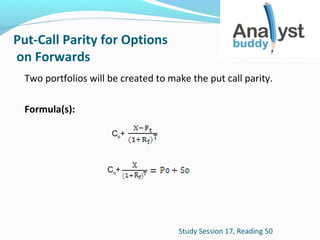
Two portfolios will be created to make the put call parity.
Formula(s):
Co+

Co+

Study Session 17, Reading 50
American and European Options
on Forwards and Futures
The Black model can be used to price the European options on
futures:
c = e − rcT[FN(d1) − XN(d2)]
p = e − rcT[X(1-N( − d2)) – F(1-N( − d1))]

Study Session 17, Reading 50
Pricing and Valuation of Swaps
A swap rate (fixed rate) is determined at the time of initiation

of the swap.
The value of the swap at the time of the initiation is zero to
both the parties.
The swap rate makes the present value of the fixed rate
component equal to the floating rate component of the swap.

Study Session 17, Reading 51
Interest Rate Swaps
to Off-Market FRAs
Swaps are also referred to as a series of off- market FRAs.
Each FRA fixed rate differs but the swap fixed rates are known

for the life of the swap.
The swap fixed rate is equal to “average” rate of on-market
FRAs.
The FRA payment is determined at the end of the period.

Study Session 17, Reading 51
Plain Vanilla Swap to Interest Rate
Call and Put
Swaps can also be equal to interest rate calls and puts.
A fixed rate paying swap is equal to long interest rate call and

short interest rate put.
A fixed rate receiver swap is equal to long interest rate put
and short interest rate call.

Study Session 17, Reading 51
Fixed Rate and Market Value of the
Swap
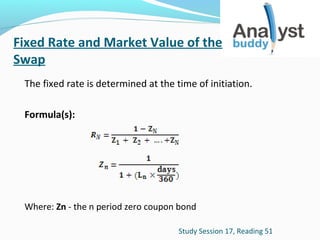
The fixed rate is determined at the time of initiation.
Formula(s):

Where: Zn - the n period zero coupon bond
Study Session 17, Reading 51
Fixed Rate and Market Value of the
Swap (cont.)
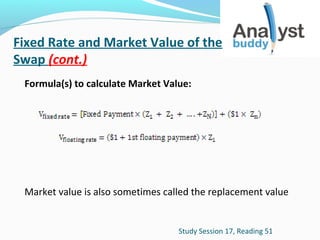
Formula(s) to calculate Market Value:

Market value is also sometimes called the replacement value

Study Session 17, Reading 51
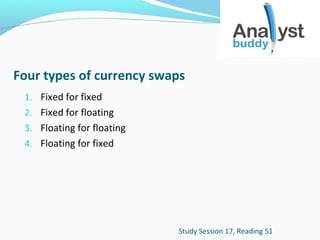
Four types of currency swaps
1. Fixed for fixed
2. Fixed for floating
3. Floating for floating
4. Floating for fixed

Study Session 17, Reading 51
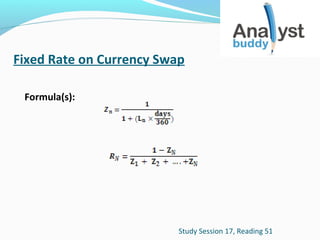
Fixed Rate on Currency Swap
Formula(s):

Study Session 17, Reading 51
Three types of equity swaps
1. Pay fixed and receive return on the equity
2. Pay floating rate and receive the return on the equity
3. Pay the return on one equity and receive the return on

another equity

Study Session 17, Reading 51
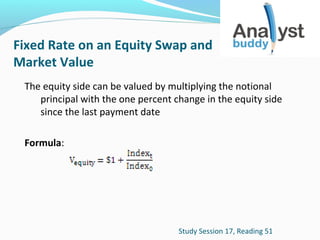
Fixed Rate on an Equity Swap and
Market Value
The equity side can be valued by multiplying the notional
principal with the one percent change in the equity side
since the last payment date
Formula:

Study Session 17, Reading 51
Swaptions
swaption - an option on a swap. It gives the holder a right to
enter into an interest rate swap in the future.
strike rate - the fixed rate in the Swaption is predetermined

Study Session 17, Reading 51
Payoffs and Cash Flows
of an Interest Rate Swaption
If the swap rates rise, a payer Swaption is in the money.
A receiver swaption is in the money if the interest rates fall.
Annuity payments will be achieved by the holder of the option

by exercising an in the money swaption.
Payoff comes in the form of interest savings.

Study Session 17, Reading 51
The Value of an Interest Rate Swaption
at Expiration
payoff of a payer swaption = max×∑(discount factor)
payoff of a receiver swaption = ×∑(discount factor)
The value of the receiver swaption at expiration is the maximum
of zero and the present value of a stream of payments.

Study Session 17, Reading 51
Credit Risk
swap credit risk - the risk that one party will be unable to make
the payments owed to the other party
current credit risk - the risk pertaining to the current payment
due
potential credit risk - the risk of a party being unable to make a
future payment is called the

Study Session 17, Reading 51
Swap Spread and its Relation
to Credit Risk
The swap spread indicates the average credit risk in the global

economy.
The swap spread is the quality or default risk spread between
a default free security and LIBOR.
Swap Spread = Fixed-rate on Swap - yield on default free
security of the same maturity as the swap

Study Session 17, Reading 51
Interest Rate Caps
interest rate cap or ceiling - an agreement where one party
agrees to pay when the reference rate is greater than
predetermined rate
caplets - individual interest rate call options
long cap - equal to a portfolio of long put options on fixed
income security prices.

Study Session 17, Reading 52
Interest Rate Floors
interest rate floor - an agreement in which one party agrees to
pay when the reference rate is less than the predetermined
rate
floorlet - separate put option
long floor - is equal to a portfolio of long call options on fixed
income security prices

Study Session 17, Reading 52
Payoff for a Cap and Floor
Formula(s):
Payoff to cap buyer= Max (0, Notional Principal×(Reference rateCap rate)×(actual days/360))
Payoff to floor buyer = Max (0, Notional Principal×(Floor ratereference rate)×(actual days/360))

Study Session 17, Reading 52
Interest Rate Collar
interest rate collar - a combination of a long interest rate cap
and a short interest rate floor.
zero-cost collar - a collar is structured such that the premium
paid for a cap is equal to the premium received from the floor

Study Session 17, Reading 52
Credit Default Swaps
and Corporate Bonds
CDS is just like an insurance contract. It provides the buyer

protection against the default risk, bankruptcy or credit
ratings downgrade.
CDS are usually written on fixed income securities, a bond, or
a loan.

Study Session 17, Reading 53
Advantages of Credit Default Swaps
Credit Default Swaps (CDS) provide a hedge against event risk.
CDS allow for the management of credit risk separately.
Default risk and interest rate risk can be managed separately.

Study Session 17, Reading 59
Uses of Credit Default Swaps
To hedge the credit risk exposure
Easy liquidity and access to the rest of the participants in the

market
To satisfy regulatory capital requirements
For hedging and enhancing income

Study Session 17, Reading 59
Credit Derivative Trading Strategies
Basis Trade
Curve Trade
Index Trade
Options Trades
Capital Structure Trades
Correlation Trades

Study Session 17, Reading 59
Basis Trade
Value:
cash-default swap = CDS spread (premium)- asset (bond) swap
spread
negative basis - the bond is cheaper than the CDS and a positive
annuity can be built by buying bond and the CDS
positive basis trade - involves shorting the bond which makes it
complicated to execute
Study Session 17, Reading 59

L2 flash cards derivatives - ss 17

  • 1.
    Synthetic Call fiduciary call- consists of a European call and a risk free bond. protective put - consists of a put and underlying asset. Formula: Study Session 17, Reading 50
  • 2.
    Synthetic Put Formula: It saysthat a put is equal to a long call. A short position in the underlying. Long position in the bond. Study Session 17, Reading 50
  • 3.
    Synthetic Stock Formula: Buy aEuropean call. Sell a European put. Invest the present value of exercise price in a riskless pure discount bond. Study Session 17, Reading 50
  • 4.
    Synthetic Bond synthetic bond- a portfolio of financial instruments designed to mimic the cash flow and risk profile of a bond. A synthetic bond may contain financial instruments such as bond puts, bond calls, bond futures, Treasuries, money market securities, and CDS'. Study Session 17, Reading 50
  • 5.
    Binomial Model forOptions on Assets A binomial tree is built depicting different prices under different probabilities. If there is no risk involved, all assets will be priced to provide a riskless rate of return. Value: P=1+r-d/u-d Study Session 17, Reading 50
  • 6.
    Binomial Interest RateOption Pricing Formula(s): Expiration value of a caplet = max⦋0,{(1-yr-cap rate)×notional principal}⦋/1+one year rate Expiration value of a floorlet = max⦋0,{(floor rate-one year rate)×notional principal}⦋/1+one year rate Study Session 17, Reading 50
  • 7.
    Assumptions Underlying the Black-Scholes-MertonModel Price of the underlying follows a lognormal distribution. Lognormal variable has values which are normally distributed. The value of the option has a minimum of zero. The risk free rate is constant and known. Interest rate volatility is important for determining the value of bonds. Study Session 17, Reading 50
  • 8.
    Effect of Changesin Input Values on Call Option Prices Higher for higher underlying price Higher for longer time to expiration Higher for higher volatility Higher for higher risk free rate Higher for lower exercise price Study Session 17, Reading 50
  • 9.
    Effect of Changesin Input Values on Put Option Prices Higher prices for lower underlying prices Higher prices for higher volatility Higher prices for lower risk free rate Higher prices for higher exercise price Study Session 17, Reading 50
  • 10.
    Delta of anOption in Dynamic Hedging Delta estimates the change in price for a one unit change in the price of the underlying. Formula(s): Delta Call =change in call price/change in stock price. Change in call price ≈ N(d1)× change in stock price Change in put price ≈ N(d1)-1× change in stock price Where: N(d1) - call options delta N(d1)-1 - put option’s delta Study Session 17, Reading 50
  • 11.
    Delta of anOption in Dynamic Hedging (cont.) Dynamic hedging (also called delta neutral hedge) involves creating a delta neutral portfolio with a combination of short call options and the underlying stock. Formula: number of call options needed to delta hedge=number of shares hedged/delta of call option Study Session 17, Reading 50
  • 12.
    Gamma Effects ona Delta Hedge Gamma measures the rate of change in delta as the price of the underlying changes Gamma can be used as a measure of the effectiveness of a delta hedge. Hedges with at the money options will have higher gammas. Small changes in the stock prices will cause large changes in deltas and frequent rebalancing Study Session 17, Reading 50
  • 13.
    Effect of UnderlyingAsset's Cash Flows on the Price of an Option Some assets have cash flows attached to them Option prices need to be adjusted for these cash flows All else equal, cash flows on the underlying will decrease the value of a call option. All else equal, cash flows on the underlying will increase the value of a put option. Study Session 17, Reading 50
  • 14.
    Historical Volatility forEstimating the Future Volatility of the Underlying Asset Volatility - measures the day to day price changes in the market. Historical volatility - a measure of price changes during a specific time period in the past Factors to calculate volatility: 1. Calculate the continuously compounded return at each interval. 2. Calculate the daily price changes. 3. Calculate the average daily price change. 4. Calculate the standard deviation of returns. 5. Annualise historical volatility. Study Session 17, Reading 50
  • 15.
    Implied Volatility forEstimating the Future Volatility of the Underlying Asset Implied volatility looks into the future. It can be inferred by working backward by setting the BSM price equal to the market price. Study Session 17, Reading 50
  • 16.
    Put-Call Parity forOptions on Forwards Two portfolios will be created to make the put call parity. Formula(s): Co+ Co+ Study Session 17, Reading 50
  • 17.
    American and EuropeanOptions on Forwards and Futures The Black model can be used to price the European options on futures: c = e − rcT[FN(d1) − XN(d2)] p = e − rcT[X(1-N( − d2)) – F(1-N( − d1))] Study Session 17, Reading 50
  • 18.
    Pricing and Valuationof Swaps A swap rate (fixed rate) is determined at the time of initiation of the swap. The value of the swap at the time of the initiation is zero to both the parties. The swap rate makes the present value of the fixed rate component equal to the floating rate component of the swap. Study Session 17, Reading 51
  • 19.
    Interest Rate Swaps toOff-Market FRAs Swaps are also referred to as a series of off- market FRAs. Each FRA fixed rate differs but the swap fixed rates are known for the life of the swap. The swap fixed rate is equal to “average” rate of on-market FRAs. The FRA payment is determined at the end of the period. Study Session 17, Reading 51
  • 20.
    Plain Vanilla Swapto Interest Rate Call and Put Swaps can also be equal to interest rate calls and puts. A fixed rate paying swap is equal to long interest rate call and short interest rate put. A fixed rate receiver swap is equal to long interest rate put and short interest rate call. Study Session 17, Reading 51
  • 21.
    Fixed Rate andMarket Value of the Swap The fixed rate is determined at the time of initiation. Formula(s): Where: Zn - the n period zero coupon bond Study Session 17, Reading 51
  • 22.
    Fixed Rate andMarket Value of the Swap (cont.) Formula(s) to calculate Market Value: Market value is also sometimes called the replacement value Study Session 17, Reading 51
  • 23.
    Four types ofcurrency swaps 1. Fixed for fixed 2. Fixed for floating 3. Floating for floating 4. Floating for fixed Study Session 17, Reading 51
  • 24.
    Fixed Rate onCurrency Swap Formula(s): Study Session 17, Reading 51
  • 25.
    Three types ofequity swaps 1. Pay fixed and receive return on the equity 2. Pay floating rate and receive the return on the equity 3. Pay the return on one equity and receive the return on another equity Study Session 17, Reading 51
  • 26.
    Fixed Rate onan Equity Swap and Market Value The equity side can be valued by multiplying the notional principal with the one percent change in the equity side since the last payment date Formula: Study Session 17, Reading 51
  • 27.
    Swaptions swaption - anoption on a swap. It gives the holder a right to enter into an interest rate swap in the future. strike rate - the fixed rate in the Swaption is predetermined Study Session 17, Reading 51
  • 28.
    Payoffs and CashFlows of an Interest Rate Swaption If the swap rates rise, a payer Swaption is in the money. A receiver swaption is in the money if the interest rates fall. Annuity payments will be achieved by the holder of the option by exercising an in the money swaption. Payoff comes in the form of interest savings. Study Session 17, Reading 51
  • 29.
    The Value ofan Interest Rate Swaption at Expiration payoff of a payer swaption = max×∑(discount factor) payoff of a receiver swaption = ×∑(discount factor) The value of the receiver swaption at expiration is the maximum of zero and the present value of a stream of payments. Study Session 17, Reading 51
  • 30.
    Credit Risk swap creditrisk - the risk that one party will be unable to make the payments owed to the other party current credit risk - the risk pertaining to the current payment due potential credit risk - the risk of a party being unable to make a future payment is called the Study Session 17, Reading 51
  • 31.
    Swap Spread andits Relation to Credit Risk The swap spread indicates the average credit risk in the global economy. The swap spread is the quality or default risk spread between a default free security and LIBOR. Swap Spread = Fixed-rate on Swap - yield on default free security of the same maturity as the swap Study Session 17, Reading 51
  • 32.
    Interest Rate Caps interestrate cap or ceiling - an agreement where one party agrees to pay when the reference rate is greater than predetermined rate caplets - individual interest rate call options long cap - equal to a portfolio of long put options on fixed income security prices. Study Session 17, Reading 52
  • 33.
    Interest Rate Floors interestrate floor - an agreement in which one party agrees to pay when the reference rate is less than the predetermined rate floorlet - separate put option long floor - is equal to a portfolio of long call options on fixed income security prices Study Session 17, Reading 52
  • 34.
    Payoff for aCap and Floor Formula(s): Payoff to cap buyer= Max (0, Notional Principal×(Reference rateCap rate)×(actual days/360)) Payoff to floor buyer = Max (0, Notional Principal×(Floor ratereference rate)×(actual days/360)) Study Session 17, Reading 52
  • 35.
    Interest Rate Collar interestrate collar - a combination of a long interest rate cap and a short interest rate floor. zero-cost collar - a collar is structured such that the premium paid for a cap is equal to the premium received from the floor Study Session 17, Reading 52
  • 36.
    Credit Default Swaps andCorporate Bonds CDS is just like an insurance contract. It provides the buyer protection against the default risk, bankruptcy or credit ratings downgrade. CDS are usually written on fixed income securities, a bond, or a loan. Study Session 17, Reading 53
  • 37.
    Advantages of CreditDefault Swaps Credit Default Swaps (CDS) provide a hedge against event risk. CDS allow for the management of credit risk separately. Default risk and interest rate risk can be managed separately. Study Session 17, Reading 59
  • 38.
    Uses of CreditDefault Swaps To hedge the credit risk exposure Easy liquidity and access to the rest of the participants in the market To satisfy regulatory capital requirements For hedging and enhancing income Study Session 17, Reading 59
  • 39.
    Credit Derivative TradingStrategies Basis Trade Curve Trade Index Trade Options Trades Capital Structure Trades Correlation Trades Study Session 17, Reading 59
  • 40.
    Basis Trade Value: cash-default swap= CDS spread (premium)- asset (bond) swap spread negative basis - the bond is cheaper than the CDS and a positive annuity can be built by buying bond and the CDS positive basis trade - involves shorting the bond which makes it complicated to execute Study Session 17, Reading 59