Chapter - 7 Options and Their Valuation
Options An option is a contract that gives the holder a right, without any obligation, to buy or sell an asset at an agreed price on or before a specified period of time. The option to buy an asset is known as a  call option. The option to sell an asset is called a  put option .
Options The price at which option can be exercised is called an  exercise price  or a  strike price .  The asset on which the put or call option is created is referred to as the  underlying asset . The  option premium  is price that the holder of an option has to pay for obtaining a call or a put option.
When an Option can be Exercised European option  When an option is allowed to be exercised only on the maturity date, it is called a  European option . American option  When the option can be exercised any time before its maturity, it is called an  American option .
Possibilities  at Expiration In-the-money  A put or a call option is said to  in-the-money  when it is advantageous for the investor to exercise it. Out-of-the-money  A put or a call option is  out-of-the-money  if it is not advantageous for the investor to exercise it. At-the-money  When the holder of a put or a call option does not lose or gain whether or not he exercises his option.
Call Option Buy a call option  You should exercise call option when: Share price at expiration > Exercise price. Do not exercise call option when: Share price at expiration < Exercise price. The value of the call option at expiration is: Value of call option at expiration = Maximum  [Share price – Exercise price, 0]. The expression above indicates that the value of a call option at expiration is the maximum of the share price minus the exercise price or zero. The call buyer’s gain is call seller’s loss.
Put Option Buy a put option   Exercise the put option when: Exercise price > Share price at expiration. Do not exercise the put option when: Exercise price < Share price at expiration. The value or payoff of a put option at expiration will be: Value of put option at expiration = Maximum  [Exercise price – Share price at expiration, 0]. The put option buyer’s gain is the seller’s loss.
Options Trading in India The Security Exchange Board of India (SEBI) has announced a list of 31 shares for the stock-based option trading from July 2002. SEBI selected these shares for option trading on the basis of the following criteria: Shares must be among the top 200 in terms of market capitalisation and trading volume.  Shares must be traded in at least 90 per cent of the trading days.
Options Trading in India The non-promoter holding should be at least 30 per cent and the market capitalisation of free-float shares should be Rs 750 crore. The six-month average trading volume in the share in the underlying cash market should be a minimum of Rs 5 crore. The ratio of daily volatility of the share vis-à-vis the daily volatility of the index should not be more than four times at any time during the previous six months.
Options Trading in India The minimum size of the contract is Rs 2 lakh. For the first six months, there would be cash settlement in options contracts and afterwards, there would be physical settlement. The option sellers will have to pay the margin, but the buyers will have to only pay the premium in advance. The stock exchanges can set limits on exercise price.
Index Options Index options are call or put options on the stock market indices. In India, there are options on the Bombay Stock Exchange (BSE)—Sensex and the National Stock Exchange (NSE)—Nifty.
Index Options The Sensex options are European-type options and expire on the last Thursday of the contract month. The put and call index option contracts with 1-month, 2-month and 3-month maturity are available. The settlement is done in cash on a  T  + 1 basis and the prices are based on expiration price as may be decided by the Exchange. Option contracts will have a multiplier of 100.  The multiplier for the NSE Nifty Options is 200 with a minimum price change of Rs 10 (200    0.05).
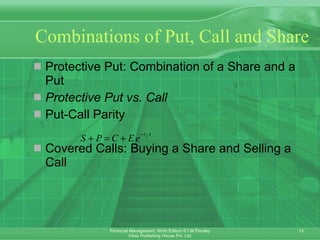
Combinations of Put, Call and Share Protective Put: Combination of a Share and a Put  Protective Put vs. Call Put-Call Parity Covered Calls: Buying a Share and Selling a Call
Combinations of Put, Call and Share Straddle: Combining Call and Put at Same Exercise Price  Strips and Straps Strangle: Combining Call and Put at Different Exercise Prices Spread: Combining Put and Call at Different Exercise Prices Spread: Combining the Long and Short Options Collars
Factors Determining Option Value Exercise price and the share (underlying asset) price Volatility of returns on share Time to expiration Interest rates
Limitations of DCF Approach The DCF approach does not work for options because of the difficulty in determining the required rate of return of an option. Options are  derivative securities . Their risk is derived from the risk of the underlying security. The market value of a share continuously changes. Consequently, the required rate of return to a stock option is also continuously changing. Therefore, it is not feasible to value options using the DCF technique.
Model for Option Valuation   Simple binomial tree approach to option valuation. Black-Scholes option valuation model.
Simple Binomial Tree Approach Sell a call option on the share. We can create a portfolio of certain number of shares (let us call it delta,   ) and one call option by going long on shares and short on options that there is no uncertainty of the value of portfolio at the end of one year. Formula for determining the  option delta , represented by symbol   , can be written as follows: Option Delta = Difference in option Values /    Difference in Share Prices.
Simple Binomial Tree Approach The value of portfolio at the end of one year remains same irrespective of the increase or decrease in the share price. Since it is a risk-less portfolio, we can use the risk-free rate as the discount rate: PV of Portfolio = Value of Portfolio at end of year /    Discount rate
Simple Binomial Tree Approach Since the current price of share is  S , the value of the call option can be found out as follows: Value of a call option = No. of Shares (  ) Spot  Price – PV of Portfolio The value of the call option will remain the same irrespective of any probabilities of increase or decrease in the share price. This is so because the option is valued in terms of the price of the underlying share, and the share price already includes the probabilities of its rise or fall.
Risk Neutrality Investors are risk-neutral. They would simply expect a risk-free rate of return. In our example, the share price could rise by 100 per cent (from Rs 150 to Rs 300) or it could fall by 33.3 per cent (from Rs 150 to Rs 100). Under these situations, a risk-neutral investor’s return from the investment in the share is given in box.
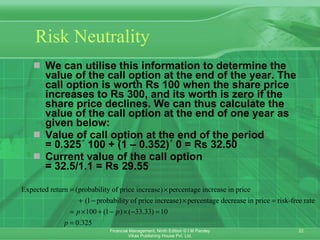
Risk Neutrality We can utilise this information to determine the value of the call option at the end of the year. The call option is worth Rs 100 when the share price increases to Rs 300, and its worth is zero if the share price declines. We can thus calculate the value of the call option at the end of one year as given below: Value of call option at the end of the period  = 0.325´ 100 + (1 – 0.352)´ 0 = Rs 32.50 Current value of the call option  = 32.5/1.1 = Rs 29.55
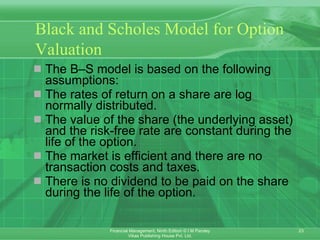
Black and Scholes Model for Option Valuation   The B–S model is based on the following assumptions: The rates of return on a share are log normally distributed. The value of the share (the underlying asset) and the risk-free rate are constant during the life of the option. The market is efficient and there are no transaction costs and taxes.  There is no dividend to be paid on the share during the life of the option.
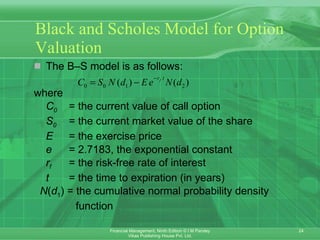
Black and Scholes Model for Option Valuation The B–S model is as follows: where  C 0  = the current value of call option S 0  = the current market value of the share E  = the exercise price e  = 2.7183, the exponential constant r f  = the risk-free rate of interest t  = the time to expiration (in years) N ( d 1 ) = the cumulative normal probability density  function
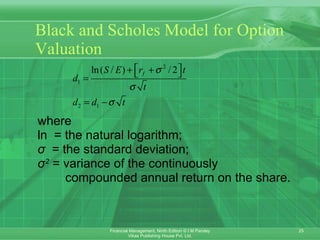
Black and Scholes Model for Option Valuation where  ln  = the natural logarithm;  σ   = the standard deviation;  σ 2  = variance of the continuously  compounded annual return on the share.
Features of B–S Model Black–Scholes model has two features- The parameters of the model, except the share price volatility, are contained in the agreement between the option buyer and seller.  In spite of its unrealistic assumptions, the model is able to predict the true price of option reasonably well.  The model is applicable to both European and American options with a few adjustments.
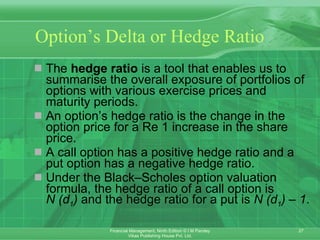
Option’s Delta or Hedge Ratio The  hedge ratio  is a tool that enables us to summarise the overall exposure of portfolios of options with various exercise prices and maturity periods.  An option’s hedge ratio is the change in the option price for a Re 1 increase in the share price.  A call option has a positive hedge ratio and a put option has a negative hedge ratio.  Under the Black–Scholes option valuation formula, the hedge ratio of a call option is  N (d 1 )  and the hedge ratio for a put is  N (d 1 ) – 1 .
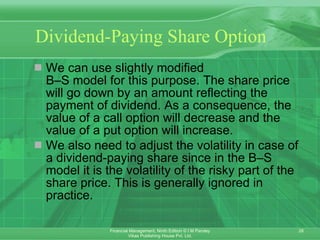
Dividend-Paying Share Option We can use slightly modified B–S model for this purpose. The share price will go down by an amount reflecting the payment of dividend. As a consequence, the value of a call option will decrease and the value of a put option will increase.  We also need to adjust the volatility in case of a dividend-paying share since in the B–S model it is the volatility of the risky part of the share price. This is generally ignored in practice.
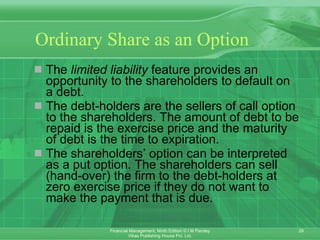
Ordinary Share as an Option The  limited liability  feature provides an opportunity to the shareholders to default on a debt.  The debt-holders are the sellers of call option to the shareholders. The amount of debt to be repaid is the exercise price and the maturity of debt is the time to expiration. The shareholders’ option can be interpreted as a put option. The shareholders can sell (hand-over) the firm to the debt-holders at zero exercise price if they do not want to make the payment that is due.

Ch 07

  • 1.
    Chapter - 7Options and Their Valuation
  • 2.
    Options An optionis a contract that gives the holder a right, without any obligation, to buy or sell an asset at an agreed price on or before a specified period of time. The option to buy an asset is known as a call option. The option to sell an asset is called a put option .
  • 3.
    Options The priceat which option can be exercised is called an exercise price or a strike price . The asset on which the put or call option is created is referred to as the underlying asset . The option premium is price that the holder of an option has to pay for obtaining a call or a put option.
  • 4.
    When an Optioncan be Exercised European option When an option is allowed to be exercised only on the maturity date, it is called a European option . American option When the option can be exercised any time before its maturity, it is called an American option .
  • 5.
    Possibilities atExpiration In-the-money A put or a call option is said to in-the-money when it is advantageous for the investor to exercise it. Out-of-the-money A put or a call option is out-of-the-money if it is not advantageous for the investor to exercise it. At-the-money When the holder of a put or a call option does not lose or gain whether or not he exercises his option.
  • 6.
    Call Option Buya call option You should exercise call option when: Share price at expiration > Exercise price. Do not exercise call option when: Share price at expiration < Exercise price. The value of the call option at expiration is: Value of call option at expiration = Maximum [Share price – Exercise price, 0]. The expression above indicates that the value of a call option at expiration is the maximum of the share price minus the exercise price or zero. The call buyer’s gain is call seller’s loss.
  • 7.
    Put Option Buya put option Exercise the put option when: Exercise price > Share price at expiration. Do not exercise the put option when: Exercise price < Share price at expiration. The value or payoff of a put option at expiration will be: Value of put option at expiration = Maximum [Exercise price – Share price at expiration, 0]. The put option buyer’s gain is the seller’s loss.
  • 8.
    Options Trading inIndia The Security Exchange Board of India (SEBI) has announced a list of 31 shares for the stock-based option trading from July 2002. SEBI selected these shares for option trading on the basis of the following criteria: Shares must be among the top 200 in terms of market capitalisation and trading volume. Shares must be traded in at least 90 per cent of the trading days.
  • 9.
    Options Trading inIndia The non-promoter holding should be at least 30 per cent and the market capitalisation of free-float shares should be Rs 750 crore. The six-month average trading volume in the share in the underlying cash market should be a minimum of Rs 5 crore. The ratio of daily volatility of the share vis-à-vis the daily volatility of the index should not be more than four times at any time during the previous six months.
  • 10.
    Options Trading inIndia The minimum size of the contract is Rs 2 lakh. For the first six months, there would be cash settlement in options contracts and afterwards, there would be physical settlement. The option sellers will have to pay the margin, but the buyers will have to only pay the premium in advance. The stock exchanges can set limits on exercise price.
  • 11.
    Index Options Indexoptions are call or put options on the stock market indices. In India, there are options on the Bombay Stock Exchange (BSE)—Sensex and the National Stock Exchange (NSE)—Nifty.
  • 12.
    Index Options TheSensex options are European-type options and expire on the last Thursday of the contract month. The put and call index option contracts with 1-month, 2-month and 3-month maturity are available. The settlement is done in cash on a T + 1 basis and the prices are based on expiration price as may be decided by the Exchange. Option contracts will have a multiplier of 100. The multiplier for the NSE Nifty Options is 200 with a minimum price change of Rs 10 (200  0.05).
  • 13.
    Combinations of Put,Call and Share Protective Put: Combination of a Share and a Put Protective Put vs. Call Put-Call Parity Covered Calls: Buying a Share and Selling a Call
  • 14.
    Combinations of Put,Call and Share Straddle: Combining Call and Put at Same Exercise Price Strips and Straps Strangle: Combining Call and Put at Different Exercise Prices Spread: Combining Put and Call at Different Exercise Prices Spread: Combining the Long and Short Options Collars
  • 15.
    Factors Determining OptionValue Exercise price and the share (underlying asset) price Volatility of returns on share Time to expiration Interest rates
  • 16.
    Limitations of DCFApproach The DCF approach does not work for options because of the difficulty in determining the required rate of return of an option. Options are derivative securities . Their risk is derived from the risk of the underlying security. The market value of a share continuously changes. Consequently, the required rate of return to a stock option is also continuously changing. Therefore, it is not feasible to value options using the DCF technique.
  • 17.
    Model for OptionValuation Simple binomial tree approach to option valuation. Black-Scholes option valuation model.
  • 18.
    Simple Binomial TreeApproach Sell a call option on the share. We can create a portfolio of certain number of shares (let us call it delta,  ) and one call option by going long on shares and short on options that there is no uncertainty of the value of portfolio at the end of one year. Formula for determining the option delta , represented by symbol  , can be written as follows: Option Delta = Difference in option Values / Difference in Share Prices.
  • 19.
    Simple Binomial TreeApproach The value of portfolio at the end of one year remains same irrespective of the increase or decrease in the share price. Since it is a risk-less portfolio, we can use the risk-free rate as the discount rate: PV of Portfolio = Value of Portfolio at end of year / Discount rate
  • 20.
    Simple Binomial TreeApproach Since the current price of share is S , the value of the call option can be found out as follows: Value of a call option = No. of Shares (  ) Spot Price – PV of Portfolio The value of the call option will remain the same irrespective of any probabilities of increase or decrease in the share price. This is so because the option is valued in terms of the price of the underlying share, and the share price already includes the probabilities of its rise or fall.
  • 21.
    Risk Neutrality Investorsare risk-neutral. They would simply expect a risk-free rate of return. In our example, the share price could rise by 100 per cent (from Rs 150 to Rs 300) or it could fall by 33.3 per cent (from Rs 150 to Rs 100). Under these situations, a risk-neutral investor’s return from the investment in the share is given in box.
  • 22.
    Risk Neutrality Wecan utilise this information to determine the value of the call option at the end of the year. The call option is worth Rs 100 when the share price increases to Rs 300, and its worth is zero if the share price declines. We can thus calculate the value of the call option at the end of one year as given below: Value of call option at the end of the period = 0.325´ 100 + (1 – 0.352)´ 0 = Rs 32.50 Current value of the call option = 32.5/1.1 = Rs 29.55
  • 23.
    Black and ScholesModel for Option Valuation The B–S model is based on the following assumptions: The rates of return on a share are log normally distributed. The value of the share (the underlying asset) and the risk-free rate are constant during the life of the option. The market is efficient and there are no transaction costs and taxes. There is no dividend to be paid on the share during the life of the option.
  • 24.
    Black and ScholesModel for Option Valuation The B–S model is as follows: where C 0 = the current value of call option S 0 = the current market value of the share E = the exercise price e = 2.7183, the exponential constant r f = the risk-free rate of interest t = the time to expiration (in years) N ( d 1 ) = the cumulative normal probability density function
  • 25.
    Black and ScholesModel for Option Valuation where ln = the natural logarithm; σ = the standard deviation; σ 2 = variance of the continuously compounded annual return on the share.
  • 26.
    Features of B–SModel Black–Scholes model has two features- The parameters of the model, except the share price volatility, are contained in the agreement between the option buyer and seller. In spite of its unrealistic assumptions, the model is able to predict the true price of option reasonably well. The model is applicable to both European and American options with a few adjustments.
  • 27.
    Option’s Delta orHedge Ratio The hedge ratio is a tool that enables us to summarise the overall exposure of portfolios of options with various exercise prices and maturity periods. An option’s hedge ratio is the change in the option price for a Re 1 increase in the share price. A call option has a positive hedge ratio and a put option has a negative hedge ratio. Under the Black–Scholes option valuation formula, the hedge ratio of a call option is N (d 1 ) and the hedge ratio for a put is N (d 1 ) – 1 .
  • 28.
    Dividend-Paying Share OptionWe can use slightly modified B–S model for this purpose. The share price will go down by an amount reflecting the payment of dividend. As a consequence, the value of a call option will decrease and the value of a put option will increase. We also need to adjust the volatility in case of a dividend-paying share since in the B–S model it is the volatility of the risky part of the share price. This is generally ignored in practice.
  • 29.
    Ordinary Share asan Option The limited liability feature provides an opportunity to the shareholders to default on a debt. The debt-holders are the sellers of call option to the shareholders. The amount of debt to be repaid is the exercise price and the maturity of debt is the time to expiration. The shareholders’ option can be interpreted as a put option. The shareholders can sell (hand-over) the firm to the debt-holders at zero exercise price if they do not want to make the payment that is due.