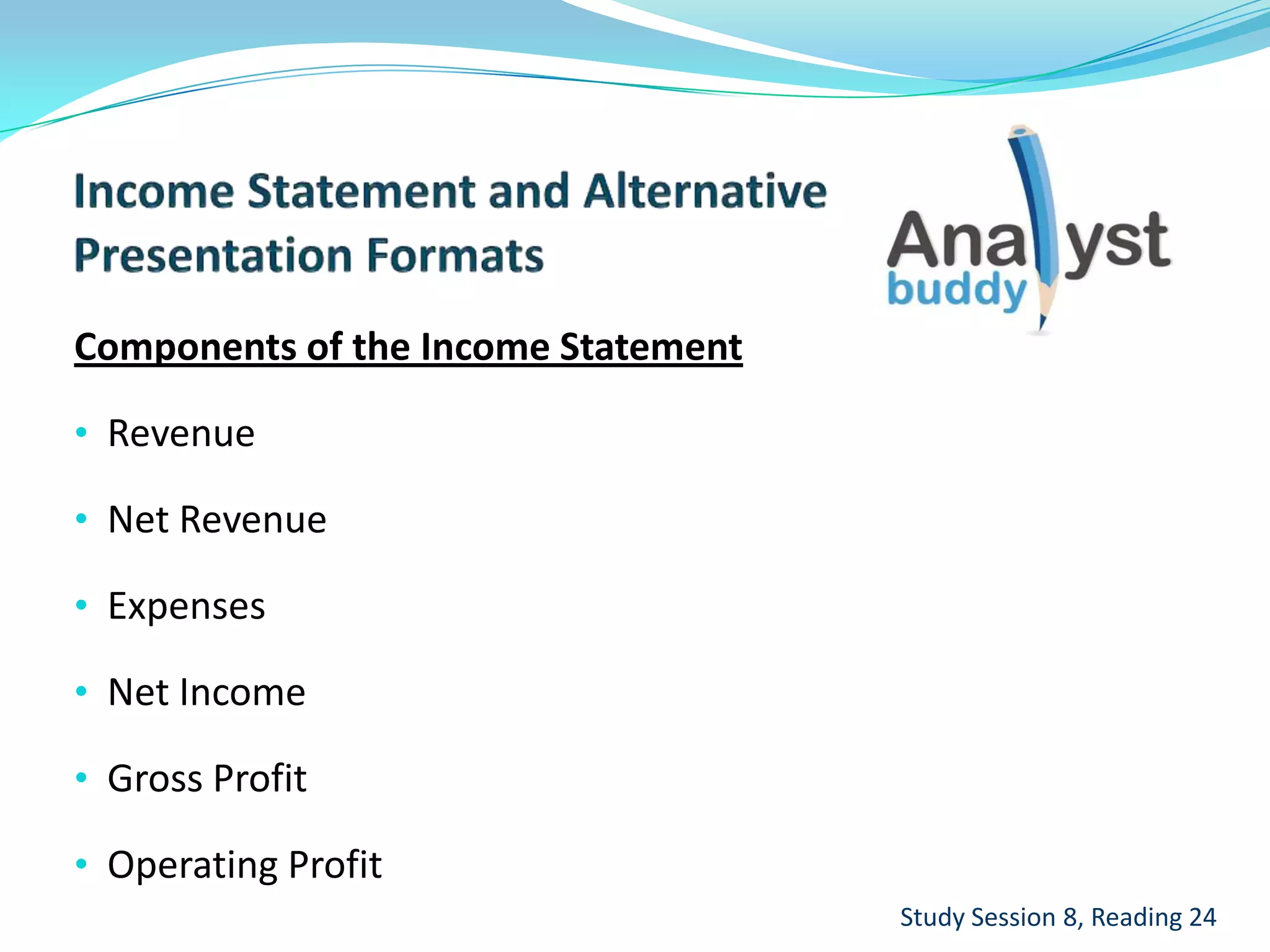
Components of the Income Statement
• Revenue
• Net Revenue
• Expenses
• Net Income
• Gross Profit
• Operating Profit
Study Session 8, Reading 24
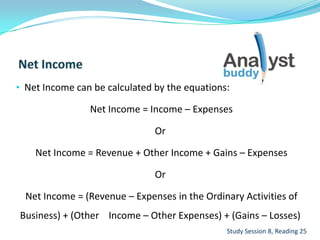
• Net Income can be calculated by the equations:
Net Income = Income – Expenses
Or
Net Income = Revenue + Other Income + Gains – Expenses
Or
Net Income = (Revenue – Expenses in the Ordinary Activities of
Business) + (Other Income – Other Expenses) + (Gains – Losses)
Study Session 8, Reading 25
• Multi-step format
• Single step format.
Study Session 8, Reading 25
• Revenue is recognized when it is earned and revenue is
recorded in financial records when the risk and reward of
ownership is transferred.
• Revenue recognition policies must be disclosed by companies
in the notes to the financial statements
Study Session 8, Reading 25
• Revenue from the sale of goods can be recognized if:
- significant risks and rewards of ownership have been
transferred
- amount of revenue and cost incurred or to be
incurred can be measured reliably
Study Session 8, Reading 25
• percentage-of-completion method
• completed contract method
Study Session 8, Reading 25
• percentage-of-completion method - percentage of contract
completed is estimated
• completed contract method - no income is reported until the
contract is substantially completed
Study Session 8, Reading 25
Gross vs Net Reporting
 Gross revenue - the sales amount received from customers
 net revenue - sale proceeds less costs
Study Session 8, Reading 25
• Expenses are deducted from the revenue to calculate net
profit or loss.
• Expenses include losses as well as expenses that arise during
the course of ordinary activities.
Study Session 8, Reading 25
• Specific Identification Method
• FIFO
• LIFO
• Weighted Average Cost
Study Session 8, Reading 25
• Straight line method
• Accelerated method
• Diminishing balance method
Study Session 8, Reading 25
• Separate expenses and income items related to prior years
that are likely to continue in the future from those items that are
less likely to continue.
Study Session 8, Reading 25
• Extraordinary items and items related to discontinued
operations should be shown separately in the income
statement.
Study Session 8, Reading 25
• Non-operating items are shown separately from operating
items in the income statement.
Study Session 8, Reading 25
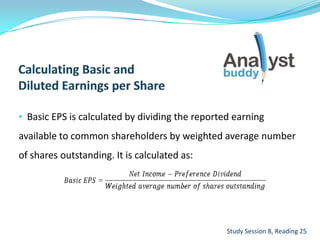
• Basic EPS is calculated by dividing the reported earning
available to common shareholders by weighted average number
of shares outstanding. It is calculated as:
Study Session 8, Reading 25
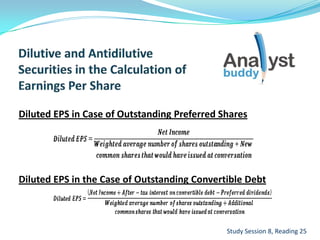
Diluted EPS in Case of Outstanding Preferred Shares
Diluted EPS in the Case of Outstanding Convertible Debt
Study Session 8, Reading 25
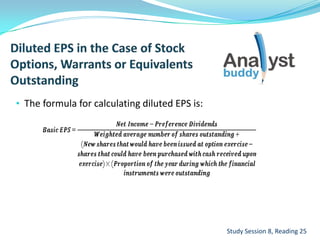
• The formula for calculating diluted EPS is:
Study Session 8, Reading 25
• Obtained by stating each line item of the income statement as
a percentage of sales.
Study Session 8, Reading 25
• Different ratios used to measure profitability are:
• Gross Profit Margin
• Net Profit Margin
• Operating Profit Margin
• Pre-tax Profit Margin.
Study Session 8, Reading 25
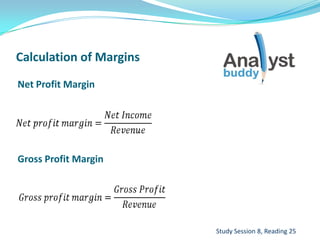
Calculation of Margins
Net Profit Margin
Gross Profit Margin
Study Session 8, Reading 25
Includes both:
• Net Income (from the Statement of Financial Performance)
• Other Comprehensive Income.
Study Session 8, Reading 25
• Foreign Currency Translation Adjustments
• Unrealized Gains or Losses on Derivative Contracts Accounted
as Hedges
• Unrealized Holding Gains and Losses on Available-for-Sale
Securities
• Defined Benefit Post Retirement Plans costs
Study Session 8, Reading 25
The basic elements of the Balance Sheet are:
• Assets
• Liabilities
• Equity
• The equation of balance sheet is:
Assets = Liabilities + Equity
Study Session 8, Reading 26
• Provides information about the financial position of an
enterprise
• Helps analysts measure the liquidity and solvency position of
the company.
Study Session 8, Reading 26
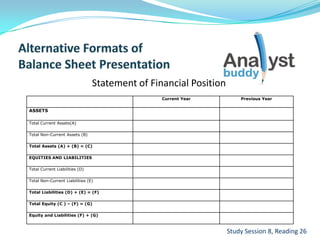
Statement of Financial Position
Study Session 8, Reading 26
Current Year Previous Year
ASSETS
Total Current Assets(A)
Total Non-Current Assets (B)
Total Assets (A) + (B) = (C)
EQUITIES AND LIABILITIES
Total Current Liabilities (D)
Total Non-Current Liabilities (E)
Total Liabilities (D) + (E) = (F)
Total Equity (C ) – (F) = (G)
Equity and Liabilities (F) + (G)
Study Session 8, Reading 26
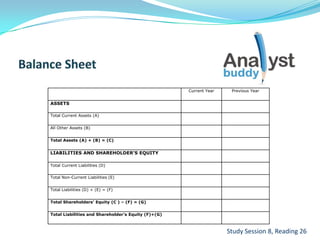
Current Year Previous Year
ASSETS
Total Current Assets (A)
All Other Assets (B)
Total Assets (A) + (B) = (C)
LIABILITIES AND SHAREHOLDER’S EQUITY
Total Current Liabilities (D)
Total Non-Current Liabilities (E)
Total Liabilities (D) + (E) = (F)
Total Shareholders’ Equity (C ) – (F) = (G)
Total Liabilities and Shareholder’s Equity (F)+(G)
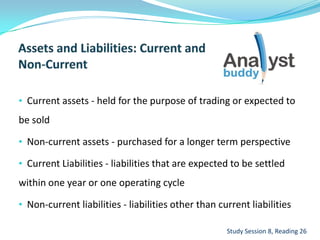
• Current assets - held for the purpose of trading or expected to
be sold
• Non-current assets - purchased for a longer term perspective
• Current Liabilities - liabilities that are expected to be settled
within one year or one operating cycle
• Non-current liabilities - liabilities other than current liabilities
Study Session 8, Reading 26
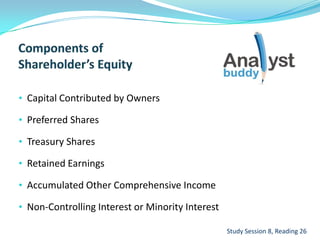
• Capital Contributed by Owners
• Preferred Shares
• Treasury Shares
• Retained Earnings
• Accumulated Other Comprehensive Income
• Non-Controlling Interest or Minority Interest
Study Session 8, Reading 26
• The analysis of the balance sheet helps in assessing the
solvency and liquidity position of the company.
• The Statement of Changes in Equity shows the details of the
increase or decrease in company’s equity over a reporting
period.
Study Session 8, Reading 26
• In vertical common size analysis, each balance sheet item is
shown as a percentage of total assets.
Study Session 8, Reading 26
• Used in comparing the financial position of a company over
a period of time.
• Used to compare the financial position of companies across
the same industry.
• Facilitate the comparison between different size companies.
Study Session 8, Reading 26
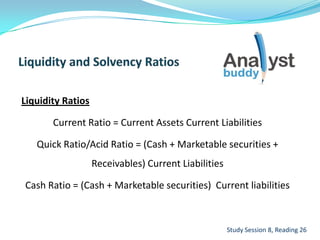
Liquidity Ratios
Current Ratio = Current Assets Current Liabilities
Quick Ratio/Acid Ratio = (Cash + Marketable securities +
Receivables) Current Liabilities
Cash Ratio = (Cash + Marketable securities) Current liabilities
Study Session 8, Reading 26
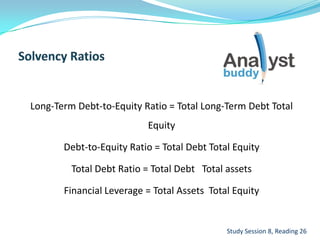
Long-Term Debt-to-Equity Ratio = Total Long-Term Debt Total
Equity
Debt-to-Equity Ratio = Total Debt Total Equity
Total Debt Ratio = Total Debt Total assets
Financial Leverage = Total Assets Total Equity
Study Session 8, Reading 26
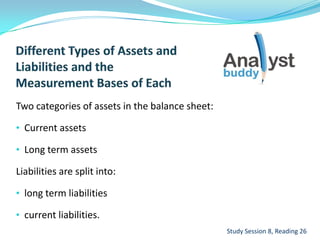
Two categories of assets in the balance sheet:
• Current assets
• Long term assets
Liabilities are split into:
• long term liabilities
• current liabilities.
Study Session 8, Reading 26
The first step in preparing the cash flow statement is
determining the cash flows from operating activities. There are
two methods to complete this:
• The direct and
• Indirect methods
Study Session 8, Reading 27
• Cash received from customers can be calculated as:
= Opening Accounts Receivable + Sales (Credit) – Closing
Accounts Receivable
= Revenue – Increase in Account Receivable
Study Session 8, Reading 27
• Cash paid to suppliers or creditors figures can be calculated as:
= Cost of Goods Sold + Increase in Inventory – Increase in
Accounts Payable
= Opening Creditors + Purchases (Credit) – Closing Creditors
Study Session 8, Reading 27
• Amount paid as salary and wages is calculated as:
= Opening Outstanding Salaries and Wages + Salary and Wages
Expense – Closing Balance of Outstanding Salaries and Wages
• Cash paid for other operating expenses is computed by:
=Other Operating Expenses – Increase in Prepaid Expenses –
Increase in Other Accrued Liabilities
Study Session 8, Reading 27
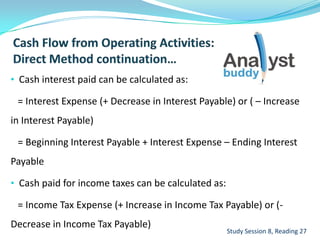
• Cash interest paid can be calculated as:
= Interest Expense (+ Decrease in Interest Payable) or ( – Increase
in Interest Payable)
= Beginning Interest Payable + Interest Expense – Ending Interest
Payable
• Cash paid for income taxes can be calculated as:
= Income Tax Expense (+ Increase in Income Tax Payable) or (-
Decrease in Income Tax Payable)
Study Session 8, Reading 27
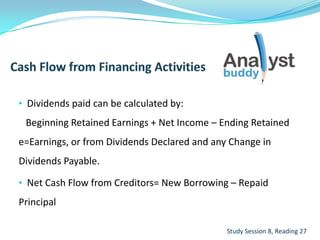
• Dividends paid can be calculated by:
Beginning Retained Earnings + Net Income – Ending Retained
e=Earnings, or from Dividends Declared and any Change in
Dividends Payable.
• Net Cash Flow from Creditors= New Borrowing – Repaid
Principal
Study Session 8, Reading 27
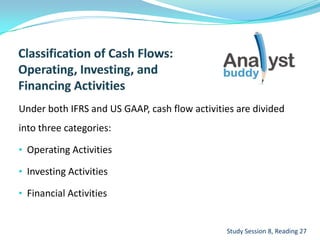
Under both IFRS and US GAAP, cash flow activities are divided
into three categories:
• Operating Activities
• Investing Activities
• Financial Activities
Study Session 8, Reading 27
• There is no flow of cash in non-cash transactions. Hence, these
transactions are not represented in the Cash Flow Statement.
• As these transactions affect a company’s capital and asset
structure, significant non-cash transactions are disclosed in a
separate note or a supplementary schedule to the cash flow
statement.
Study Session 8, Reading 27
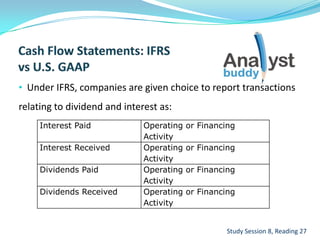
• Under IFRS, companies are given choice to report transactions
relating to dividend and interest as:
Study Session 8, Reading 27
Interest Paid Operating or Financing
Activity
Interest Received Operating or Financing
Activity
Dividends Paid Operating or Financing
Activity
Dividends Received Operating or Financing
Activity
• Direct method - operating cash inflows by sources and operating
cash outflows by uses are disclosed.
• Indirect method - net income is reconciled to operating cash
flows.
Study Session 8, Reading 27
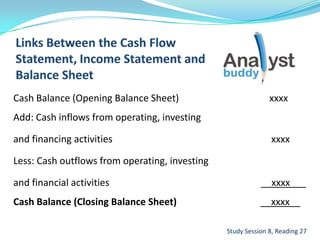
Cash Balance (Opening Balance Sheet) xxxx
Add: Cash inflows from operating, investing
and financing activities xxxx
Less: Cash outflows from operating, investing
and financial activities __xxxx___
Cash Balance (Closing Balance Sheet) __xxxx__
Study Session 8, Reading 27
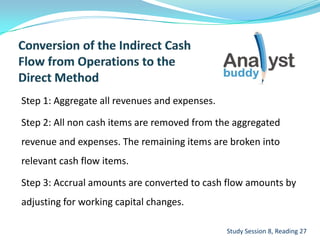
Step 1: Aggregate all revenues and expenses.
Step 2: All non cash items are removed from the aggregated
revenue and expenses. The remaining items are broken into
relevant cash flow items.
Step 3: Accrual amounts are converted to cash flow amounts by
adjusting for working capital changes.
Study Session 8, Reading 27
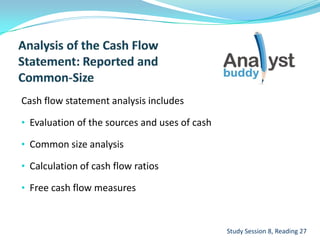
Cash flow statement analysis includes
• Evaluation of the sources and uses of cash
• Common size analysis
• Calculation of cash flow ratios
• Free cash flow measures
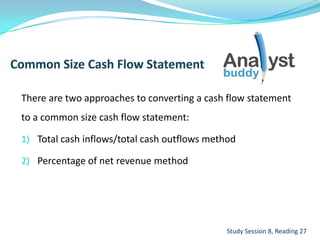
There are two approaches to converting a cash flow statement
to a common size cash flow statement:
1) Total cash inflows/total cash outflows method
2) Percentage of net revenue method
Study Session 8, Reading 27
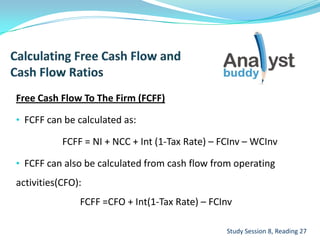
Free Cash Flow To The Firm (FCFF)
• FCFF can be calculated as:
FCFF = NI + NCC + Int (1-Tax Rate) – FCInv – WCInv
• FCFF can also be calculated from cash flow from operating
activities(CFO):
FCFF =CFO + Int(1-Tax Rate) – FCInv
Study Session 8, Reading 27
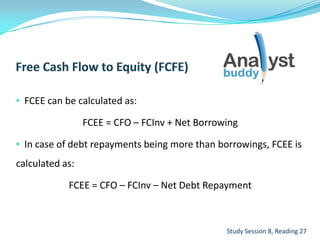
• FCEE can be calculated as:
FCEE = CFO – FCInv + Net Borrowing
• In case of debt repayments being more than borrowings, FCEE is
calculated as:
FCEE = CFO – FCInv – Net Debt Repayment
Study Session 8, Reading 27
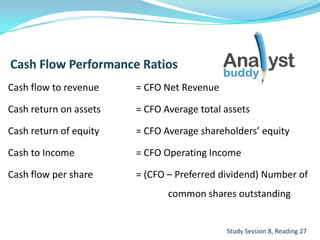
Cash flow to revenue = CFO Net Revenue
Cash return on assets = CFO Average total assets
Cash return of equity = CFO Average shareholders’ equity
Cash to Income = CFO Operating Income
Cash flow per share = (CFO – Preferred dividend) Number of
common shares outstanding
Study Session 8, Reading 27
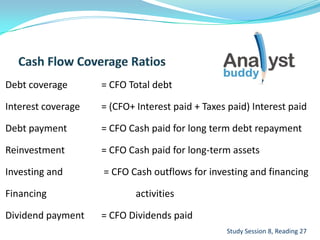
Debt coverage = CFO Total debt
Interest coverage = (CFO+ Interest paid + Taxes paid) Interest paid
Debt payment = CFO Cash paid for long term debt repayment
Reinvestment = CFO Cash paid for long-term assets
Investing and = CFO Cash outflows for investing and financing
Financing activities
Dividend payment = CFO Dividends paid
Study Session 8, Reading 27

L1 flash cards financial reporting (ss8)

  • 1.
    Components of theIncome Statement • Revenue • Net Revenue • Expenses • Net Income • Gross Profit • Operating Profit Study Session 8, Reading 24
  • 2.
    • Net Incomecan be calculated by the equations: Net Income = Income – Expenses Or Net Income = Revenue + Other Income + Gains – Expenses Or Net Income = (Revenue – Expenses in the Ordinary Activities of Business) + (Other Income – Other Expenses) + (Gains – Losses) Study Session 8, Reading 25
  • 3.
    • Multi-step format •Single step format. Study Session 8, Reading 25
  • 4.
    • Revenue isrecognized when it is earned and revenue is recorded in financial records when the risk and reward of ownership is transferred. • Revenue recognition policies must be disclosed by companies in the notes to the financial statements Study Session 8, Reading 25
  • 5.
    • Revenue fromthe sale of goods can be recognized if: - significant risks and rewards of ownership have been transferred - amount of revenue and cost incurred or to be incurred can be measured reliably Study Session 8, Reading 25
  • 6.
    • percentage-of-completion method •completed contract method Study Session 8, Reading 25
  • 7.
    • percentage-of-completion method- percentage of contract completed is estimated • completed contract method - no income is reported until the contract is substantially completed Study Session 8, Reading 25
  • 8.
    Gross vs NetReporting  Gross revenue - the sales amount received from customers  net revenue - sale proceeds less costs Study Session 8, Reading 25
  • 9.
    • Expenses arededucted from the revenue to calculate net profit or loss. • Expenses include losses as well as expenses that arise during the course of ordinary activities. Study Session 8, Reading 25
  • 10.
    • Specific IdentificationMethod • FIFO • LIFO • Weighted Average Cost Study Session 8, Reading 25
  • 11.
    • Straight linemethod • Accelerated method • Diminishing balance method Study Session 8, Reading 25
  • 12.
    • Separate expensesand income items related to prior years that are likely to continue in the future from those items that are less likely to continue. Study Session 8, Reading 25
  • 13.
    • Extraordinary itemsand items related to discontinued operations should be shown separately in the income statement. Study Session 8, Reading 25
  • 14.
    • Non-operating itemsare shown separately from operating items in the income statement. Study Session 8, Reading 25
  • 15.
    • Basic EPSis calculated by dividing the reported earning available to common shareholders by weighted average number of shares outstanding. It is calculated as: Study Session 8, Reading 25
  • 16.
    Diluted EPS inCase of Outstanding Preferred Shares Diluted EPS in the Case of Outstanding Convertible Debt Study Session 8, Reading 25
  • 17.
    • The formulafor calculating diluted EPS is: Study Session 8, Reading 25
  • 18.
    • Obtained bystating each line item of the income statement as a percentage of sales. Study Session 8, Reading 25
  • 19.
    • Different ratiosused to measure profitability are: • Gross Profit Margin • Net Profit Margin • Operating Profit Margin • Pre-tax Profit Margin. Study Session 8, Reading 25
  • 20.
    Calculation of Margins NetProfit Margin Gross Profit Margin Study Session 8, Reading 25
  • 21.
    Includes both: • NetIncome (from the Statement of Financial Performance) • Other Comprehensive Income. Study Session 8, Reading 25
  • 22.
    • Foreign CurrencyTranslation Adjustments • Unrealized Gains or Losses on Derivative Contracts Accounted as Hedges • Unrealized Holding Gains and Losses on Available-for-Sale Securities • Defined Benefit Post Retirement Plans costs Study Session 8, Reading 25
  • 23.
    The basic elementsof the Balance Sheet are: • Assets • Liabilities • Equity • The equation of balance sheet is: Assets = Liabilities + Equity Study Session 8, Reading 26
  • 24.
    • Provides informationabout the financial position of an enterprise • Helps analysts measure the liquidity and solvency position of the company. Study Session 8, Reading 26
  • 25.
    Statement of FinancialPosition Study Session 8, Reading 26 Current Year Previous Year ASSETS Total Current Assets(A) Total Non-Current Assets (B) Total Assets (A) + (B) = (C) EQUITIES AND LIABILITIES Total Current Liabilities (D) Total Non-Current Liabilities (E) Total Liabilities (D) + (E) = (F) Total Equity (C ) – (F) = (G) Equity and Liabilities (F) + (G)
  • 26.
    Study Session 8,Reading 26 Current Year Previous Year ASSETS Total Current Assets (A) All Other Assets (B) Total Assets (A) + (B) = (C) LIABILITIES AND SHAREHOLDER’S EQUITY Total Current Liabilities (D) Total Non-Current Liabilities (E) Total Liabilities (D) + (E) = (F) Total Shareholders’ Equity (C ) – (F) = (G) Total Liabilities and Shareholder’s Equity (F)+(G)
  • 27.
    • Current assets- held for the purpose of trading or expected to be sold • Non-current assets - purchased for a longer term perspective • Current Liabilities - liabilities that are expected to be settled within one year or one operating cycle • Non-current liabilities - liabilities other than current liabilities Study Session 8, Reading 26
  • 28.
    • Capital Contributedby Owners • Preferred Shares • Treasury Shares • Retained Earnings • Accumulated Other Comprehensive Income • Non-Controlling Interest or Minority Interest Study Session 8, Reading 26
  • 29.
    • The analysisof the balance sheet helps in assessing the solvency and liquidity position of the company. • The Statement of Changes in Equity shows the details of the increase or decrease in company’s equity over a reporting period. Study Session 8, Reading 26
  • 30.
    • In verticalcommon size analysis, each balance sheet item is shown as a percentage of total assets. Study Session 8, Reading 26
  • 31.
    • Used incomparing the financial position of a company over a period of time. • Used to compare the financial position of companies across the same industry. • Facilitate the comparison between different size companies. Study Session 8, Reading 26
  • 32.
    Liquidity Ratios Current Ratio= Current Assets Current Liabilities Quick Ratio/Acid Ratio = (Cash + Marketable securities + Receivables) Current Liabilities Cash Ratio = (Cash + Marketable securities) Current liabilities Study Session 8, Reading 26
  • 33.
    Long-Term Debt-to-Equity Ratio= Total Long-Term Debt Total Equity Debt-to-Equity Ratio = Total Debt Total Equity Total Debt Ratio = Total Debt Total assets Financial Leverage = Total Assets Total Equity Study Session 8, Reading 26
  • 34.
    Two categories ofassets in the balance sheet: • Current assets • Long term assets Liabilities are split into: • long term liabilities • current liabilities. Study Session 8, Reading 26
  • 35.
    The first stepin preparing the cash flow statement is determining the cash flows from operating activities. There are two methods to complete this: • The direct and • Indirect methods Study Session 8, Reading 27
  • 36.
    • Cash receivedfrom customers can be calculated as: = Opening Accounts Receivable + Sales (Credit) – Closing Accounts Receivable = Revenue – Increase in Account Receivable Study Session 8, Reading 27
  • 37.
    • Cash paidto suppliers or creditors figures can be calculated as: = Cost of Goods Sold + Increase in Inventory – Increase in Accounts Payable = Opening Creditors + Purchases (Credit) – Closing Creditors Study Session 8, Reading 27
  • 38.
    • Amount paidas salary and wages is calculated as: = Opening Outstanding Salaries and Wages + Salary and Wages Expense – Closing Balance of Outstanding Salaries and Wages • Cash paid for other operating expenses is computed by: =Other Operating Expenses – Increase in Prepaid Expenses – Increase in Other Accrued Liabilities Study Session 8, Reading 27
  • 39.
    • Cash interestpaid can be calculated as: = Interest Expense (+ Decrease in Interest Payable) or ( – Increase in Interest Payable) = Beginning Interest Payable + Interest Expense – Ending Interest Payable • Cash paid for income taxes can be calculated as: = Income Tax Expense (+ Increase in Income Tax Payable) or (- Decrease in Income Tax Payable) Study Session 8, Reading 27
  • 40.
    • Dividends paidcan be calculated by: Beginning Retained Earnings + Net Income – Ending Retained e=Earnings, or from Dividends Declared and any Change in Dividends Payable. • Net Cash Flow from Creditors= New Borrowing – Repaid Principal Study Session 8, Reading 27
  • 41.
    Under both IFRSand US GAAP, cash flow activities are divided into three categories: • Operating Activities • Investing Activities • Financial Activities Study Session 8, Reading 27
  • 42.
    • There isno flow of cash in non-cash transactions. Hence, these transactions are not represented in the Cash Flow Statement. • As these transactions affect a company’s capital and asset structure, significant non-cash transactions are disclosed in a separate note or a supplementary schedule to the cash flow statement. Study Session 8, Reading 27
  • 43.
    • Under IFRS,companies are given choice to report transactions relating to dividend and interest as: Study Session 8, Reading 27 Interest Paid Operating or Financing Activity Interest Received Operating or Financing Activity Dividends Paid Operating or Financing Activity Dividends Received Operating or Financing Activity
  • 44.
    • Direct method- operating cash inflows by sources and operating cash outflows by uses are disclosed. • Indirect method - net income is reconciled to operating cash flows. Study Session 8, Reading 27
  • 45.
    Cash Balance (OpeningBalance Sheet) xxxx Add: Cash inflows from operating, investing and financing activities xxxx Less: Cash outflows from operating, investing and financial activities __xxxx___ Cash Balance (Closing Balance Sheet) __xxxx__ Study Session 8, Reading 27
  • 46.
    Step 1: Aggregateall revenues and expenses. Step 2: All non cash items are removed from the aggregated revenue and expenses. The remaining items are broken into relevant cash flow items. Step 3: Accrual amounts are converted to cash flow amounts by adjusting for working capital changes. Study Session 8, Reading 27
  • 47.
    Study Session 8,Reading 27 Cash flow statement analysis includes • Evaluation of the sources and uses of cash • Common size analysis • Calculation of cash flow ratios • Free cash flow measures
  • 48.
    There are twoapproaches to converting a cash flow statement to a common size cash flow statement: 1) Total cash inflows/total cash outflows method 2) Percentage of net revenue method Study Session 8, Reading 27
  • 49.
    Free Cash FlowTo The Firm (FCFF) • FCFF can be calculated as: FCFF = NI + NCC + Int (1-Tax Rate) – FCInv – WCInv • FCFF can also be calculated from cash flow from operating activities(CFO): FCFF =CFO + Int(1-Tax Rate) – FCInv Study Session 8, Reading 27
  • 50.
    • FCEE canbe calculated as: FCEE = CFO – FCInv + Net Borrowing • In case of debt repayments being more than borrowings, FCEE is calculated as: FCEE = CFO – FCInv – Net Debt Repayment Study Session 8, Reading 27
  • 51.
    Cash flow torevenue = CFO Net Revenue Cash return on assets = CFO Average total assets Cash return of equity = CFO Average shareholders’ equity Cash to Income = CFO Operating Income Cash flow per share = (CFO – Preferred dividend) Number of common shares outstanding Study Session 8, Reading 27
  • 52.
    Debt coverage =CFO Total debt Interest coverage = (CFO+ Interest paid + Taxes paid) Interest paid Debt payment = CFO Cash paid for long term debt repayment Reinvestment = CFO Cash paid for long-term assets Investing and = CFO Cash outflows for investing and financing Financing activities Dividend payment = CFO Dividends paid Study Session 8, Reading 27