Presented by:
Ajeeth Ramanan
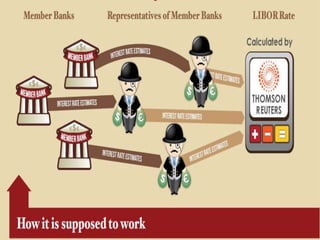
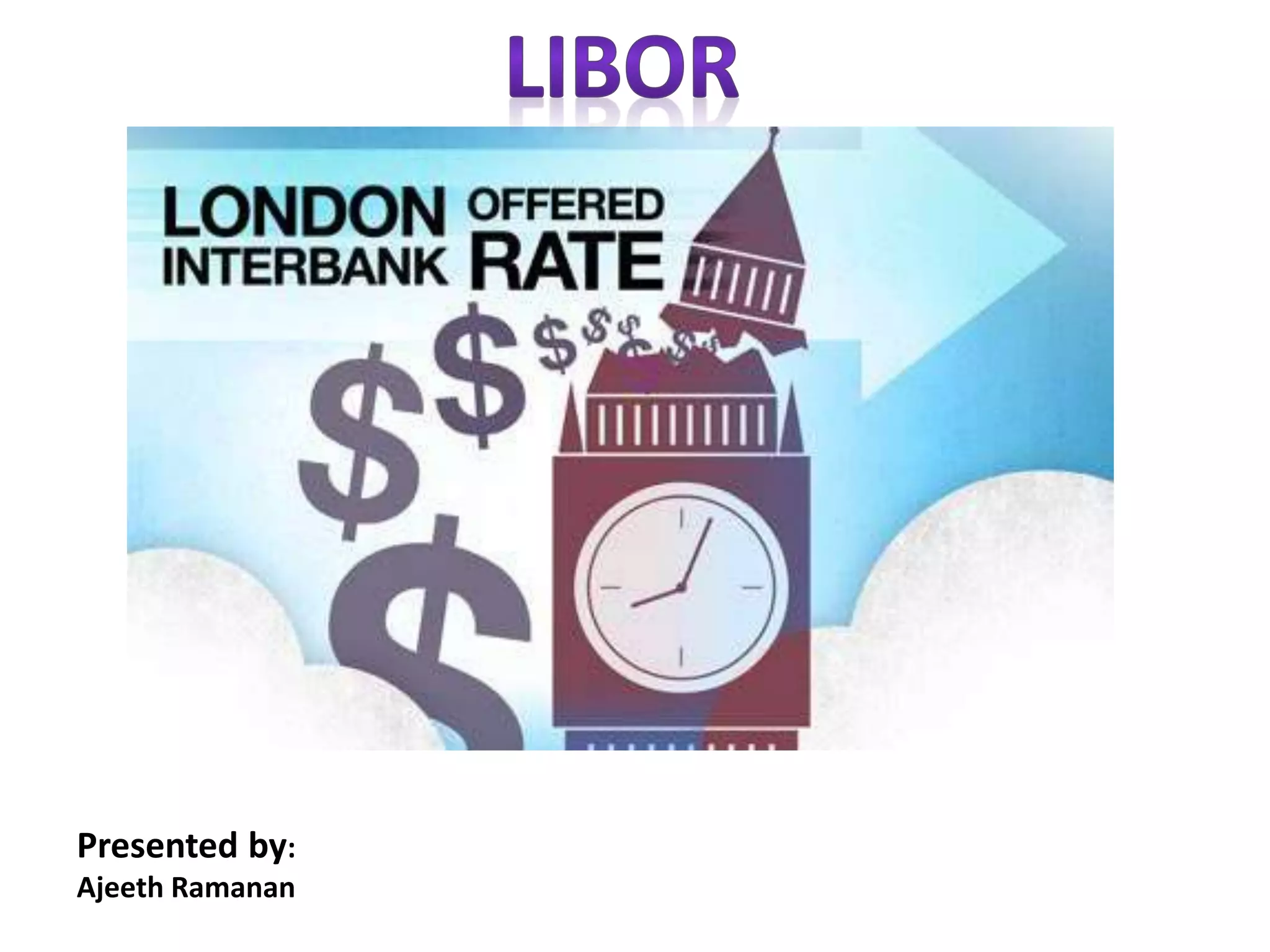
The London Interbank Offered Rate is the average of interest rates estimated by each of the
leading banks in London that it would be charged were it to borrow from other banks.[1] It is
usually abbreviated to Libor or LIBOR, or more officially to ICE LIBOR (for Intercontinental
Exchange Libor). It was formerly known as BBA Libor (for British Bankers' Association Libor
or the trademark bba libor) before the responsibility for the administration was transferred
to Intercontinental Exchange. It is the primary benchmark, along with the Euribor, for short-
term interest rates around the world
Libor rates are calculated for 5 currencies and 7 borrowing periods ranging from overnight
to one year and are published each business day by Thomson Reuters. Many financial
institutions, mortgage lenders and credit card agencies set their own rates relative to it. At
least $350 trillion in derivatives and other financial products are tied to the Libor.
• The London Interbank Offered Rate is the average interest rate estimated by leading
banks in London that they would be charged if borrowing from other banks.
• Libor rates are calculated for ten currencies and fifteen borrowing periods ranging
from overnight to one year and are published daily at 11:30 am (London time)
by Thomson Reuters.
• Many financial institutions, mortgage lenders and credit card agencies set their own
rates relative to it. At least $350 trillion in derivatives and other financial products
are tied to the Libor.
• There are four money markets in the world having interbank offered rate fixings in
USD, including:
• Libor fixed in London
– Mibor, or MIBOR (Mumbai Interbank Offered Rate) fixed in India
– Sibor, or SIBOR (Singapore Interbank Offered Rate) fixed in Singapore
– Hibor, or HIBOR (Hong Kong Interbank Offered Rate) fixed in Hong Kong
• Each LIBOR rate is calculated using the “trimmed mean” of the
contributing banks’ submissions.
•
• Trimmed mean is calculated by discarding the top 25% and bottom 25% of
the submitted interest rates and then taking an average of the remaining
middle 50% (for example, if 18 banks submit rates for the 30-day U.S.
dollar LIBOR rate, the top 4 and bottom 4 submissions are discarded
before an average is taken of the middle 10 submissions)
• This calculation reduces the impact that any single contributing bank can
have on the final officially published rate.
• Nearly $800 trillion in financial instruments—including corporate
debt, mortgages, student loans, interest rate and other
derivatives—reference LIBOR in some form or other.
• LIBOR is often used as the base for variable-rate loans.
• LIBOR has become the shorthand measure of stress in global
money markets.
• LIBOR rates are also used in many derivatives transactions
• On 27 July 2012, The Financial Times published an article by a former
trader that Libor manipulation had been common since 1991. Reports
on this have been flashed on BBC, News Agency Reuters and other
financial programs.
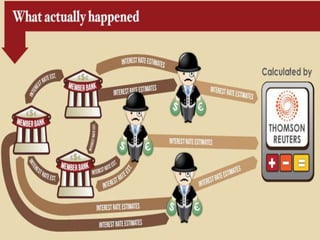
• During the 2007-2012 global financial crisis the banks involved had
artificially lowered rate submissions to make their bank look healthy.
• Two days later the UK Serious Fraud Office opened a criminal
investigation into manipulation of interest rates. The investigation was
not limited to Barclays; around 20 major banks have been named in
investigations and court cases.
• The CFTC (in mid-2008), the SEC (in 2009) and the DOJ (in 2010)
opened investigations into the manipulation of LIBOR.
• On 16th April 2008 – the Wall street Journal released a controversial article
suggesting that some banks might have understated borrowing costs they
reported for the Libor during 2008 credit crunch.
• Two years later in April 2010, a study by economist , Snider and Youle,
corroborated the results of the Wall Street Journal. They argued that banks did
this because they sought to make substantial profits on their large Libor
interest-linked-Portfolios.ion of these banks
• In 2009 the Citigroup reported that it would make $936 million in net interest
revenue if interest rates fall by .25% and that they would make $1935 million if
the interest rates fall by 1%.
• The Governor and the deputy Governor of the Bank of England were aware
that because of industry concerns the Libor rate was being under-reported
• A trader from Royal Bank of Scotland claimed that it was a common practice
among senior employees of the bank to make requests to the bank’s rate
setters to appropriate Libor rate.
• The Federal Reserve Bank of New York first received indications of inaccurate
LIBOR rates in the fall of 2007 as a part of its normal market intelligence
gathering process.
• Canadian branches of Royal Bank of Scotland/HSBC/Deutsche Bank/JPMorgan
Bank/Citibank were involved in this.
• On 27 June 2012—Barclay’s bank was the first to be fined $200 million by
Commodity Futures Trading Commission/ $160 million by the U.S. Department
of Justice – for attempting to manipulate Libor rates in 2007-12.
Did U.S. and U.K. regulators know about the
manipulation of LIBOR at the time it was occurring,
and what has their response entailed?
YES!!!
The Fed first received concrete information that LIBOR rates were being
intentionally misreported on April 11, 2008 during a call with a Barclays employee,
who explained that Barclays was under-reporting its rate to “avoid the stigma
associated with being an outlier with respect to its LIBOR submissions, relative to
other participating banks.
The manipulation of LIBOR continued through at least mid-2009, not just for the
sake of avoiding the stigma associated with appearing weak during the financial
crisis, but also for the then unknown motive of benefitting individual derivatives
trades.
• Barclays bank has had to pay nearly $453 million dollars in penalties to
U.S. and U.K. regulators. Barclays received an estimated 30 percent
discount on its penalties in exchange for cooperating fully with the
authorities’ ongoing investigation.
• Early estimates are that the rate manipulation scandal cost US states,
counties, and local governments at least $6 billion in fraudulent interest
payments, above $4 billion that state and local governments have already
had to spend to unwind their positions exposed to rate manipulation. An
increasingly smaller set of banks are participating in setting the LIBOR,
calling into question its future as a benchmark standard, but without any
viable alternative to replace it.
• The administration of Libor has itself become a regulated activity overseen by the
UK's Financial Conduct Authority.[31] Furthermore, knowingly or deliberately making
false or misleading statements in relation to benchmark-setting was made a criminal
offence in UK law under the Financial Services Act 2012.
• The Danish, Swedish, Canadian, Australian and New Zealand Libor rates have been
terminated.
• From the end of July 2013, only five currencies and seven maturities will be quoted
every day (35 rates), reduced from 150 different Libor rates – 15 maturities for each of
ten currencies, making it more likely that the rates submitted are underpinned by real
trades.
• Since the beginning of July 2013, each individual submission that comes in from the
banks is embargoed for three months to reduce the motivation to submit a false rate
to portray a flattering picture of creditworthiness.
Libor

Libor

  • 1.
  • 2.
    The London InterbankOffered Rate is the average of interest rates estimated by each of the leading banks in London that it would be charged were it to borrow from other banks.[1] It is usually abbreviated to Libor or LIBOR, or more officially to ICE LIBOR (for Intercontinental Exchange Libor). It was formerly known as BBA Libor (for British Bankers' Association Libor or the trademark bba libor) before the responsibility for the administration was transferred to Intercontinental Exchange. It is the primary benchmark, along with the Euribor, for short- term interest rates around the world Libor rates are calculated for 5 currencies and 7 borrowing periods ranging from overnight to one year and are published each business day by Thomson Reuters. Many financial institutions, mortgage lenders and credit card agencies set their own rates relative to it. At least $350 trillion in derivatives and other financial products are tied to the Libor.
  • 3.
    • The LondonInterbank Offered Rate is the average interest rate estimated by leading banks in London that they would be charged if borrowing from other banks. • Libor rates are calculated for ten currencies and fifteen borrowing periods ranging from overnight to one year and are published daily at 11:30 am (London time) by Thomson Reuters. • Many financial institutions, mortgage lenders and credit card agencies set their own rates relative to it. At least $350 trillion in derivatives and other financial products are tied to the Libor. • There are four money markets in the world having interbank offered rate fixings in USD, including: • Libor fixed in London – Mibor, or MIBOR (Mumbai Interbank Offered Rate) fixed in India – Sibor, or SIBOR (Singapore Interbank Offered Rate) fixed in Singapore – Hibor, or HIBOR (Hong Kong Interbank Offered Rate) fixed in Hong Kong
  • 4.
    • Each LIBORrate is calculated using the “trimmed mean” of the contributing banks’ submissions. • • Trimmed mean is calculated by discarding the top 25% and bottom 25% of the submitted interest rates and then taking an average of the remaining middle 50% (for example, if 18 banks submit rates for the 30-day U.S. dollar LIBOR rate, the top 4 and bottom 4 submissions are discarded before an average is taken of the middle 10 submissions) • This calculation reduces the impact that any single contributing bank can have on the final officially published rate.
  • 5.
    • Nearly $800trillion in financial instruments—including corporate debt, mortgages, student loans, interest rate and other derivatives—reference LIBOR in some form or other. • LIBOR is often used as the base for variable-rate loans. • LIBOR has become the shorthand measure of stress in global money markets. • LIBOR rates are also used in many derivatives transactions
  • 8.
    • On 27July 2012, The Financial Times published an article by a former trader that Libor manipulation had been common since 1991. Reports on this have been flashed on BBC, News Agency Reuters and other financial programs. • During the 2007-2012 global financial crisis the banks involved had artificially lowered rate submissions to make their bank look healthy. • Two days later the UK Serious Fraud Office opened a criminal investigation into manipulation of interest rates. The investigation was not limited to Barclays; around 20 major banks have been named in investigations and court cases. • The CFTC (in mid-2008), the SEC (in 2009) and the DOJ (in 2010) opened investigations into the manipulation of LIBOR.
  • 9.
    • On 16thApril 2008 – the Wall street Journal released a controversial article suggesting that some banks might have understated borrowing costs they reported for the Libor during 2008 credit crunch. • Two years later in April 2010, a study by economist , Snider and Youle, corroborated the results of the Wall Street Journal. They argued that banks did this because they sought to make substantial profits on their large Libor interest-linked-Portfolios.ion of these banks • In 2009 the Citigroup reported that it would make $936 million in net interest revenue if interest rates fall by .25% and that they would make $1935 million if the interest rates fall by 1%. • The Governor and the deputy Governor of the Bank of England were aware that because of industry concerns the Libor rate was being under-reported
  • 10.
    • A traderfrom Royal Bank of Scotland claimed that it was a common practice among senior employees of the bank to make requests to the bank’s rate setters to appropriate Libor rate. • The Federal Reserve Bank of New York first received indications of inaccurate LIBOR rates in the fall of 2007 as a part of its normal market intelligence gathering process. • Canadian branches of Royal Bank of Scotland/HSBC/Deutsche Bank/JPMorgan Bank/Citibank were involved in this. • On 27 June 2012—Barclay’s bank was the first to be fined $200 million by Commodity Futures Trading Commission/ $160 million by the U.S. Department of Justice – for attempting to manipulate Libor rates in 2007-12.
  • 11.
    Did U.S. andU.K. regulators know about the manipulation of LIBOR at the time it was occurring, and what has their response entailed? YES!!! The Fed first received concrete information that LIBOR rates were being intentionally misreported on April 11, 2008 during a call with a Barclays employee, who explained that Barclays was under-reporting its rate to “avoid the stigma associated with being an outlier with respect to its LIBOR submissions, relative to other participating banks. The manipulation of LIBOR continued through at least mid-2009, not just for the sake of avoiding the stigma associated with appearing weak during the financial crisis, but also for the then unknown motive of benefitting individual derivatives trades.
  • 12.
    • Barclays bankhas had to pay nearly $453 million dollars in penalties to U.S. and U.K. regulators. Barclays received an estimated 30 percent discount on its penalties in exchange for cooperating fully with the authorities’ ongoing investigation. • Early estimates are that the rate manipulation scandal cost US states, counties, and local governments at least $6 billion in fraudulent interest payments, above $4 billion that state and local governments have already had to spend to unwind their positions exposed to rate manipulation. An increasingly smaller set of banks are participating in setting the LIBOR, calling into question its future as a benchmark standard, but without any viable alternative to replace it.
  • 13.
    • The administrationof Libor has itself become a regulated activity overseen by the UK's Financial Conduct Authority.[31] Furthermore, knowingly or deliberately making false or misleading statements in relation to benchmark-setting was made a criminal offence in UK law under the Financial Services Act 2012. • The Danish, Swedish, Canadian, Australian and New Zealand Libor rates have been terminated. • From the end of July 2013, only five currencies and seven maturities will be quoted every day (35 rates), reduced from 150 different Libor rates – 15 maturities for each of ten currencies, making it more likely that the rates submitted are underpinned by real trades. • Since the beginning of July 2013, each individual submission that comes in from the banks is embargoed for three months to reduce the motivation to submit a false rate to portray a flattering picture of creditworthiness.