• Provide information about a company’s financial performance,
financial position and changes in financial position.
• Include audited financial statements
• Financial Statement Analysis uses financial reports of the
company
Study Session 7, Reading 22
• There are 4 basic financial statements:
- Statement of Financial Position
- Statement of Comprehensive Income
- Statement of Changes in Equity
- Statement of Cash Flows
Study Session 7, Reading 22
• The following equation represents relation between three
components of the Balance Sheet:
Assets = Liabilities + Owner’s Equity
Study Session 7, Reading 22
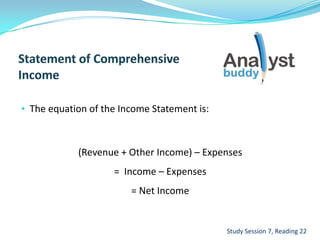
• The equation of the Income Statement is:
(Revenue + Other Income) – Expenses
= Income – Expenses
= Net Income
Study Session 7, Reading 22
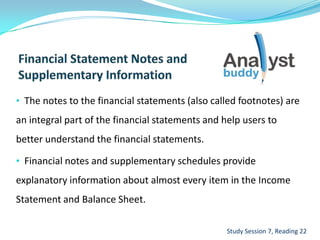
• The notes to the financial statements (also called footnotes) are
an integral part of the financial statements and help users to
better understand the financial statements.
• Financial notes and supplementary schedules provide
explanatory information about almost every item in the Income
Statement and Balance Sheet.
Study Session 7, Reading 22
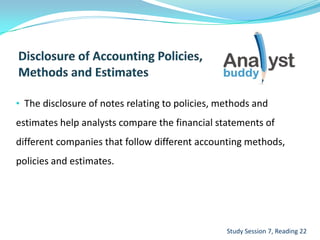
• The disclosure of notes relating to policies, methods and
estimates help analysts compare the financial statements of
different companies that follow different accounting methods,
policies and estimates.
Study Session 7, Reading 22
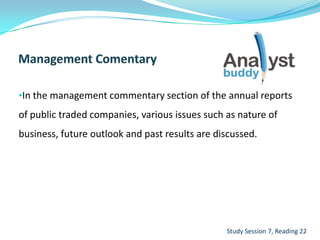
•In the management commentary section of the annual reports
of public traded companies, various issues such as nature of
business, future outlook and past results are discussed.
Study Session 7, Reading 22
• Financial statements of companies are required to be audited in
accordance with specific auditing standards.
• A written opinion on the financial statements by the
independent auditor is called an Audit Report.
Study Session 7, Reading 22
• Unqualified or clean audit opinion
• Qualified audit opinion
• Adverse opinion
• Disclaimer of opinion
Study Session 7, Reading 22
• While undertaking analysis, analysts also consider other
information provided by management and information from
external sources.
• Besides financial statements, notes and supplementary
information and auditor’s reports; the companies provide other
information through annual reports, press release, websites,
conference calls etc.
Study Session 7, Reading 22
• Industry
• Economy
• Peer companies.
Study Session 7, Reading 22
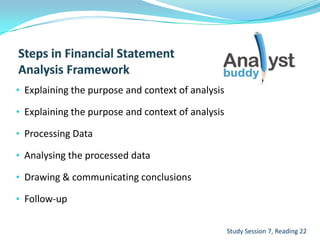
• Explaining the purpose and context of analysis
• Processing Data
• Analysing the processed data
• Drawing & communicating conclusions
• Follow-up
Study Session 7, Reading 22
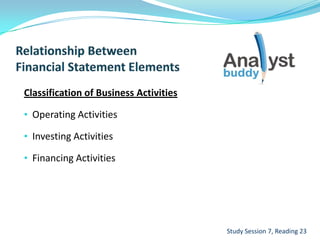
Classification of Business Activities
• Operating Activities
• Investing Activities
• Financing Activities
Study Session 7, Reading 23
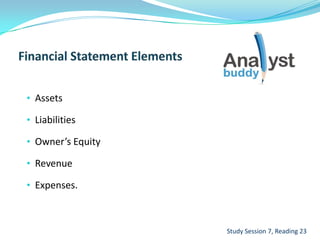
• Assets
• Liabilities
• Owner’s Equity
• Revenue
• Expenses.
Study Session 7, Reading 23
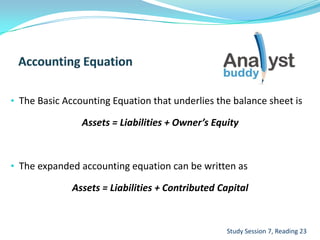
• The Basic Accounting Equation that underlies the balance sheet is
Assets = Liabilities + Owner’s Equity
• The expanded accounting equation can be written as
Assets = Liabilities + Contributed Capital
Study Session 7, Reading 23
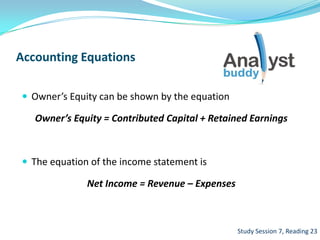
Accounting Equations
 Owner’s Equity can be shown by the equation
Owner’s Equity = Contributed Capital + Retained Earnings
 The equation of the income statement is
Net Income = Revenue – Expenses
Study Session 7, Reading 23
• The accounting process involves recording business transactions in
such a way that periodic financial statements can be prepared.
• Recording of business transactions in the accounting system is
done with the help of basic and expanded accounting equations.
Study Session 7, Reading 23
• Identifying the affected account, amount and whether there is
increase or decrease.
• Determining the element type of account affected.
• Entering the amount into the appropriate column or
spreadsheet.
• Ensuring the accounting equation is in balance.
Study Session 7, Reading 23
• Revenues should be recorded when earned and expenses should
be recorded when incurred irrespective of when the cash related to
the transaction received or paid.
• The purpose of accrual accounting is to ensure that revenues and
expenses are recorded in the proper accounting period.
Study Session 7, Reading 23
• Deferred revenue
• Accrued revenue
• Prepaid expenses
• Accrued expenses
Study Session 7, Reading 23
• The equation underlying retained earnings can be represented
as:
Ending Retained Earnings= Beginning Retained Earning + Net
Income – Dividends
Study Session 7, Reading 23
• Income Statement equation:
Assets = Liabilities + Contributed Capital + Ending Retained
Earnings
or
Assets = Liabilities + Contributed Capital + Beginning Retained
Earnings + Revenue – Expenses – Dividends
Study Session 7, Reading 23
• The flow of information in an accounting system involves the
following steps:
• Journal entries and adjusting entries
• General ledger and T-accounts
• Trial balance and adjusted trial balance
• Financial statements.
Study Session 7, Reading 23
• Financial reports that are used by analysts in security valuation,
equity analysis, and credit analysis.
Study Session 7, Reading 23
• Include financial statements and other supplementary
disclosures.
• Describe principles that should be used in preparing financial
reports.
Study Session 7, Reading 24
• To provide financial information
• Requires a company to choose from different policies and
estimates
• Try to ensure consistency in the judgements.
• Developed in accordance with a framework.
Study Session 7, Reading 24
• International Accounting Standard Board (IASB)
• Financial Accounting Standards Board (FASB).
• Securities and Exchange Commission (SEC)
• Financial Service Authority (FSA)
Study Session 7, Reading 24
• Should be clearly defined
• Should be independent and should not be under the influence of
pressure from external sources.
• Should observe high professional standards, standards of ethics,
and confidentiality.
• Should be in public interest
Study Session 7, Reading 24
• To protect investor’s interests, ensuring transparency and
efficiency in markets and reducing systematic risk.
• To ensure uniform regulation across world markets.
Study Session 7, Reading 24
• The IASB, FASB and other standard setters are trying to achieve
convergence of financial reporting standards across the globe.
• With the efforts to move towards global convergence,
challenges to the convergence are also becoming apparent.
Study Session 7, Reading 24
• Differences in institutional, regulatory, cultural and the
business environment,
• Changes.
• political pressure
• Enforcement is not uniform and standards are not applied
consistently
Study Session 7, Reading 24
• The conceptual framework is helpful in:
–Assisting standard setters
–Guiding preparers
–Helping auditors
–Assisting analysts
Study Session 7, Reading 24
• Relevance
• Materiality
• Faithful Representation
Assumptions in Preparing Financial Statements
• Accrual Accounting
• Going Concern
Study Session 7, Reading 24
• Assets
• Liabilities
• Equity
• Revenue
• Expenses
Study Session 7, Reading 24
• Statement of Financial Position
• Single Statement of Comprehensive Income or two statements
• Statement of Changes in Equity
• Statement of Cash Flows
Study Session 7, Reading 22
• Assets and liabilities should be classified as either current and
non-current.
• There should be specific disclosures in the notes about the
information provided in the financial statements.
Study Session 7, Reading 24
• Companies use either IFRS or US GAAP standard when
preparing financial reports.
• Though these two systems of standards are converging, there
still remains difference regarding the framework and general
reporting requirements.
Study Session 7, Reading 24
• There should be full disclosure
• Should be comprehensive
• should have consistency
Study Session 7, Reading 24
• Various bases for measuring the value of assets and liabilities.
• Establishing financial reporting standards based on different
approaches.
• Difficulty in establishing financial reporting standards .
Study Session 7, Reading 24
• Though there has been advancement towards global
convergence of financial reporting system, there are significant
differences in financial reporting system in global capital
markets.
Study Session 7, Reading 24
• An analyst has to monitor the following three areas:
–new products or transactions.
–actions of standard setters and other groups representing
users of financial statements.
–disclosure of accounting policies and estimates by
companies.
Study Session 7, Reading 24
• In the notes to the financial statements and accompanying
discussion, companies provide information about accounting
policies and estimates.
• The policies that management deems important are discussed
in management commentary.
Study Session 7, Reading 24
• Changes in accounting policies may be driven by changes in
some accounting standards or by the company voluntarily
changing the policy.
Study Session 7, Reading 24

L1 flash cards financial reporting (ss7)

  • 1.
    • Provide informationabout a company’s financial performance, financial position and changes in financial position. • Include audited financial statements • Financial Statement Analysis uses financial reports of the company Study Session 7, Reading 22
  • 2.
    • There are4 basic financial statements: - Statement of Financial Position - Statement of Comprehensive Income - Statement of Changes in Equity - Statement of Cash Flows Study Session 7, Reading 22
  • 3.
    • The followingequation represents relation between three components of the Balance Sheet: Assets = Liabilities + Owner’s Equity Study Session 7, Reading 22
  • 4.
    • The equationof the Income Statement is: (Revenue + Other Income) – Expenses = Income – Expenses = Net Income Study Session 7, Reading 22
  • 5.
    • The notesto the financial statements (also called footnotes) are an integral part of the financial statements and help users to better understand the financial statements. • Financial notes and supplementary schedules provide explanatory information about almost every item in the Income Statement and Balance Sheet. Study Session 7, Reading 22
  • 6.
    • The disclosureof notes relating to policies, methods and estimates help analysts compare the financial statements of different companies that follow different accounting methods, policies and estimates. Study Session 7, Reading 22
  • 7.
    •In the managementcommentary section of the annual reports of public traded companies, various issues such as nature of business, future outlook and past results are discussed. Study Session 7, Reading 22
  • 8.
    • Financial statementsof companies are required to be audited in accordance with specific auditing standards. • A written opinion on the financial statements by the independent auditor is called an Audit Report. Study Session 7, Reading 22
  • 9.
    • Unqualified orclean audit opinion • Qualified audit opinion • Adverse opinion • Disclaimer of opinion Study Session 7, Reading 22
  • 10.
    • While undertakinganalysis, analysts also consider other information provided by management and information from external sources. • Besides financial statements, notes and supplementary information and auditor’s reports; the companies provide other information through annual reports, press release, websites, conference calls etc. Study Session 7, Reading 22
  • 11.
    • Industry • Economy •Peer companies. Study Session 7, Reading 22
  • 12.
    • Explaining thepurpose and context of analysis • Explaining the purpose and context of analysis • Processing Data • Analysing the processed data • Drawing & communicating conclusions • Follow-up Study Session 7, Reading 22
  • 13.
    Classification of BusinessActivities • Operating Activities • Investing Activities • Financing Activities Study Session 7, Reading 23
  • 14.
    • Assets • Liabilities •Owner’s Equity • Revenue • Expenses. Study Session 7, Reading 23
  • 15.
    • The BasicAccounting Equation that underlies the balance sheet is Assets = Liabilities + Owner’s Equity • The expanded accounting equation can be written as Assets = Liabilities + Contributed Capital Study Session 7, Reading 23
  • 16.
    Accounting Equations  Owner’sEquity can be shown by the equation Owner’s Equity = Contributed Capital + Retained Earnings  The equation of the income statement is Net Income = Revenue – Expenses Study Session 7, Reading 23
  • 17.
    • The accountingprocess involves recording business transactions in such a way that periodic financial statements can be prepared. • Recording of business transactions in the accounting system is done with the help of basic and expanded accounting equations. Study Session 7, Reading 23
  • 18.
    • Identifying theaffected account, amount and whether there is increase or decrease. • Determining the element type of account affected. • Entering the amount into the appropriate column or spreadsheet. • Ensuring the accounting equation is in balance. Study Session 7, Reading 23
  • 19.
    • Revenues shouldbe recorded when earned and expenses should be recorded when incurred irrespective of when the cash related to the transaction received or paid. • The purpose of accrual accounting is to ensure that revenues and expenses are recorded in the proper accounting period. Study Session 7, Reading 23
  • 20.
    • Deferred revenue •Accrued revenue • Prepaid expenses • Accrued expenses Study Session 7, Reading 23
  • 21.
    • The equationunderlying retained earnings can be represented as: Ending Retained Earnings= Beginning Retained Earning + Net Income – Dividends Study Session 7, Reading 23
  • 22.
    • Income Statementequation: Assets = Liabilities + Contributed Capital + Ending Retained Earnings or Assets = Liabilities + Contributed Capital + Beginning Retained Earnings + Revenue – Expenses – Dividends Study Session 7, Reading 23
  • 23.
    • The flowof information in an accounting system involves the following steps: • Journal entries and adjusting entries • General ledger and T-accounts • Trial balance and adjusted trial balance • Financial statements. Study Session 7, Reading 23
  • 24.
    • Financial reportsthat are used by analysts in security valuation, equity analysis, and credit analysis. Study Session 7, Reading 23
  • 25.
    • Include financialstatements and other supplementary disclosures. • Describe principles that should be used in preparing financial reports. Study Session 7, Reading 24
  • 26.
    • To providefinancial information • Requires a company to choose from different policies and estimates • Try to ensure consistency in the judgements. • Developed in accordance with a framework. Study Session 7, Reading 24
  • 27.
    • International AccountingStandard Board (IASB) • Financial Accounting Standards Board (FASB). • Securities and Exchange Commission (SEC) • Financial Service Authority (FSA) Study Session 7, Reading 24
  • 28.
    • Should beclearly defined • Should be independent and should not be under the influence of pressure from external sources. • Should observe high professional standards, standards of ethics, and confidentiality. • Should be in public interest Study Session 7, Reading 24
  • 29.
    • To protectinvestor’s interests, ensuring transparency and efficiency in markets and reducing systematic risk. • To ensure uniform regulation across world markets. Study Session 7, Reading 24
  • 30.
    • The IASB,FASB and other standard setters are trying to achieve convergence of financial reporting standards across the globe. • With the efforts to move towards global convergence, challenges to the convergence are also becoming apparent. Study Session 7, Reading 24
  • 31.
    • Differences ininstitutional, regulatory, cultural and the business environment, • Changes. • political pressure • Enforcement is not uniform and standards are not applied consistently Study Session 7, Reading 24
  • 32.
    • The conceptualframework is helpful in: –Assisting standard setters –Guiding preparers –Helping auditors –Assisting analysts Study Session 7, Reading 24
  • 33.
    • Relevance • Materiality •Faithful Representation Assumptions in Preparing Financial Statements • Accrual Accounting • Going Concern Study Session 7, Reading 24
  • 34.
    • Assets • Liabilities •Equity • Revenue • Expenses Study Session 7, Reading 24
  • 35.
    • Statement ofFinancial Position • Single Statement of Comprehensive Income or two statements • Statement of Changes in Equity • Statement of Cash Flows Study Session 7, Reading 22
  • 36.
    • Assets andliabilities should be classified as either current and non-current. • There should be specific disclosures in the notes about the information provided in the financial statements. Study Session 7, Reading 24
  • 37.
    • Companies useeither IFRS or US GAAP standard when preparing financial reports. • Though these two systems of standards are converging, there still remains difference regarding the framework and general reporting requirements. Study Session 7, Reading 24
  • 38.
    • There shouldbe full disclosure • Should be comprehensive • should have consistency Study Session 7, Reading 24
  • 39.
    • Various basesfor measuring the value of assets and liabilities. • Establishing financial reporting standards based on different approaches. • Difficulty in establishing financial reporting standards . Study Session 7, Reading 24
  • 40.
    • Though therehas been advancement towards global convergence of financial reporting system, there are significant differences in financial reporting system in global capital markets. Study Session 7, Reading 24
  • 41.
    • An analysthas to monitor the following three areas: –new products or transactions. –actions of standard setters and other groups representing users of financial statements. –disclosure of accounting policies and estimates by companies. Study Session 7, Reading 24
  • 42.
    • In thenotes to the financial statements and accompanying discussion, companies provide information about accounting policies and estimates. • The policies that management deems important are discussed in management commentary. Study Session 7, Reading 24
  • 43.
    • Changes inaccounting policies may be driven by changes in some accounting standards or by the company voluntarily changing the policy. Study Session 7, Reading 24