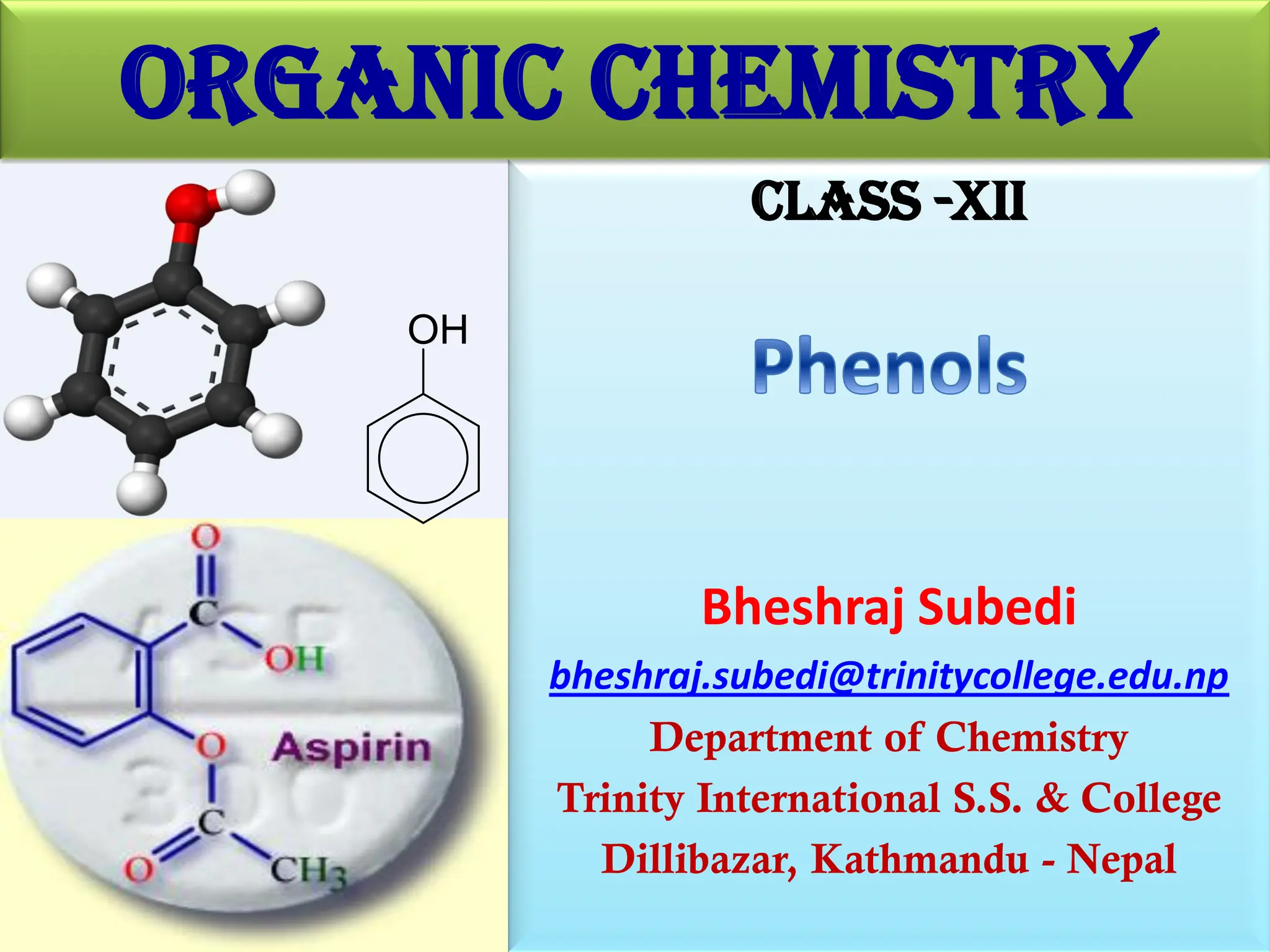
Class -XII
Bheshraj Subedi
bheshraj.subedi@trinitycollege.edu.np
Department of Chemistry
Trinity International S.S. & College
Dillibazar, Kathmandu - Nepal
ORGANIC CHEMISTRY
 Introduction of phenol
 Nomenclature of phenols
 General methods of preparation of phenols
 Physical properties of phenols
 Chemical properties of phenols
 Test of phenol
 Uses of phenols
 Some important questions for exam
Course content
Phenols
Introduction
The hydroxy derivative of arenes (Aromatic
hydrocarbon) in which the –OH group is directly
attached to carbon atom of aromatic ring are called
phenols. They are formed by replacing one or more
hydrogen atom by –OH group in benzene ring.
[The –OH group is bonded to
carbon atom of side chain of
aromatic ring are called
aromatic alcohol]
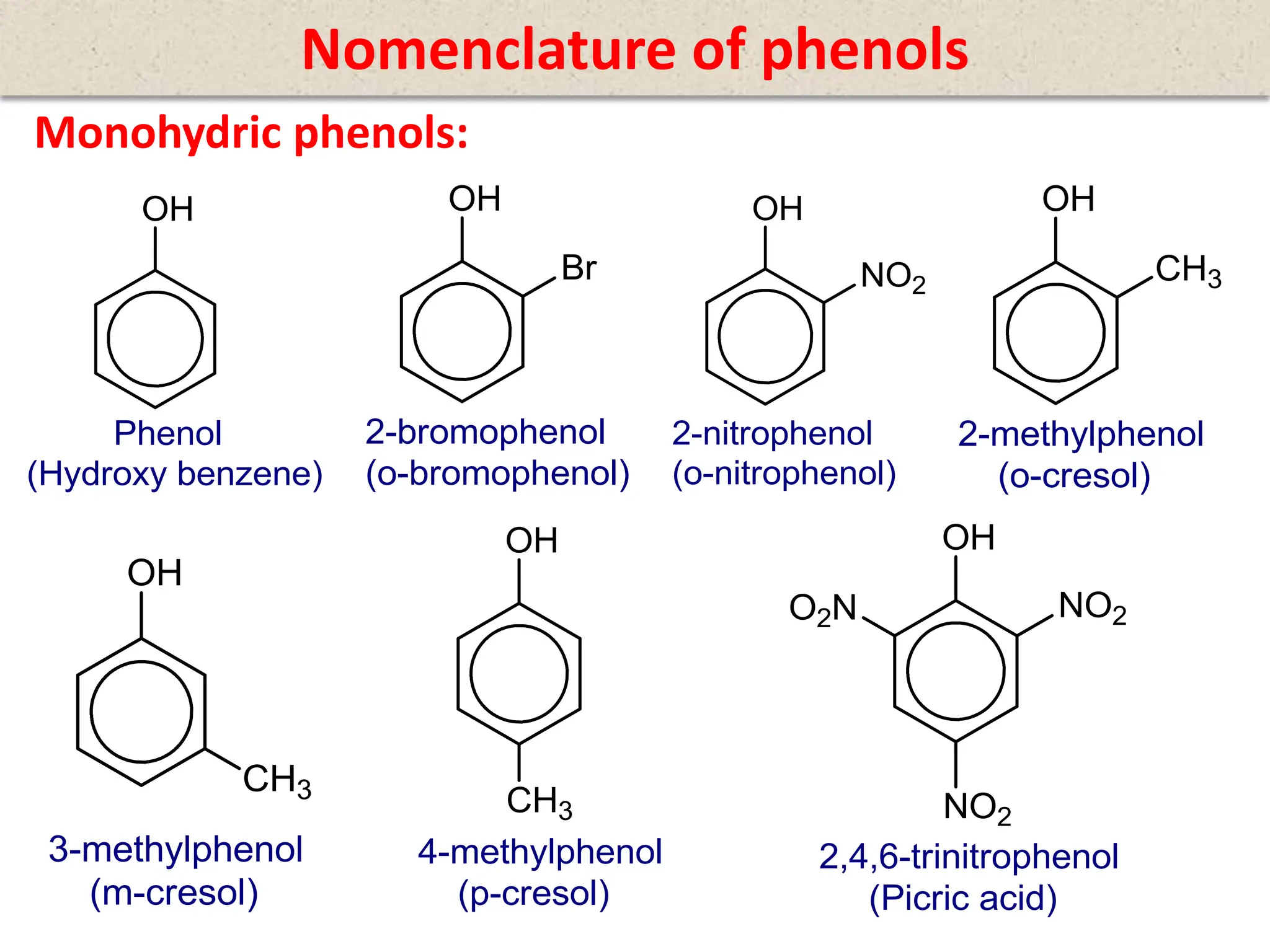
Monohydric phenols:
Nomenclature of phenols
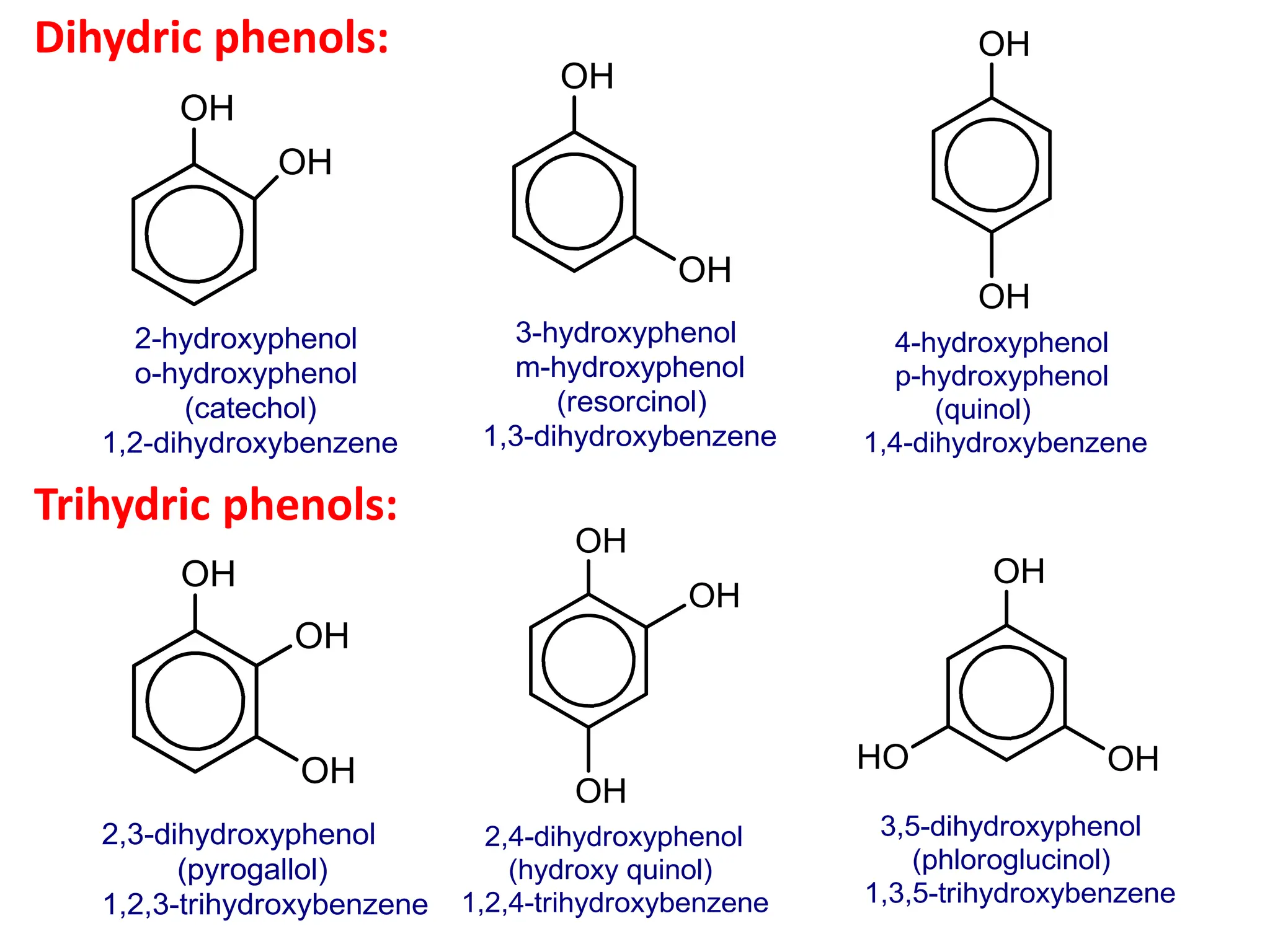
Dihydric phenols:
Trihydric phenols:
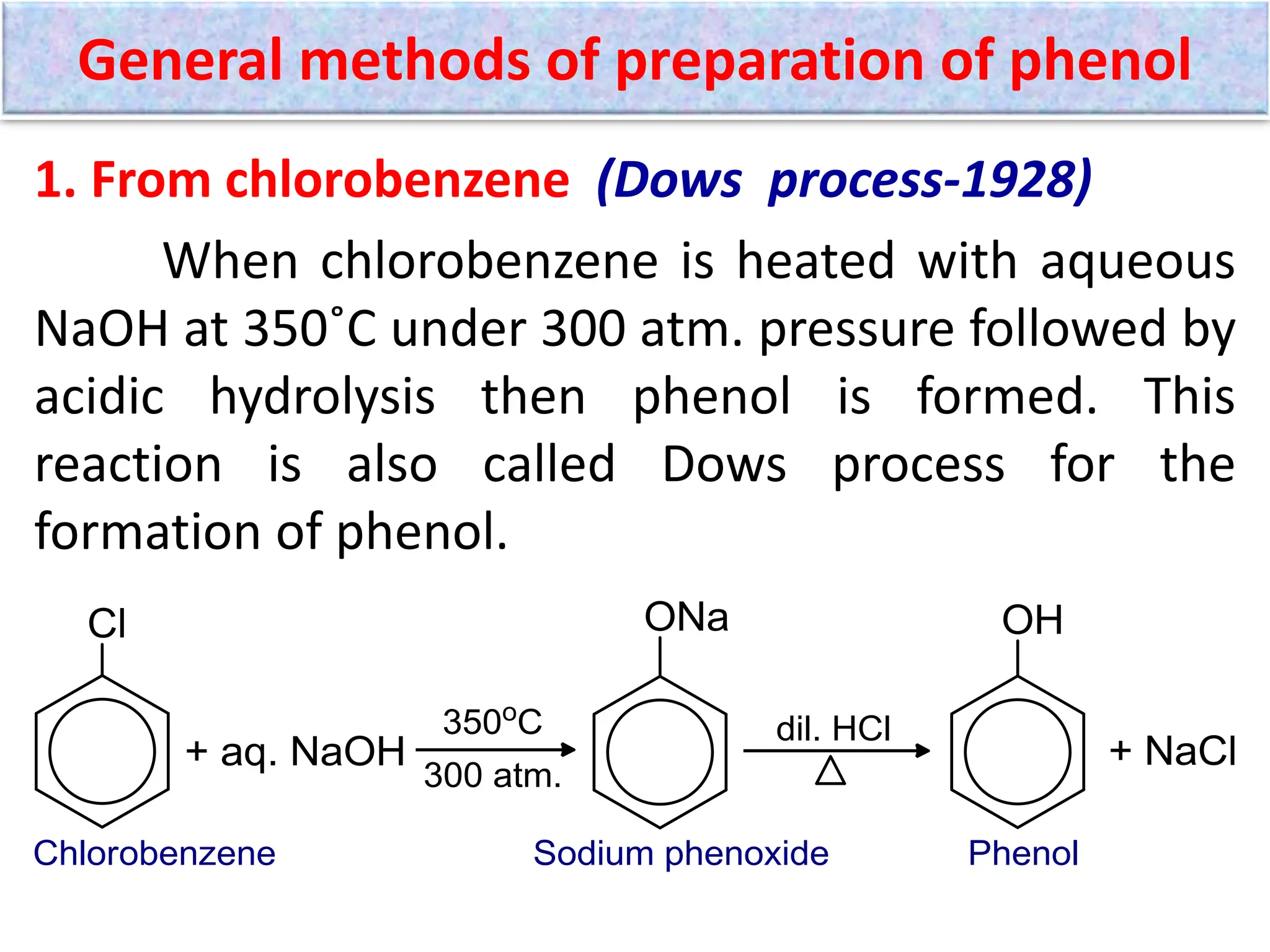
1. From chlorobenzene (Dows process-1928)
When chlorobenzene is heated with aqueous
NaOH at 350˚C under 300 atm. pressure followed by
acidic hydrolysis then phenol is formed. This
reaction is also called Dows process for the
formation of phenol.
General methods of preparation of phenol
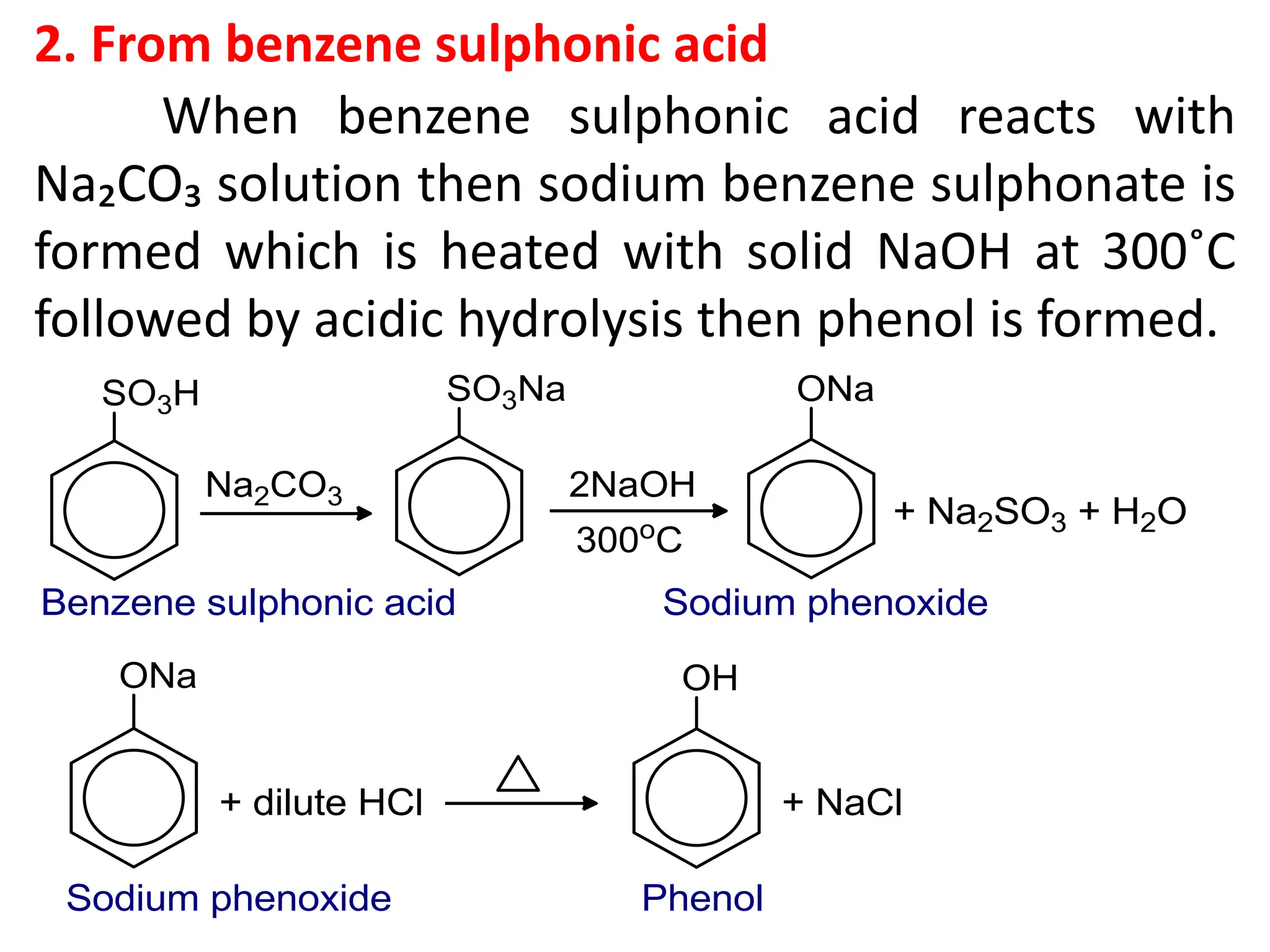
2. From benzene sulphonic acid
When benzene sulphonic acid reacts with
Na₂CO₃ solution then sodium benzene sulphonate is
formed which is heated with solid NaOH at 300˚C
followed by acidic hydrolysis then phenol is formed.
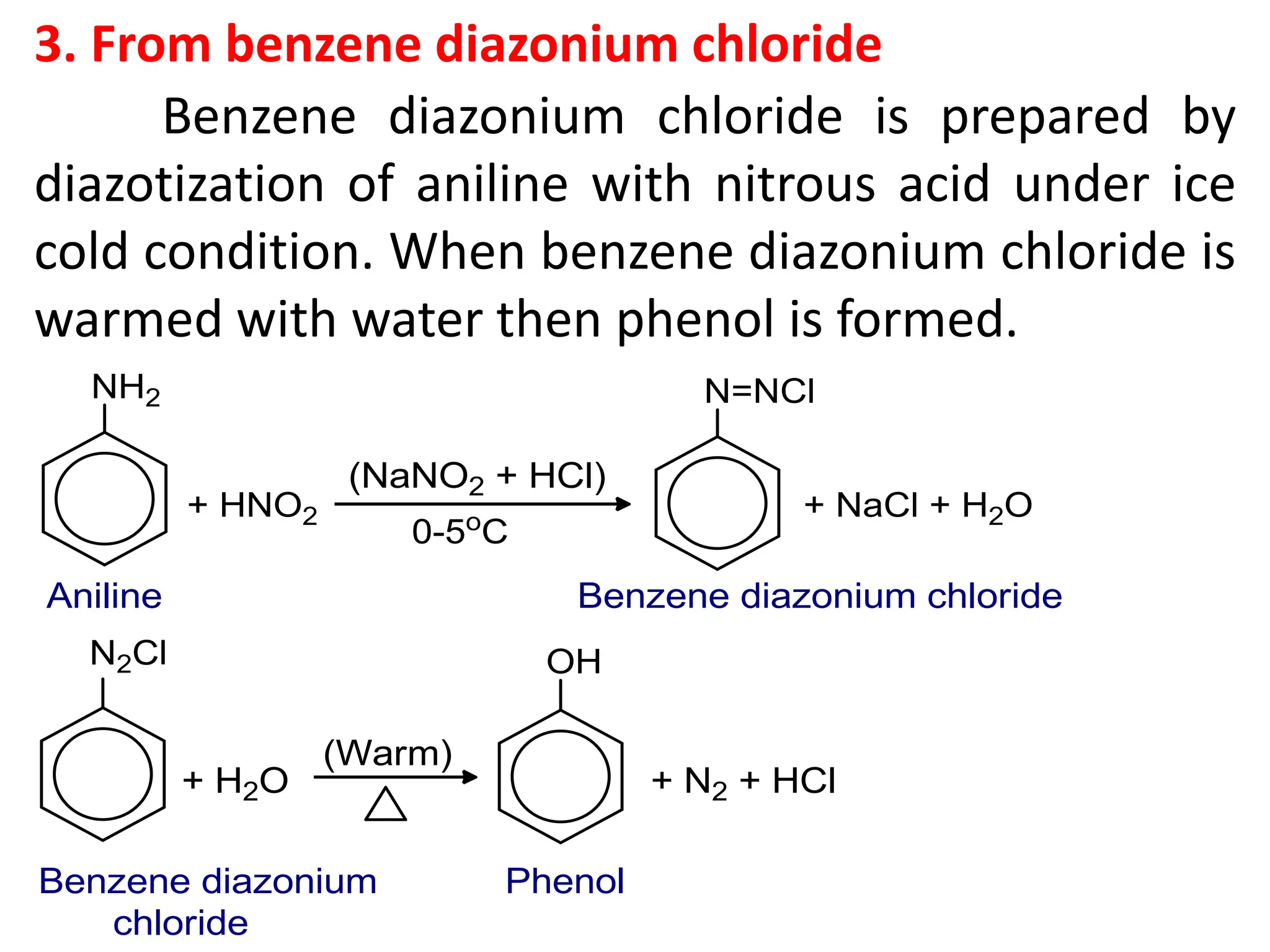
3. From benzene diazonium chloride
Benzene diazonium chloride is prepared by
diazotization of aniline with nitrous acid under ice
cold condition. When benzene diazonium chloride is
warmed with water then phenol is formed.
Physical properties of phenol
1. They are colorless liquid and crystalline solid.
2. They are slightly soluble in water and soluble in
organic solvent.
3. Phenol is colorless hygroscopic crystalline solid.
4. The melting point of phenol is 41˚C and boiling
point is 182˚C.
5. They possess carbolic smell having anti-bacterial
property.
6. When phenol is exposed to atmospheric air then
it becomes slightly red or pink in color.
Chemical properties of phenol
1. Acidic nature of phenol
Phenol is weakly acidic in nature because it
slightly ionize in aqueous solution to give phenoxide
ion and H⁺ or H₃O⁺ ions.
Phenol turns blue litmus paper to red which indicates
acidic nature.
[A] Reaction due to –OH group of phenol
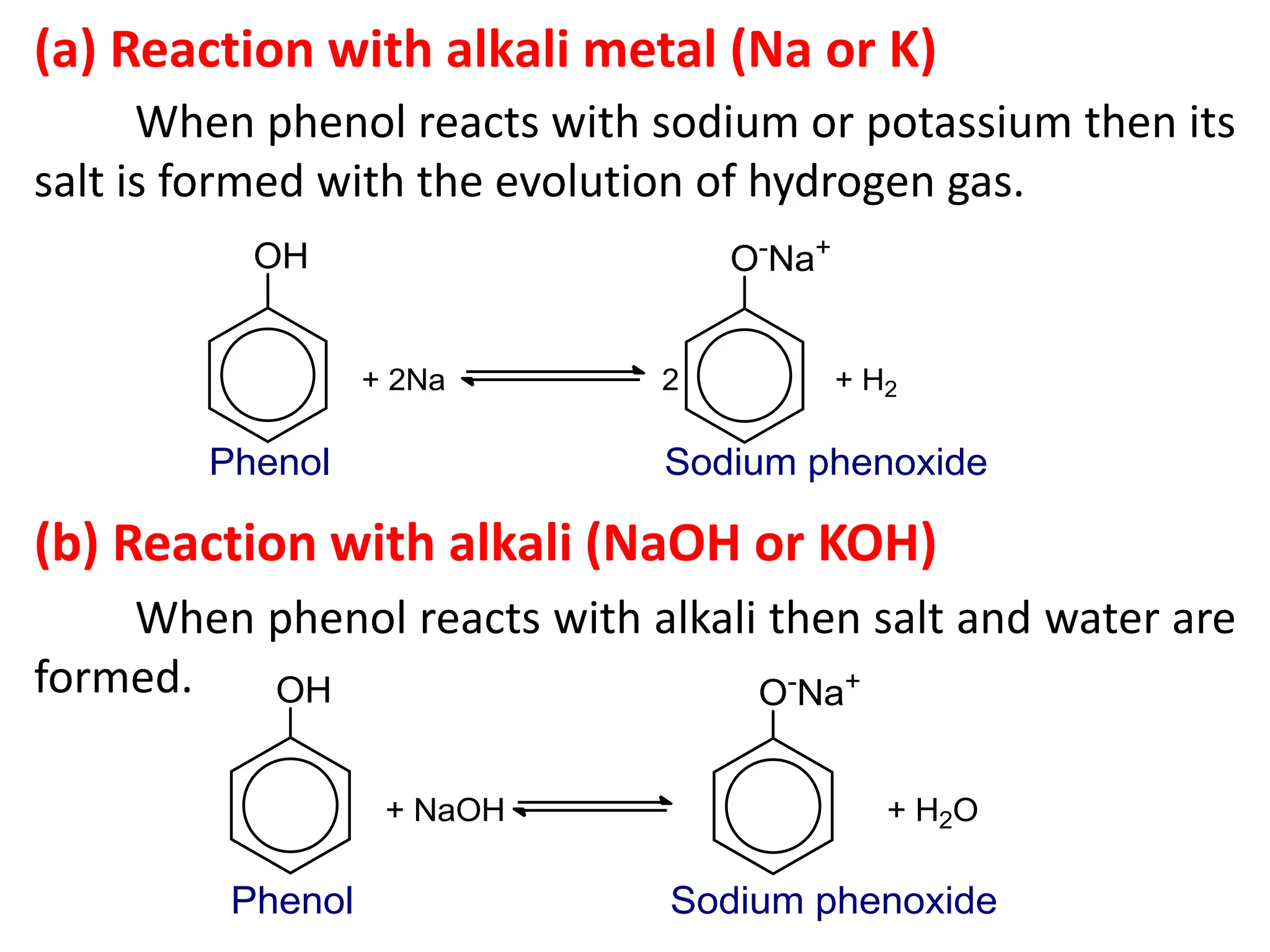
(a) Reaction with alkali metal (Na or K)
When phenol reacts with sodium or potassium then its
salt is formed with the evolution of hydrogen gas.
(b) Reaction with alkali (NaOH or KOH)
When phenol reacts with alkali then salt and water are
formed.
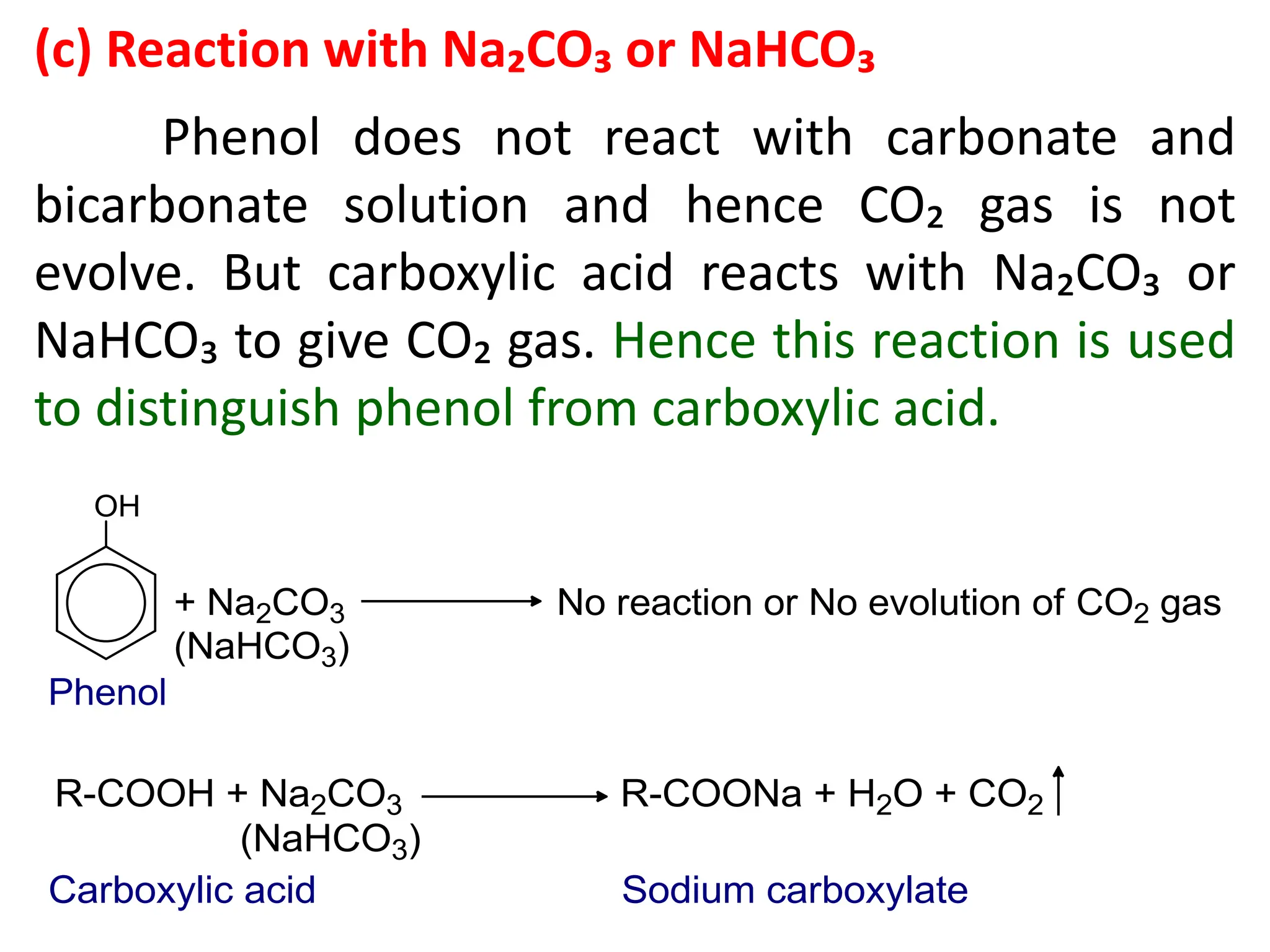
(c) Reaction with Na₂CO₃ or NaHCO₃
Phenol does not react with carbonate and
bicarbonate solution and hence CO₂ gas is not
evolve. But carboxylic acid reacts with Na₂CO₃ or
NaHCO₃ to give CO₂ gas. Hence this reaction is used
to distinguish phenol from carboxylic acid.
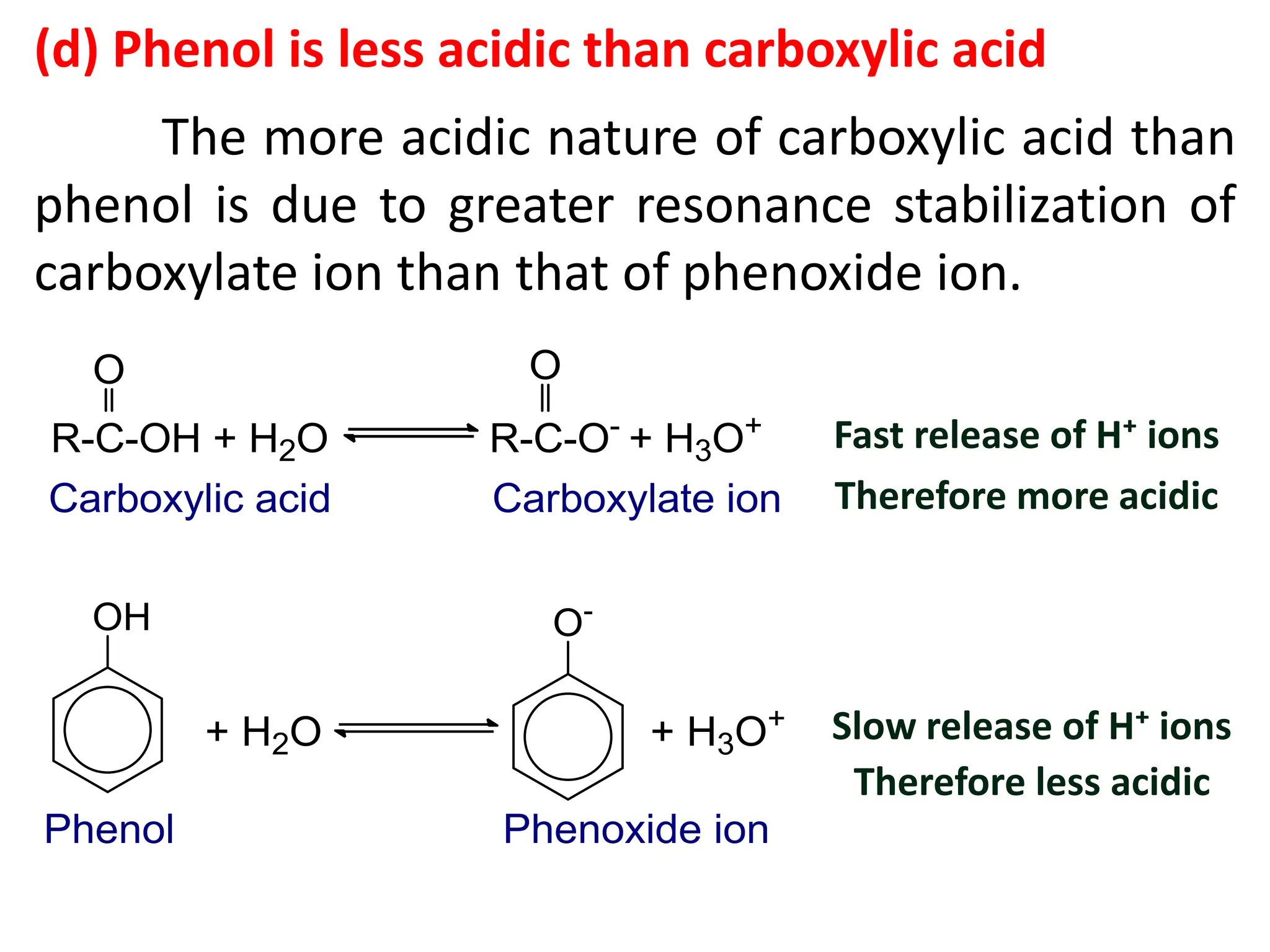
(d) Phenol is less acidic than carboxylic acid
The more acidic nature of carboxylic acid than
phenol is due to greater resonance stabilization of
carboxylate ion than that of phenoxide ion.
Fast release of H⁺ ions
Therefore more acidic
Slow release of H⁺ ions
Therefore less acidic
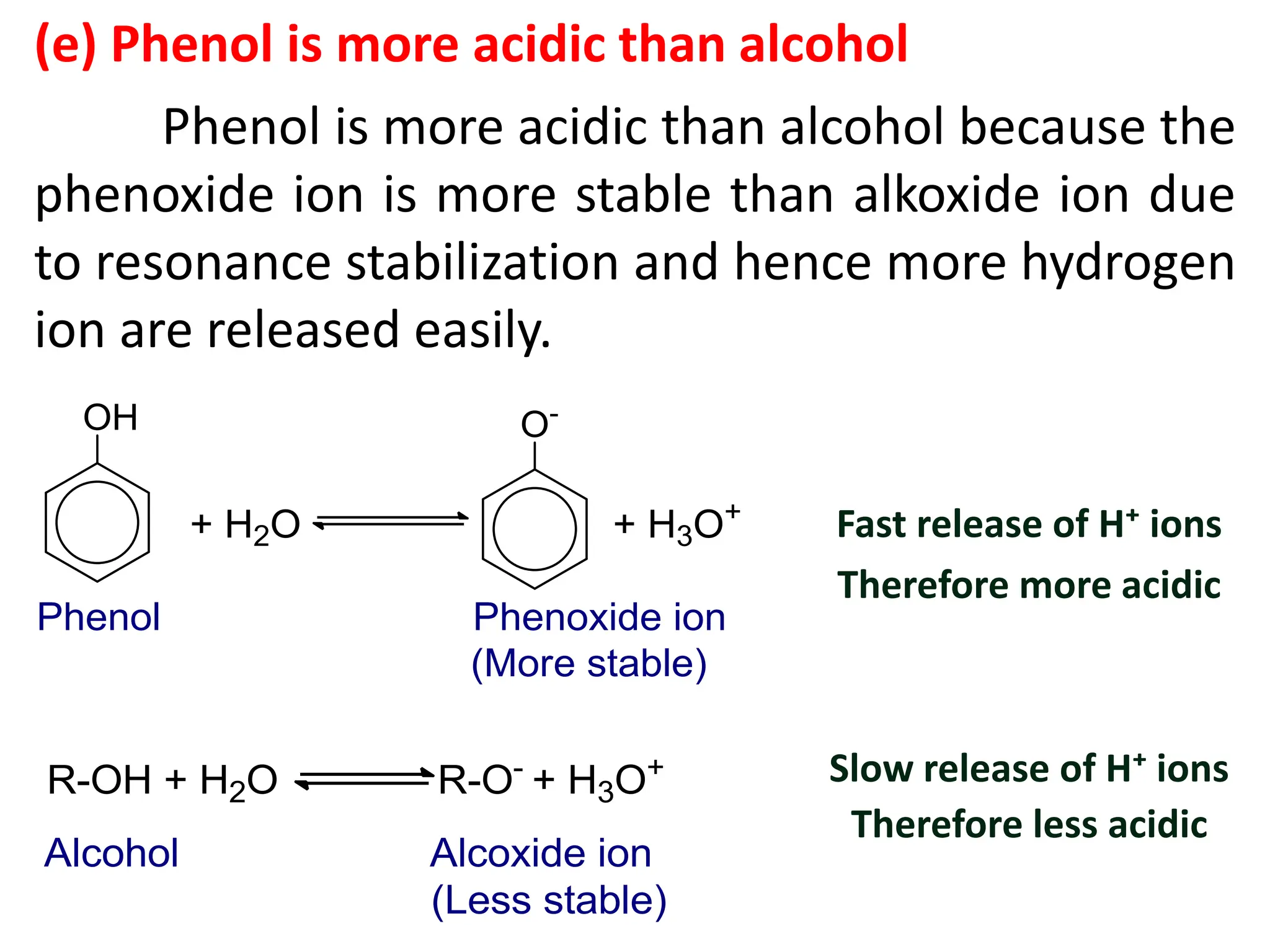
(e) Phenol is more acidic than alcohol
Phenol is more acidic than alcohol because the
phenoxide ion is more stable than alkoxide ion due
to resonance stabilization and hence more hydrogen
ion are released easily.
Fast release of H⁺ ions
Therefore more acidic
Slow release of H⁺ ions
Therefore less acidic
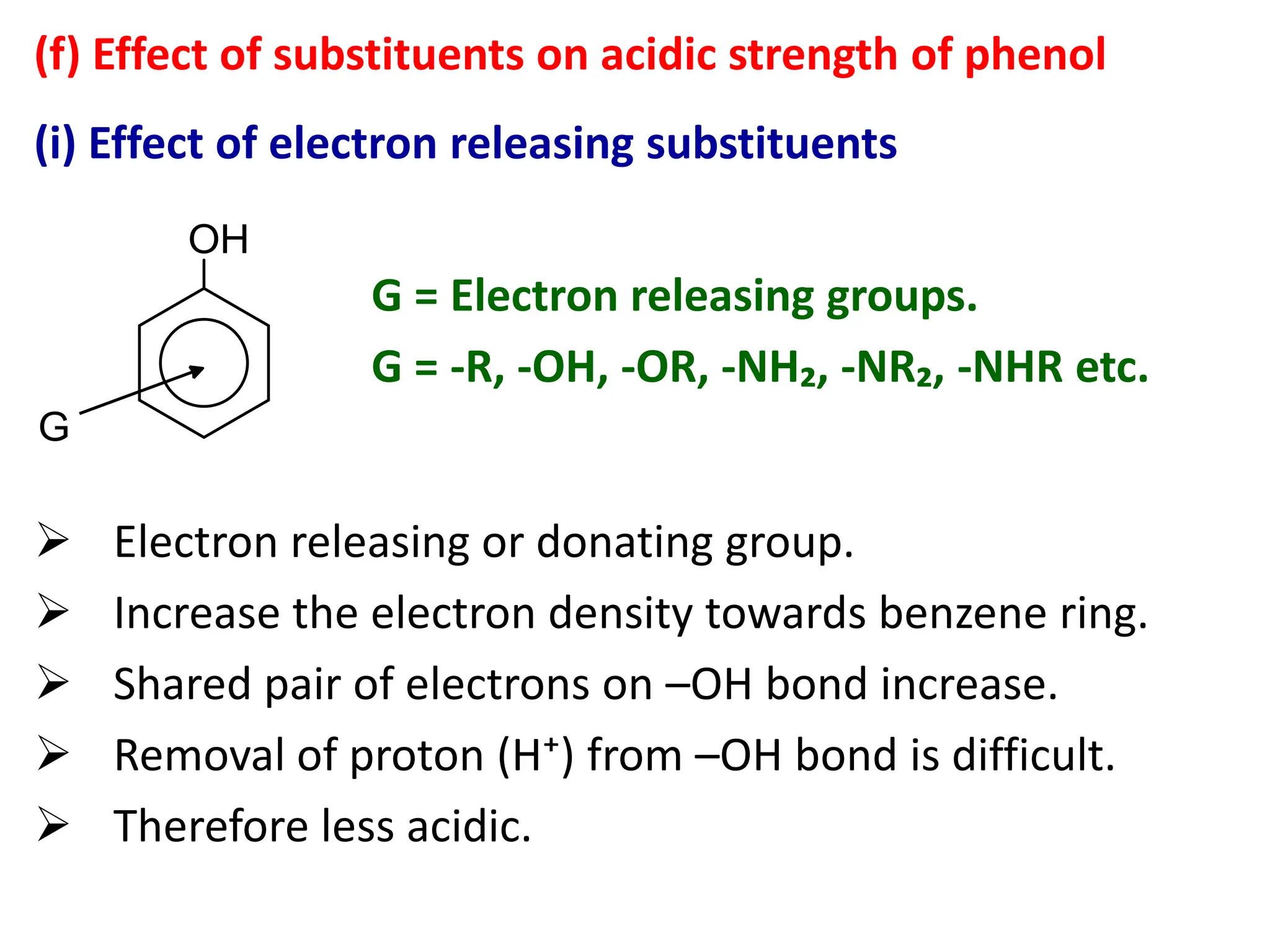
(f) Effect of substituents on acidic strength of phenol
(i) Effect of electron releasing substituents
G = Electron releasing groups.
G = -R, -OH, -OR, -NH₂, -NR₂, -NHR etc.
 Electron releasing or donating group.
 Increase the electron density towards benzene ring.
 Shared pair of electrons on –OH bond increase.
 Removal of proton (H⁺) from –OH bond is difficult.
 Therefore less acidic.
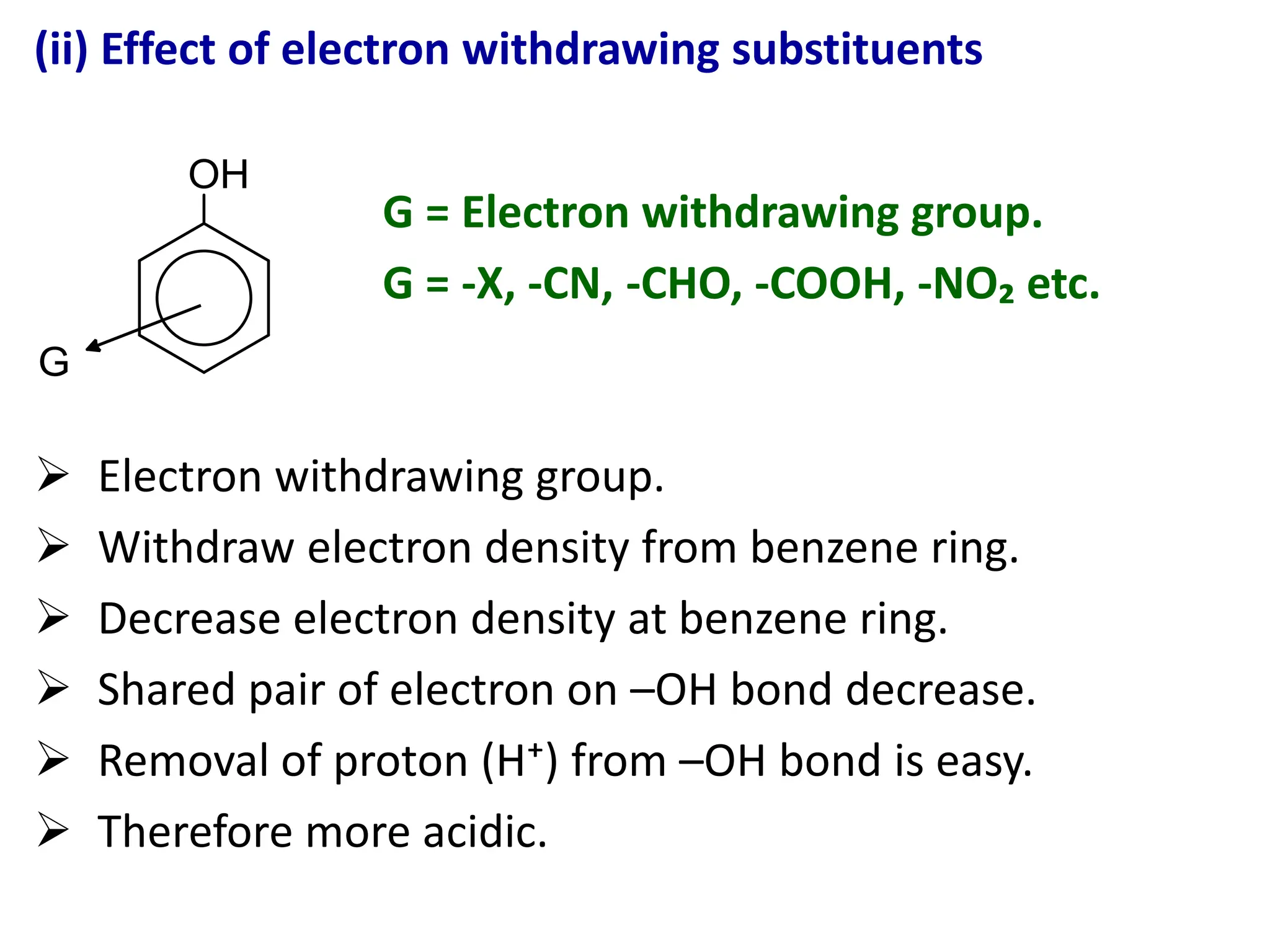
(ii) Effect of electron withdrawing substituents
G = Electron withdrawing group.
G = -X, -CN, -CHO, -COOH, -NO₂ etc.
 Electron withdrawing group.
 Withdraw electron density from benzene ring.
 Decrease electron density at benzene ring.
 Shared pair of electron on –OH bond decrease.
 Removal of proton (H⁺) from –OH bond is easy.
 Therefore more acidic.
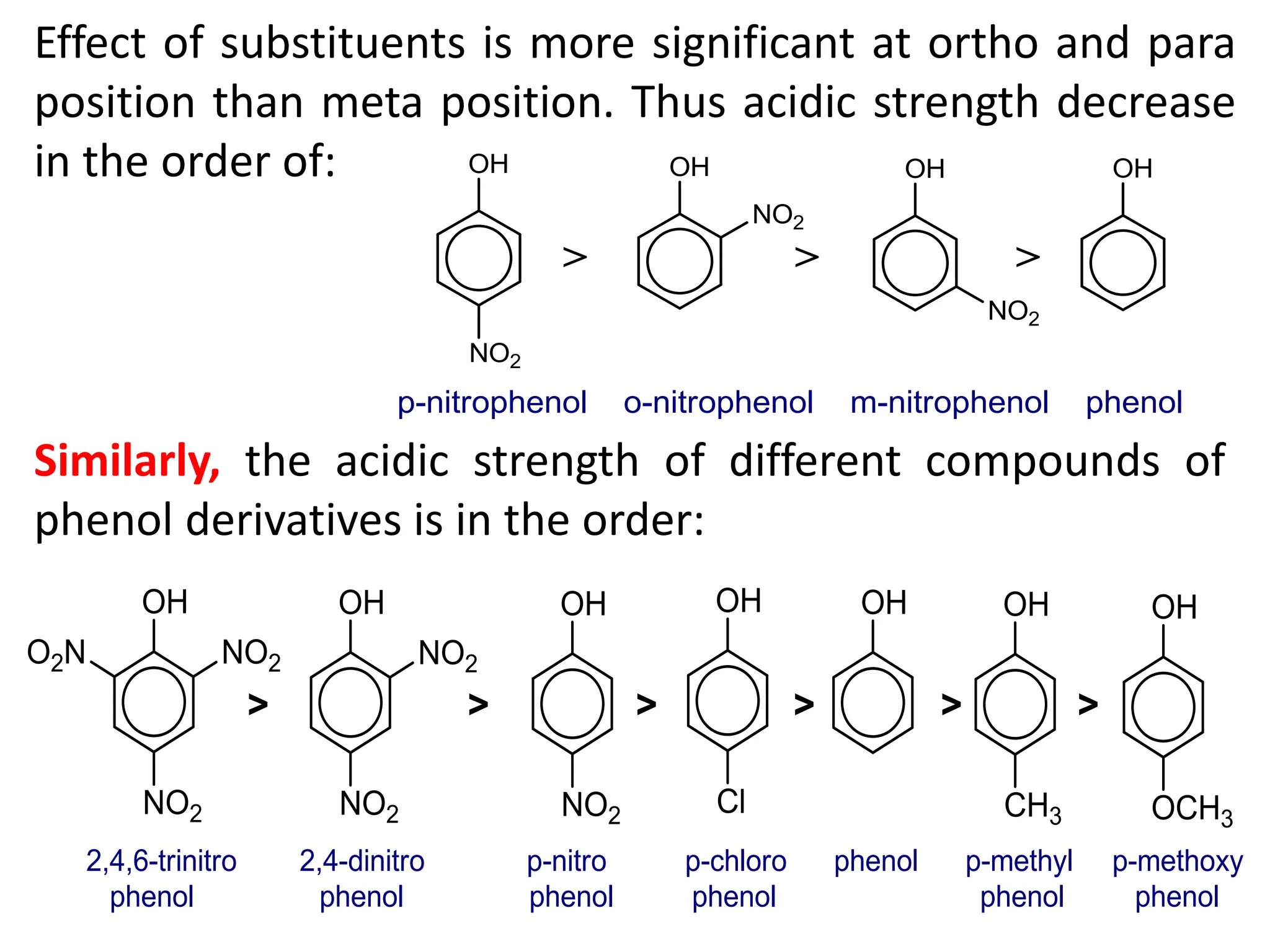
Effect of substituents is more significant at ortho and para
position than meta position. Thus acidic strength decrease
in the order of:
Similarly, the acidic strength of different compounds of
phenol derivatives is in the order:
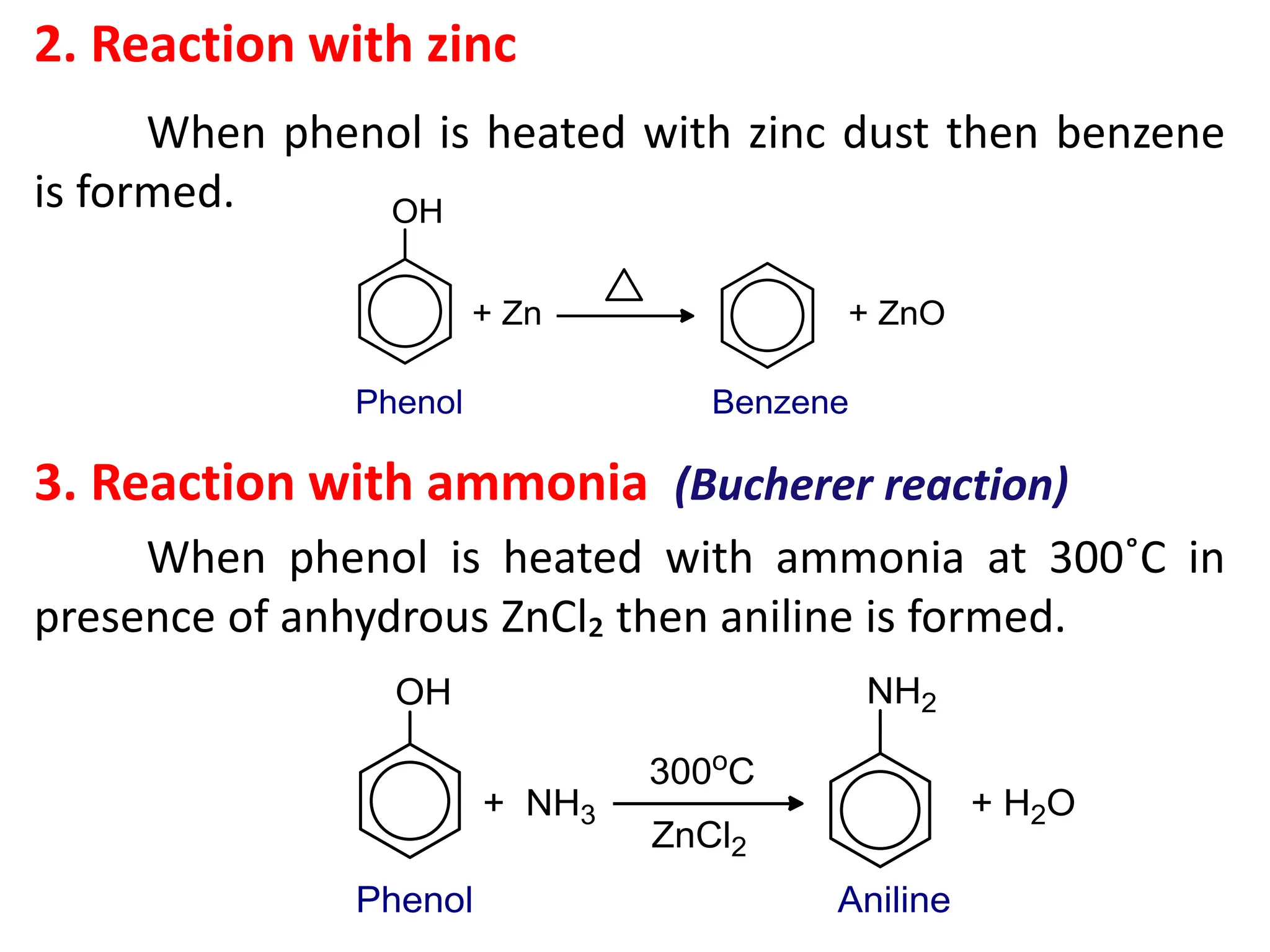
2. Reaction with zinc
When phenol is heated with zinc dust then benzene
is formed.
3. Reaction with ammonia (Bucherer reaction)
When phenol is heated with ammonia at 300˚C in
presence of anhydrous ZnCl₂ then aniline is formed.
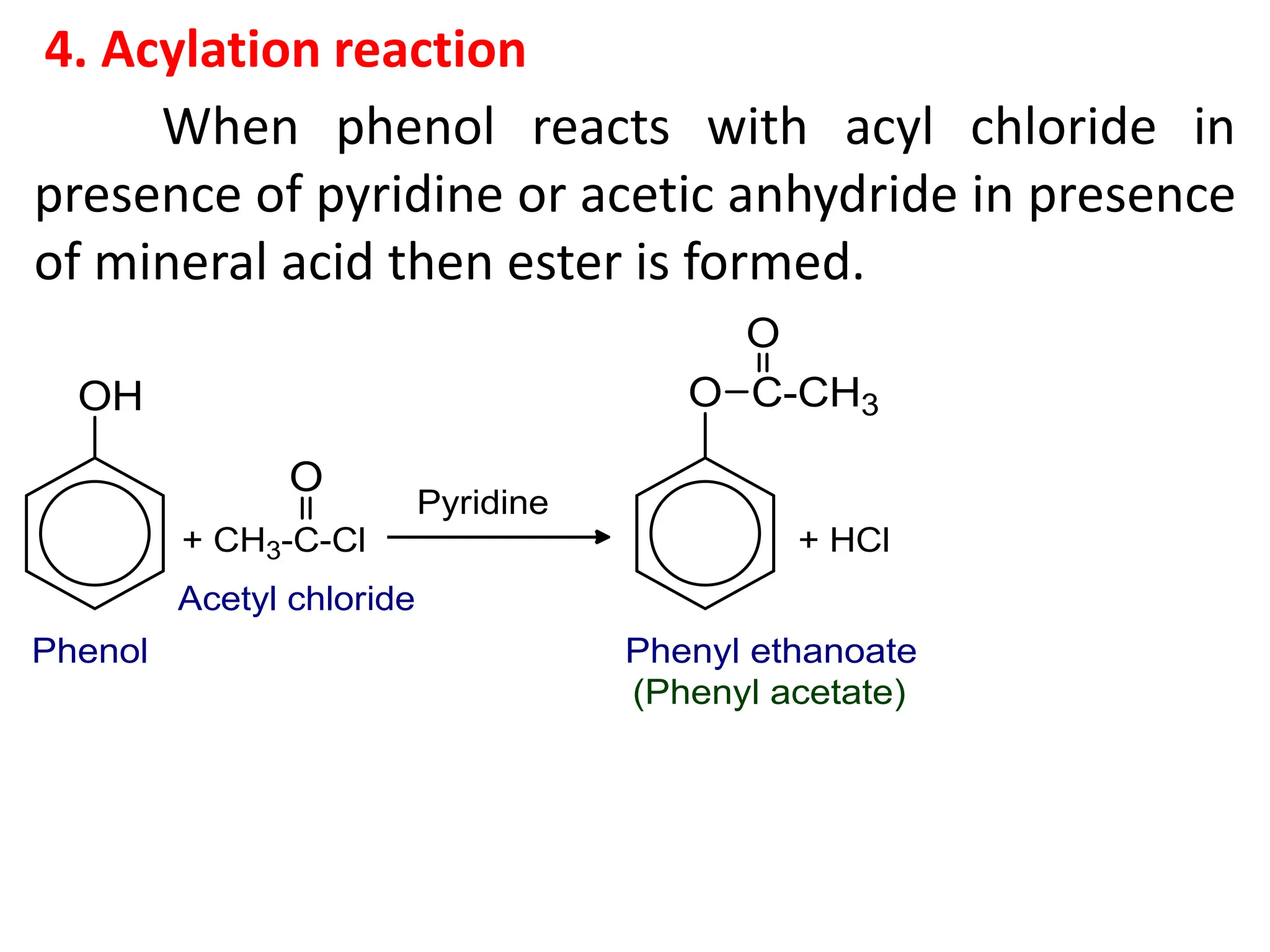
4. Acylation reaction
When phenol reacts with acyl chloride in
presence of pyridine or acetic anhydride in presence
of mineral acid then ester is formed.
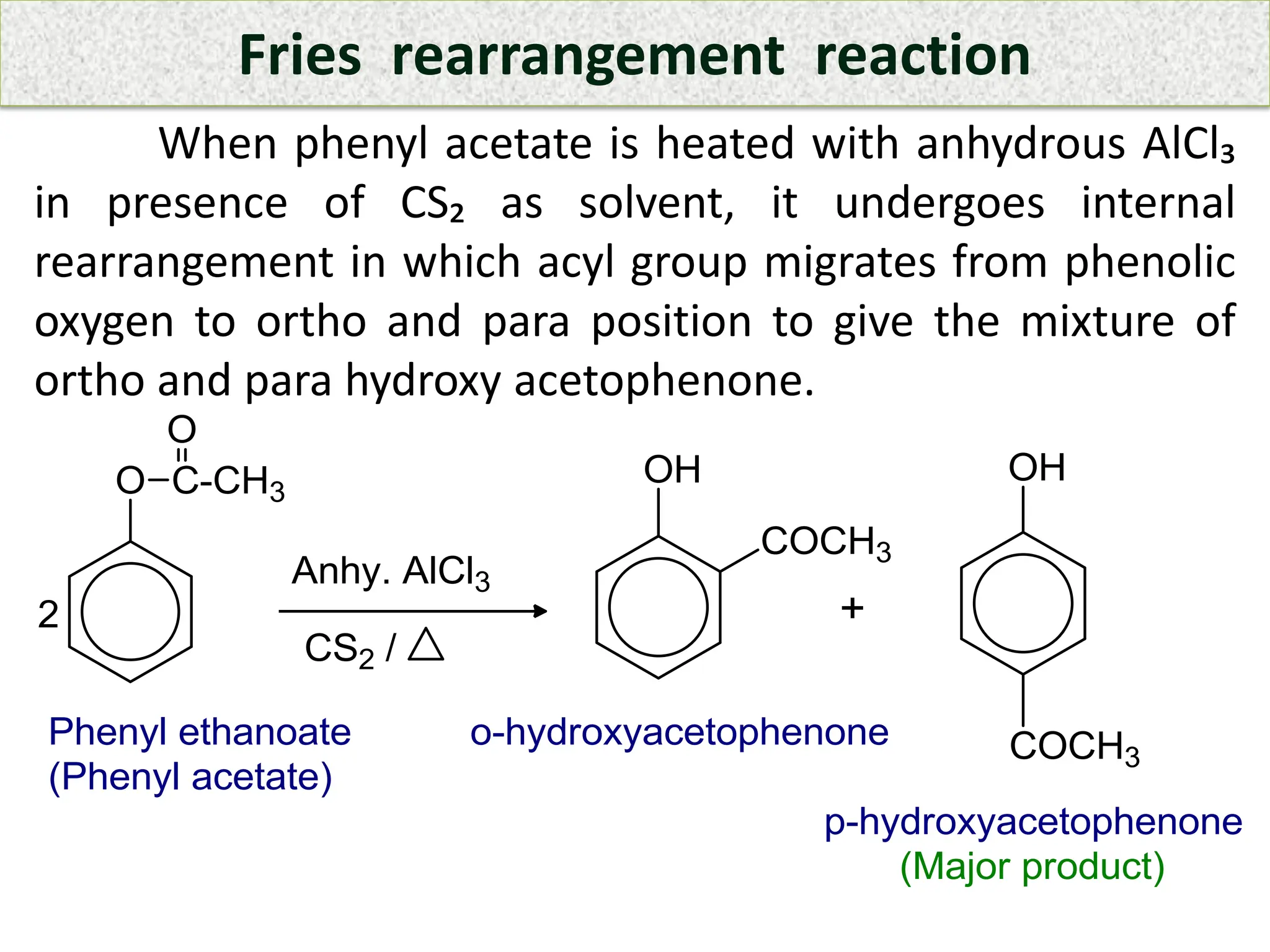
Fries rearrangement reaction
When phenyl acetate is heated with anhydrous AlCl₃
in presence of CS₂ as solvent, it undergoes internal
rearrangement in which acyl group migrates from phenolic
oxygen to ortho and para position to give the mixture of
ortho and para hydroxy acetophenone.
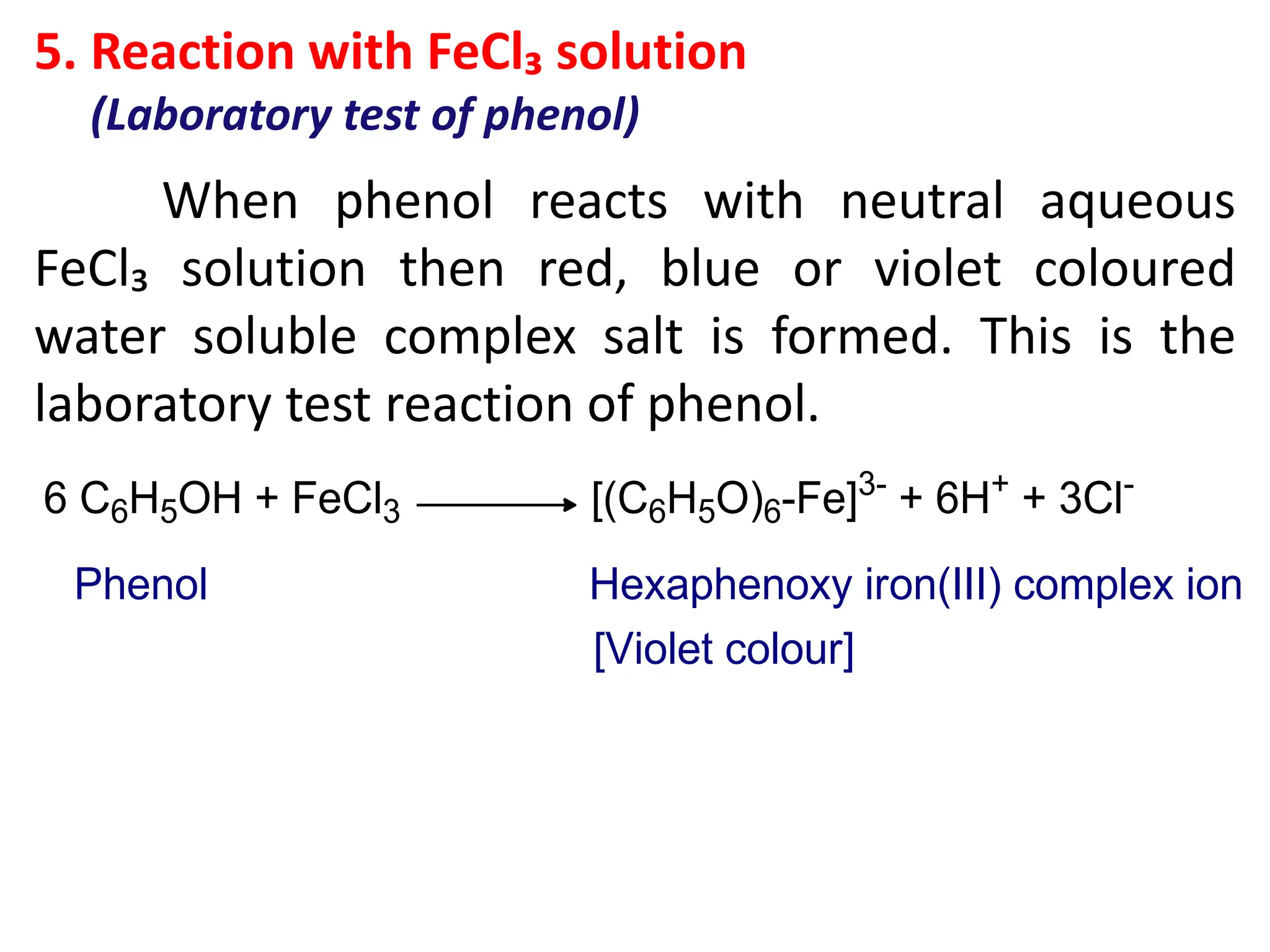
5. Reaction with FeCl₃ solution
(Laboratory test of phenol)
When phenol reacts with neutral aqueous
FeCl₃ solution then red, blue or violet coloured
water soluble complex salt is formed. This is the
laboratory test reaction of phenol.
[B] Reaction due to aromatic ring
(Electrophilic substitution reaction)
The –OH group in phenol is electron releasing
group that increase electron density at benzene ring
and benzene ring becomes more reactive. Therefore
the –OH group in phenol is ring activator group due
to positive resonance effect (+R effect).
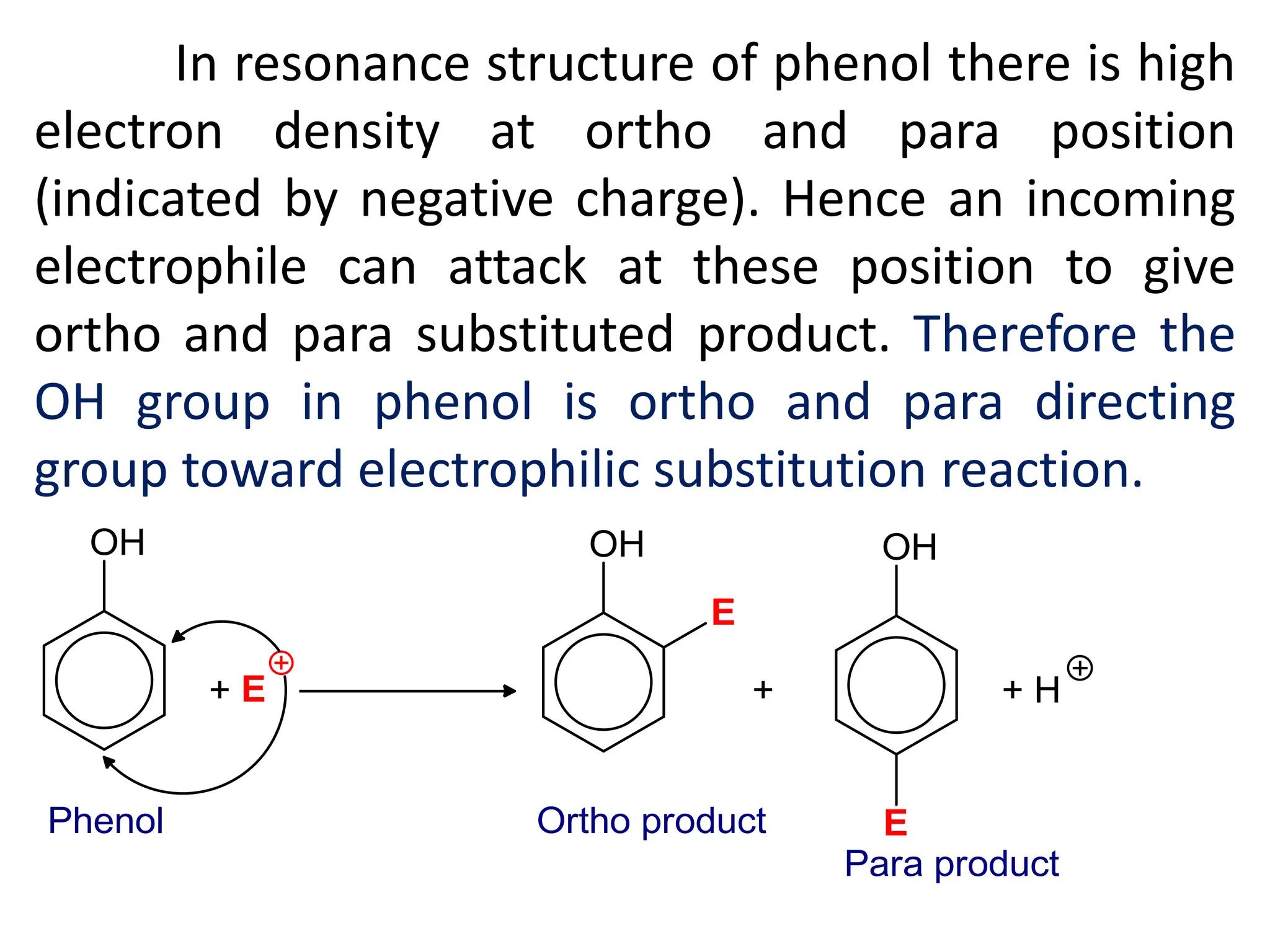
In resonance structure of phenol there is high
electron density at ortho and para position
(indicated by negative charge). Hence an incoming
electrophile can attack at these position to give
ortho and para substituted product. Therefore the
OH group in phenol is ortho and para directing
group toward electrophilic substitution reaction.
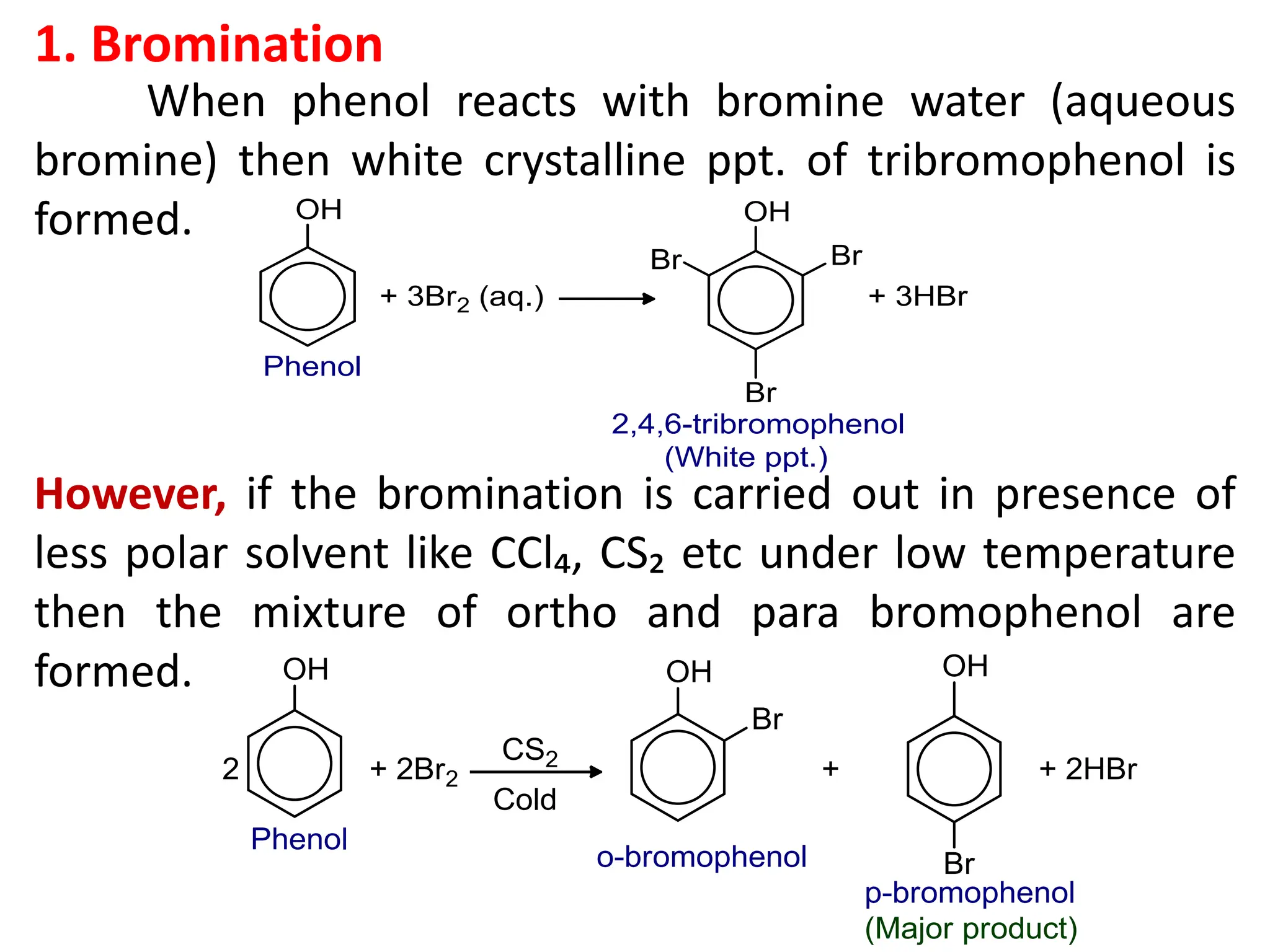
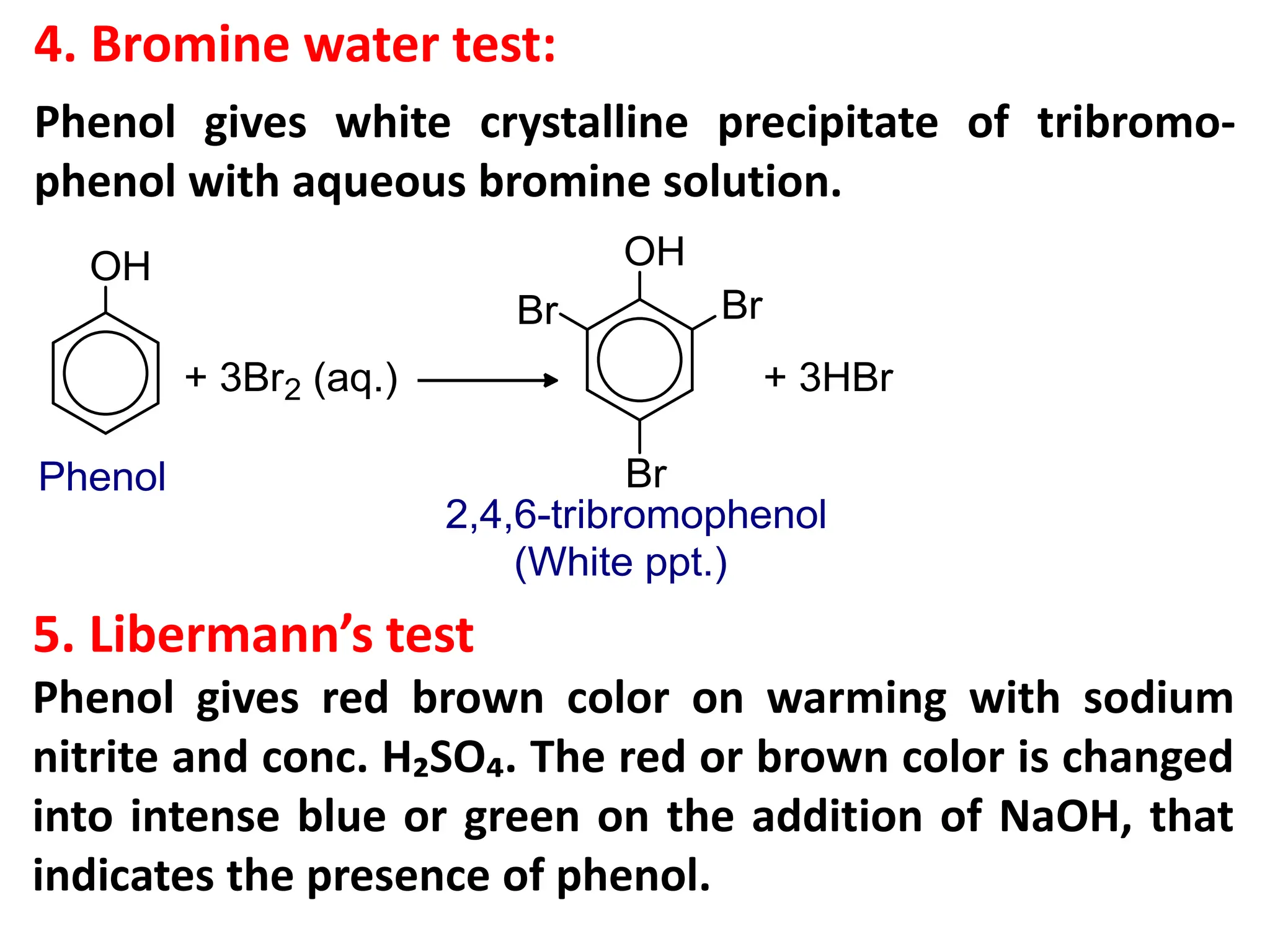
1. Bromination
When phenol reacts with bromine water (aqueous
bromine) then white crystalline ppt. of tribromophenol is
formed.
However, if the bromination is carried out in presence of
less polar solvent like CCl₄, CS₂ etc under low temperature
then the mixture of ortho and para bromophenol are
formed.
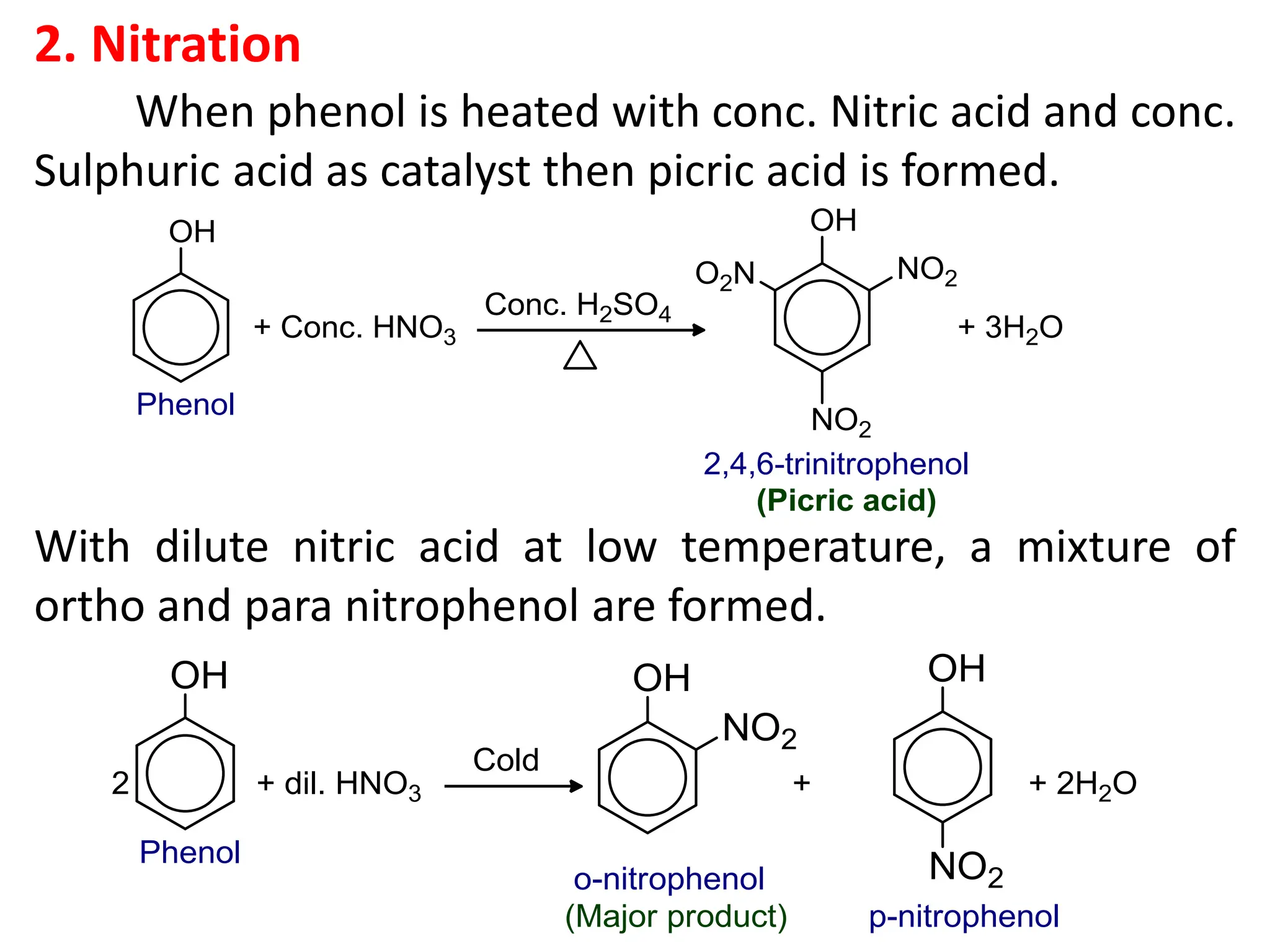
2. Nitration
When phenol is heated with conc. Nitric acid and conc.
Sulphuric acid as catalyst then picric acid is formed.
With dilute nitric acid at low temperature, a mixture of
ortho and para nitrophenol are formed.
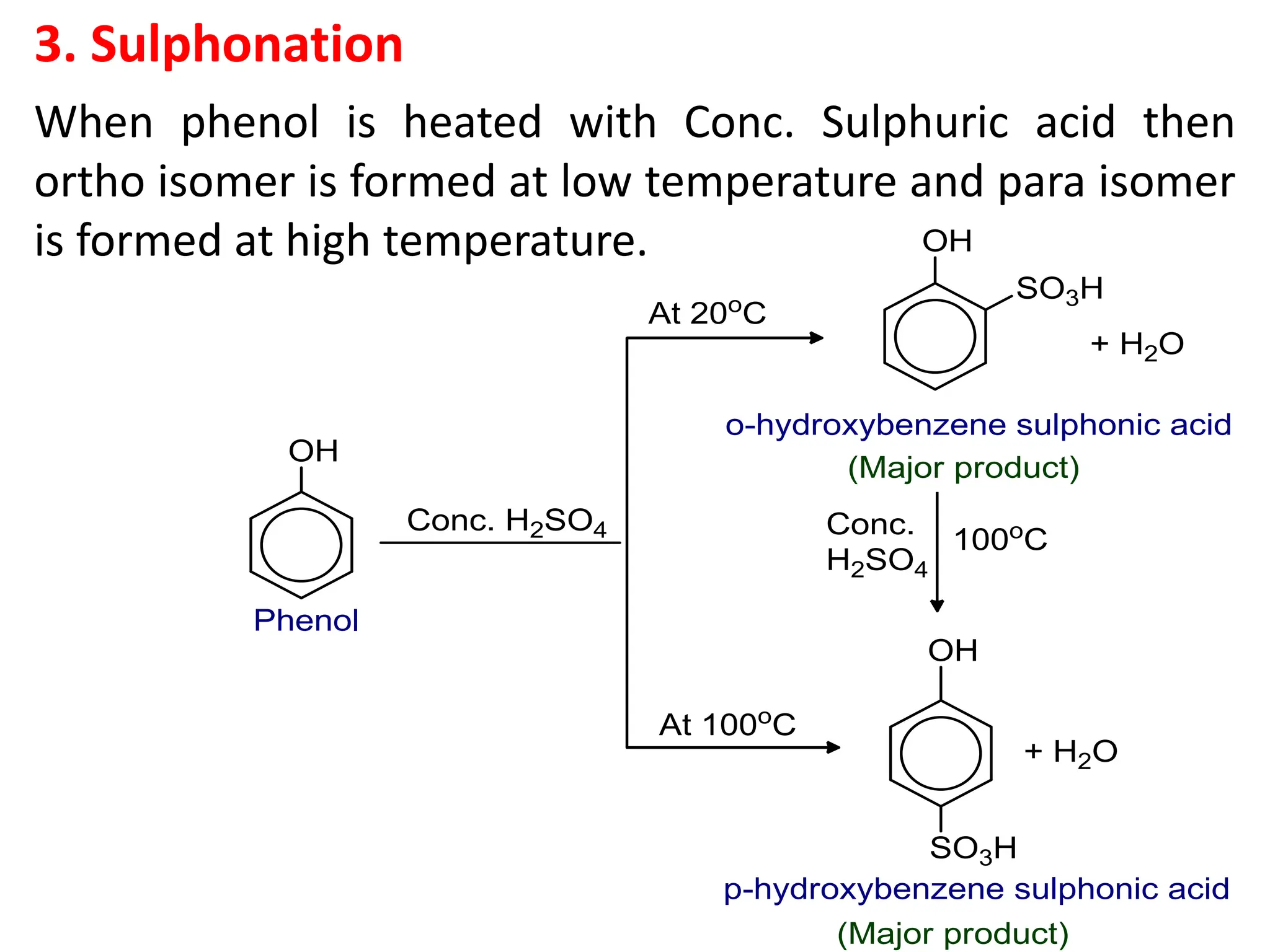
3. Sulphonation
When phenol is heated with Conc. Sulphuric acid then
ortho isomer is formed at low temperature and para isomer
is formed at high temperature.
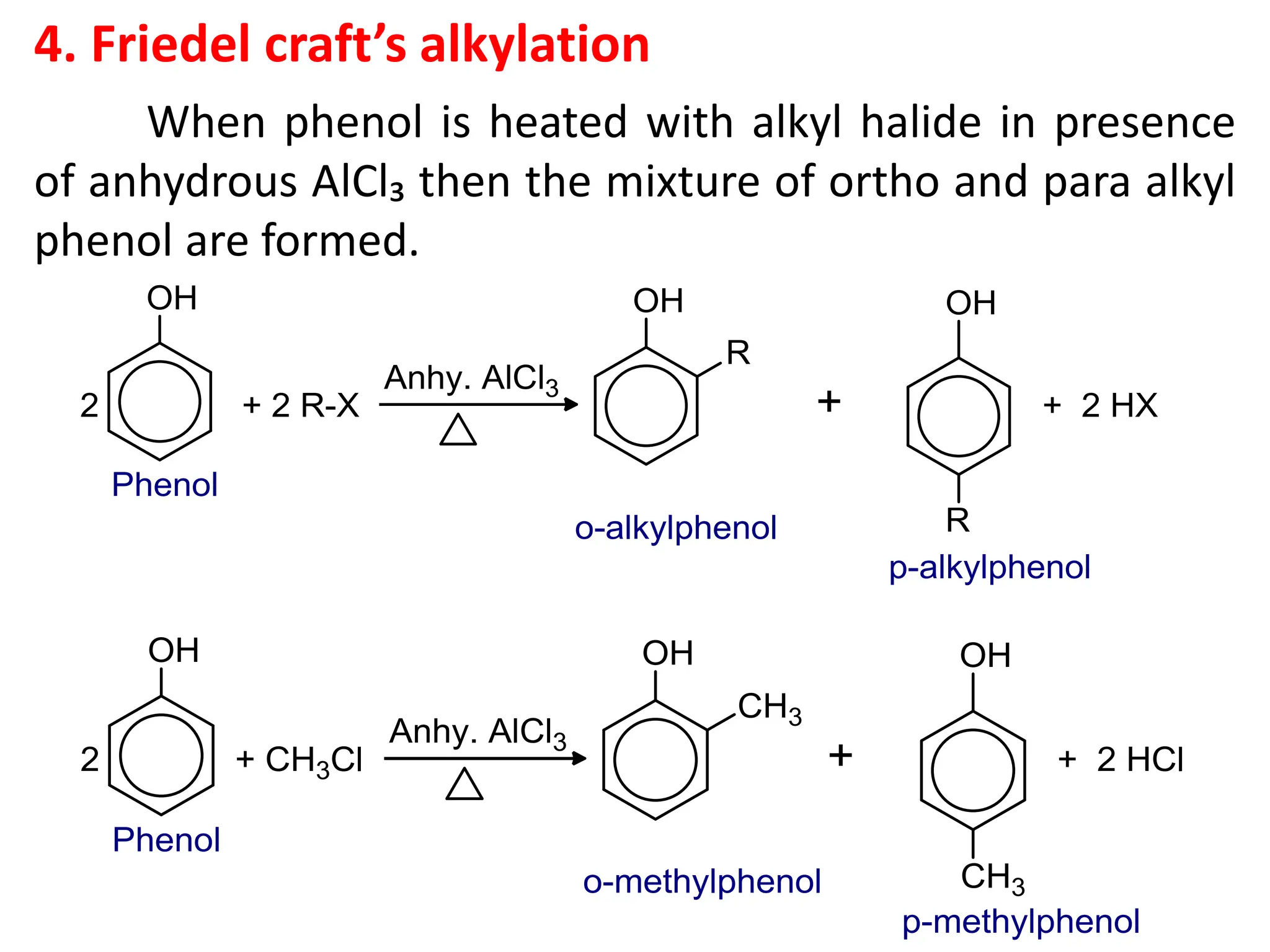
4. Friedel craft’s alkylation
When phenol is heated with alkyl halide in presence
of anhydrous AlCl₃ then the mixture of ortho and para alkyl
phenol are formed.
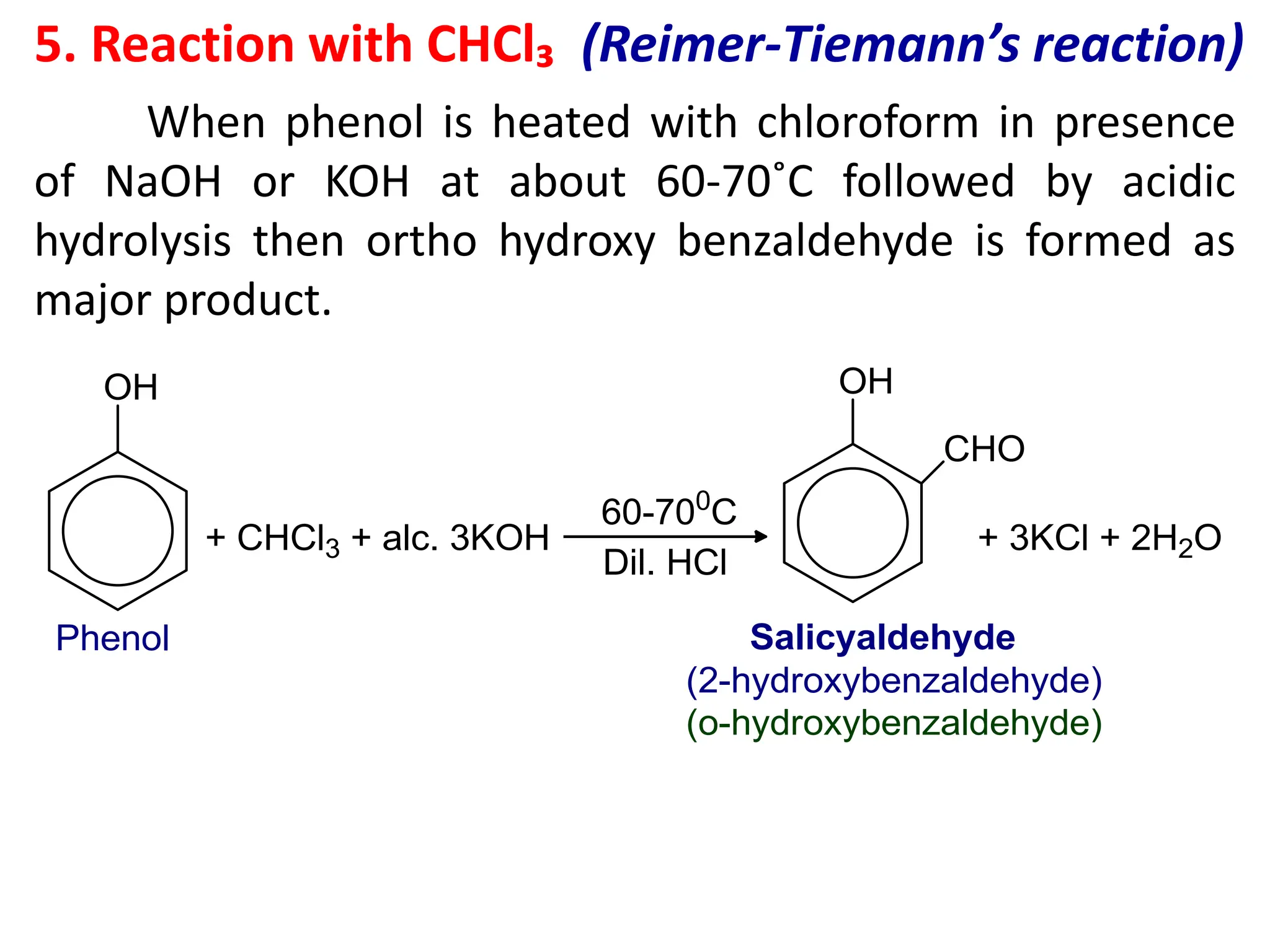
5. Reaction with CHCl₃ (Reimer-Tiemann’s reaction)
When phenol is heated with chloroform in presence
of NaOH or KOH at about 60-70˚C followed by acidic
hydrolysis then ortho hydroxy benzaldehyde is formed as
major product.
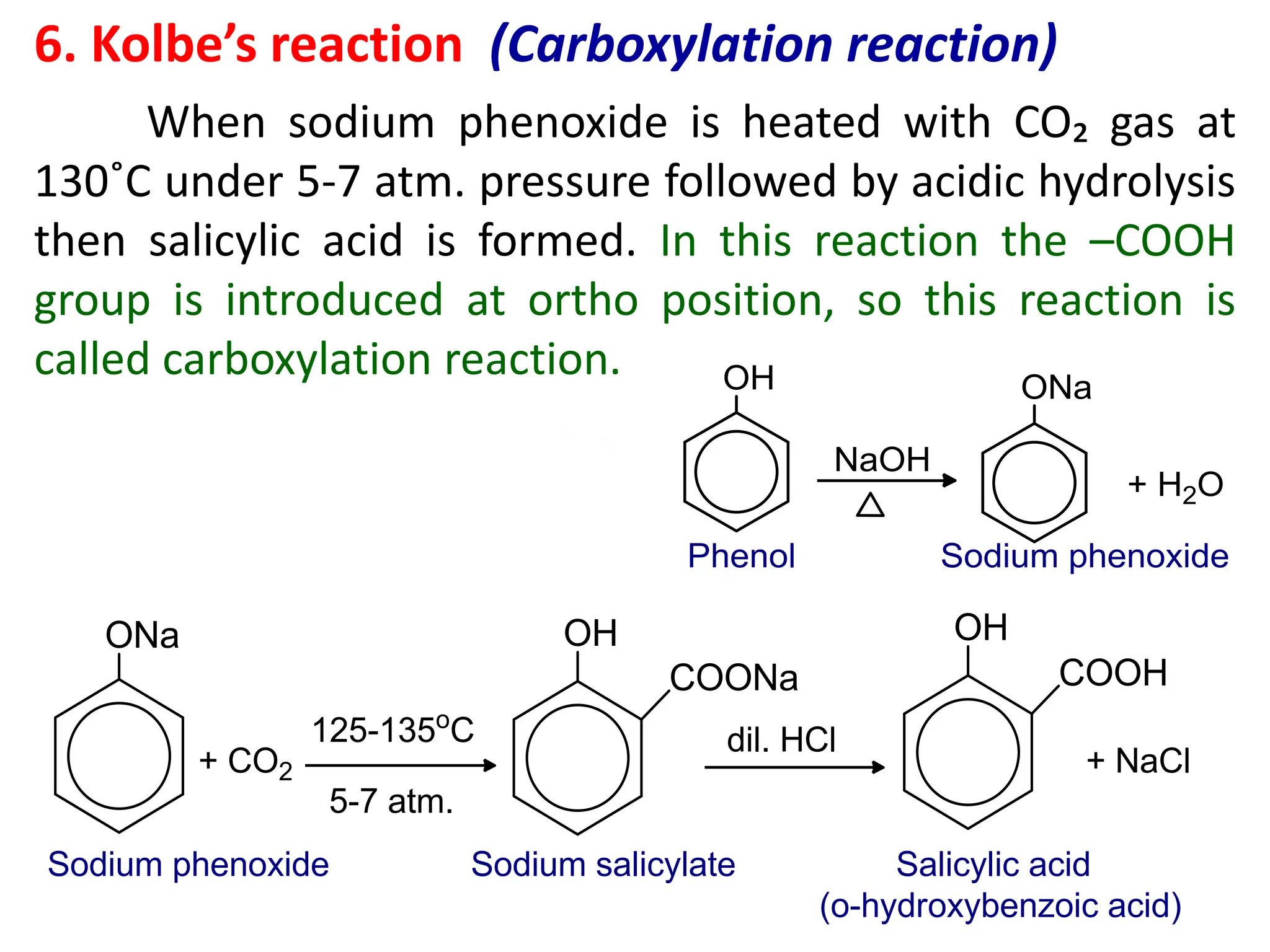
6. Kolbe’s reaction (Carboxylation reaction)
When sodium phenoxide is heated with CO₂ gas at
130˚C under 5-7 atm. pressure followed by acidic hydrolysis
then salicylic acid is formed. In this reaction the –COOH
group is introduced at ortho position, so this reaction is
called carboxylation reaction.
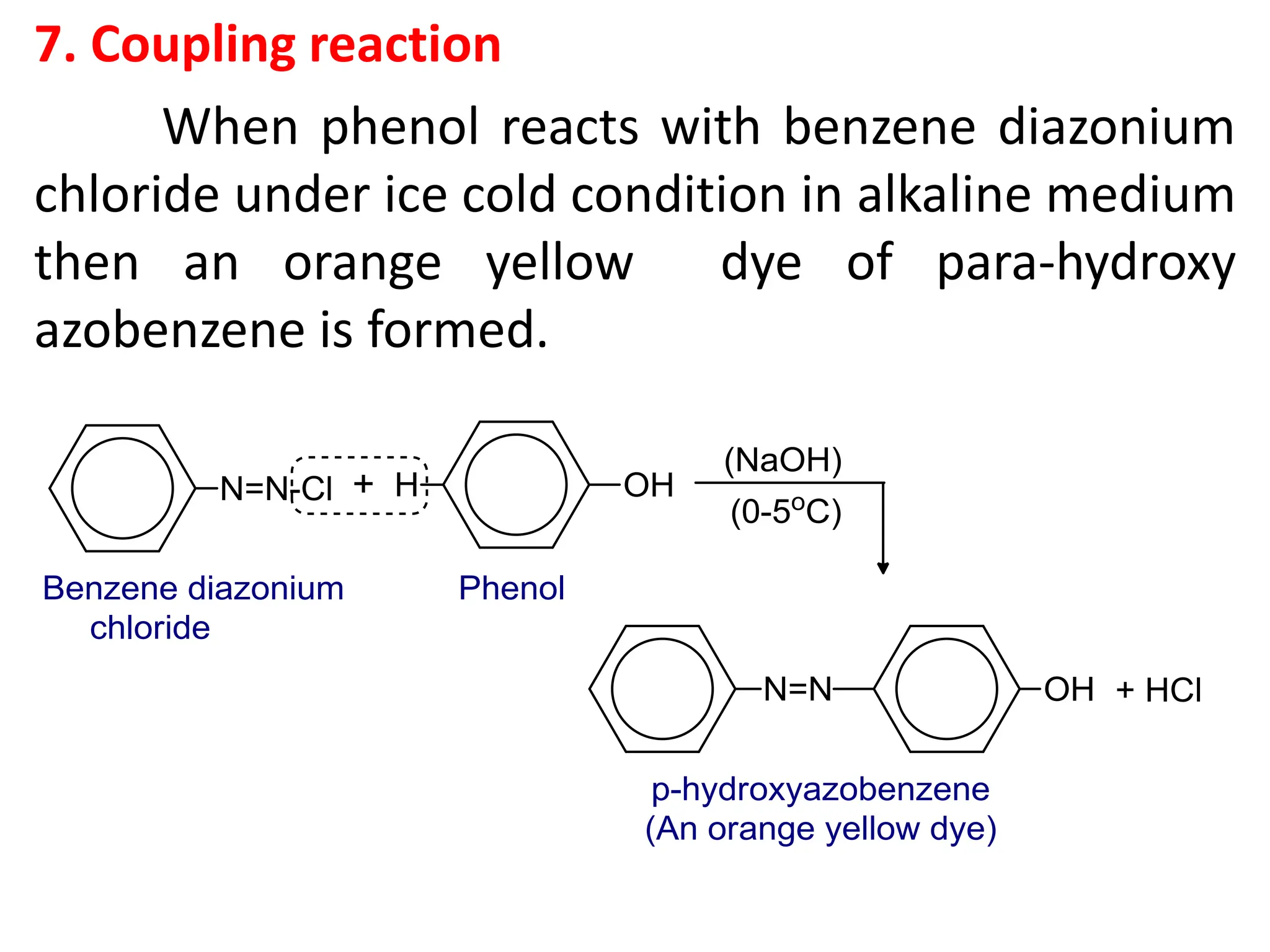
7. Coupling reaction
When phenol reacts with benzene diazonium
chloride under ice cold condition in alkaline medium
then an orange yellow dye of para-hydroxy
azobenzene is formed.
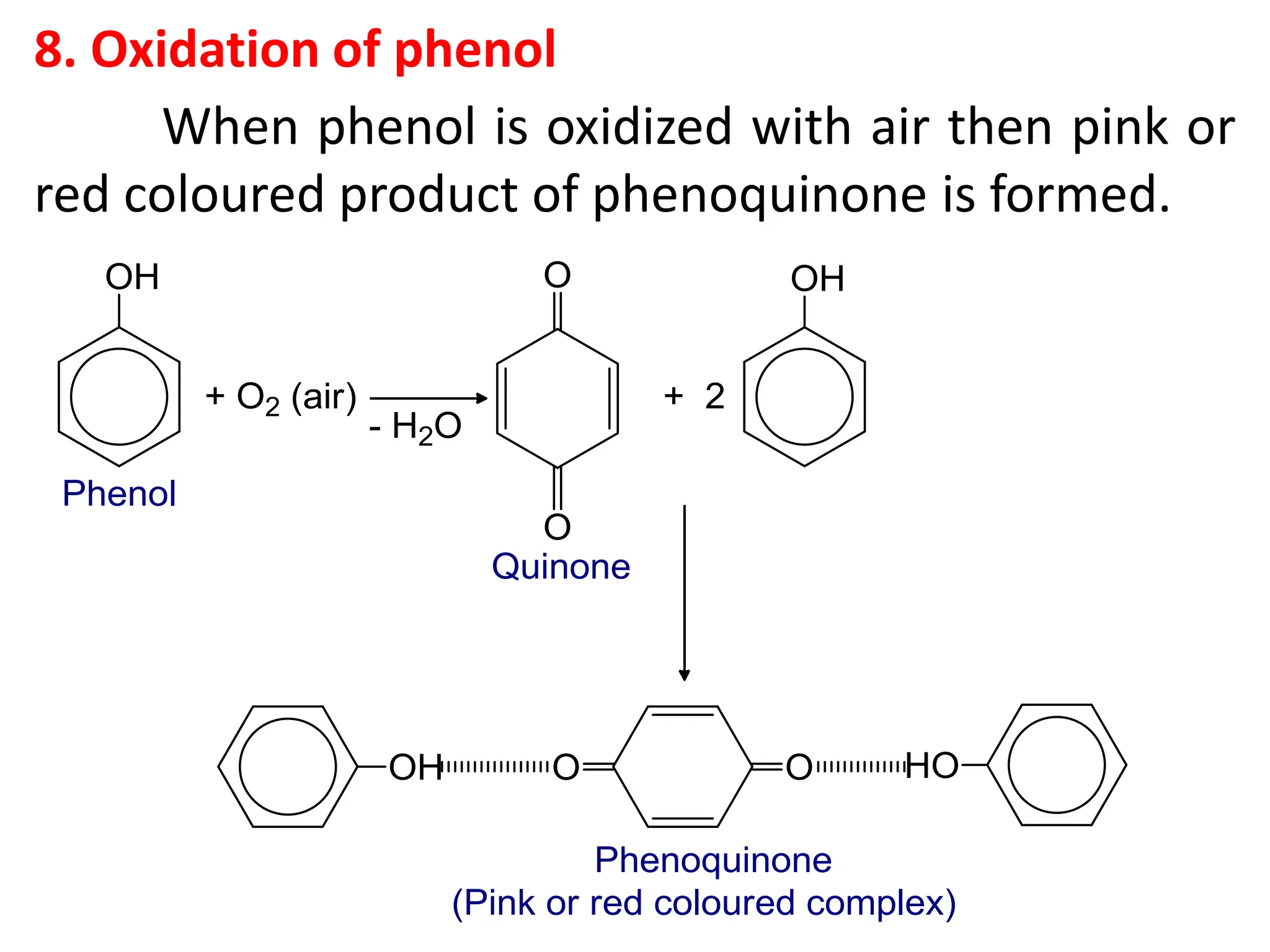
8. Oxidation of phenol
When phenol is oxidized with air then pink or
red coloured product of phenoquinone is formed.
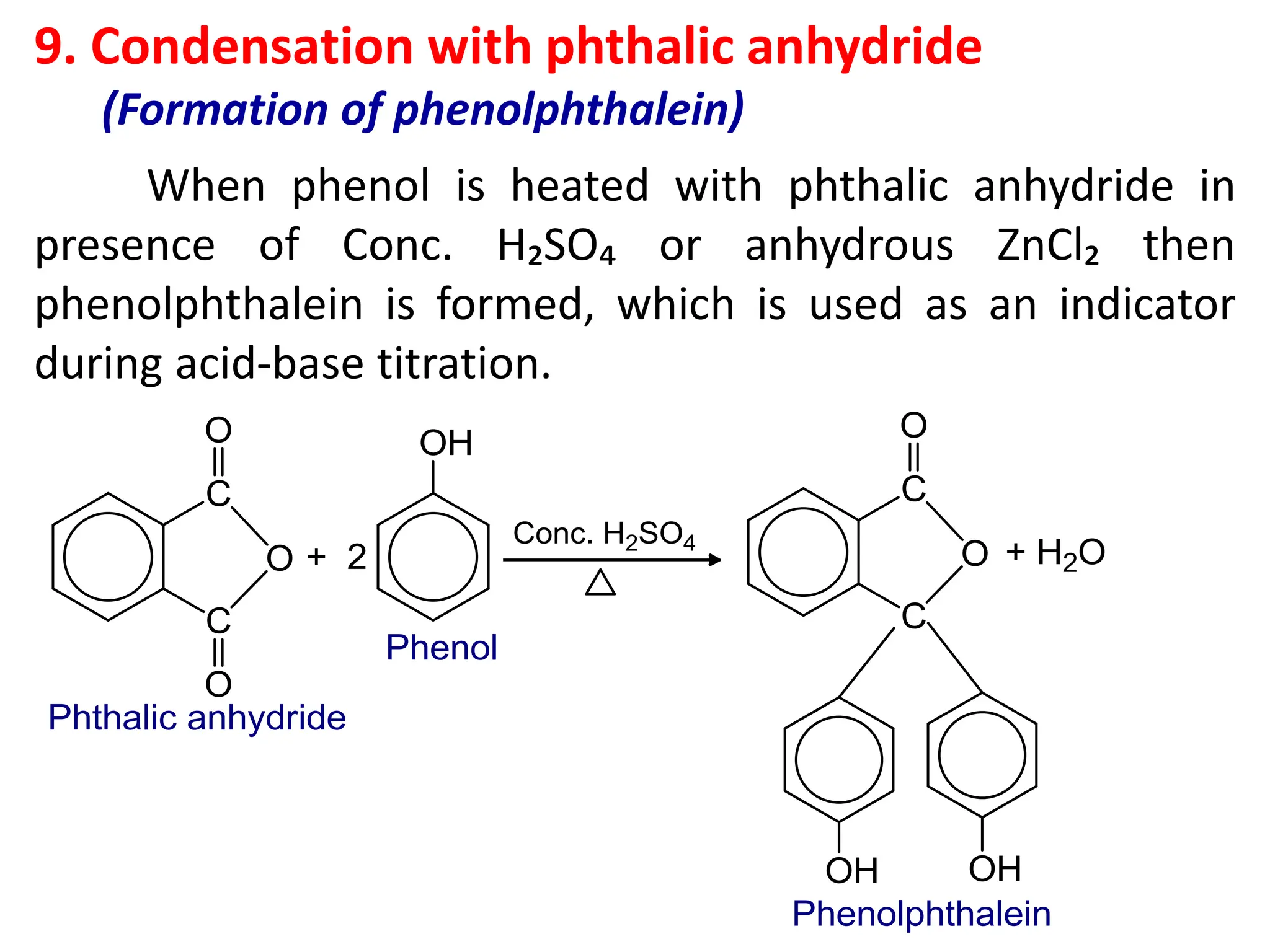
9. Condensation with phthalic anhydride
(Formation of phenolphthalein)
When phenol is heated with phthalic anhydride in
presence of Conc. H₂SO₄ or anhydrous ZnCl₂ then
phenolphthalein is formed, which is used as an indicator
during acid-base titration.
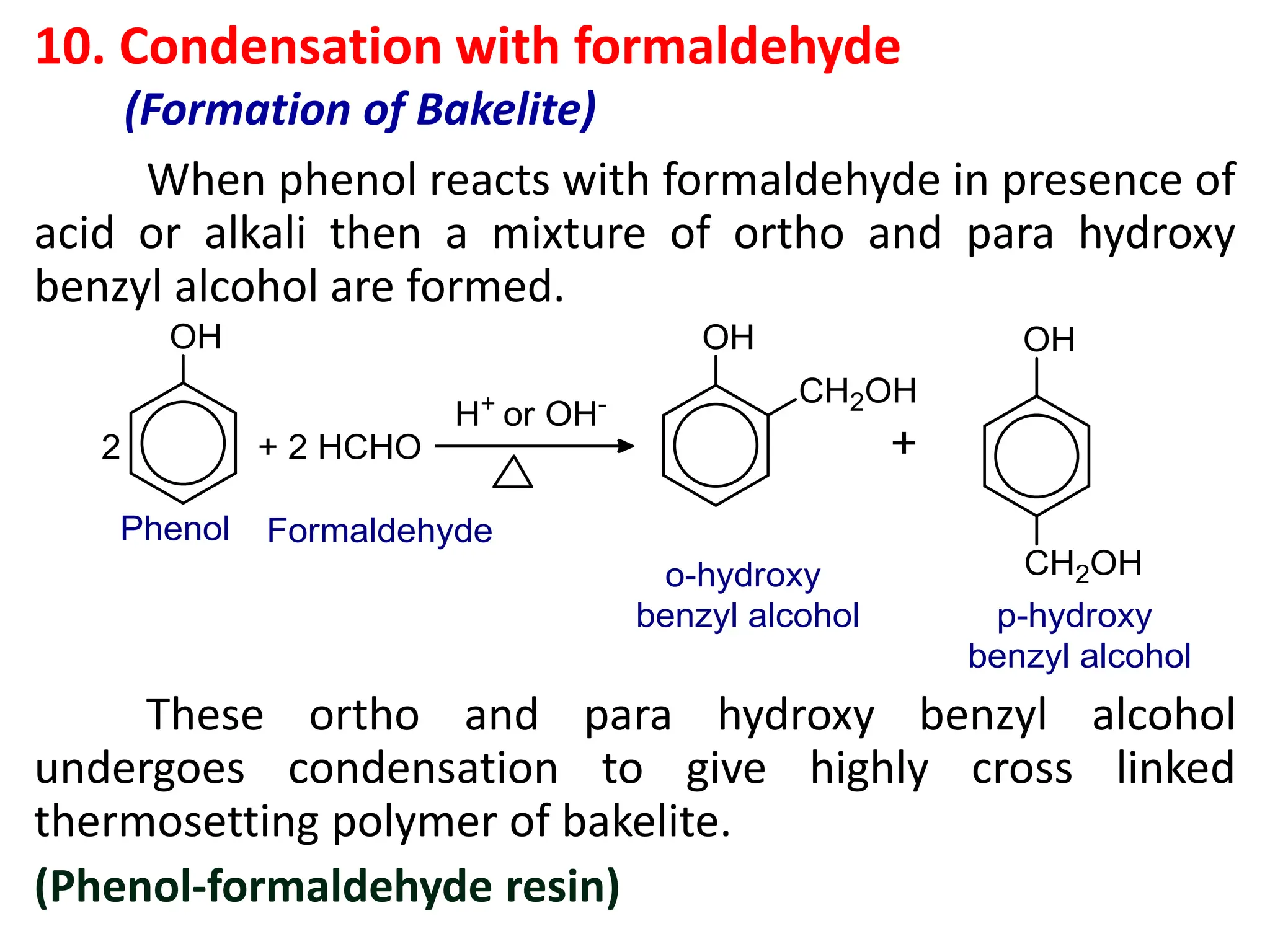
10. Condensation with formaldehyde
(Formation of Bakelite)
When phenol reacts with formaldehyde in presence of
acid or alkali then a mixture of ortho and para hydroxy
benzyl alcohol are formed.
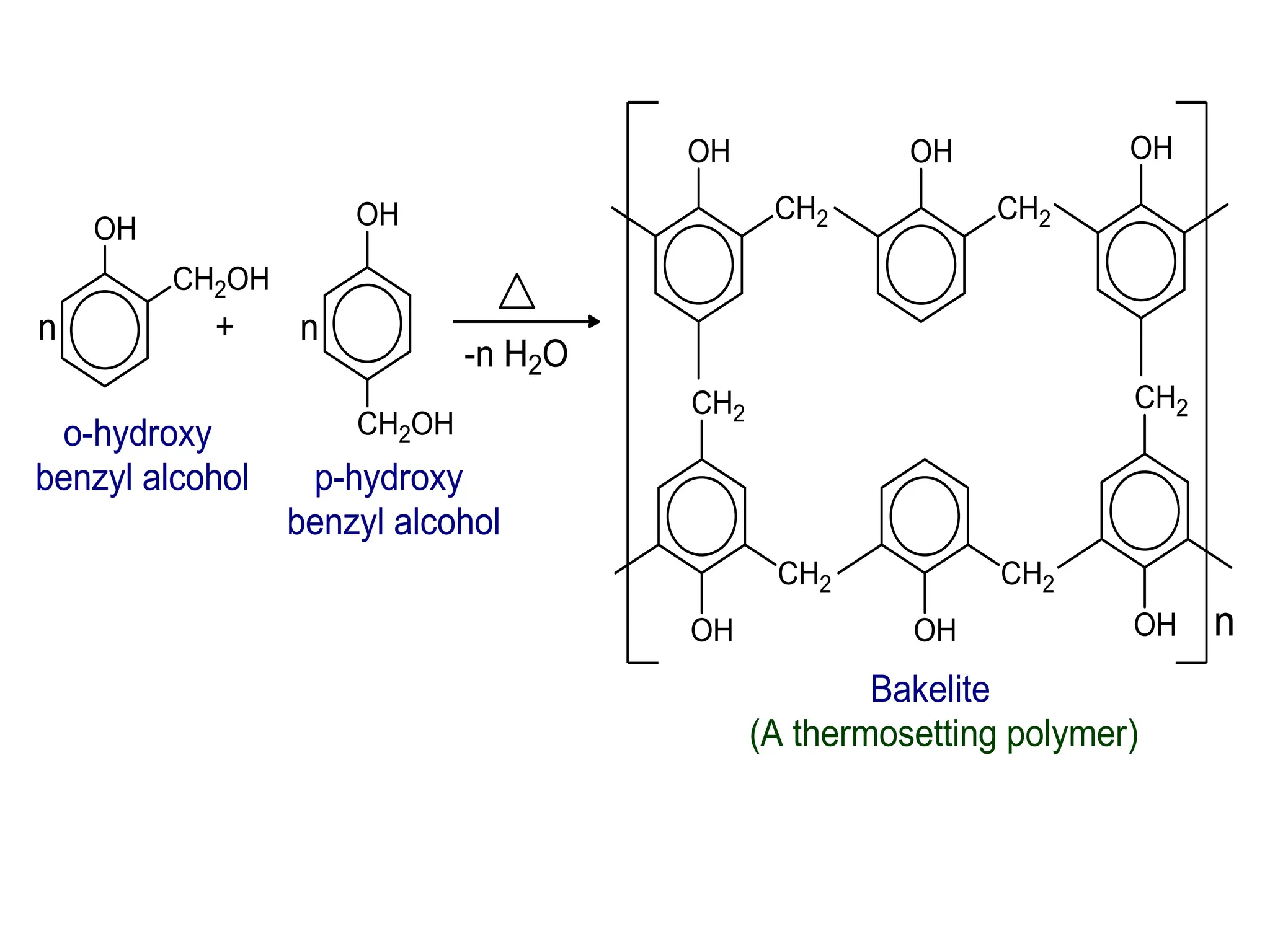
These ortho and para hydroxy benzyl alcohol
undergoes condensation to give highly cross linked
thermosetting polymer of bakelite.
(Phenol-formaldehyde resin)
…
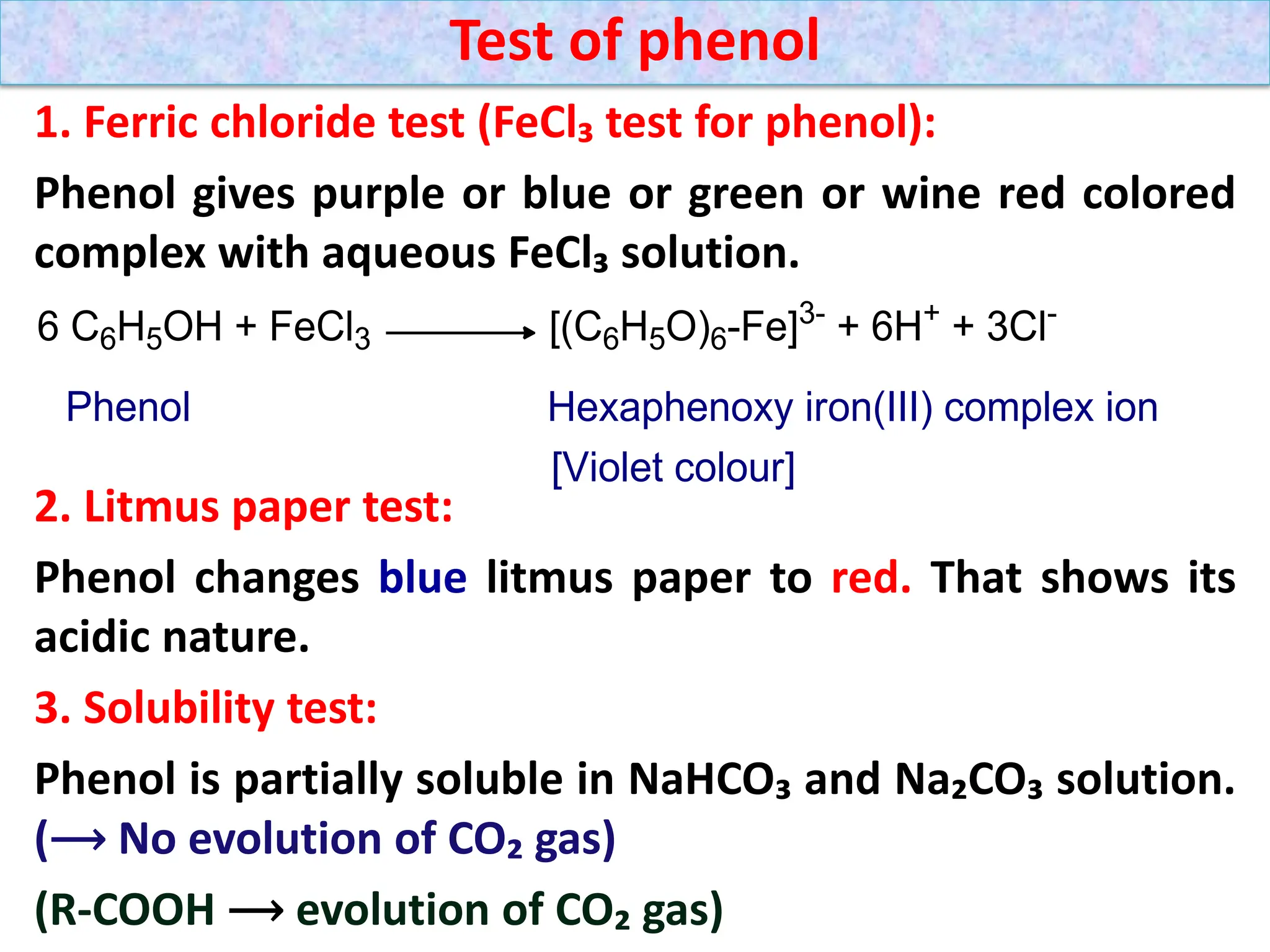
1. Ferric chloride test (FeCl₃ test for phenol):
Phenol gives purple or blue or green or wine red colored
complex with aqueous FeCl₃ solution.
2. Litmus paper test:
Phenol changes blue litmus paper to red. That shows its
acidic nature.
3. Solubility test:
Phenol is partially soluble in NaHCO₃ and Na₂CO₃ solution.
(⟶​ No evolution of CO₂ gas)
(R-COOH ⟶​ evolution of CO₂ gas)
Test of phenol
4. Bromine water test:
Phenol gives white crystalline precipitate of tribromo-
phenol with aqueous bromine solution.
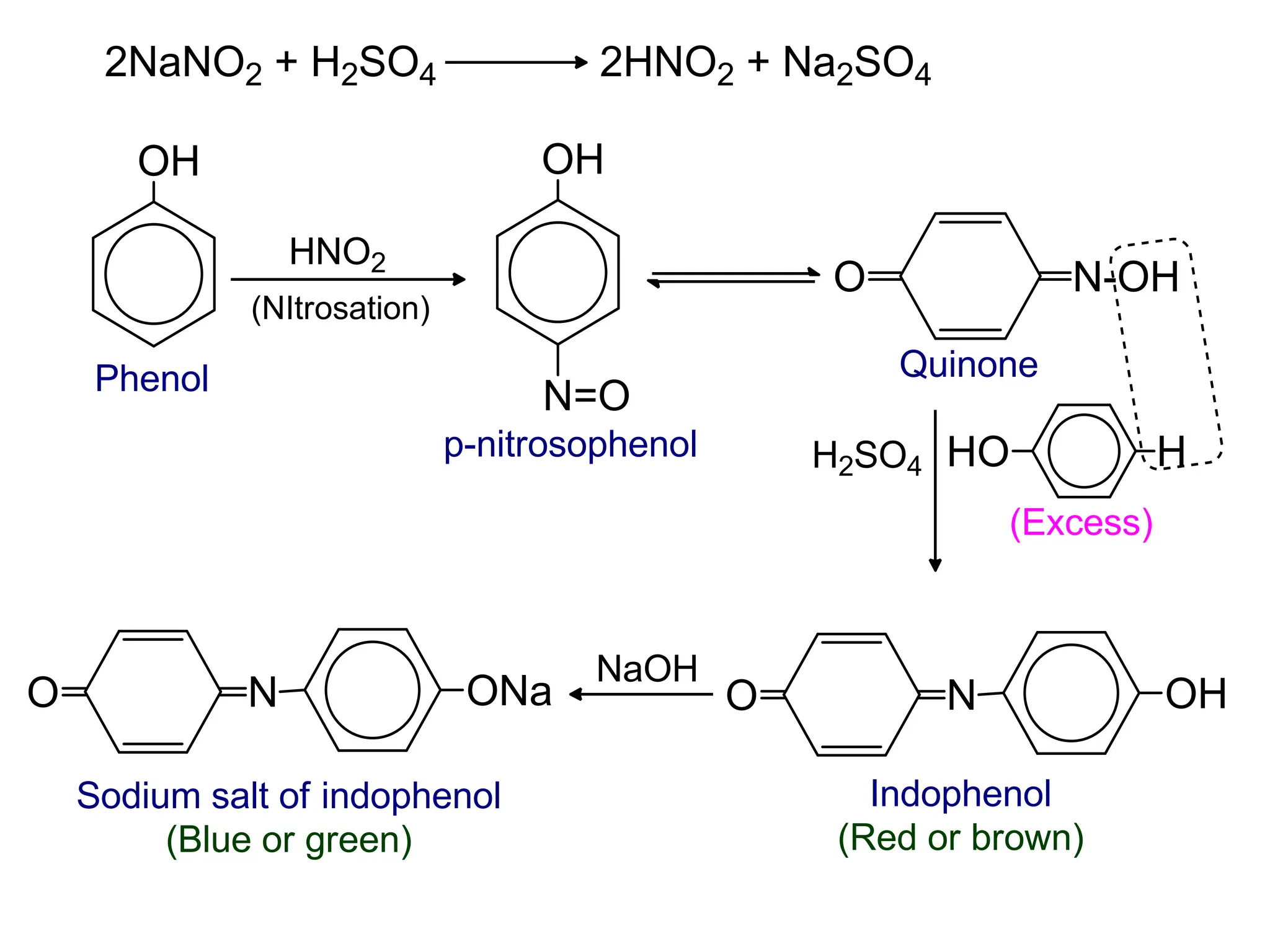
5. Libermann’s test
Phenol gives red brown color on warming with sodium
nitrite and conc. H₂SO₄. The red or brown color is changed
into intense blue or green on the addition of NaOH, that
indicates the presence of phenol.
It is used for the manufacture of dyes (p-hydroxy
azobenzene), drugs (aspirin), explosives (Picric
acid), phenolphthalein (indicator), bakelite
(polymer), salicylic acid, etc.
It is also used to prepare antiseptic and
disinfectants.
It is used as a preservative for ink.
It is also used as gasoline additives.
Uses of Phenol
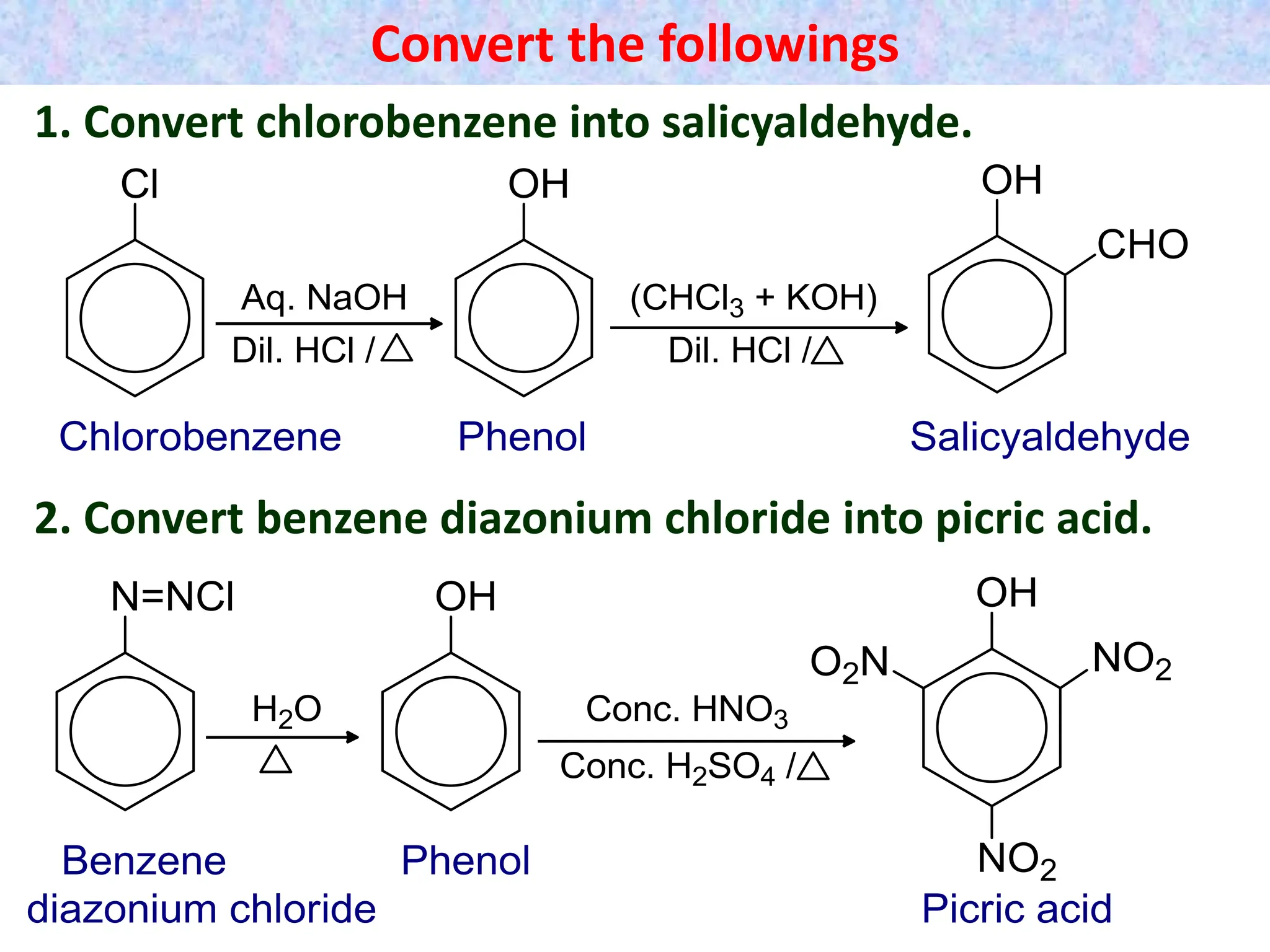
Convert the followings
1. Convert chlorobenzene into salicyaldehyde.
2. Convert benzene diazonium chloride into picric acid.
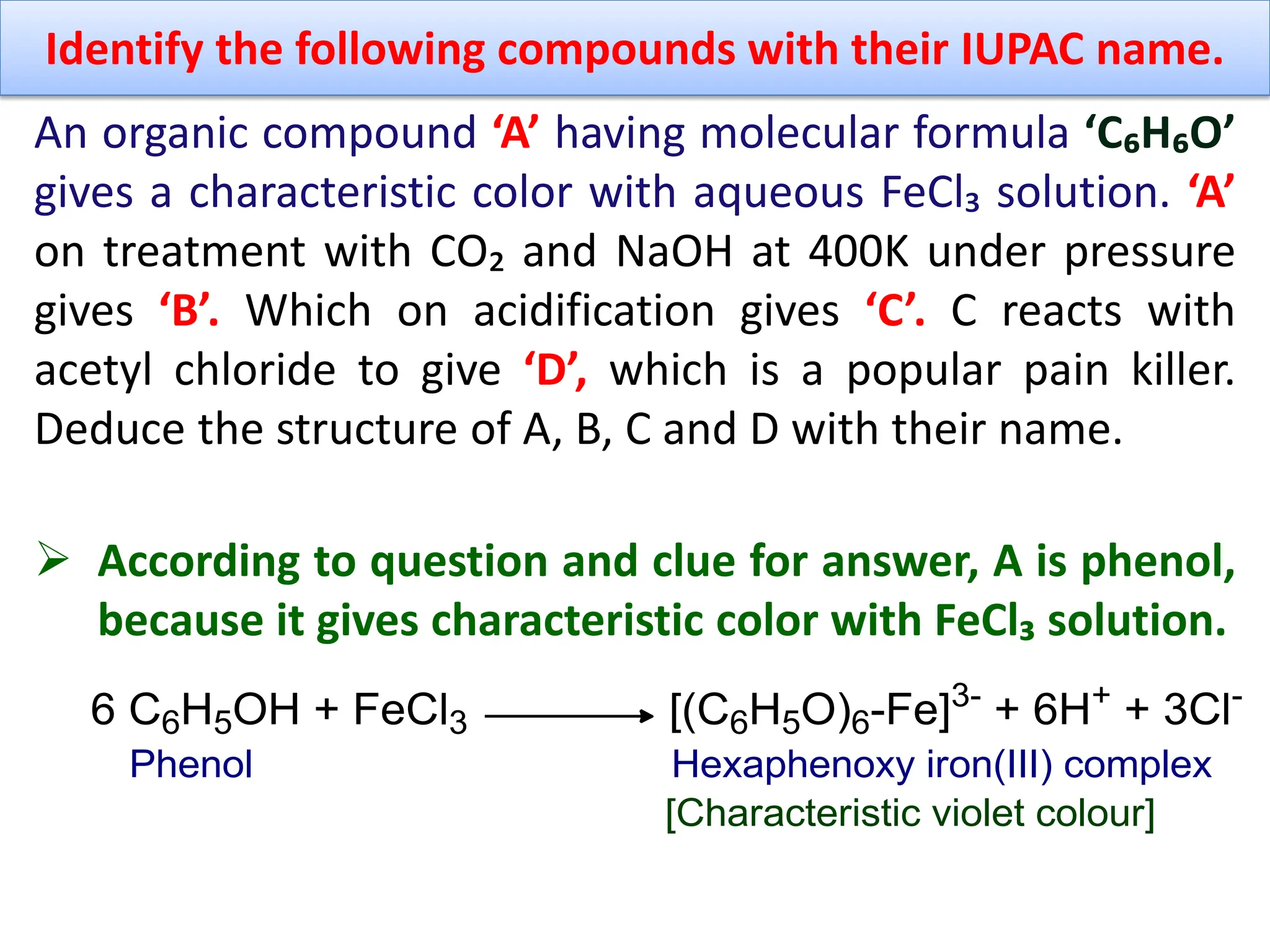
Identify the following compounds with their IUPAC name.
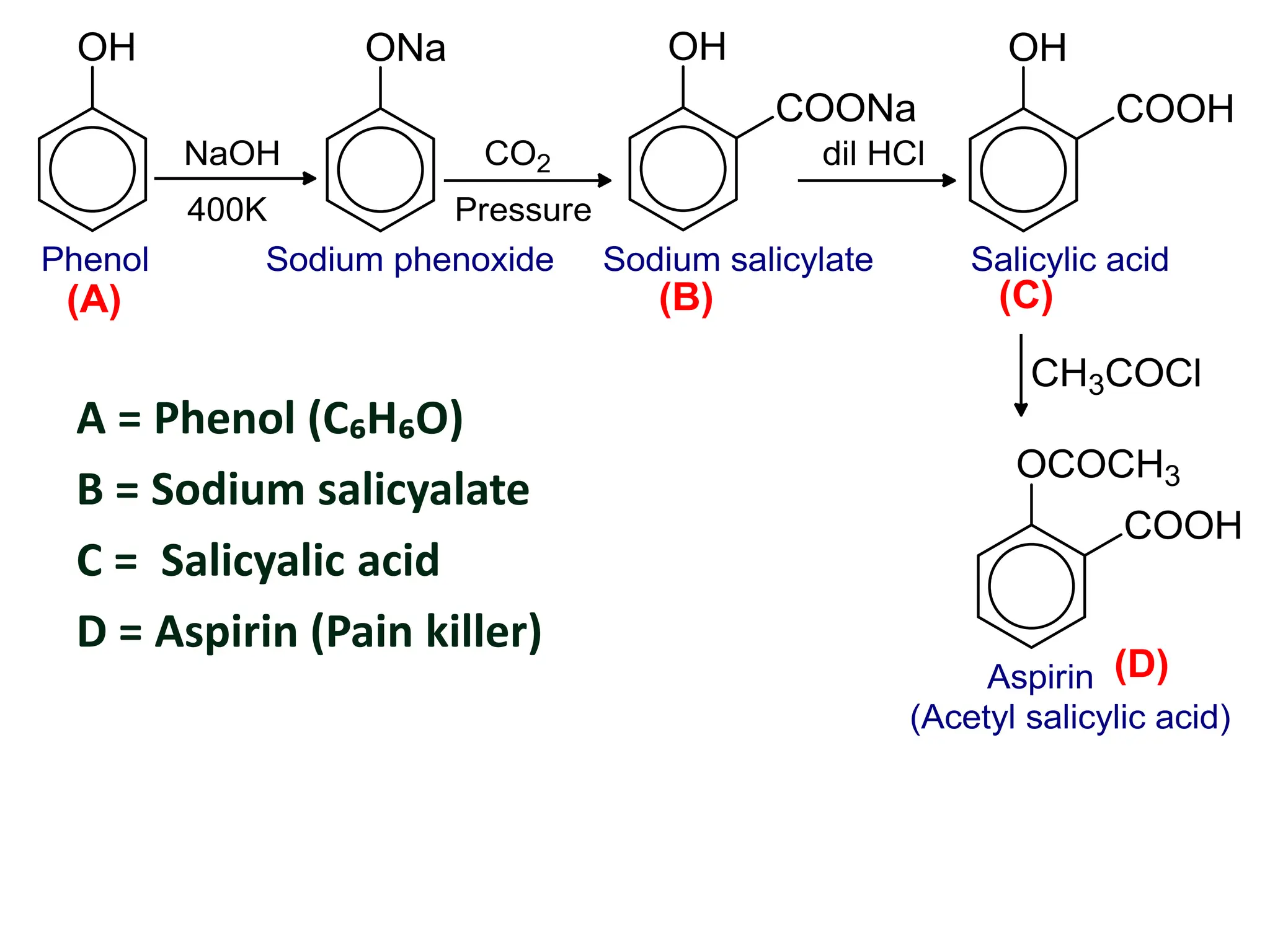
An organic compound ‘A’ having molecular formula ‘C₆H₆O’
gives a characteristic color with aqueous FeCl₃ solution. ‘A’
on treatment with CO₂ and NaOH at 400K under pressure
gives ‘B’. Which on acidification gives ‘C’. C reacts with
acetyl chloride to give ‘D’, which is a popular pain killer.
Deduce the structure of A, B, C and D with their name.
 According to question and clue for answer, A is phenol,
because it gives characteristic color with FeCl₃ solution.
A = Phenol (C₆H₆O)
B = Sodium salicyalate
C = Salicyalic acid
D = Aspirin (Pain killer)
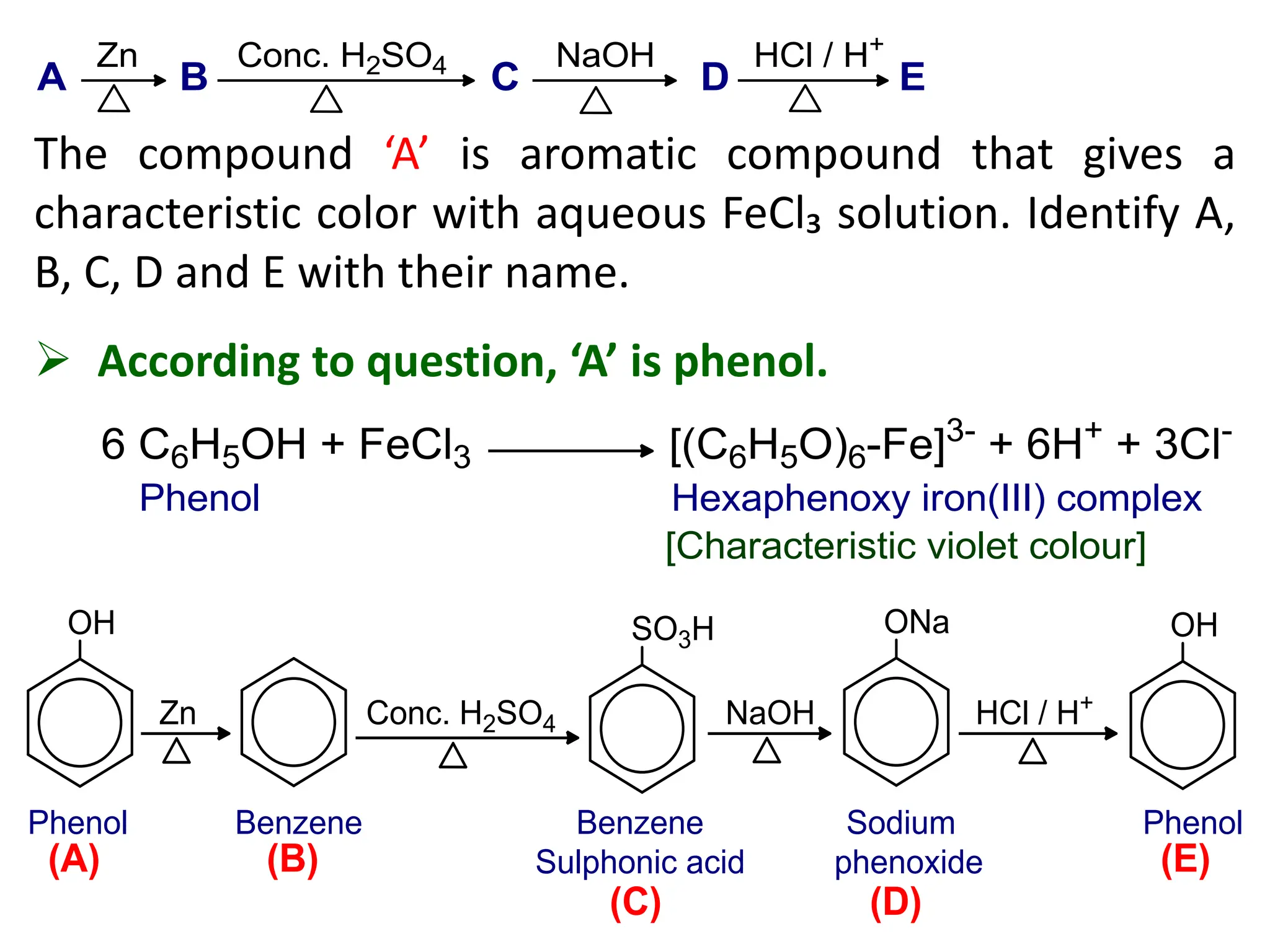
The compound ‘A’ is aromatic compound that gives a
characteristic color with aqueous FeCl₃ solution. Identify A,
B, C, D and E with their name.
 According to question, ‘A’ is phenol.
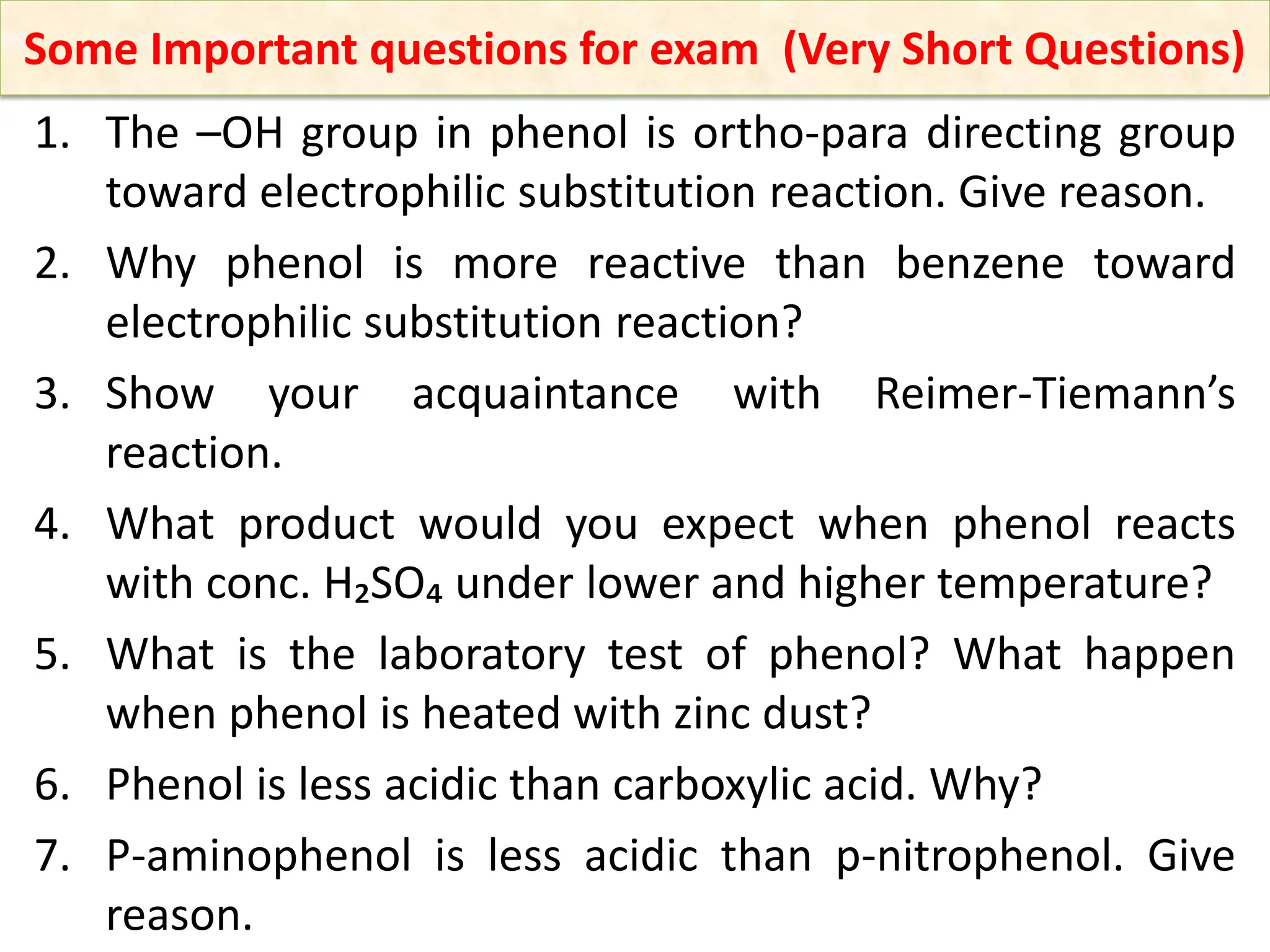
1. The –OH group in phenol is ortho-para directing group
toward electrophilic substitution reaction. Give reason.
2. Why phenol is more reactive than benzene toward
electrophilic substitution reaction?
3. Show your acquaintance with Reimer-Tiemann’s
reaction.
4. What product would you expect when phenol reacts
with conc. H₂SO₄ under lower and higher temperature?
5. What is the laboratory test of phenol? What happen
when phenol is heated with zinc dust?
6. Phenol is less acidic than carboxylic acid. Why?
7. P-aminophenol is less acidic than p-nitrophenol. Give
reason.
Some Important questions for exam (Very Short Questions)
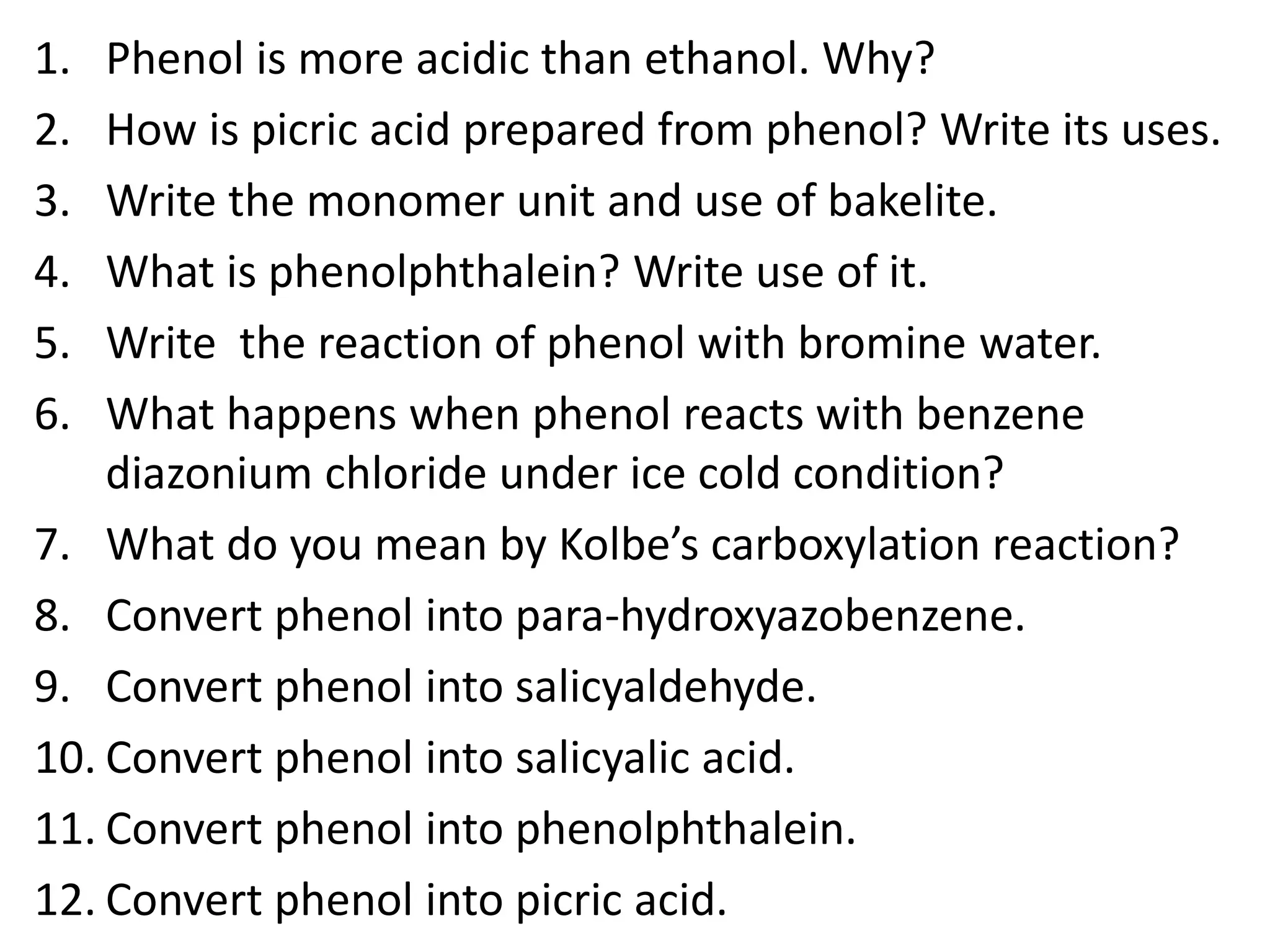
1. Phenol is more acidic than ethanol. Why?
2. How is picric acid prepared from phenol? Write its uses.
3. Write the monomer unit and use of bakelite.
4. What is phenolphthalein? Write use of it.
5. Write the reaction of phenol with bromine water.
6. What happens when phenol reacts with benzene
diazonium chloride under ice cold condition?
7. What do you mean by Kolbe’s carboxylation reaction?
8. Convert phenol into para-hydroxyazobenzene.
9. Convert phenol into salicyaldehyde.
10. Convert phenol into salicyalic acid.
11. Convert phenol into phenolphthalein.
12. Convert phenol into picric acid.
1. Write any three general methods of preparation of
phenol. What is the test reaction of phenol? [3+2]
2. How is phenol prepared from (a) benzene sulphonic
acid (b) aniline (c) chlorobenzene. How would you
explain the –OH group in phenol is ortho para directing
group toward electrophilic substitution reaction? [3+2]
3. Starting from phenol, how would you prepare (a) p-
hydroxyazobenzene (b) salicyaldehyde (c) phenyl
acetate (d) salicylic acid (e) p-nitrophenol. [1x5=5]
4. What happens when phenol is treated with (a) Aqueous
bromine (b) FeCl₃ solution (c) dilute HNO₃ (d) heated
zinc dust (e) Conc. HNO₃ and H₂SO₄? [1x5=5]
Some Important questions for exam (Short Questions)
1. Identify major product A, B, C and D in the following
reaction sequence.
2. An aromatic compound ‘A’ gives parent hydrocarbon ‘B’
when heated with Zn dust. The compound B can also be
obtained by polymerization of acetylene. The
compound A gives characteristic violet color with FeCl₃
solution. Identify A and B with their name and suitable
chemical reaction. Why the compound A is slightly
acidic in nature? [4+1]
The compound D gives toluene with zinc amalgam in
presence of HCl. [4+1]
Some Important questions for exam (Long Questions)
 Phenol is an important starting material for the
preparation of large number of industrial materials, out
of them picric acid is important explosive substance.
(a) Write the principle reaction for the preparation of
phenol from chlorobenzene.
(b) How phenol can also be obtained from benzene
diazonium chloride?
(c) How picric acid is obtained from phenol? Write any use
of picric acid.
(d) How phenol is slightly acidic in nature? Compare the
acidic strength of phenol with alcohol.
(e) Write any two important uses of phenol.
[2+1+2+2+1]
 An aromatic compound ‘A’ on diazotization gives
compound ‘B’ which is warmed with water to give
compound ‘C’. The compound C is heated with acetyl
chloride in presence of pyridine gives ‘D’ which
undergoes internal rearrangement in presence of
anhydrous AlCl₃ and CS₂ as solvent gives a mixture of ‘E’
and ‘F’. The compound C is heated with zinc dust to give
parent hydrocarbon benzene. Identify A, B, C, D, E and F
with their name and suitable chemical reaction involved
for it.
(a) What happens when compound C is heated with conc.
HNO₃ and conc. H₂SO₄?
(b) Write any two uses of Compound C.
[6+1+1]
 An aromatic hydrocarbon ‘A’ reacts with sodium
carbonate to give ‘B’ which is heated with solid NaOH at
about 300⁰C gives ‘C’. On acidification of C it gives ‘D’.
The compound D reacts with benzene diazonium
chloride to give ‘E’ which is an important dye. The
compound D is an aromatic compound having
molecular formula ‘C₆H₆O’ which give characteristic
violet color with FeCl₃ solution and is also obtained by
warming benzene diazonium chloride with water.
Identify A, B, C, D and E with their name and suitable
chemical reaction.
(a) What happens when compound D reacts with aq. Br₂?
(b) What is the action of compound D with blue litmus
paper? [6+1+1]
THANK YOU
Best of Luck
Stay safe, stay healthy
Bheshraj subedi
bheshraj.subedi@trinitycollege.edu.np

4. Phenols.pdf which explain about the general methods of preparation of phenols, physical and chemical properties and it's uses

  • 1.
    Class -XII Bheshraj Subedi bheshraj.subedi@trinitycollege.edu.np Departmentof Chemistry Trinity International S.S. & College Dillibazar, Kathmandu - Nepal ORGANIC CHEMISTRY
  • 2.
     Introduction ofphenol  Nomenclature of phenols  General methods of preparation of phenols  Physical properties of phenols  Chemical properties of phenols  Test of phenol  Uses of phenols  Some important questions for exam Course content
  • 3.
    Phenols Introduction The hydroxy derivativeof arenes (Aromatic hydrocarbon) in which the –OH group is directly attached to carbon atom of aromatic ring are called phenols. They are formed by replacing one or more hydrogen atom by –OH group in benzene ring. [The –OH group is bonded to carbon atom of side chain of aromatic ring are called aromatic alcohol]
  • 4.
  • 5.
  • 6.
    1. From chlorobenzene(Dows process-1928) When chlorobenzene is heated with aqueous NaOH at 350˚C under 300 atm. pressure followed by acidic hydrolysis then phenol is formed. This reaction is also called Dows process for the formation of phenol. General methods of preparation of phenol
  • 7.
    2. From benzenesulphonic acid When benzene sulphonic acid reacts with Na₂CO₃ solution then sodium benzene sulphonate is formed which is heated with solid NaOH at 300˚C followed by acidic hydrolysis then phenol is formed.
  • 8.
    3. From benzenediazonium chloride Benzene diazonium chloride is prepared by diazotization of aniline with nitrous acid under ice cold condition. When benzene diazonium chloride is warmed with water then phenol is formed.
  • 9.
    Physical properties ofphenol 1. They are colorless liquid and crystalline solid. 2. They are slightly soluble in water and soluble in organic solvent. 3. Phenol is colorless hygroscopic crystalline solid. 4. The melting point of phenol is 41˚C and boiling point is 182˚C. 5. They possess carbolic smell having anti-bacterial property. 6. When phenol is exposed to atmospheric air then it becomes slightly red or pink in color.
  • 10.
    Chemical properties ofphenol 1. Acidic nature of phenol Phenol is weakly acidic in nature because it slightly ionize in aqueous solution to give phenoxide ion and H⁺ or H₃O⁺ ions. Phenol turns blue litmus paper to red which indicates acidic nature. [A] Reaction due to –OH group of phenol
  • 11.
    (a) Reaction withalkali metal (Na or K) When phenol reacts with sodium or potassium then its salt is formed with the evolution of hydrogen gas. (b) Reaction with alkali (NaOH or KOH) When phenol reacts with alkali then salt and water are formed.
  • 12.
    (c) Reaction withNa₂CO₃ or NaHCO₃ Phenol does not react with carbonate and bicarbonate solution and hence CO₂ gas is not evolve. But carboxylic acid reacts with Na₂CO₃ or NaHCO₃ to give CO₂ gas. Hence this reaction is used to distinguish phenol from carboxylic acid.
  • 13.
    (d) Phenol isless acidic than carboxylic acid The more acidic nature of carboxylic acid than phenol is due to greater resonance stabilization of carboxylate ion than that of phenoxide ion. Fast release of H⁺ ions Therefore more acidic Slow release of H⁺ ions Therefore less acidic
  • 14.
    (e) Phenol ismore acidic than alcohol Phenol is more acidic than alcohol because the phenoxide ion is more stable than alkoxide ion due to resonance stabilization and hence more hydrogen ion are released easily. Fast release of H⁺ ions Therefore more acidic Slow release of H⁺ ions Therefore less acidic
  • 15.
    (f) Effect ofsubstituents on acidic strength of phenol (i) Effect of electron releasing substituents G = Electron releasing groups. G = -R, -OH, -OR, -NH₂, -NR₂, -NHR etc.  Electron releasing or donating group.  Increase the electron density towards benzene ring.  Shared pair of electrons on –OH bond increase.  Removal of proton (H⁺) from –OH bond is difficult.  Therefore less acidic.
  • 16.
    (ii) Effect ofelectron withdrawing substituents G = Electron withdrawing group. G = -X, -CN, -CHO, -COOH, -NO₂ etc.  Electron withdrawing group.  Withdraw electron density from benzene ring.  Decrease electron density at benzene ring.  Shared pair of electron on –OH bond decrease.  Removal of proton (H⁺) from –OH bond is easy.  Therefore more acidic.
  • 17.
    Effect of substituentsis more significant at ortho and para position than meta position. Thus acidic strength decrease in the order of: Similarly, the acidic strength of different compounds of phenol derivatives is in the order:
  • 18.
    2. Reaction withzinc When phenol is heated with zinc dust then benzene is formed. 3. Reaction with ammonia (Bucherer reaction) When phenol is heated with ammonia at 300˚C in presence of anhydrous ZnCl₂ then aniline is formed.
  • 19.
    4. Acylation reaction Whenphenol reacts with acyl chloride in presence of pyridine or acetic anhydride in presence of mineral acid then ester is formed.
  • 20.
    Fries rearrangement reaction Whenphenyl acetate is heated with anhydrous AlCl₃ in presence of CS₂ as solvent, it undergoes internal rearrangement in which acyl group migrates from phenolic oxygen to ortho and para position to give the mixture of ortho and para hydroxy acetophenone.
  • 21.
    5. Reaction withFeCl₃ solution (Laboratory test of phenol) When phenol reacts with neutral aqueous FeCl₃ solution then red, blue or violet coloured water soluble complex salt is formed. This is the laboratory test reaction of phenol.
  • 22.
    [B] Reaction dueto aromatic ring (Electrophilic substitution reaction) The –OH group in phenol is electron releasing group that increase electron density at benzene ring and benzene ring becomes more reactive. Therefore the –OH group in phenol is ring activator group due to positive resonance effect (+R effect).
  • 23.
    In resonance structureof phenol there is high electron density at ortho and para position (indicated by negative charge). Hence an incoming electrophile can attack at these position to give ortho and para substituted product. Therefore the OH group in phenol is ortho and para directing group toward electrophilic substitution reaction.
  • 24.
    1. Bromination When phenolreacts with bromine water (aqueous bromine) then white crystalline ppt. of tribromophenol is formed. However, if the bromination is carried out in presence of less polar solvent like CCl₄, CS₂ etc under low temperature then the mixture of ortho and para bromophenol are formed.
  • 25.
    2. Nitration When phenolis heated with conc. Nitric acid and conc. Sulphuric acid as catalyst then picric acid is formed. With dilute nitric acid at low temperature, a mixture of ortho and para nitrophenol are formed.
  • 26.
    3. Sulphonation When phenolis heated with Conc. Sulphuric acid then ortho isomer is formed at low temperature and para isomer is formed at high temperature.
  • 27.
    4. Friedel craft’salkylation When phenol is heated with alkyl halide in presence of anhydrous AlCl₃ then the mixture of ortho and para alkyl phenol are formed.
  • 28.
    5. Reaction withCHCl₃ (Reimer-Tiemann’s reaction) When phenol is heated with chloroform in presence of NaOH or KOH at about 60-70˚C followed by acidic hydrolysis then ortho hydroxy benzaldehyde is formed as major product.
  • 29.
    6. Kolbe’s reaction(Carboxylation reaction) When sodium phenoxide is heated with CO₂ gas at 130˚C under 5-7 atm. pressure followed by acidic hydrolysis then salicylic acid is formed. In this reaction the –COOH group is introduced at ortho position, so this reaction is called carboxylation reaction.
  • 30.
    7. Coupling reaction Whenphenol reacts with benzene diazonium chloride under ice cold condition in alkaline medium then an orange yellow dye of para-hydroxy azobenzene is formed.
  • 31.
    8. Oxidation ofphenol When phenol is oxidized with air then pink or red coloured product of phenoquinone is formed.
  • 32.
    9. Condensation withphthalic anhydride (Formation of phenolphthalein) When phenol is heated with phthalic anhydride in presence of Conc. H₂SO₄ or anhydrous ZnCl₂ then phenolphthalein is formed, which is used as an indicator during acid-base titration.
  • 33.
    10. Condensation withformaldehyde (Formation of Bakelite) When phenol reacts with formaldehyde in presence of acid or alkali then a mixture of ortho and para hydroxy benzyl alcohol are formed. These ortho and para hydroxy benzyl alcohol undergoes condensation to give highly cross linked thermosetting polymer of bakelite. (Phenol-formaldehyde resin)
  • 34.
  • 35.
    1. Ferric chloridetest (FeCl₃ test for phenol): Phenol gives purple or blue or green or wine red colored complex with aqueous FeCl₃ solution. 2. Litmus paper test: Phenol changes blue litmus paper to red. That shows its acidic nature. 3. Solubility test: Phenol is partially soluble in NaHCO₃ and Na₂CO₃ solution. (⟶​ No evolution of CO₂ gas) (R-COOH ⟶​ evolution of CO₂ gas) Test of phenol
  • 36.
    4. Bromine watertest: Phenol gives white crystalline precipitate of tribromo- phenol with aqueous bromine solution. 5. Libermann’s test Phenol gives red brown color on warming with sodium nitrite and conc. H₂SO₄. The red or brown color is changed into intense blue or green on the addition of NaOH, that indicates the presence of phenol.
  • 38.
    It is usedfor the manufacture of dyes (p-hydroxy azobenzene), drugs (aspirin), explosives (Picric acid), phenolphthalein (indicator), bakelite (polymer), salicylic acid, etc. It is also used to prepare antiseptic and disinfectants. It is used as a preservative for ink. It is also used as gasoline additives. Uses of Phenol
  • 39.
    Convert the followings 1.Convert chlorobenzene into salicyaldehyde. 2. Convert benzene diazonium chloride into picric acid.
  • 40.
    Identify the followingcompounds with their IUPAC name. An organic compound ‘A’ having molecular formula ‘C₆H₆O’ gives a characteristic color with aqueous FeCl₃ solution. ‘A’ on treatment with CO₂ and NaOH at 400K under pressure gives ‘B’. Which on acidification gives ‘C’. C reacts with acetyl chloride to give ‘D’, which is a popular pain killer. Deduce the structure of A, B, C and D with their name.  According to question and clue for answer, A is phenol, because it gives characteristic color with FeCl₃ solution.
  • 41.
    A = Phenol(C₆H₆O) B = Sodium salicyalate C = Salicyalic acid D = Aspirin (Pain killer)
  • 42.
    The compound ‘A’is aromatic compound that gives a characteristic color with aqueous FeCl₃ solution. Identify A, B, C, D and E with their name.  According to question, ‘A’ is phenol.
  • 43.
    1. The –OHgroup in phenol is ortho-para directing group toward electrophilic substitution reaction. Give reason. 2. Why phenol is more reactive than benzene toward electrophilic substitution reaction? 3. Show your acquaintance with Reimer-Tiemann’s reaction. 4. What product would you expect when phenol reacts with conc. H₂SO₄ under lower and higher temperature? 5. What is the laboratory test of phenol? What happen when phenol is heated with zinc dust? 6. Phenol is less acidic than carboxylic acid. Why? 7. P-aminophenol is less acidic than p-nitrophenol. Give reason. Some Important questions for exam (Very Short Questions)
  • 44.
    1. Phenol ismore acidic than ethanol. Why? 2. How is picric acid prepared from phenol? Write its uses. 3. Write the monomer unit and use of bakelite. 4. What is phenolphthalein? Write use of it. 5. Write the reaction of phenol with bromine water. 6. What happens when phenol reacts with benzene diazonium chloride under ice cold condition? 7. What do you mean by Kolbe’s carboxylation reaction? 8. Convert phenol into para-hydroxyazobenzene. 9. Convert phenol into salicyaldehyde. 10. Convert phenol into salicyalic acid. 11. Convert phenol into phenolphthalein. 12. Convert phenol into picric acid.
  • 45.
    1. Write anythree general methods of preparation of phenol. What is the test reaction of phenol? [3+2] 2. How is phenol prepared from (a) benzene sulphonic acid (b) aniline (c) chlorobenzene. How would you explain the –OH group in phenol is ortho para directing group toward electrophilic substitution reaction? [3+2] 3. Starting from phenol, how would you prepare (a) p- hydroxyazobenzene (b) salicyaldehyde (c) phenyl acetate (d) salicylic acid (e) p-nitrophenol. [1x5=5] 4. What happens when phenol is treated with (a) Aqueous bromine (b) FeCl₃ solution (c) dilute HNO₃ (d) heated zinc dust (e) Conc. HNO₃ and H₂SO₄? [1x5=5] Some Important questions for exam (Short Questions)
  • 46.
    1. Identify majorproduct A, B, C and D in the following reaction sequence. 2. An aromatic compound ‘A’ gives parent hydrocarbon ‘B’ when heated with Zn dust. The compound B can also be obtained by polymerization of acetylene. The compound A gives characteristic violet color with FeCl₃ solution. Identify A and B with their name and suitable chemical reaction. Why the compound A is slightly acidic in nature? [4+1] The compound D gives toluene with zinc amalgam in presence of HCl. [4+1]
  • 47.
    Some Important questionsfor exam (Long Questions)  Phenol is an important starting material for the preparation of large number of industrial materials, out of them picric acid is important explosive substance. (a) Write the principle reaction for the preparation of phenol from chlorobenzene. (b) How phenol can also be obtained from benzene diazonium chloride? (c) How picric acid is obtained from phenol? Write any use of picric acid. (d) How phenol is slightly acidic in nature? Compare the acidic strength of phenol with alcohol. (e) Write any two important uses of phenol. [2+1+2+2+1]
  • 48.
     An aromaticcompound ‘A’ on diazotization gives compound ‘B’ which is warmed with water to give compound ‘C’. The compound C is heated with acetyl chloride in presence of pyridine gives ‘D’ which undergoes internal rearrangement in presence of anhydrous AlCl₃ and CS₂ as solvent gives a mixture of ‘E’ and ‘F’. The compound C is heated with zinc dust to give parent hydrocarbon benzene. Identify A, B, C, D, E and F with their name and suitable chemical reaction involved for it. (a) What happens when compound C is heated with conc. HNO₃ and conc. H₂SO₄? (b) Write any two uses of Compound C. [6+1+1]
  • 49.
     An aromatichydrocarbon ‘A’ reacts with sodium carbonate to give ‘B’ which is heated with solid NaOH at about 300⁰C gives ‘C’. On acidification of C it gives ‘D’. The compound D reacts with benzene diazonium chloride to give ‘E’ which is an important dye. The compound D is an aromatic compound having molecular formula ‘C₆H₆O’ which give characteristic violet color with FeCl₃ solution and is also obtained by warming benzene diazonium chloride with water. Identify A, B, C, D and E with their name and suitable chemical reaction. (a) What happens when compound D reacts with aq. Br₂? (b) What is the action of compound D with blue litmus paper? [6+1+1]
  • 50.
    THANK YOU Best ofLuck Stay safe, stay healthy Bheshraj subedi bheshraj.subedi@trinitycollege.edu.np