PHENOLS
B KARUNA DEVI
ASSISTANT PROFESSOR
PHARMACEUTICAL CHEMISTRY
GOKARAJU RANGARAJU COLLEGE OF PHARMACY
LEARNING OUTCOMES
• Classify phenols.
• Explain nomenclature.
• Explain physico-chemical properties.
• Explain methods of preparations.
• Discuss the reactions of phenols.
• Uses of phenol, o- cresol, resorcinol and naphthol.
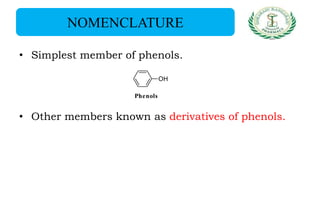
NOMENCLATURE
• Simplest member of phenols.
• Other members known as derivatives of phenols.
OH
Phenols
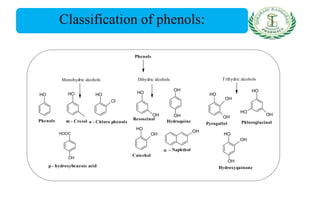
Classification of phenols:
Phenols
Monohydric alcohols Dihydric alcohols Trihydric alcohols
OH OH OH
Cl
HOOC
OH
Phenols m - Cresol o - Chloro phenols
p - hydroxybenzoic acid
OH
OH
OH
OH
OH
OH
OH
Resoscinol
Hydroquine
Catechol
 Naphthol
OH
OH
OH
Pyragallol
OH
OH
OH
Hydroxyquinone
OH
OH
OH
Phloroglucinol
PHYSICO-CHEMICAL PROPERTIES
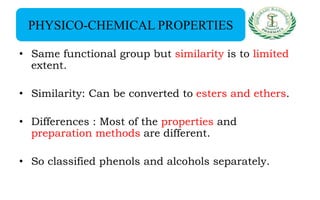
• Same functional group but similarity is to limited
extent.
• Similarity: Can be converted to esters and ethers.
• Differences : Most of the properties and
preparation methods are different.
• So classified phenols and alcohols separately.
PHYSICO-CHEMICAL PROPERTIES
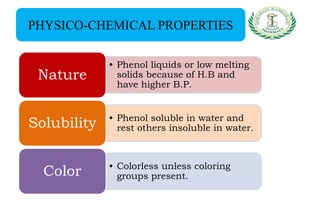
• Phenol liquids or low melting
solids because of H.B and
have higher B.P.
Nature
• Phenol soluble in water and
rest others insoluble in water.Solubility
• Colorless unless coloring
groups present.Color
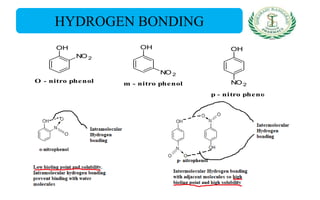
HYDROGEN BONDING
OH
NO 2
OH
NO 2
OH
NO 2
O - nitro phenol
p - nitro phenol
m - nitro phenol
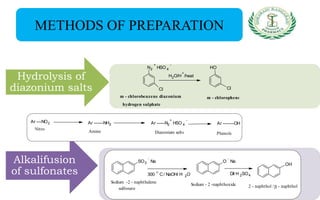
METHODS OF PREPARATION
Hydrolysis of
diazonium salts
Alkalifusion
of sulfonates
N2
+
HSO 4
-
Cl Cl
OH
m - chlorobenzene diazonium
hydrogen sulphate
m - chlorophenol
H2O/H
+
/heat
Ar ---NO2 Ar ------NH2 Ar -----N2
+
HSO 4
-
Ar -------OH
Nitro
Amine Diazonium salts Phenols
SO3
-
Na O
-
Na
Sodium -2 - naphthalene
sulfonate
Sodium - 2 -naphthoxide
300

C / NaOH/ H 2O
OH
2 - naphthol / - naphthol
Dil H 2SO4
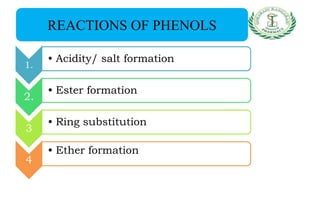
REACTIONS OF PHENOLS
1.
• Acidity/ salt formation
2.
• Ester formation
3
• Ring substitution
4
• Ether formation
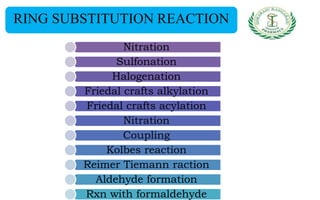
RING SUBSTITUTION REACTION
Nitration
Sulfonation
Halogenation
Friedal crafts alkylation
Friedal crafts acylation
Nitration
Coupling
Kolbes reaction
Reimer Tiemann raction
Aldehyde formation
Rxn with formaldehyde
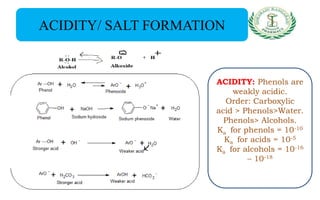
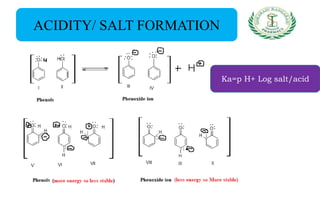
ACIDITY/ SALT FORMATION
ACIDITY: Phenols are
weakly acidic.
Order: Carboxylic
acid > Phenols>Water.
Phenols> Alcohols.
Ka for phenols = 10-10
Ka for acids = 10-5
Ka for alcohols = 10-16
– 10-18
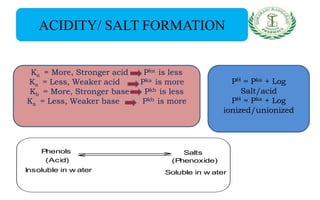
ACIDITY/ SALT FORMATION
Ka = More, Stronger acid Pka is less
Ka = Less, Weaker acid Pka is more
Kb = More, Stronger base Pkb is less
Ka = Less, Weaker base Pkb is more
PH = Pka + Log
Salt/acid
PH = Pka + Log
ionized/unionized
Phenols Salts
(Acid) (Phenoxide)
Insoluble in w ater Soluble in w ater
ACIDITY/ SALT FORMATION
Ka=p H+ Log salt/acid
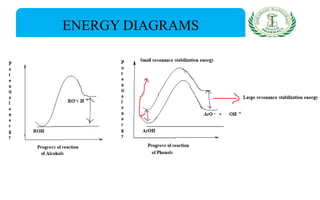
ENERGY DIAGRAMS
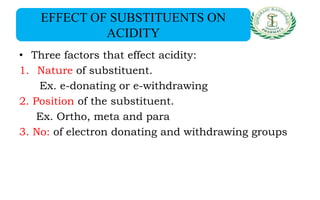
EFFECT OF SUBSTITUENTS ON
ACIDITY
• Three factors that effect acidity:
1. Nature of substituent.
Ex. e-donating or e-withdrawing
2. Position of the substituent.
Ex. Ortho, meta and para
3. No: of electron donating and withdrawing groups
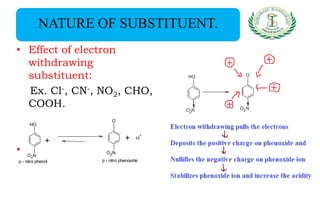
NATURE OF SUBSTITUENT.
• Effect of electron
withdrawing
substituent:
Ex. Cl-, CN-, NO2, CHO,
COOH.
•
OH
O2N
+
O2N
O
-
+ H
+
p - nitro phenol p - nitro phenoxide
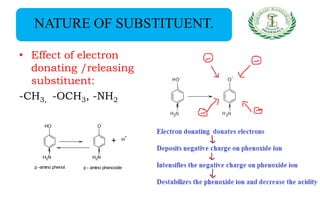
• Effect of electron
donating /releasing
substituent:
-CH3, -OCH3, -NH2
NATURE OF SUBSTITUENT.
+ H
+
OH
NH2
O
-
NH2
p -amino phenol p - amino phenoxide
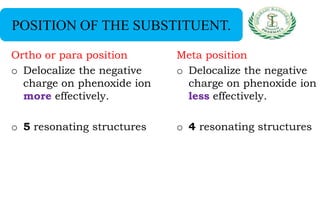
POSITION OF THE SUBSTITUENT.
Ortho or para position
o Delocalize the negative
charge on phenoxide ion
more effectively.
o 5 resonating structures
Meta position
o Delocalize the negative
charge on phenoxide ion
less effectively.
o 4 resonating structures
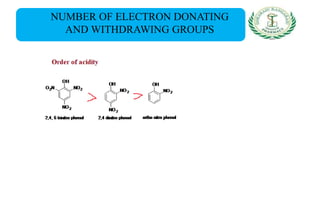
NUMBER OF ELECTRON DONATING
AND WITHDRAWING GROUPS
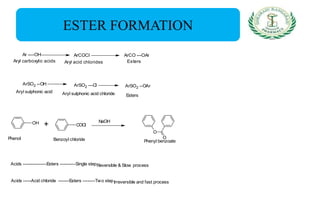
ESTER FORMATION
ArSO2 --OH ArSO2 ---Cl ArSO2 --OAr
Aryl sulphonic acid Aryl sulphonic acid chloride Esters
Ar ----OH ArCOCl ArCO ---OAr
Aryl carboxylic acids Aryl acid chlorides Esters
OH COCl
O
O
+ NaOH
Phenol Benzoyl chloride Phenyl benzoate
Acids ---------------Esters ----------Single stepReversible & Slow process
Acids -----Acid chloride -------Esters --------Two stepIrreversible and fast process
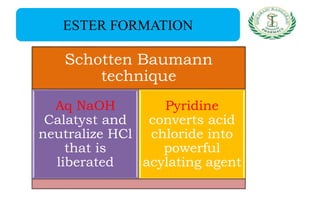
ESTER FORMATION
Schotten Baumann
technique
Aq NaOH
Calatyst and
neutralize HCl
that is
liberated
Pyridine
converts acid
chloride into
powerful
acylating agent
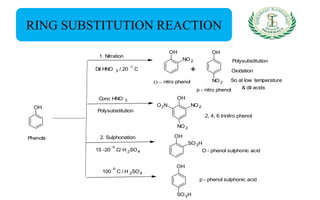
RING SUBSTITUTION REACTION
OH
1. Nitration
Dil HNO 3 / 20

C
OH
NO2
OH
NO2
+
ļļ€ ļ€­ nitro phenol
p - nitro phenol
Polysubstitution
Oxidation
So at low temperature
& dil acids
Conc HNO 3
Polysubstitution
OH
NO2
NO2
O2N
2, 4, 6 trinitro phenol
2. Sulphonation
15 -20
o
C/ H 2SO4
OH
SO3H
O - phenol sulphonic acid
OH
SO3H
p - phenol sulphonic acid
100
o
C / H 2SO4
Phenols
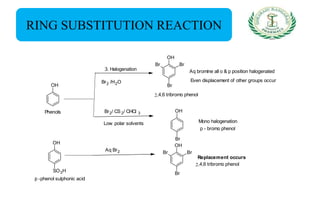
RING SUBSTITUTION REACTION
OH
3. Halogenation
Br2 /H2O
OH
BrBr
Br
,4,6 tribromo phenol
Br2/ CS 2/ CHCl 3
Low polar solvents
OH
Br
p - bromo phenol
Aq Br2
Phenols
Aq bromine all o & p position halogenated
Even displacement of other groups occur
Mono halogenation
OH
BrBr
Br
,4,6 tribromo phenol
OH
SO3H
p -phenol sulphonic acid
Replacement occurs
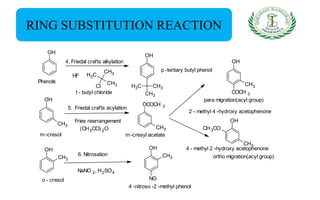
RING SUBSTITUTION REACTION
OH
4. Friedal crafts alkylation
HF
OH
CH3 CH3
CH3
5. Friedal crafts acylation
Fries rearrangement
OCOCH 3
CH3
m-cresyl acetate
6. Nitrosation
NaNO 2, H2SO4
OH
CH3
NO
Phenols CH3Cl
CH3CH3
t - butyl chloride
p -tertiary butyl phenol
OH
CH3
m-cresol
(CH3CO) 2O
OH
CH3
COCH 3
OH
CH3
CH3CO
2 - methyl 4 -hydroxy acetophenone
4 - methyl 2 -hydroxy acetophenone
para migration(acyl group)
ortho migration(acyl group)
OH
CH3
o - cresol
4 -nitroso -2 -methyl phenol
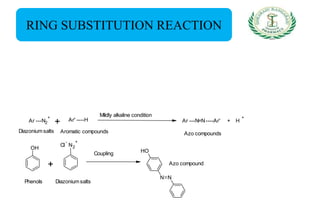
RING SUBSTITUTION REACTION
OH
Phenols
+
Cl
-
N2
+
Diazoniumsalts
Coupling OH
N N
Azo compound
Ar ---N2
+
+ Ar' ----H
Mildly alkaline condition
Ar ---N=N----Ar' + H
+
Diazoniumsalts Aromatic compounds Azo compounds
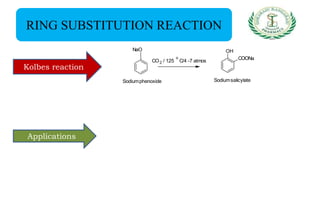
RING SUBSTITUTION REACTION
NaO
CO2 / 125
o
C/4 -7 atmos
OH
COONa
Sodiumphenoxide Sodiumsalicylate
Kolbes reaction
Applications
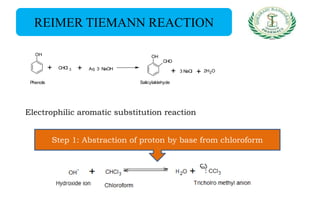
REIMER TIEMANN REACTION
OH
Phenols
+ CHCl 3 + Aq 3 NaOH
OH
CHO
Salicylaldehyde
+ 3 NaCl + 2H2O
Electrophilic aromatic substitution reaction
Step 1: Abstraction of proton by base from chloroform
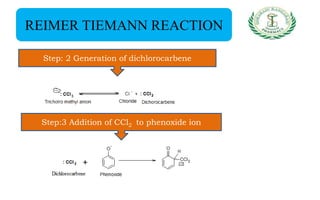
REIMER TIEMANN REACTION
Step: 2 Generation of dichlorocarbene
Step:3 Addition of CCl2 to phenoxide ion
REIMER TIEMANN REACTION
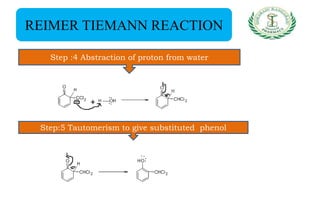
Step :4 Abstraction of proton from water
Step:5 Tautomerism to give substituted phenol
REIMER TIEMANN REACTION
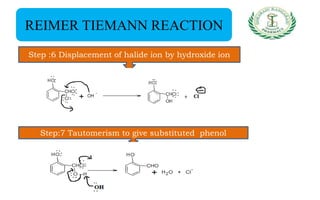
Step :6 Displacement of halide ion by hydroxide ion
Step:7 Tautomerism to give substituted phenol
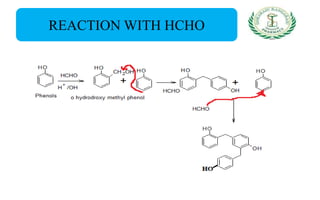
REACTION WITH HCHO
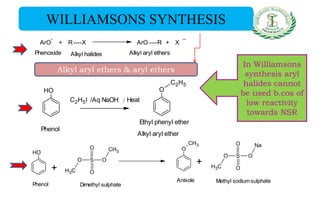
WILLIAMSONS SYNTHESIS
ArO
-
+ R----X ArO ----R + X
--
Phenoxide Alkyl halides Alkyl aryl ethers
OH
C2H5I /Aq NaOH Heat
O
C2H5
Phenol
Ethyl phenyl ether
Alkyl aryl ether
OH
+ CH3
O S O
CH3
O
O
Phenol Dimethyl sulphate
O
CH3
CH3
O S O
Na
O
O
+
Anisole Methyl sodiumsulphate
In Williamsons
synthesis aryl
halides cannot
be used b.cos of
low reactivity
towards NSR
Alkyl aryl ethers & aryl ethers
QUALITATIVE TESTS FOR PHENOLS
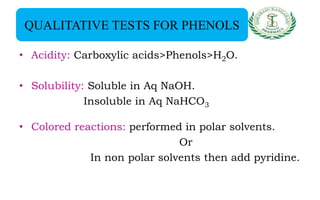
• Acidity: Carboxylic acids>Phenols>H2O.
• Solubility: Soluble in Aq NaOH.
Insoluble in Aq NaHCO3
• Colored reactions: performed in polar solvents.
Or
In non polar solvents then add pyridine.
QUALITATIVE TESTS FOR PHENOLS
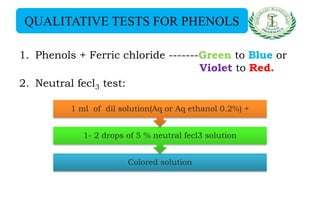
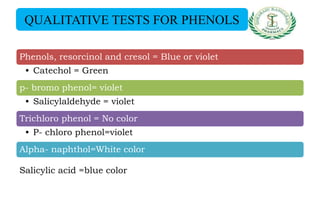
1. Phenols + Ferric chloride -------Green to Blue or
Violet to Red.
2. Neutral fecl3 test:
Colored solution
1- 2 drops of 5 % neutral fecl3 solution
1 ml of dil solution(Aq or Aq ethanol 0.2%) +
Phenols, resorcinol and cresol = Blue or violet
• Catechol = Green
p- bromo phenol= violet
• Salicylaldehyde = violet
Trichloro phenol = No color
• P- chloro phenol=violet
Alpha- naphthol=White color
Salicylic acid =blue color
QUALITATIVE TESTS FOR PHENOLS
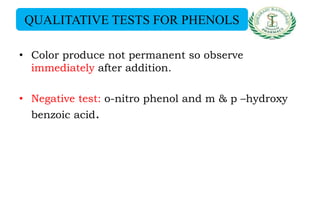
• Color produce not permanent so observe
immediately after addition.
• Negative test: o-nitro phenol and m & p –hydroxy
benzoic acid.
QUALITATIVE TESTS FOR PHENOLS
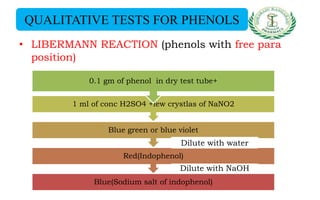
• LIBERMANN REACTION (phenols with free para
position)
QUALITATIVE TESTS FOR PHENOLS
Blue(Sodium salt of indophenol)
Red(Indophenol)
Blue green or blue violet
1 ml of conc H2SO4 +few crystlas of NaNO2
0.1 gm of phenol in dry test tube+
Dilute with water
Dilute with NaOH
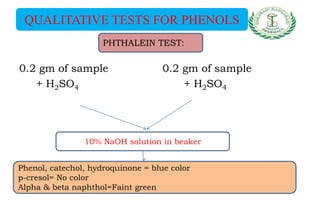
0.2 gm of sample 0.2 gm of sample
+ H2SO4 + H2SO4
QUALITATIVE TESTS FOR PHENOLS
10% NaOH solution in beaker
Phenol, catechol, hydroquinone = blue color
p-cresol= No color
Alpha & beta naphthol=Faint green
PHTHALEIN TEST:
STRUCTURE & USES
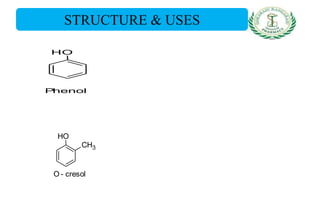
OH
Phenol
OH
CH3
O - cresol
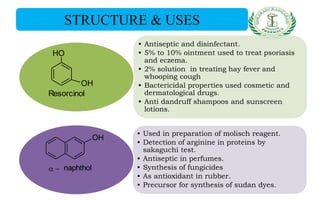
• Antiseptic and disinfectant.
• 5% to 10% ointment used to treat psoriasis
and eczema.
• 2% solution in treating hay fever and
whooping cough
• Bactericidal properties used cosmetic and
dermatological drugs.
• Anti dandruff shampoos and sunscreen
lotions.
• Used in preparation of molisch reagent.
• Detection of arginine in proteins by
sakaguchi test.
• Antiseptic in perfumes.
• Synthesis of fungicides
• As antioxidant in rubber.
• Precursor for synthesis of sudan dyes.
STRUCTURE & USES
OH
OH
Resorcinol
OH
naphthol
Phenols

Phenols

  • 1.
    PHENOLS B KARUNA DEVI ASSISTANTPROFESSOR PHARMACEUTICAL CHEMISTRY GOKARAJU RANGARAJU COLLEGE OF PHARMACY
  • 2.
    LEARNING OUTCOMES • Classifyphenols. • Explain nomenclature. • Explain physico-chemical properties. • Explain methods of preparations. • Discuss the reactions of phenols. • Uses of phenol, o- cresol, resorcinol and naphthol.
  • 3.
    NOMENCLATURE • Simplest memberof phenols. • Other members known as derivatives of phenols. OH Phenols
  • 4.
    Classification of phenols: Phenols Monohydricalcohols Dihydric alcohols Trihydric alcohols OH OH OH Cl HOOC OH Phenols m - Cresol o - Chloro phenols p - hydroxybenzoic acid OH OH OH OH OH OH OH Resoscinol Hydroquine Catechol  Naphthol OH OH OH Pyragallol OH OH OH Hydroxyquinone OH OH OH Phloroglucinol
  • 5.
    PHYSICO-CHEMICAL PROPERTIES • Samefunctional group but similarity is to limited extent. • Similarity: Can be converted to esters and ethers. • Differences : Most of the properties and preparation methods are different. • So classified phenols and alcohols separately.
  • 6.
    PHYSICO-CHEMICAL PROPERTIES • Phenolliquids or low melting solids because of H.B and have higher B.P. Nature • Phenol soluble in water and rest others insoluble in water.Solubility • Colorless unless coloring groups present.Color
  • 7.
    HYDROGEN BONDING OH NO 2 OH NO2 OH NO 2 O - nitro phenol p - nitro phenol m - nitro phenol
  • 8.
    METHODS OF PREPARATION Hydrolysisof diazonium salts Alkalifusion of sulfonates N2 + HSO 4 - Cl Cl OH m - chlorobenzene diazonium hydrogen sulphate m - chlorophenol H2O/H + /heat Ar ---NO2 Ar ------NH2 Ar -----N2 + HSO 4 - Ar -------OH Nitro Amine Diazonium salts Phenols SO3 - Na O - Na Sodium -2 - naphthalene sulfonate Sodium - 2 -naphthoxide 300  C / NaOH/ H 2O OH 2 - naphthol / - naphthol Dil H 2SO4
  • 9.
    REACTIONS OF PHENOLS 1. •Acidity/ salt formation 2. • Ester formation 3 • Ring substitution 4 • Ether formation
  • 10.
    RING SUBSTITUTION REACTION Nitration Sulfonation Halogenation Friedalcrafts alkylation Friedal crafts acylation Nitration Coupling Kolbes reaction Reimer Tiemann raction Aldehyde formation Rxn with formaldehyde
  • 11.
    ACIDITY/ SALT FORMATION ACIDITY:Phenols are weakly acidic. Order: Carboxylic acid > Phenols>Water. Phenols> Alcohols. Ka for phenols = 10-10 Ka for acids = 10-5 Ka for alcohols = 10-16 – 10-18
  • 12.
    ACIDITY/ SALT FORMATION Ka= More, Stronger acid Pka is less Ka = Less, Weaker acid Pka is more Kb = More, Stronger base Pkb is less Ka = Less, Weaker base Pkb is more PH = Pka + Log Salt/acid PH = Pka + Log ionized/unionized Phenols Salts (Acid) (Phenoxide) Insoluble in w ater Soluble in w ater
  • 13.
  • 14.
  • 15.
    EFFECT OF SUBSTITUENTSON ACIDITY • Three factors that effect acidity: 1. Nature of substituent. Ex. e-donating or e-withdrawing 2. Position of the substituent. Ex. Ortho, meta and para 3. No: of electron donating and withdrawing groups
  • 16.
    NATURE OF SUBSTITUENT. •Effect of electron withdrawing substituent: Ex. Cl-, CN-, NO2, CHO, COOH. • OH O2N + O2N O - + H + p - nitro phenol p - nitro phenoxide
  • 17.
    • Effect ofelectron donating /releasing substituent: -CH3, -OCH3, -NH2 NATURE OF SUBSTITUENT. + H + OH NH2 O - NH2 p -amino phenol p - amino phenoxide
  • 18.
    POSITION OF THESUBSTITUENT. Ortho or para position o Delocalize the negative charge on phenoxide ion more effectively. o 5 resonating structures Meta position o Delocalize the negative charge on phenoxide ion less effectively. o 4 resonating structures
  • 19.
    NUMBER OF ELECTRONDONATING AND WITHDRAWING GROUPS
  • 20.
    ESTER FORMATION ArSO2 --OHArSO2 ---Cl ArSO2 --OAr Aryl sulphonic acid Aryl sulphonic acid chloride Esters Ar ----OH ArCOCl ArCO ---OAr Aryl carboxylic acids Aryl acid chlorides Esters OH COCl O O + NaOH Phenol Benzoyl chloride Phenyl benzoate Acids ---------------Esters ----------Single stepReversible & Slow process Acids -----Acid chloride -------Esters --------Two stepIrreversible and fast process
  • 21.
    ESTER FORMATION Schotten Baumann technique AqNaOH Calatyst and neutralize HCl that is liberated Pyridine converts acid chloride into powerful acylating agent
  • 22.
    RING SUBSTITUTION REACTION OH 1.Nitration Dil HNO 3 / 20  C OH NO2 OH NO2 + ļļ€ ļ€­ nitro phenol p - nitro phenol Polysubstitution Oxidation So at low temperature & dil acids Conc HNO 3 Polysubstitution OH NO2 NO2 O2N 2, 4, 6 trinitro phenol 2. Sulphonation 15 -20 o C/ H 2SO4 OH SO3H O - phenol sulphonic acid OH SO3H p - phenol sulphonic acid 100 o C / H 2SO4 Phenols
  • 23.
    RING SUBSTITUTION REACTION OH 3.Halogenation Br2 /H2O OH BrBr Br ,4,6 tribromo phenol Br2/ CS 2/ CHCl 3 Low polar solvents OH Br p - bromo phenol Aq Br2 Phenols Aq bromine all o & p position halogenated Even displacement of other groups occur Mono halogenation OH BrBr Br ,4,6 tribromo phenol OH SO3H p -phenol sulphonic acid Replacement occurs
  • 24.
    RING SUBSTITUTION REACTION OH 4.Friedal crafts alkylation HF OH CH3 CH3 CH3 5. Friedal crafts acylation Fries rearrangement OCOCH 3 CH3 m-cresyl acetate 6. Nitrosation NaNO 2, H2SO4 OH CH3 NO Phenols CH3Cl CH3CH3 t - butyl chloride p -tertiary butyl phenol OH CH3 m-cresol (CH3CO) 2O OH CH3 COCH 3 OH CH3 CH3CO 2 - methyl 4 -hydroxy acetophenone 4 - methyl 2 -hydroxy acetophenone para migration(acyl group) ortho migration(acyl group) OH CH3 o - cresol 4 -nitroso -2 -methyl phenol
  • 25.
    RING SUBSTITUTION REACTION OH Phenols + Cl - N2 + Diazoniumsalts CouplingOH N N Azo compound Ar ---N2 + + Ar' ----H Mildly alkaline condition Ar ---N=N----Ar' + H + Diazoniumsalts Aromatic compounds Azo compounds
  • 26.
    RING SUBSTITUTION REACTION NaO CO2/ 125 o C/4 -7 atmos OH COONa Sodiumphenoxide Sodiumsalicylate Kolbes reaction Applications
  • 27.
    REIMER TIEMANN REACTION OH Phenols +CHCl 3 + Aq 3 NaOH OH CHO Salicylaldehyde + 3 NaCl + 2H2O Electrophilic aromatic substitution reaction Step 1: Abstraction of proton by base from chloroform
  • 28.
    REIMER TIEMANN REACTION Step:2 Generation of dichlorocarbene Step:3 Addition of CCl2 to phenoxide ion
  • 29.
    REIMER TIEMANN REACTION Step:4 Abstraction of proton from water Step:5 Tautomerism to give substituted phenol
  • 30.
    REIMER TIEMANN REACTION Step:6 Displacement of halide ion by hydroxide ion Step:7 Tautomerism to give substituted phenol
  • 31.
  • 32.
    WILLIAMSONS SYNTHESIS ArO - + R----XArO ----R + X -- Phenoxide Alkyl halides Alkyl aryl ethers OH C2H5I /Aq NaOH Heat O C2H5 Phenol Ethyl phenyl ether Alkyl aryl ether OH + CH3 O S O CH3 O O Phenol Dimethyl sulphate O CH3 CH3 O S O Na O O + Anisole Methyl sodiumsulphate In Williamsons synthesis aryl halides cannot be used b.cos of low reactivity towards NSR Alkyl aryl ethers & aryl ethers
  • 33.
    QUALITATIVE TESTS FORPHENOLS • Acidity: Carboxylic acids>Phenols>H2O. • Solubility: Soluble in Aq NaOH. Insoluble in Aq NaHCO3 • Colored reactions: performed in polar solvents. Or In non polar solvents then add pyridine.
  • 34.
    QUALITATIVE TESTS FORPHENOLS 1. Phenols + Ferric chloride -------Green to Blue or Violet to Red. 2. Neutral fecl3 test: Colored solution 1- 2 drops of 5 % neutral fecl3 solution 1 ml of dil solution(Aq or Aq ethanol 0.2%) +
  • 35.
    Phenols, resorcinol andcresol = Blue or violet • Catechol = Green p- bromo phenol= violet • Salicylaldehyde = violet Trichloro phenol = No color • P- chloro phenol=violet Alpha- naphthol=White color Salicylic acid =blue color QUALITATIVE TESTS FOR PHENOLS
  • 36.
    • Color producenot permanent so observe immediately after addition. • Negative test: o-nitro phenol and m & p –hydroxy benzoic acid. QUALITATIVE TESTS FOR PHENOLS
  • 37.
    • LIBERMANN REACTION(phenols with free para position) QUALITATIVE TESTS FOR PHENOLS Blue(Sodium salt of indophenol) Red(Indophenol) Blue green or blue violet 1 ml of conc H2SO4 +few crystlas of NaNO2 0.1 gm of phenol in dry test tube+ Dilute with water Dilute with NaOH
  • 38.
    0.2 gm ofsample 0.2 gm of sample + H2SO4 + H2SO4 QUALITATIVE TESTS FOR PHENOLS 10% NaOH solution in beaker Phenol, catechol, hydroquinone = blue color p-cresol= No color Alpha & beta naphthol=Faint green PHTHALEIN TEST:
  • 39.
  • 40.
    • Antiseptic anddisinfectant. • 5% to 10% ointment used to treat psoriasis and eczema. • 2% solution in treating hay fever and whooping cough • Bactericidal properties used cosmetic and dermatological drugs. • Anti dandruff shampoos and sunscreen lotions. • Used in preparation of molisch reagent. • Detection of arginine in proteins by sakaguchi test. • Antiseptic in perfumes. • Synthesis of fungicides • As antioxidant in rubber. • Precursor for synthesis of sudan dyes. STRUCTURE & USES OH OH Resorcinol OH naphthol