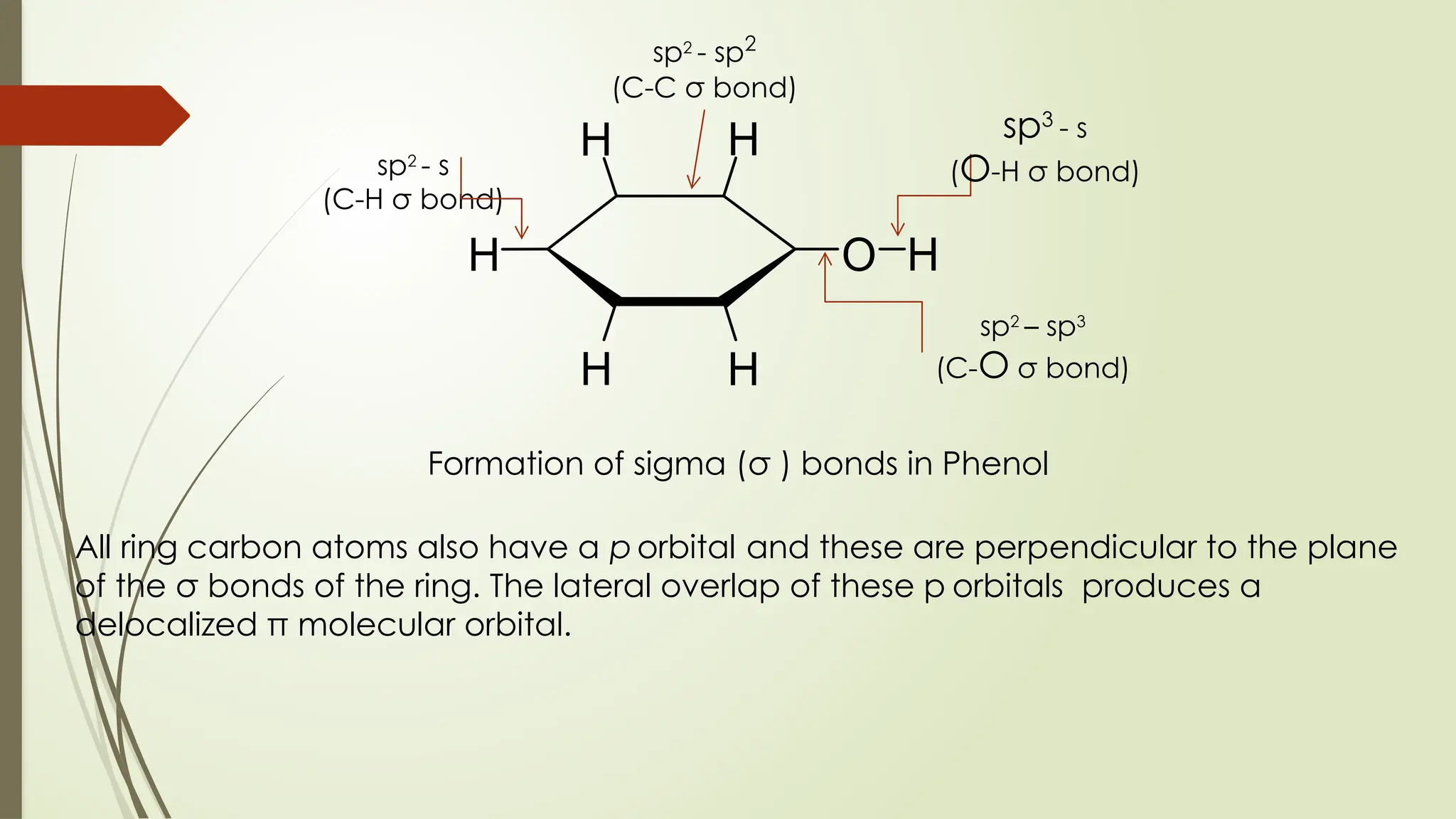
sp2
- sp2
(C-C σbond)
sp3
- s
(O-H σ bond)
sp2
– sp3
(C-O σ bond)
sp2
- s
(C-H σ bond)
Formation of sigma (σ ) bonds in Phenol
All ring carbon atoms also have a p orbital and these are perpendicular to the plane
of the σ bonds of the ring. The lateral overlap of these p orbitals produces a
delocalized π molecular orbital.
O
H H
H
H H
H
7.
O
H
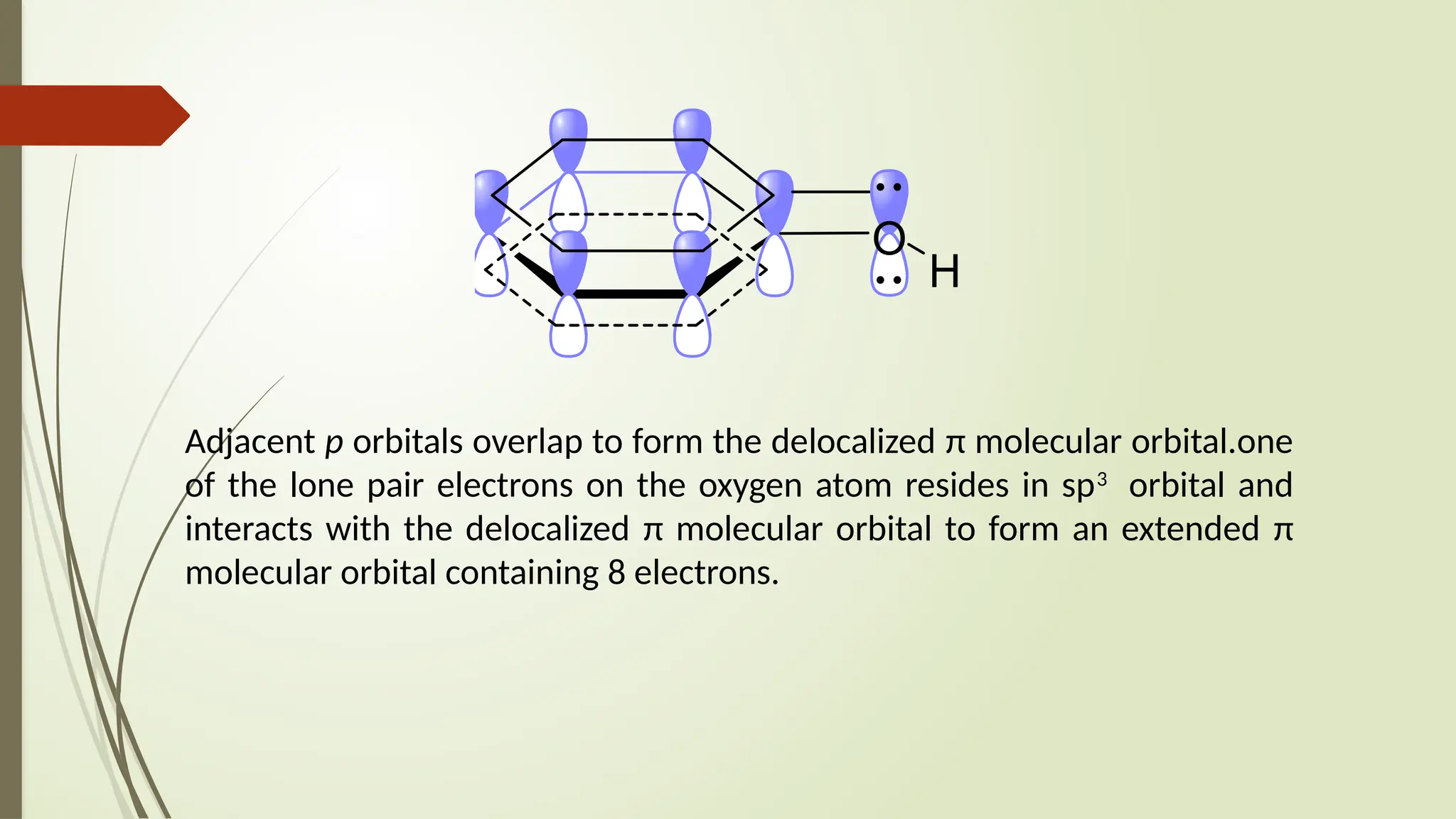
Adjacent p orbitalsoverlap to form the delocalized π molecular orbital.one
of the lone pair electrons on the oxygen atom resides in sp3
orbital and
interacts with the delocalized π molecular orbital to form an extended π
molecular orbital containing 8 electrons.
Sources
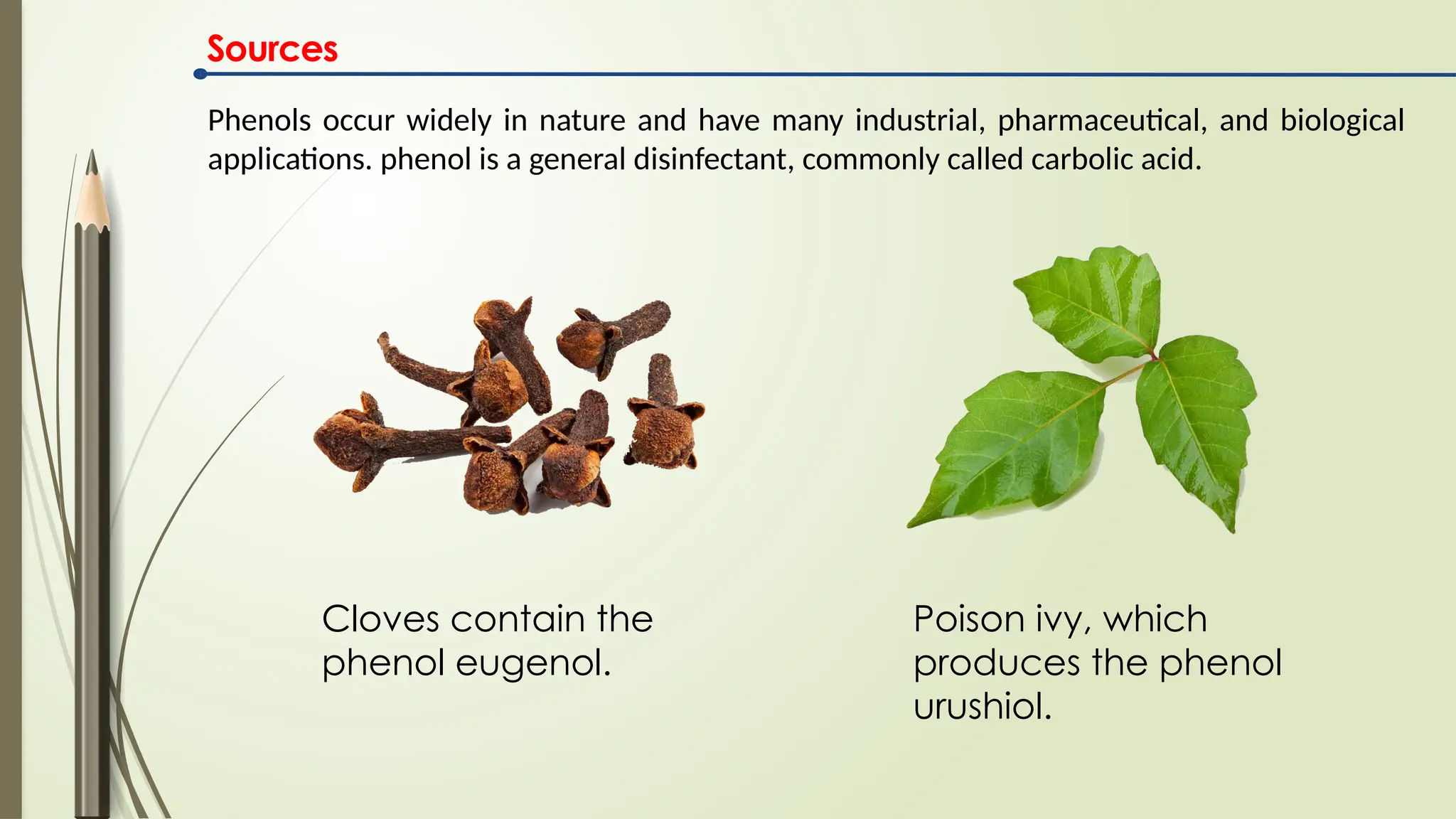
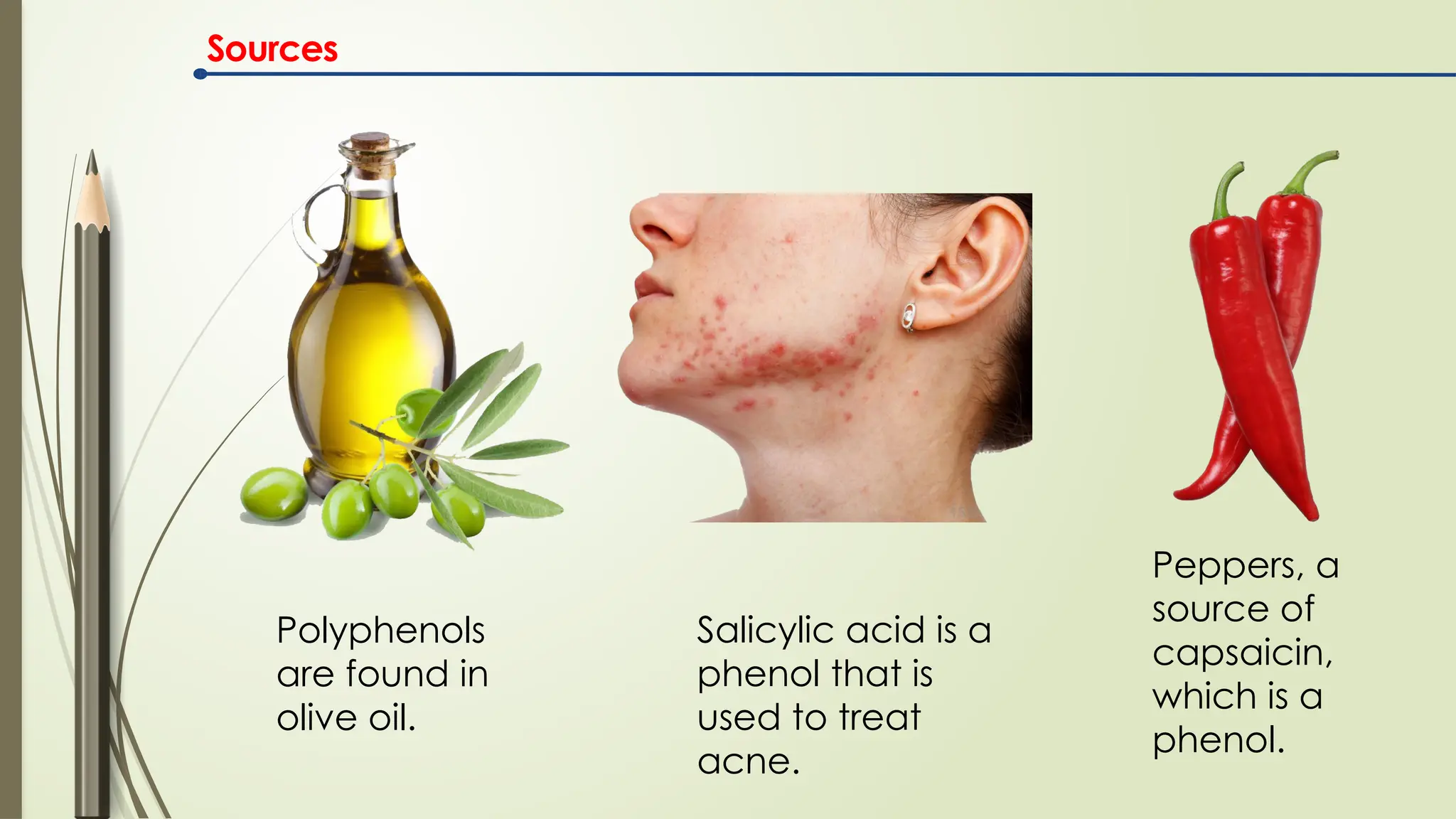
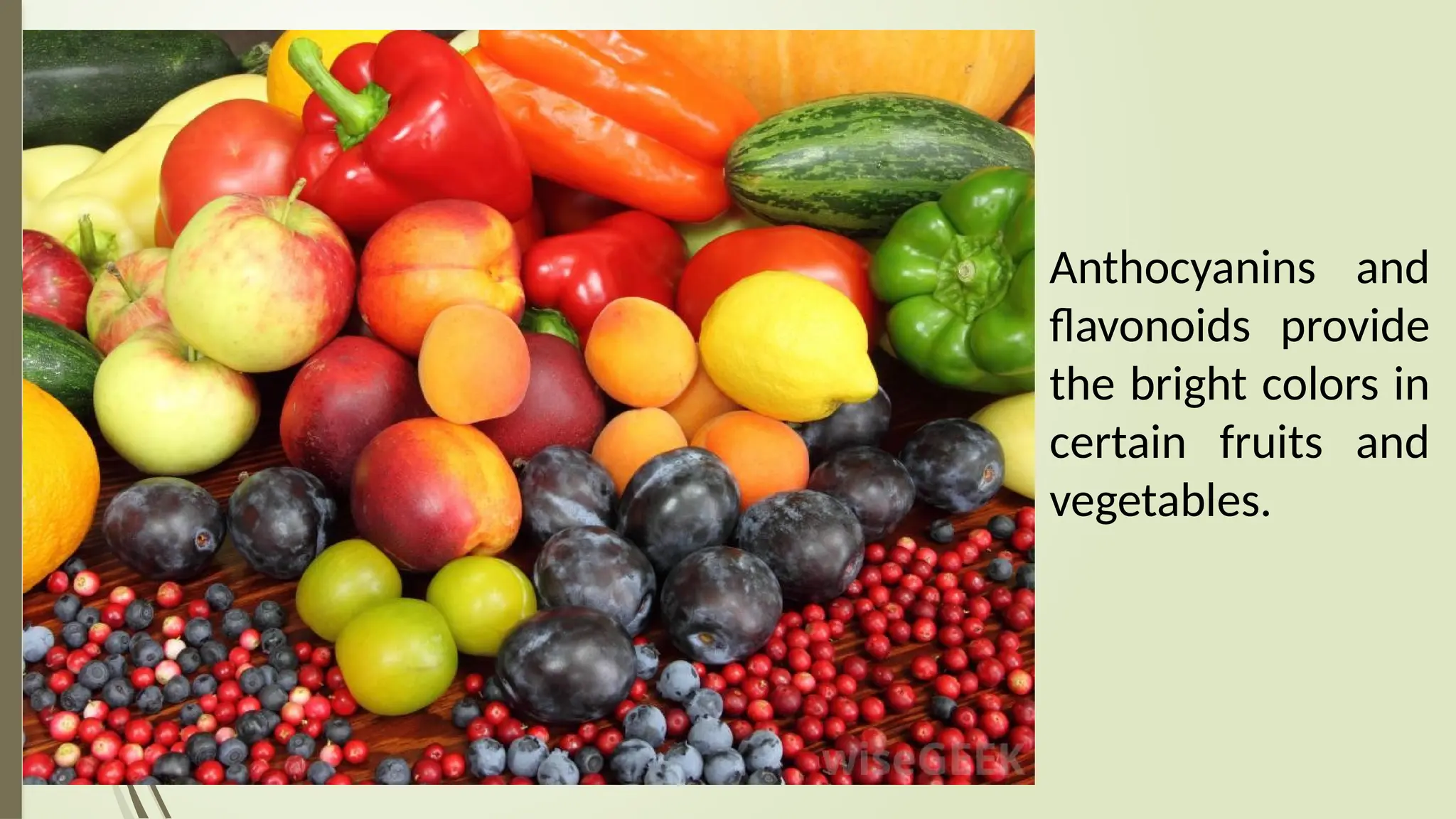
Phenols occur widelyin nature and have many industrial, pharmaceutical, and biological
applications. phenol is a general disinfectant, commonly called carbolic acid.
Poison ivy, which
produces the phenol
urushiol.
Cloves contain the
phenol eugenol.
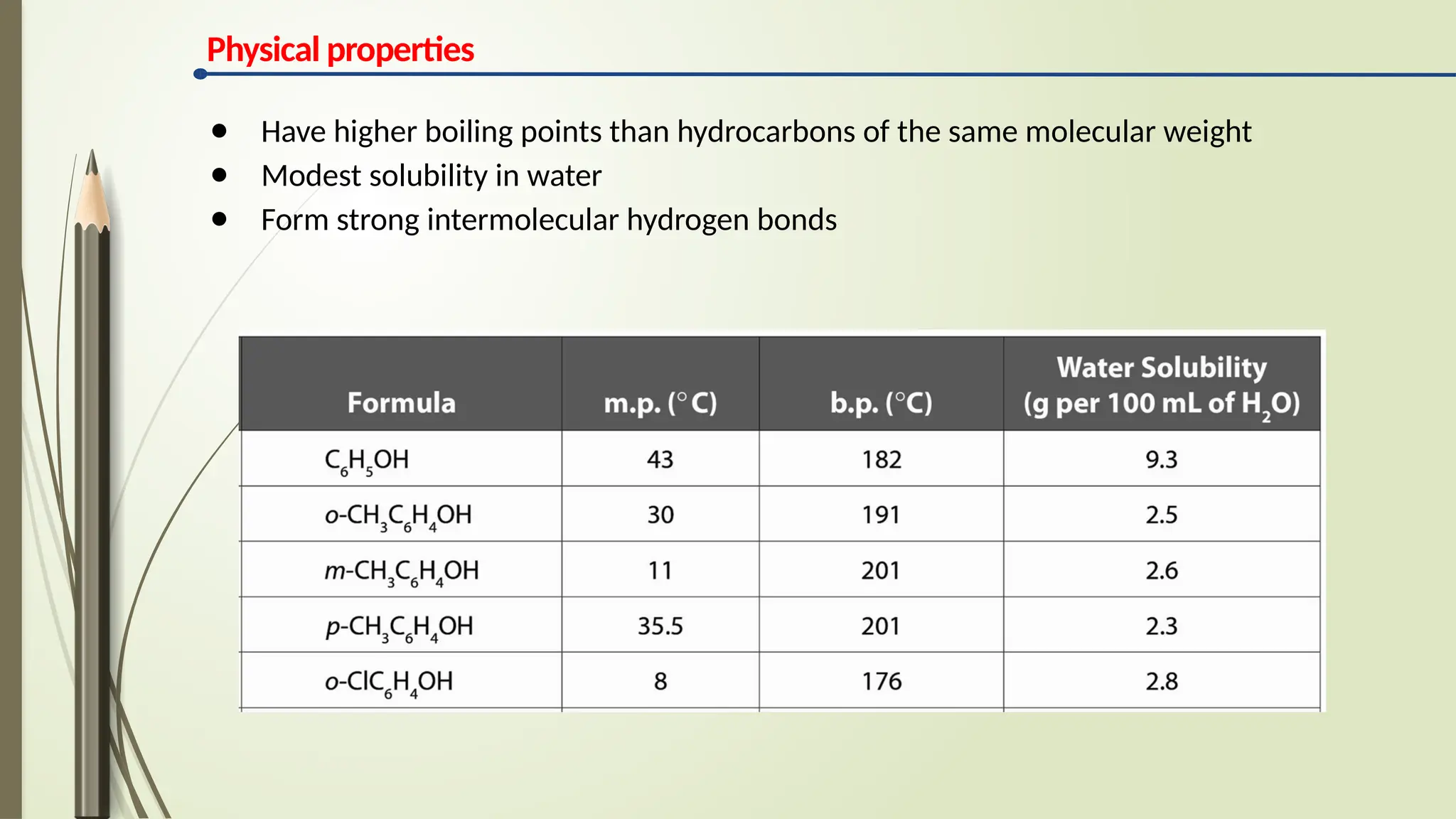
Physical properties
● Havehigher boiling points than hydrocarbons of the same molecular weight
● Modest solubility in water
● Form strong intermolecular hydrogen bonds
15.
Physical properties
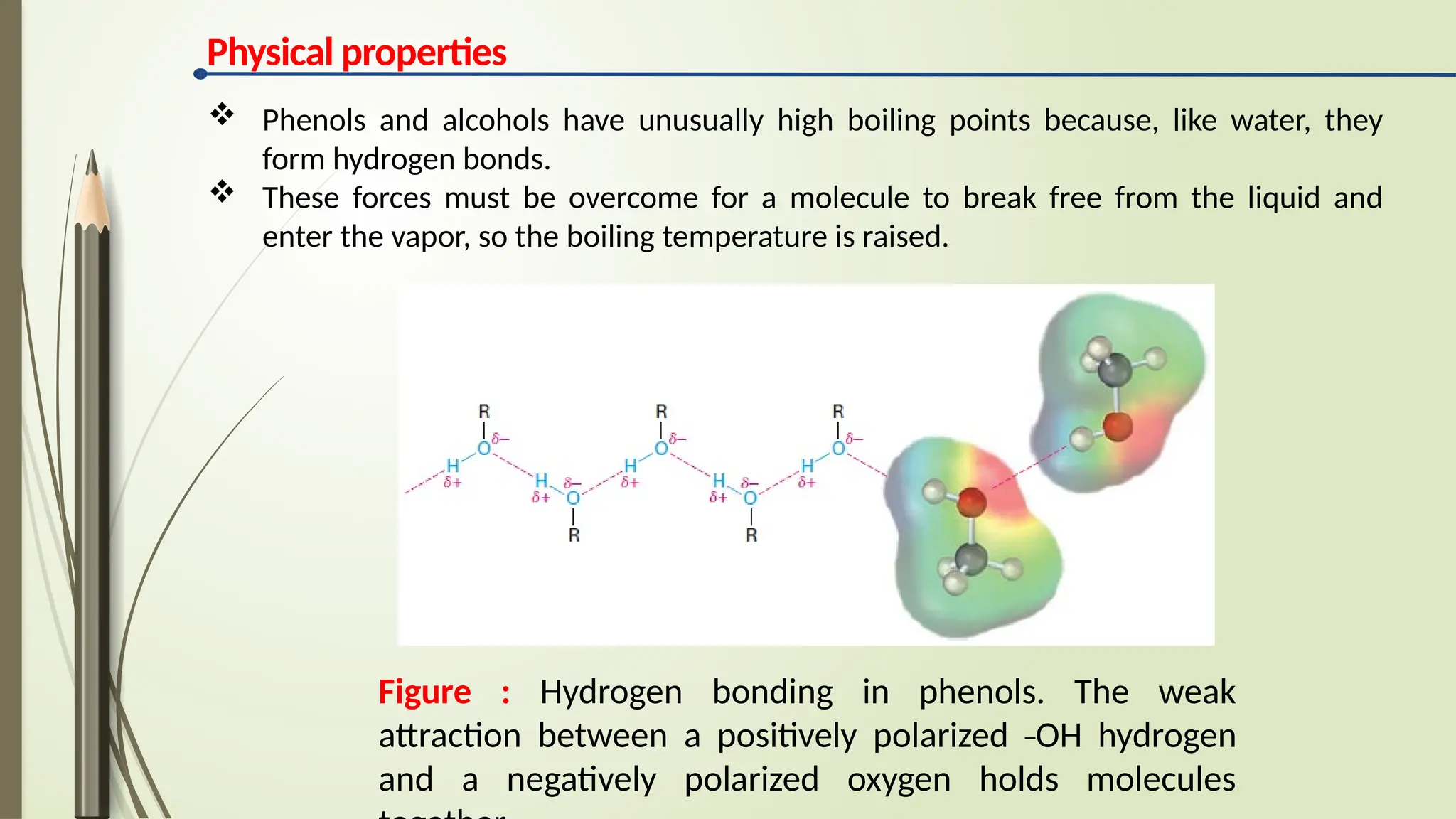
Figure :Hydrogen bonding in phenols. The weak
attraction between a positively polarized _
OH hydrogen
and a negatively polarized oxygen holds molecules
Phenols and alcohols have unusually high boiling points because, like water, they
form hydrogen bonds.
These forces must be overcome for a molecule to break free from the liquid and
enter the vapor, so the boiling temperature is raised.
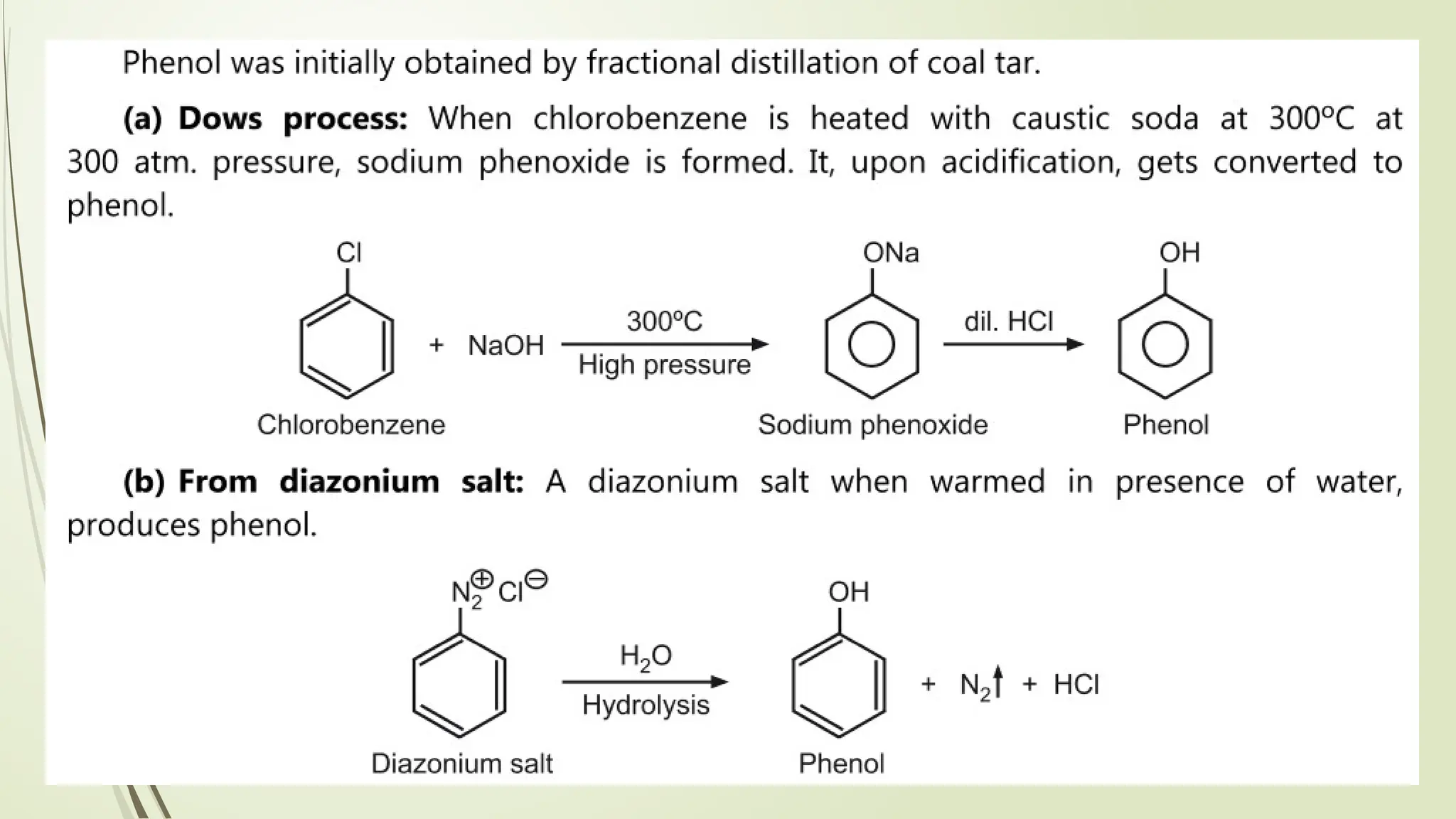
a) Dow process
b)From diazonium salt
c) From benzene sulphonate
d) From salicylic acid
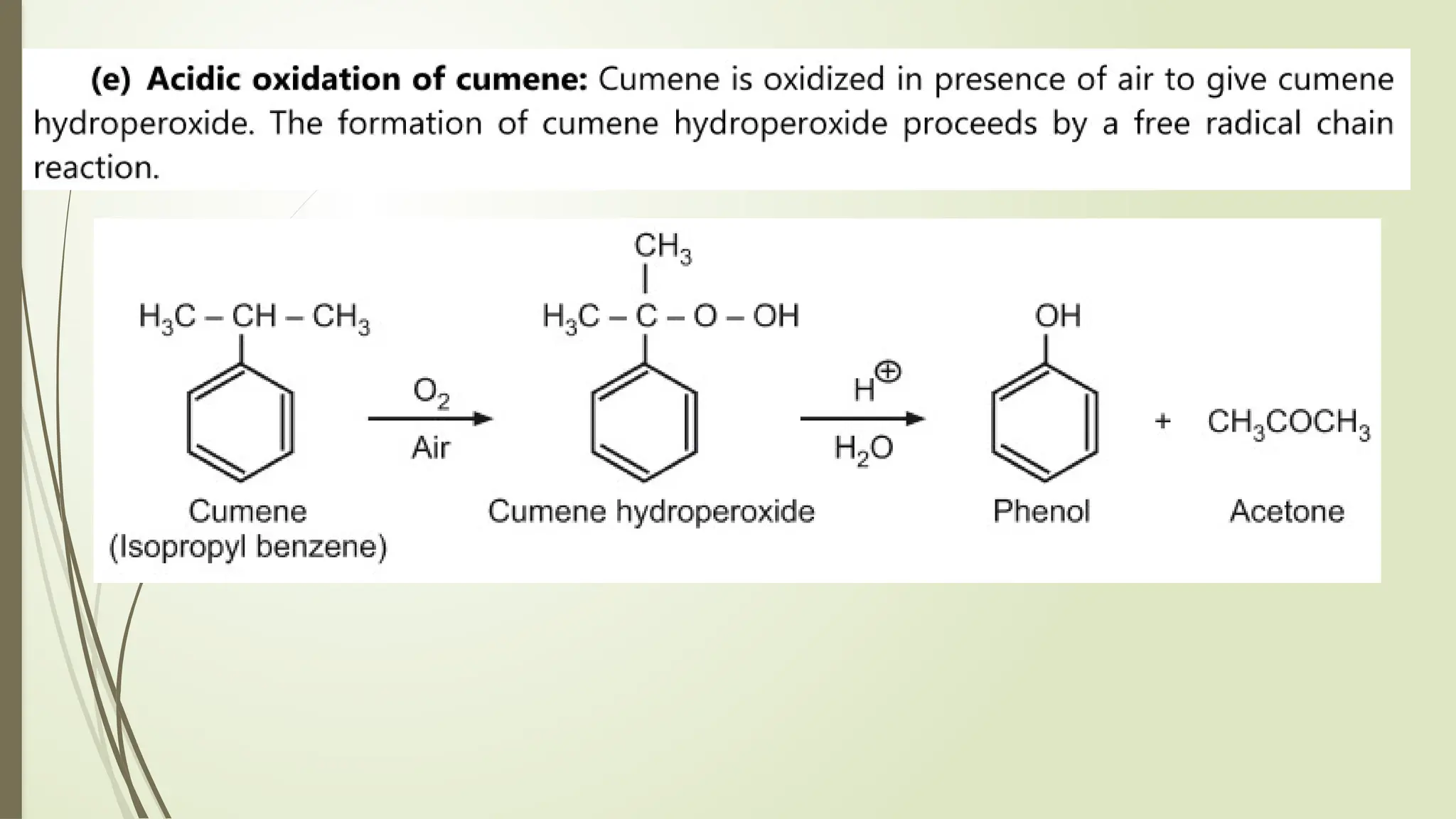
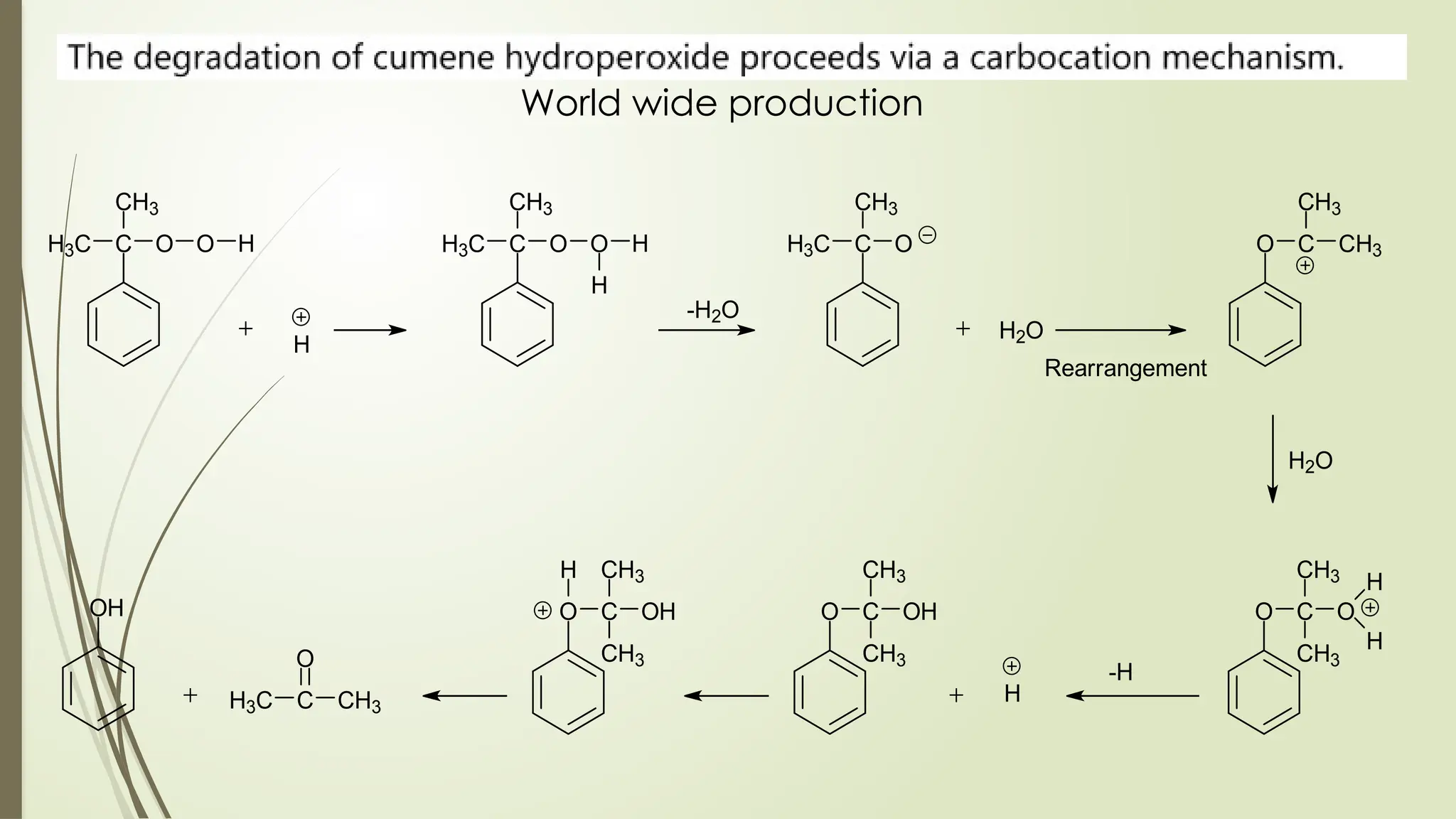
e) from oxidation of cumene
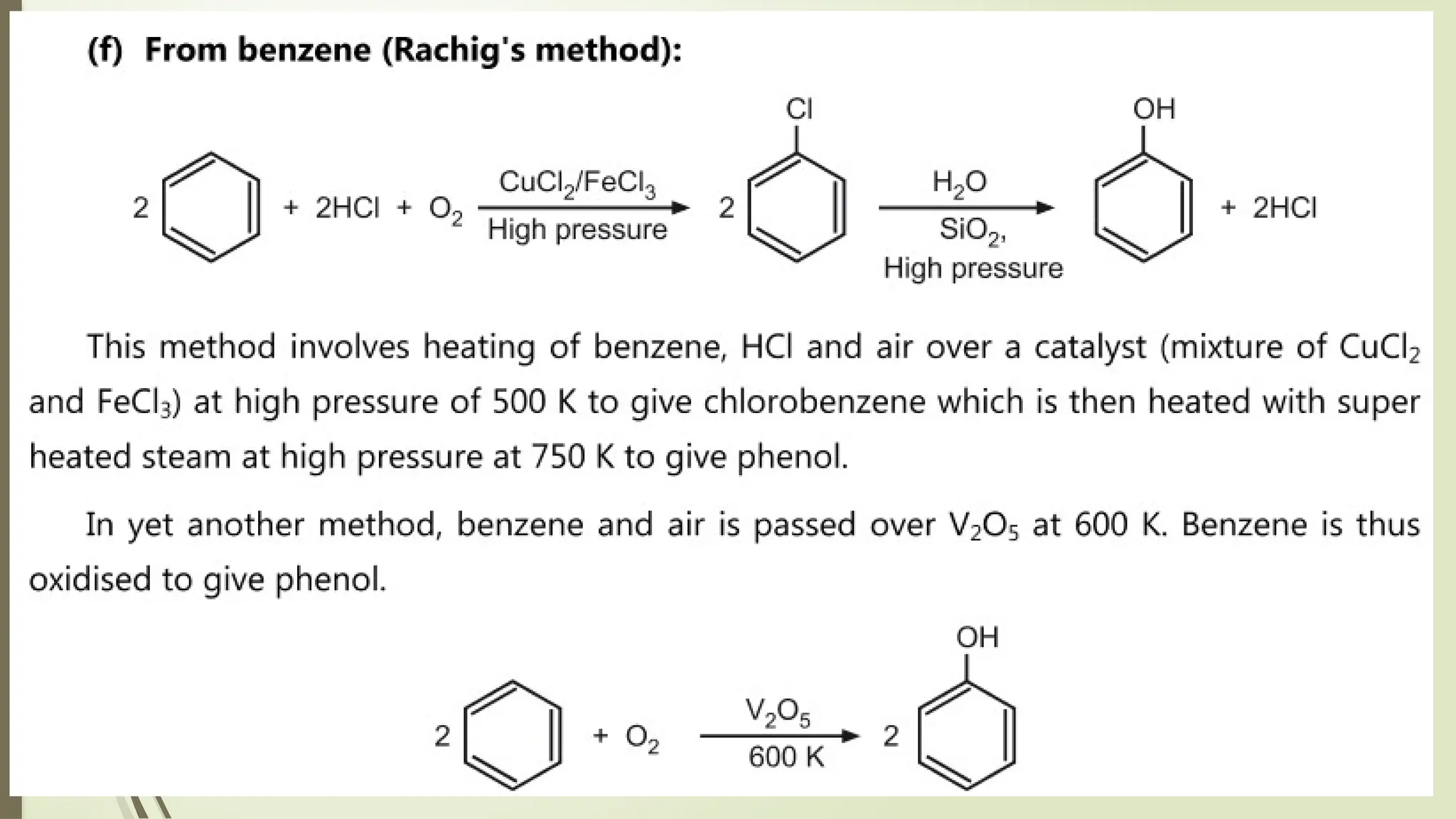
f) From benzene
Preparation of phenols
22.
C
H3C
CH3
O O H
H
C
H3C
CH3
OO H
H
C
H3C
CH3
O
H2O
O C
CH3
CH3
H2O
O C
CH3
O
CH3
H
H
O C
CH3
OH
CH3
H
O C
CH3
OH
CH3
H
OH
H3C C CH3
O
Rearrangement
-H2O
-H
World wide production
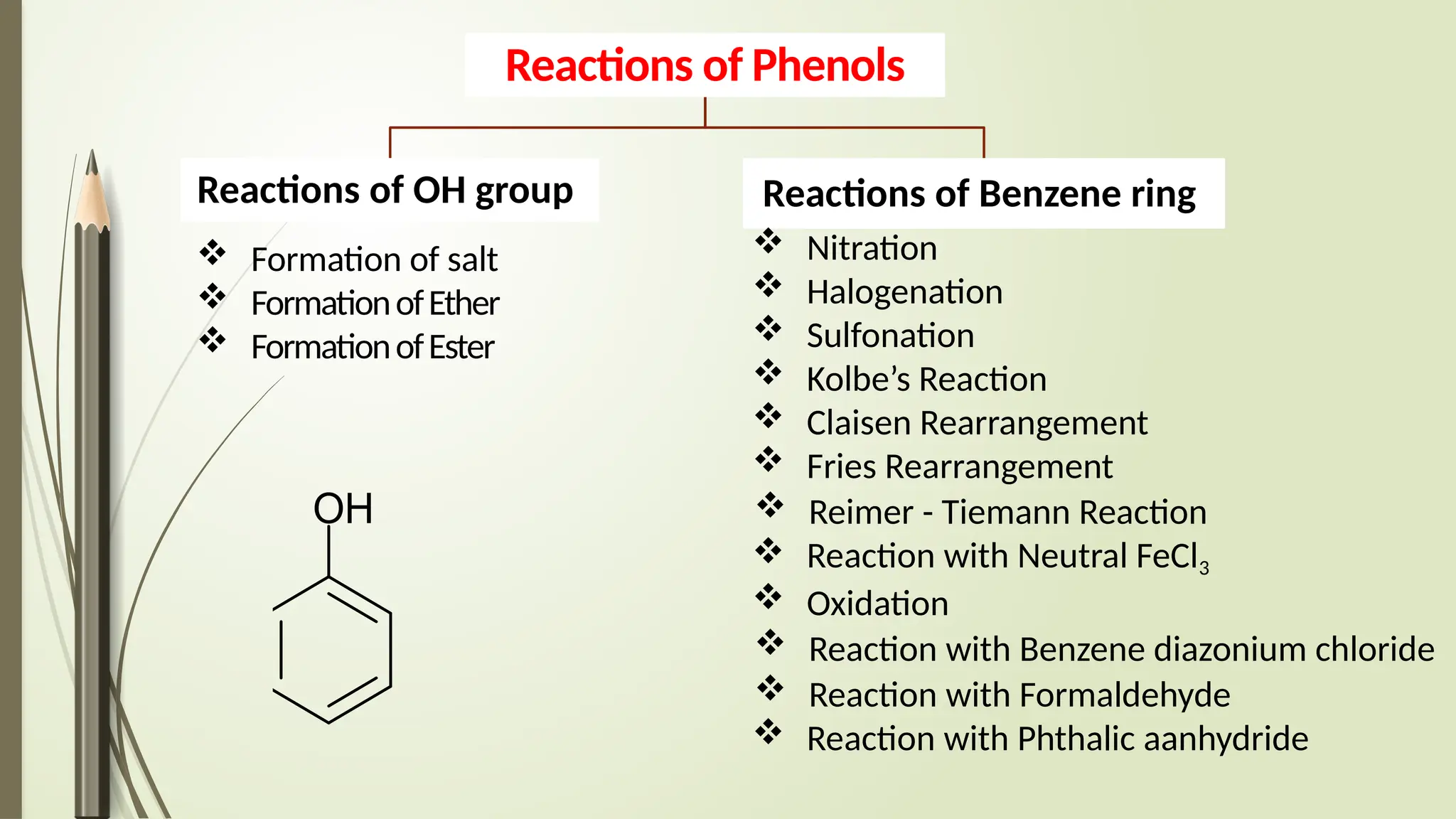
Reactions of Phenols
Reactionsof OH group Reactions of Benzene ring
Nitration
Halogenation
Sulfonation
Kolbe’s Reaction
Claisen Rearrangement
Fries Rearrangement
Reimer - Tiemann Reaction
Reaction with Neutral FeCl3
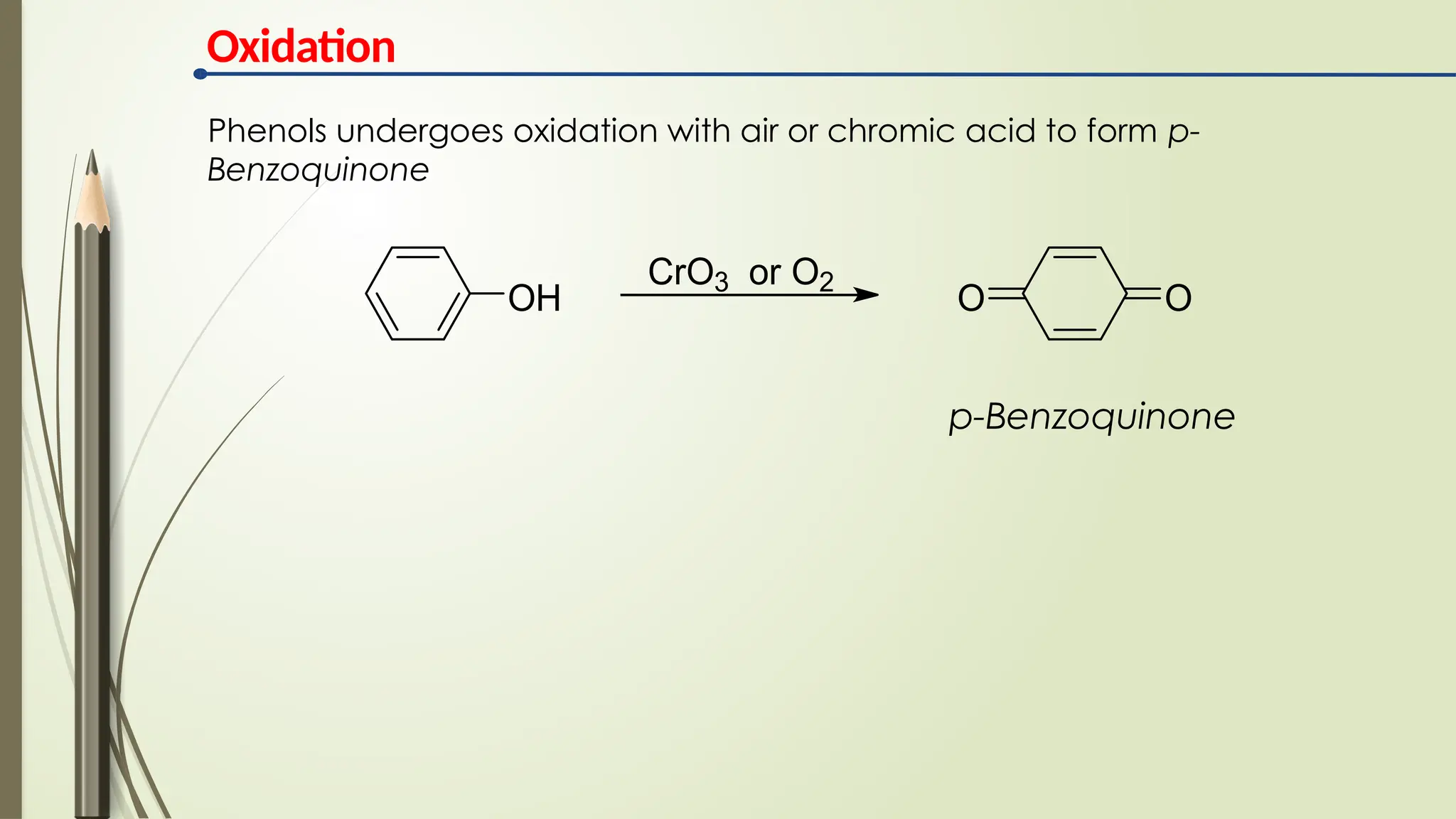
Oxidation
Reaction with Benzene diazonium chloride
Reaction with Formaldehyde
Reaction with Phthalic aanhydride
Formation of salt
FormationofEther
FormationofEster
OH
26.
Reactions of Phenols
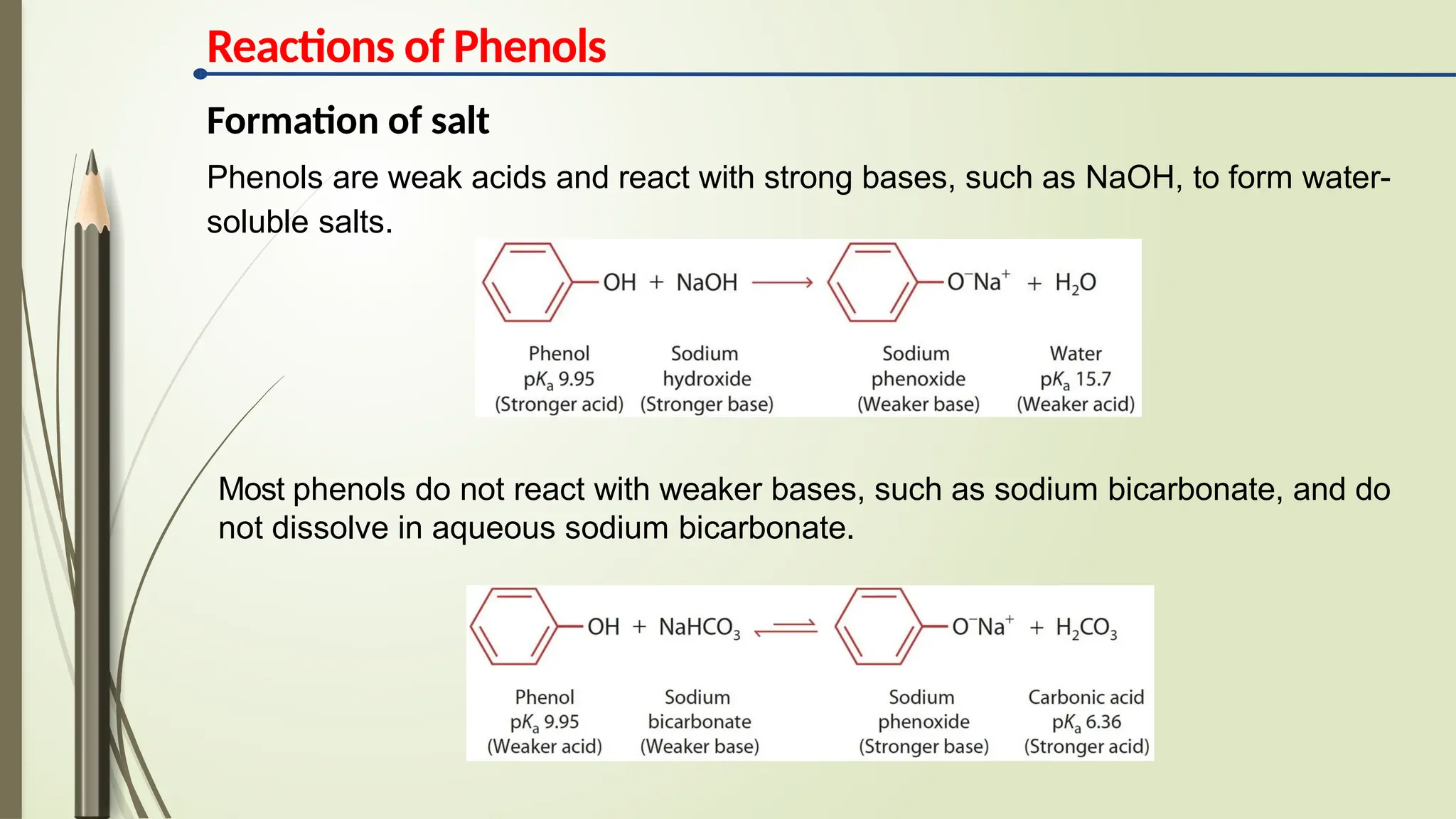
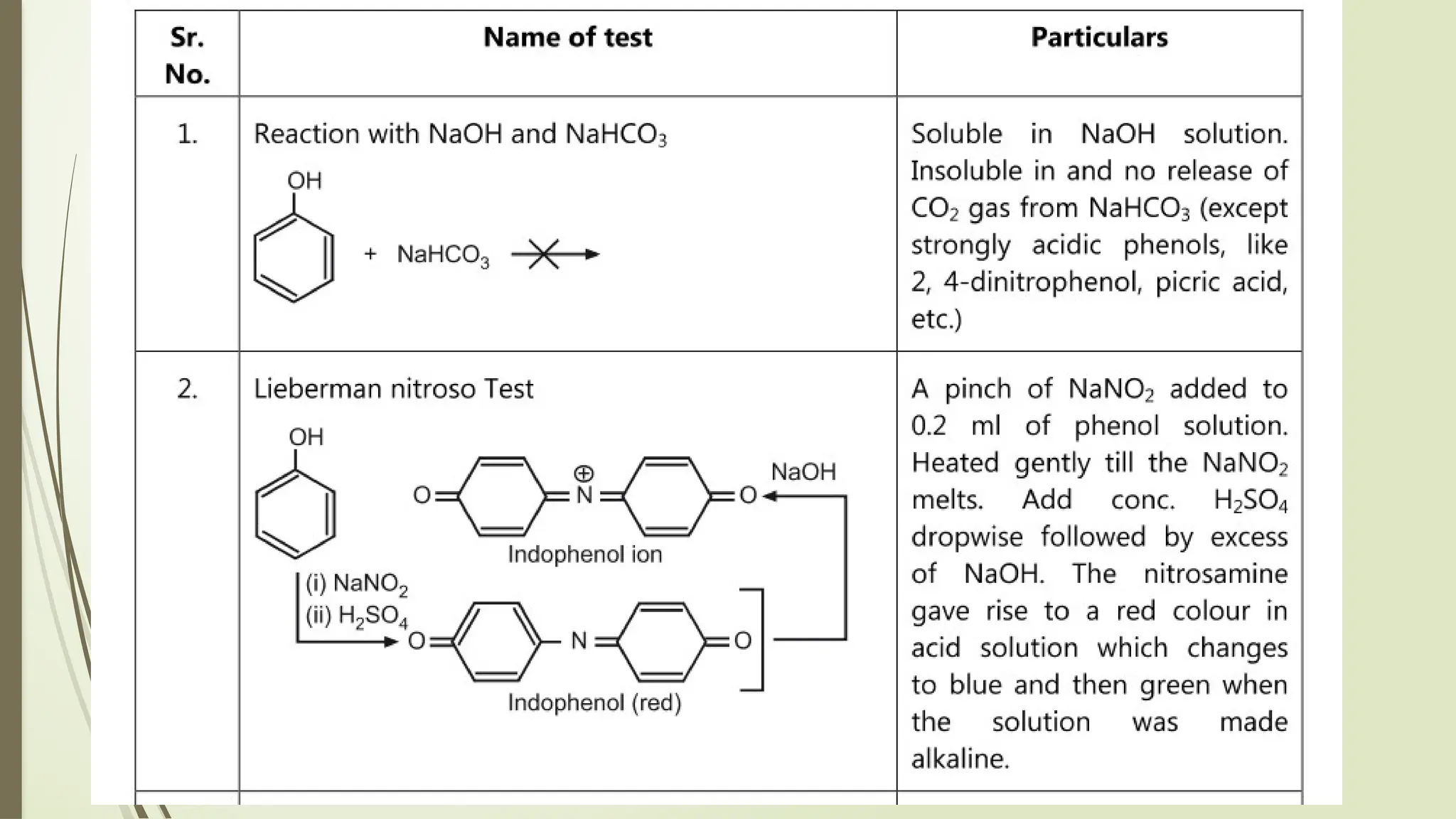
Formationof salt
Phenols are weak acids and react with strong bases, such as NaOH, to form water-
soluble salts.
Most phenols do not react with weaker bases, such as sodium bicarbonate, and do
not dissolve in aqueous sodium bicarbonate.
27.
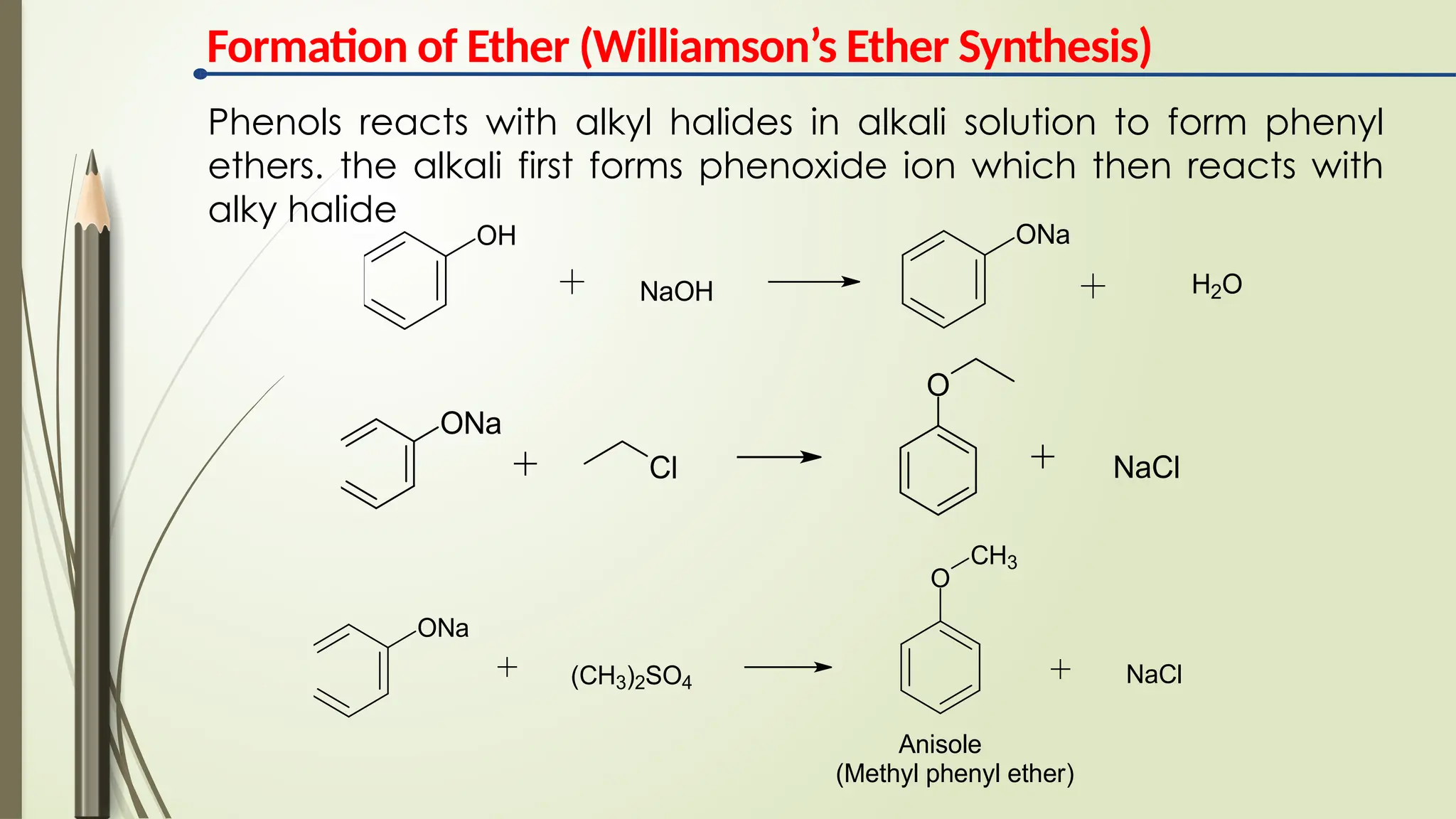
Formation of Ether(Williamson’s Ether Synthesis)
Phenols reacts with alkyl halides in alkali solution to form phenyl
ethers. the alkali first forms phenoxide ion which then reacts with
alky halide
OH
NaOH
ONa
H2O
ONa
(CH3)2SO4
O
NaCl
CH3
Anisole
(Methyl phenyl ether)
ONa
Cl
O
NaCl
28.
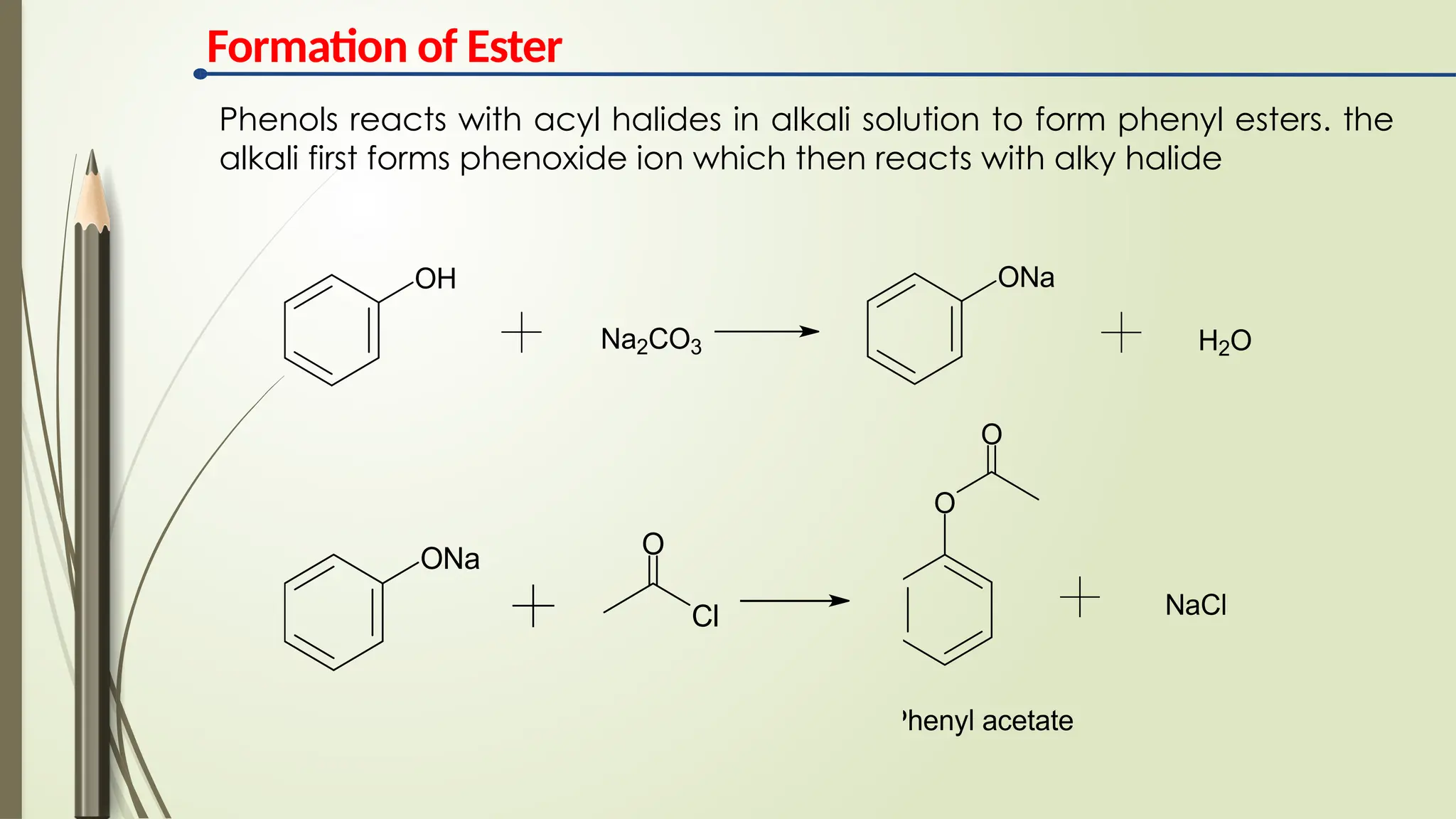
Formation of Ester
O
NaCl
O
Phenylacetate
ONa
Cl
O
OH
Na2CO3
ONa
H2O
Phenols reacts with acyl halides in alkali solution to form phenyl esters. the
alkali first forms phenoxide ion which then reacts with alky halide
29.
Formation of Ester
OH
RO
O
R
O
phenol Anhydride
O R
O
Ester
OH
R
O
Phenols reacts with anhydrides in alkali solution to form phenyl esters. the
alkali first forms phenoxide ion which then reacts with alky halide
30.
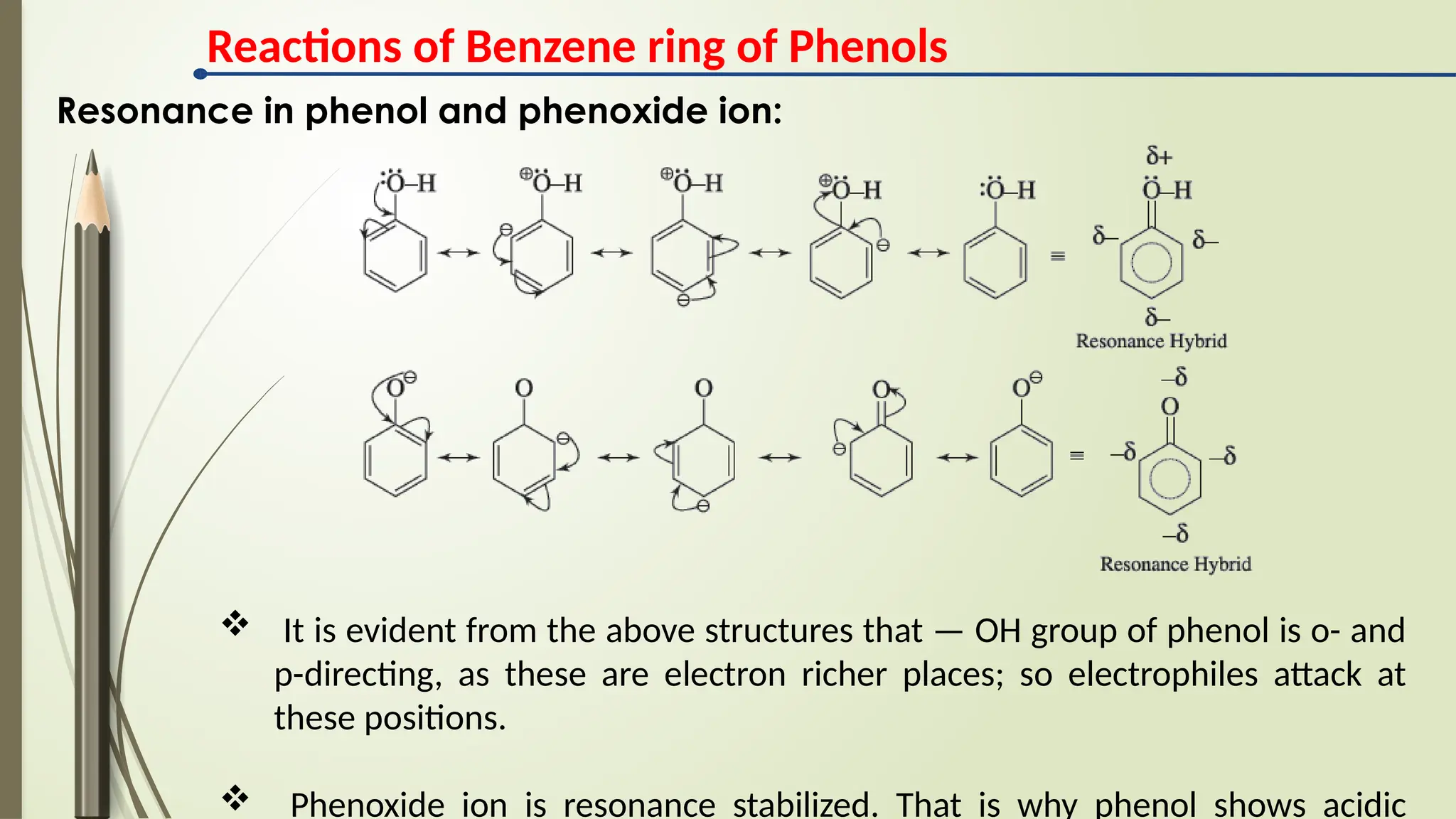
Resonance in phenoland phenoxide ion:
It is evident from the above structures that — OH group of phenol is o- and
p-directing, as these are electron richer places; so electrophiles attack at
these positions.
Phenoxide ion is resonance stabilized. That is why phenol shows acidic
Reactions of Benzene ring of Phenols
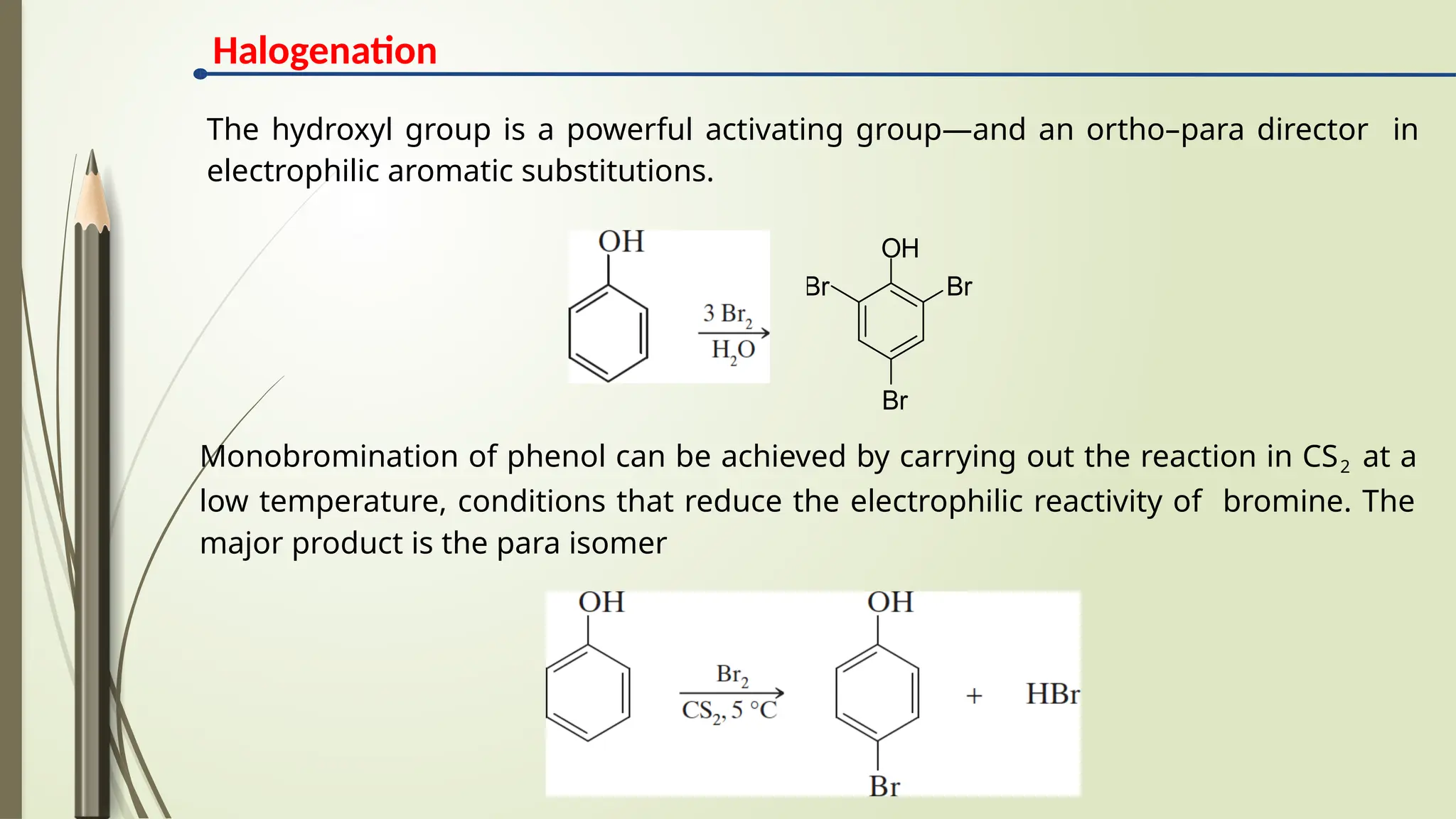
The hydroxyl groupis a powerful activating group—and an ortho–para director in
electrophilic aromatic substitutions.
Monobromination of phenol can be achieved by carrying out the reaction in CS2 at a
low temperature, conditions that reduce the electrophilic reactivity of bromine. The
major product is the para isomer
OH
Br
Br
Br
Halogenation
33.
Nitration
Phenol reacts withdilute nitric acid to yield a mixture of o- and p-
nitrophenol.
Although the yield is relatively low (because of oxidation of the ring),
the ortho and para isomers can be separated by steam distillation.
34.
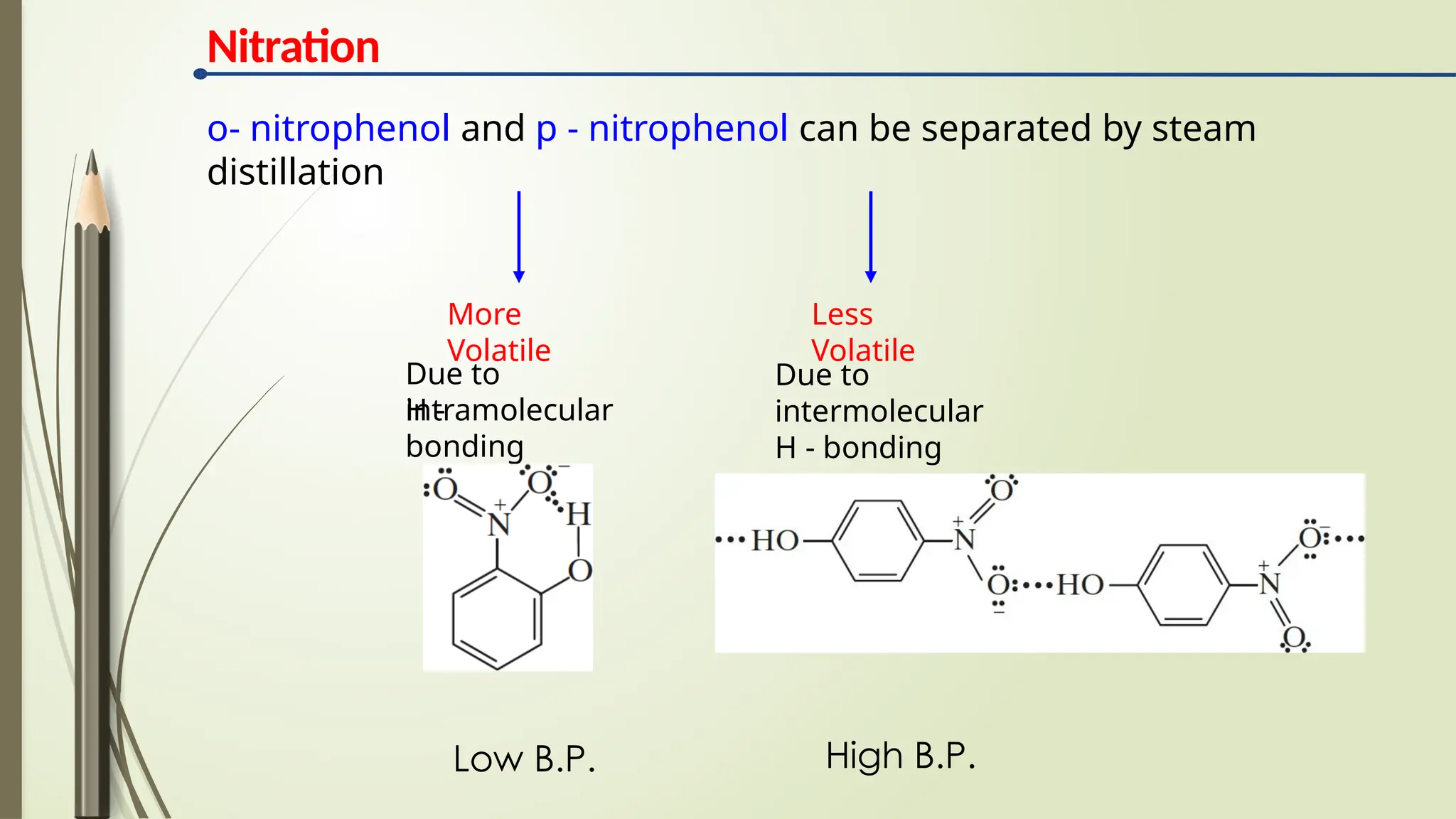
o- nitrophenol andp - nitrophenol can be separated by steam
distillation
More
Volatile
Less
Volatile
Due to
intramolecular
H -
bonding
Due to
intermolecular
H - bonding
Low B.P. High B.P.
Nitration
35.
With concentrated HNO3, phenol is converted to 2,4,6 – trinitrophenol ( Picric
acid ). The yield of reaction product is poor.
Nitration
Nowadays picric acid is prepared by treating phenol first with concentrated
sulphuric acid which converts it to phenol-2,4-disulphonic acid, and then with
concentrated nitric acid to get 2,4,6-trinitrophenol.
OH OH
NO2
O2N
NO2
Conc.HNO3
Oxidative cleavage of the ring
phenol picric acid
36.
Sulfonation
Phenol reacts withconcentrated sulfuric acid to yield mainly the ortho-sulfonated product
if the reaction is carried out at 25 o
C and mainly the para- sulfonated product at 100 oC.
37.
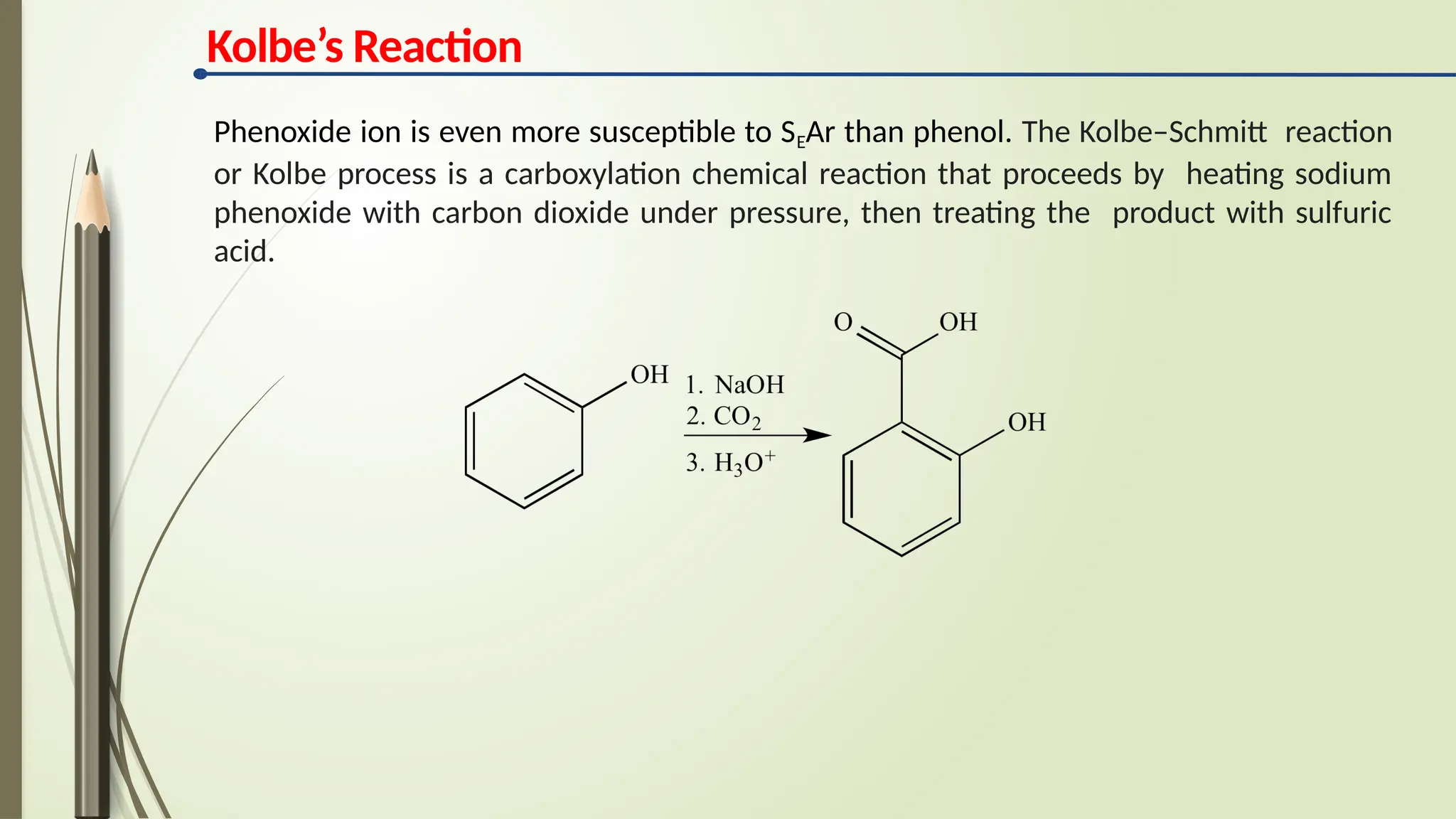
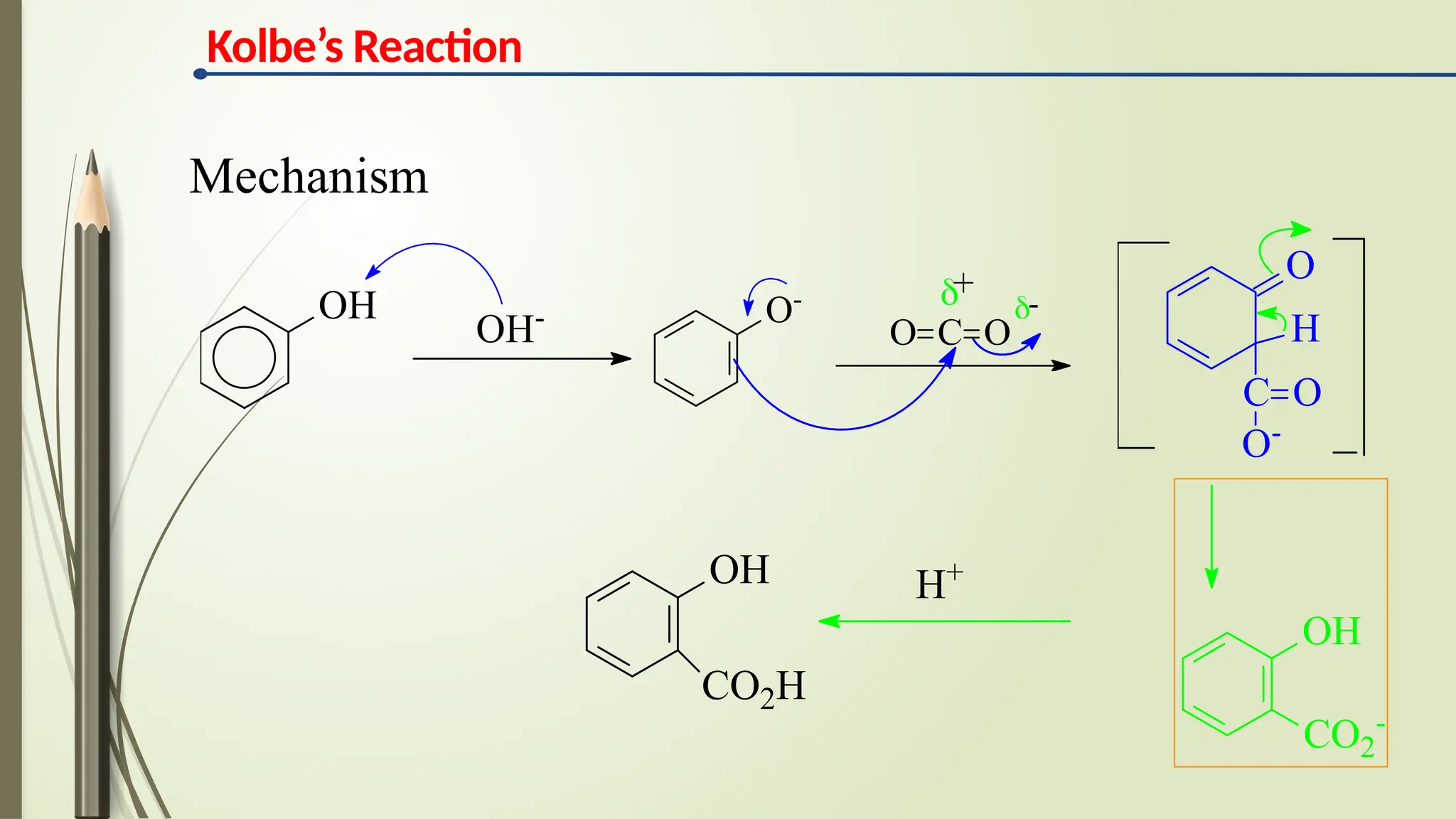
Kolbe’s Reaction
Phenoxide ionis even more susceptible to SEAr than phenol. The Kolbe–Schmitt reaction
or Kolbe process is a carboxylation chemical reaction that proceeds by heating sodium
phenoxide with carbon dioxide under pressure, then treating the product with sulfuric
acid.
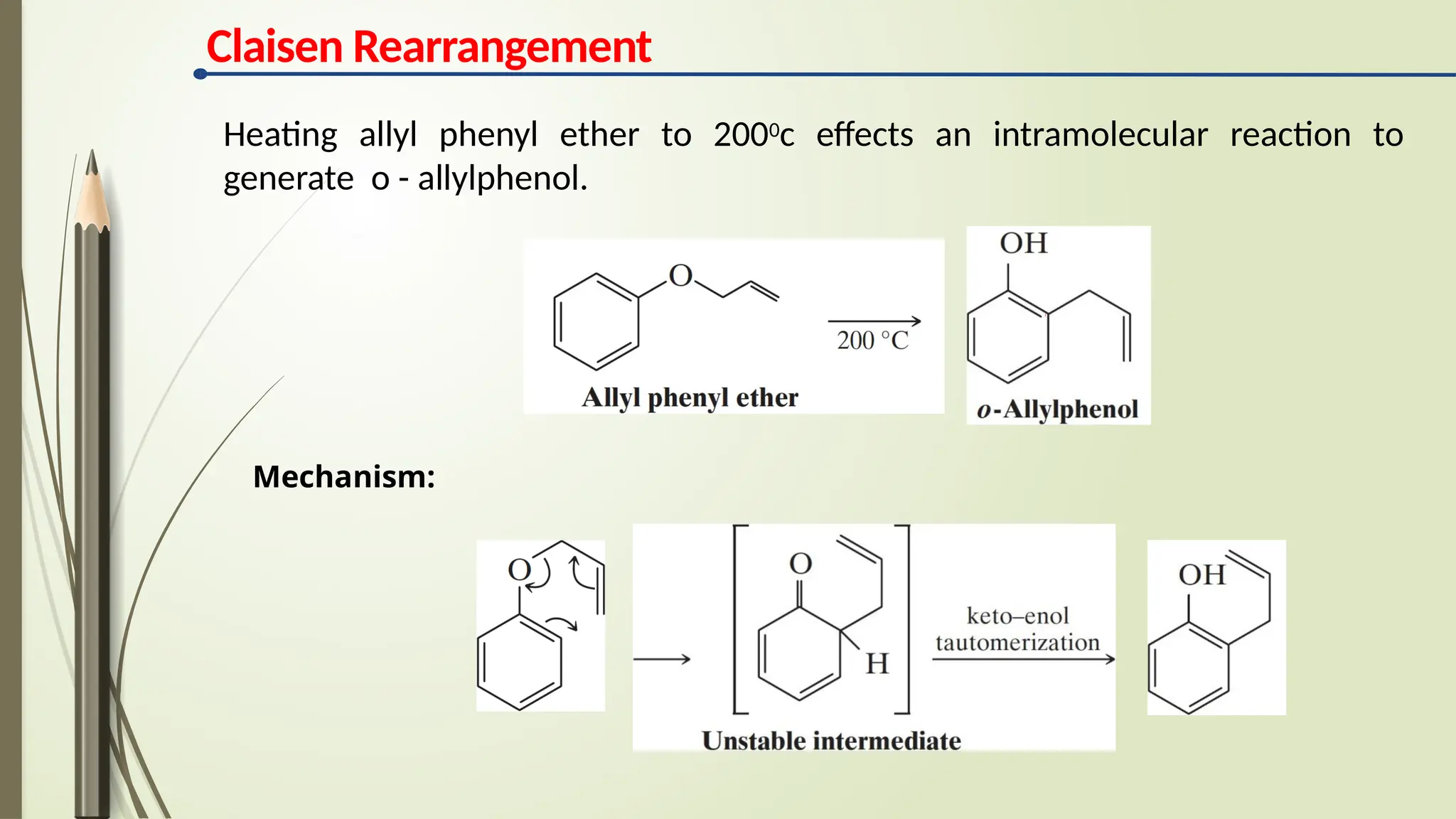
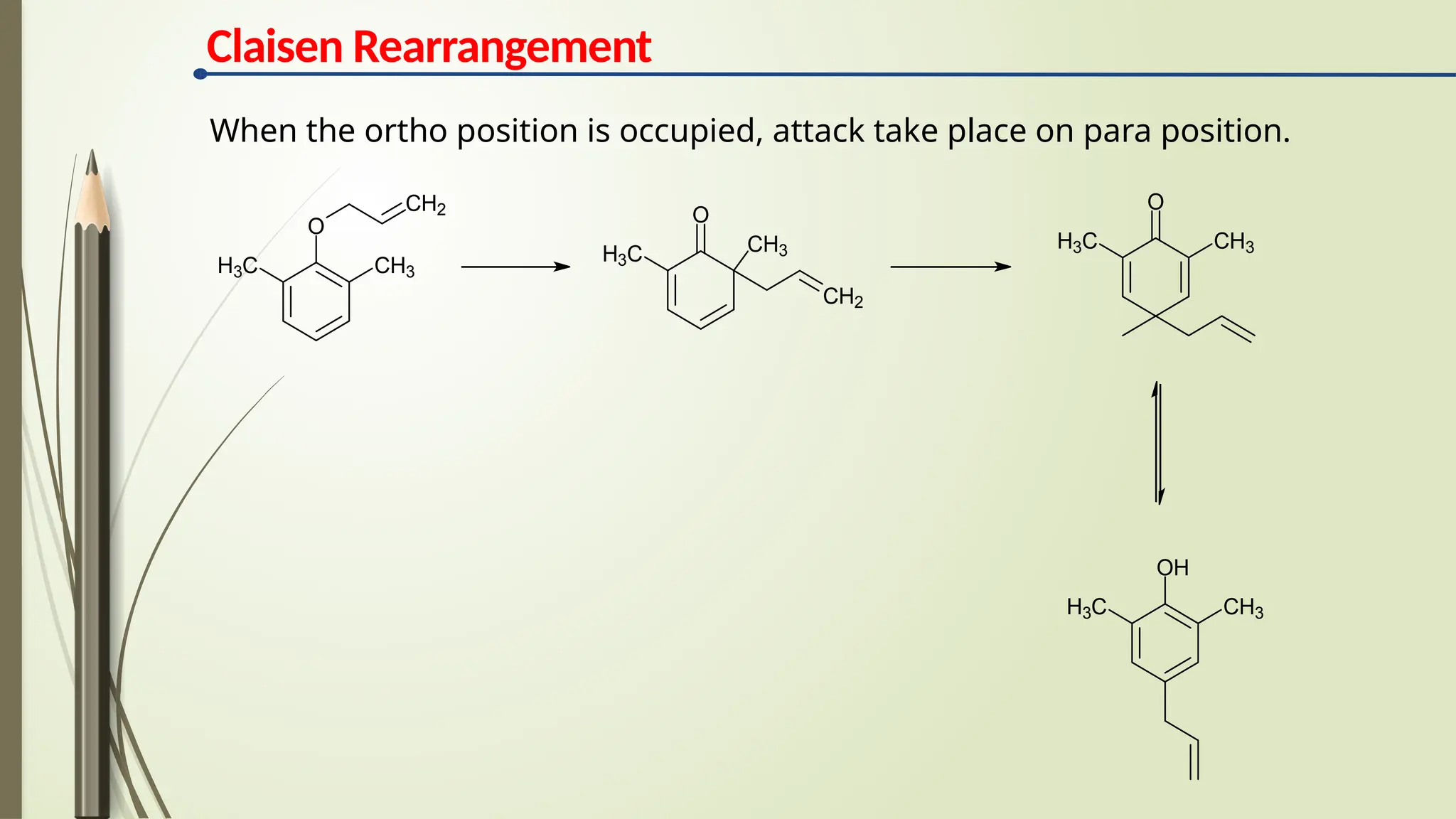
Claisen Rearrangement
When theortho position is occupied, attack take place on para position.
H3C
O
CH3
CH2
H3C
O
CH3
CH2
H3C
O
CH3
H3C
OH
CH3
41.
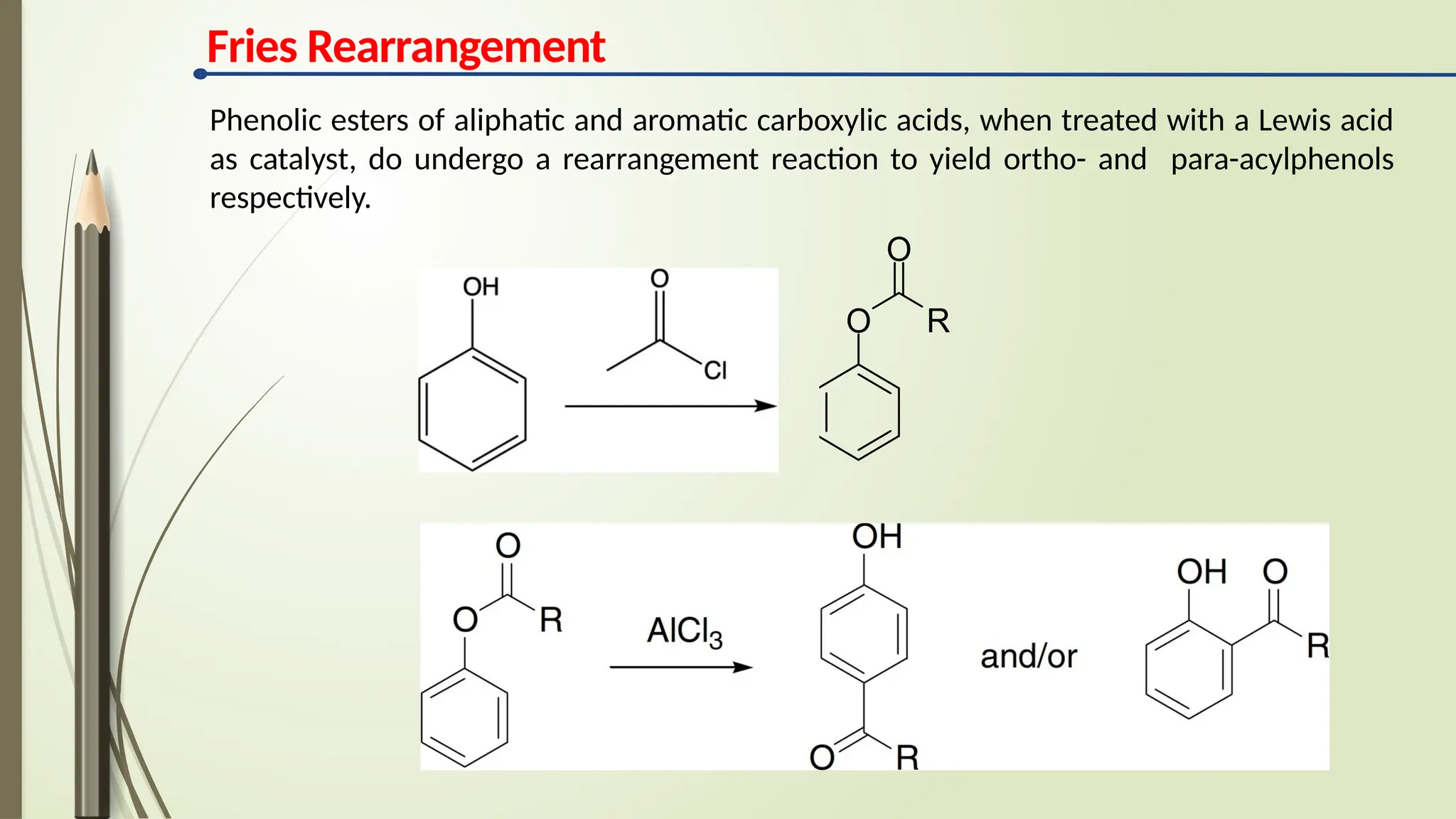
Fries Rearrangement
O R
O
Phenolicesters of aliphatic and aromatic carboxylic acids, when treated with a Lewis acid
as catalyst, do undergo a rearrangement reaction to yield ortho- and para-acylphenols
respectively.
42.
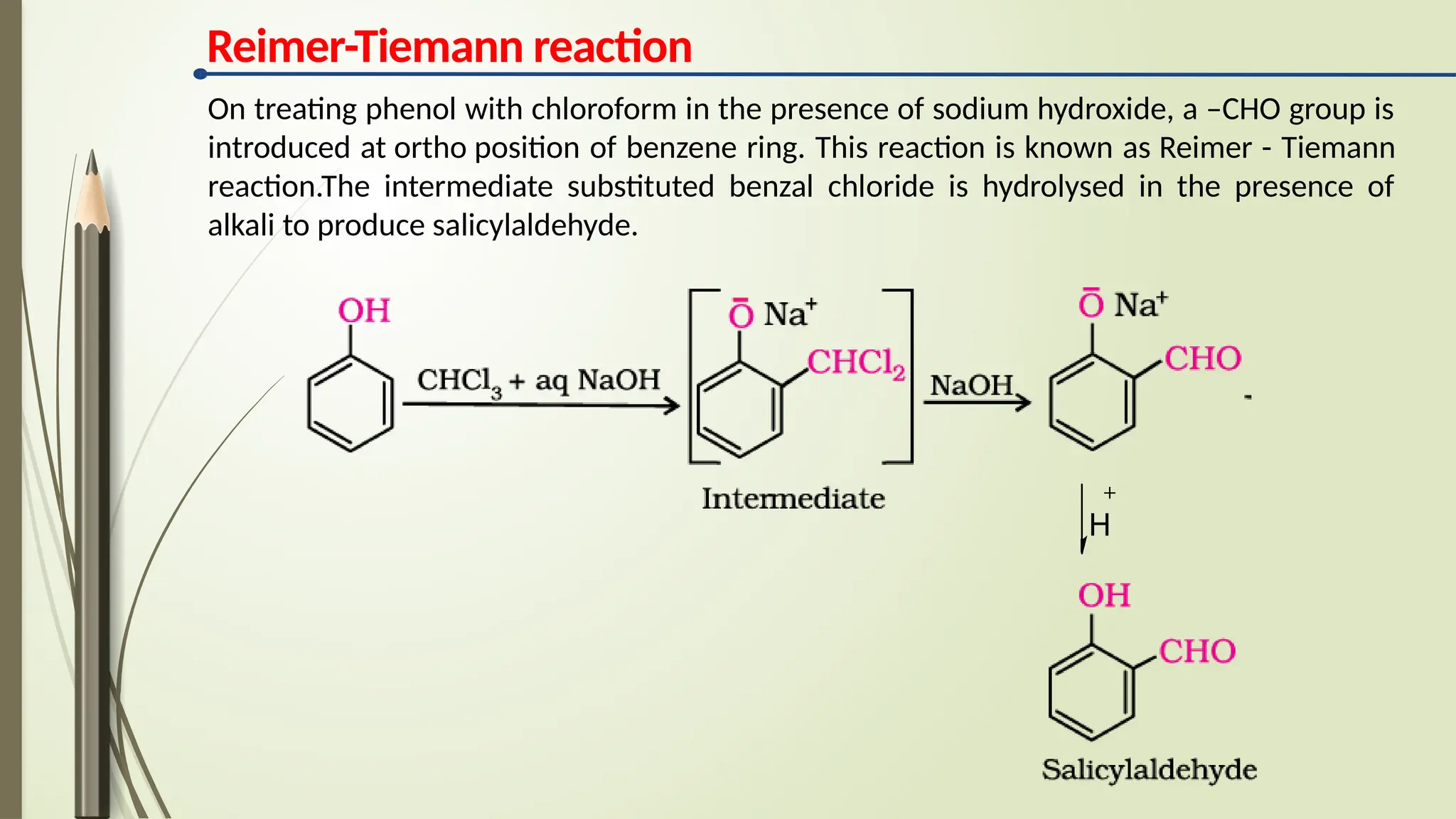
Reimer-Tiemann reaction
On treatingphenol with chloroform in the presence of sodium hydroxide, a –CHO group is
introduced at ortho position of benzene ring. This reaction is known as Reimer - Tiemann
reaction.The intermediate substituted benzal chloride is hydrolysed in the presence of
alkali to produce salicylaldehyde.
H
Reaction with Benzenediazonium chloride
N
2
Cl
OH
1.
NaOH
2.
H
N
N
OH
Benzene
diazonium
chloride
Phenol p-Hydroxyazobenzene
Phenols couples with Benzene diazonium chloride in an alkaline solution to
form p-Hydroxyazobenzene
45.
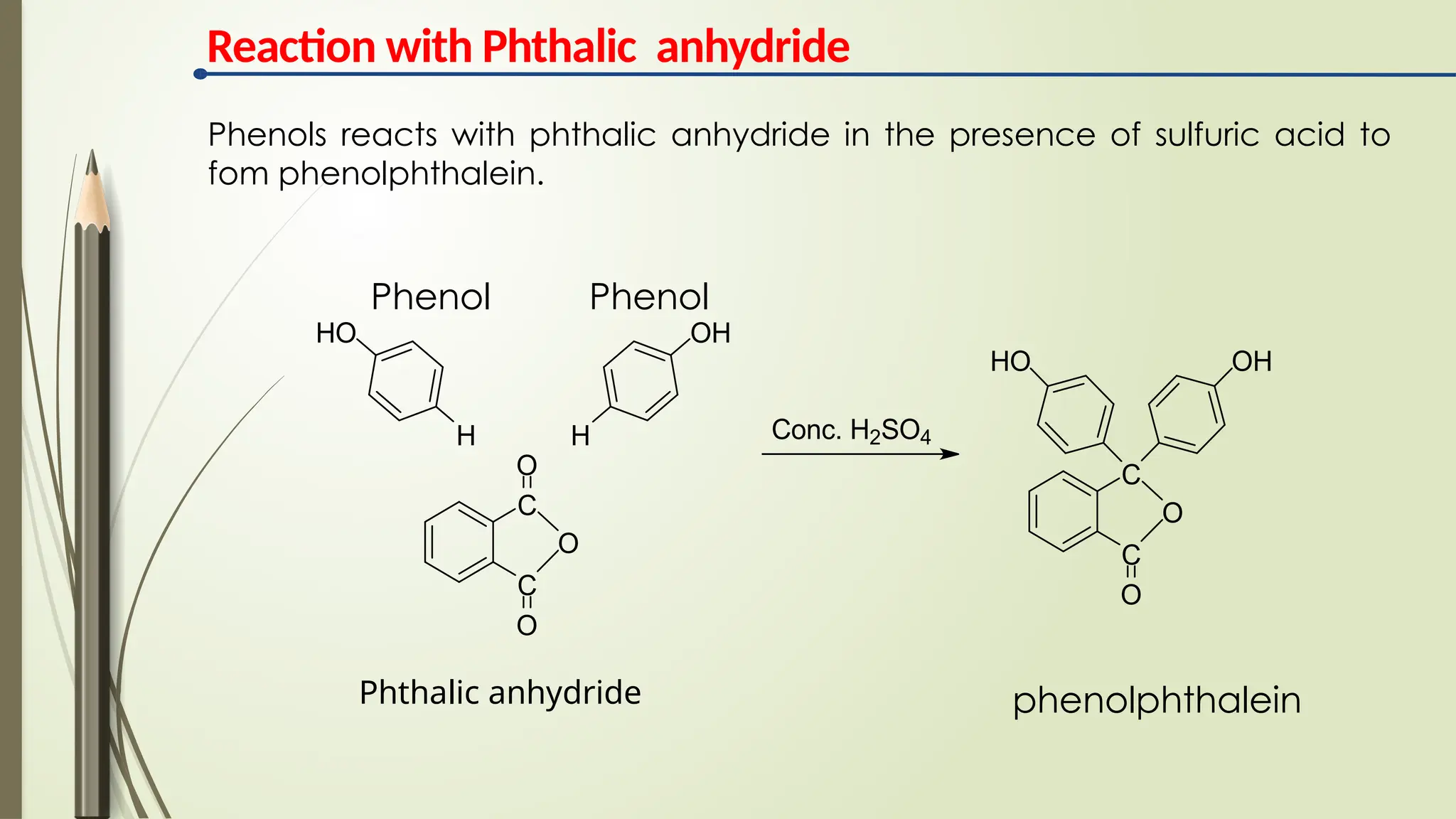
Reaction with Phthalicanhydride
HO
H
OH
H Conc. H2SO4
C
C
O
O
O C
C
O
O
HO OH
Phenols reacts with phthalic anhydride in the presence of sulfuric acid to
fom phenolphthalein.
Phthalic anhydride phenolphthalein
Phenol Phenol
46.
Reaction with Formaldehyde
Phenolo and p-Hydroxyazobenzyl alcohol
Phenols is treated with an alkaline solution of formaldehyde, a mixture of o-
and p-Hydroxybenzyl alcohol is formed.
OH
H
C
O
H
Aq. NaOH
OH
OH
H2
C
H2C
OH
OH
47.
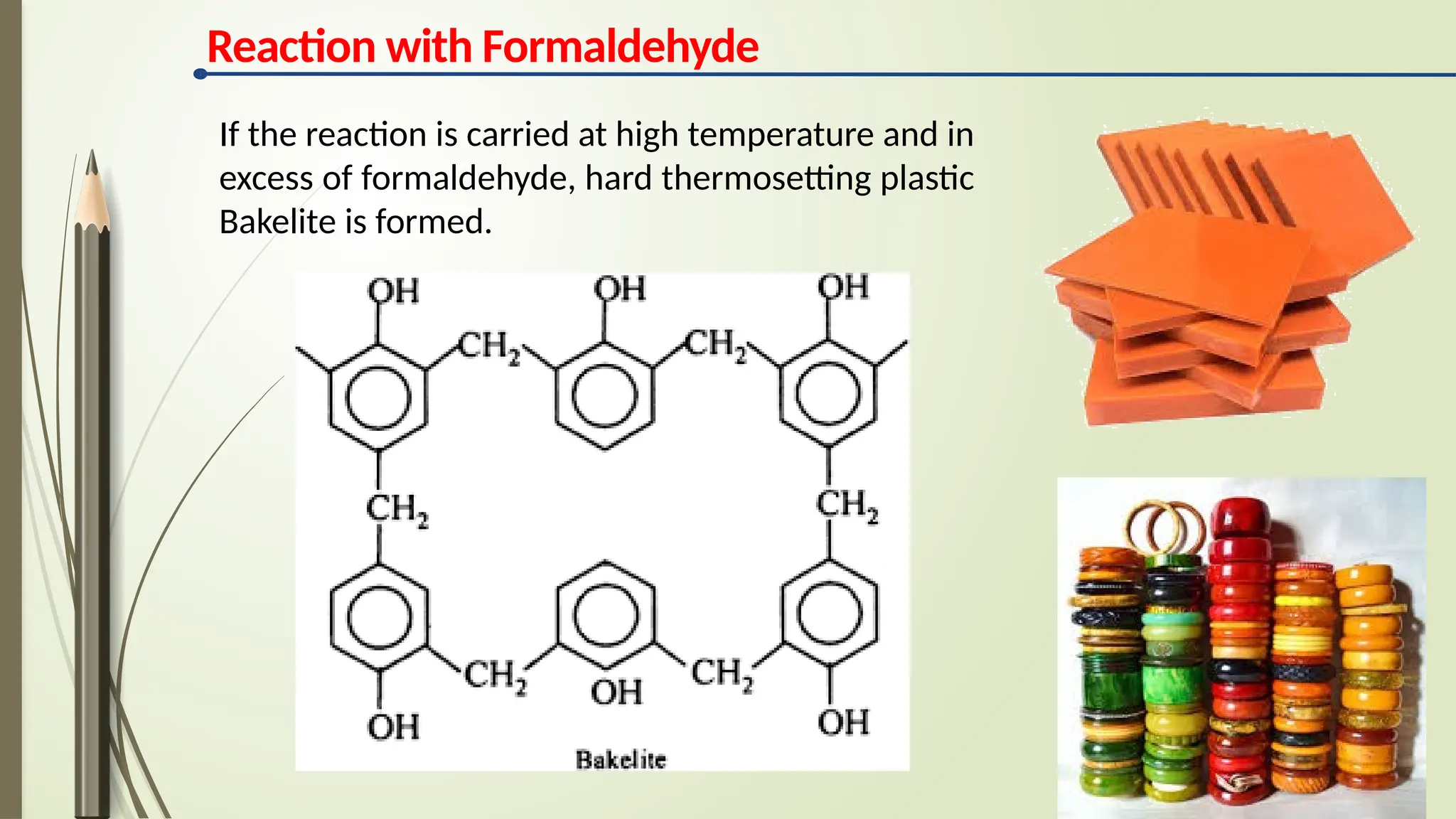
Reaction with Formaldehyde
Ifthe reaction is carried at high temperature and in
excess of formaldehyde, hard thermosetting plastic
Bakelite is formed.
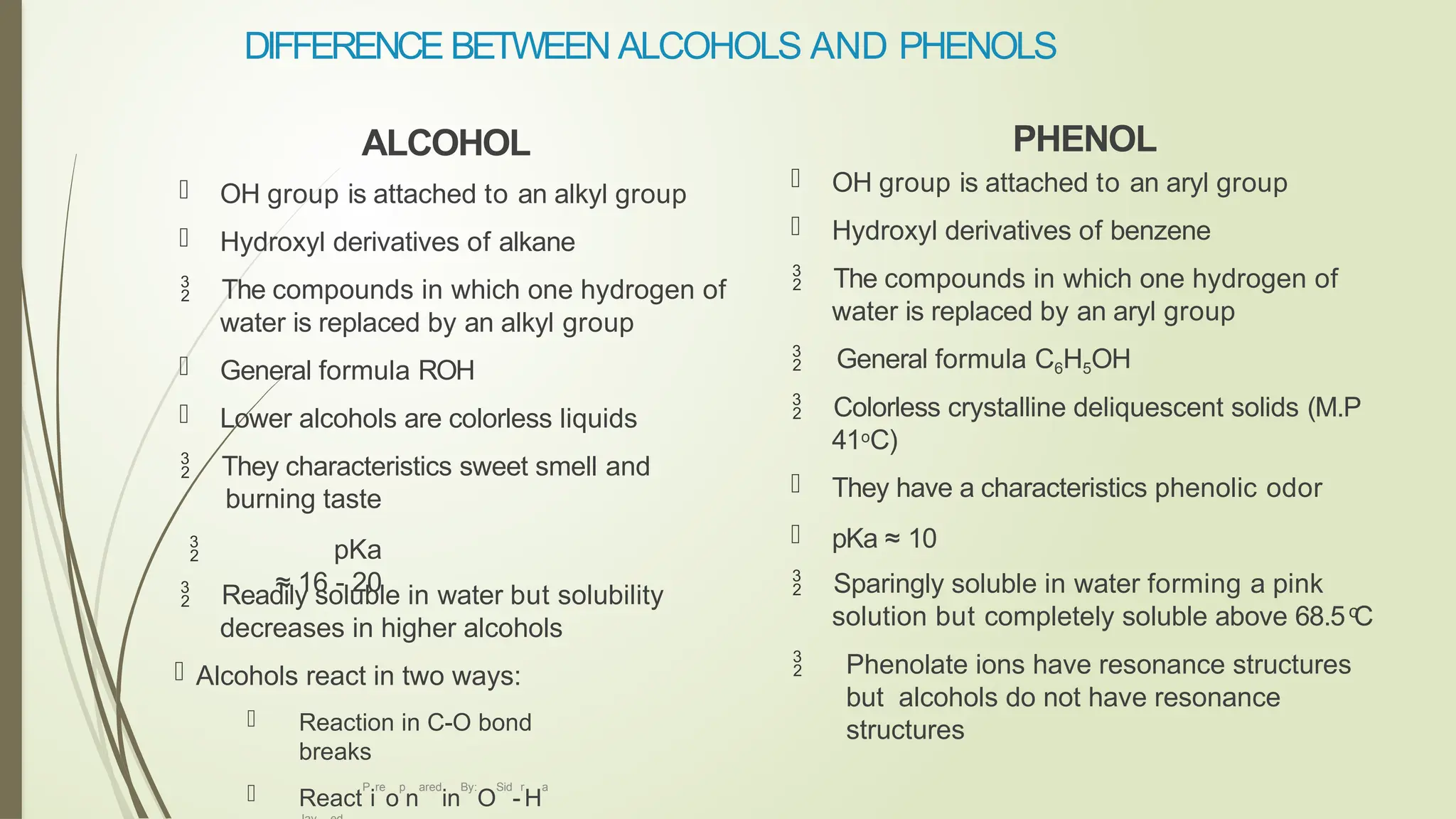
DIFFERENCE BETWEEN ALCOHOLSAND PHENOLS
ALCOHOL
OH group is attached to an alkyl group
Hydroxyl derivatives of alkane
The compounds in which one hydrogen of
water is replaced by an alkyl group
General formula ROH
Lower alcohols are colorless liquids
They characteristics sweet smell and
burning taste
pKa
≈ 16 - 20
Readily soluble in water but solubility
PHENOL
OH group is attached to an aryl group
Hydroxyl derivatives of benzene
The compounds in which one hydrogen of
water is replaced by an aryl group
General formula C6H5OH
Colorless crystalline deliquescent solids (M.P
41oC)
They have a characteristics phenolic odor
pKa ≈ 10
Sparingly soluble in water forming a pink
o
solution but completely soluble above 68.5 C
Phenolate ions have resonance structures
but alcohols do not have resonance
structures
decreases in higher alcohols
Alcohols react in two ways:
Reaction in C-O bond
breaks
React
P
i
re
o
p
n
ared
in
By:
O
Sid
-
r
H
a