Presented By:
Faraz Ahmad Rana
University of Lahore
CARBOCATIONS &
STABILITY
Acarbocation is a species where a carbon atom bonds to three carbon
atoms and has a positive charge.
Carbocations are electron deficient species and therefore very reactive
and unstable.
Anything which donates electron density to the electron-deficient
center will help to stabilize them.
CARBOCATIONS & STABILITY
Neighboringcarbon atoms (inductiveeffect)
Neighboring carbon-carbonmultiple bonds(resonance effect)
Neighboringatoms withlone pairs(resonance effect)
Factors that stabilize them are the following:
CARBOCATIONS & STABILITY
How carbocations are stabilized by neighboring carbons atoms?
The stability of carbocations decreases as the number
of carbons attached to the C+ decreases.
That means that tertiary carbocations are more stable
than secondary that in turn are more stable than
primary (Fig. 1)
CARBOCATIONS & STABILITY
Fig. 1: Carbocation stability increases as methyl substitution increases
around the electron deficient carbon C+. The methyl groups (-CH3 ) are
electron donating and therefore stabilize the positive charge (inductive
effect).
CARBOCATIONS & STABILITY
An explanation for this is that the
methyl group (-CH3) acts as an
electron-donor and therefore
stabilizes the positively
charged cation.
Remember that the C atom has an
electronegativity of 2.5 and that
H 2.2.
CARBOCATIONS & STABILITY
Abetter explanation is that electrons are
donated from the C-H bonds to the empty
p orbital of the C+ therefore stabilizing the
carbocation through hyperconjugation
(the more the - CH3 groups attached to
the C+ the more stable the carbocation
becomes).
CARBOCATIONS & STABILITY
How carbocations are stabilized by carboncarbon multiple bonds
(resonance)?
Carbocations where the C+ is adjacent to another
carbon atom that has a double or triple bond have
extra stability because of the overlap of the empty p
orbital of the carbocation with the p orbitals of the π
CARBOCATIONS & STABILITY
bond. This overlap of the orbitals allows the
charge to be shared between multiple
atoms – delocalization of the charge - and
therefore stabilizes the carbocation.
CARBOCATIONS & STABILITY
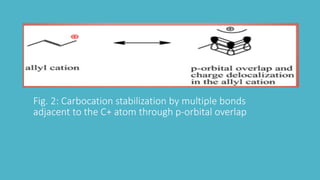
Fig. 2: Carbocation stabilization by multiple bonds
adjacent to the C+ atom through p-orbital overlap
This effect is called charge delocalization and is shown
by drawing resonance structures where the charge
moves from atom to atom.
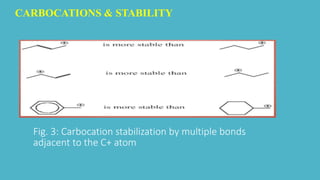
It greatly stabilizes even primary carbocations –
normally very unstable – that are adjacent to a
carboncarbon multiple bond.
CARBOCATIONS & STABILITY
Fig. 3: Carbocation stabilization by multiple bonds
adjacent to the C+ atom
CARBOCATIONS & STABILITY
How carbocations are stabilized by adjacent atoms with
lone pairs?
Adjacent atoms with lone pairs act as electron donors to the
electron-poor carbocation.
This results in forming a double bond (π bond) and the charge
is delocalized to the atom donating the electron pair (π
donation). Nitrogen and oxygen atoms are the most powerful π
donors. However, even halogen atoms stabilize carbocations
through donation of a lone pair
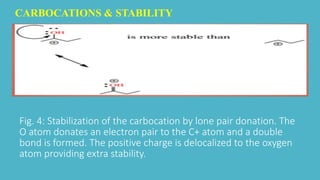
Fig. 4: Stabilization of the carbocation by lone pair donation. The
O atom donates an electron pair to the C+ atom and a double
bond is formed. The positive charge is delocalized to the oxygen
atom providing extra stability.
CARBOCATIONS & STABILITY

Carbocations and Their Stability

  • 1.
    Presented By: Faraz AhmadRana University of Lahore
  • 2.
  • 3.
    Acarbocation is aspecies where a carbon atom bonds to three carbon atoms and has a positive charge. Carbocations are electron deficient species and therefore very reactive and unstable. Anything which donates electron density to the electron-deficient center will help to stabilize them. CARBOCATIONS & STABILITY
  • 4.
    Neighboringcarbon atoms (inductiveeffect) Neighboringcarbon-carbonmultiple bonds(resonance effect) Neighboringatoms withlone pairs(resonance effect) Factors that stabilize them are the following: CARBOCATIONS & STABILITY
  • 5.
    How carbocations arestabilized by neighboring carbons atoms? The stability of carbocations decreases as the number of carbons attached to the C+ decreases. That means that tertiary carbocations are more stable than secondary that in turn are more stable than primary (Fig. 1) CARBOCATIONS & STABILITY
  • 6.
    Fig. 1: Carbocationstability increases as methyl substitution increases around the electron deficient carbon C+. The methyl groups (-CH3 ) are electron donating and therefore stabilize the positive charge (inductive effect). CARBOCATIONS & STABILITY
  • 7.
    An explanation forthis is that the methyl group (-CH3) acts as an electron-donor and therefore stabilizes the positively charged cation. Remember that the C atom has an electronegativity of 2.5 and that H 2.2. CARBOCATIONS & STABILITY
  • 8.
    Abetter explanation isthat electrons are donated from the C-H bonds to the empty p orbital of the C+ therefore stabilizing the carbocation through hyperconjugation (the more the - CH3 groups attached to the C+ the more stable the carbocation becomes). CARBOCATIONS & STABILITY
  • 9.
    How carbocations arestabilized by carboncarbon multiple bonds (resonance)? Carbocations where the C+ is adjacent to another carbon atom that has a double or triple bond have extra stability because of the overlap of the empty p orbital of the carbocation with the p orbitals of the π CARBOCATIONS & STABILITY
  • 10.
    bond. This overlapof the orbitals allows the charge to be shared between multiple atoms – delocalization of the charge - and therefore stabilizes the carbocation. CARBOCATIONS & STABILITY
  • 11.
    Fig. 2: Carbocationstabilization by multiple bonds adjacent to the C+ atom through p-orbital overlap
  • 12.
    This effect iscalled charge delocalization and is shown by drawing resonance structures where the charge moves from atom to atom. It greatly stabilizes even primary carbocations – normally very unstable – that are adjacent to a carboncarbon multiple bond. CARBOCATIONS & STABILITY
  • 13.
    Fig. 3: Carbocationstabilization by multiple bonds adjacent to the C+ atom CARBOCATIONS & STABILITY
  • 14.
    How carbocations arestabilized by adjacent atoms with lone pairs? Adjacent atoms with lone pairs act as electron donors to the electron-poor carbocation. This results in forming a double bond (π bond) and the charge is delocalized to the atom donating the electron pair (π donation). Nitrogen and oxygen atoms are the most powerful π donors. However, even halogen atoms stabilize carbocations through donation of a lone pair
  • 15.
    Fig. 4: Stabilizationof the carbocation by lone pair donation. The O atom donates an electron pair to the C+ atom and a double bond is formed. The positive charge is delocalized to the oxygen atom providing extra stability. CARBOCATIONS & STABILITY