PHENOLS
P.M. Jadhav
Assistant Professor
Dept. of Chemistry
M.S.P. Mandals, Shri Muktanand college,
Gangapur, Dist: Aurangabad.
Phenol
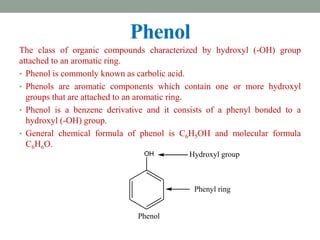
The class of organic compounds characterized by hydroxyl (-OH) group
attached to an aromatic ring.
• Phenol is commonly known as carbolic acid.
• Phenols are aromatic components which contain one or more hydroxyl
groups that are attached to an aromatic ring.
• Phenol is a benzene derivative and it consists of a phenyl bonded to a
hydroxyl (-OH) group.
• General chemical formula of phenol is C6H5OH and molecular formula
C6H6O.
OH Hydroxyl group
Phenyl ring
Phenol
Nomenclature of Phenol
Phenol is a monohydroxy derivative of benzene prepared by the replacing of
one of the hydrogen of benzene by hydroxyl group. Phenol contain two part
one part is aryl group (phenyl) and other is hydroxyl group.
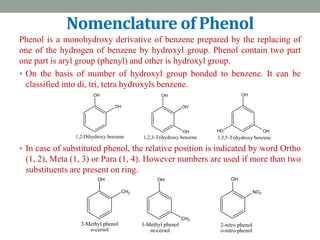
 On the basis of number of hydroxyl group bonded to benzene. It can be
classified into di, tri, tetra hydroxyls benzene.
 In case of substituted phenol, the relative position is indicated by word Ortho
(1, 2), Meta (1, 3) or Para (1, 4). However numbers are used if more than two
substituents are present on ring.
OH
1,2-Dihydroxy benzene
OH
OH
1,2,3-Trihydroxy benzene
OH
OH
OH
1,3,5-Trihydroxy benzene
OHHO
OH
2-Methyl phenol
o-cersol
CH3
OH
3-Methyl phenol
m-cersol
CH3
OH
2-nitro phenol
o-nitro phenol
NO2
Preparation Methods
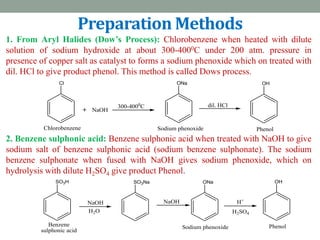
1. From Aryl Halides (Dow’s Process): Chlorobenzene when heated with dilute
solution of sodium hydroxide at about 300-4000C under 200 atm. pressure in
presence of copper salt as catalyst to forms a sodium phenoxide which on treated with
dil. HCl to give product phenol. This method is called Dows process.
2. Benzene sulphonic acid: Benzene sulphonic acid when treated with NaOH to give
sodium salt of benzene sulphonic acid (sodium benzene sulphonate). The sodium
benzene sulphonate when fused with NaOH gives sodium phenoxide, which on
hydrolysis with dilute H2SO4 give product Phenol.
Cl
Chlorobenzene
NaOH
300-4000
C
ONa
Sodium phenoxide
OH
dil. HCl
Phenol
NaOH
SO3H
H2O
SO3Na ONa
NaOH H+
H2SO4
OH
PhenolBenzene
sulphonic acid
Sodium phenoxide
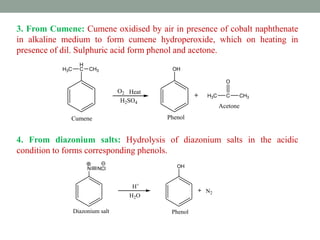
3. From Cumene: Cumene oxidised by air in presence of cobalt naphthenate
in alkaline medium to form cumene hydroperoxide, which on heating in
presence of dil. Sulphuric acid form phenol and acetone.
4. From diazonium salts: Hydrolysis of diazonium salts in the acidic
condition to forms corresponding phenols.
H
C
H2SO4
CH3H3C
O2 Heat
Cumene
OH
Phenol
H3C C CH3
O
Acetone
OH
N2
PhenolDiazonium salt
N NCl
H+
H2O
Physical Properties of Phenol
Molecular formula C6H6O
Molar mass 94.11 g/mole
Appearance Colorless, Crystalline solid
Density 1.07 g/cm3
Melting point 41°C
Boiling point 182°C
Solubility in water Soluble in water
Acidic Nature of Phenol
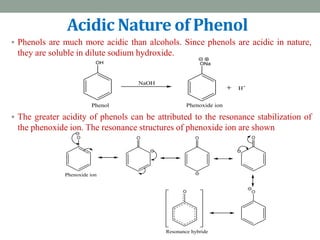
 Phenols are much more acidic than alcohols. Since phenols are acidic in nature,
they are soluble in dilute sodium hydroxide.
 The greater acidity of phenols can be attributed to the resonance stabilization of
the phenoxide ion. The resonance structures of phenoxide ion are shown
OH
Phenol
NaOH
ONa
H+
Phenoxide ion
O
Phenoxide ion
O O O
OO
Resonance hybride
Electrophilic Substitution Reactions
• The hydroxyl group is a activating group and hence it readily undergo electrophilic
substitution reactions.
• Phenol is ortho and para director as the ortho and para positions of the phenol are
electron rich, the substitution takes place at these positions.
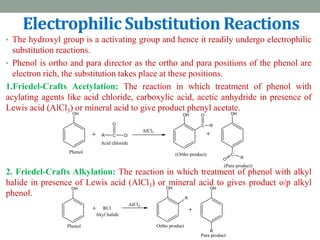
1.Friedel-Crafts Acetylation: The reaction in which treatment of phenol with
acylating agents like acid chloride, carboxylic acid, acetic anhydride in presence of
Lewis acid (AlCl3) or mineral acid to give product phenyl acetate.
2. Friedel-Crafts Alkylation: The reaction in which treatment of phenol with alkyl
halide in presence of Lewis acid (AlCl3) or mineral acid to gives product o/p alkyl
phenol.
OH
Phenol
R C
O
Cl
AlCl3
OH OH
C
C
O
R
O R
(Ortho product)
(Para product)
Acid chloride
OH
RCl
AlCl3
OH OH
R
R
Ortho product
Para product
Phenol
Akyl halide
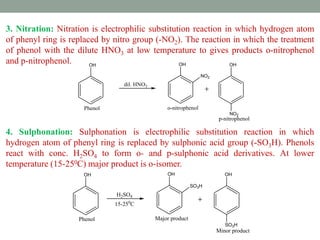
3. Nitration: Nitration is electrophilic substitution reaction in which hydrogen atom
of phenyl ring is replaced by nitro group (-NO2). The reaction in which the treatment
of phenol with the dilute HNO3 at low temperature to gives products o-nitrophenol
and p-nitrophenol.
4. Sulphonation: Sulphonation is electrophilic substitution reaction in which
hydrogen atom of phenyl ring is replaced by sulphonic acid group (-SO3H). Phenols
react with conc. H2SO4 to form o- and p-sulphonic acid derivatives. At lower
temperature (15-250C) major product is o-isomer.
OH
dil. HNO3
OH OH
NO2
NO2
o-nitrophenol
p-nitrophenol
Phenol
OH
H2SO4
OH OH
SO3H
SO3H
Major product
Minor product
Phenol
15-250
C
5. Kolbe Reaction: Kolbe Reaction is a electrophilic substitution reaction in which
hydrogen atom of phenyl ring is replaced by carboxyl group (-COOH). The formation
of aromatic carboxylic acid by the reaction of phenoxide with carbon dioxide at
1200C under pressure to gives product salicylic acid.
6. Reimer-Tiemann Reaction: Phenols when react with chloroform in the
presence of sodium hydroxide or potassium hydroxide to give hydroxy aldehydes,
this formylation reaction is called as Reimer-Tiemann reaction.
ONa
Phenoxide ion
OH
COOH
CO2
1200
C
Salicylic acid
OH
Phenol
CHCl3
NaOH
H2O
OH OH
CHO
CHOOrtho
(Major product) Para
(Minor product)
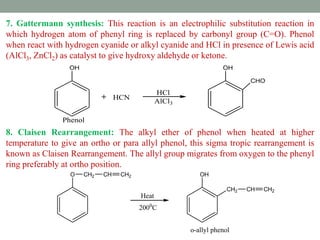
7. Gattermann synthesis: This reaction is an electrophilic substitution reaction in
which hydrogen atom of phenyl ring is replaced by carbonyl group (C=O). Phenol
when react with hydrogen cyanide or alkyl cyanide and HCl in presence of Lewis acid
(AlCl3, ZnCl2) as catalyst to give hydroxy aldehyde or ketone.
8. Claisen Rearrangement: The alkyl ether of phenol when heated at higher
temperature to give an ortho or para allyl phenol, this sigma tropic rearrangement is
known as Claisen Rearrangement. The allyl group migrates from oxygen to the phenyl
ring preferably at ortho position.
OH OH
CHO
HCN
Phenol
AlCl3
HCl
O CH2 CH CH2
Heat
2000
C
OH
CH2 CH CH2
o-allyl phenol
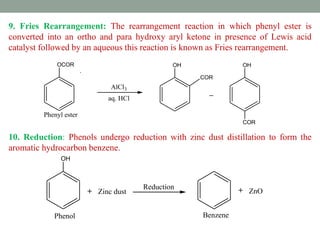
9. Fries Rearrangement: The rearrangement reaction in which phenyl ester is
converted into an ortho and para hydroxy aryl ketone in presence of Lewis acid
catalyst followed by an aqueous this reaction is known as Fries rearrangement.
10. Reduction: Phenols undergo reduction with zinc dust distillation to form the
aromatic hydrocarbon benzene.
OH
Zinc dust ZnO
Reduction
Phenol Benzene
OCOR
Phenyl ester
OH
COR
AlCl3
aq. HCl
OH
COR
THANK YOU

Phenols

  • 1.
    PHENOLS P.M. Jadhav Assistant Professor Dept.of Chemistry M.S.P. Mandals, Shri Muktanand college, Gangapur, Dist: Aurangabad.
  • 2.
    Phenol The class oforganic compounds characterized by hydroxyl (-OH) group attached to an aromatic ring. • Phenol is commonly known as carbolic acid. • Phenols are aromatic components which contain one or more hydroxyl groups that are attached to an aromatic ring. • Phenol is a benzene derivative and it consists of a phenyl bonded to a hydroxyl (-OH) group. • General chemical formula of phenol is C6H5OH and molecular formula C6H6O. OH Hydroxyl group Phenyl ring Phenol
  • 3.
    Nomenclature of Phenol Phenolis a monohydroxy derivative of benzene prepared by the replacing of one of the hydrogen of benzene by hydroxyl group. Phenol contain two part one part is aryl group (phenyl) and other is hydroxyl group.  On the basis of number of hydroxyl group bonded to benzene. It can be classified into di, tri, tetra hydroxyls benzene.  In case of substituted phenol, the relative position is indicated by word Ortho (1, 2), Meta (1, 3) or Para (1, 4). However numbers are used if more than two substituents are present on ring. OH 1,2-Dihydroxy benzene OH OH 1,2,3-Trihydroxy benzene OH OH OH 1,3,5-Trihydroxy benzene OHHO OH 2-Methyl phenol o-cersol CH3 OH 3-Methyl phenol m-cersol CH3 OH 2-nitro phenol o-nitro phenol NO2
  • 4.
    Preparation Methods 1. FromAryl Halides (Dow’s Process): Chlorobenzene when heated with dilute solution of sodium hydroxide at about 300-4000C under 200 atm. pressure in presence of copper salt as catalyst to forms a sodium phenoxide which on treated with dil. HCl to give product phenol. This method is called Dows process. 2. Benzene sulphonic acid: Benzene sulphonic acid when treated with NaOH to give sodium salt of benzene sulphonic acid (sodium benzene sulphonate). The sodium benzene sulphonate when fused with NaOH gives sodium phenoxide, which on hydrolysis with dilute H2SO4 give product Phenol. Cl Chlorobenzene NaOH 300-4000 C ONa Sodium phenoxide OH dil. HCl Phenol NaOH SO3H H2O SO3Na ONa NaOH H+ H2SO4 OH PhenolBenzene sulphonic acid Sodium phenoxide
  • 5.
    3. From Cumene:Cumene oxidised by air in presence of cobalt naphthenate in alkaline medium to form cumene hydroperoxide, which on heating in presence of dil. Sulphuric acid form phenol and acetone. 4. From diazonium salts: Hydrolysis of diazonium salts in the acidic condition to forms corresponding phenols. H C H2SO4 CH3H3C O2 Heat Cumene OH Phenol H3C C CH3 O Acetone OH N2 PhenolDiazonium salt N NCl H+ H2O
  • 6.
    Physical Properties ofPhenol Molecular formula C6H6O Molar mass 94.11 g/mole Appearance Colorless, Crystalline solid Density 1.07 g/cm3 Melting point 41°C Boiling point 182°C Solubility in water Soluble in water
  • 7.
    Acidic Nature ofPhenol  Phenols are much more acidic than alcohols. Since phenols are acidic in nature, they are soluble in dilute sodium hydroxide.  The greater acidity of phenols can be attributed to the resonance stabilization of the phenoxide ion. The resonance structures of phenoxide ion are shown OH Phenol NaOH ONa H+ Phenoxide ion O Phenoxide ion O O O OO Resonance hybride
  • 8.
    Electrophilic Substitution Reactions •The hydroxyl group is a activating group and hence it readily undergo electrophilic substitution reactions. • Phenol is ortho and para director as the ortho and para positions of the phenol are electron rich, the substitution takes place at these positions. 1.Friedel-Crafts Acetylation: The reaction in which treatment of phenol with acylating agents like acid chloride, carboxylic acid, acetic anhydride in presence of Lewis acid (AlCl3) or mineral acid to give product phenyl acetate. 2. Friedel-Crafts Alkylation: The reaction in which treatment of phenol with alkyl halide in presence of Lewis acid (AlCl3) or mineral acid to gives product o/p alkyl phenol. OH Phenol R C O Cl AlCl3 OH OH C C O R O R (Ortho product) (Para product) Acid chloride OH RCl AlCl3 OH OH R R Ortho product Para product Phenol Akyl halide
  • 9.
    3. Nitration: Nitrationis electrophilic substitution reaction in which hydrogen atom of phenyl ring is replaced by nitro group (-NO2). The reaction in which the treatment of phenol with the dilute HNO3 at low temperature to gives products o-nitrophenol and p-nitrophenol. 4. Sulphonation: Sulphonation is electrophilic substitution reaction in which hydrogen atom of phenyl ring is replaced by sulphonic acid group (-SO3H). Phenols react with conc. H2SO4 to form o- and p-sulphonic acid derivatives. At lower temperature (15-250C) major product is o-isomer. OH dil. HNO3 OH OH NO2 NO2 o-nitrophenol p-nitrophenol Phenol OH H2SO4 OH OH SO3H SO3H Major product Minor product Phenol 15-250 C
  • 10.
    5. Kolbe Reaction:Kolbe Reaction is a electrophilic substitution reaction in which hydrogen atom of phenyl ring is replaced by carboxyl group (-COOH). The formation of aromatic carboxylic acid by the reaction of phenoxide with carbon dioxide at 1200C under pressure to gives product salicylic acid. 6. Reimer-Tiemann Reaction: Phenols when react with chloroform in the presence of sodium hydroxide or potassium hydroxide to give hydroxy aldehydes, this formylation reaction is called as Reimer-Tiemann reaction. ONa Phenoxide ion OH COOH CO2 1200 C Salicylic acid OH Phenol CHCl3 NaOH H2O OH OH CHO CHOOrtho (Major product) Para (Minor product)
  • 11.
    7. Gattermann synthesis:This reaction is an electrophilic substitution reaction in which hydrogen atom of phenyl ring is replaced by carbonyl group (C=O). Phenol when react with hydrogen cyanide or alkyl cyanide and HCl in presence of Lewis acid (AlCl3, ZnCl2) as catalyst to give hydroxy aldehyde or ketone. 8. Claisen Rearrangement: The alkyl ether of phenol when heated at higher temperature to give an ortho or para allyl phenol, this sigma tropic rearrangement is known as Claisen Rearrangement. The allyl group migrates from oxygen to the phenyl ring preferably at ortho position. OH OH CHO HCN Phenol AlCl3 HCl O CH2 CH CH2 Heat 2000 C OH CH2 CH CH2 o-allyl phenol
  • 12.
    9. Fries Rearrangement:The rearrangement reaction in which phenyl ester is converted into an ortho and para hydroxy aryl ketone in presence of Lewis acid catalyst followed by an aqueous this reaction is known as Fries rearrangement. 10. Reduction: Phenols undergo reduction with zinc dust distillation to form the aromatic hydrocarbon benzene. OH Zinc dust ZnO Reduction Phenol Benzene OCOR Phenyl ester OH COR AlCl3 aq. HCl OH COR
  • 13.