PHENOLS
Phenols are compounds with an –OH group
attached to an aromatic carbon. Although they
share the same functional group with alcohols,
where the –OH group is attached to an aliphatic
carbon, the chemistry of phenols is very different
from that of alcohols.
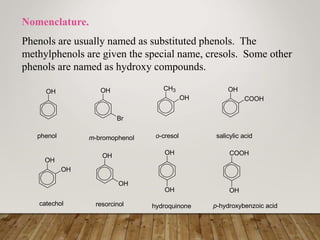
Nomenclature.
Phenols are usually named as substituted phenols. The
methylphenols are given the special name, cresols. Some other
phenols are named as hydroxy compounds.
OH
phenol
OH
Br
m-bromophenol
CH3
OH
o-cresol
OH
COOH
salicylic acid
OH
OH
OH
OH
OH
OH
catechol resorcinol hydroquinone
COOH
OH
p-hydroxybenzoic acid
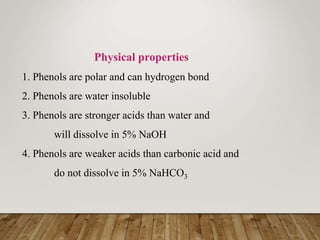
Physical properties
1. Phenols are polar and can hydrogen bond
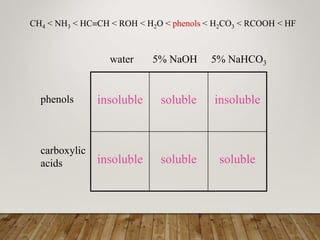
2. Phenols are water insoluble
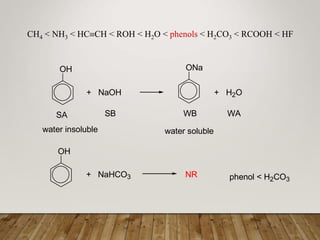
3. Phenols are stronger acids than water and
will dissolve in 5% NaOH
4. Phenols are weaker acids than carbonic acid and
do not dissolve in 5% NaHCO3
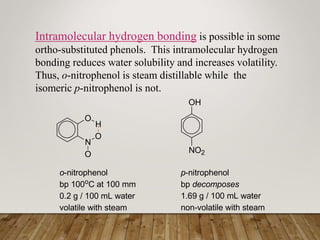
Intramolecular hydrogen bonding is possible in some
ortho-substituted phenols. This intramolecular hydrogen
bonding reduces water solubility and increases volatility.
Thus, o-nitrophenol is steam distillable while the
isomeric p-nitrophenol is not.
N
O
H
O
O
o-nitrophenol
bp 100oC at 100 mm
0.2 g / 100 mL water
volatile with steam
OH
NO2
p-nitrophenol
bp decomposes
1.69 g / 100 mL water
non-volatile with steam
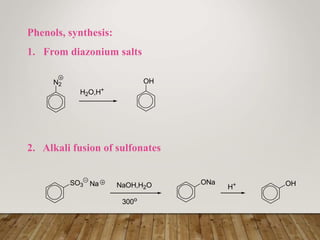
Phenols, synthesis:
1. From diazonium salts
2. Alkali fusion of sulfonates
N2
H2O,H+
OH
SO3 Na NaOH,H2O
300o
ONa
H+ OH
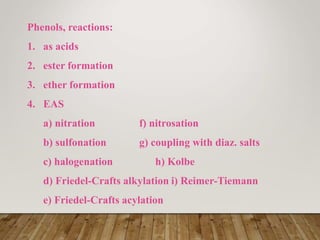
Phenols, reactions:
1. as acids
2. ester formation
3. ether formation
4. EAS
a) nitration f) nitrosation
b) sulfonation g) coupling with diaz. salts
c) halogenation h) Kolbe
d) Friedel-Crafts alkylation i) Reimer-Tiemann
e) Friedel-Crafts acylation
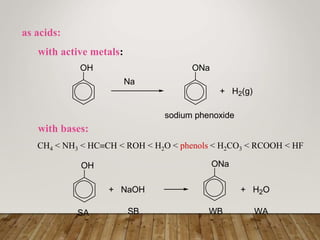
as acids:
with active metals:
with bases:
CH4 < NH3 < HCCH < ROH < H2O < phenols < H2CO3 < RCOOH < HF
OH
Na
ONa
sodium phenoxide
+ H2(g)
OH
+ NaOH
ONa
+ H2O
SA SB WB WA
CH4 < NH3 < HCCH < ROH < H2O < phenols < H2CO3 < RCOOH < HF
OH
+ NaOH
ONa
+ H2O
SA SB WB WA
water insoluble water soluble
OH
+ NaHCO3 NR phenol < H2CO3
insoluble soluble insoluble
insoluble soluble soluble
water 5% NaOH 5% NaHCO3
phenols
carboxylic
acids
CH4 < NH3 < HCCH < ROH < H2O < phenols < H2CO3 < RCOOH < HF
We use the ionization of acids in water to measure acid
strength (Ka):
HBase + H2O H3O+ + Base-
Ka = [H3O+ ][ Base ] / [ HBase]
ROH Ka ~ 10-16 - 10-18
ArOH Ka ~ 10-10
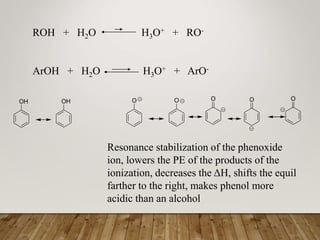
Why are phenols more acidic than alcohols?
ROH + H2O H3O+ + RO-
ArOH + H2O H3O+ + ArO-
OH OH O O O O O
Resonance stabilization of the phenoxide
ion, lowers the PE of the products of the
ionization, decreases the ΔH, shifts the equil
farther to the right, makes phenol more
acidic than an alcohol
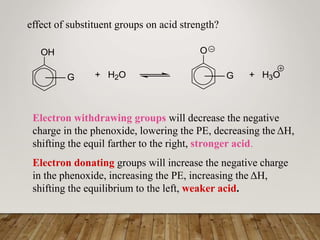
effect of substituent groups on acid strength?
OH
G + H2O
O
G + H3O
Electron withdrawing groups will decrease the negative
charge in the phenoxide, lowering the PE, decreasing the ΔH,
shifting the equil farther to the right, stronger acid.
Electron donating groups will increase the negative charge
in the phenoxide, increasing the PE, increasing the ΔH,
shifting the equilibrium to the left, weaker acid.
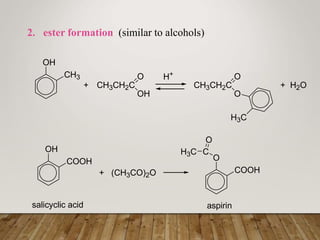
2. ester formation (similar to alcohols)
OH
CH3
+ CH3CH2C
O
OH
H+
CH3CH2C
O
O
H3C
+ H2O
OH
COOH
salicyclic acid
+ (CH3CO)2O
O
COOH
C
H3C
O
aspirin
O
COOH
C
H3C
O
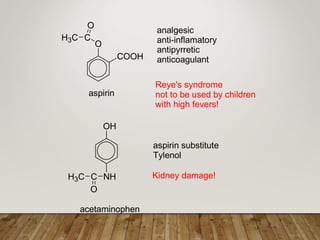
aspirin
analgesic
anti-inflamatory
antipyrretic
anticoagulant
Reye's syndrome
not to be used by children
with high fevers!
OH
NH
C
H3C
O
acetaminophen
aspirin substitute
Tylenol
Kidney damage!
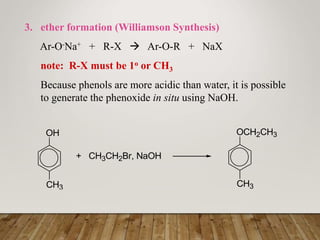
3. ether formation (Williamson Synthesis)
Ar-O-Na+ + R-X  Ar-O-R + NaX
note: R-X must be 1o or CH3
Because phenols are more acidic than water, it is possible
to generate the phenoxide in situ using NaOH.
OH
CH3
+ CH3CH2Br, NaOH
OCH2CH3
CH3
4. Electrophilic Aromatic Substitution
The –OH group is a powerful activating group in EAS
and an ortho/para director.
a) nitration
OH OH
NO2
NO2
O2N
polynitration!
OH
dilute HNO3
OH OH
NO2
NO2
+
HNO3
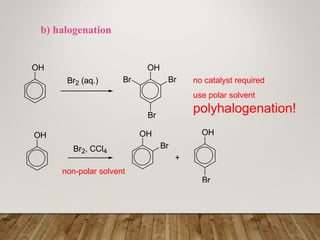
OH
Br2 (aq.)
OH
Br
Br
Br no catalyst required
use polar solvent
polyhalogenation!
OH
Br2, CCl4
OH OH
Br
Br
+
non-polar solvent
b) halogenation
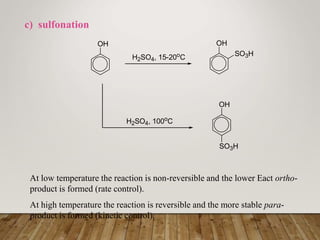
c) sulfonation
OH
H2SO4, 15-20oC
OH
SO3H
H2SO4, 100oC
OH
SO3H
At low temperature the reaction is non-reversible and the lower Eact ortho-
product is formed (rate control).
At high temperature the reaction is reversible and the more stable para-
product is formed (kinetic control).
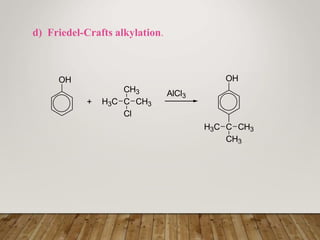
d) Friedel-Crafts alkylation.
OH
+ H3C C CH3
CH3
Cl
AlCl3
OH
C CH3
CH3
H3C
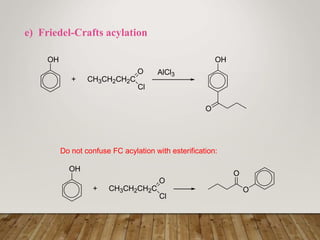
e) Friedel-Crafts acylation
OH
CH3CH2CH2C
O
Cl
+
AlCl3
OH
O
Do not confuse FC acylation with esterification:
OH
CH3CH2CH2C
O
Cl
+ O
O
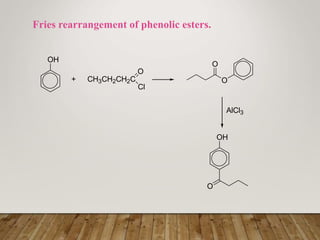
OH
O
OH
CH3CH2CH2C
O
Cl
+ O
O
AlCl3
Fries rearrangement of phenolic esters.
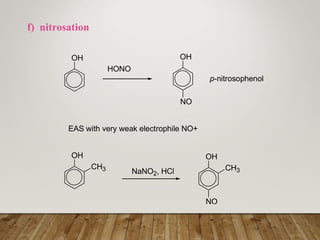
f) nitrosation
OH
HONO
OH
NO
EAS with very weak electrophile NO+
OH
CH3 NaNO2, HCl
OH
CH3
NO
p-nitrosophenol
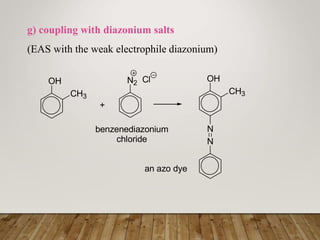
g) coupling with diazonium salts
(EAS with the weak electrophile diazonium)
OH
CH3
+
N2 Cl
benzenediazonium
chloride
CH3
OH
N
N
an azo dye
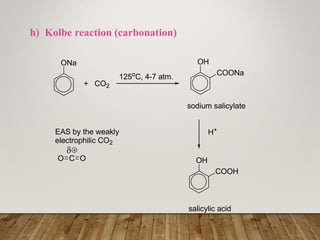
h) Kolbe reaction (carbonation)
ONa
+ CO2
125o
C, 4-7 atm.
OH
COONa
sodium salicylate
H+
OH
COOH
salicylic acid
EAS by the weakly
electrophilic CO2
O C O

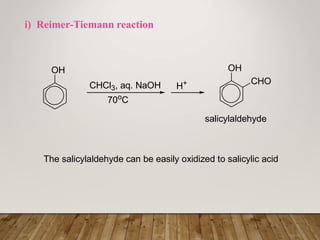
i) Reimer-Tiemann reaction
OH
CHCl3, aq. NaOH
70oC
H+
OH
CHO
salicylaldehyde
The salicylaldehyde can be easily oxidized to salicylic acid
STRUCTURES AND USES
OF PHENOLS
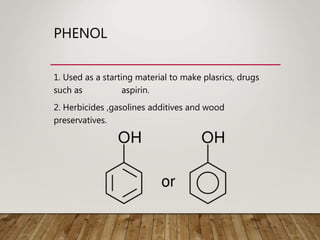
PHENOL
1. Used as a starting material to make plasrics, drugs
such as aspirin.
2. Herbicides ,gasolines additives and wood
preservatives.
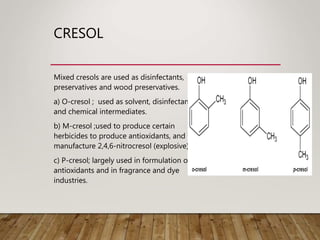
CRESOL
Mixed cresols are used as disinfectants,
preservatives and wood preservatives.
a) O-cresol ; used as solvent, disinfectants
and chemical intermediates.
b) M-cresol ;used to produce certain
herbicides to produce antioxidants, and to
manufacture 2,4,6-nitrocresol (explosive)
c) P-cresol; largely used in formulation of
antioxidants and in fragrance and dye
industries.
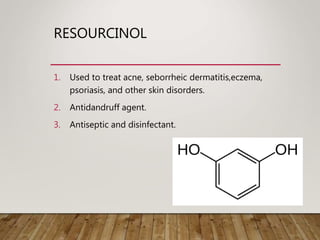
RESOURCINOL
1. Used to treat acne, seborrheic dermatitis,eczema,
psoriasis, and other skin disorders.
2. Antidandruff agent.
3. Antiseptic and disinfectant.
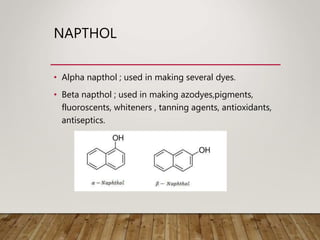
NAPTHOL
• Alpha napthol ; used in making several dyes.
• Beta napthol ; used in making azodyes,pigments,
fluoroscents, whiteners , tanning agents, antioxidants,
antiseptics.
THANK YOU

1288_phenols.ppt

  • 1.
    PHENOLS Phenols are compoundswith an –OH group attached to an aromatic carbon. Although they share the same functional group with alcohols, where the –OH group is attached to an aliphatic carbon, the chemistry of phenols is very different from that of alcohols.
  • 2.
    Nomenclature. Phenols are usuallynamed as substituted phenols. The methylphenols are given the special name, cresols. Some other phenols are named as hydroxy compounds. OH phenol OH Br m-bromophenol CH3 OH o-cresol OH COOH salicylic acid OH OH OH OH OH OH catechol resorcinol hydroquinone COOH OH p-hydroxybenzoic acid
  • 3.
    Physical properties 1. Phenolsare polar and can hydrogen bond 2. Phenols are water insoluble 3. Phenols are stronger acids than water and will dissolve in 5% NaOH 4. Phenols are weaker acids than carbonic acid and do not dissolve in 5% NaHCO3
  • 4.
    Intramolecular hydrogen bondingis possible in some ortho-substituted phenols. This intramolecular hydrogen bonding reduces water solubility and increases volatility. Thus, o-nitrophenol is steam distillable while the isomeric p-nitrophenol is not. N O H O O o-nitrophenol bp 100oC at 100 mm 0.2 g / 100 mL water volatile with steam OH NO2 p-nitrophenol bp decomposes 1.69 g / 100 mL water non-volatile with steam
  • 5.
    Phenols, synthesis: 1. Fromdiazonium salts 2. Alkali fusion of sulfonates N2 H2O,H+ OH SO3 Na NaOH,H2O 300o ONa H+ OH
  • 6.
    Phenols, reactions: 1. asacids 2. ester formation 3. ether formation 4. EAS a) nitration f) nitrosation b) sulfonation g) coupling with diaz. salts c) halogenation h) Kolbe d) Friedel-Crafts alkylation i) Reimer-Tiemann e) Friedel-Crafts acylation
  • 7.
    as acids: with activemetals: with bases: CH4 < NH3 < HCCH < ROH < H2O < phenols < H2CO3 < RCOOH < HF OH Na ONa sodium phenoxide + H2(g) OH + NaOH ONa + H2O SA SB WB WA
  • 8.
    CH4 < NH3< HCCH < ROH < H2O < phenols < H2CO3 < RCOOH < HF OH + NaOH ONa + H2O SA SB WB WA water insoluble water soluble OH + NaHCO3 NR phenol < H2CO3
  • 9.
    insoluble soluble insoluble insolublesoluble soluble water 5% NaOH 5% NaHCO3 phenols carboxylic acids CH4 < NH3 < HCCH < ROH < H2O < phenols < H2CO3 < RCOOH < HF
  • 10.
    We use theionization of acids in water to measure acid strength (Ka): HBase + H2O H3O+ + Base- Ka = [H3O+ ][ Base ] / [ HBase] ROH Ka ~ 10-16 - 10-18 ArOH Ka ~ 10-10 Why are phenols more acidic than alcohols?
  • 11.
    ROH + H2OH3O+ + RO- ArOH + H2O H3O+ + ArO- OH OH O O O O O Resonance stabilization of the phenoxide ion, lowers the PE of the products of the ionization, decreases the ΔH, shifts the equil farther to the right, makes phenol more acidic than an alcohol
  • 12.
    effect of substituentgroups on acid strength? OH G + H2O O G + H3O Electron withdrawing groups will decrease the negative charge in the phenoxide, lowering the PE, decreasing the ΔH, shifting the equil farther to the right, stronger acid. Electron donating groups will increase the negative charge in the phenoxide, increasing the PE, increasing the ΔH, shifting the equilibrium to the left, weaker acid.
  • 13.
    2. ester formation(similar to alcohols) OH CH3 + CH3CH2C O OH H+ CH3CH2C O O H3C + H2O OH COOH salicyclic acid + (CH3CO)2O O COOH C H3C O aspirin
  • 14.
    O COOH C H3C O aspirin analgesic anti-inflamatory antipyrretic anticoagulant Reye's syndrome not tobe used by children with high fevers! OH NH C H3C O acetaminophen aspirin substitute Tylenol Kidney damage!
  • 15.
    3. ether formation(Williamson Synthesis) Ar-O-Na+ + R-X  Ar-O-R + NaX note: R-X must be 1o or CH3 Because phenols are more acidic than water, it is possible to generate the phenoxide in situ using NaOH. OH CH3 + CH3CH2Br, NaOH OCH2CH3 CH3
  • 16.
    4. Electrophilic AromaticSubstitution The –OH group is a powerful activating group in EAS and an ortho/para director. a) nitration OH OH NO2 NO2 O2N polynitration! OH dilute HNO3 OH OH NO2 NO2 + HNO3
  • 17.
    OH Br2 (aq.) OH Br Br Br nocatalyst required use polar solvent polyhalogenation! OH Br2, CCl4 OH OH Br Br + non-polar solvent b) halogenation
  • 18.
    c) sulfonation OH H2SO4, 15-20oC OH SO3H H2SO4,100oC OH SO3H At low temperature the reaction is non-reversible and the lower Eact ortho- product is formed (rate control). At high temperature the reaction is reversible and the more stable para- product is formed (kinetic control).
  • 19.
    d) Friedel-Crafts alkylation. OH +H3C C CH3 CH3 Cl AlCl3 OH C CH3 CH3 H3C
  • 20.
    e) Friedel-Crafts acylation OH CH3CH2CH2C O Cl + AlCl3 OH O Donot confuse FC acylation with esterification: OH CH3CH2CH2C O Cl + O O
  • 21.
  • 22.
    f) nitrosation OH HONO OH NO EAS withvery weak electrophile NO+ OH CH3 NaNO2, HCl OH CH3 NO p-nitrosophenol
  • 23.
    g) coupling withdiazonium salts (EAS with the weak electrophile diazonium) OH CH3 + N2 Cl benzenediazonium chloride CH3 OH N N an azo dye
  • 24.
    h) Kolbe reaction(carbonation) ONa + CO2 125o C, 4-7 atm. OH COONa sodium salicylate H+ OH COOH salicylic acid EAS by the weakly electrophilic CO2 O C O 
  • 25.
    i) Reimer-Tiemann reaction OH CHCl3,aq. NaOH 70oC H+ OH CHO salicylaldehyde The salicylaldehyde can be easily oxidized to salicylic acid
  • 26.
  • 27.
    PHENOL 1. Used asa starting material to make plasrics, drugs such as aspirin. 2. Herbicides ,gasolines additives and wood preservatives.
  • 28.
    CRESOL Mixed cresols areused as disinfectants, preservatives and wood preservatives. a) O-cresol ; used as solvent, disinfectants and chemical intermediates. b) M-cresol ;used to produce certain herbicides to produce antioxidants, and to manufacture 2,4,6-nitrocresol (explosive) c) P-cresol; largely used in formulation of antioxidants and in fragrance and dye industries.
  • 29.
    RESOURCINOL 1. Used totreat acne, seborrheic dermatitis,eczema, psoriasis, and other skin disorders. 2. Antidandruff agent. 3. Antiseptic and disinfectant.
  • 30.
    NAPTHOL • Alpha napthol; used in making several dyes. • Beta napthol ; used in making azodyes,pigments, fluoroscents, whiteners , tanning agents, antioxidants, antiseptics.
  • 31.