LIQUID
 CRYSTAL
POLYMERS
LIQUID CRYSTAL POLYMER
• These polymers which have a       glass or melting transition
  tendency to allign their          point.
  chains parallel over a long
  distance , prior to the
  crystallization from their melt
  or solution.
• Occurrence: Liquid
  crystallinity in polymers may
  occur either by dissolving a
  polymer in a solvent or by
  heating a polymer above its
TYPES OF LCPs

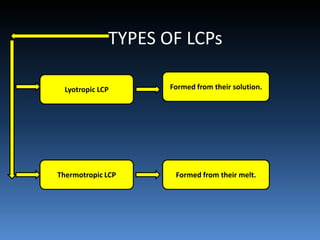
  Lyotropic LCP      Formed from their solution.


Thermotropic LCP      Formed from their melt.
CONDITIONS
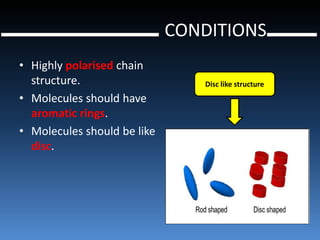
• Highly polarised chain
  structure.                    Disc like structure
• Molecules should have
  aromatic rings.
• Molecules should be like
  disc.
MISCELLAENOUS
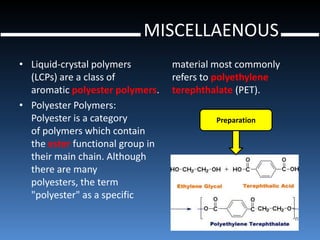
• Liquid-crystal polymers         material most commonly
  (LCPs) are a class of           refers to polyethylene
  aromatic polyester polymers.    terephthalate (PET).
• Polyester Polymers:
  Polyester is a category                  Preparation
  of polymers which contain
  the ester functional group in
  their main chain. Although
  there are many
  polyesters, the term
  "polyester" as a specific
PROPERTIES
• Higher crystallinity in   temperature.
  solid state.
• High tensile strength.
• Very tough.
• Higher Tm and Tg.
• Have property of
  multiple internal
  reflection.
• Used at higher working
APPLICATIONS
• For optical fibres.       • Used as fillers for
• Electrical and electronics composites.
  app.
• Transport,automotive,mil
  itary app.
• Aircraft and aerospace
  app.
• Chemical and consumer
  app.
KEVLAR
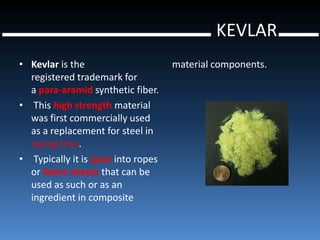
• Kevlar is the                     material components.
  registered trademark for
  a para-aramid synthetic fiber.
• This high strength material
  was first commercially used
  as a replacement for steel in
  racing tires.
• Typically it is spun into ropes
  or fabric sheets that can be
  used as such or as an
  ingredient in composite
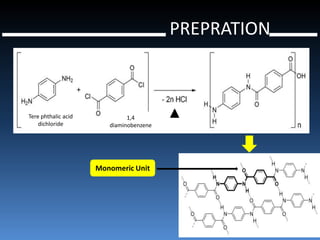
PREPRATION


Tere phthalic acid            1,4
    dichloride          diaminobenzene


                     Monomeric Unit
PROPERTIES
• Has a tensile strength of
  about 3,620 MPa.
• A relative density of 1.44.
• 5 times stronger than steel.
• Although it has high melting
  point, it can be easily
  moulded.
• It has high heat stability.
OTHER PROPERTIES
• It is slightly stronger at low temperatures.
• At higher temperatures the tensile strength is
  immediately reduced by about 10–20%.
• After some hours the strength progressively
  reduces further.
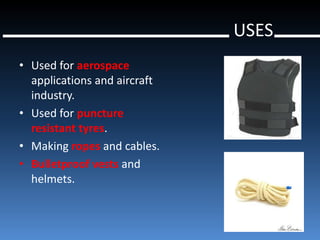
USES
• Used for aerospace
  applications and aircraft
  industry.
• Used for puncture
  resistant tyres.
• Making ropes and cables.
• Bulletproof vests and
  helmets.
OTHER USES
• Used in sports
  equipments.
• Particle physics.
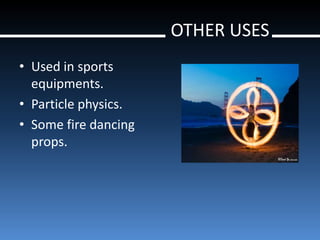
• Some fire dancing
  props.

KEVLAR POLYMER BY ROHAN

  • 1.
  • 2.
    LIQUID CRYSTAL POLYMER •These polymers which have a glass or melting transition tendency to allign their point. chains parallel over a long distance , prior to the crystallization from their melt or solution. • Occurrence: Liquid crystallinity in polymers may occur either by dissolving a polymer in a solvent or by heating a polymer above its
  • 3.
    TYPES OF LCPs Lyotropic LCP Formed from their solution. Thermotropic LCP Formed from their melt.
  • 4.
    CONDITIONS • Highly polarisedchain structure. Disc like structure • Molecules should have aromatic rings. • Molecules should be like disc.
  • 5.
    MISCELLAENOUS • Liquid-crystal polymers material most commonly (LCPs) are a class of refers to polyethylene aromatic polyester polymers. terephthalate (PET). • Polyester Polymers: Polyester is a category Preparation of polymers which contain the ester functional group in their main chain. Although there are many polyesters, the term "polyester" as a specific
  • 6.
    PROPERTIES • Higher crystallinityin temperature. solid state. • High tensile strength. • Very tough. • Higher Tm and Tg. • Have property of multiple internal reflection. • Used at higher working
  • 7.
    APPLICATIONS • For opticalfibres. • Used as fillers for • Electrical and electronics composites. app. • Transport,automotive,mil itary app. • Aircraft and aerospace app. • Chemical and consumer app.
  • 8.
    KEVLAR • Kevlar isthe material components. registered trademark for a para-aramid synthetic fiber. • This high strength material was first commercially used as a replacement for steel in racing tires. • Typically it is spun into ropes or fabric sheets that can be used as such or as an ingredient in composite
  • 9.
    PREPRATION Tere phthalic acid 1,4 dichloride diaminobenzene Monomeric Unit
  • 10.
    PROPERTIES • Has atensile strength of about 3,620 MPa. • A relative density of 1.44. • 5 times stronger than steel. • Although it has high melting point, it can be easily moulded. • It has high heat stability.
  • 11.
    OTHER PROPERTIES • Itis slightly stronger at low temperatures. • At higher temperatures the tensile strength is immediately reduced by about 10–20%. • After some hours the strength progressively reduces further.
  • 12.
    USES • Used foraerospace applications and aircraft industry. • Used for puncture resistant tyres. • Making ropes and cables. • Bulletproof vests and helmets.
  • 13.
    OTHER USES • Usedin sports equipments. • Particle physics. • Some fire dancing props.