PLASTICIZER


          By
1
      Amar Arakh
PLASTICIZER
 Chemicals that are added to other polymeric
  substances, to improve the flexibility of the
  polymer or to aid in processing the polymer.
 Additive designed to space out the polymer
  molecules, facilitating their movements and
  leading to enhanced flexibility (lower modulus)and
  ductility. Widely used to convert PVC from the rigid
  to the flexible variety. Can sometimes be
  polymeric.
 The main role of the plasticizer is to improve
  mechanical properties of the polymers by
  increasing flexibility, decreasing tensile strength
  and lowering the second order transition               2
  temperature
CONT...
 Mostly used in PVC (second largest material selling in
  Western Europe).
 80-90% plasticizers are used in PVC.

 The Successful addition of a plasticizer will result in
  the formation of a product with a degree of
  flexibility, such as a cable insulation or sheathing, a
  floor covering or flexible profile.
 Plasticizers acts to reduce the Tg of PVC .


                                                            3
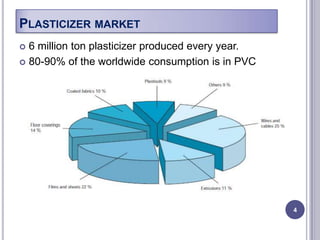
PLASTICIZER MARKET
 6 million ton plasticizer produced every year.
 80-90% of the worldwide consumption is in PVC


                                                   4
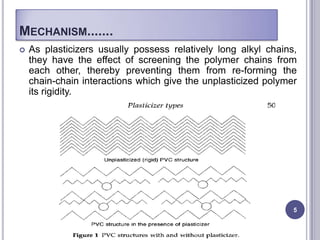
MECHANISM.......
   As plasticizers usually possess relatively long alkyl chains,
    they have the effect of screening the polymer chains from
    each other, thereby preventing them from re-forming the
    chain-chain interactions which give the unplasticized polymer
    its rigidity.


                                                                5
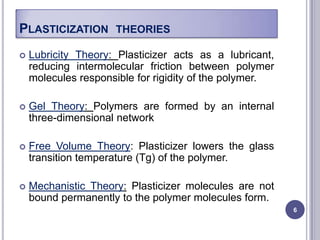
PLASTICIZATION       THEORIES

   Lubricity Theory: Plasticizer acts as a lubricant,
    reducing intermolecular friction between polymer
    molecules responsible for rigidity of the polymer.

   Gel Theory: Polymers are formed by an internal
    three-dimensional network

   Free Volume Theory: Plasticizer lowers the glass
    transition temperature (Tg) of the polymer.

   Mechanistic Theory: Plasticizer molecules are not
    bound permanently to the polymer molecules form.
                                                         6
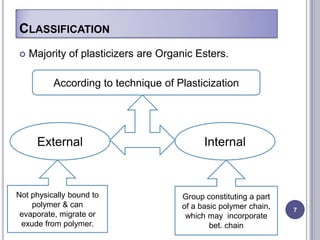
CLASSIFICATION
   Majority of plasticizers are Organic Esters.

          According to technique of Plasticization


     External                              Internal


Not physically bound to              Group constituting a part
    polymer & can                    of a basic polymer chain,   7
 evaporate, migrate or                which may incorporate
 exude from polymer.                         bet. chain
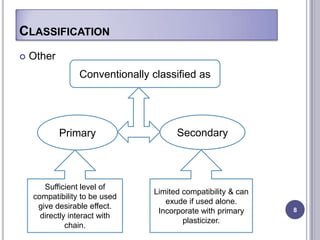
CLASSIFICATION
   Other
                 Conventionally classified as


            Primary                   Secondary


       Sufficient level of
                                Limited compatibility & can
    compatibility to be used
                                   exude if used alone.
     give desirable effect.                                   8
                                 Incorporate with primary
      directly interact with
                                        plasticizer.
              chain.
9
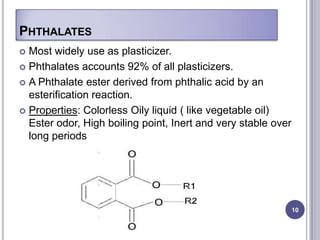
PHTHALATES
 Most widely use as plasticizer.
 Phthalates accounts 92% of all plasticizers.

 A Phthalate ester derived from phthalic acid by an
  esterification reaction.
 Properties: Colorless Oily liquid ( like vegetable oil)
  Ester odor, High boiling point, Inert and very stable over
  long periods


                                                               10
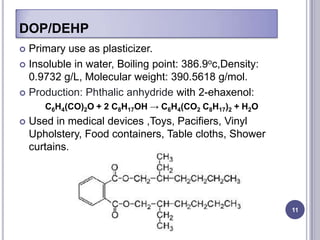
DOP/DEHP
 Primary use as plasticizer.
 Insoluble in water, Boiling point: 386.9oc,Density:
  0.9732 g/L, Molecular weight: 390.5618 g/mol.
 Production: Phthalic anhydride with 2-ehaxenol:
       C6H4(CO)2O + 2 C8H17OH → C6H4(CO2 C8H17)2 + H2O
   Used in medical devices ,Toys, Pacifiers, Vinyl
    Upholstery, Food containers, Table cloths, Shower
    curtains.


                                                         11
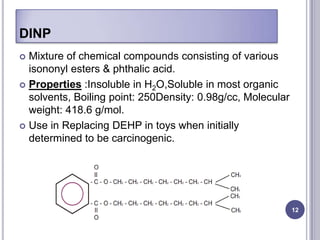
DINP
 Mixture of chemical compounds consisting of various
  isononyl esters & phthalic acid.
 Properties :Insoluble in H2O,Soluble in most organic
  solvents, Boiling point: 250Density: 0.98g/cc, Molecular
  weight: 418.6 g/mol.
 Use in Replacing DEHP in toys when initially
  determined to be carcinogenic.


                                                             12
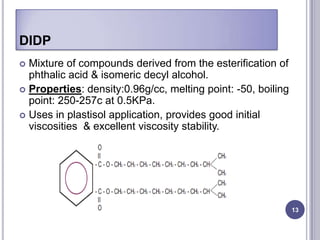
DIDP
 Mixture of compounds derived from the esterification of
  phthalic acid & isomeric decyl alcohol.
 Properties: density:0.96g/cc, melting point: -50, boiling
  point: 250-257c at 0.5KPa.
 Uses in plastisol application, provides good initial
  viscosities & excellent viscosity stability.


                                                              13
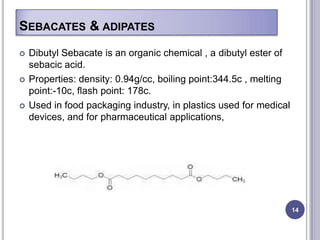
SEBACATES & ADIPATES
   Dibutyl Sebacate is an organic chemical , a dibutyl ester of
    sebacic acid.
   Properties: density: 0.94g/cc, boiling point:344.5c , melting
    point:-10c, flash point: 178c.
   Used in food packaging industry, in plastics used for medical
    devices, and for pharmaceutical applications,


                                                                    14
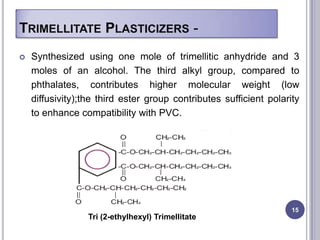
TRIMELLITATE PLASTICIZERS -
   Synthesized using one mole of trimellitic anhydride and 3
    moles of an alcohol. The third alkyl group, compared to
    phthalates, contributes higher molecular weight (low
    diffusivity);the third ester group contributes sufficient polarity
    to enhance compatibility with PVC.


                                                                    15
                  Tri (2-ethylhexyl) Trimellitate
FATTY ACID ESTERS
 Esters of fatty acids & monocarboxylic acids can be
  used as viscosities depressant for PVC pastes &
  also as secondary plasticizers for plasticized PVC.
 Present in liquid form.

 Stearic acid esters are used as plasticizers &
  processing agent for various plastics & also as
  lubricants for PS.


                                                        16
OLIGOMERIC/POLYMERIC PLASTICIZER
 These extend the life of PVC products considerably
 They reduce migration, extraction & volatility.

 In these adipates are generally used in mixture with
  other plasticizer to increase plasticization & improve
  low temp. Properties.
 Epoxied plasticizer (soybean oil & linseed oil) are
  used as stabilizing plasticizer offering properties of
  migration resistance in PVC compounds.


                                                           17
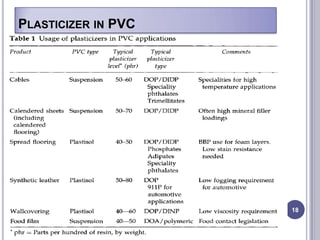
PLASTICIZER IN PVC


                     18
SELECTION CRITERIA
   Choice of plasticizer depends upon the properties
    required in final product, the application technology
    used to make it !!

   Prize boundaries present for product process.

   Stability in processing & service condition.

   Compatibility & ease of mixing.

   Toxicity.                                               19
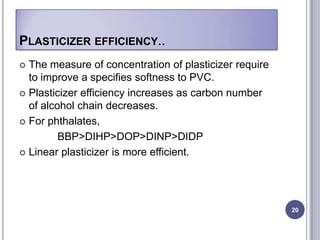
PLASTICIZER EFFICIENCY..
 The measure of concentration of plasticizer require
  to improve a specifies softness to PVC.
 Plasticizer efficiency increases as carbon number
  of alcohol chain decreases.
 For phthalates,

         BBP>DIHP>DOP>DINP>DIDP
 Linear plasticizer is more efficient.


                                                        20
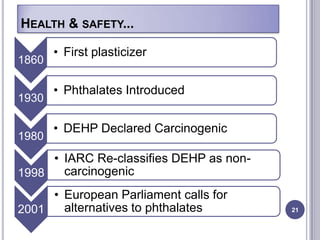
HEALTH & SAFETY...

       • First plasticizer
1860

       • Phthalates Introduced
1930

       • DEHP Declared Carcinogenic
1980
     • IARC Re-classifies DEHP as non-
1998   carcinogenic
     • European Parliament calls for
2001   alternatives to phthalates        21
22

Plasticizer

  • 1.
    PLASTICIZER By 1 Amar Arakh
  • 2.
    PLASTICIZER  Chemicals thatare added to other polymeric substances, to improve the flexibility of the polymer or to aid in processing the polymer.  Additive designed to space out the polymer molecules, facilitating their movements and leading to enhanced flexibility (lower modulus)and ductility. Widely used to convert PVC from the rigid to the flexible variety. Can sometimes be polymeric.  The main role of the plasticizer is to improve mechanical properties of the polymers by increasing flexibility, decreasing tensile strength and lowering the second order transition 2 temperature
  • 3.
    CONT...  Mostly usedin PVC (second largest material selling in Western Europe).  80-90% plasticizers are used in PVC.  The Successful addition of a plasticizer will result in the formation of a product with a degree of flexibility, such as a cable insulation or sheathing, a floor covering or flexible profile.  Plasticizers acts to reduce the Tg of PVC . 3
  • 4.
    PLASTICIZER MARKET  6million ton plasticizer produced every year.  80-90% of the worldwide consumption is in PVC 4
  • 5.
    MECHANISM.......  As plasticizers usually possess relatively long alkyl chains, they have the effect of screening the polymer chains from each other, thereby preventing them from re-forming the chain-chain interactions which give the unplasticized polymer its rigidity. 5
  • 6.
    PLASTICIZATION THEORIES  Lubricity Theory: Plasticizer acts as a lubricant, reducing intermolecular friction between polymer molecules responsible for rigidity of the polymer.  Gel Theory: Polymers are formed by an internal three-dimensional network  Free Volume Theory: Plasticizer lowers the glass transition temperature (Tg) of the polymer.  Mechanistic Theory: Plasticizer molecules are not bound permanently to the polymer molecules form. 6
  • 7.
    CLASSIFICATION  Majority of plasticizers are Organic Esters. According to technique of Plasticization External Internal Not physically bound to Group constituting a part polymer & can of a basic polymer chain, 7 evaporate, migrate or which may incorporate exude from polymer. bet. chain
  • 8.
    CLASSIFICATION  Other Conventionally classified as Primary Secondary Sufficient level of Limited compatibility & can compatibility to be used exude if used alone. give desirable effect. 8 Incorporate with primary directly interact with plasticizer. chain.
  • 9.
  • 10.
    PHTHALATES  Most widelyuse as plasticizer.  Phthalates accounts 92% of all plasticizers.  A Phthalate ester derived from phthalic acid by an esterification reaction.  Properties: Colorless Oily liquid ( like vegetable oil) Ester odor, High boiling point, Inert and very stable over long periods 10
  • 11.
    DOP/DEHP  Primary useas plasticizer.  Insoluble in water, Boiling point: 386.9oc,Density: 0.9732 g/L, Molecular weight: 390.5618 g/mol.  Production: Phthalic anhydride with 2-ehaxenol: C6H4(CO)2O + 2 C8H17OH → C6H4(CO2 C8H17)2 + H2O  Used in medical devices ,Toys, Pacifiers, Vinyl Upholstery, Food containers, Table cloths, Shower curtains. 11
  • 12.
    DINP  Mixture ofchemical compounds consisting of various isononyl esters & phthalic acid.  Properties :Insoluble in H2O,Soluble in most organic solvents, Boiling point: 250Density: 0.98g/cc, Molecular weight: 418.6 g/mol.  Use in Replacing DEHP in toys when initially determined to be carcinogenic. 12
  • 13.
    DIDP  Mixture ofcompounds derived from the esterification of phthalic acid & isomeric decyl alcohol.  Properties: density:0.96g/cc, melting point: -50, boiling point: 250-257c at 0.5KPa.  Uses in plastisol application, provides good initial viscosities & excellent viscosity stability. 13
  • 14.
    SEBACATES & ADIPATES  Dibutyl Sebacate is an organic chemical , a dibutyl ester of sebacic acid.  Properties: density: 0.94g/cc, boiling point:344.5c , melting point:-10c, flash point: 178c.  Used in food packaging industry, in plastics used for medical devices, and for pharmaceutical applications, 14
  • 15.
    TRIMELLITATE PLASTICIZERS -  Synthesized using one mole of trimellitic anhydride and 3 moles of an alcohol. The third alkyl group, compared to phthalates, contributes higher molecular weight (low diffusivity);the third ester group contributes sufficient polarity to enhance compatibility with PVC. 15 Tri (2-ethylhexyl) Trimellitate
  • 16.
    FATTY ACID ESTERS Esters of fatty acids & monocarboxylic acids can be used as viscosities depressant for PVC pastes & also as secondary plasticizers for plasticized PVC.  Present in liquid form.  Stearic acid esters are used as plasticizers & processing agent for various plastics & also as lubricants for PS. 16
  • 17.
    OLIGOMERIC/POLYMERIC PLASTICIZER  Theseextend the life of PVC products considerably  They reduce migration, extraction & volatility.  In these adipates are generally used in mixture with other plasticizer to increase plasticization & improve low temp. Properties.  Epoxied plasticizer (soybean oil & linseed oil) are used as stabilizing plasticizer offering properties of migration resistance in PVC compounds. 17
  • 18.
  • 19.
    SELECTION CRITERIA  Choice of plasticizer depends upon the properties required in final product, the application technology used to make it !!  Prize boundaries present for product process.  Stability in processing & service condition.  Compatibility & ease of mixing.  Toxicity. 19
  • 20.
    PLASTICIZER EFFICIENCY..  Themeasure of concentration of plasticizer require to improve a specifies softness to PVC.  Plasticizer efficiency increases as carbon number of alcohol chain decreases.  For phthalates, BBP>DIHP>DOP>DINP>DIDP  Linear plasticizer is more efficient. 20
  • 21.
    HEALTH & SAFETY... • First plasticizer 1860 • Phthalates Introduced 1930 • DEHP Declared Carcinogenic 1980 • IARC Re-classifies DEHP as non- 1998 carcinogenic • European Parliament calls for 2001 alternatives to phthalates 21
  • 22.