UNIT III NON-METALLIC MATERIALS
Polymers – types of polymer, commodity and
engineering polymers – thermosetting and thermo plastic
polymers – properties , structures and applications of:
Polyethylene (PE), Polypropylene (PP), Polystyrene (PS),
Polyvinylchloride (PVC), Poly methyl metha acrylate
(PMMA), Polyethylene terephthalate (PET), Polycarbonate
(PC), Polyamide (PA), Polyimide (PI), Polyamide-imide
(PAI), Polyphenylene oxide (PPO), Polyphenylenesulfide
(PPS), Polyether ether ketone (PEEK), Poly tetra fluro
ethylene (PTFE) – Engineering Ceramics – Properties and
applications of: Alumina (Al2O3), Silicon carbide (SiC),
Silicon nitride (Si3N4), Partially stabilized zirconia (PSZ) and
SIALON – Fibre and particulate reinforced composites.
NON METALLIC
MATERIALS -
POLYMERS (Plastics, Rubbers and Adhesives)
CERAMICS AND COMPOSITES
UNIT-3
INTRODUCTION - polymers
• Polymers are used in number of applications ----
• toys,
• home appliances,
• structural and decorative items,
• coatings, paints, adhesives,
• automobile tyres
• Foams and packing
.
POLYMERISATION
• Its reaction of joining of small molecules to form
molecule having higher weight called polymer.
Types of Polymers:
• There are many types of polymers including
synthetic and natural polymers.
• Natural polymers
Proteins - silk, collagen, keratin.
Carbohydrates - cellulose, starch, glycogen
DNA – RNA
• Other Natural polymers: Rubber (hydrocarbon base) and
silicones (alternating silicon and oxygen).
Classification of Polymers:
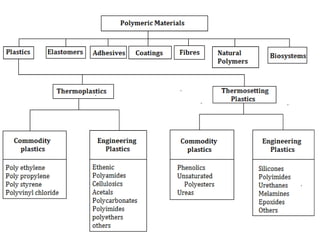
• Homopolymers -
• Copolymers -
Polymers are further classified by the reaction
mode of polymerization, these include:
• Addition Polymers -
• Condensation Polymers
Classification based upon the physical property
related to heating:
• Thermoplastics -
• Thermosets -
Terminology used in polymers
1.Monomer
2. Polymer
3. Polymerization
Types of homo polymers
• Linear polymer
Here the mer units are joined to end to end in
single chain.
• Branched polymer
Here the side branch chains are connected to the
main chain
• Cross linked polymer
Here the adjacent linear chains are joined one to
another at various positions by covalant bond
• Network polymers
It has three active covalent bonds (trifunctional
mer units) which form these dimensional
networks instead of the linear chain frame work
Types of homo polymers
Types of copolymers
1. Random copolymers
Here 2 different units are randomly dispersed along
a chain
2. Alternating copolymer
The 2 mer units placed alternatively
Types of copolymers
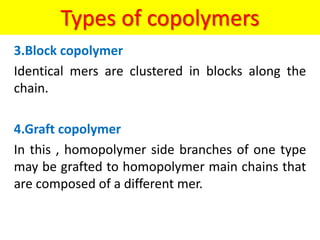
3.Block copolymer
Identical mers are clustered in blocks along the
chain.
4.Graft copolymer
In this , homopolymer side branches of one type
may be grafted to homopolymer main chains that
are composed of a different mer.
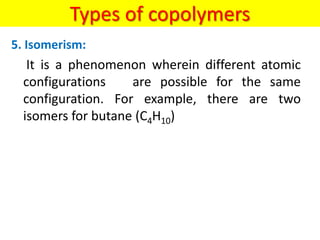
5. Isomerism:
It is a phenomenon wherein different atomic
configurations are possible for the same
configuration. For example, there are two
isomers for butane (C4H10)
Types of copolymers
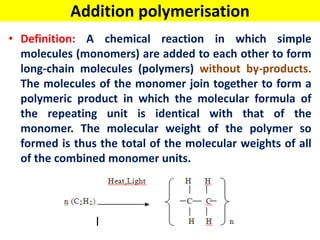
Addition polymerisation
• Definition: A chemical reaction in which simple
molecules (monomers) are added to each other to form
long-chain molecules (polymers) without by-products.
The molecules of the monomer join together to form a
polymeric product in which the molecular formula of
the repeating unit is identical with that of the
monomer. The molecular weight of the polymer so
formed is thus the total of the molecular weights of all
of the combined monomer units.
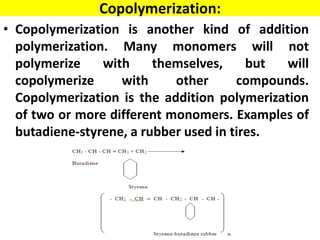
Copolymerization:
• Copolymerization is another kind of addition
polymerization. Many monomers will not
polymerize with themselves, but will
copolymerize with other compounds.
Copolymerization is the addition polymerization
of two or more different monomers. Examples of
butadiene-styrene, a rubber used in tires.
Properties and applications
of thermoplastics
PLASTICS
Polyethylene (PE)
• Polyethylene is made from petroleum or natural gas Raw products.
• The early processes for production involved extremely high pressure
and temperature as high as 400 low density Polyethylene.
• It’s produced two process. High density and low density
Polyethylene.
• High density Polyethylene is made by low pressure and low
temperature. The current trend is to use these latter processes
because of their lower energy requirements.
• The most recent processes produces’ Polyethylene grade called
linear low-density Polyethylene (LLDPE).
Properties of PE
• They have excellent resistance to most solvent
and chemicals.
• It has a good flexibility property.
• They are non-toxic.
• They possess good electrical insulation
properties.
Polypropylene (PP)
• Polypropylene is formed the manomer propane
• i.e., Propylene.
• Polypropylene has becomes a major plastics, especially for
injection molding.
• It is similar to high density polyethylene (HDPE). It is
lightest of the plastics and strength to weight ratio is high.
Properties of PP
• They are high melting point.
• They are lighter weight.
• It has excellent fatigue resistance.
• They are stiffer, hardener and stronger.
• It has good chemical and thermal resistance.
• Low density.
• Good surface hardness and good dimensional
stability.
• Good resistance against moisture and chemicals.
Polystyrene (PS)
• This plastics account for about 20% of all the
thermoplastics in commercials use.
• Polystyrene is made from ethyl benzene.
• A large benzene ring replaces a hydrogen atom
on an ethylene molecule.
• Polystyrenes are predominantly amorphous and a
tactic.
Polyvinyl Chloride (PVC)
• The widely used acronym for polyvinyl chloride is PVC.
• It is one of the most widely used plastics in terms of
volume produced.
• PVC is made by reacting acetylene gas ( C2H2 ) with
hydrochloride acid in the presence of a suitable catalyst.
• The manomer has one chlorine atom substituted for a
hydrogen atom.
Polymethyl methacrylate (PMMA)
• This complicated name applies to a polymer
that everyone is familiar with. Polymethyl
methacrylate is the polymer used to make the
clear, sheet material in unbreakable windows.
• It may be more readily recognized by the trade
name Plexiglas.
• Another name commonly used for polymers
based on polymethyl methacrylate is acrylics.
Polypthylene Terephthalate (PET)
• Thermoplastics polyesters have been used for
about 35 years, predominantly in films for
packaging and in fibers.
• Everyone is familiar with polyester clothing and
polyester auto tire reinforcement.
• These are thermoplastics polyester, usually
polyethylene terephthalate.
Polycarbonates ( PC )
• Polycarbonates are really polyester, since
both are ester of carbonic acid and an
aromatic biphenol.
• The polycarbonate is amorphous linear
polyesters with excellent mold ability and
impact strength.
• Which is made from the condensation of
biphenol A and carbonic acid.
Engineering
CERAMICS
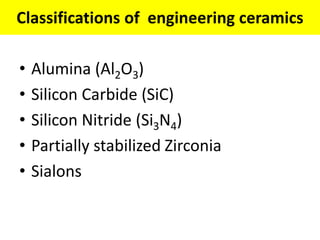
Classifications of engineering ceramics
• Alumina (Al2O3)
• Silicon Carbide (SiC)
• Silicon Nitride (Si3N4)
• Partially stabilized Zirconia
• Sialons
composites
To get a require properties in metals
.
,
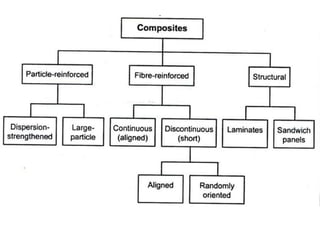
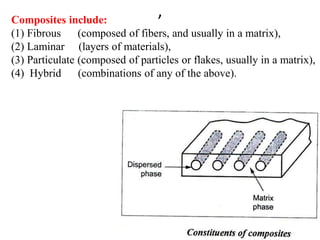
Composites include:
(1) Fibrous (composed of fibers, and usually in a matrix),
(2) Laminar (layers of materials),
(3) Particulate (composed of particles or flakes, usually in a matrix),
(4) Hybrid (combinations of any of the above).
Particle re-inforced composites
• Its consist of particles of one material dispersed in
a matrix of a second material
• The fine dispersion particle posses
good strength in composites.
• The size, distribution and orientation of particles
defines the strength of the composite.
• Types
1. dispersion strengthened composites
2. Large particle composites
.

UNIT- III ---NON-METALLIC MATERIALS.pptx

  • 1.
    UNIT III NON-METALLICMATERIALS Polymers – types of polymer, commodity and engineering polymers – thermosetting and thermo plastic polymers – properties , structures and applications of: Polyethylene (PE), Polypropylene (PP), Polystyrene (PS), Polyvinylchloride (PVC), Poly methyl metha acrylate (PMMA), Polyethylene terephthalate (PET), Polycarbonate (PC), Polyamide (PA), Polyimide (PI), Polyamide-imide (PAI), Polyphenylene oxide (PPO), Polyphenylenesulfide (PPS), Polyether ether ketone (PEEK), Poly tetra fluro ethylene (PTFE) – Engineering Ceramics – Properties and applications of: Alumina (Al2O3), Silicon carbide (SiC), Silicon nitride (Si3N4), Partially stabilized zirconia (PSZ) and SIALON – Fibre and particulate reinforced composites.
  • 2.
    NON METALLIC MATERIALS - POLYMERS(Plastics, Rubbers and Adhesives) CERAMICS AND COMPOSITES UNIT-3
  • 3.
    INTRODUCTION - polymers •Polymers are used in number of applications ---- • toys, • home appliances, • structural and decorative items, • coatings, paints, adhesives, • automobile tyres • Foams and packing
  • 4.
  • 5.
    POLYMERISATION • Its reactionof joining of small molecules to form molecule having higher weight called polymer.
  • 6.
    Types of Polymers: •There are many types of polymers including synthetic and natural polymers. • Natural polymers Proteins - silk, collagen, keratin. Carbohydrates - cellulose, starch, glycogen DNA – RNA • Other Natural polymers: Rubber (hydrocarbon base) and silicones (alternating silicon and oxygen).
  • 7.
    Classification of Polymers: •Homopolymers - • Copolymers -
  • 8.
    Polymers are furtherclassified by the reaction mode of polymerization, these include: • Addition Polymers - • Condensation Polymers
  • 9.
    Classification based uponthe physical property related to heating: • Thermoplastics - • Thermosets -
  • 10.
    Terminology used inpolymers 1.Monomer 2. Polymer 3. Polymerization
  • 11.
    Types of homopolymers • Linear polymer Here the mer units are joined to end to end in single chain. • Branched polymer Here the side branch chains are connected to the main chain
  • 12.
    • Cross linkedpolymer Here the adjacent linear chains are joined one to another at various positions by covalant bond • Network polymers It has three active covalent bonds (trifunctional mer units) which form these dimensional networks instead of the linear chain frame work Types of homo polymers
  • 13.
    Types of copolymers 1.Random copolymers Here 2 different units are randomly dispersed along a chain 2. Alternating copolymer The 2 mer units placed alternatively
  • 14.
    Types of copolymers 3.Blockcopolymer Identical mers are clustered in blocks along the chain. 4.Graft copolymer In this , homopolymer side branches of one type may be grafted to homopolymer main chains that are composed of a different mer.
  • 15.
    5. Isomerism: It isa phenomenon wherein different atomic configurations are possible for the same configuration. For example, there are two isomers for butane (C4H10) Types of copolymers
  • 16.
    Addition polymerisation • Definition:A chemical reaction in which simple molecules (monomers) are added to each other to form long-chain molecules (polymers) without by-products. The molecules of the monomer join together to form a polymeric product in which the molecular formula of the repeating unit is identical with that of the monomer. The molecular weight of the polymer so formed is thus the total of the molecular weights of all of the combined monomer units.
  • 17.
    Copolymerization: • Copolymerization isanother kind of addition polymerization. Many monomers will not polymerize with themselves, but will copolymerize with other compounds. Copolymerization is the addition polymerization of two or more different monomers. Examples of butadiene-styrene, a rubber used in tires.
  • 18.
    Properties and applications ofthermoplastics PLASTICS
  • 19.
    Polyethylene (PE) • Polyethyleneis made from petroleum or natural gas Raw products. • The early processes for production involved extremely high pressure and temperature as high as 400 low density Polyethylene. • It’s produced two process. High density and low density Polyethylene. • High density Polyethylene is made by low pressure and low temperature. The current trend is to use these latter processes because of their lower energy requirements. • The most recent processes produces’ Polyethylene grade called linear low-density Polyethylene (LLDPE).
  • 20.
    Properties of PE •They have excellent resistance to most solvent and chemicals. • It has a good flexibility property. • They are non-toxic. • They possess good electrical insulation properties.
  • 21.
    Polypropylene (PP) • Polypropyleneis formed the manomer propane • i.e., Propylene. • Polypropylene has becomes a major plastics, especially for injection molding. • It is similar to high density polyethylene (HDPE). It is lightest of the plastics and strength to weight ratio is high.
  • 22.
    Properties of PP •They are high melting point. • They are lighter weight. • It has excellent fatigue resistance. • They are stiffer, hardener and stronger. • It has good chemical and thermal resistance. • Low density. • Good surface hardness and good dimensional stability. • Good resistance against moisture and chemicals.
  • 23.
    Polystyrene (PS) • Thisplastics account for about 20% of all the thermoplastics in commercials use. • Polystyrene is made from ethyl benzene. • A large benzene ring replaces a hydrogen atom on an ethylene molecule. • Polystyrenes are predominantly amorphous and a tactic.
  • 24.
    Polyvinyl Chloride (PVC) •The widely used acronym for polyvinyl chloride is PVC. • It is one of the most widely used plastics in terms of volume produced. • PVC is made by reacting acetylene gas ( C2H2 ) with hydrochloride acid in the presence of a suitable catalyst. • The manomer has one chlorine atom substituted for a hydrogen atom.
  • 25.
    Polymethyl methacrylate (PMMA) •This complicated name applies to a polymer that everyone is familiar with. Polymethyl methacrylate is the polymer used to make the clear, sheet material in unbreakable windows. • It may be more readily recognized by the trade name Plexiglas. • Another name commonly used for polymers based on polymethyl methacrylate is acrylics.
  • 26.
    Polypthylene Terephthalate (PET) •Thermoplastics polyesters have been used for about 35 years, predominantly in films for packaging and in fibers. • Everyone is familiar with polyester clothing and polyester auto tire reinforcement. • These are thermoplastics polyester, usually polyethylene terephthalate.
  • 27.
    Polycarbonates ( PC) • Polycarbonates are really polyester, since both are ester of carbonic acid and an aromatic biphenol. • The polycarbonate is amorphous linear polyesters with excellent mold ability and impact strength. • Which is made from the condensation of biphenol A and carbonic acid.
  • 28.
  • 29.
    Classifications of engineeringceramics • Alumina (Al2O3) • Silicon Carbide (SiC) • Silicon Nitride (Si3N4) • Partially stabilized Zirconia • Sialons
  • 30.
    composites To get arequire properties in metals
  • 31.
  • 32.
    , Composites include: (1) Fibrous(composed of fibers, and usually in a matrix), (2) Laminar (layers of materials), (3) Particulate (composed of particles or flakes, usually in a matrix), (4) Hybrid (combinations of any of the above).
  • 33.
    Particle re-inforced composites •Its consist of particles of one material dispersed in a matrix of a second material • The fine dispersion particle posses good strength in composites. • The size, distribution and orientation of particles defines the strength of the composite. • Types 1. dispersion strengthened composites 2. Large particle composites
  • 34.