Physical Properties of Polymers Muhammad Zafar Iqbal Date: 22-05-2008
Sequence Glassy State and Glass Transition Temperature Introduction States of aggregates States of phases Transitions and physical Properties Factors affecting  Tg Measurement techniques for Tg from different instruments (General Introduction) Detailed study of Differential Scanning Calorimeter
Structure- Property Relationships Two distinct models have been proposed for interpreting the influence of different features on Tg in Amorphous Polymers 1- Molecular Flexibility Model 2- Free Volume Model Factors affecting the Tg include: 1- Chemical Structure 2- Molecular Weight 3- Plasticizers 4- Co-Polymers 5- Tg - Melting Point
Effect  of Chemical Structure Following facts are included in effect of chemistry on Tg: 1- Main Chain Structure 2- Side groups 3- Main- Chain Polarity Main Chain Structure If the molecular geometry permits the formation of a definite molecular orientation, leading to LRO, the polymer has high crystallizablity.  Polymers with stereo-regular structure are crystalline Polymers with irregular chain backbone or randomly placed side groups are amorphous.
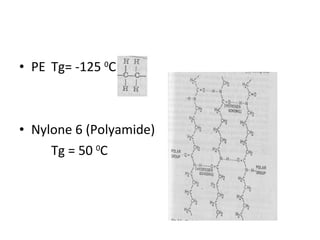
The flexibility of the chain segments is determined by the degree of freedom with which the segments rotate along the chain backbone. Linear polymers with single bonds have high degree of rotation. The presence of aromatics, cyclic structures in backbone  hinder this rotation.. Higher the freedom to rotate, the more flexible are the chains, and more is their segmental mobility, lower is its Tg. Due to bulky groups in backbone, intermolecular cohesive forces are increased. Therefore highly crystalline polymers have high Tg See the examples:
PE Tg= -125  0 C Nylone 6 (Polyamide) Tg = 50  0 C
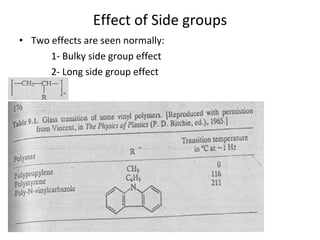
Effect of Side groups Two effects are seen normally: 1- Bulky side group effect 2- Long side group effect
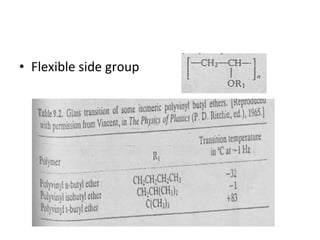
Flexible side group
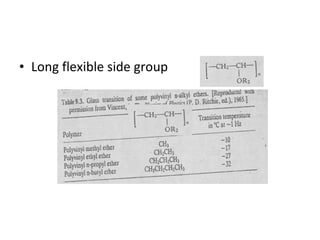
Long flexible side group
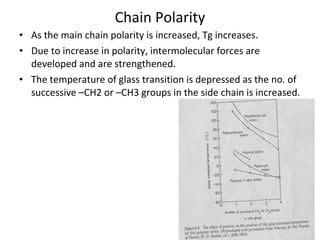
Chain Polarity As the main chain polarity is increased, Tg increases. Due to increase in polarity, intermolecular forces are developed and are strengthened. The temperature of glass transition is depressed as the no. of successive –CH2 or –CH3 groups in the side chain is increased.
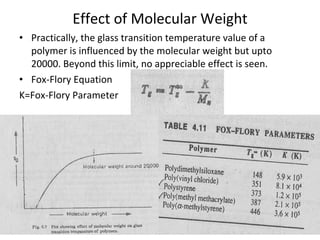
Effect of Molecular Weight Practically, the glass transition temperature value of a polymer is influenced by the molecular weight but upto 20000. Beyond this limit, no appreciable effect is seen. Fox-Flory Equation K=Fox-Flory Parameter
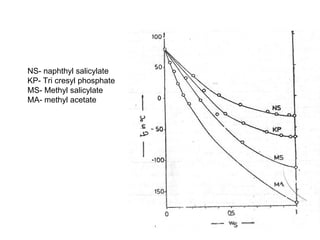
Effect of Plasticizers (Diluents) Plasticizers are low mol.wt., non-volatile substances (mostly liquids), which are added into the polymers to improve its flexibility, processability, and utility. Plasticizers reduce Tg This is due to the reduction in cohesive forces between the polymer chains.  Plasticizer molecules penetrate into the polymer matrix and establish polar attractive between it and polymer chains. These attractive forces reduce the cohesive forces between the polar chains and increase the segmental motion, thus reduce Tg. The plasticizer’s efficiency depends upon solubility parameter, polarity, density and wt.fraction. Commercial selection of plasticizer is based on compatibility, effecciency, migration effect and the cost.
NS- naphthyl salicylate KP- Tri cresyl phosphate MS- Methyl salicylate MA- methyl acetate
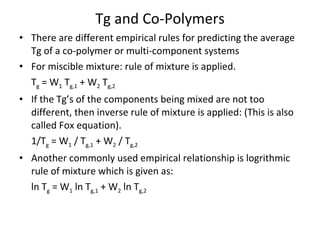
Tg and Co-Polymers There are different empirical rules for predicting the average Tg of a co-polymer or multi-component systems For miscible mixture: rule of mixture is applied. T g  = W 1  T g,1  + W 2  T g,2 If the Tg’s of the components being mixed are not too different, then inverse rule of mixture is applied: (This is also called Fox equation). 1/T g  = W 1  / T g,1  + W 2  / T g,2 Another commonly used empirical relationship is logrithmic rule of mixture which is given as: ln T g  = W 1  ln T g,1  + W 2  ln T g,2
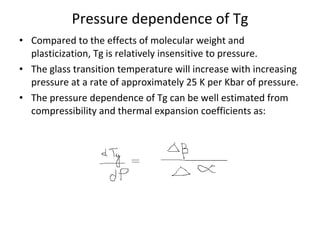
Pressure dependence of Tg Compared to the effects of molecular weight and plasticization, Tg is relatively insensitive to pressure. The glass transition temperature will increase with increasing pressure at a rate of approximately 25 K per Kbar of pressure. The pressure dependence of Tg can be well estimated from compressibility and thermal expansion coefficients as:
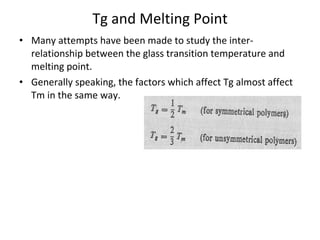
Tg and Melting Point Many attempts have been made to study the inter-relationship between the glass transition temperature and melting point. Generally speaking, the factors which affect Tg almost affect Tm in the same way.

Ppp8 2 Factors Affecting Tg

  • 1.
    Physical Properties ofPolymers Muhammad Zafar Iqbal Date: 22-05-2008
  • 2.
    Sequence Glassy Stateand Glass Transition Temperature Introduction States of aggregates States of phases Transitions and physical Properties Factors affecting Tg Measurement techniques for Tg from different instruments (General Introduction) Detailed study of Differential Scanning Calorimeter
  • 3.
    Structure- Property RelationshipsTwo distinct models have been proposed for interpreting the influence of different features on Tg in Amorphous Polymers 1- Molecular Flexibility Model 2- Free Volume Model Factors affecting the Tg include: 1- Chemical Structure 2- Molecular Weight 3- Plasticizers 4- Co-Polymers 5- Tg - Melting Point
  • 4.
    Effect ofChemical Structure Following facts are included in effect of chemistry on Tg: 1- Main Chain Structure 2- Side groups 3- Main- Chain Polarity Main Chain Structure If the molecular geometry permits the formation of a definite molecular orientation, leading to LRO, the polymer has high crystallizablity. Polymers with stereo-regular structure are crystalline Polymers with irregular chain backbone or randomly placed side groups are amorphous.
  • 5.
    The flexibility ofthe chain segments is determined by the degree of freedom with which the segments rotate along the chain backbone. Linear polymers with single bonds have high degree of rotation. The presence of aromatics, cyclic structures in backbone hinder this rotation.. Higher the freedom to rotate, the more flexible are the chains, and more is their segmental mobility, lower is its Tg. Due to bulky groups in backbone, intermolecular cohesive forces are increased. Therefore highly crystalline polymers have high Tg See the examples:
  • 6.
    PE Tg= -125 0 C Nylone 6 (Polyamide) Tg = 50 0 C
  • 7.
    Effect of Sidegroups Two effects are seen normally: 1- Bulky side group effect 2- Long side group effect
  • 8.
  • 9.
  • 10.
    Chain Polarity Asthe main chain polarity is increased, Tg increases. Due to increase in polarity, intermolecular forces are developed and are strengthened. The temperature of glass transition is depressed as the no. of successive –CH2 or –CH3 groups in the side chain is increased.
  • 11.
    Effect of MolecularWeight Practically, the glass transition temperature value of a polymer is influenced by the molecular weight but upto 20000. Beyond this limit, no appreciable effect is seen. Fox-Flory Equation K=Fox-Flory Parameter
  • 12.
    Effect of Plasticizers(Diluents) Plasticizers are low mol.wt., non-volatile substances (mostly liquids), which are added into the polymers to improve its flexibility, processability, and utility. Plasticizers reduce Tg This is due to the reduction in cohesive forces between the polymer chains. Plasticizer molecules penetrate into the polymer matrix and establish polar attractive between it and polymer chains. These attractive forces reduce the cohesive forces between the polar chains and increase the segmental motion, thus reduce Tg. The plasticizer’s efficiency depends upon solubility parameter, polarity, density and wt.fraction. Commercial selection of plasticizer is based on compatibility, effecciency, migration effect and the cost.
  • 13.
    NS- naphthyl salicylateKP- Tri cresyl phosphate MS- Methyl salicylate MA- methyl acetate
  • 14.
    Tg and Co-PolymersThere are different empirical rules for predicting the average Tg of a co-polymer or multi-component systems For miscible mixture: rule of mixture is applied. T g = W 1 T g,1 + W 2 T g,2 If the Tg’s of the components being mixed are not too different, then inverse rule of mixture is applied: (This is also called Fox equation). 1/T g = W 1 / T g,1 + W 2 / T g,2 Another commonly used empirical relationship is logrithmic rule of mixture which is given as: ln T g = W 1 ln T g,1 + W 2 ln T g,2
  • 15.
    Pressure dependence ofTg Compared to the effects of molecular weight and plasticization, Tg is relatively insensitive to pressure. The glass transition temperature will increase with increasing pressure at a rate of approximately 25 K per Kbar of pressure. The pressure dependence of Tg can be well estimated from compressibility and thermal expansion coefficients as:
  • 16.
    Tg and MeltingPoint Many attempts have been made to study the inter-relationship between the glass transition temperature and melting point. Generally speaking, the factors which affect Tg almost affect Tm in the same way.