SYNTHETIC POLYMERS
Dr. LALITHOMAS KOTTURAN
Associate Professor
Department of chemistry
LITTLE FLOWER COLLEGE , GURUVAYOOR
POLYMER
•A polymer is a giant molecule made from small
identical repeating molecules called monomers
joined together by covalent bonds.
•The process of interlinking the monomers to
form a polymer is called polymerization
CLASSIFICATION OF POLYMERS
•The Classification of Polymers are
possible based on different parameters.
CLASSIFICATION OF POLYMERS
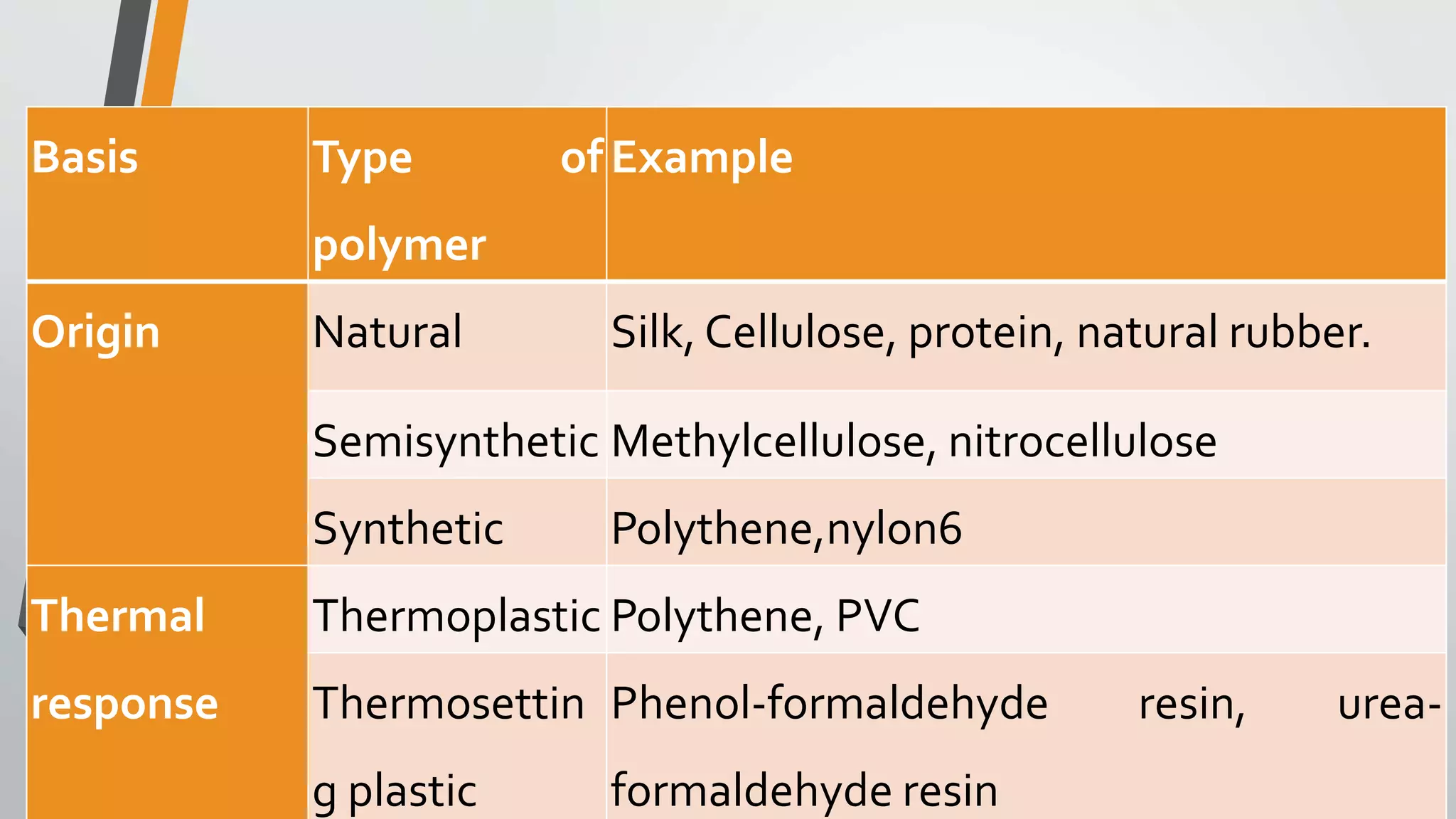
Basis Type of
polymer
Example
Origin Natural Silk, Cellulose, protein, natural rubber.
Semisynthetic Methylcellulose, nitrocellulose
Synthetic Polythene,nylon6
Thermal
response
Thermoplastic Polythene, PVC
Thermosettin
g plastic
Phenol-formaldehyde resin, urea-
formaldehyde resin
Based on Origin
• Natural
Cellulose proteins etc
• semi-synthetic,
Semisynthetic polymers are chemically modified natural
polymers like nitrocellulose, cellulose alkane
• synthetic
Synthetic polymers are manmade polymers synthesized from
monomers. Example- polythene, nylon-6.
Based on thermal processing Behavior
• Thermoplastics
The plastics that can be recovered and refabricated by applying suitable
pressure and heat without much change in the properties are called.
Ex - Polystyrene, polythene, and polyvinyl chloride
• thermosetting plastics (thermosets).
polymers that cannot be thermally processed and resist heat softening,
mechanical deformation, and solvent attack.
They can be strengthened when heated but cannot successfully be
remolded or reheated after initial heat forming.
In these polymers, individual chains are interlinked by covalent bonds.
These cross-links are responsible for heat resistance.
Ex - epoxy, Phenol Formaldehyde Resin.
Based upon the Mechanism of
polymerization
addition polymers
Formed by simple addition of monomeric molecules.
The process of polymerization is called addition polymerization.
EX: Polyethylene, Poly vinyl chloride
condensation polymers
formed from intermolecular reactions between molecules with the elimination of small molecules
like water or carbon dioxide.
The process of polymerization is called condensation polymerization. Examples- Nylon-6,
nylone66,Terylene.
Based on line structure
• linear polymers
Linear polymers of finite length. Ex. Nylon 6, High-density polythene, polystyrene
• branched polymers.
Polymers of finite length with short or long branches .
Ex: Low density polymer
• Cross linked polymer or network polymer
Planar- graphite like polymer or space diamond like structure.
Ex: epoxy resins, polyurethane, vulcanized rubber.
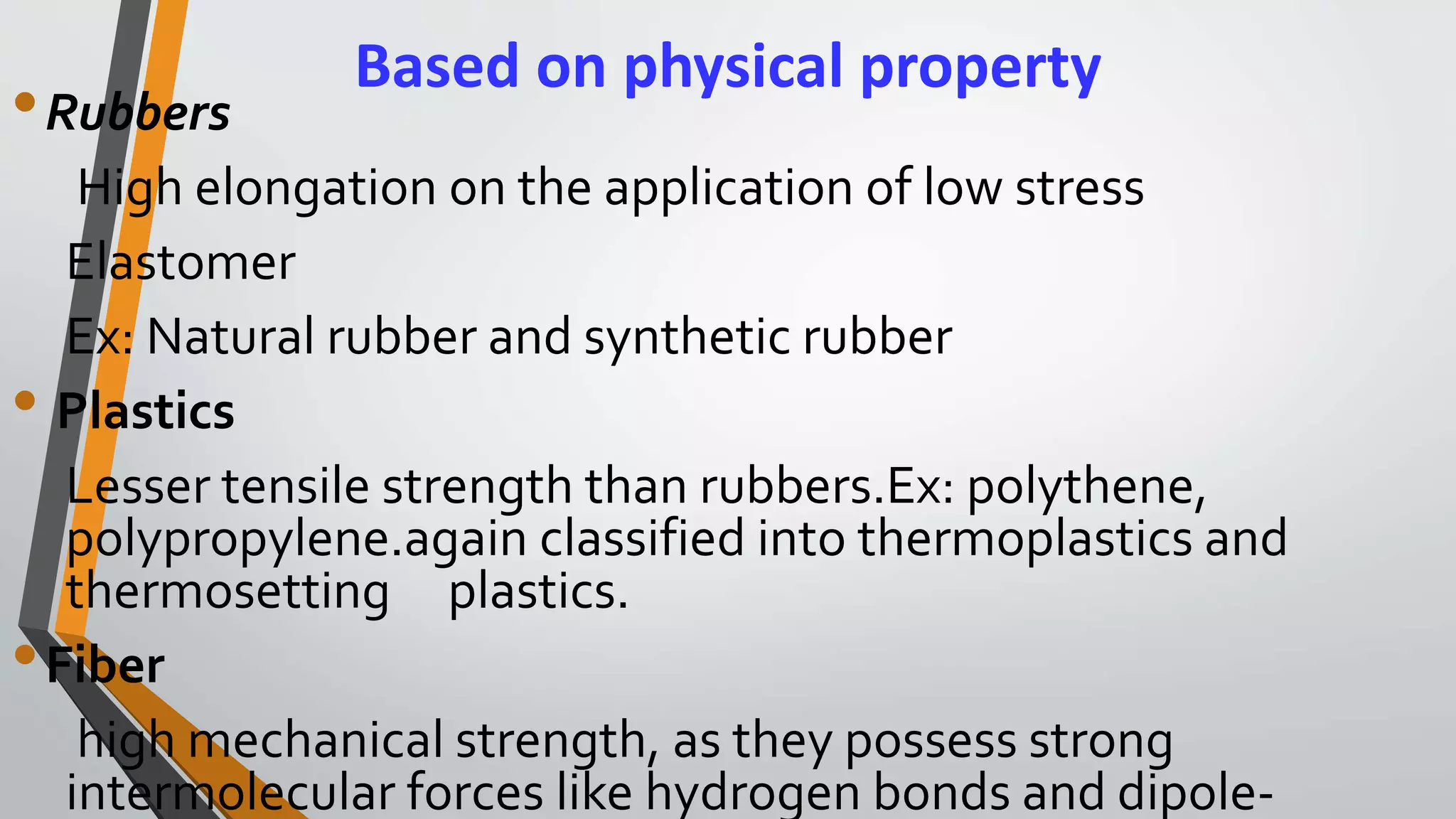
Based on physical property
•Rubbers
High elongation on the application of low stress
Elastomer
Ex: Natural rubber and synthetic rubber
• Plastics
Lesser tensile strength than rubbers.Ex: polythene,
polypropylene.again classified into thermoplastics and
thermosetting plastics.
•Fiber
high mechanical strength, as they possess strong
intermolecular forces like hydrogen bonds and dipole-
BASED ON CRYSTALLINITY
Amorphous polymers
Ex: polycarbonate, Natural rubber, polystyrene.
Crystalline polymers
Ex: polypropylene, Nylon, Kevlar.
BASED ON DEGRADABILITY
Based on degradability by microorganisms can be classified into
non-degradable polymers
Polythene, polystyrene.
Biodegradable polymers
PGA, PLA, and PHBV
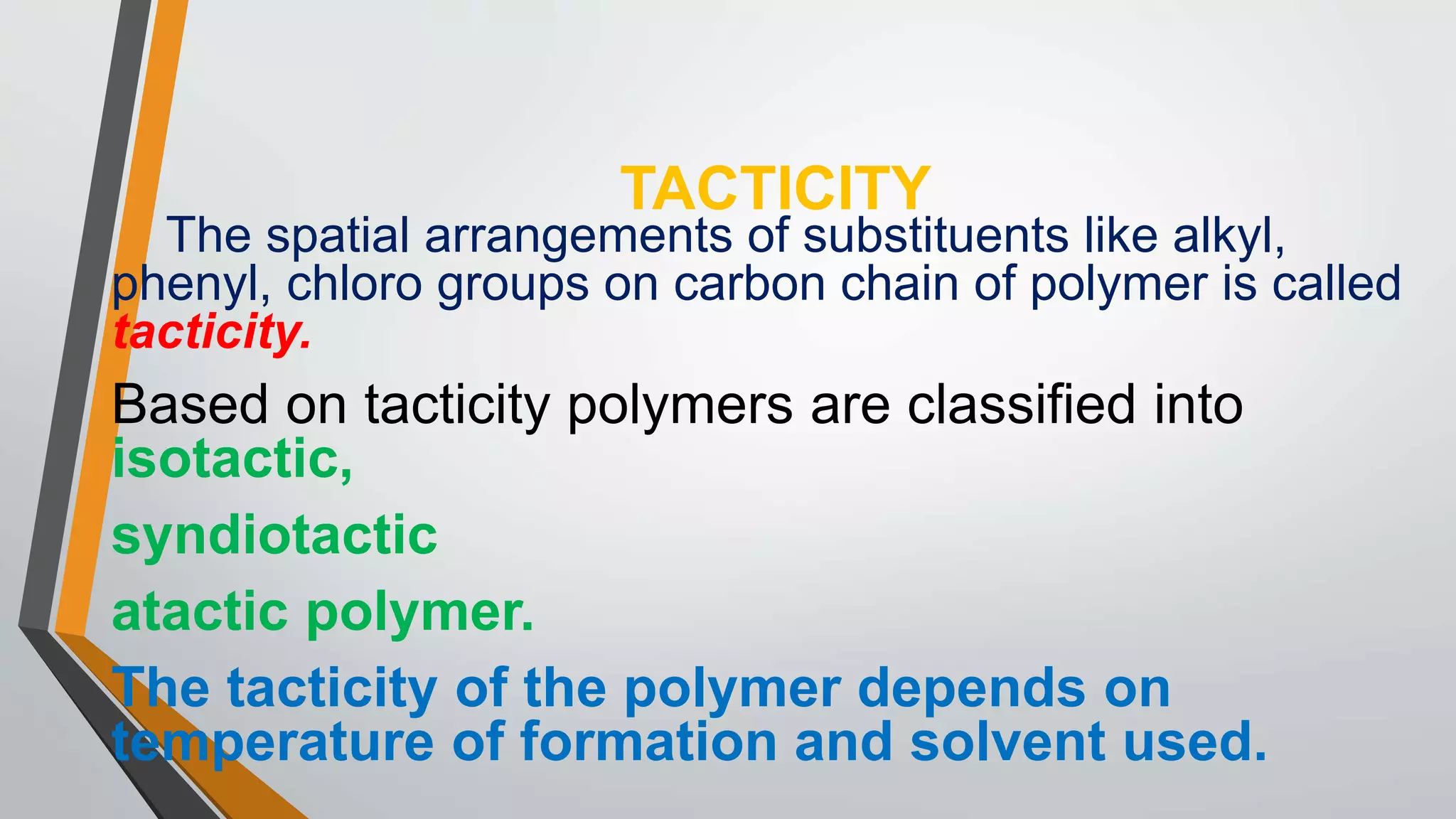
TACTICITY
The spatial arrangements of substituents like alkyl,
phenyl, chloro groups on carbon chain of polymer is called
tacticity.
Based on tacticity polymers are classified into
isotactic,
syndiotactic
atactic polymer.
The tacticity of the polymer depends on
temperature of formation and solvent used.
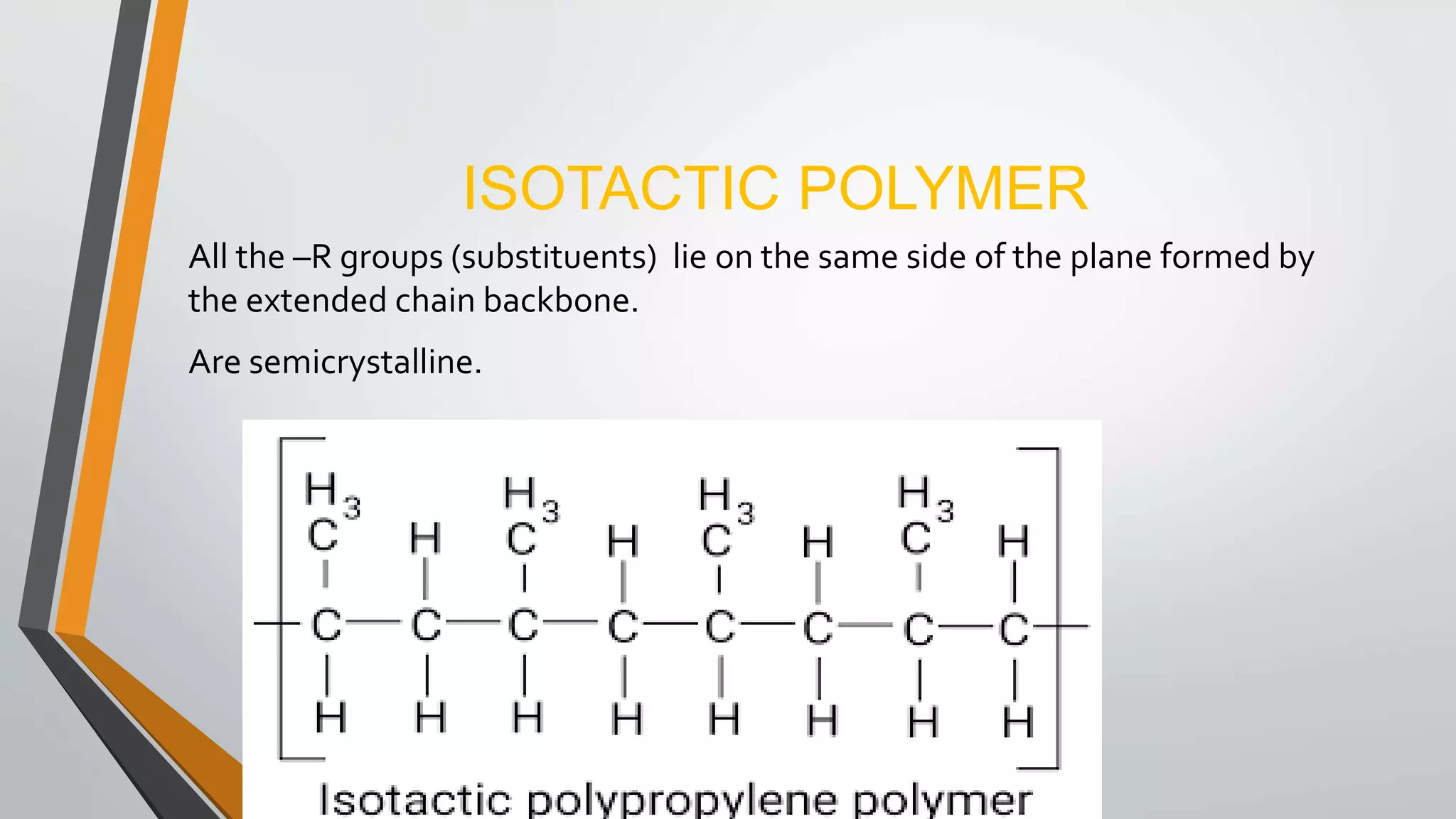
ISOTACTIC POLYMER
All the –R groups (substituents) lie on the same side of the plane formed by
the extended chain backbone.
Are semicrystalline.
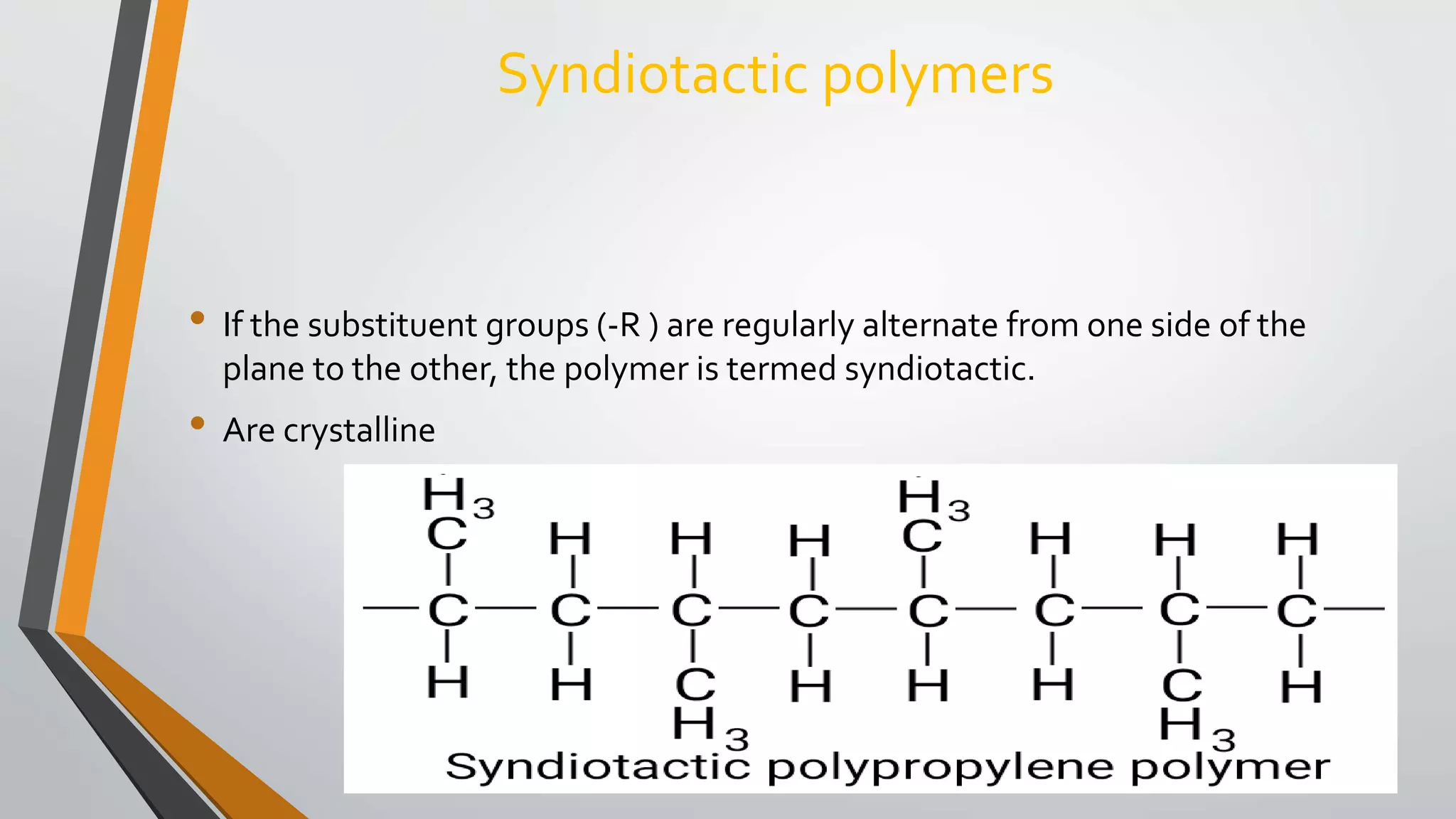
Syndiotactic polymers
• If the substituent groups (-R ) are regularly alternate from one side of the
plane to the other, the polymer is termed syndiotactic.
• Are crystalline
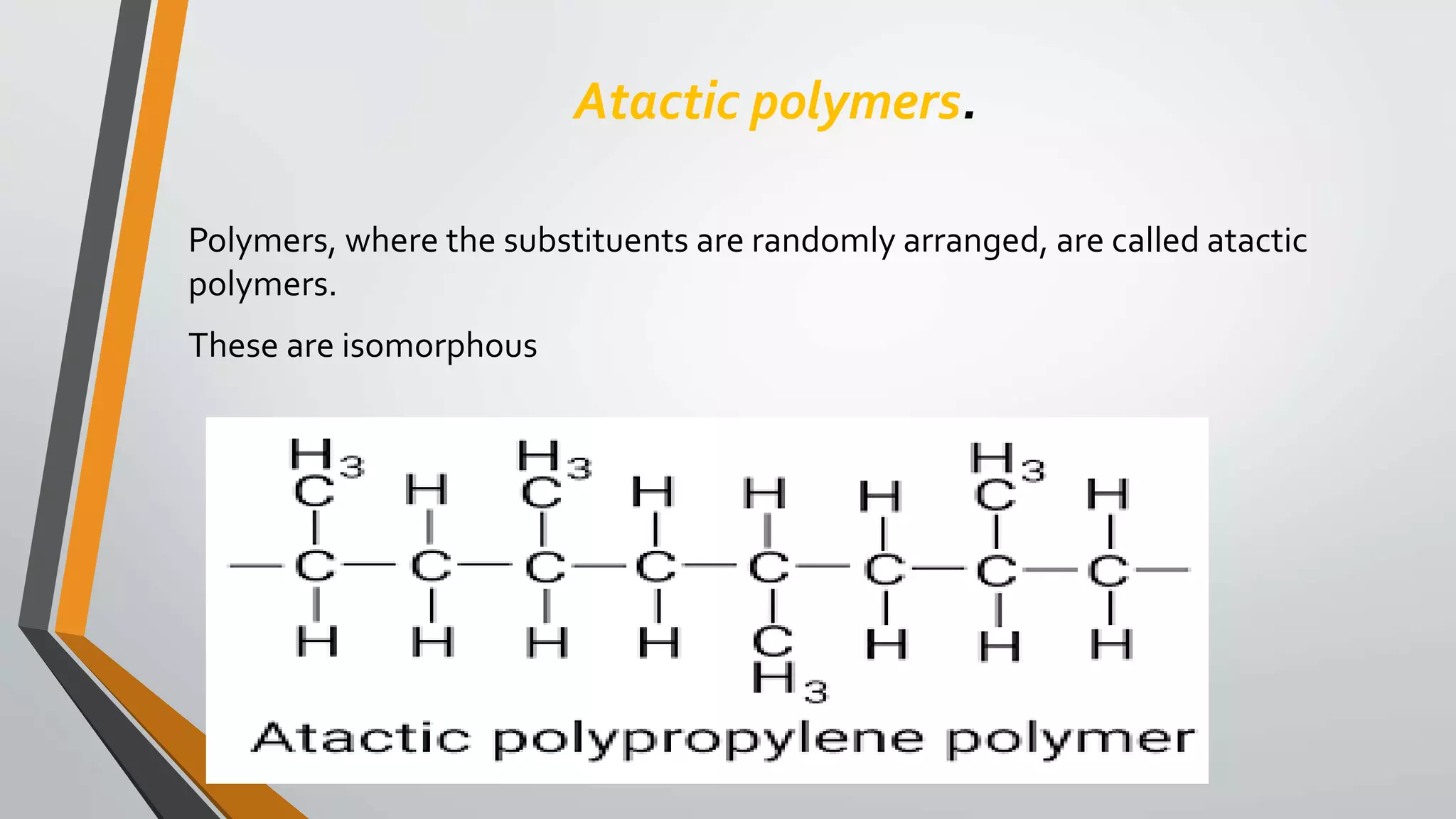
Atactic polymers.
Polymers, where the substituents are randomly arranged, are called atactic
polymers.
These are isomorphous
ADDITION POLYMERS
• Formed from unsaturated compounds
• Process is addition polymerization or chain growth polymerisation.
Steps of polymerization are
(1)chain initiation step
(2)chain propagation step
(3)chain termination step
Chain Initiation step
• The initiation step involves the production of free radicals, carbonium ions,
or carbanion under the influence of heat, light radiation, or catalyst.The free
radical adds to the unsaturated compound to form a fresh reactive center.
• I→ 2R*
• R* + M → RM1*
(where M is monomer)
Chain Propagation Step
• The new reactive center adds to another monomer and the process is
repeated successively adding many more monomers to form a chain of the
required length.
• RM1
* + M → RM2
* , RM2
*+ M→RM3
*, RM3
*+M→……. , RM(n-1)
* +M→RMn
*.
Chain termination step
• The chain growth is terminated either by combination or by
disproportionation.
• RMm
* + RMn
* →RMmMnR (termination by combination)
• RMm
* +RMn
* →RMm +RMn (termination by disproprtionation)
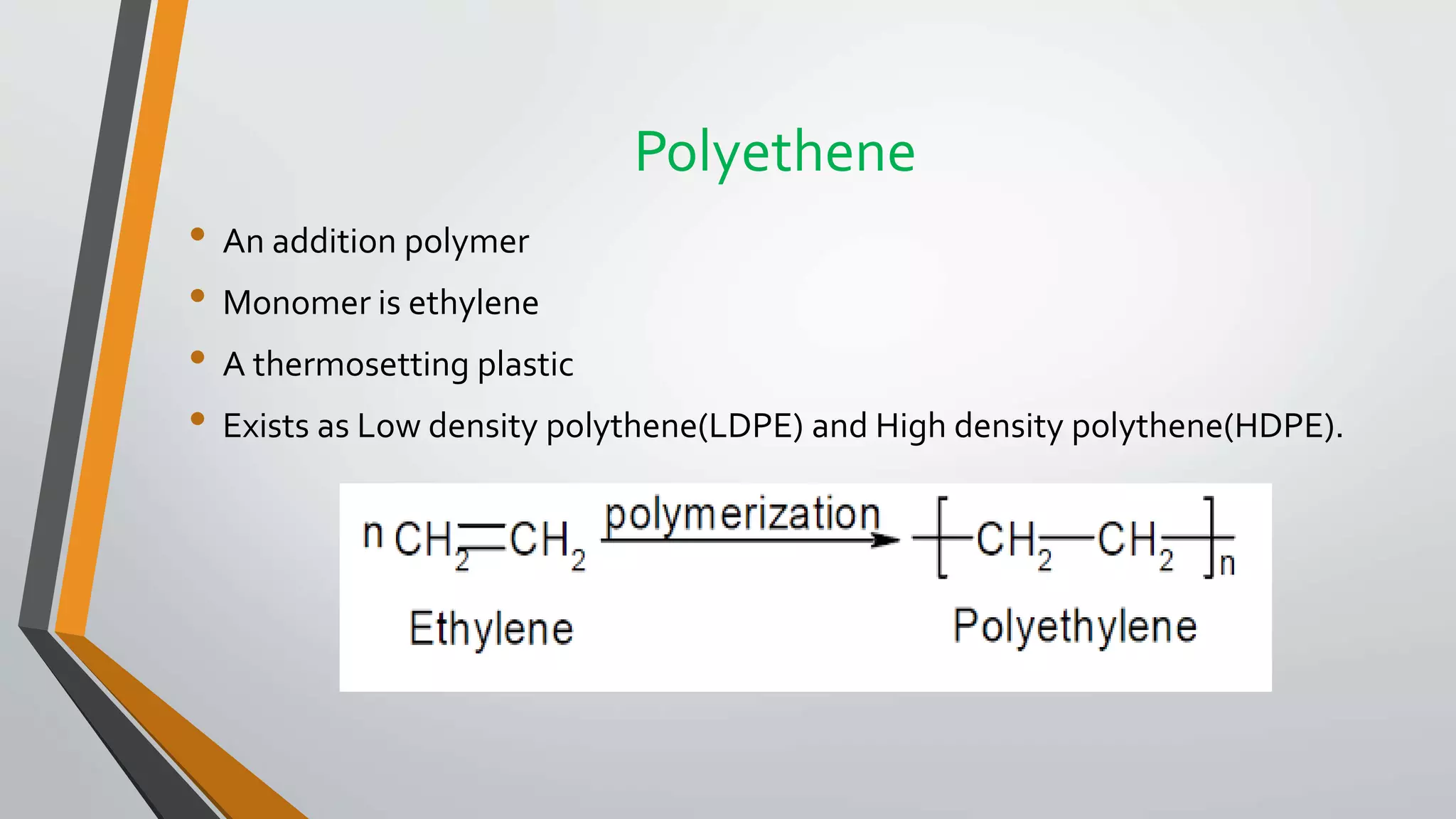
Polyethene
• An addition polymer
• Monomer is ethylene
• A thermosetting plastic
• Exists as Low density polythene(LDPE) and High density polythene(HDPE).
Low-density polyethylene (LDPE)
• LDPE is formed from ethylene at a high pressure of 1500-3000 atmosphere at a
temperature range of175-250oC in presence of some oxygen, peroxide, or
azocompounds as initiators.
• LDPE has nearly 20–50 branches (both long and short branches) per 1000 linear
carbon atoms in the chain molecules.
• The loss of molecular symmetry due to the high degree of branching results in a
lower density range (0.915–0.94 g/cm3 ) and lower softening or melting
temperature.
• LDPE dissolves in toluene at or above 60°C
High-density poly ethylene (HDPE)
• The polymerization at a low temperature and pressure in presence of metal
oxide catalyst
• HDPE is usually more resistant to chemicals than LDPE.
• HDPE is soluble in toluene at 900C.
• 2–5 short branches or side chains per 1000 carbon atoms in the main chain,
thus having a higher density range (0.945–0.96) and high melting
temperature (125–130°C) compared to LDPE.
USES Of POLYETHYLENE
• Polyethylenes are very good insulating materials and are adequately flexible
hence used as an insulator in wires and cables.
• They find extensive uses and applications as molded or formed objects,
films, sheets, bottles and containers, pipes, and tubes.
• Polythene finds application in packaging, waterproofing, irrigation, and
water management including canal lining and mulching, and in coating and
lamination.
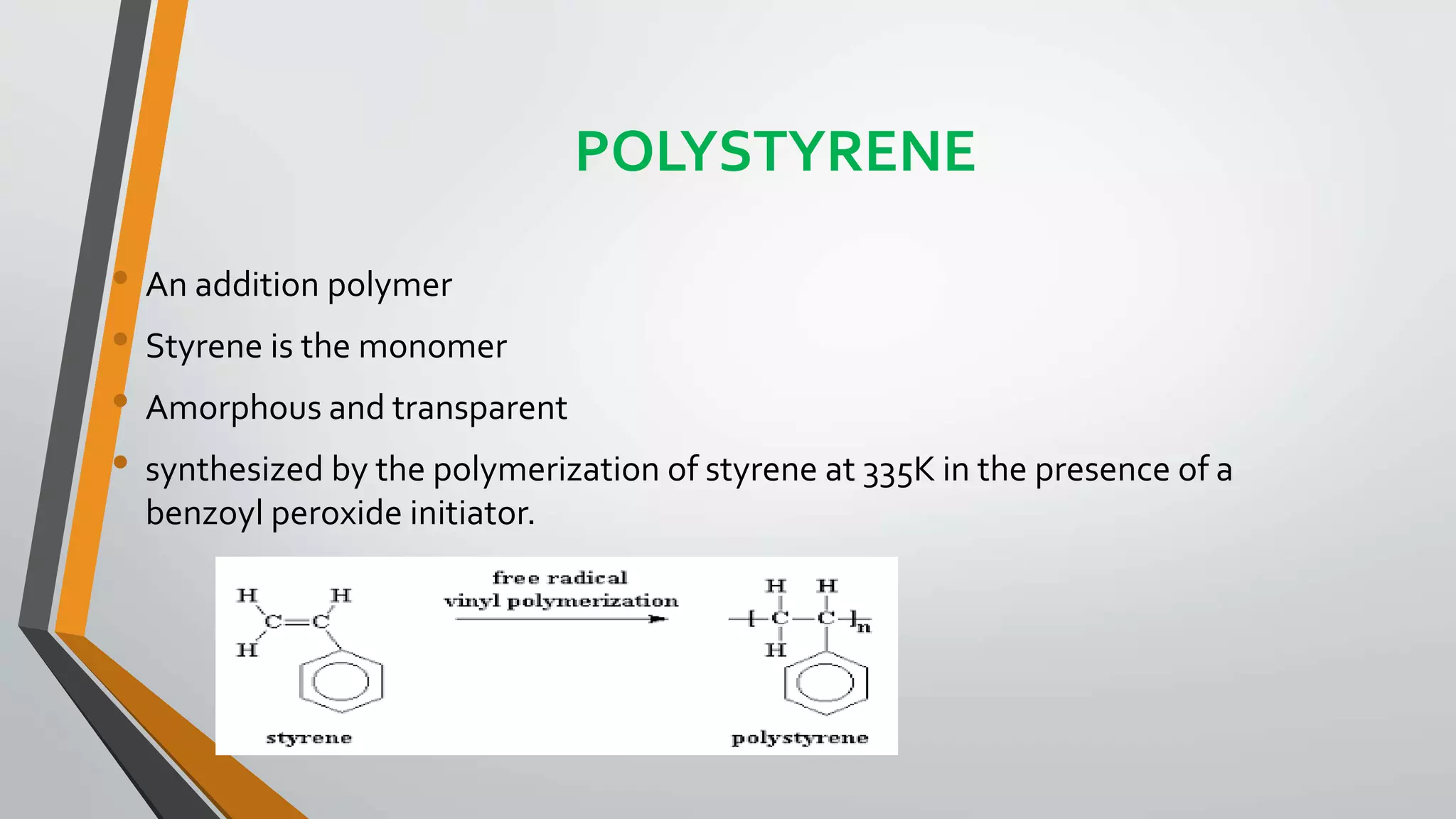
POLYSTYRENE
• An addition polymer
• Styrene is the monomer
• Amorphous and transparent
• synthesized by the polymerization of styrene at 335K in the presence of a
benzoyl peroxide initiator.
USES OF POLYSTYRENE
• As electrical insulator.
• Expanded polystyrene finds extensive use in packaging and shock absorbing
applications, in thermal insulation, and as acoustic improvers in halls and auditoria.
• High impact grades are suitable for use as toys, games and sports articles, casings
and cabinets for electrical/ electronic gadgets and equipment, and inner liners of
refrigerators.
• Another major use of polystyrene is in the making of ion-exchange resins.
Poly(Methyl Methacrylate) (PMMA)
• An addition polymer
• Monomer is methyl methacrylate.
• using peroxide or azonitrile initiators
at about 100°C, preferably in the absence of air.
USES OF POLYMETHYL METHACRYLATE
• PMMA is used for making an automotive tail lamp, signal light lenses,
jewelry, lenses of optical equipment, and contact lenses.
• Used in display and advertisement applications;
• Application in the building industry is also notable. Perspex, Plexiglas, Lucite
and Acrylite are common trade names.
• Used in paints and enamel applications
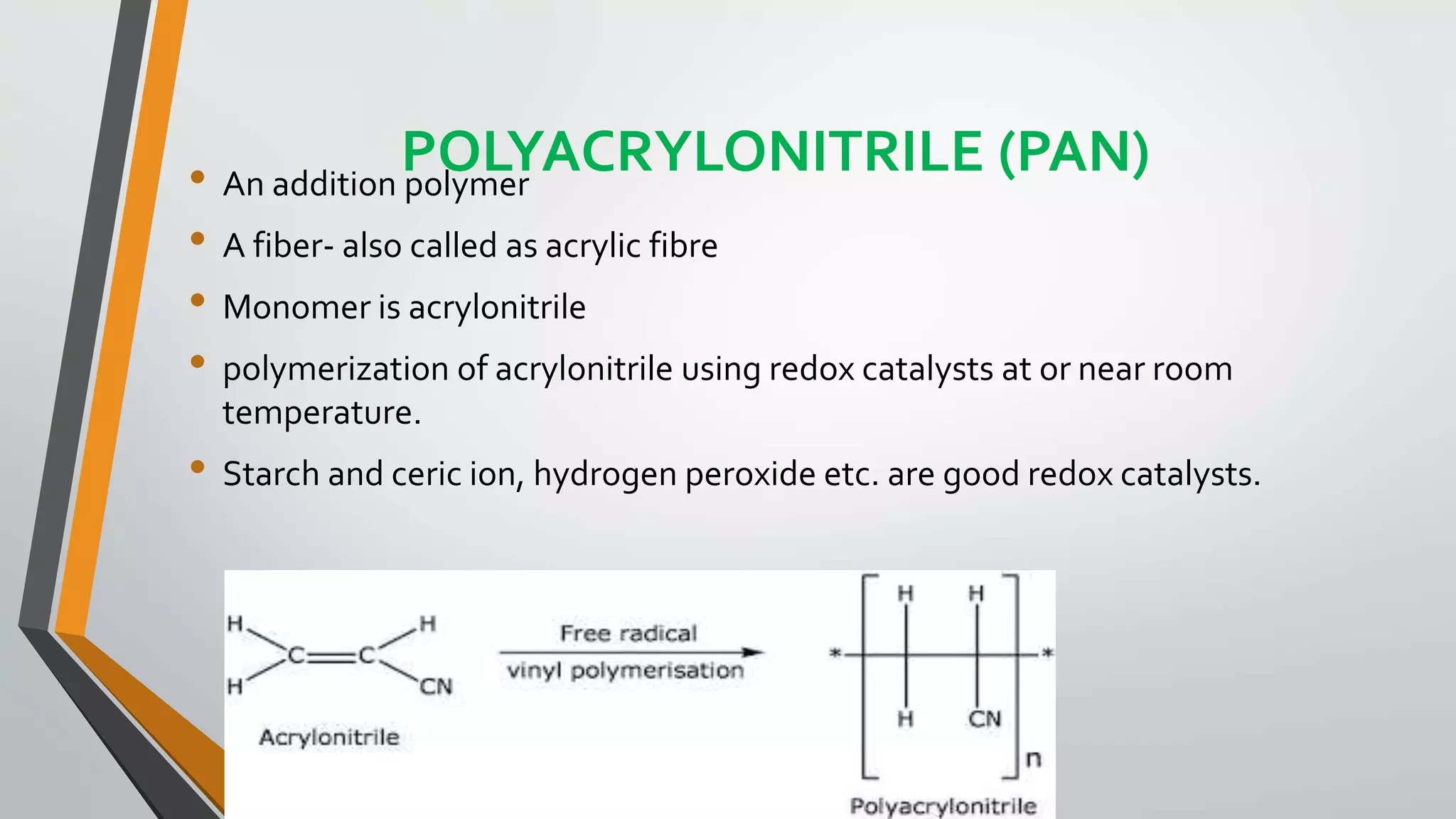
POLYACRYLONITRILE (PAN)
• An addition polymer
• A fiber- also called as acrylic fibre
• Monomer is acrylonitrile
• polymerization of acrylonitrile using redox catalysts at or near room
temperature.
• Starch and ceric ion, hydrogen peroxide etc. are good redox catalysts.
USES OF PAN
• A good fiber
• Wool can be replaced by PAN as In bulkiness, feel and warmth, the acrylic
fibers are very much similar to wool.
• They are widely blended with other fibers, particularly wool, to form various
textile items.
CONDENSATION POLYMERS or step-growth
polymers.
• The bifunctional or polyfunctional monomers condense intermolecularly
• The growth of the molecule or chain extension takes place in controlled,
distinguishable steps
• The process is normally associated with the elimination of small byproducts
such as H2O, HCl, etc, at each step of the reaction.
• Examples are nylon 6, nylon66, bakelite, Kevlar, and terylene.
Poly(Hexamethylene Adipamide): Nylon 66
•A condensation or Chain growth polymer
•Monomers are hexamethylene diamine and adpic acid.
•The first 6 in 66 denotes number of carbon atoms in
diamine and second 6 denotes the number of carbon atoms
in diacid.
•Reaction occurs at 523K
USES OF NYLON 66
•Used for making stockings, socks, and
tights.
•Used for making fishing nets, brush
bristles, ropes, etc.
Nylon 6
• A polyamide (All polyamides are called as Nylon)
• Monomer is caprolactum
• 6 indicates number of carbon atoms in caprolactum.
• Caprolactam is heated with traces of water (acting as the catalyst) and traces of
acetic acid (chain length regulator) are charged into a reactor and heated at
250°C under a blanket of nitrogen for 10–12 h.
USES OF NYLON 6
• 1.Widespread applications for the manufacture of gears, bearings, bushes,
etc.
• 2. Nylon films feature low odor transmission and are useful in packaging for
foodstuffs, drugs, and pharmaceuticals.
• 3. Nylon 6 and nylon 66 are melt-spun into fibers or filaments and the fibers
and cords made from them are extensively used as reinforcing agents for
plastics and rubbers (in the construction of composites including hoses and
beltings and as tyre cords).
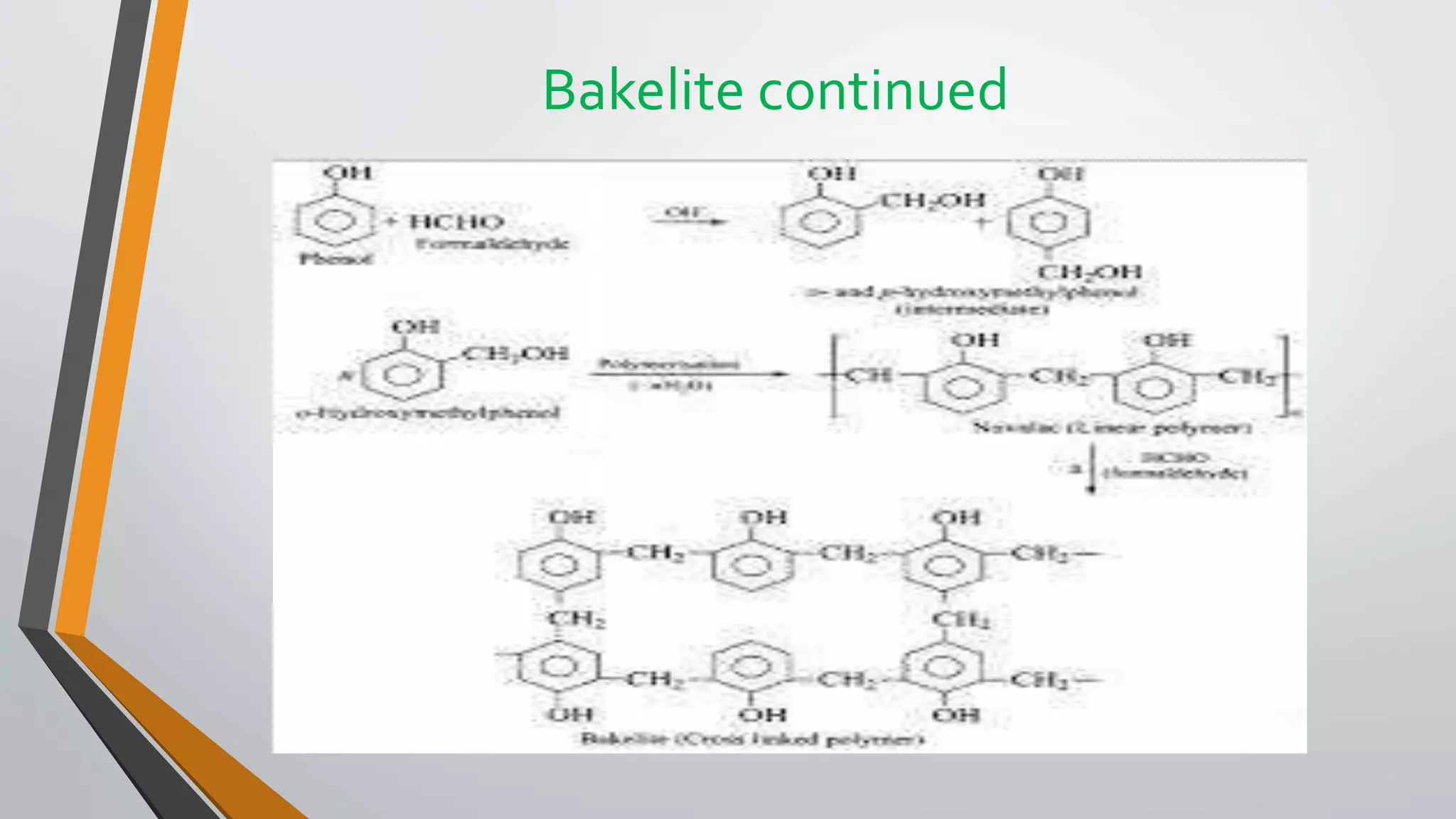
Bakelite
• A condensation polymer.
• Monomers are phenol and formaldehyde.
• by the condensation polymerization of phenol with a 75% stoichiometric
quantity of formaldehyde catalyzed by acids or bases.The product formed is
called novlak resins
• If formaldehyde is taken in excess three-dimensional polymer bakelite
resins are formed.
Bakelite continued
BAKELITE USES
•Bakelite was first used for making Billiard balls and
later to make valve parts, knobs, buttons, knife
handles, etc.
•The bakelite resins are compounded with asbestos
powder or sawdust and used for molding electrical
items, telephone instruments, and so on.
KEVLAR- Poly(para-phenyleneterephthalimide)
• Aromatic polyamide
• Five times more tensile strength than steel
• polycondensation polymer
• Monomers are p-phenylene diamine [p-H2N-(C6H4)-NH2] and terephthaloyl
chloride. [p-ClOC-(C6H4)-COCl].
USES OF KEVLAR
• Used in industrial applications, such as cables, ropes,
body/vehicle armor, brake linings, bulletproof body armors.
• To make high-performance structural composites in aircraft
components, boat hulls, and high-performance cars.
• For making Friction products and gaskets
• For making Adhesives and sealants
• For making Protective apparel in automobile and Aircraft
• For making tennis strings
Terylene • A polycondensation polymer
• Polyester
• Other name is dacron
• Monomers are terephthalic acid and ethylene glycol
• The reaction occurs at 423-473 k under vacuum.
USES OFTERYLENE
•Terylene is extensively used in the textile industry
to make hard-wear clothes like sarees, and dress
material.
•It is mixed with a natural fiber like cotton and wool
to make more variety of clothes.
•Used for making plastic bottles.
Ziegler Nutta Catalyst
• The catalyst was developed by Karl Ziegler and Giulio Natta in the 1950
• permitted the synthesis of unbranched, stereospecific, high molecular
weight polyolefins.
• Ziegler-Natta catalysts can be prepared by mixing transition metal halides
such as titanium tetrachloride (TiCl4), with organometallic compounds of
groups I - III of the periodic table, such as triethylaluminum (Al(C2H5)3).
• A typical Ziegler Natta catalyst is a mixture of titanium tetrachloride and
triethyl Aluminium
• Zieglr Nutta catalyzed polymers are coordination polymerisations.
ZIEGLER NUTTA CATALYST
ADVANTAGES OF USING ZIEGLER NUTTA
CATALYST
•Produce high molecular weight,
•Unbranched
• stereoregular polymers.
•All the products formed will be cis product.
Plastic identification code
•identifies the type of plastic resin
•makes it easier for re-processors to
identify and separate used plastics for a
range of new applications
Biodegradable polymers
• can be broken down by the bacterial decomposition process to
natural byproducts such as gases (CO2, N2), water, biomass, and
inorganic salts.
• all-natural polymers are biodegradable.
• Poly(β-hydroxy alkanoate) is a commercially important naturally
occurring biodegradable polymer.
• PLA, PGA, and PHBV are some of the biodegradable synthetic
polymers.
• The common functional group present in biodegradable
polymers are esters, anhydrides, and amides.
PLA (polylactic acid ) or poly(lactide)
•A thermoplastic
•Monomer is lactic acid
•Lactic acid is first subjected to acid-catalyzed thermal
dimerization to form a lactide.
•The ring-opening polymerization of lactide is carried out
in presence of a metallic catalyst at 140–190 °C for 10–12
h under reduced pressure.
PLA continued……..
USES OF PLA
1. PLA is used to manufacture degradable plastic film for
packaging, bottles.
2. TO make biodegradable medical devices, including screws, pins,
plates, and rods that are designed to biodegrade within 6 to 12
months)
3. For making absorbable sutures for surgery.
4. used for making biodegradable disposable garments, feminine
hygiene products, and diapers
PGA (Poly(glycolic acid) or Poly(glycolide)
•A thermoplastic
•A linear polyester
•First, the glycolic acid(hydroxyl acetic acid) is converted
to glycolide by heating.
•The glycolide undergoes ring-opening polycondensation
in presence of catalysts like Sb2O3, SbCl3, or zinc acetate
at 195-2300C yielding poly(glycolide), PGA.
PGA continued………..
USES Of PGA
1. PGA is used for subcutaneous sutures in
abdominal and thoracic surgeries.
2. It is used for manufacturing biodegradable
devices including pins, rods, and screws which need
not be removed at a later stage after implant.
3. It is used to enhance facial nerve regeneration.
4. PGA is used in wound healing adhesives in
combination with fibrin sealant.
PHBV -Poly(β-hydroxybutyrate-co-hydroxy
valerate)
•A thermosetting plastic
•Aliphatic polyester
•a copolymer of 3-hydroxybutyric acid and 3-
hydroxy pentanoic acid.
PHBV continued………
USES OF PHBV
Natural fibers, cellulose, clay, wood, etc. can be incorporated into the PHBV
matrix making its application vast.
• 1. It is used to make specialty packaging films.
• 2. For making orthopedic devices
• 3. Finds application in controlled release of drugs.
• 4. Used in tissue engineering.
THANKYOU

Synthetic polymers - a content written by Dr.Lali Thomas Kotturan about man made polymers .This covers module 4 of sem 6 of UG Chemistry of Calicut University Kerala.

  • 1.
    SYNTHETIC POLYMERS Dr. LALITHOMASKOTTURAN Associate Professor Department of chemistry LITTLE FLOWER COLLEGE , GURUVAYOOR
  • 2.
    POLYMER •A polymer isa giant molecule made from small identical repeating molecules called monomers joined together by covalent bonds. •The process of interlinking the monomers to form a polymer is called polymerization
  • 3.
    CLASSIFICATION OF POLYMERS •TheClassification of Polymers are possible based on different parameters.
  • 4.
    CLASSIFICATION OF POLYMERS BasisType of polymer Example Origin Natural Silk, Cellulose, protein, natural rubber. Semisynthetic Methylcellulose, nitrocellulose Synthetic Polythene,nylon6 Thermal response Thermoplastic Polythene, PVC Thermosettin g plastic Phenol-formaldehyde resin, urea- formaldehyde resin
  • 5.
    Based on Origin •Natural Cellulose proteins etc • semi-synthetic, Semisynthetic polymers are chemically modified natural polymers like nitrocellulose, cellulose alkane • synthetic Synthetic polymers are manmade polymers synthesized from monomers. Example- polythene, nylon-6.
  • 6.
    Based on thermalprocessing Behavior • Thermoplastics The plastics that can be recovered and refabricated by applying suitable pressure and heat without much change in the properties are called. Ex - Polystyrene, polythene, and polyvinyl chloride • thermosetting plastics (thermosets). polymers that cannot be thermally processed and resist heat softening, mechanical deformation, and solvent attack. They can be strengthened when heated but cannot successfully be remolded or reheated after initial heat forming. In these polymers, individual chains are interlinked by covalent bonds. These cross-links are responsible for heat resistance. Ex - epoxy, Phenol Formaldehyde Resin.
  • 7.
    Based upon theMechanism of polymerization addition polymers Formed by simple addition of monomeric molecules. The process of polymerization is called addition polymerization. EX: Polyethylene, Poly vinyl chloride condensation polymers formed from intermolecular reactions between molecules with the elimination of small molecules like water or carbon dioxide. The process of polymerization is called condensation polymerization. Examples- Nylon-6, nylone66,Terylene.
  • 8.
    Based on linestructure • linear polymers Linear polymers of finite length. Ex. Nylon 6, High-density polythene, polystyrene • branched polymers. Polymers of finite length with short or long branches . Ex: Low density polymer • Cross linked polymer or network polymer Planar- graphite like polymer or space diamond like structure. Ex: epoxy resins, polyurethane, vulcanized rubber.
  • 9.
    Based on physicalproperty •Rubbers High elongation on the application of low stress Elastomer Ex: Natural rubber and synthetic rubber • Plastics Lesser tensile strength than rubbers.Ex: polythene, polypropylene.again classified into thermoplastics and thermosetting plastics. •Fiber high mechanical strength, as they possess strong intermolecular forces like hydrogen bonds and dipole-
  • 10.
    BASED ON CRYSTALLINITY Amorphouspolymers Ex: polycarbonate, Natural rubber, polystyrene. Crystalline polymers Ex: polypropylene, Nylon, Kevlar.
  • 11.
    BASED ON DEGRADABILITY Basedon degradability by microorganisms can be classified into non-degradable polymers Polythene, polystyrene. Biodegradable polymers PGA, PLA, and PHBV
  • 12.
    TACTICITY The spatial arrangementsof substituents like alkyl, phenyl, chloro groups on carbon chain of polymer is called tacticity. Based on tacticity polymers are classified into isotactic, syndiotactic atactic polymer. The tacticity of the polymer depends on temperature of formation and solvent used.
  • 13.
    ISOTACTIC POLYMER All the–R groups (substituents) lie on the same side of the plane formed by the extended chain backbone. Are semicrystalline.
  • 14.
    Syndiotactic polymers • Ifthe substituent groups (-R ) are regularly alternate from one side of the plane to the other, the polymer is termed syndiotactic. • Are crystalline
  • 15.
    Atactic polymers. Polymers, wherethe substituents are randomly arranged, are called atactic polymers. These are isomorphous
  • 16.
    ADDITION POLYMERS • Formedfrom unsaturated compounds • Process is addition polymerization or chain growth polymerisation. Steps of polymerization are (1)chain initiation step (2)chain propagation step (3)chain termination step
  • 17.
    Chain Initiation step •The initiation step involves the production of free radicals, carbonium ions, or carbanion under the influence of heat, light radiation, or catalyst.The free radical adds to the unsaturated compound to form a fresh reactive center. • I→ 2R* • R* + M → RM1* (where M is monomer)
  • 18.
    Chain Propagation Step •The new reactive center adds to another monomer and the process is repeated successively adding many more monomers to form a chain of the required length. • RM1 * + M → RM2 * , RM2 *+ M→RM3 *, RM3 *+M→……. , RM(n-1) * +M→RMn *.
  • 19.
    Chain termination step •The chain growth is terminated either by combination or by disproportionation. • RMm * + RMn * →RMmMnR (termination by combination) • RMm * +RMn * →RMm +RMn (termination by disproprtionation)
  • 20.
    Polyethene • An additionpolymer • Monomer is ethylene • A thermosetting plastic • Exists as Low density polythene(LDPE) and High density polythene(HDPE).
  • 21.
    Low-density polyethylene (LDPE) •LDPE is formed from ethylene at a high pressure of 1500-3000 atmosphere at a temperature range of175-250oC in presence of some oxygen, peroxide, or azocompounds as initiators. • LDPE has nearly 20–50 branches (both long and short branches) per 1000 linear carbon atoms in the chain molecules. • The loss of molecular symmetry due to the high degree of branching results in a lower density range (0.915–0.94 g/cm3 ) and lower softening or melting temperature. • LDPE dissolves in toluene at or above 60°C
  • 22.
    High-density poly ethylene(HDPE) • The polymerization at a low temperature and pressure in presence of metal oxide catalyst • HDPE is usually more resistant to chemicals than LDPE. • HDPE is soluble in toluene at 900C. • 2–5 short branches or side chains per 1000 carbon atoms in the main chain, thus having a higher density range (0.945–0.96) and high melting temperature (125–130°C) compared to LDPE.
  • 23.
    USES Of POLYETHYLENE •Polyethylenes are very good insulating materials and are adequately flexible hence used as an insulator in wires and cables. • They find extensive uses and applications as molded or formed objects, films, sheets, bottles and containers, pipes, and tubes. • Polythene finds application in packaging, waterproofing, irrigation, and water management including canal lining and mulching, and in coating and lamination.
  • 24.
    POLYSTYRENE • An additionpolymer • Styrene is the monomer • Amorphous and transparent • synthesized by the polymerization of styrene at 335K in the presence of a benzoyl peroxide initiator.
  • 25.
    USES OF POLYSTYRENE •As electrical insulator. • Expanded polystyrene finds extensive use in packaging and shock absorbing applications, in thermal insulation, and as acoustic improvers in halls and auditoria. • High impact grades are suitable for use as toys, games and sports articles, casings and cabinets for electrical/ electronic gadgets and equipment, and inner liners of refrigerators. • Another major use of polystyrene is in the making of ion-exchange resins.
  • 26.
    Poly(Methyl Methacrylate) (PMMA) •An addition polymer • Monomer is methyl methacrylate. • using peroxide or azonitrile initiators at about 100°C, preferably in the absence of air.
  • 27.
    USES OF POLYMETHYLMETHACRYLATE • PMMA is used for making an automotive tail lamp, signal light lenses, jewelry, lenses of optical equipment, and contact lenses. • Used in display and advertisement applications; • Application in the building industry is also notable. Perspex, Plexiglas, Lucite and Acrylite are common trade names. • Used in paints and enamel applications
  • 28.
    POLYACRYLONITRILE (PAN) • Anaddition polymer • A fiber- also called as acrylic fibre • Monomer is acrylonitrile • polymerization of acrylonitrile using redox catalysts at or near room temperature. • Starch and ceric ion, hydrogen peroxide etc. are good redox catalysts.
  • 29.
    USES OF PAN •A good fiber • Wool can be replaced by PAN as In bulkiness, feel and warmth, the acrylic fibers are very much similar to wool. • They are widely blended with other fibers, particularly wool, to form various textile items.
  • 30.
    CONDENSATION POLYMERS orstep-growth polymers. • The bifunctional or polyfunctional monomers condense intermolecularly • The growth of the molecule or chain extension takes place in controlled, distinguishable steps • The process is normally associated with the elimination of small byproducts such as H2O, HCl, etc, at each step of the reaction. • Examples are nylon 6, nylon66, bakelite, Kevlar, and terylene.
  • 31.
    Poly(Hexamethylene Adipamide): Nylon66 •A condensation or Chain growth polymer •Monomers are hexamethylene diamine and adpic acid. •The first 6 in 66 denotes number of carbon atoms in diamine and second 6 denotes the number of carbon atoms in diacid. •Reaction occurs at 523K
  • 32.
    USES OF NYLON66 •Used for making stockings, socks, and tights. •Used for making fishing nets, brush bristles, ropes, etc.
  • 33.
    Nylon 6 • Apolyamide (All polyamides are called as Nylon) • Monomer is caprolactum • 6 indicates number of carbon atoms in caprolactum. • Caprolactam is heated with traces of water (acting as the catalyst) and traces of acetic acid (chain length regulator) are charged into a reactor and heated at 250°C under a blanket of nitrogen for 10–12 h.
  • 34.
    USES OF NYLON6 • 1.Widespread applications for the manufacture of gears, bearings, bushes, etc. • 2. Nylon films feature low odor transmission and are useful in packaging for foodstuffs, drugs, and pharmaceuticals. • 3. Nylon 6 and nylon 66 are melt-spun into fibers or filaments and the fibers and cords made from them are extensively used as reinforcing agents for plastics and rubbers (in the construction of composites including hoses and beltings and as tyre cords).
  • 35.
    Bakelite • A condensationpolymer. • Monomers are phenol and formaldehyde. • by the condensation polymerization of phenol with a 75% stoichiometric quantity of formaldehyde catalyzed by acids or bases.The product formed is called novlak resins • If formaldehyde is taken in excess three-dimensional polymer bakelite resins are formed.
  • 36.
  • 37.
    BAKELITE USES •Bakelite wasfirst used for making Billiard balls and later to make valve parts, knobs, buttons, knife handles, etc. •The bakelite resins are compounded with asbestos powder or sawdust and used for molding electrical items, telephone instruments, and so on.
  • 38.
    KEVLAR- Poly(para-phenyleneterephthalimide) • Aromaticpolyamide • Five times more tensile strength than steel • polycondensation polymer • Monomers are p-phenylene diamine [p-H2N-(C6H4)-NH2] and terephthaloyl chloride. [p-ClOC-(C6H4)-COCl].
  • 39.
    USES OF KEVLAR •Used in industrial applications, such as cables, ropes, body/vehicle armor, brake linings, bulletproof body armors. • To make high-performance structural composites in aircraft components, boat hulls, and high-performance cars. • For making Friction products and gaskets • For making Adhesives and sealants • For making Protective apparel in automobile and Aircraft • For making tennis strings
  • 40.
    Terylene • Apolycondensation polymer • Polyester • Other name is dacron • Monomers are terephthalic acid and ethylene glycol • The reaction occurs at 423-473 k under vacuum.
  • 41.
    USES OFTERYLENE •Terylene isextensively used in the textile industry to make hard-wear clothes like sarees, and dress material. •It is mixed with a natural fiber like cotton and wool to make more variety of clothes. •Used for making plastic bottles.
  • 42.
    Ziegler Nutta Catalyst •The catalyst was developed by Karl Ziegler and Giulio Natta in the 1950 • permitted the synthesis of unbranched, stereospecific, high molecular weight polyolefins. • Ziegler-Natta catalysts can be prepared by mixing transition metal halides such as titanium tetrachloride (TiCl4), with organometallic compounds of groups I - III of the periodic table, such as triethylaluminum (Al(C2H5)3). • A typical Ziegler Natta catalyst is a mixture of titanium tetrachloride and triethyl Aluminium • Zieglr Nutta catalyzed polymers are coordination polymerisations.
  • 43.
  • 44.
    ADVANTAGES OF USINGZIEGLER NUTTA CATALYST •Produce high molecular weight, •Unbranched • stereoregular polymers. •All the products formed will be cis product.
  • 45.
    Plastic identification code •identifiesthe type of plastic resin •makes it easier for re-processors to identify and separate used plastics for a range of new applications
  • 47.
    Biodegradable polymers • canbe broken down by the bacterial decomposition process to natural byproducts such as gases (CO2, N2), water, biomass, and inorganic salts. • all-natural polymers are biodegradable. • Poly(β-hydroxy alkanoate) is a commercially important naturally occurring biodegradable polymer. • PLA, PGA, and PHBV are some of the biodegradable synthetic polymers. • The common functional group present in biodegradable polymers are esters, anhydrides, and amides.
  • 48.
    PLA (polylactic acid) or poly(lactide) •A thermoplastic •Monomer is lactic acid •Lactic acid is first subjected to acid-catalyzed thermal dimerization to form a lactide. •The ring-opening polymerization of lactide is carried out in presence of a metallic catalyst at 140–190 °C for 10–12 h under reduced pressure.
  • 49.
  • 50.
    USES OF PLA 1.PLA is used to manufacture degradable plastic film for packaging, bottles. 2. TO make biodegradable medical devices, including screws, pins, plates, and rods that are designed to biodegrade within 6 to 12 months) 3. For making absorbable sutures for surgery. 4. used for making biodegradable disposable garments, feminine hygiene products, and diapers
  • 51.
    PGA (Poly(glycolic acid)or Poly(glycolide) •A thermoplastic •A linear polyester •First, the glycolic acid(hydroxyl acetic acid) is converted to glycolide by heating. •The glycolide undergoes ring-opening polycondensation in presence of catalysts like Sb2O3, SbCl3, or zinc acetate at 195-2300C yielding poly(glycolide), PGA.
  • 52.
  • 53.
    USES Of PGA 1.PGA is used for subcutaneous sutures in abdominal and thoracic surgeries. 2. It is used for manufacturing biodegradable devices including pins, rods, and screws which need not be removed at a later stage after implant. 3. It is used to enhance facial nerve regeneration. 4. PGA is used in wound healing adhesives in combination with fibrin sealant.
  • 54.
    PHBV -Poly(β-hydroxybutyrate-co-hydroxy valerate) •A thermosettingplastic •Aliphatic polyester •a copolymer of 3-hydroxybutyric acid and 3- hydroxy pentanoic acid.
  • 55.
  • 56.
    USES OF PHBV Naturalfibers, cellulose, clay, wood, etc. can be incorporated into the PHBV matrix making its application vast. • 1. It is used to make specialty packaging films. • 2. For making orthopedic devices • 3. Finds application in controlled release of drugs. • 4. Used in tissue engineering.
  • 57.