INTRODUCTION
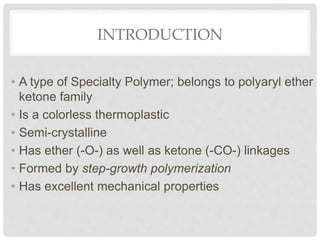
• A type of Specialty Polymer; belongs to polyaryl ether
ketone family
• Is a colorless thermoplastic
• Semi-crystalline
• Has ether (-O-) as well as ketone (-CO-) linkages
• Formed by step-growth polymerization
• Has excellent mechanical properties
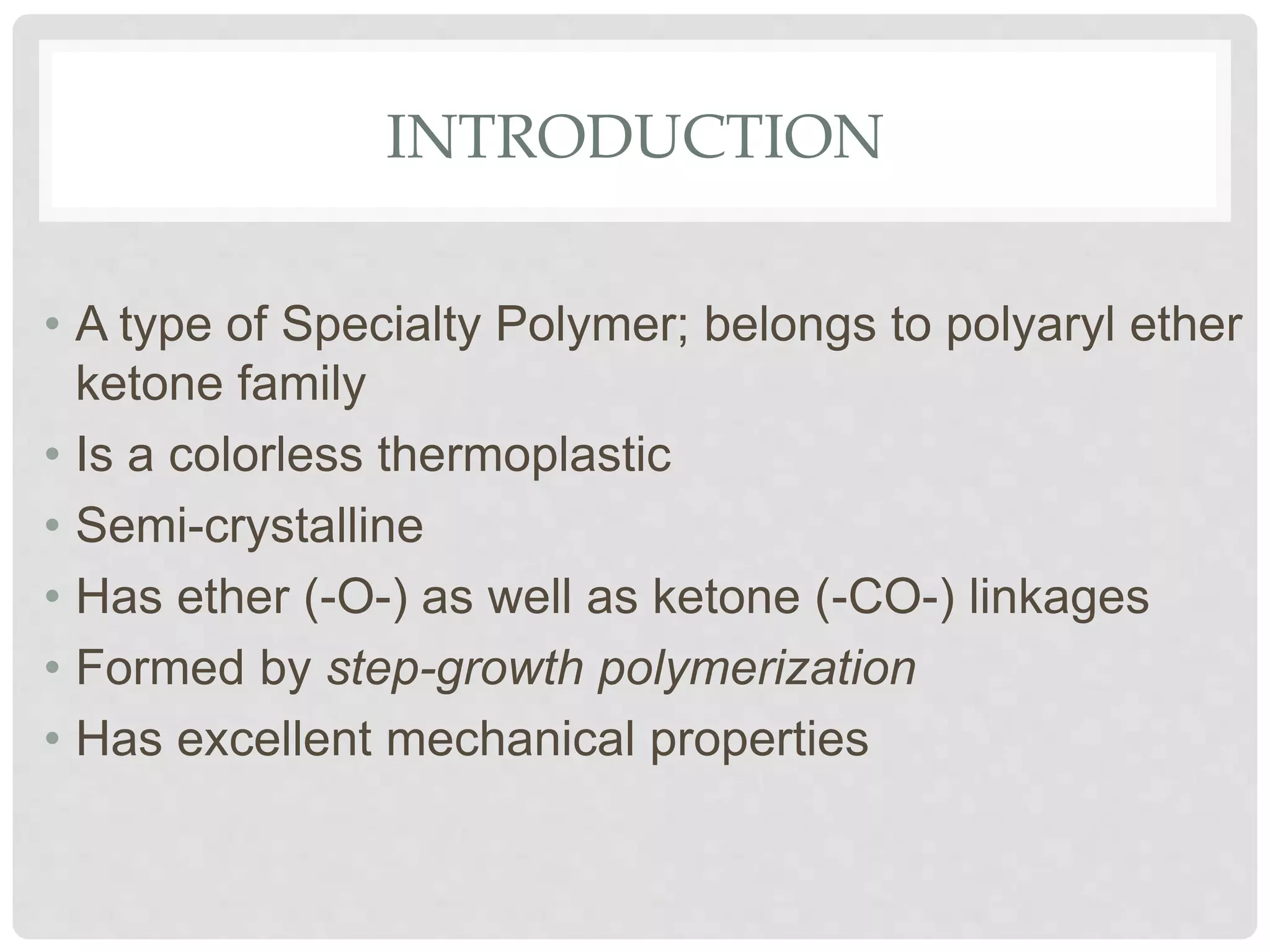
Properties
 Density  1.32 g cm-3
 Young’s Modulus  3.6 GPa
 Tensile Strength  90-100
MPa
 Elongation @ Break  50%
 Tg  1430C
 Tm  3430C
 Excellent creep resistance,
fatigue, stress crack,
chemical & hydrolysis
resistance
 Very low moisture absorption
(~ 0.1% in 24 hours)
 Attacked by halogens,
halogenated compounds &
aliphatics @ high temp
 Soluble in H2SO4 @ room
temp
 Can withstand high temp
(~2500C)
 Resistant to thermal as well
as biodegradation
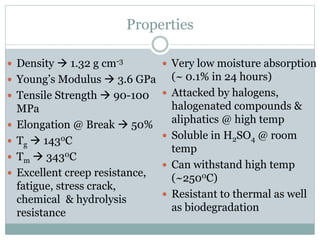
Steel Brass Aluminum
PEEK has 83% lower
density
PEEK has 85% low
Density
PEEK has 50% low
density
PEEK has better chemical
resistance
PEEK has better chemical
resistance
PEEK has better chemical
resistance
PEEK is softer PEEK is harder PEEK is harder
PEEK has better dry wear
PEEK has better wear &
friction resistance
PEEK has better wear &
friction resistance
PEEK vs. Steel vs. Brass vs. Aluminum
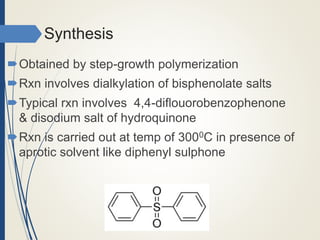
Synthesis
Obtained by step-growth polymerization
Rxn involves dialkylation of bisphenolate salts
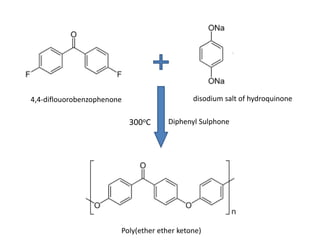
Typical rxn involves 4,4-diflouorobenzophenone
& disodium salt of hydroquinone
Rxn is carried out at temp of 3000C in presence of
aprotic solvent like diphenyl sulphone
4,4-diflouorobenzophenone disodium salt of hydroquinone
Poly(ether ether ketone)
300oC Diphenyl Sulphone
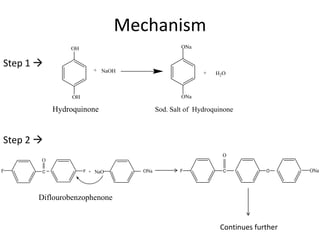
Mechanism
Step 1 
Step 2 
OH
+ NaOH + H2O
OH ONa
ONa
Hydroquinone Sod. Salt of Hydroquinone
C
O
F F + NaO ONa
Diflourobenzophenone
F C
O
O ONa
Continues further
APPLICATIONS
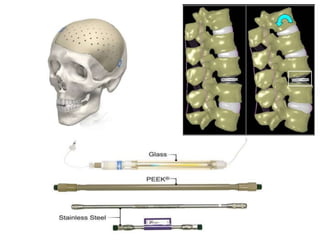
 Used in medical implants
 Fabrication of bearings, pistons, pumps, HPLC,
compressor plate valves & cable insulation
 Used for ultra high vacuum applications
 Coatings for metals
 Applications in aerospace, automotive & chemical
processing industries
 Used in spinal fusion devices
 Used as reinforcing rods
PEEK as Metal/Steel replacement
 PEEK is much lighter in wt
 Has comparable strength
 Resistant to chemicals at room temp
 Resistance to corrosion
 Is weld able, machinable
 Can be bonded with epoxies
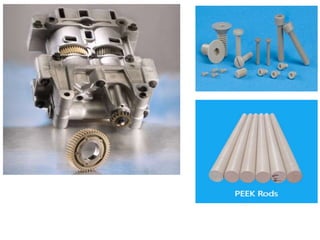
PEEK in Aerospace Industry
 Light in wt; Saves a lot of money (~ USD 5 Million)
 It matches aluminum’s mechanical property
 Resistant to hydraulic fluids
 PEEK tubing is superior to those of aluminum as
well as steel
 PEEK tubing & fittings have excellent abrasion
resistance
References
 https://en.wikipedia.org/wiki/PEEK
 Google images
 https://www.bpf.co.uk/plastipedia/polymers/p
eek.aspx
 http://www.offshore-
europe.co.uk/__novadocuments/88940?v=63
5702546462770000
Peek (polyether ether ketone)

Peek (polyether ether ketone)

  • 1.
    INTRODUCTION • A typeof Specialty Polymer; belongs to polyaryl ether ketone family • Is a colorless thermoplastic • Semi-crystalline • Has ether (-O-) as well as ketone (-CO-) linkages • Formed by step-growth polymerization • Has excellent mechanical properties
  • 2.
    Properties  Density 1.32 g cm-3  Young’s Modulus  3.6 GPa  Tensile Strength  90-100 MPa  Elongation @ Break  50%  Tg  1430C  Tm  3430C  Excellent creep resistance, fatigue, stress crack, chemical & hydrolysis resistance  Very low moisture absorption (~ 0.1% in 24 hours)  Attacked by halogens, halogenated compounds & aliphatics @ high temp  Soluble in H2SO4 @ room temp  Can withstand high temp (~2500C)  Resistant to thermal as well as biodegradation
  • 3.
    Steel Brass Aluminum PEEKhas 83% lower density PEEK has 85% low Density PEEK has 50% low density PEEK has better chemical resistance PEEK has better chemical resistance PEEK has better chemical resistance PEEK is softer PEEK is harder PEEK is harder PEEK has better dry wear PEEK has better wear & friction resistance PEEK has better wear & friction resistance PEEK vs. Steel vs. Brass vs. Aluminum
  • 4.
    Synthesis Obtained by step-growthpolymerization Rxn involves dialkylation of bisphenolate salts Typical rxn involves 4,4-diflouorobenzophenone & disodium salt of hydroquinone Rxn is carried out at temp of 3000C in presence of aprotic solvent like diphenyl sulphone
  • 5.
    4,4-diflouorobenzophenone disodium saltof hydroquinone Poly(ether ether ketone) 300oC Diphenyl Sulphone
  • 6.
    Mechanism Step 1  Step2  OH + NaOH + H2O OH ONa ONa Hydroquinone Sod. Salt of Hydroquinone C O F F + NaO ONa Diflourobenzophenone F C O O ONa Continues further
  • 7.
    APPLICATIONS  Used inmedical implants  Fabrication of bearings, pistons, pumps, HPLC, compressor plate valves & cable insulation  Used for ultra high vacuum applications  Coatings for metals  Applications in aerospace, automotive & chemical processing industries  Used in spinal fusion devices  Used as reinforcing rods
  • 8.
    PEEK as Metal/Steelreplacement  PEEK is much lighter in wt  Has comparable strength  Resistant to chemicals at room temp  Resistance to corrosion  Is weld able, machinable  Can be bonded with epoxies
  • 9.
    PEEK in AerospaceIndustry  Light in wt; Saves a lot of money (~ USD 5 Million)  It matches aluminum’s mechanical property  Resistant to hydraulic fluids  PEEK tubing is superior to those of aluminum as well as steel  PEEK tubing & fittings have excellent abrasion resistance
  • 12.
    References  https://en.wikipedia.org/wiki/PEEK  Googleimages  https://www.bpf.co.uk/plastipedia/polymers/p eek.aspx  http://www.offshore- europe.co.uk/__novadocuments/88940?v=63 5702546462770000