1
Crystallisation, Flow and Continuous
Processing.
By
Professor Malcolm Mackley
Department of Chemical Engineering and
Biotechnology.
University of Cambridge
UK
Strathclyde 2014
A story that started for me in 1970
2
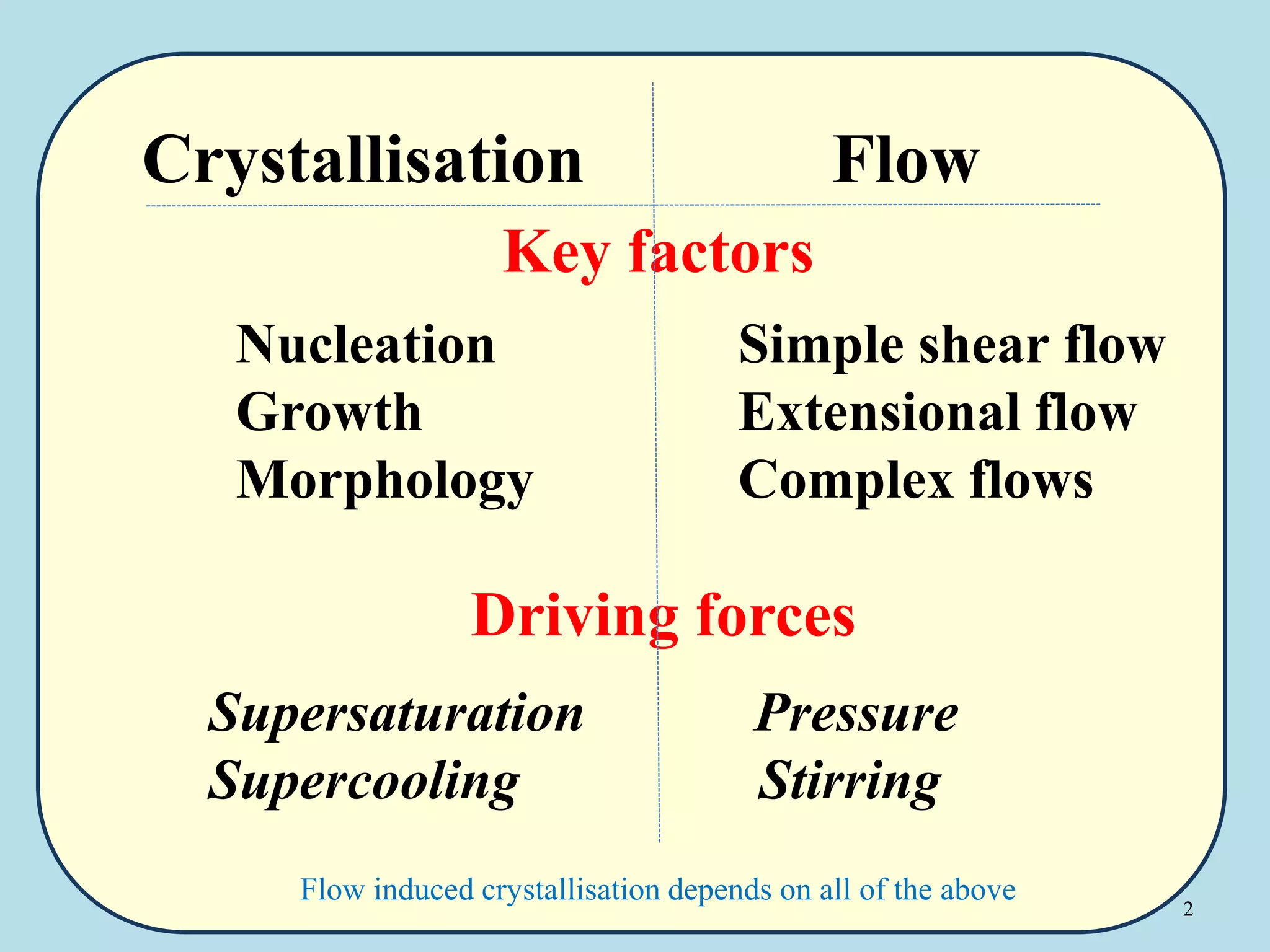
Crystallisation Flow
Nucleation
Growth
Morphology
Supersaturation Pressure
Supercooling Stirring
Simple shear flow
Extensional flow
Complex flows
Driving forces
Key factors
Flow induced crystallisation depends on all of the above
3
Types of Flow
Laminar or Complex flow
Go with the flow!
where
 = density
u = velocity
D = a length scale
h = viscosity
Re < 1 𝐿𝑎𝑚𝑖𝑛𝑎𝑟 𝑅𝑒 ≈ 1 − 1000 𝐶𝑜𝑚𝑝𝑙𝑒𝑥 𝑅𝑒 > 1000 𝑇𝑢𝑟𝑏𝑢𝑙𝑒𝑛𝑡
Reynolds number Re =
𝜌 𝑢 𝐷
𝜂
4
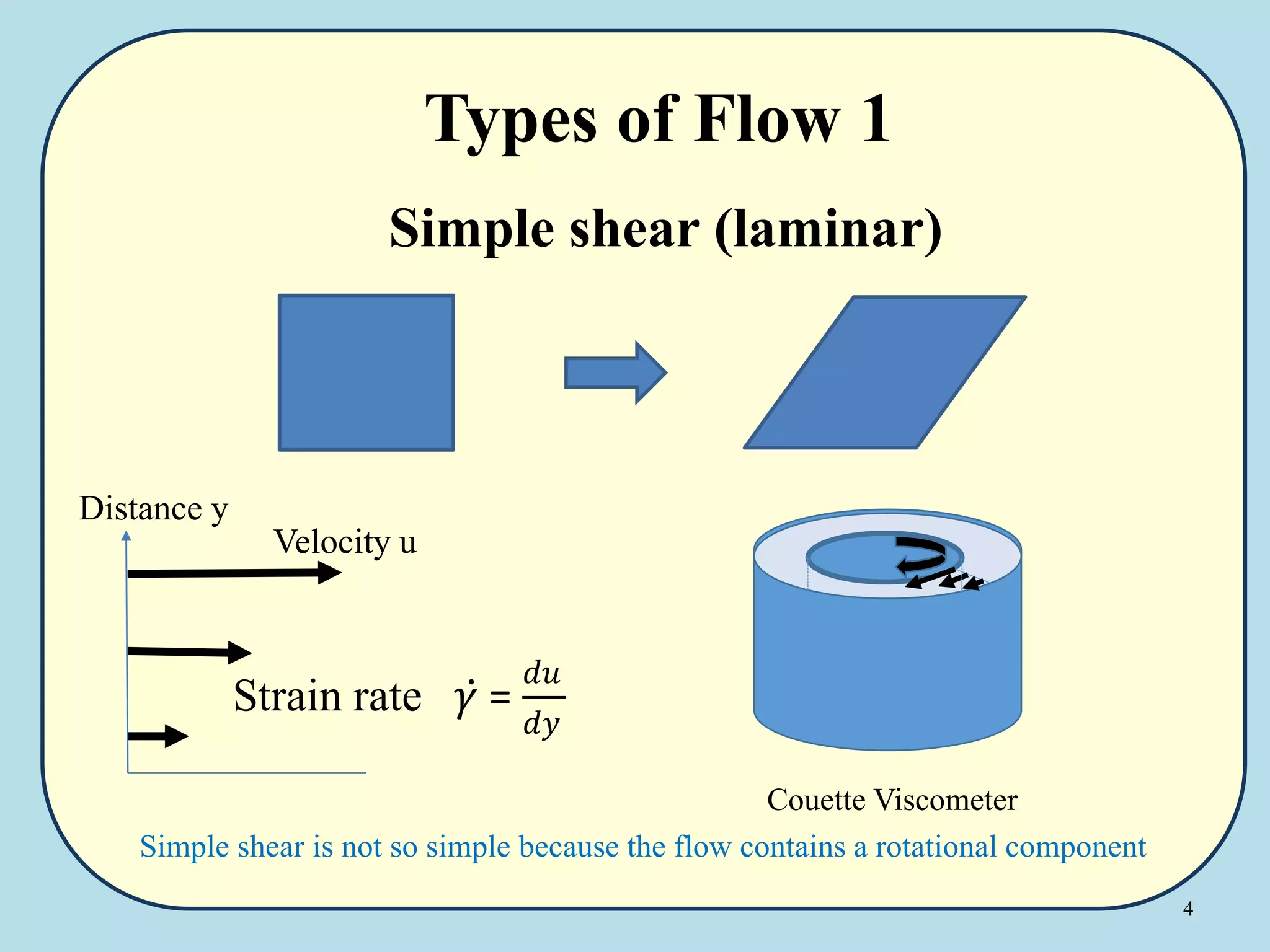
Types of Flow 1
Simple shear (laminar)
Simple shear is not so simple because the flow contains a rotational component
Couette Viscometer
Strain rate 𝛾 =
𝑑𝑢
𝑑𝑦
Velocity u
Distance y
5
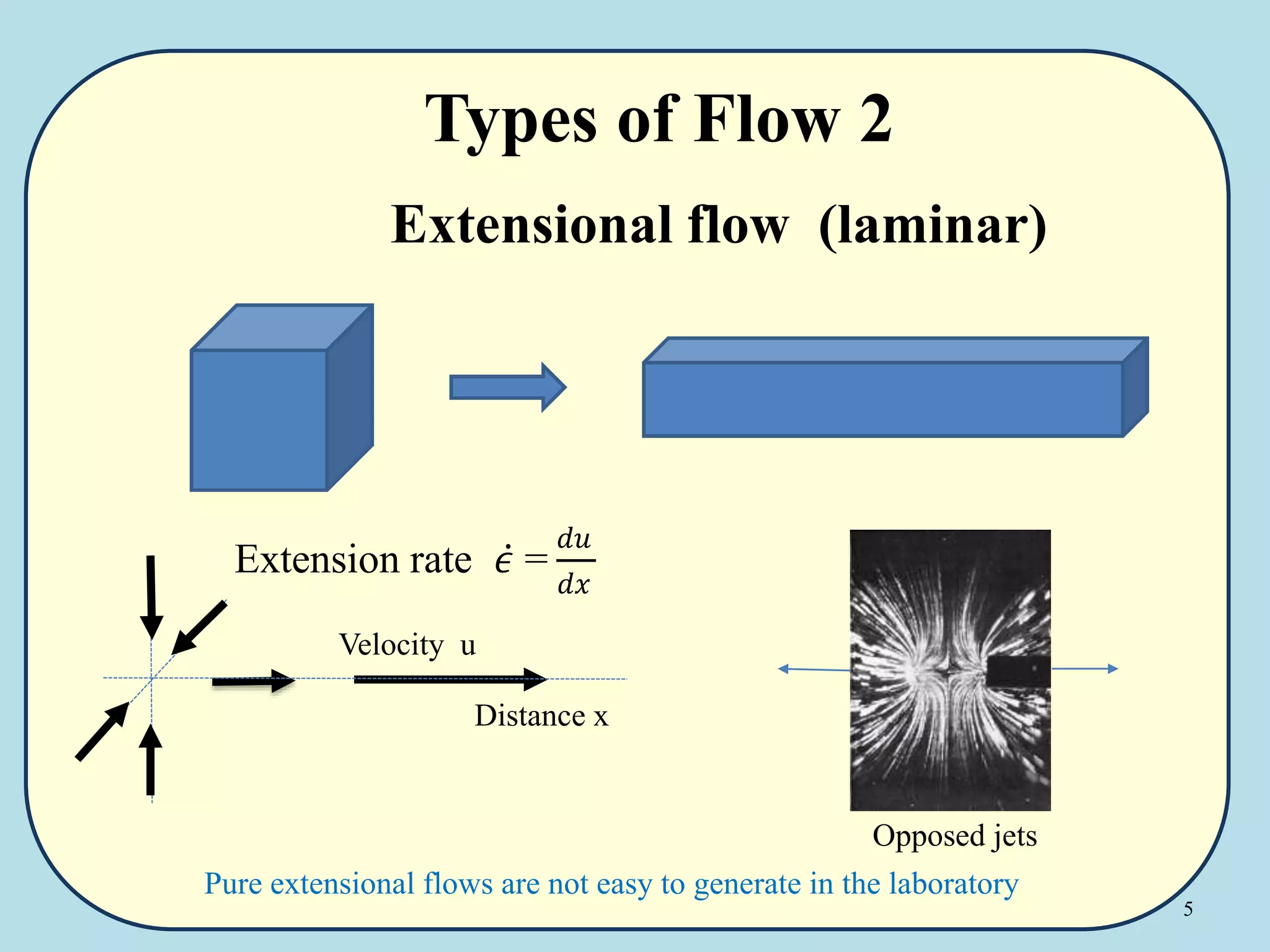
Types of Flow 2
Extensional flow (laminar)
Pure extensional flows are not easy to generate in the laboratory
Extension rate 𝜖 =
𝑑𝑢
𝑑𝑥
Velocity u
Distance x
Opposed jets
6
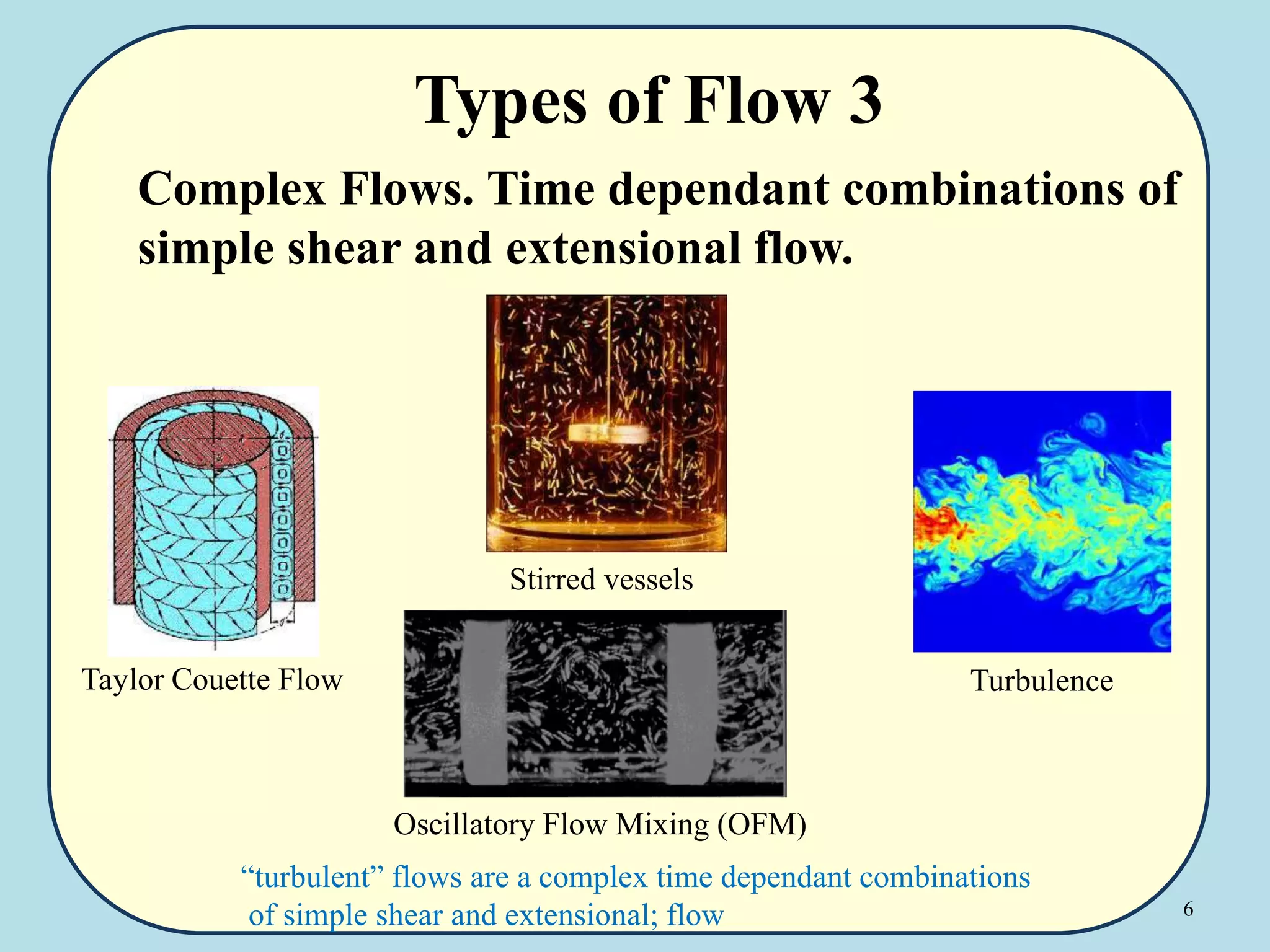
Types of Flow 3
Complex Flows. Time dependant combinations of
simple shear and extensional flow.
Taylor Couette Flow Turbulence
Stirred vessels
Oscillatory Flow Mixing (OFM)
“turbulent” flows are a complex time dependant combinations
of simple shear and extensional; flow
7
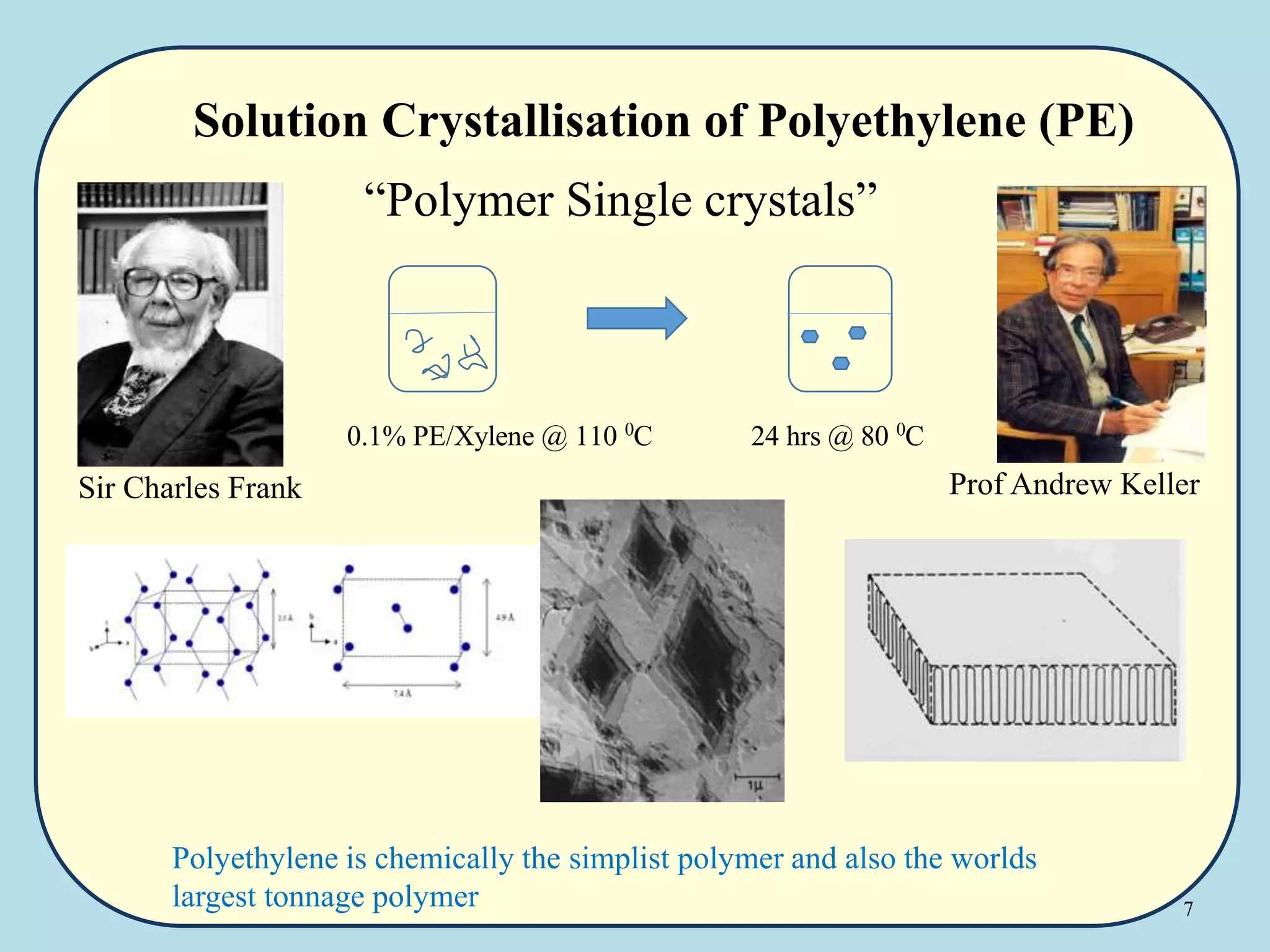
Solution Crystallisation of Polyethylene (PE)
Polyethylene is chemically the simplist polymer and also the worlds
largest tonnage polymer
“Polymer Single crystals”
Sir Charles Frank Prof Andrew Keller
0.1% PE/Xylene @ 110 0
C 24 hrs @ 80 0
C
8
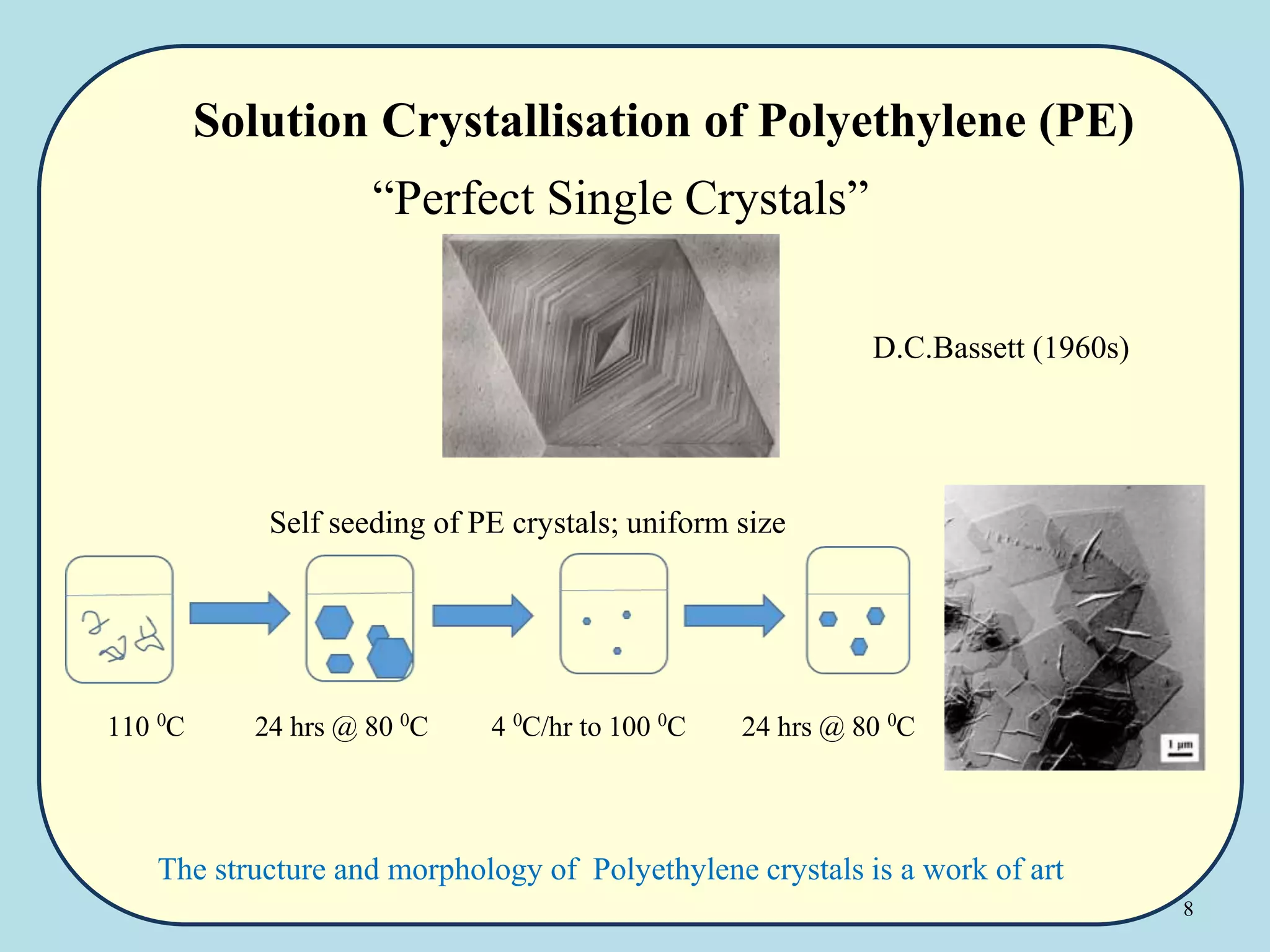
Solution Crystallisation of Polyethylene (PE)
The structure and morphology of Polyethylene crystals is a work of art
“Perfect Single Crystals”
Self seeding of PE crystals; uniform size
110 0
C 24 hrs @ 80 0
C 4 0
C/hr to 100 0
C 24 hrs @ 80 0
C
D.C.Bassett (1960s)
9
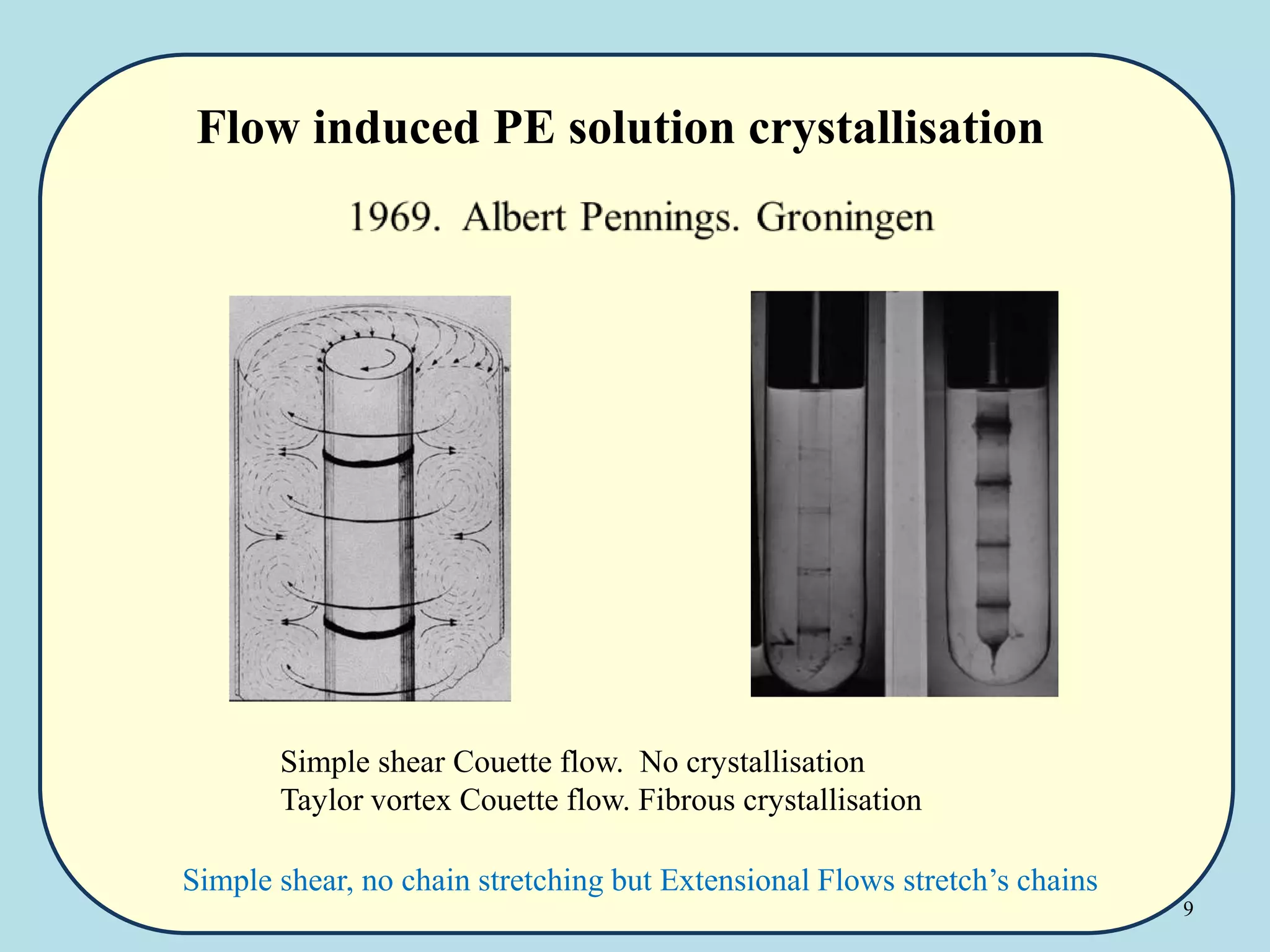
Flow induced PE solution crystallisation
Simple shear, no chain stretching but Extensional Flows stretch’s chains
Simple shear Couette flow. No crystallisation
Taylor vortex Couette flow. Fibrous crystallisation
10
Flow induced PE solution crystallisation
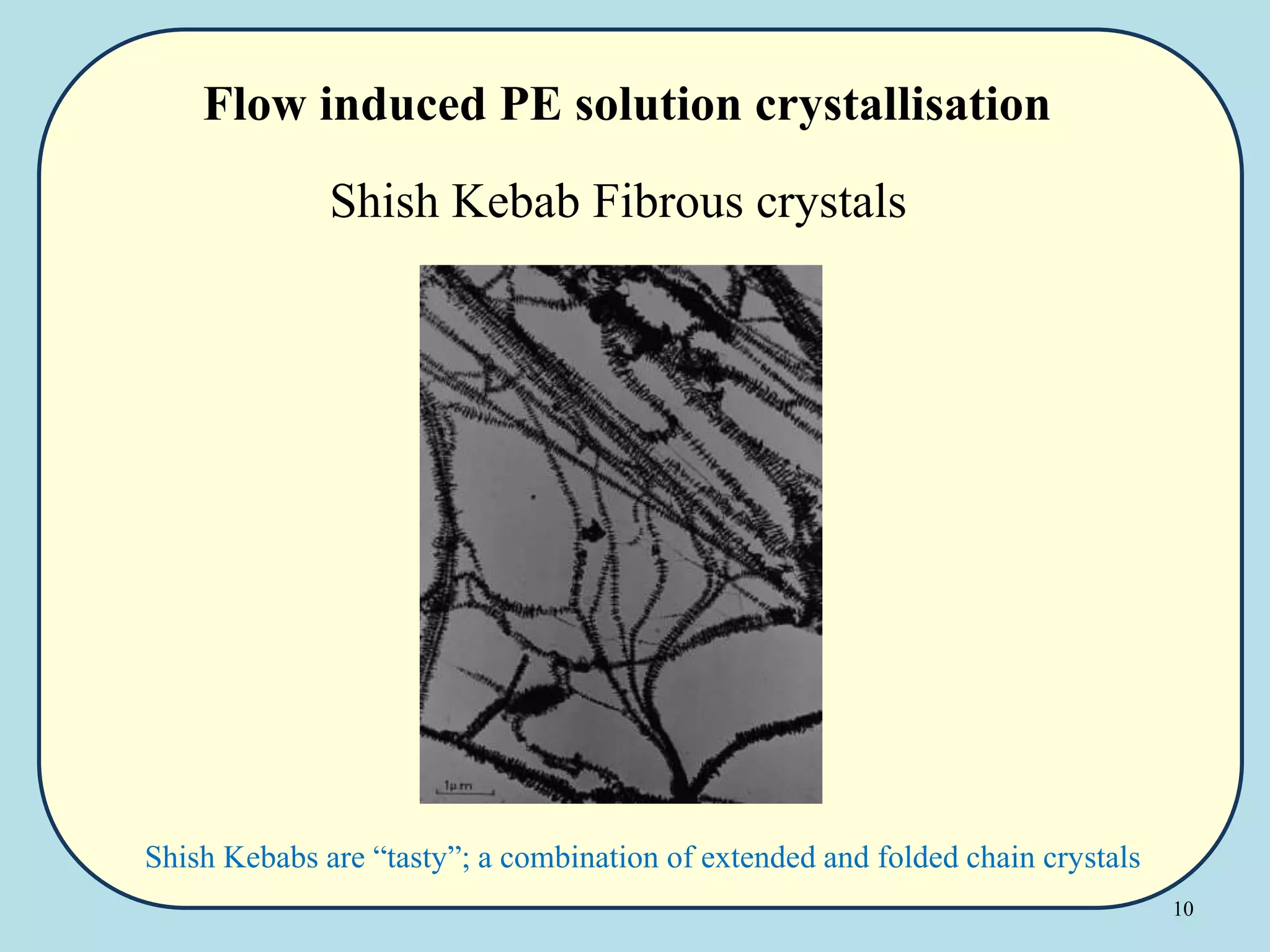
Shish Kebabs are “tasty”; a combination of extended and folded chain crystals
Shish Kebab Fibrous crystals
11
Flow induced PE solution crystallisation
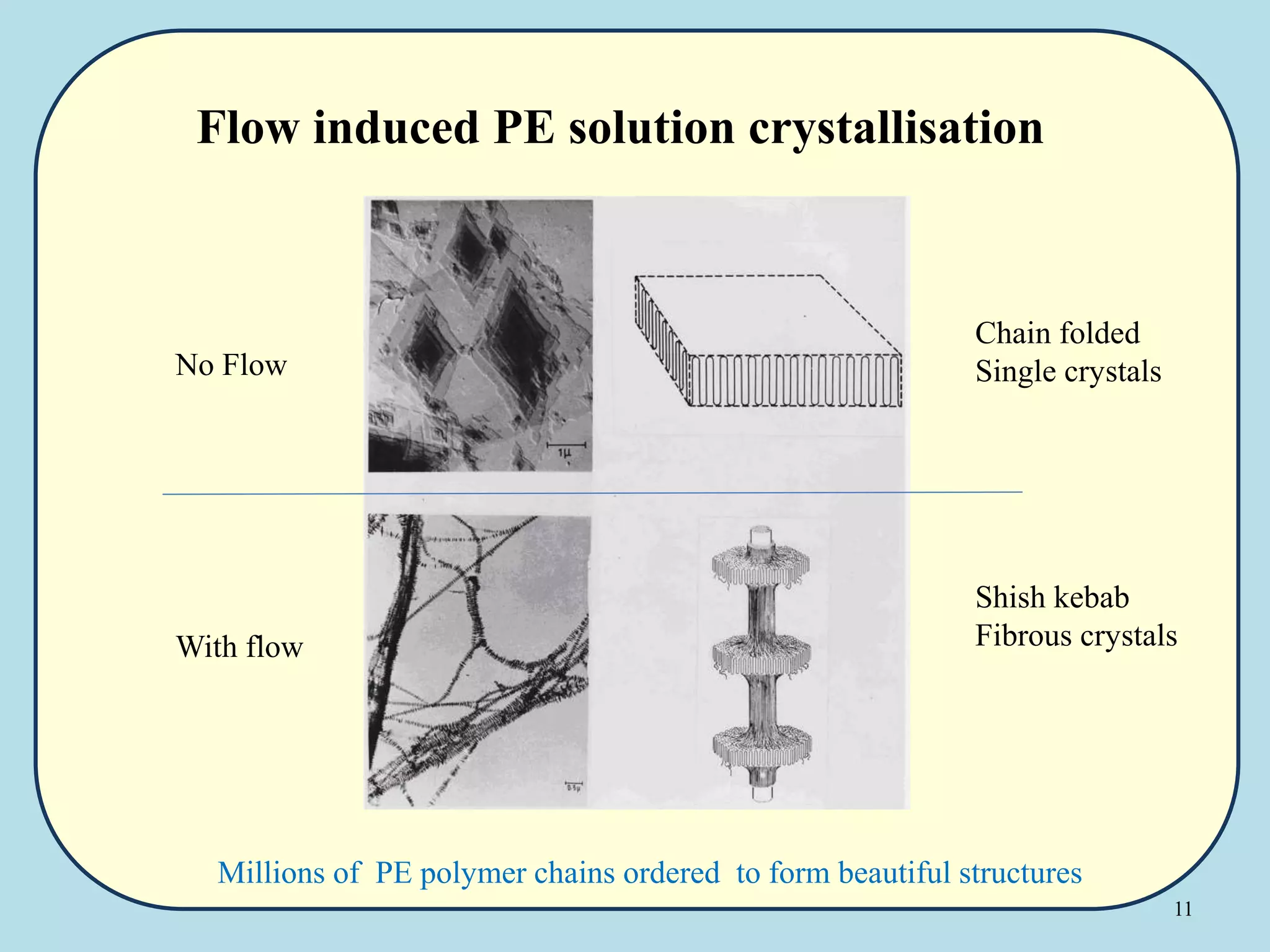
Millions of PE polymer chains ordered to form beautiful structures
No Flow
With flow
Chain folded
Single crystals
Shish kebab
Fibrous crystals
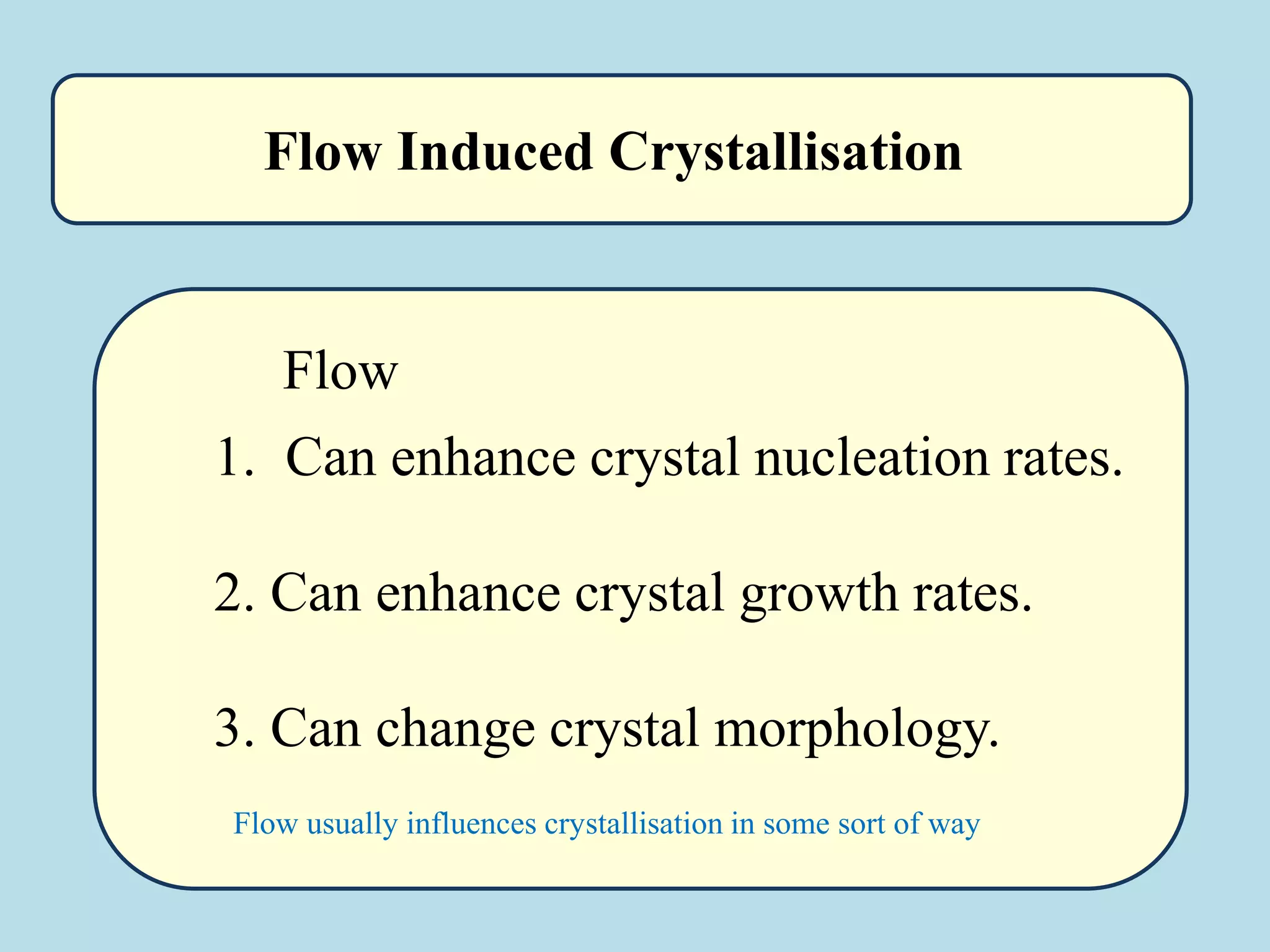
1. Can enhance crystal nucleation rates.
2. Can enhance crystal growth rates.
3. Can change crystal morphology.
Flow Induced Crystallisation
Flow usually influences crystallisation in some sort of way
Flow
Flow Induced Crystallisation
Some things in life are not simple
Think
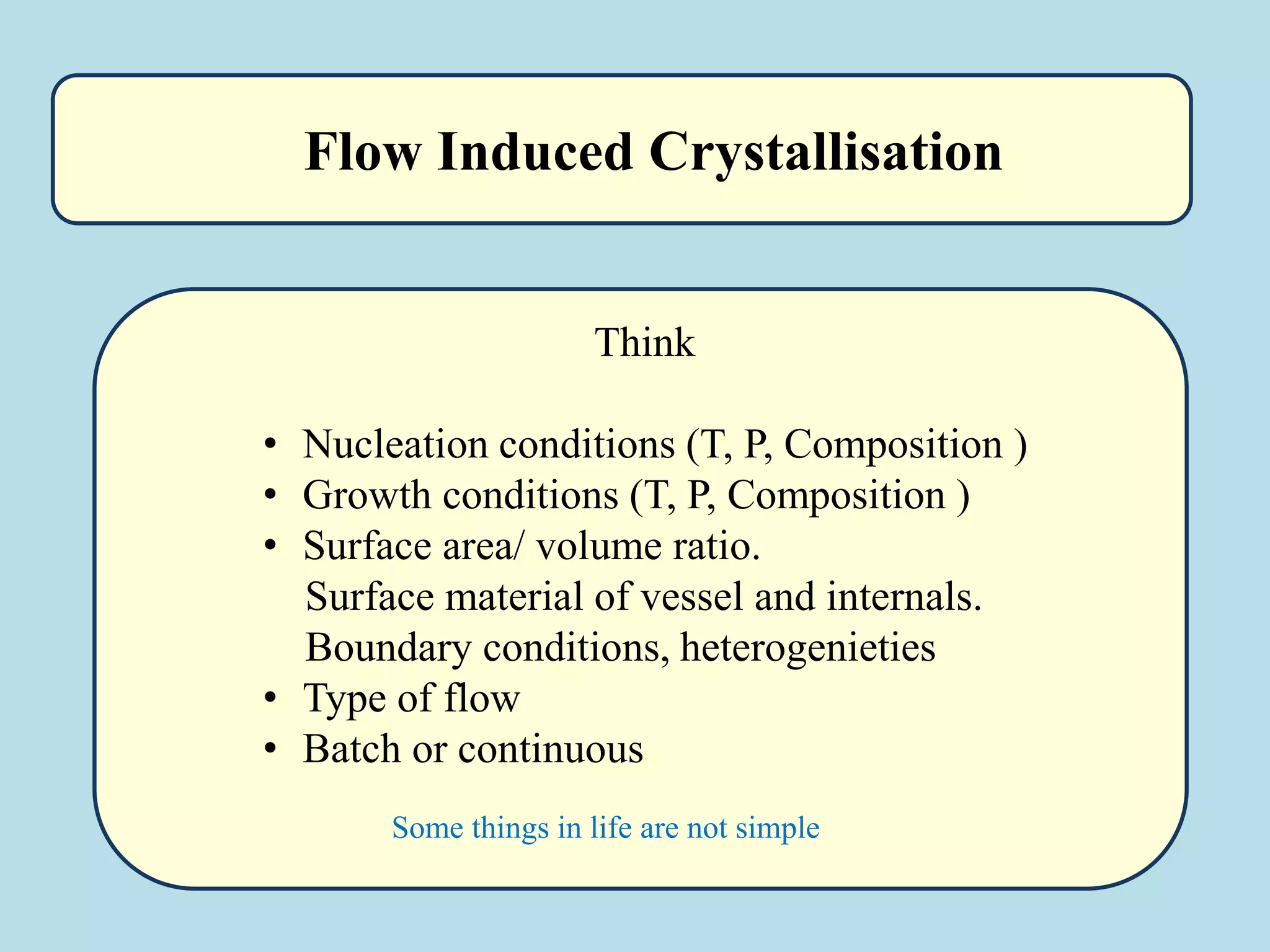
• Nucleation conditions (T, P, Composition )
• Growth conditions (T, P, Composition )
• Surface area/ volume ratio.
Surface material of vessel and internals.
Boundary conditions, heterogenieties
• Type of flow
• Batch or continuous
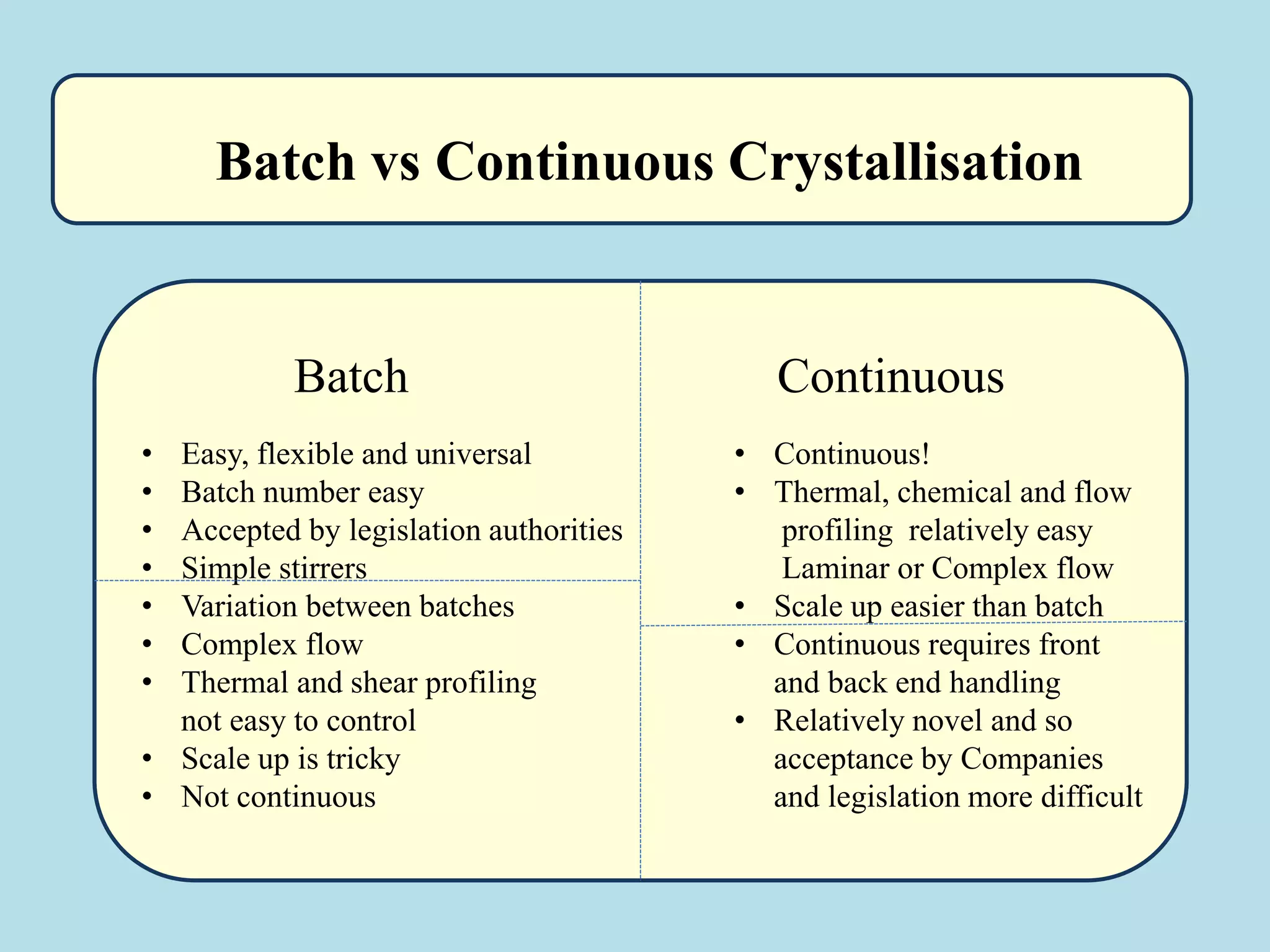
Batch vs Continuous Crystallisation
Batch Continuous
• Easy, flexible and universal
• Batch number easy
• Accepted by legislation authorities
• Simple stirrers
• Variation between batches
• Complex flow
• Thermal and shear profiling
not easy to control
• Scale up is tricky
• Not continuous
• Continuous!
• Thermal, chemical and flow
profiling relatively easy
Laminar or Complex flow
• Scale up easier than batch
• Continuous requires front
and back end handling
• Relatively novel and so
acceptance by Companies
and legislation more difficult
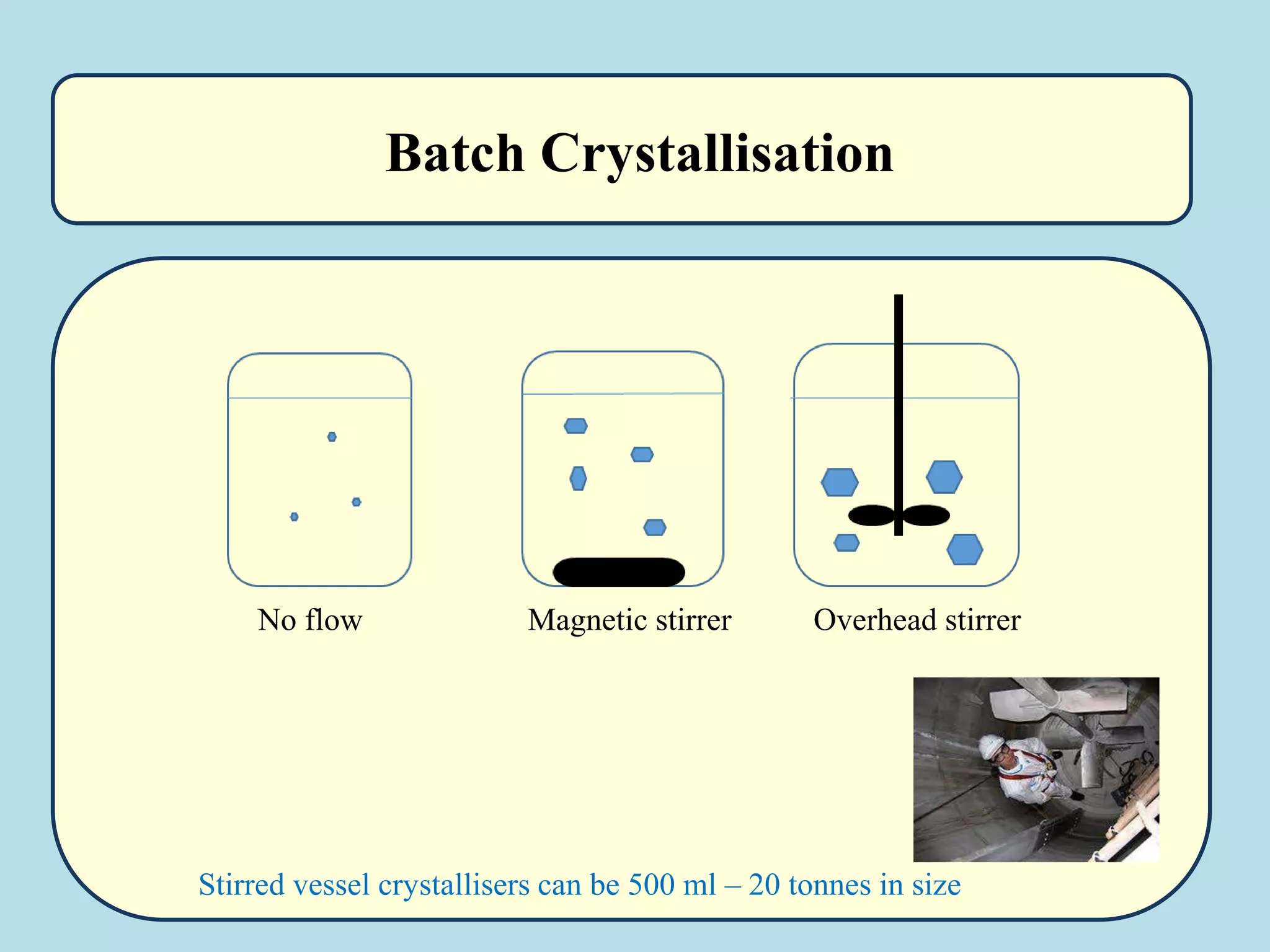
Batch Crystallisation
No flow Magnetic stirrer Overhead stirrer
Stirred vessel crystallisers can be 500 ml – 20 tonnes in size
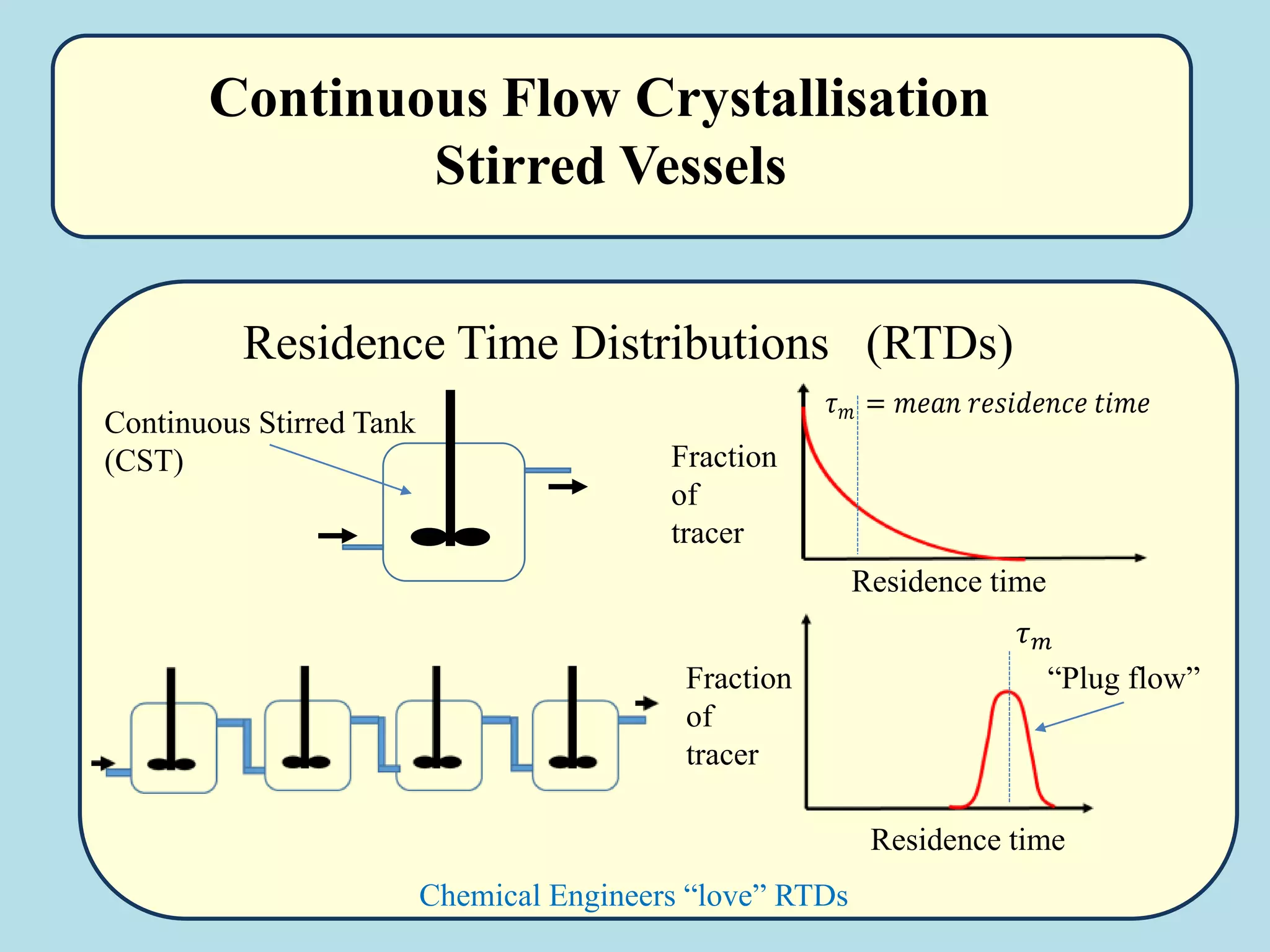
Continuous Flow Crystallisation
Stirred Vessels
Residence Time Distributions (RTDs)
Chemical Engineers “love” RTDs
Residence time
Fraction
of
tracer
Fraction
of
tracer
Residence time
“Plug flow”
Continuous Stirred Tank
(CST)
𝜏 𝑚 = 𝑚𝑒𝑎𝑛 𝑟𝑒𝑠𝑖𝑑𝑒𝑛𝑐𝑒 𝑡𝑖𝑚𝑒
𝜏 𝑚
17
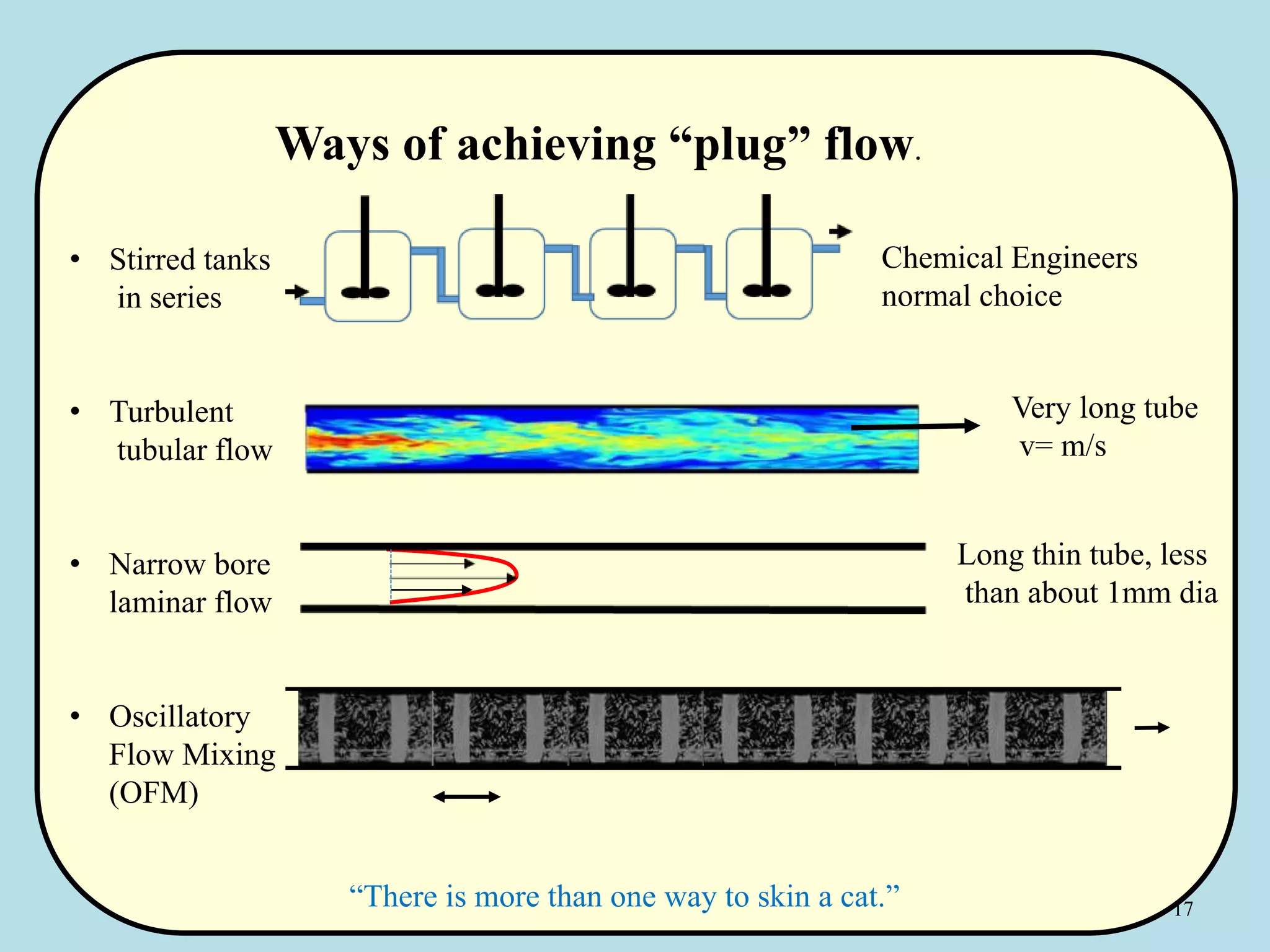
Ways of achieving “plug” flow.
• Stirred tanks
in series
• Turbulent
tubular flow
• Narrow bore
laminar flow
• Oscillatory
Flow Mixing
(OFM)
Very long tube
v= m/s
Chemical Engineers
normal choice
Long thin tube, less
than about 1mm dia
“There is more than one way to skin a cat.”
18
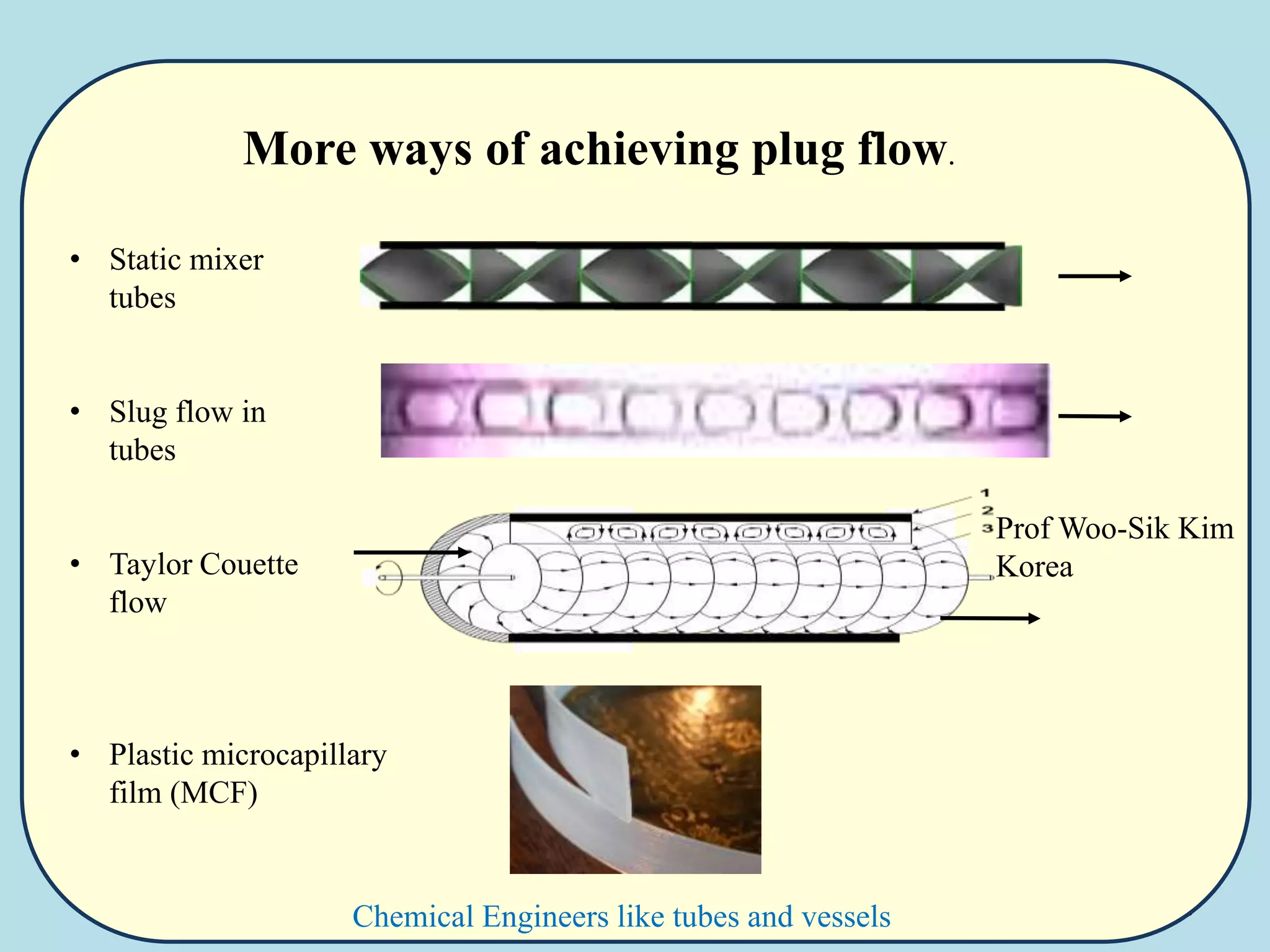
More ways of achieving plug flow.
• Static mixer
tubes
• Slug flow in
tubes
• Taylor Couette
flow
• Plastic microcapillary
film (MCF)
Prof Woo-Sik Kim
Korea
Chemical Engineers like tubes and vessels
19
Oscillatory Flow Mixing (OFM)
Inertial mixing flow. Tube diameters, mm - cms
A question of scale!
g/hr, Kg/hr, tonnes/hr
“Discovered” in 1980s
20
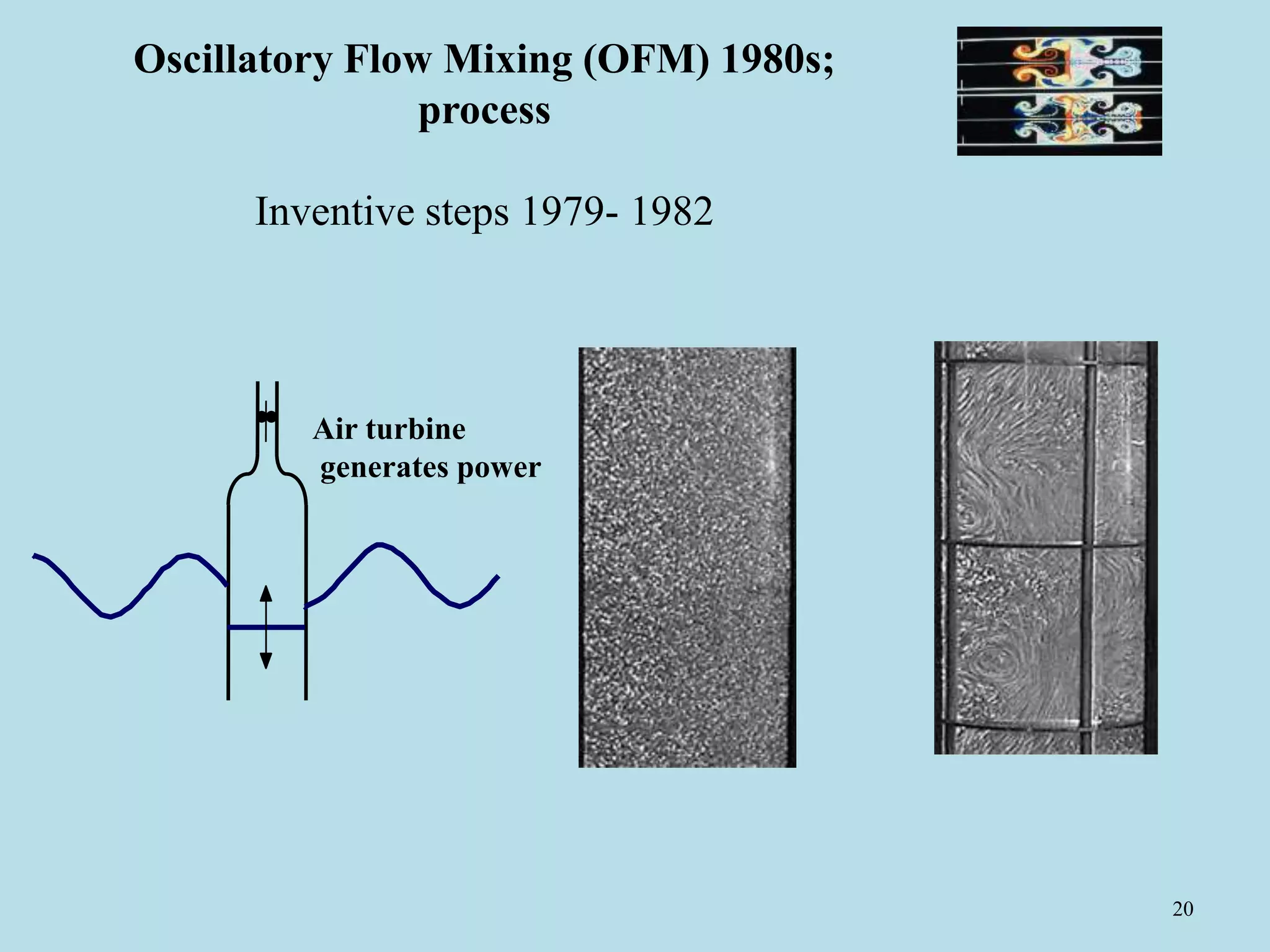
Oscillatory Flow Mixing (OFM) 1980s;
process
Inventive steps 1979- 1982
Air turbine
generates power
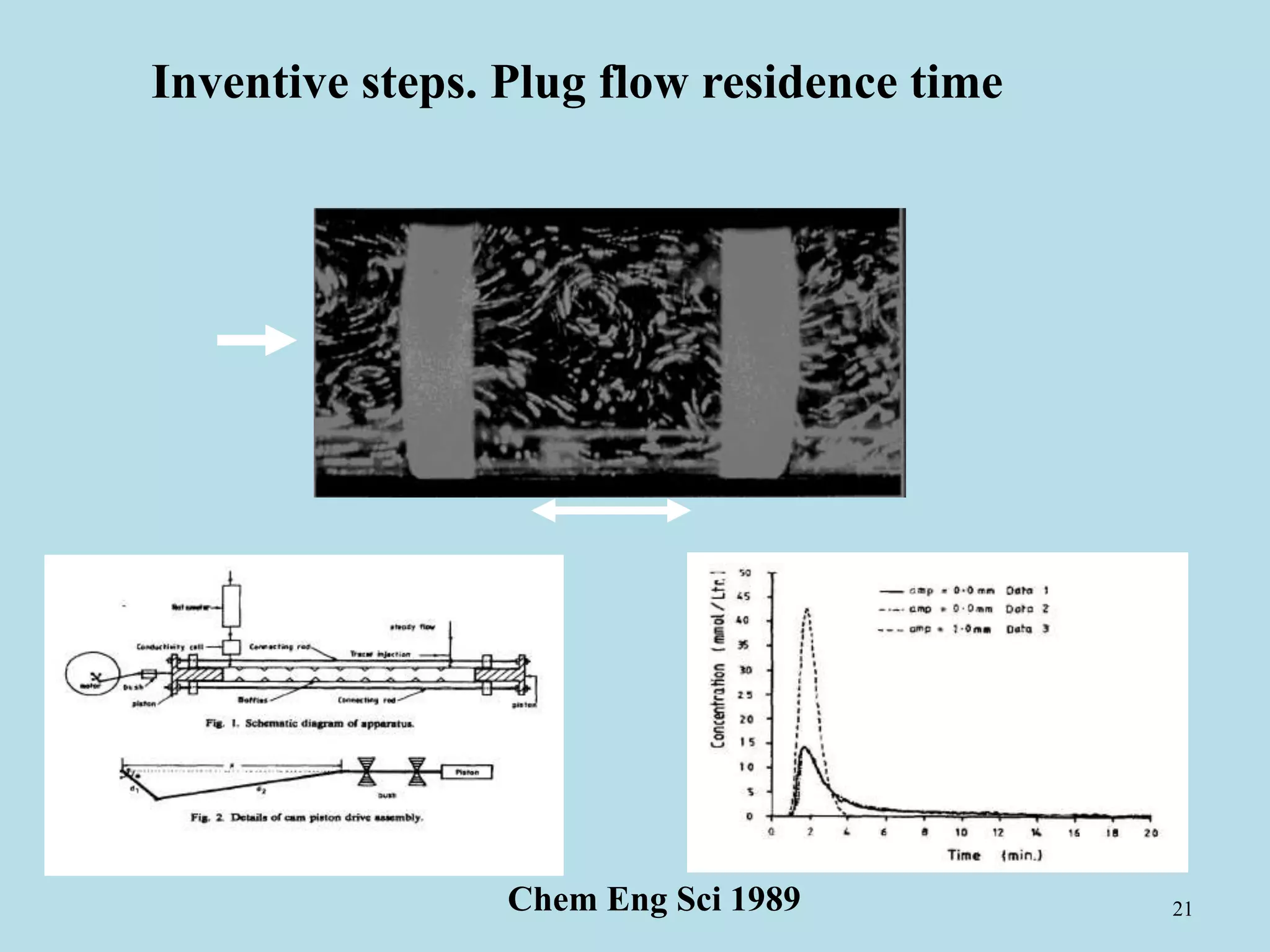
21Chem Eng Sci 1989
Inventive steps. Plug flow residence time
22
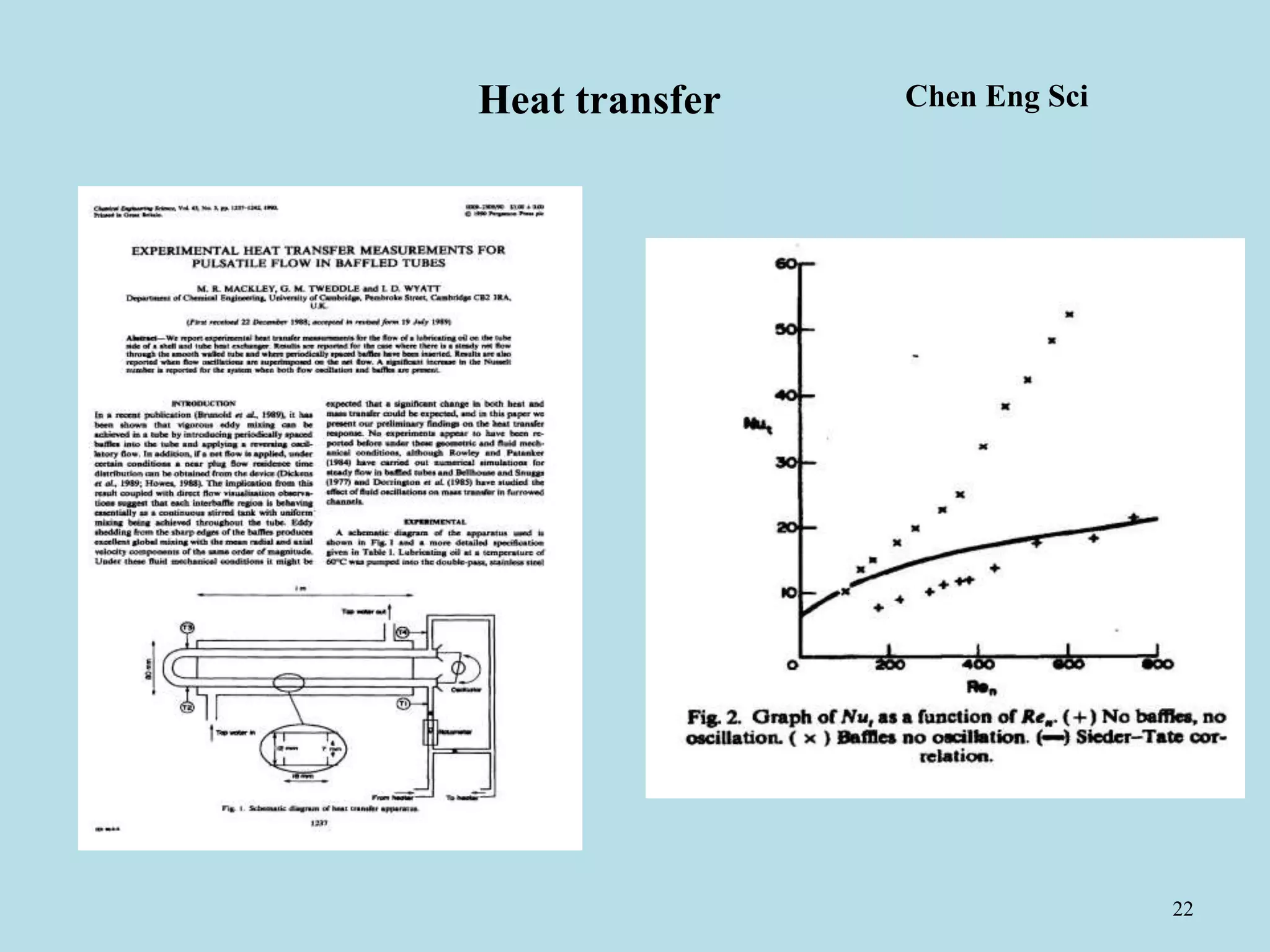
Heat transfer Chen Eng Sci
23
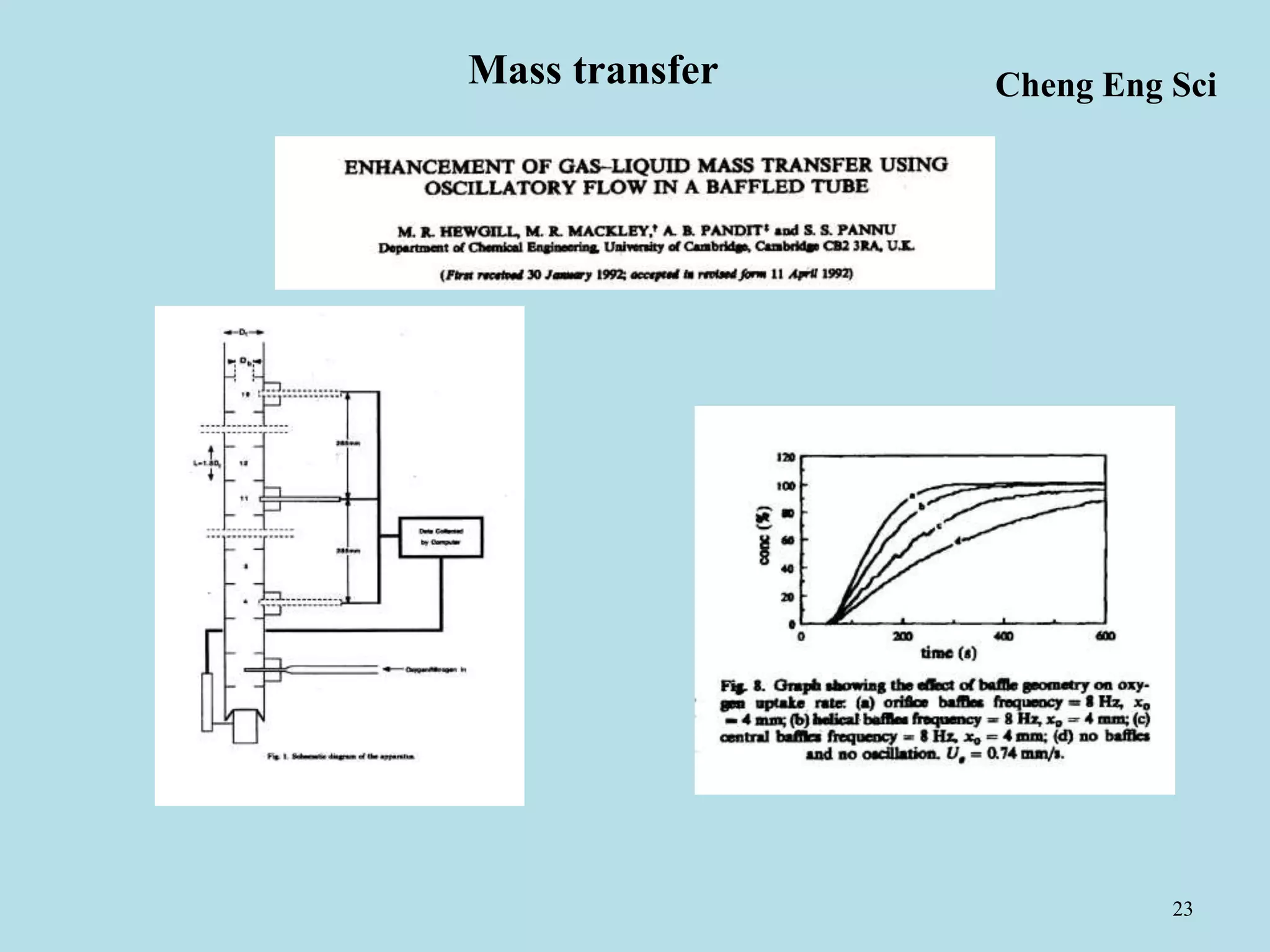
Mass transfer Cheng Eng Sci
24
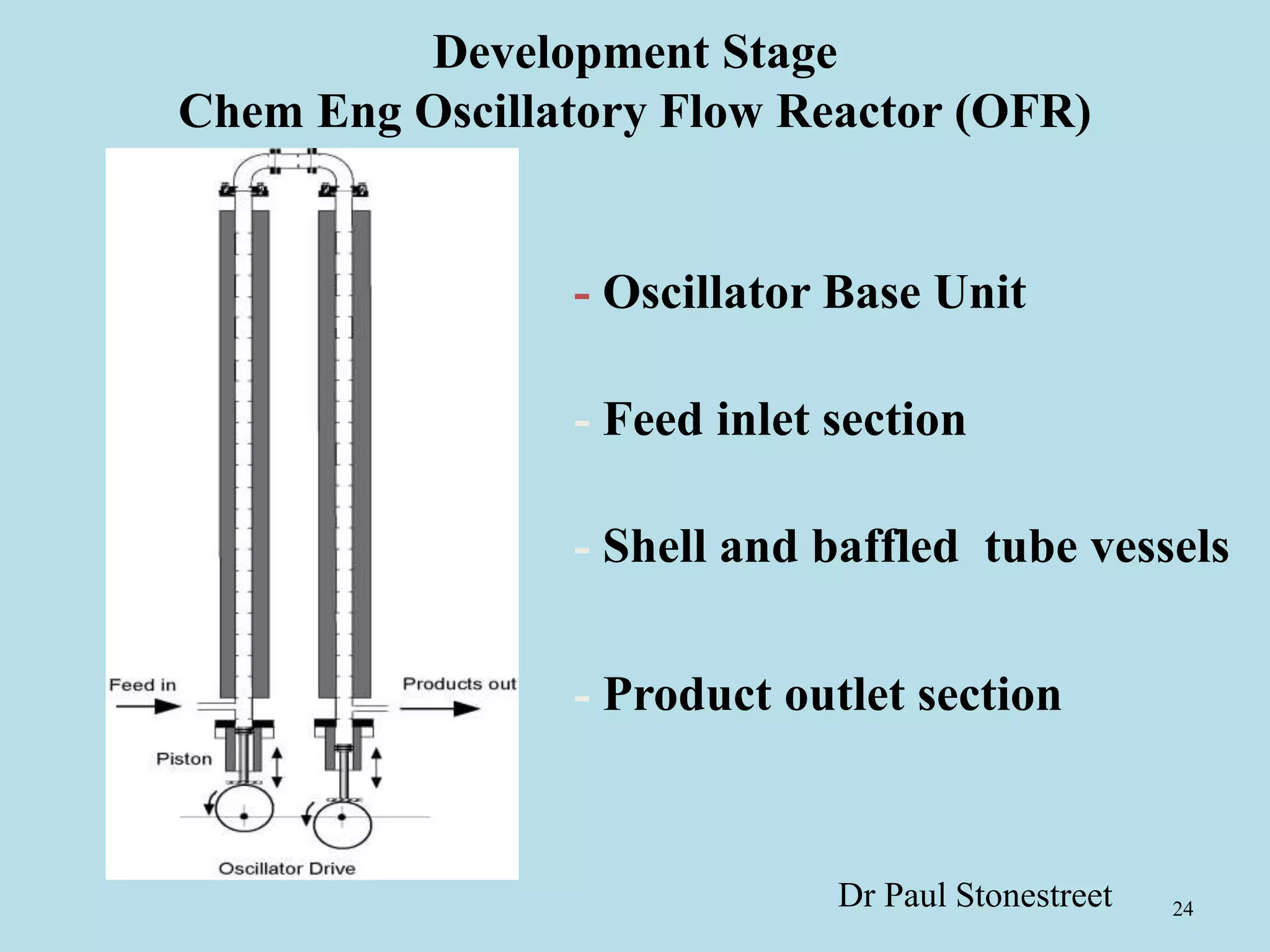
- Oscillator Base Unit
- Feed inlet section
- Shell and baffled tube vessels
- Product outlet section
Development Stage
Chem Eng Oscillatory Flow Reactor (OFR)
Dr Paul Stonestreet
25
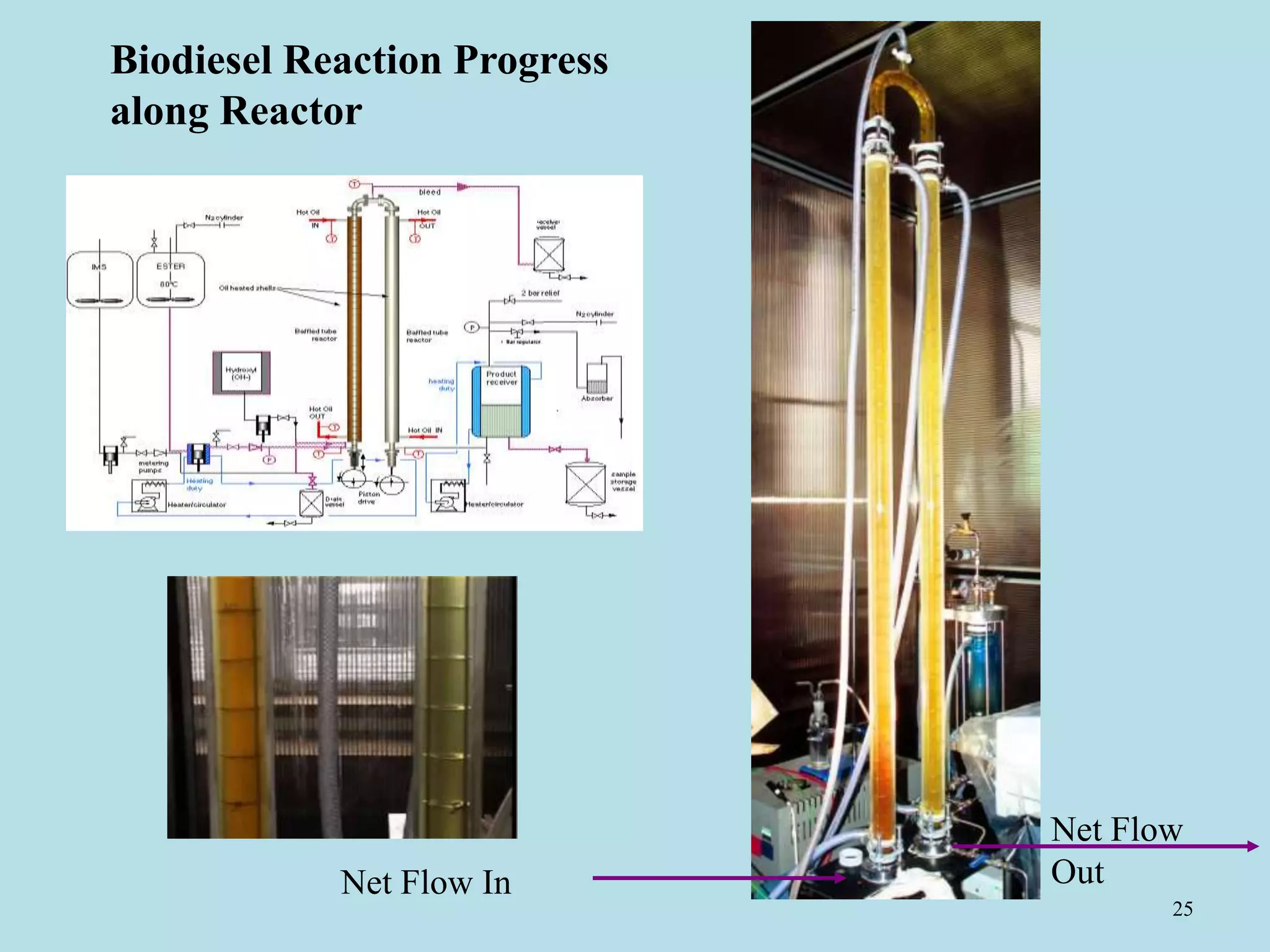
Net Flow In
Net Flow
Out
Biodiesel Reaction Progress
along Reactor
26
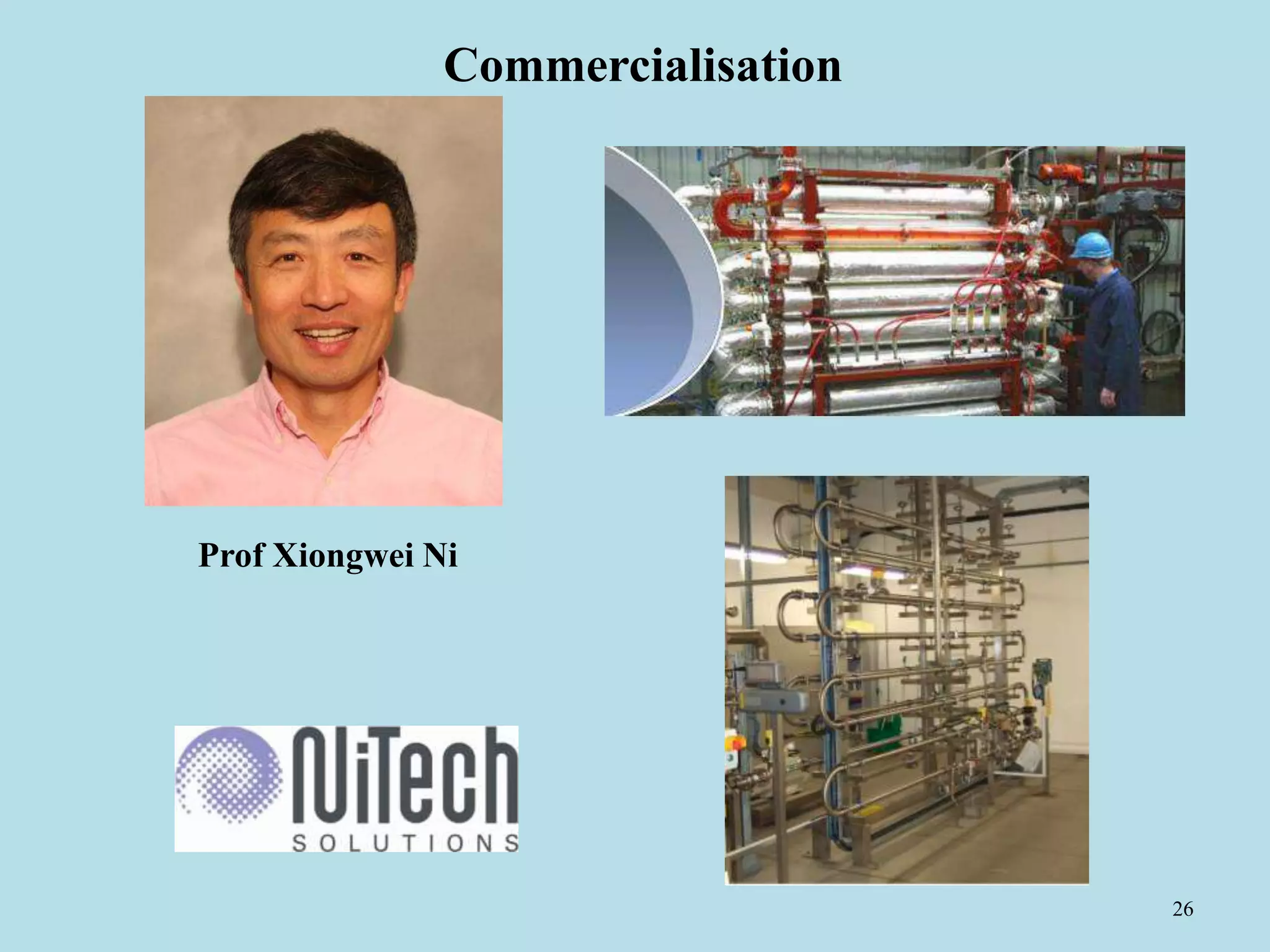
Prof Xiongwei Ni
Commercialisation
27
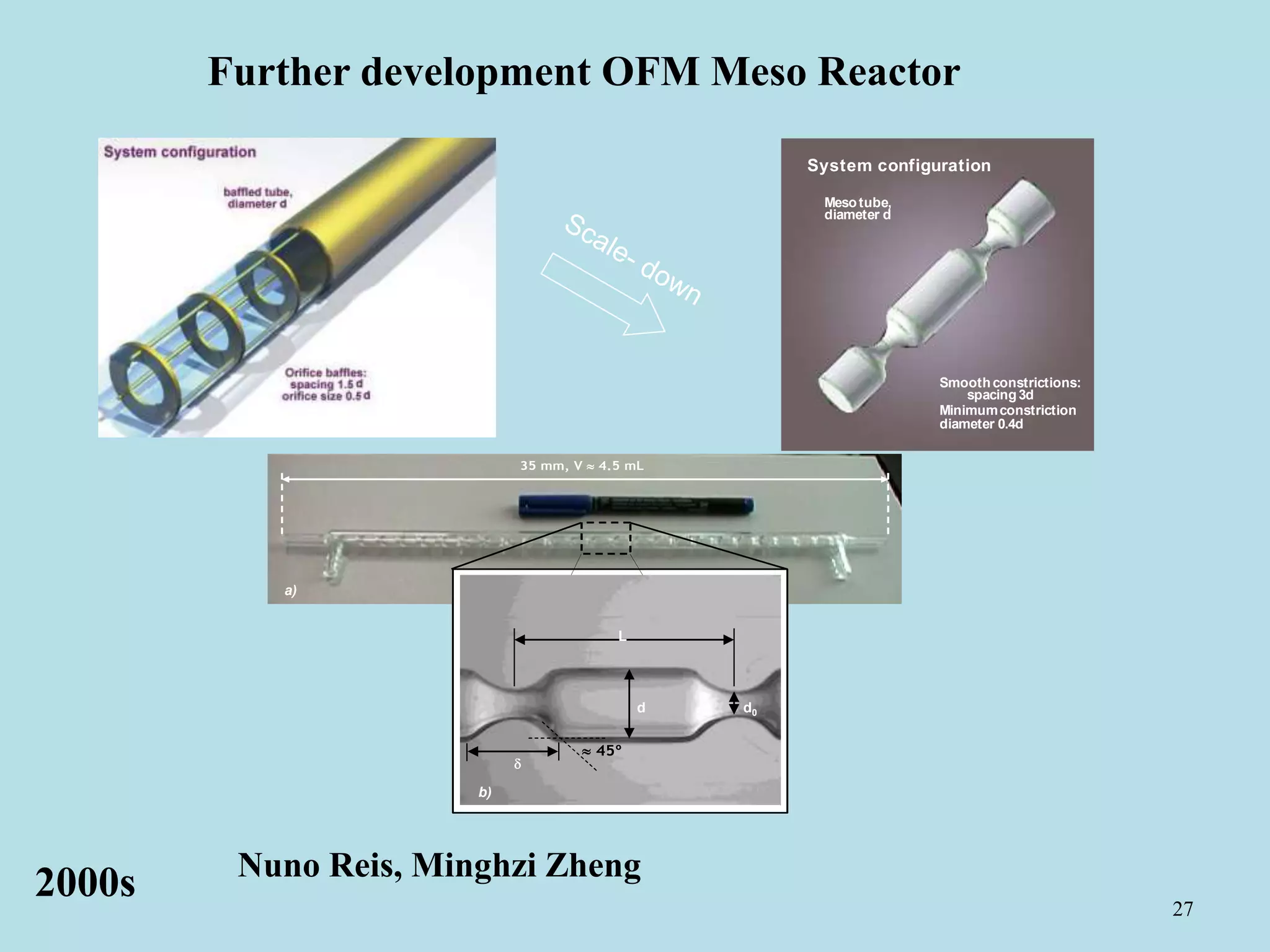
Further development OFM Meso Reactor
Nuno Reis, Minghzi Zheng
System configuration
Mesotube,
diameter d
Smoothconstrictions:
spacing3d
Minimumconstriction
diameter 0.4d
2000s
 45º
35 mm, V  4.5 mL
 45º
35 mm, V  4.5 mL
a)
b)
L
d d0

28
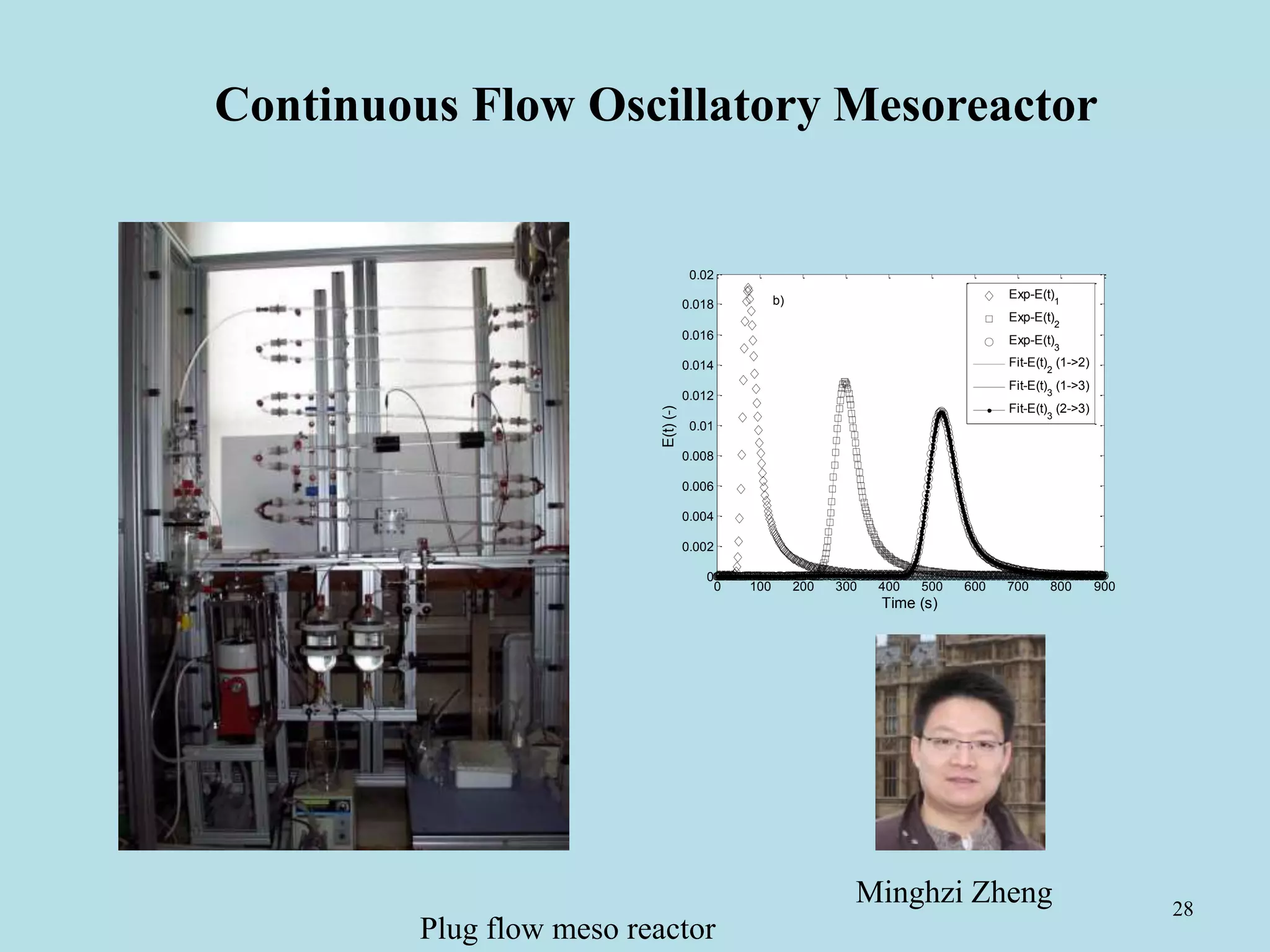
0 100 200 300 400 500 600 700 800 900
0
0.002
0.004
0.006
0.008
0.01
0.012
0.014
0.016
0.018
0.02
Time (s)
E(t)(-)
b) Exp-E(t)1
Exp-E(t)2
Exp-E(t)3
Fit-E(t)2
(1->2)
Fit-E(t)3
(1->3)
Fit-E(t)
3
(2->3)
Continuous Flow Oscillatory Mesoreactor
Minghzi Zheng
Plug flow meso reactor
29
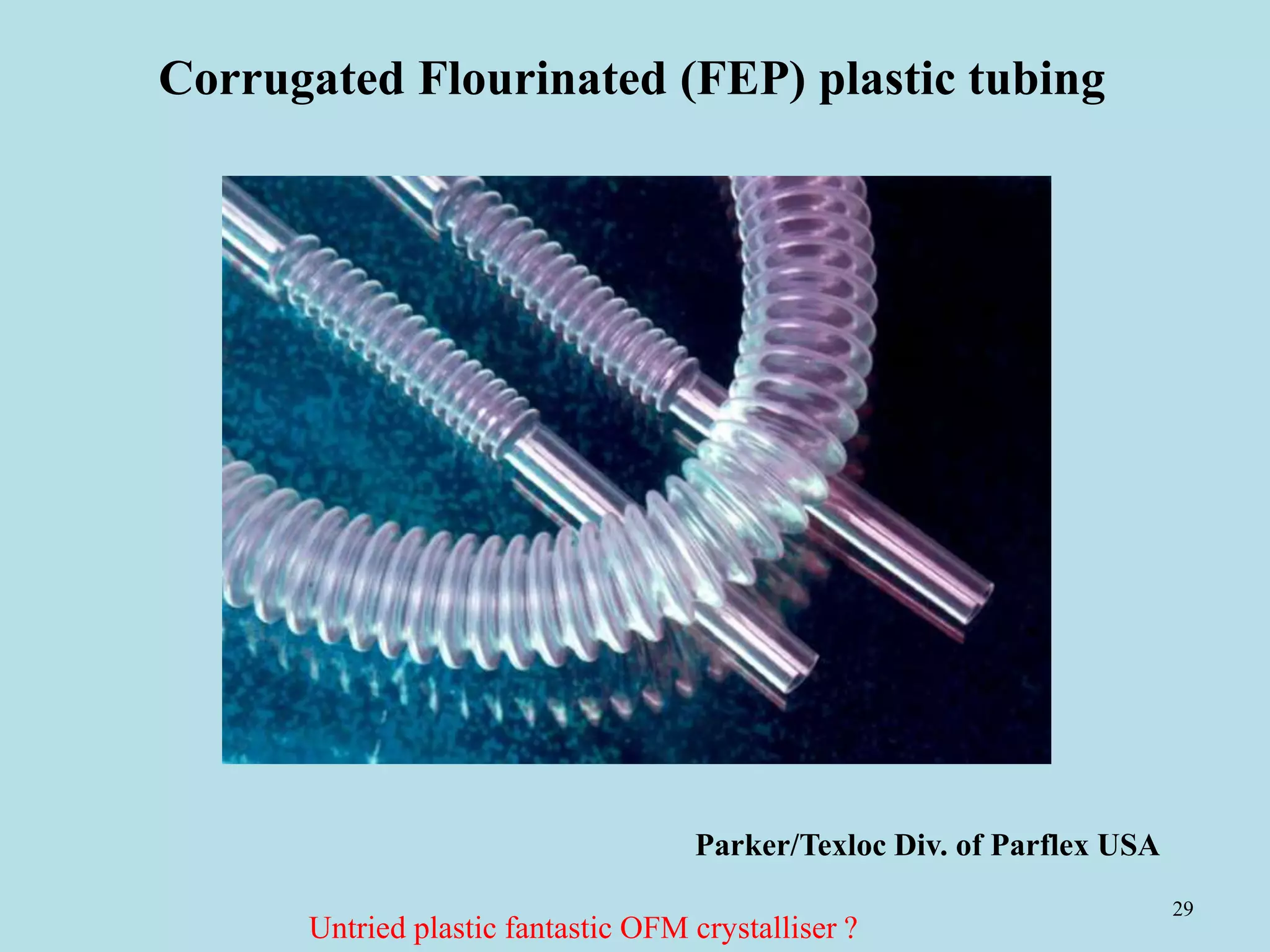
Corrugated Flourinated (FEP) plastic tubing
Parker/Texloc Div. of Parflex USA
Untried plastic fantastic OFM crystalliser ?
30
• Viable flow configuration for crystallisation
• Long residence times possible
• Flow, thermal or concentration profiling
possible
Oscillatory Flow Mixing (OFM)
31
Microcapillary Films (MCFs)
“Plastic Fantastic”
“Discovered” in 1990s
32
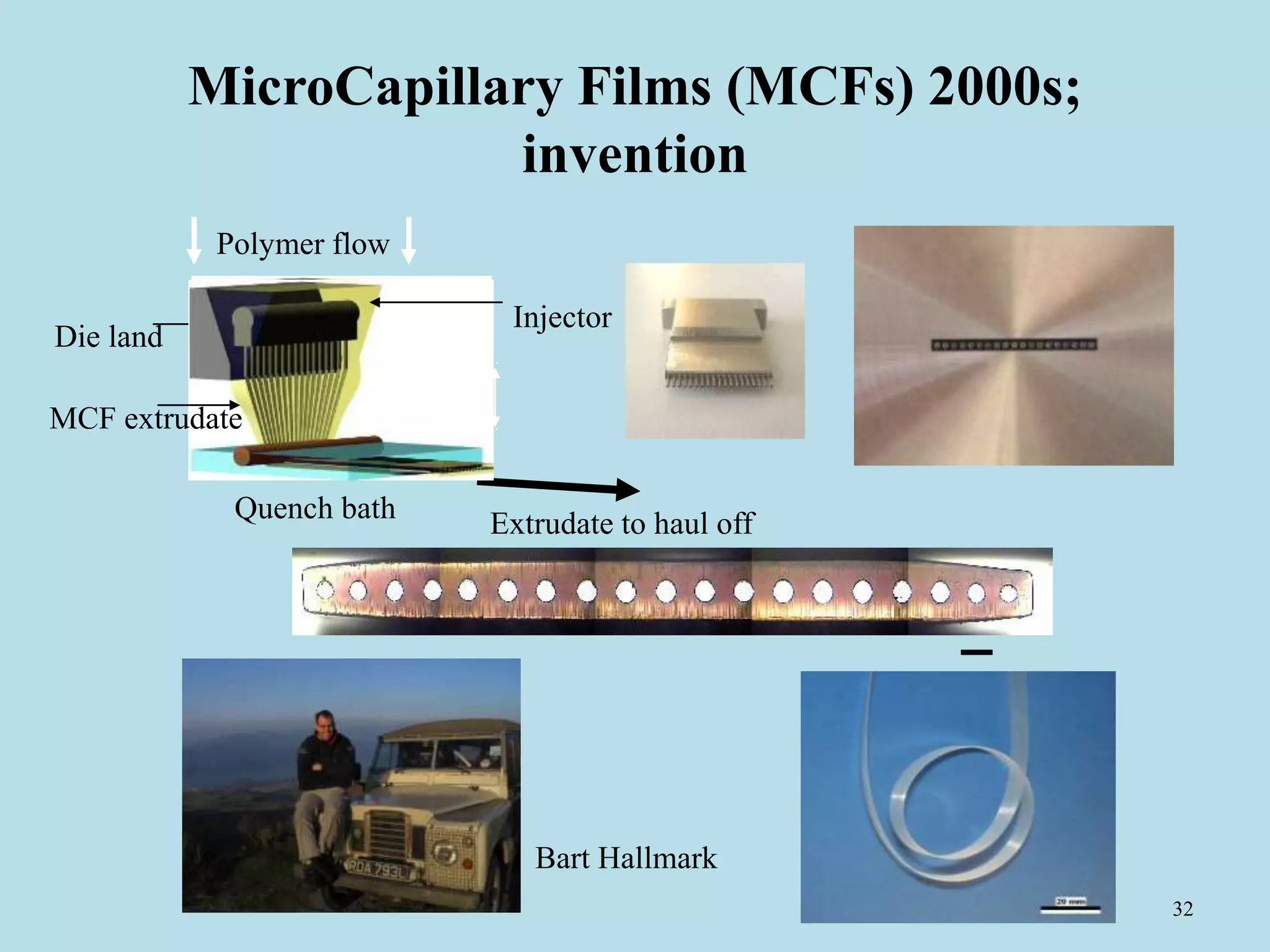
MicroCapillary Films (MCFs) 2000s;
invention
Die land
Polymer flow
Quench bath Extrudate to haul off
Injector
MCF extrudate
Bart Hallmark
33
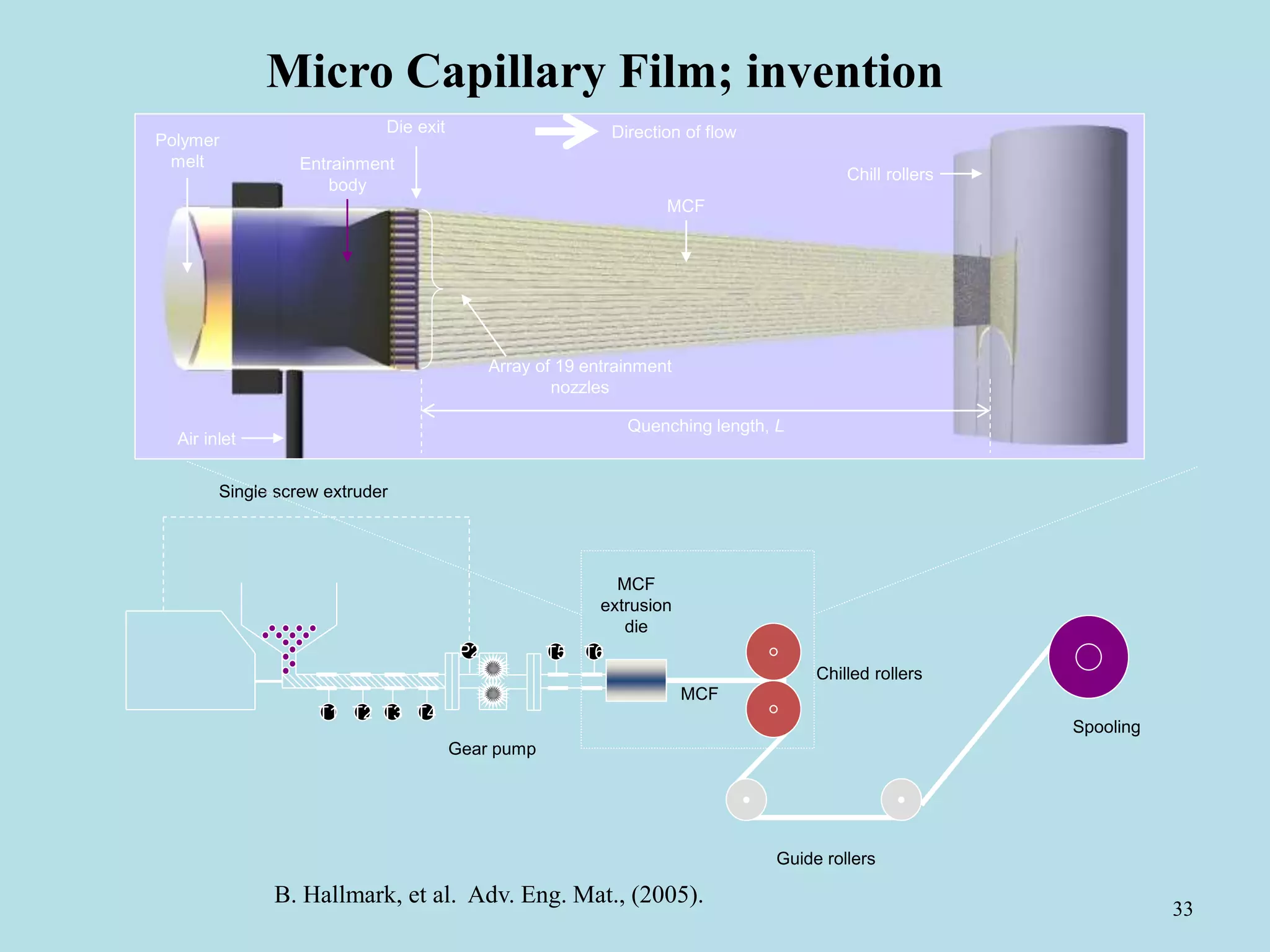
T1 T2 T3 T4
T5 T6P2
Single screw extruder
MCF
extrusion
die
Chilled rollers
Spooling
Guide rollers
Gear pump
MCF
PLAN VIEW
MCF
Chill rollers
Direction of flow
Array of 19 entrainment
nozzles
Entrainment
body
Air inlet
Polymer
melt
Die exit
Quenching length, L
Micro Capillary Film; invention
B. Hallmark, et al. Adv. Eng. Mat., (2005).
34
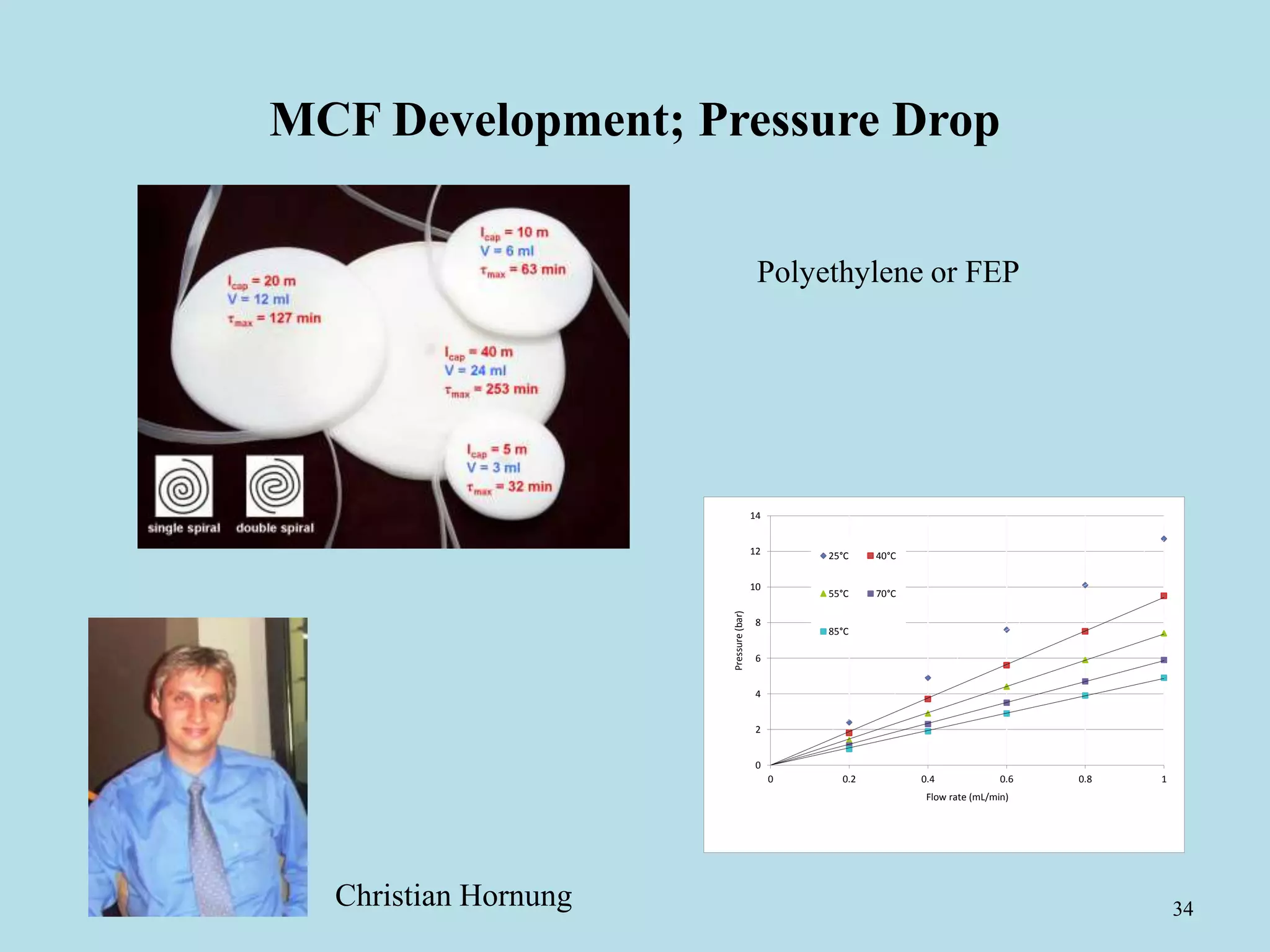
MCF Development; Pressure Drop
0
2
4
6
8
10
12
14
0 0.2 0.4 0.6 0.8 1
Pressure(bar)
Flow rate (mL/min)
25°C 40°C
55°C 70°C
85°C
Christian Hornung
Polyethylene or FEP
35
MCF Development RTD
0
5
10
15
20
25
30
35
40
45
50
0 5 10 15 20 25 30
t [min]
c[mg/l]
inlet
outlet
length = 20 m
flow rate = 0.5 ml/min
Plug flow, laminar flow MCF! Radial dispersion through molecular diffusion
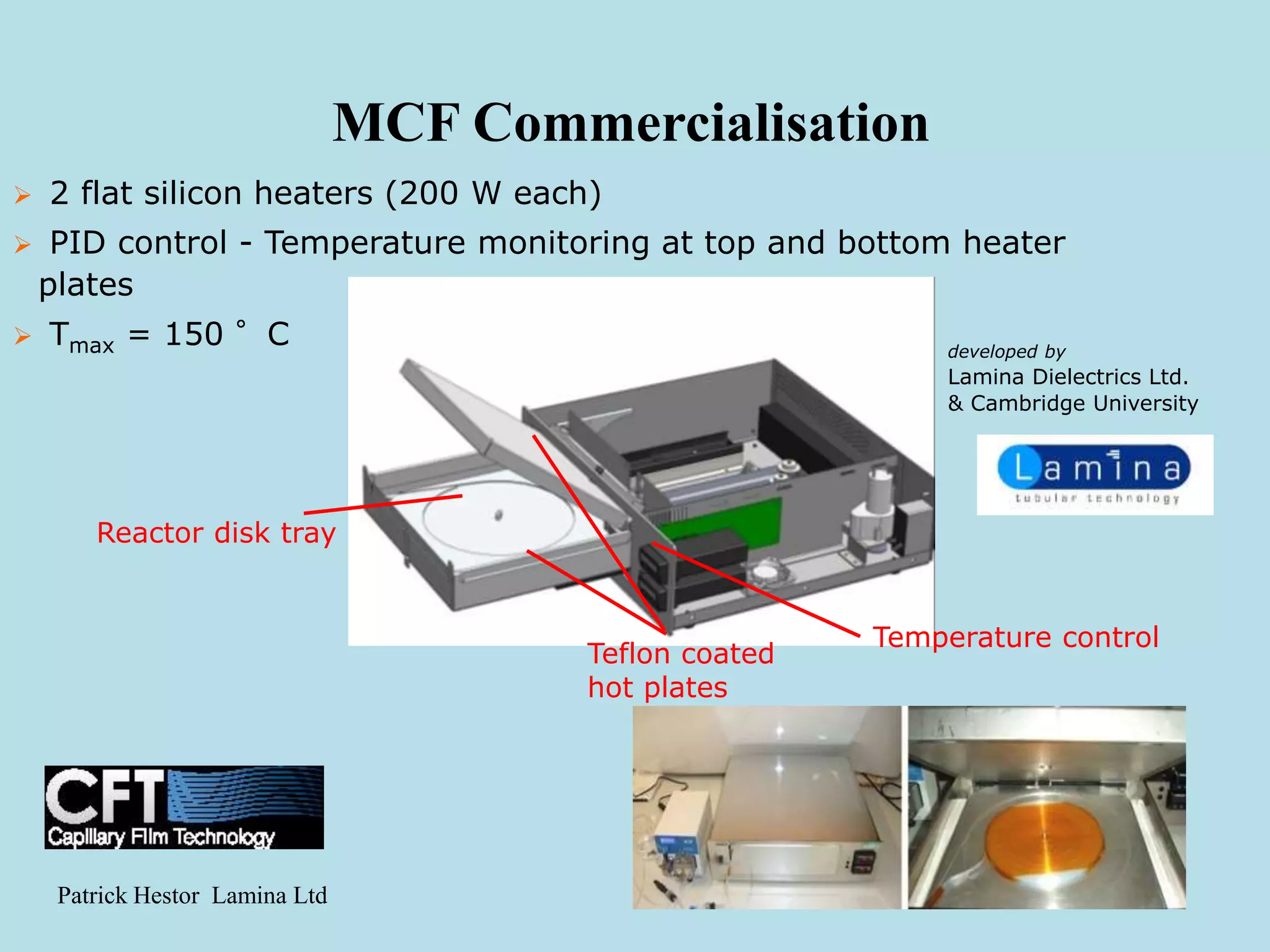
MCF Commercialisation
 2 flat silicon heaters (200 W each)
 PID control - Temperature monitoring at top and bottom heater
plates
 Tmax = 150 °C developed by
Lamina Dielectrics Ltd.
& Cambridge University
Teflon coated
hot plates
Temperature control
Reactor disk tray
Patrick Hestor Lamina Ltd
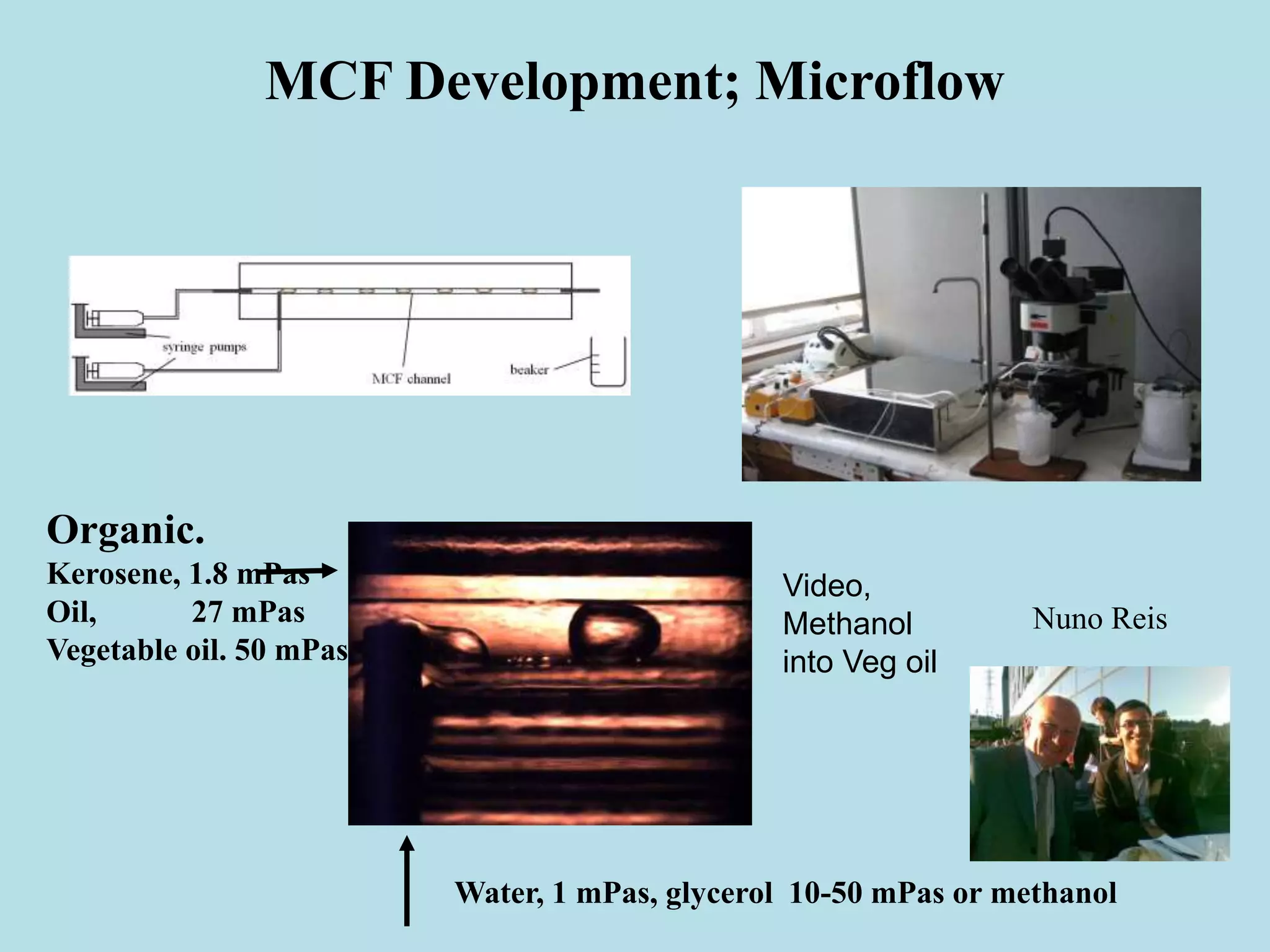
MCF Development; Microflow
Organic.
Kerosene, 1.8 mPas
Oil, 27 mPas
Vegetable oil. 50 mPas
Water, 1 mPas, glycerol 10-50 mPas or methanol
Video,
Methanol
into Veg oil
Nuno Reis
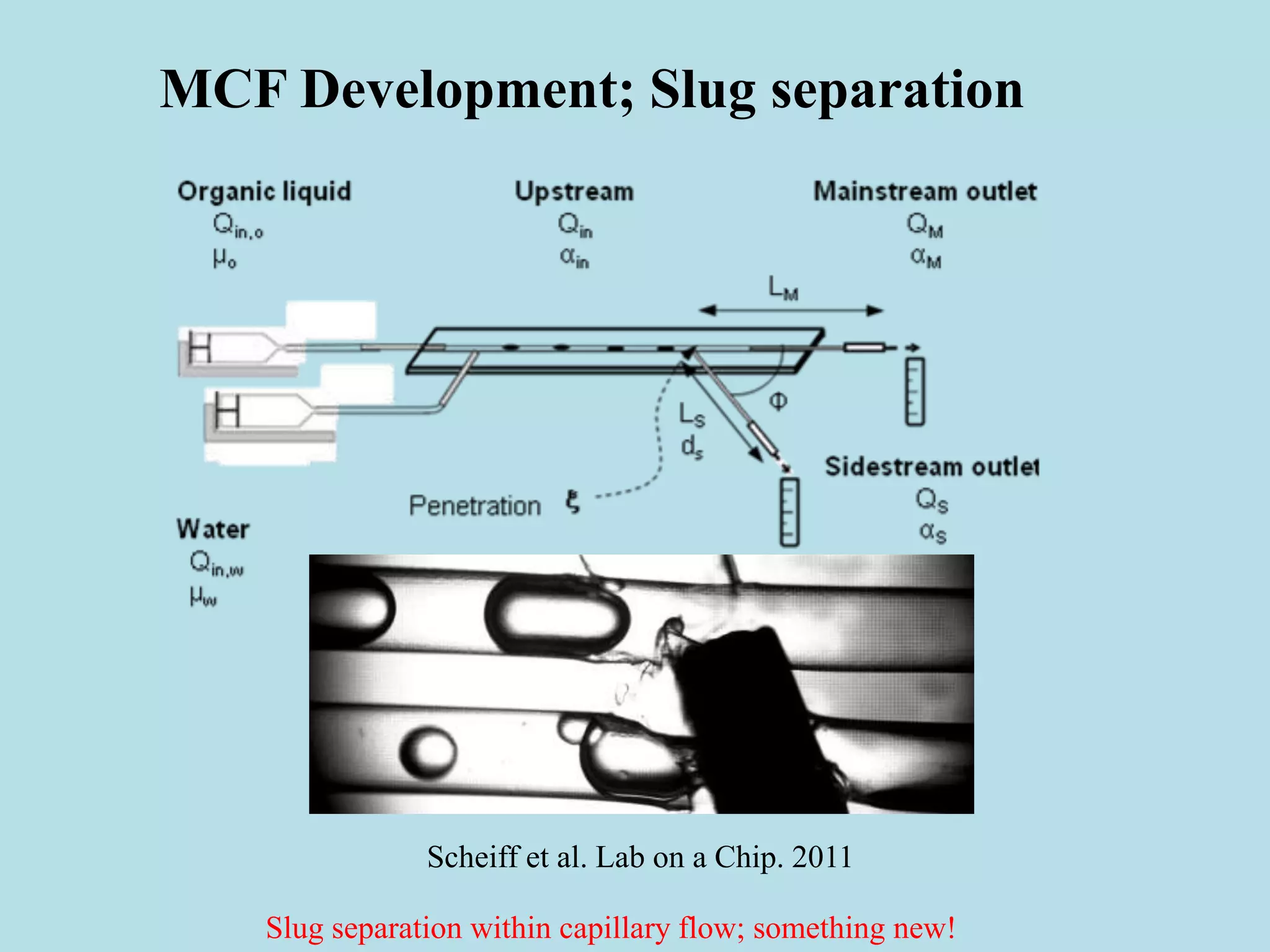
MCF Development; Slug separation
Scheiff et al. Lab on a Chip. 2011
Slug separation within capillary flow; something new!
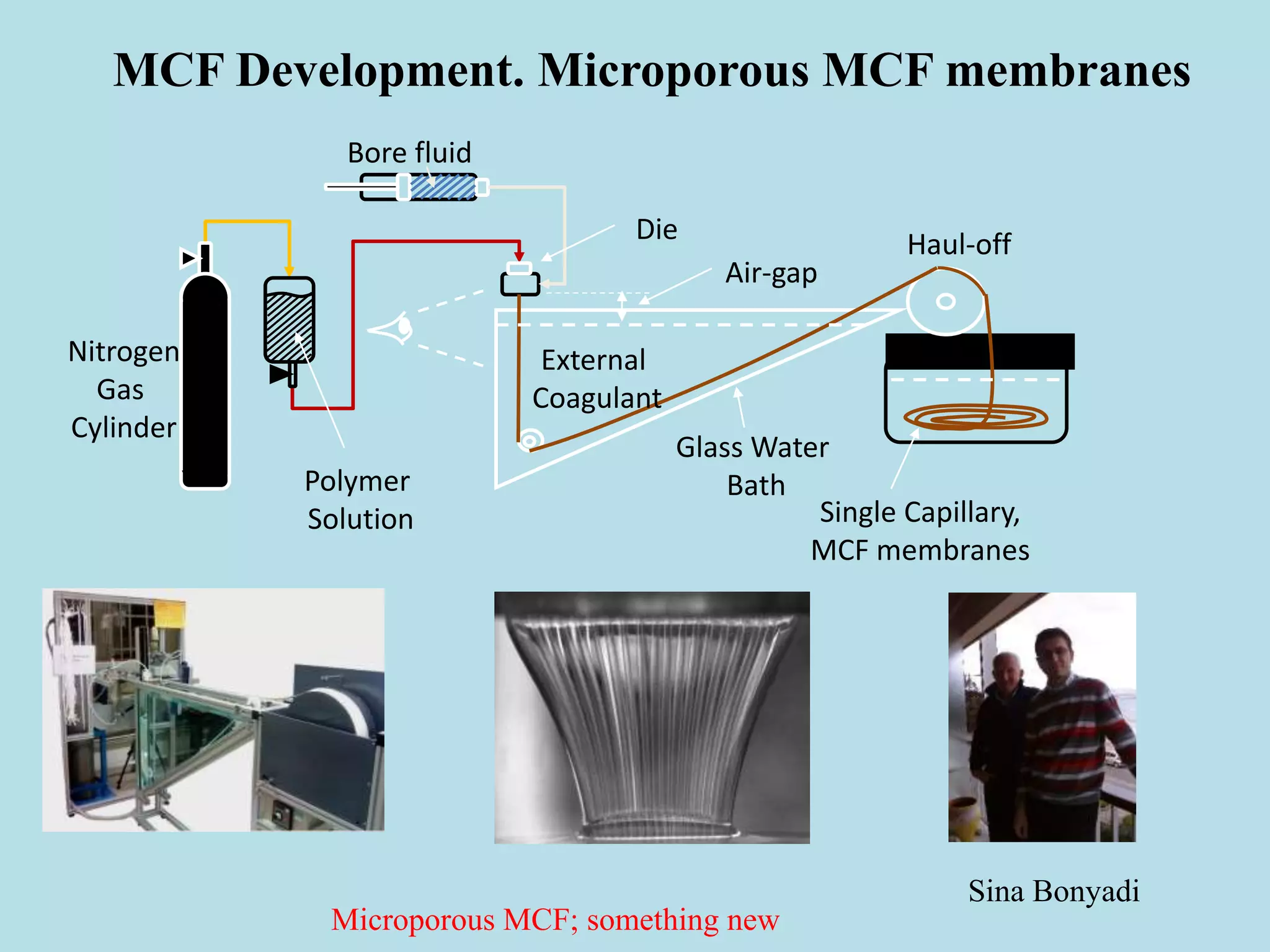
Bore fluid
Nitrogen
Gas
Cylinder
Polymer
Solution
Die
External
Coagulant
Haul-off
Single Capillary,
MCF membranes
Air-gap
Glass Water
Bath
MCF Development. Microporous MCF membranes
Sina Bonyadi
Microporous MCF; something new
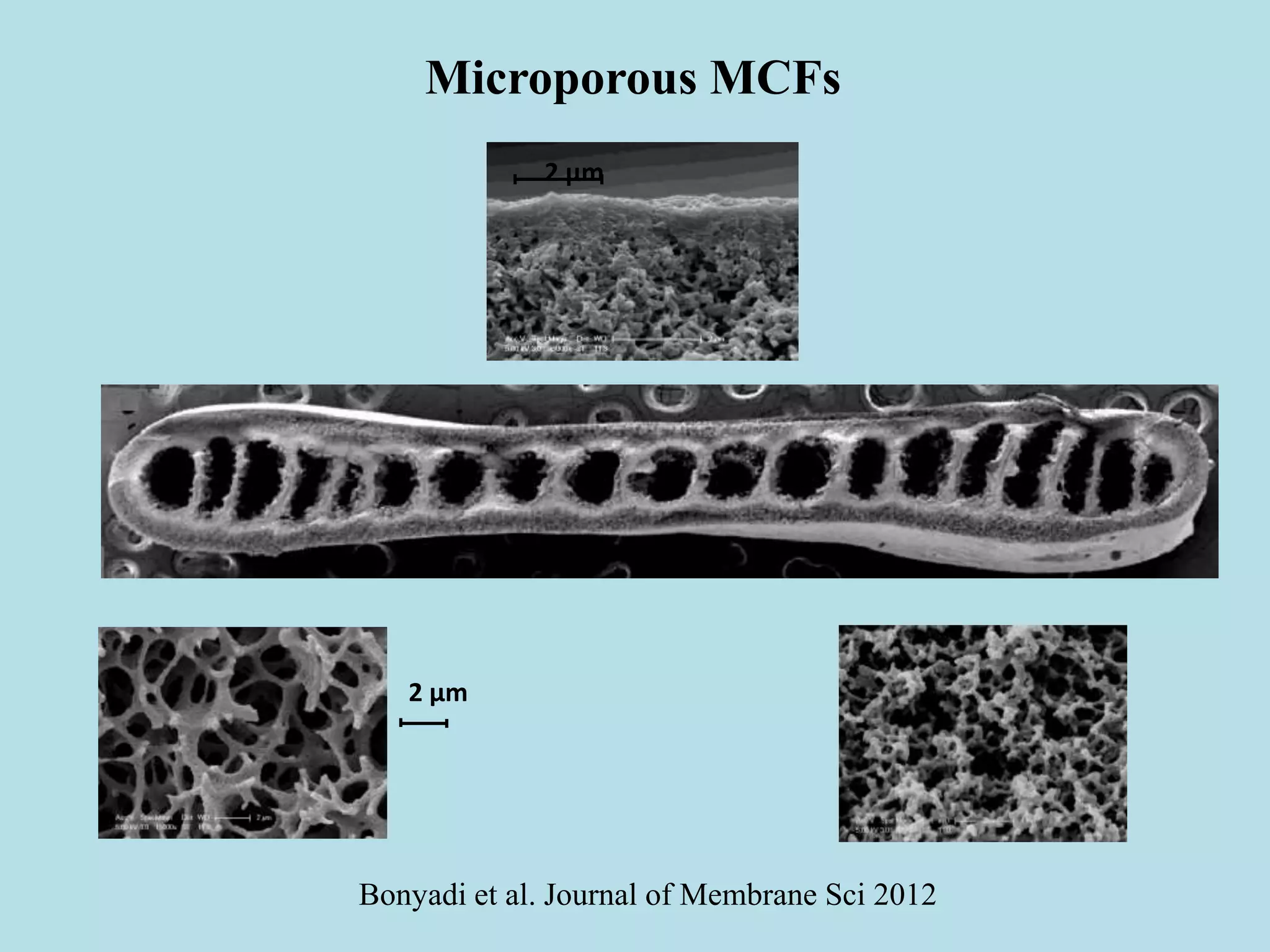
Microporous MCFs
2 µm
100 µm
2 µm
1 µm
Bonyadi et al. Journal of Membrane Sci 2012
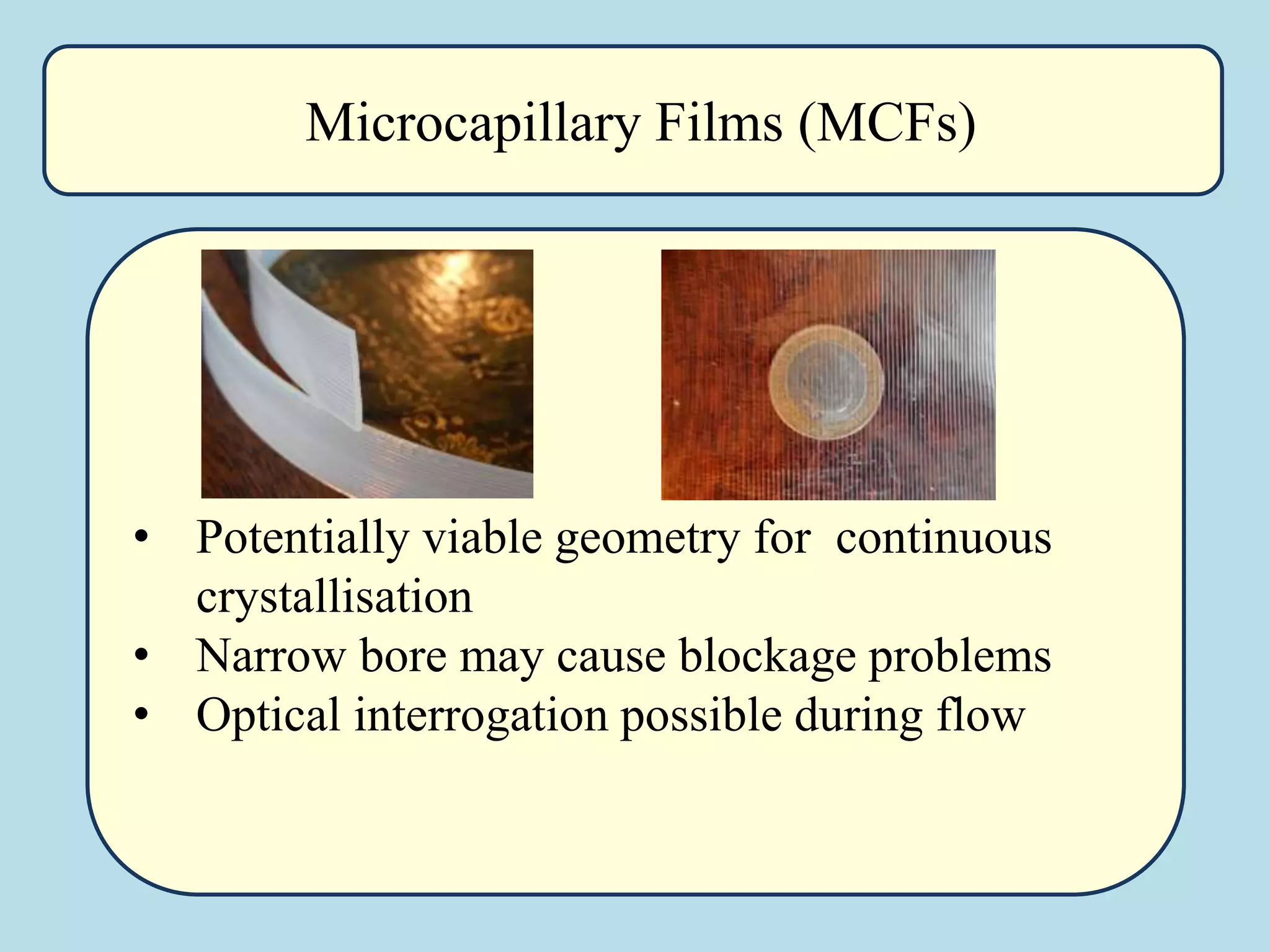
• Potentially viable geometry for continuous
crystallisation
• Narrow bore may cause blockage problems
• Optical interrogation possible during flow
Microcapillary Films (MCFs)
42
• Flow can be complicated.
• Crystallisation can be complicated.
• Flow induced crystallisation can be very complicated.
• OFM and MCFs can give plug flow processing.
Message
43
Go to
http://www.malcolmmackley.com
Want to know more?

Flow, Crystallisation and Continuous Processing

  • 1.
    1 Crystallisation, Flow andContinuous Processing. By Professor Malcolm Mackley Department of Chemical Engineering and Biotechnology. University of Cambridge UK Strathclyde 2014 A story that started for me in 1970
  • 2.
    2 Crystallisation Flow Nucleation Growth Morphology Supersaturation Pressure SupercoolingStirring Simple shear flow Extensional flow Complex flows Driving forces Key factors Flow induced crystallisation depends on all of the above
  • 3.
    3 Types of Flow Laminaror Complex flow Go with the flow! where  = density u = velocity D = a length scale h = viscosity Re < 1 𝐿𝑎𝑚𝑖𝑛𝑎𝑟 𝑅𝑒 ≈ 1 − 1000 𝐶𝑜𝑚𝑝𝑙𝑒𝑥 𝑅𝑒 > 1000 𝑇𝑢𝑟𝑏𝑢𝑙𝑒𝑛𝑡 Reynolds number Re = 𝜌 𝑢 𝐷 𝜂
  • 4.
    4 Types of Flow1 Simple shear (laminar) Simple shear is not so simple because the flow contains a rotational component Couette Viscometer Strain rate 𝛾 = 𝑑𝑢 𝑑𝑦 Velocity u Distance y
  • 5.
    5 Types of Flow2 Extensional flow (laminar) Pure extensional flows are not easy to generate in the laboratory Extension rate 𝜖 = 𝑑𝑢 𝑑𝑥 Velocity u Distance x Opposed jets
  • 6.
    6 Types of Flow3 Complex Flows. Time dependant combinations of simple shear and extensional flow. Taylor Couette Flow Turbulence Stirred vessels Oscillatory Flow Mixing (OFM) “turbulent” flows are a complex time dependant combinations of simple shear and extensional; flow
  • 7.
    7 Solution Crystallisation ofPolyethylene (PE) Polyethylene is chemically the simplist polymer and also the worlds largest tonnage polymer “Polymer Single crystals” Sir Charles Frank Prof Andrew Keller 0.1% PE/Xylene @ 110 0 C 24 hrs @ 80 0 C
  • 8.
    8 Solution Crystallisation ofPolyethylene (PE) The structure and morphology of Polyethylene crystals is a work of art “Perfect Single Crystals” Self seeding of PE crystals; uniform size 110 0 C 24 hrs @ 80 0 C 4 0 C/hr to 100 0 C 24 hrs @ 80 0 C D.C.Bassett (1960s)
  • 9.
    9 Flow induced PEsolution crystallisation Simple shear, no chain stretching but Extensional Flows stretch’s chains Simple shear Couette flow. No crystallisation Taylor vortex Couette flow. Fibrous crystallisation
  • 10.
    10 Flow induced PEsolution crystallisation Shish Kebabs are “tasty”; a combination of extended and folded chain crystals Shish Kebab Fibrous crystals
  • 11.
    11 Flow induced PEsolution crystallisation Millions of PE polymer chains ordered to form beautiful structures No Flow With flow Chain folded Single crystals Shish kebab Fibrous crystals
  • 12.
    1. Can enhancecrystal nucleation rates. 2. Can enhance crystal growth rates. 3. Can change crystal morphology. Flow Induced Crystallisation Flow usually influences crystallisation in some sort of way Flow
  • 13.
    Flow Induced Crystallisation Somethings in life are not simple Think • Nucleation conditions (T, P, Composition ) • Growth conditions (T, P, Composition ) • Surface area/ volume ratio. Surface material of vessel and internals. Boundary conditions, heterogenieties • Type of flow • Batch or continuous
  • 14.
    Batch vs ContinuousCrystallisation Batch Continuous • Easy, flexible and universal • Batch number easy • Accepted by legislation authorities • Simple stirrers • Variation between batches • Complex flow • Thermal and shear profiling not easy to control • Scale up is tricky • Not continuous • Continuous! • Thermal, chemical and flow profiling relatively easy Laminar or Complex flow • Scale up easier than batch • Continuous requires front and back end handling • Relatively novel and so acceptance by Companies and legislation more difficult
  • 15.
    Batch Crystallisation No flowMagnetic stirrer Overhead stirrer Stirred vessel crystallisers can be 500 ml – 20 tonnes in size
  • 16.
    Continuous Flow Crystallisation StirredVessels Residence Time Distributions (RTDs) Chemical Engineers “love” RTDs Residence time Fraction of tracer Fraction of tracer Residence time “Plug flow” Continuous Stirred Tank (CST) 𝜏 𝑚 = 𝑚𝑒𝑎𝑛 𝑟𝑒𝑠𝑖𝑑𝑒𝑛𝑐𝑒 𝑡𝑖𝑚𝑒 𝜏 𝑚
  • 17.
    17 Ways of achieving“plug” flow. • Stirred tanks in series • Turbulent tubular flow • Narrow bore laminar flow • Oscillatory Flow Mixing (OFM) Very long tube v= m/s Chemical Engineers normal choice Long thin tube, less than about 1mm dia “There is more than one way to skin a cat.”
  • 18.
    18 More ways ofachieving plug flow. • Static mixer tubes • Slug flow in tubes • Taylor Couette flow • Plastic microcapillary film (MCF) Prof Woo-Sik Kim Korea Chemical Engineers like tubes and vessels
  • 19.
    19 Oscillatory Flow Mixing(OFM) Inertial mixing flow. Tube diameters, mm - cms A question of scale! g/hr, Kg/hr, tonnes/hr “Discovered” in 1980s
  • 20.
    20 Oscillatory Flow Mixing(OFM) 1980s; process Inventive steps 1979- 1982 Air turbine generates power
  • 21.
    21Chem Eng Sci1989 Inventive steps. Plug flow residence time
  • 22.
  • 23.
  • 24.
    24 - Oscillator BaseUnit - Feed inlet section - Shell and baffled tube vessels - Product outlet section Development Stage Chem Eng Oscillatory Flow Reactor (OFR) Dr Paul Stonestreet
  • 25.
    25 Net Flow In NetFlow Out Biodiesel Reaction Progress along Reactor
  • 26.
  • 27.
    27 Further development OFMMeso Reactor Nuno Reis, Minghzi Zheng System configuration Mesotube, diameter d Smoothconstrictions: spacing3d Minimumconstriction diameter 0.4d 2000s  45º 35 mm, V  4.5 mL  45º 35 mm, V  4.5 mL a) b) L d d0 
  • 28.
    28 0 100 200300 400 500 600 700 800 900 0 0.002 0.004 0.006 0.008 0.01 0.012 0.014 0.016 0.018 0.02 Time (s) E(t)(-) b) Exp-E(t)1 Exp-E(t)2 Exp-E(t)3 Fit-E(t)2 (1->2) Fit-E(t)3 (1->3) Fit-E(t) 3 (2->3) Continuous Flow Oscillatory Mesoreactor Minghzi Zheng Plug flow meso reactor
  • 29.
    29 Corrugated Flourinated (FEP)plastic tubing Parker/Texloc Div. of Parflex USA Untried plastic fantastic OFM crystalliser ?
  • 30.
    30 • Viable flowconfiguration for crystallisation • Long residence times possible • Flow, thermal or concentration profiling possible Oscillatory Flow Mixing (OFM)
  • 31.
    31 Microcapillary Films (MCFs) “PlasticFantastic” “Discovered” in 1990s
  • 32.
    32 MicroCapillary Films (MCFs)2000s; invention Die land Polymer flow Quench bath Extrudate to haul off Injector MCF extrudate Bart Hallmark
  • 33.
    33 T1 T2 T3T4 T5 T6P2 Single screw extruder MCF extrusion die Chilled rollers Spooling Guide rollers Gear pump MCF PLAN VIEW MCF Chill rollers Direction of flow Array of 19 entrainment nozzles Entrainment body Air inlet Polymer melt Die exit Quenching length, L Micro Capillary Film; invention B. Hallmark, et al. Adv. Eng. Mat., (2005).
  • 34.
    34 MCF Development; PressureDrop 0 2 4 6 8 10 12 14 0 0.2 0.4 0.6 0.8 1 Pressure(bar) Flow rate (mL/min) 25°C 40°C 55°C 70°C 85°C Christian Hornung Polyethylene or FEP
  • 35.
    35 MCF Development RTD 0 5 10 15 20 25 30 35 40 45 50 05 10 15 20 25 30 t [min] c[mg/l] inlet outlet length = 20 m flow rate = 0.5 ml/min Plug flow, laminar flow MCF! Radial dispersion through molecular diffusion
  • 36.
    MCF Commercialisation  2flat silicon heaters (200 W each)  PID control - Temperature monitoring at top and bottom heater plates  Tmax = 150 °C developed by Lamina Dielectrics Ltd. & Cambridge University Teflon coated hot plates Temperature control Reactor disk tray Patrick Hestor Lamina Ltd
  • 37.
    MCF Development; Microflow Organic. Kerosene,1.8 mPas Oil, 27 mPas Vegetable oil. 50 mPas Water, 1 mPas, glycerol 10-50 mPas or methanol Video, Methanol into Veg oil Nuno Reis
  • 38.
    MCF Development; Slugseparation Scheiff et al. Lab on a Chip. 2011 Slug separation within capillary flow; something new!
  • 39.
    Bore fluid Nitrogen Gas Cylinder Polymer Solution Die External Coagulant Haul-off Single Capillary, MCFmembranes Air-gap Glass Water Bath MCF Development. Microporous MCF membranes Sina Bonyadi Microporous MCF; something new
  • 40.
    Microporous MCFs 2 µm 100µm 2 µm 1 µm Bonyadi et al. Journal of Membrane Sci 2012
  • 41.
    • Potentially viablegeometry for continuous crystallisation • Narrow bore may cause blockage problems • Optical interrogation possible during flow Microcapillary Films (MCFs)
  • 42.
    42 • Flow canbe complicated. • Crystallisation can be complicated. • Flow induced crystallisation can be very complicated. • OFM and MCFs can give plug flow processing. Message
  • 43.