FRP: also referred to as a fiber-reinforced
     polymer is a composite material
                  made of a
    polymer matrix and some reinforcing
materials (eg. Fibers, particles)
  The reinforcing materials are also referred to as
  dispersed phase
Process definition
•A polymer is generally manufactured by
   •Step-growth polymerization
   •Addition polymerization.
                        •When combined with various agents
                        to enhance or in any way alter the
                        material properties of polymers the
                        result is referred to as a plastic.
Composite plastics refer to those types of plastics that
result from bonding two or more homogeneous
materials with different material properties to derive a
final product with certain desired material and
mechanical properties
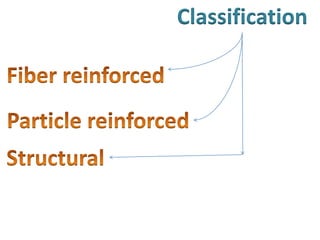
Classification
•Fibre reinforced plastics are a category of composite
plastics that specifically use fibre materials to
mechanically enhance the strength and elasticity of
plastics

The original plastic material without fibre
reinforcement is known as the matrix. The matrix is a
tough but relatively weak plastic that is reinforced by
stronger stiffer reinforcing filaments or fibres
Factors affecting Properties of
               FRP
mechanical properties of both
the fibre and matrix

                   their volume relative to one another


fibre length and orientation within the matrix
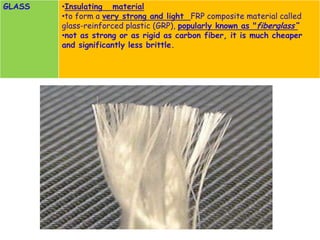
GLASS   •Insulating material
        •to form a very strong and light FRP composite material called
        glass-reinforced plastic (GRP), popularly known as "fiberglass“
        •not as strong or as rigid as carbon fiber, it is much cheaper
        and significantly less brittle.
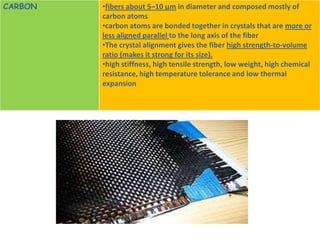
CARBON   •fibers about 5–10 μm in diameter and composed mostly of
         carbon atoms
         •carbon atoms are bonded together in crystals that are more or
         less aligned parallel to the long axis of the fiber
         •The crystal alignment gives the fiber high strength-to-volume
         ratio (makes it strong for its size).
         •high stiffness, high tensile strength, low weight, high chemical
         resistance, high temperature tolerance and low thermal
         expansion
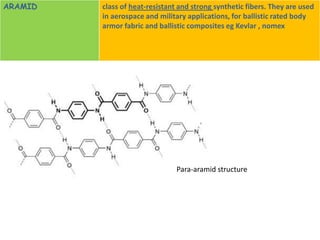
ARAMID   class of heat-resistant and strong synthetic fibers. They are used
         in aerospace and military applications, for ballistic rated body
         armor fabric and ballistic composites eg Kevlar , nomex


                                Para-aramid structure
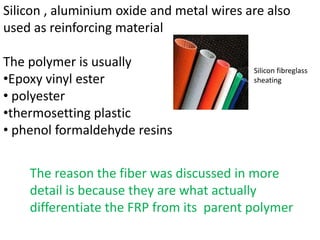
Silicon , aluminium oxide and metal wires are also
used as reinforcing material

The polymer is usually                     Silicon fibreglass
•Epoxy vinyl ester                         sheating

• polyester
•thermosetting plastic
• phenol formaldehyde resins


    The reason the fiber was discussed in more
    detail is because they are what actually
    differentiate the FRP from its parent polymer
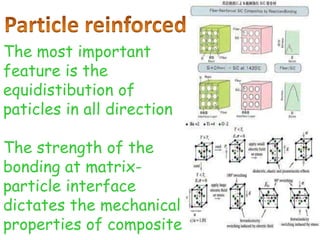
The most important
feature is the
equidistibution of
paticles in all direction

The strength of the
bonding at matrix-
particle interface
dictates the mechanical
properties of composite
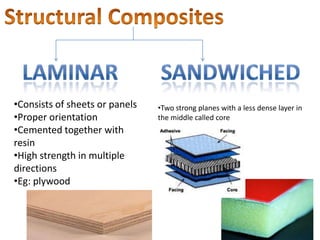
•Consists of sheets or panels   •Two strong planes with a less dense layer in
•Proper orientation             the middle called core
•Cemented together with
resin
•High strength in multiple
directions
•Eg: plywood
•Low coefficient of expansion
•High dimensional stability
•High tensile strength
•High heat stability
•Better abrasion and wear
resistance
•Better toughness and impact
strength
•Aerospace
•Missile tech
•Automotives
•High speed machinery
•Equipment parts
•Coolers
•Office cabins
•Room insulations

FIBER REINFORCED PLASTICS by sairam

  • 2.
    FRP: also referredto as a fiber-reinforced polymer is a composite material made of a polymer matrix and some reinforcing materials (eg. Fibers, particles) The reinforcing materials are also referred to as dispersed phase
  • 3.
    Process definition •A polymeris generally manufactured by •Step-growth polymerization •Addition polymerization. •When combined with various agents to enhance or in any way alter the material properties of polymers the result is referred to as a plastic. Composite plastics refer to those types of plastics that result from bonding two or more homogeneous materials with different material properties to derive a final product with certain desired material and mechanical properties
  • 4.
  • 5.
    •Fibre reinforced plasticsare a category of composite plastics that specifically use fibre materials to mechanically enhance the strength and elasticity of plastics The original plastic material without fibre reinforcement is known as the matrix. The matrix is a tough but relatively weak plastic that is reinforced by stronger stiffer reinforcing filaments or fibres
  • 6.
    Factors affecting Propertiesof FRP mechanical properties of both the fibre and matrix their volume relative to one another fibre length and orientation within the matrix
  • 8.
    GLASS •Insulating material •to form a very strong and light FRP composite material called glass-reinforced plastic (GRP), popularly known as "fiberglass“ •not as strong or as rigid as carbon fiber, it is much cheaper and significantly less brittle.
  • 9.
    CARBON •fibers about 5–10 μm in diameter and composed mostly of carbon atoms •carbon atoms are bonded together in crystals that are more or less aligned parallel to the long axis of the fiber •The crystal alignment gives the fiber high strength-to-volume ratio (makes it strong for its size). •high stiffness, high tensile strength, low weight, high chemical resistance, high temperature tolerance and low thermal expansion
  • 10.
    ARAMID class of heat-resistant and strong synthetic fibers. They are used in aerospace and military applications, for ballistic rated body armor fabric and ballistic composites eg Kevlar , nomex Para-aramid structure
  • 11.
    Silicon , aluminiumoxide and metal wires are also used as reinforcing material The polymer is usually Silicon fibreglass •Epoxy vinyl ester sheating • polyester •thermosetting plastic • phenol formaldehyde resins The reason the fiber was discussed in more detail is because they are what actually differentiate the FRP from its parent polymer
  • 12.
    The most important featureis the equidistibution of paticles in all direction The strength of the bonding at matrix- particle interface dictates the mechanical properties of composite
  • 13.
    •Consists of sheetsor panels •Two strong planes with a less dense layer in •Proper orientation the middle called core •Cemented together with resin •High strength in multiple directions •Eg: plywood
  • 14.
    •Low coefficient ofexpansion •High dimensional stability •High tensile strength •High heat stability •Better abrasion and wear resistance •Better toughness and impact strength
  • 15.
    •Aerospace •Missile tech •Automotives •High speedmachinery •Equipment parts •Coolers •Office cabins •Room insulations