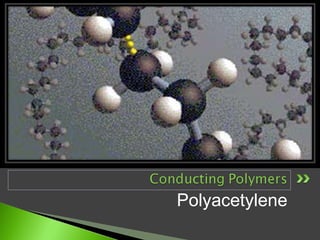
Polyacetylene
 Organic polymers that conduct electricity are
  called conducting polymers.
 Such compounds may have metallic conductivity

  or can be semiconductors.
 The biggest advantage of conductive polymers is

  their processability, mainly by dispersion.
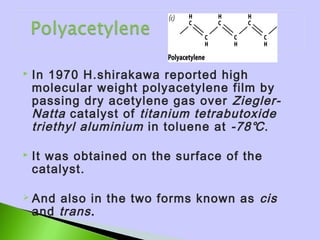
   In 1970 H.shirakawa reported high
    molecular weight polyacetylene film by
    passing dry acetylene gas over Ziegler-
    Natta catalyst of titanium tetrabutoxide
    triethyl aluminium in toluene at -78℃ .

   It was obtained on the surface of the
    catalyst.

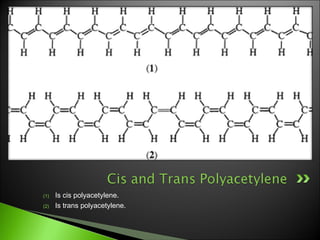
 And   also in the two forms known as cis
    and trans .
(1)   Is cis polyacetylene.
(2)   Is trans polyacetylene.
The role of a dopant is to either add or
 remove electrons to the polymer.
 It is of two kinds:


 (1)   Oxidative or p-doping.
    (2) Reductive or n-doping.
   The oxidizing agents for P-doping are like iodine
    vapours,I₂ dissolved in CCl₄ , HBF₄, HClO₄ ,
    Br₂..etc.

   (CH)n    → (CH)n ⁺ I₃⁻

 The    conduction in this type of doping increases up
    to 10⁵ s/cm.
   The reducing agents for n-doping are like Na
    metal ,FeCl₂, lithium metal ,sodium
    naphthalide..etc.

   (CH)n → (CH)⁻ Na⁺

   Negative charge resonates throughout the chain
    and transferred to neighbouring chains through
    Na⁺ during conduction.
 For making rechargeable batteries.
 Used as sensors for phenol , O₂..etc at low

  concentrations.
 For manufacture of transistors ,LEDs, lasers and

  solar cells.
 In telecommunication systems
 In the construction of photovoltaic cells.
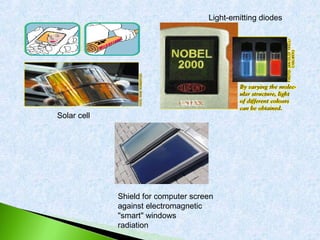
Light-emitting diodes


Solar cell


             Shield for computer screen
             against electromagnetic
             "smart" windows
             radiation
Conducting polymers by ankit gupta

Conducting polymers by ankit gupta

  • 1.
  • 2.
     Organic polymersthat conduct electricity are called conducting polymers.  Such compounds may have metallic conductivity or can be semiconductors.  The biggest advantage of conductive polymers is their processability, mainly by dispersion.
  • 3.
    In 1970 H.shirakawa reported high molecular weight polyacetylene film by passing dry acetylene gas over Ziegler- Natta catalyst of titanium tetrabutoxide triethyl aluminium in toluene at -78℃ .  It was obtained on the surface of the catalyst.  And also in the two forms known as cis and trans .
  • 4.
    (1) Is cis polyacetylene. (2) Is trans polyacetylene.
  • 5.
    The role ofa dopant is to either add or remove electrons to the polymer.  It is of two kinds:  (1) Oxidative or p-doping. (2) Reductive or n-doping.
  • 6.
    The oxidizing agents for P-doping are like iodine vapours,I₂ dissolved in CCl₄ , HBF₄, HClO₄ , Br₂..etc.  (CH)n → (CH)n ⁺ I₃⁻  The conduction in this type of doping increases up to 10⁵ s/cm.
  • 7.
    The reducing agents for n-doping are like Na metal ,FeCl₂, lithium metal ,sodium naphthalide..etc.  (CH)n → (CH)⁻ Na⁺  Negative charge resonates throughout the chain and transferred to neighbouring chains through Na⁺ during conduction.
  • 8.
     For makingrechargeable batteries.  Used as sensors for phenol , O₂..etc at low concentrations.  For manufacture of transistors ,LEDs, lasers and solar cells.  In telecommunication systems  In the construction of photovoltaic cells.
  • 9.
    Light-emitting diodes Solar cell Shield for computer screen against electromagnetic "smart" windows radiation