CONSTRUCTION & MATERIALS
THERMOPLASTICS
PLASTICS - INTRODUCTION
• Material of “New age”
• Its basic constituent is prepared synthetically or semi-
synthetically from monomer.
• Easily machined , cast and joined
• Ease of manufacturing and versatility
• hardness, elasticity, breaking strength, temperature resistance,
thermal dimensional stability, chemical resistance
• Properties
• Low cost
• ease of manufacture
• Versatility
• imperviousness to water
• usually low melting point
• electrical insulator (except stretch-oriented polyacetylene).
• Some may decompose to toxic substances when heated.
PLASTICS HISTORY
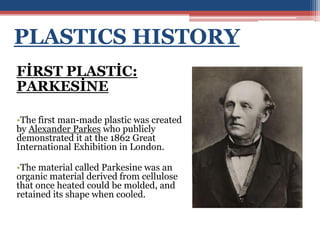
FİRST PLASTİC:
PARKESİNE
•The first man-made plastic was created
by Alexander Parkes who publicly
demonstrated it at the 1862 Great
International Exhibition in London.
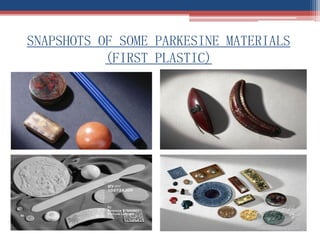
•The material called Parkesine was an
organic material derived from cellulose
that once heated could be molded, and
retained its shape when cooled.
SNAPSHOTS OF SOME PARKESINE MATERIALS
(FIRST PLASTIC)
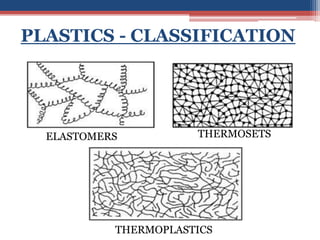
PLASTICS - CLASSIFICATION
ELASTOMERS THERMOSETS
THERMOPLASTICS
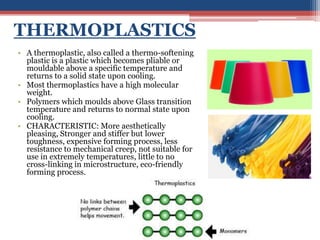
THERMOPLASTICS
• A thermoplastic, also called a thermo-softening
plastic is a plastic which becomes pliable or
mouldable above a specific temperature and
returns to a solid state upon cooling.
• Most thermoplastics have a high molecular
weight.
• Polymers which moulds above Glass transition
temperature and returns to normal state upon
cooling.
• CHARACTERISTIC: More aesthetically
pleasing, Stronger and stiffer but lower
toughness, expensive forming process, less
resistance to mechanical creep, not suitable for
use in extremely temperatures, little to no
cross-linking in microstructure, eco-friendly
forming process.
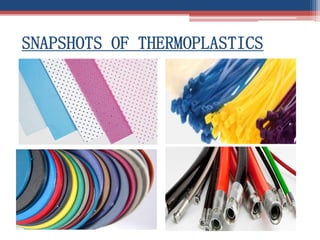
SNAPSHOTS OF THERMOPLASTICS
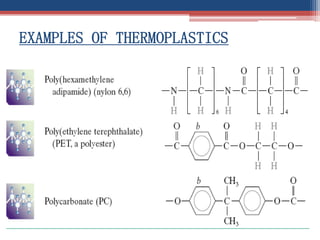
EXAMPLES OF THERMOPLASTICS
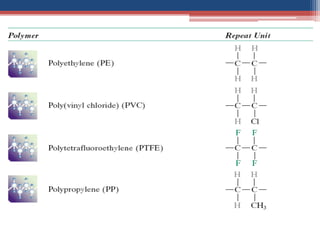
POLYVINYL CHLORIDE (PVC)
• Polyvinyl chloride is produced by polymerization of the vinyl
chloride monomer (VCM)
• PVC comes in two forms, rigid -RPVC (for construction in
pipe and in doors and windows) and are made more flexible
by addition of plasticizers (phthalates). [Add ease of work,
used for cables, lowers glass transition temperature, increased
flexibility and durability]
PROPERTIES
• Tough
• lightweight material that is resistant to acids and bases.
• High hardness
• high modulus of elasticity (rigid-type), very low modulus of
elasticity (flexible)
• Poor heat stability, small expansion coefficient
• Good flame retarding
• Electrical insulator
USES
• Much of it is used by the construction industry, such as for
vinyl siding, drainpipes, gutters and roofing sheets.
• PVC pipes, electric cable insulation, uPVC in place of wood,
signs, clothing, furniture
• It is also converted to flexible forms with the addition of
plasticizers, thereby making it useful for items such as hoses,
tubing, electrical insulation, coats, jackets and upholstery.
• Flexible PVC is also used in inflatable products, such as water
beds and pool toys.
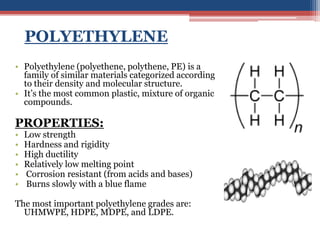
POLYETHYLENE
• Polyethylene (polyethene, polythene, PE) is a
family of similar materials categorized according
to their density and molecular structure.
• It’s the most common plastic, mixture of organic
compounds.
PROPERTIES:
• Low strength
• Hardness and rigidity
• High ductility
• Relatively low melting point
• Corrosion resistant (from acids and bases)
• Burns slowly with a blue flame
The most important polyethylene grades are:
UHMWPE, HDPE, MDPE, and LDPE.
1)ULTRA-HIGH MOLECULAR WEIGHT PE (UHMWPE):
• Tough and resistant to chemicals.
USES:
• manufacture moving machine parts
• bearings gears
• artificial joints
• some bulletproof vests.
2) HIGH-DENSITY POLYETHYLENE (HDPE):
• Density >= 0.941g/cm3.
• Low degree of branching low tensile strength
USES:
• milk jugs
• detergent bottles
• garbage containers
• water pipes.
3)MEDIUM-DENSITY POLYETHYLENE (MDPE):
• Density 0.926-0.940g/cm3.
• Good shock and drop resistance
• less notch sensitive than HDPE
• stress cracking resistance is also better.
USES:
• gas pipes and fittings
• sacks
• shrink film
• carrier bags.
4)LOW-DENSITY POLYETHYLENE (LDPE)
• Density 0.910-0.940g/cm3,
• lower tensile strength, increased ductility
USES:
• rigid containers
• plastic film applications.
POLYPROPYLENE
PROPERTIES
• Tough & flexible
• light weight & durable
• used as an engineering plastic when copolymerized with ethylene
• good resistance to fatigue
• corrosion resistant & heat resistant
• resilient to impact and freezing, can be joined by heat fusion
USES
• Plastic hinges,
• as a dielectric, kettles, food containers, carpets, rugs, ropes,
• PVC alternative
• electrical cables
• plastic mouldings (bottle tops, bottles, and fittings)
POLYMETHYLMETHACRYLATE (PERSPEX)
• Shatter resistant which is also called acrylic glass
PROPERTIES:
• Moderate strength
• easy handling and processing
• low cost
• prone to scratching
USES:
• Transparent glass substitute (submersibles, aircraft, riot
control, aquariums)
• daylight radiation
• implants
• acrylic paint
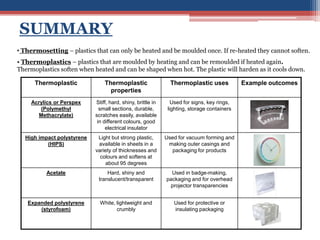
Materials – Plastics
Thermoplastic Thermoplastic
properties
Thermoplastic uses Example outcomes
Acrylics or Perspex
(Polymethyl
Methacrylate)
Stiff, hard, shiny, brittle in
small sections, durable,
scratches easily, available
in different colours, good
electrical insulator
Used for signs, key rings,
lighting, storage containers
High impact polystyrene
(HIPS)
Light but strong plastic,
available in sheets in a
variety of thicknesses and
colours and softens at
about 95 degrees
Used for vacuum forming and
making outer casings and
packaging for products
Acetate Hard, shiny and
translucent/transparent
Used in badge-making,
packaging and for overhead
projector transparencies
Expanded polystyrene
(styrofoam)
White, lightweight and
crumbly
Used for protective or
insulating packaging
• Thermosetting – plastics that can only be heated and be moulded once. If re-heated they cannot soften.
• Thermoplastics – plastics that are moulded by heating and can be remoulded if heated again.
Thermoplastics soften when heated and can be shaped when hot. The plastic will harden as it cools down.
SUMMARY
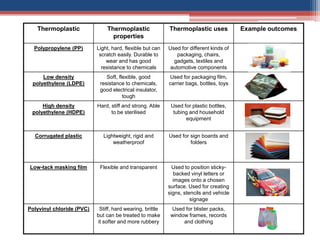
Materials – PlasticsThermoplastic Thermoplastic
properties
Thermoplastic uses Example outcomes
Polypropylene (PP) Light, hard, flexible but can
scratch easily. Durable to
wear and has good
resistance to chemicals
Used for different kinds of
packaging, chairs,
gadgets, textiles and
automotive components
Low density
polyethylene (LDPE)
Soft, flexible, good
resistance to chemicals,
good electrical insulator,
tough
Used for packaging film,
carrier bags, bottles, toys
High density
polyethylene (HDPE)
Hard, stiff and strong. Able
to be sterilised
Used for plastic bottles,
tubing and household
equipment
Corrugated plastic Lightweight, rigid and
weatherproof
Used for sign boards and
folders
Low-tack masking film Flexible and transparent Used to position sticky-
backed vinyl letters or
images onto a chosen
surface. Used for creating
signs, stencils and vehicle
signage
Polyvinyl chloride (PVC) Stiff, hard wearing, brittle
but can be treated to make
it softer and more rubbery
Used for blister packs,
window frames, records
and clothing

Thermoplastics

  • 1.
  • 2.
    PLASTICS - INTRODUCTION •Material of “New age” • Its basic constituent is prepared synthetically or semi- synthetically from monomer. • Easily machined , cast and joined • Ease of manufacturing and versatility • hardness, elasticity, breaking strength, temperature resistance, thermal dimensional stability, chemical resistance • Properties • Low cost • ease of manufacture • Versatility • imperviousness to water • usually low melting point • electrical insulator (except stretch-oriented polyacetylene). • Some may decompose to toxic substances when heated.
  • 3.
    PLASTICS HISTORY FİRST PLASTİC: PARKESİNE •Thefirst man-made plastic was created by Alexander Parkes who publicly demonstrated it at the 1862 Great International Exhibition in London. •The material called Parkesine was an organic material derived from cellulose that once heated could be molded, and retained its shape when cooled.
  • 4.
    SNAPSHOTS OF SOMEPARKESINE MATERIALS (FIRST PLASTIC)
  • 5.
    PLASTICS - CLASSIFICATION ELASTOMERSTHERMOSETS THERMOPLASTICS
  • 6.
    THERMOPLASTICS • A thermoplastic,also called a thermo-softening plastic is a plastic which becomes pliable or mouldable above a specific temperature and returns to a solid state upon cooling. • Most thermoplastics have a high molecular weight. • Polymers which moulds above Glass transition temperature and returns to normal state upon cooling. • CHARACTERISTIC: More aesthetically pleasing, Stronger and stiffer but lower toughness, expensive forming process, less resistance to mechanical creep, not suitable for use in extremely temperatures, little to no cross-linking in microstructure, eco-friendly forming process.
  • 7.
  • 8.
  • 10.
    POLYVINYL CHLORIDE (PVC) •Polyvinyl chloride is produced by polymerization of the vinyl chloride monomer (VCM) • PVC comes in two forms, rigid -RPVC (for construction in pipe and in doors and windows) and are made more flexible by addition of plasticizers (phthalates). [Add ease of work, used for cables, lowers glass transition temperature, increased flexibility and durability]
  • 11.
    PROPERTIES • Tough • lightweightmaterial that is resistant to acids and bases. • High hardness • high modulus of elasticity (rigid-type), very low modulus of elasticity (flexible) • Poor heat stability, small expansion coefficient • Good flame retarding • Electrical insulator USES • Much of it is used by the construction industry, such as for vinyl siding, drainpipes, gutters and roofing sheets. • PVC pipes, electric cable insulation, uPVC in place of wood, signs, clothing, furniture • It is also converted to flexible forms with the addition of plasticizers, thereby making it useful for items such as hoses, tubing, electrical insulation, coats, jackets and upholstery. • Flexible PVC is also used in inflatable products, such as water beds and pool toys.
  • 12.
    POLYETHYLENE • Polyethylene (polyethene,polythene, PE) is a family of similar materials categorized according to their density and molecular structure. • It’s the most common plastic, mixture of organic compounds. PROPERTIES: • Low strength • Hardness and rigidity • High ductility • Relatively low melting point • Corrosion resistant (from acids and bases) • Burns slowly with a blue flame The most important polyethylene grades are: UHMWPE, HDPE, MDPE, and LDPE.
  • 13.
    1)ULTRA-HIGH MOLECULAR WEIGHTPE (UHMWPE): • Tough and resistant to chemicals. USES: • manufacture moving machine parts • bearings gears • artificial joints • some bulletproof vests. 2) HIGH-DENSITY POLYETHYLENE (HDPE): • Density >= 0.941g/cm3. • Low degree of branching low tensile strength USES: • milk jugs • detergent bottles • garbage containers • water pipes.
  • 14.
    3)MEDIUM-DENSITY POLYETHYLENE (MDPE): •Density 0.926-0.940g/cm3. • Good shock and drop resistance • less notch sensitive than HDPE • stress cracking resistance is also better. USES: • gas pipes and fittings • sacks • shrink film • carrier bags. 4)LOW-DENSITY POLYETHYLENE (LDPE) • Density 0.910-0.940g/cm3, • lower tensile strength, increased ductility USES: • rigid containers • plastic film applications.
  • 15.
    POLYPROPYLENE PROPERTIES • Tough &flexible • light weight & durable • used as an engineering plastic when copolymerized with ethylene • good resistance to fatigue • corrosion resistant & heat resistant • resilient to impact and freezing, can be joined by heat fusion USES • Plastic hinges, • as a dielectric, kettles, food containers, carpets, rugs, ropes, • PVC alternative • electrical cables • plastic mouldings (bottle tops, bottles, and fittings)
  • 16.
    POLYMETHYLMETHACRYLATE (PERSPEX) • Shatterresistant which is also called acrylic glass PROPERTIES: • Moderate strength • easy handling and processing • low cost • prone to scratching USES: • Transparent glass substitute (submersibles, aircraft, riot control, aquariums) • daylight radiation • implants • acrylic paint
  • 17.
    Materials – Plastics ThermoplasticThermoplastic properties Thermoplastic uses Example outcomes Acrylics or Perspex (Polymethyl Methacrylate) Stiff, hard, shiny, brittle in small sections, durable, scratches easily, available in different colours, good electrical insulator Used for signs, key rings, lighting, storage containers High impact polystyrene (HIPS) Light but strong plastic, available in sheets in a variety of thicknesses and colours and softens at about 95 degrees Used for vacuum forming and making outer casings and packaging for products Acetate Hard, shiny and translucent/transparent Used in badge-making, packaging and for overhead projector transparencies Expanded polystyrene (styrofoam) White, lightweight and crumbly Used for protective or insulating packaging • Thermosetting – plastics that can only be heated and be moulded once. If re-heated they cannot soften. • Thermoplastics – plastics that are moulded by heating and can be remoulded if heated again. Thermoplastics soften when heated and can be shaped when hot. The plastic will harden as it cools down. SUMMARY
  • 18.
    Materials – PlasticsThermoplasticThermoplastic properties Thermoplastic uses Example outcomes Polypropylene (PP) Light, hard, flexible but can scratch easily. Durable to wear and has good resistance to chemicals Used for different kinds of packaging, chairs, gadgets, textiles and automotive components Low density polyethylene (LDPE) Soft, flexible, good resistance to chemicals, good electrical insulator, tough Used for packaging film, carrier bags, bottles, toys High density polyethylene (HDPE) Hard, stiff and strong. Able to be sterilised Used for plastic bottles, tubing and household equipment Corrugated plastic Lightweight, rigid and weatherproof Used for sign boards and folders Low-tack masking film Flexible and transparent Used to position sticky- backed vinyl letters or images onto a chosen surface. Used for creating signs, stencils and vehicle signage Polyvinyl chloride (PVC) Stiff, hard wearing, brittle but can be treated to make it softer and more rubbery Used for blister packs, window frames, records and clothing