JOURNAL CLUB

Dr Awadhesh Kumar Sharma
INTRODUCTION
 Primary percutaneous coronary intervention (pPCI) is highly
  effective in restoring a normal Thrombolysis In Myocardial
  Infarction (TIMI) flow in patients with ST segment elevation
  acute myocardial infarction (STEMI).
 But a relevant proportion of patients (approx 15%) shows a
  poor myocardial reperfusion, which strongly correlates with
  larger infarct size and worse clinical outcome.
 Thrombectomy devices aim at improving myocardial
  reperfusion by preventing distal thrombus embolization
  during pPCI.
 After controversial results of the initial studies, 2 recent
  randomized single-center studies demonstrated a significant
  benefit of thrombus aspiration on clinical outcome although
  not on infarct size.
 Currently, magnetic resonance imaging (MRI) with late
  gadolinium enhancement (LGE) is the best method to assess
  infarct size.


                               (TAPAS): a 1-year follow-up study. Lancet
                               2008;371:1915–20.
                              JETSTENT trial. J Am Coll Cardiol 2010;56:1298 –306
Cardiac death and reinfarction after 1 year in the Thrombus Aspiration during
Percutaneous coronary intervention in Acute myocardial infarction Study
(TAPAS): a 1-year follow-up study

 Findings
 Cardiac death at 1 year was 3·6% (19 of 535 patients) in the
  thrombus aspiration group and 6¡7% (36 of 536) in the
  conventional PCI group (hazard ratio [HR] 1·93; 95% CI 1·11—
  3¡37; p=0¡020). 1-year cardiac death or non-fatal reinfarction
  occurred in 5¡6% (30 of 535) of patients in the thrombus
  aspiration group and 9¡9% (53 of 536) of patients in the
  conventional PCI group (HR 1·81; 95% CI 1·16—2·84;
  p=0¡009).
 Interpretation
 Compared with conventional PCI, thrombus aspiration before
  stenting of the infarcted artery seems to improve the 1-year
  clinical outcome after PCI for ST-elevation myocardial infarction.


                                               Lancet 2008;371:1915–20.
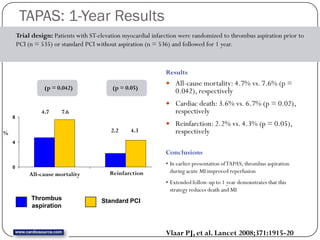
TAPAS: 1-Year Results
        Trial design: Patients with ST-elevation myocardial infarction were randomized to thrombus aspiration prior to
        PCI (n = 535) or standard PCI without aspiration (n = 536) and followed for 1 year.


                                                                 Results
                                                                  All-cause mortality: 4.7% vs. 7.6% (p =
                   (p = 0.042)              (p = 0.05)
                                                                     0.042), respectively
                                                                  Cardiac death: 3.6% vs. 6.7% (p = 0.02),
                 4.7     7.6                                         respectively
    8
                                                                  Reinfarction: 2.2% vs. 4.3% (p = 0.05),
%                                           2.2    4.3               respectively
    4

                                                                 Conclusions
                                                                 • In earlier presentation of TAPAS, thrombus aspiration
    0
                                           Reinfarction            during acute MI improved reperfusion
             All-cause mortality
              All-cause mortality          Re-infarction
                                                                 • Extended follow-up to 1 year demonstrates that this
                                                                   strategy reduces death and MI
             Thrombus                   Standard PCI
             aspiration


                                                                 Vlaar PJ, et al. Lancet 2008;371:1915-20
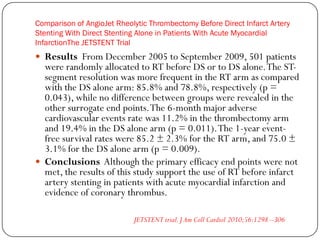
Comparison of AngioJet Rheolytic Thrombectomy Before Direct Infarct Artery
Stenting With Direct Stenting Alone in Patients With Acute Myocardial
InfarctionThe JETSTENT Trial
 Results From December 2005 to September 2009, 501 patients
  were randomly allocated to RT before DS or to DS alone. The ST-
  segment resolution was more frequent in the RT arm as compared
  with the DS alone arm: 85.8% and 78.8%, respectively (p =
  0.043), while no difference between groups were revealed in the
  other surrogate end points. The 6-month major adverse
  cardiovascular events rate was 11.2% in the thrombectomy arm
  and 19.4% in the DS alone arm (p = 0.011). The 1-year event-
  free survival rates were 85.2 Âą 2.3% for the RT arm, and 75.0 Âą
  3.1% for the DS alone arm (p = 0.009).
 Conclusions Although the primary efficacy end points were not
  met, the results of this study support the use of RT before infarct
  artery stenting in patients with acute myocardial infarction and
  evidence of coronary thrombus.

                            JETSTENT trial. J Am Coll Cardiol 2010;56:1298 –306
The aim of the study
 The aim of this study was to assess the impact of
  thrombectomy, either manual or rheolytic, on myocardial
  reperfusion and infarct size in patients with high thrombotic
  burden.
Methods
 Study design and patients-
 A multicenter prospective randomized study
 Assigned patients in a 1:1 ratio to either thrombectomy as an
  adjunct to pPCI (Group T) or standard pPCI without
  thrombectomy (Group S)
Inclusion criteria
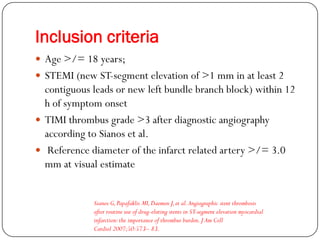
 Age >/= 18 years;
 STEMI (new ST-segment elevation of >1 mm in at least 2
  contiguous leads or new left bundle branch block) within 12
  h of symptom onset
 TIMI thrombus grade >3 after diagnostic angiography
  according to Sianos et al.
 Reference diameter of the infarct related artery >/= 3.0
  mm at visual estimate


             Sianos G, Papafaklis MI, Daemen J, et al. Angiographic stent thrombosis
             after routine use of drug-eluting stents in ST-segment elevation myocardial
             infarction: the importance of thrombus burden. J Am Coll
             Cardiol 2007;50:573– 83.
Exclusion criteria

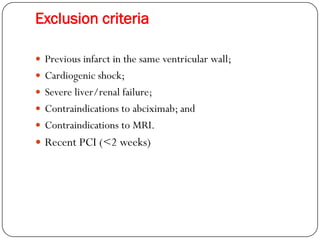
 Previous infarct in the same ventricular wall;
 Cardiogenic shock;
 Severe liver/renal failure;
 Contraindications to abciximab; and
 Contraindications to MRI.
 Recent PCI (<2 weeks)
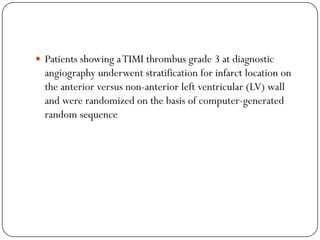
 Patients showing a TIMI thrombus grade 3 at diagnostic
  angiography underwent stratification for infarct location on
  the anterior versus non-anterior left ventricular (LV) wall
  and were randomized on the basis of computer-generated
  random sequence
PCI procedure
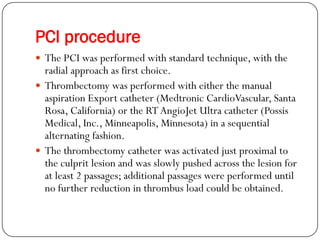
 The PCI was performed with standard technique, with the
  radial approach as first choice.
 Thrombectomy was performed with either the manual
  aspiration Export catheter (Medtronic CardioVascular, Santa
  Rosa, California) or the RT AngioJet Ultra catheter (Possis
  Medical, Inc., Minneapolis, Minnesota) in a sequential
  alternating fashion.
 The thrombectomy catheter was activated just proximal to
  the culprit lesion and was slowly pushed across the lesion for
  at least 2 passages; additional passages were performed until
  no further reduction in thrombus load could be obtained.
 Pre-dilation with small balloons was performed only if the
    thrombectomy catheter failed to cross the lesion.
   Direct stenting was recommended, whereas choice of coronary
    stents was left at the discretion of the physician.
   Use of embolic protection devices was not allowed.
   All patients received IV aspirin 250 mg and clopidogrel 600 mg
    oral load at time of STEMI diagnosis.
    In the catheterization laboratory, IV boluses of unfractionated
    heparin (60 U/kg body weight) and abciximab (0.25 mg/kg) were
    administered, followed by a12-h abciximab infusion at 0.125
    micro g/kg/min.
   The activated clotting time was kept in the 200- to 250-s range
    during pPCI.
Angiographic and electrocardiographic
analysis
 All angiograms were analyzed by 2 experienced investigators
  in the core laboratory in Pisa University Hospital.
 Investigators assessed the initial and post-procedural TIMI
  flow grade, corrected TIMI frame count (cTFC), and
  myocardial blush grade (MBG).
 Thrombotic burden was graded according to the TIMI
  thrombus classification modified according to Sianos et al.
 Complete thrombus removal by thrombectomy was defined
  by a reduction in thrombus grade from grade 4 to grade 0 to
  1.
 Procedural success was defined as a final TIMI flow grade 3
  with a residual stenosis < 20%.
 The ST-segment elevation was measured 40 ms after the J
  point, and the sum of ST-segment deviations was determined
  on a 12-lead electrocardiogram before and 60 min after
  intervention.
 The ST-segment elevation resolution (STR) was categorized
  as complete (70%), partial (30% to 70%), or absent (30%).
MRI protocol.
 Three months after PCI, MRI was performed with a 1.5-T
  scanner with an 8-element cardiac phased array receiver
  surface coil (CVi, HD release; GE Healthcare, Milwaukee,
  Wisconsin).
 Left ventricular functional parameters were obtained from
  short-axis cine images from mitral valve plane to the apex,
  with a steady-state free precession pulse sequence
 Rest myocardial perfusion images were acquired during 30 to
  40 consecutive heartbeats, immediately after administration
  of a 0.1-mmol/kg bolus of Magnevist (Schering, Berlin,
  Germany)
 Early enhancement images were acquired in the same short- and
    long-axis slices used for cine-MRI
   Late-enhancement images were obtained 10 min after the
    injection of contrast medium in the same acquisition planes.
   Infarct size was expressed as percentage of LV mass.
   To measure infarct transmurality, investigators divided the
    myocardium according to the standard 17-segment model.
    Each segment was then divided into 100 chordae, perpendicularly
    directed from the endocardial to the epicardial border.
    LGE was calculated automatically in each chorda and defined as
    transmural when it spanned 75% of myocardial thickness.
 Microvascular obstruction (MVO) was defined as the
  presence of hypo-intense areas within the infarct core scar
  characterized by enhanced myocardium in LGE images.
 Briefly, investigators considered areas of unenhanced
  myocardium, defined with a signal-intensity threshold of 6
  SD above mean reference signal intensity, inside the scar as
  islands of viable myocardium .
 Infarct inhomogeneity was defined by the presence of islands
  of viable myocardium covering 5% of myocardial scar.
Follow-up-

 Follow-up visits were scheduled at 1, 6, and 12 months after
  pPCI.
 Investigators assessed the 1-year rate of major adverse cardiac
  events (MACE), defined as a composite of death,
  reinfarction, and target vessel revascularization
Study endpoints
 The primary endpoints were:
    1) the rate of complete STR at 60 min after pPCI, and
    2) infarct size at 3 months.
 The secondary endpoints were:
    1) post-procedural TIMI flow grade;
    2) post-procedural MBG;
    3) infarct transmurality at 3 months;
    4) MVO at 3 months; and
    5) 1-year actuarial freedom from MACE.
Results
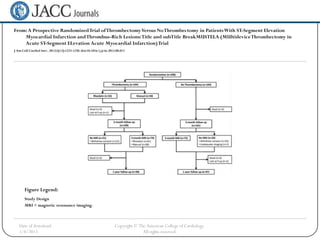
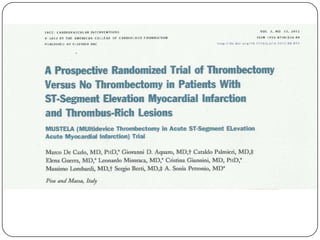
From: A Prospective Randomized Trial of Thrombectomy Versus No Thrombectomy in Patients With ST-Segment Elevation
    Myocardial Infarction and Thrombus-Rich Lesions: Title and subTitle BreakMUSTELA (MUltidevice Thrombectomy in
    Acute ST-Segment ELevation Acute Myocardial Infarction) Trial
J Am Coll Cardiol Intv. 2012;5(12):1223-1230. doi:10.1016/j.jcin.2012.08.013


       Figure Legend:
       Study Design
       MRI = magnetic resonance imaging.


   Date of download:                                                 Copyright Š The American College of Cardiology.
   1/8/2013                                                                        All rights reserved.
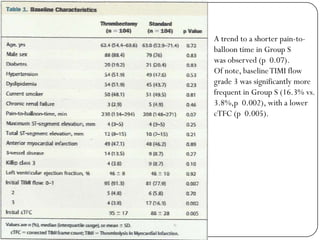
A trend to a shorter pain-to-
balloon time in Group S
was observed (p 0.07).
Of note, baseline TIMI flow
grade 3 was significantly more
frequent in Group S (16.3% vs.
3.8%,p 0.002), with a lower
cTFC (p 0.005).
Procedural results
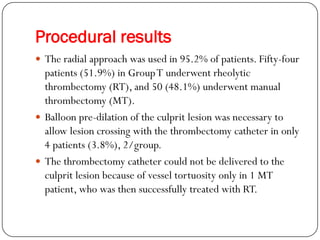
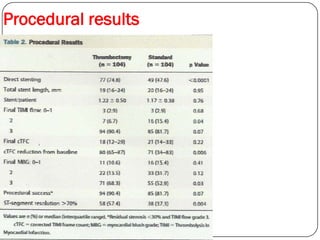
 The radial approach was used in 95.2% of patients. Fifty-four
  patients (51.9%) in Group T underwent rheolytic
  thrombectomy (RT), and 50 (48.1%) underwent manual
  thrombectomy (MT).
 Balloon pre-dilation of the culprit lesion was necessary to
  allow lesion crossing with the thrombectomy catheter in only
  4 patients (3.8%), 2/group.
 The thrombectomy catheter could not be delivered to the
  culprit lesion because of vessel tortuosity only in 1 MT
  patient, who was then successfully treated with RT.
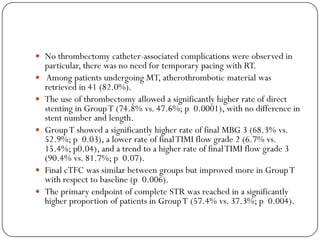
 No thrombectomy catheter-associated complications were observed in
    particular, there was no need for temporary pacing with RT.
   Among patients undergoing MT, atherothrombotic material was
    retrieved in 41 (82.0%).
   The use of thrombectomy allowed a significantly higher rate of direct
    stenting in Group T (74.8% vs. 47.6%; p 0.0001), with no difference in
    stent number and length.
   Group T showed a significantly higher rate of final MBG 3 (68.3% vs.
    52.9%; p 0.03), a lower rate of final TIMI flow grade 2 (6.7% vs.
    15.4%; p0.04), and a trend to a higher rate of final TIMI flow grade 3
    (90.4% vs. 81.7%; p 0.07).
   Final cTFC was similar between groups but improved more in Group T
    with respect to baseline (p 0.006).
   The primary endpoint of complete STR was reached in a significantly
    higher proportion of patients in Group T (57.4% vs. 37.3%; p 0.004).
Procedural results
MRI Results
From: A Prospective Randomized Trial of Thrombectomy Versus No Thrombectomy in Patients With ST-Segment Elevation
    Myocardial Infarction and Thrombus-Rich Lesions: Title and subTitle BreakMUSTELA (MUltidevice Thrombectomy in
    Acute ST-Segment ELevation Acute Myocardial Infarction) Trial
J Am Coll Cardiol Intv. 2012;5(12):1223-1230. doi:10.1016/j.jcin.2012.08.013


       Figure Legend:
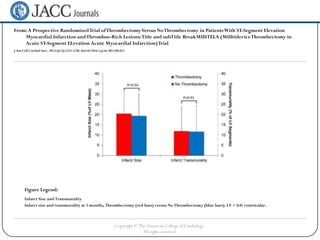
       Infarct Size and Transmurality
       Infarct size and transmurality at 3 months, Thrombectomy (red bars) versus No Thrombectomy (blue bars). LV = left ventricular.


                                                                     Copyright Š The American College of Cardiology.
                                                                                   All rights reserved.
MT versus RT
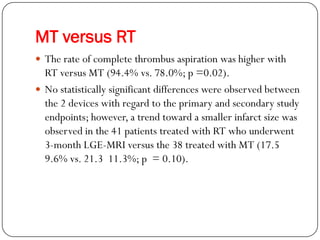
 The rate of complete thrombus aspiration was higher with
  RT versus MT (94.4% vs. 78.0%; p =0.02).
 No statistically significant differences were observed between
  the 2 devices with regard to the primary and secondary study
  endpoints; however, a trend toward a smaller infarct size was
  observed in the 41 patients treated with RT who underwent
  3-month LGE-MRI versus the 38 treated with MT (17.5
  9.6% vs. 21.3 11.3%; p = 0.10).
One year outcome
 One-year follow-up was 98.6% complete, with only 1 patient of
    Group T and 2 of Group S being lost.
    Ninety-eight patients of Group T and 97 of Group S reached the
    1-year follow-up.
   In Group T, 5 patients died because of cardiac causes, 2 suffered
    reinfarction (treated with PCI in 1 case), and 1 underwent target
    vessel revascularization.
   In Group S, 4 patients died because of cardiac causes, 1 died
    because of hepatic cancer, 2 suffered reinfarction (treated with
    PCI in both cases), and 1 underwent target vessel
    revascularization.
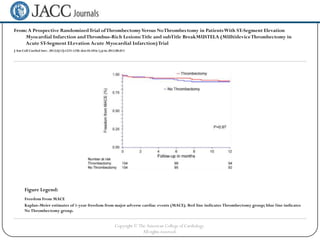
   The actuarial freedom from MACE was 91.4 +/- 2.8% in Group
    T versus 90.2 +/- 2.9% in Group S (p 0.97)
From: A Prospective Randomized Trial of Thrombectomy Versus No Thrombectomy in Patients With ST-Segment Elevation
    Myocardial Infarction and Thrombus-Rich Lesions: Title and subTitle BreakMUSTELA (MUltidevice Thrombectomy in
    Acute ST-Segment ELevation Acute Myocardial Infarction) Trial
J Am Coll Cardiol Intv. 2012;5(12):1223-1230. doi:10.1016/j.jcin.2012.08.013


       Figure Legend:
       Freedom From MACE
       Kaplan-Meier estimates of 1-year freedom from major adverse cardiac events (MACE). Red line indicates Thrombectomy group; blue line indicates
       No Thrombectomy group.


                                                                     Copyright Š The American College of Cardiology.
                                                                                   All rights reserved.
Discussion
 The present study is the first to assess the impact of thrombus
  aspiration on infarct size assessed with MRI in a large cohort
  of patients with high thrombotic burden.

 Initial single-center studies reported positive results with
  thrombectomy devices when “soft” endpoints, such as post-
  PCI TIMI flow, MBG, or STR were used.
 More recently, the single-center TAPAS (Thrombus
  Aspiration during Percutaneous coronary intervention in
  Acute myocardial infarction Study) and JETSTENT
  (AngioJet Rheolytic Thrombectomy Before Direct Infarct
  Artery Stenting in Patients Undergoing Primary PCI for
  Acute Myocardial Infarction) randomized studies
  demonstrated a significant benefit of aspiration
  thrombectomy on clinical outcomes, although no significant
  reduction in infarct size was demonstrated.
 Based mainly on the TAPAS trial, MT is currently
  recommended in all patients undergoing pPCI , although it is
  reasonable to assume that thrombus aspiration can be useful
  mainly in patients with large thrombus burden, which is an
  independent predictor of distal embolization during pPCI

 The correct assessment of infarct size in trials investigating
  thrombectomy during pPCI is of paramount importance,
  because the mechanism leading to a reduced mortality
  presumably should be a favorable effect on infarct size
 Interestingly, all randomized trials failed to demonstrate a
  significant reduction in infarct size with thrombectomy,
  whatever the technique used for its assessment

 Currently, LGE-MRI is the best technique for the assessment
  of infarct size and also allows measurement of transmurality
  and MVO
Myocardial reperfusion
 This study showed a clear advantage of thrombectomy on
  surrogate markers of reperfusion at tissue level, with a
  complete STR of 57.4% of Group T patients versus 37.3% of
  Group S (p 0.004), in agreement with previous studies
  reporting complete STR between 56.6% and 67.6% .
 Final MBG 3 was also significantly improved in Group T
  (p0.03), with a 68% rate falling within the wide range of
  46% to 88% previously described
Clinical outcome
 The 1-year actuarial freedom from MACE was similar
  between groups (p 0.97), at variance with the results of the
  TAPAS and JETSTENT trials .
 However, the lack of clinical benefit from thrombectomy in
  this trial agrees with the lack of benefit on infarct size.
MT versus RT
 This trial was not designed to compare RT versus MT, but
  the balanced use of the 2 devices allows exploring the
  potential differences between them.
 This trial describe for the first time a significantly higher rate
  of complete thrombus removal with RT versus MT (p 0.02)
  as well as a trend to a smaller infarct size at 3-month LGE (p
  0.10).
 However, larger randomized studies are mandatory to verify
  these preliminary findings.
Study limitations
 This study has some limitations. First, the trial was single-blind,
  with the operator knowing the randomization assignment;
  however, the physicians reading LGE were unaware of
  randomization assignment.
 Second, investigators enrolled only 65% of the screened STEMI
  patients, because of selection criteria. However, excluding
  patients with low thrombotic burden is very unlikely to have
  masked the benefits of thrombectomy.
 Third, infarct size assessment by LGE was performed in only 159
  of 208 patients (76.4%), mainly because of patient withdrawal and
  patient death before 3 months. Nevertheless, this is the
  thrombectomy trial with the largest population of patients
  undergoing LGE-MRI.
 Fourth, investigators did not choose the thrombectomy
  device in a randomized fashion, so that inferences on the
  comparison between devices can only be hypothesis
  generating.
 Finally, the imbalance in initial TIMI flow grade 3 might have
  disadvantaged the thrombectomy group, possibly masking a
  potential benefit; however, after adjustment for this
  imbalance, still investigators could not find a significant
  reduction in infarct size with thrombectomy.
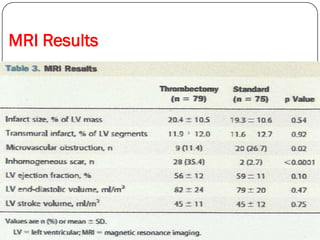
• Thrombectomy was not associated with a significant
  reduction in infarct size at 3-month MRI, even in a high-
  thrombus burden STEMI population

• However, thrombectomy was associated with a
  significantly higher rate of complete STE resolution, and
  of post-procedural myocardial perfusion grade 3, and with
  a lower rate of final TIMI 2 flow
 Thrombectomy was associated with a different MRI
  pattern of myocardial scar at 3 months, with less
  microvascular obstruction and with areas of viable tissue
  interspersed with necrotic areas
 No significant difference was observed regarding 1-year
  freedom from MACEs
 Angiojet was superior to Export in terms of thrombus
  removal, but not regarding procedural and MRI results
Recommendations for Thrombus
      Aspiration during PCI for STEMI


44
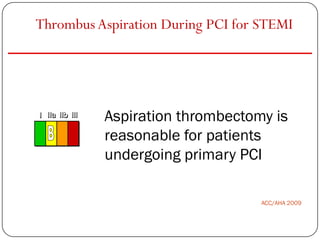
Thrombus Aspiration During PCI for STEMI


I IIa IIb III   Aspiration thrombectomy is
                reasonable for patients
                undergoing primary PCI

                                      ACC/AHA 2009
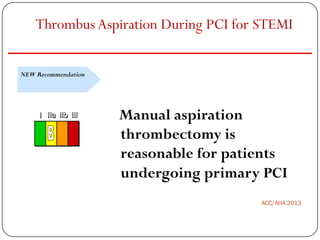
Thrombus Aspiration During PCI for STEMI

NEW Recommendation


     I IIa IIb III   Manual aspiration
                     thrombectomy is
                     reasonable for patients
                     undergoing primary PCI
                                        ACC/AHA 2013
THNAKS
TIMI THROMBUS GRADING
 According to this classification, in thrombus grade 0 (G0), no
  cineangiographic characteristics of thrombus are present; in
  thrombus grade 1 (G1), possible thrombus is present, with such
  angiography characteristics as reduced contrast density, haziness,
  irregular lesion contour, or a smooth convex meniscus at the site
  of total occlusion suggestive but not diagnostic of thrombus; in
  thrombus grade 2 (G2), there is definite thrombus, with greatest
  dimensions ≤1/2 the vessel diameter; in thrombus grade 3 (G3),
  there is definite thrombus but with greatest linear dimension
  >1/2 but <2 vessel diameters; in thrombus grade 4 (G4), there is
  definite thrombus, with the largest dimension ≥2 vessel diameters;
  and in thrombus grade 5 (G5), there is total occlusion (unable to
  assess thrombus burden due to total vessel occlusion).

Thromboectomy trial

  • 1.
  • 3.
    INTRODUCTION  Primary percutaneouscoronary intervention (pPCI) is highly effective in restoring a normal Thrombolysis In Myocardial Infarction (TIMI) flow in patients with ST segment elevation acute myocardial infarction (STEMI).  But a relevant proportion of patients (approx 15%) shows a poor myocardial reperfusion, which strongly correlates with larger infarct size and worse clinical outcome.  Thrombectomy devices aim at improving myocardial reperfusion by preventing distal thrombus embolization during pPCI.
  • 4.
     After controversialresults of the initial studies, 2 recent randomized single-center studies demonstrated a significant benefit of thrombus aspiration on clinical outcome although not on infarct size.  Currently, magnetic resonance imaging (MRI) with late gadolinium enhancement (LGE) is the best method to assess infarct size. (TAPAS): a 1-year follow-up study. Lancet 2008;371:1915–20. JETSTENT trial. J Am Coll Cardiol 2010;56:1298 –306
  • 5.
    Cardiac death andreinfarction after 1 year in the Thrombus Aspiration during Percutaneous coronary intervention in Acute myocardial infarction Study (TAPAS): a 1-year follow-up study  Findings  Cardiac death at 1 year was 3·6% (19 of 535 patients) in the thrombus aspiration group and 6·7% (36 of 536) in the conventional PCI group (hazard ratio [HR] 1·93; 95% CI 1·11— 3·37; p=0·020). 1-year cardiac death or non-fatal reinfarction occurred in 5·6% (30 of 535) of patients in the thrombus aspiration group and 9·9% (53 of 536) of patients in the conventional PCI group (HR 1·81; 95% CI 1·16—2·84; p=0·009).  Interpretation  Compared with conventional PCI, thrombus aspiration before stenting of the infarcted artery seems to improve the 1-year clinical outcome after PCI for ST-elevation myocardial infarction. Lancet 2008;371:1915–20.
  • 6.
    TAPAS: 1-Year Results Trial design: Patients with ST-elevation myocardial infarction were randomized to thrombus aspiration prior to PCI (n = 535) or standard PCI without aspiration (n = 536) and followed for 1 year. Results  All-cause mortality: 4.7% vs. 7.6% (p = (p = 0.042) (p = 0.05) 0.042), respectively  Cardiac death: 3.6% vs. 6.7% (p = 0.02), 4.7 7.6 respectively 8  Reinfarction: 2.2% vs. 4.3% (p = 0.05), % 2.2 4.3 respectively 4 Conclusions • In earlier presentation of TAPAS, thrombus aspiration 0 Reinfarction during acute MI improved reperfusion All-cause mortality All-cause mortality Re-infarction • Extended follow-up to 1 year demonstrates that this strategy reduces death and MI Thrombus Standard PCI aspiration Vlaar PJ, et al. Lancet 2008;371:1915-20
  • 7.
    Comparison of AngioJetRheolytic Thrombectomy Before Direct Infarct Artery Stenting With Direct Stenting Alone in Patients With Acute Myocardial InfarctionThe JETSTENT Trial  Results From December 2005 to September 2009, 501 patients were randomly allocated to RT before DS or to DS alone. The ST- segment resolution was more frequent in the RT arm as compared with the DS alone arm: 85.8% and 78.8%, respectively (p = 0.043), while no difference between groups were revealed in the other surrogate end points. The 6-month major adverse cardiovascular events rate was 11.2% in the thrombectomy arm and 19.4% in the DS alone arm (p = 0.011). The 1-year event- free survival rates were 85.2 ± 2.3% for the RT arm, and 75.0 ± 3.1% for the DS alone arm (p = 0.009).  Conclusions Although the primary efficacy end points were not met, the results of this study support the use of RT before infarct artery stenting in patients with acute myocardial infarction and evidence of coronary thrombus. JETSTENT trial. J Am Coll Cardiol 2010;56:1298 –306
  • 8.
    The aim ofthe study  The aim of this study was to assess the impact of thrombectomy, either manual or rheolytic, on myocardial reperfusion and infarct size in patients with high thrombotic burden.
  • 9.
    Methods  Study designand patients-  A multicenter prospective randomized study  Assigned patients in a 1:1 ratio to either thrombectomy as an adjunct to pPCI (Group T) or standard pPCI without thrombectomy (Group S)
  • 10.
    Inclusion criteria  Age>/= 18 years;  STEMI (new ST-segment elevation of >1 mm in at least 2 contiguous leads or new left bundle branch block) within 12 h of symptom onset  TIMI thrombus grade >3 after diagnostic angiography according to Sianos et al.  Reference diameter of the infarct related artery >/= 3.0 mm at visual estimate Sianos G, Papafaklis MI, Daemen J, et al. Angiographic stent thrombosis after routine use of drug-eluting stents in ST-segment elevation myocardial infarction: the importance of thrombus burden. J Am Coll Cardiol 2007;50:573– 83.
  • 11.
    Exclusion criteria  Previousinfarct in the same ventricular wall;  Cardiogenic shock;  Severe liver/renal failure;  Contraindications to abciximab; and  Contraindications to MRI.  Recent PCI (<2 weeks)
  • 12.
     Patients showinga TIMI thrombus grade 3 at diagnostic angiography underwent stratification for infarct location on the anterior versus non-anterior left ventricular (LV) wall and were randomized on the basis of computer-generated random sequence
  • 13.
    PCI procedure  ThePCI was performed with standard technique, with the radial approach as first choice.  Thrombectomy was performed with either the manual aspiration Export catheter (Medtronic CardioVascular, Santa Rosa, California) or the RT AngioJet Ultra catheter (Possis Medical, Inc., Minneapolis, Minnesota) in a sequential alternating fashion.  The thrombectomy catheter was activated just proximal to the culprit lesion and was slowly pushed across the lesion for at least 2 passages; additional passages were performed until no further reduction in thrombus load could be obtained.
  • 14.
     Pre-dilation withsmall balloons was performed only if the thrombectomy catheter failed to cross the lesion.  Direct stenting was recommended, whereas choice of coronary stents was left at the discretion of the physician.  Use of embolic protection devices was not allowed.  All patients received IV aspirin 250 mg and clopidogrel 600 mg oral load at time of STEMI diagnosis.  In the catheterization laboratory, IV boluses of unfractionated heparin (60 U/kg body weight) and abciximab (0.25 mg/kg) were administered, followed by a12-h abciximab infusion at 0.125 micro g/kg/min.  The activated clotting time was kept in the 200- to 250-s range during pPCI.
  • 15.
    Angiographic and electrocardiographic analysis All angiograms were analyzed by 2 experienced investigators in the core laboratory in Pisa University Hospital.  Investigators assessed the initial and post-procedural TIMI flow grade, corrected TIMI frame count (cTFC), and myocardial blush grade (MBG).  Thrombotic burden was graded according to the TIMI thrombus classification modified according to Sianos et al.  Complete thrombus removal by thrombectomy was defined by a reduction in thrombus grade from grade 4 to grade 0 to 1.
  • 16.
     Procedural successwas defined as a final TIMI flow grade 3 with a residual stenosis < 20%.  The ST-segment elevation was measured 40 ms after the J point, and the sum of ST-segment deviations was determined on a 12-lead electrocardiogram before and 60 min after intervention.  The ST-segment elevation resolution (STR) was categorized as complete (70%), partial (30% to 70%), or absent (30%).
  • 17.
    MRI protocol.  Threemonths after PCI, MRI was performed with a 1.5-T scanner with an 8-element cardiac phased array receiver surface coil (CVi, HD release; GE Healthcare, Milwaukee, Wisconsin).  Left ventricular functional parameters were obtained from short-axis cine images from mitral valve plane to the apex, with a steady-state free precession pulse sequence  Rest myocardial perfusion images were acquired during 30 to 40 consecutive heartbeats, immediately after administration of a 0.1-mmol/kg bolus of Magnevist (Schering, Berlin, Germany)
  • 18.
     Early enhancementimages were acquired in the same short- and long-axis slices used for cine-MRI  Late-enhancement images were obtained 10 min after the injection of contrast medium in the same acquisition planes.  Infarct size was expressed as percentage of LV mass.  To measure infarct transmurality, investigators divided the myocardium according to the standard 17-segment model.  Each segment was then divided into 100 chordae, perpendicularly directed from the endocardial to the epicardial border.  LGE was calculated automatically in each chorda and defined as transmural when it spanned 75% of myocardial thickness.
  • 19.
     Microvascular obstruction(MVO) was defined as the presence of hypo-intense areas within the infarct core scar characterized by enhanced myocardium in LGE images.  Briefly, investigators considered areas of unenhanced myocardium, defined with a signal-intensity threshold of 6 SD above mean reference signal intensity, inside the scar as islands of viable myocardium .  Infarct inhomogeneity was defined by the presence of islands of viable myocardium covering 5% of myocardial scar.
  • 20.
    Follow-up-  Follow-up visitswere scheduled at 1, 6, and 12 months after pPCI.  Investigators assessed the 1-year rate of major adverse cardiac events (MACE), defined as a composite of death, reinfarction, and target vessel revascularization
  • 21.
    Study endpoints  Theprimary endpoints were: 1) the rate of complete STR at 60 min after pPCI, and 2) infarct size at 3 months.  The secondary endpoints were: 1) post-procedural TIMI flow grade; 2) post-procedural MBG; 3) infarct transmurality at 3 months; 4) MVO at 3 months; and 5) 1-year actuarial freedom from MACE.
  • 22.
  • 23.
    From: A ProspectiveRandomized Trial of Thrombectomy Versus No Thrombectomy in Patients With ST-Segment Elevation Myocardial Infarction and Thrombus-Rich Lesions: Title and subTitle BreakMUSTELA (MUltidevice Thrombectomy in Acute ST-Segment ELevation Acute Myocardial Infarction) Trial J Am Coll Cardiol Intv. 2012;5(12):1223-1230. doi:10.1016/j.jcin.2012.08.013 Figure Legend: Study Design MRI = magnetic resonance imaging. Date of download: Copyright Š The American College of Cardiology. 1/8/2013 All rights reserved.
  • 24.
    A trend toa shorter pain-to- balloon time in Group S was observed (p 0.07). Of note, baseline TIMI flow grade 3 was significantly more frequent in Group S (16.3% vs. 3.8%,p 0.002), with a lower cTFC (p 0.005).
  • 25.
    Procedural results  Theradial approach was used in 95.2% of patients. Fifty-four patients (51.9%) in Group T underwent rheolytic thrombectomy (RT), and 50 (48.1%) underwent manual thrombectomy (MT).  Balloon pre-dilation of the culprit lesion was necessary to allow lesion crossing with the thrombectomy catheter in only 4 patients (3.8%), 2/group.  The thrombectomy catheter could not be delivered to the culprit lesion because of vessel tortuosity only in 1 MT patient, who was then successfully treated with RT.
  • 26.
     No thrombectomycatheter-associated complications were observed in particular, there was no need for temporary pacing with RT.  Among patients undergoing MT, atherothrombotic material was retrieved in 41 (82.0%).  The use of thrombectomy allowed a significantly higher rate of direct stenting in Group T (74.8% vs. 47.6%; p 0.0001), with no difference in stent number and length.  Group T showed a significantly higher rate of final MBG 3 (68.3% vs. 52.9%; p 0.03), a lower rate of final TIMI flow grade 2 (6.7% vs. 15.4%; p0.04), and a trend to a higher rate of final TIMI flow grade 3 (90.4% vs. 81.7%; p 0.07).  Final cTFC was similar between groups but improved more in Group T with respect to baseline (p 0.006).  The primary endpoint of complete STR was reached in a significantly higher proportion of patients in Group T (57.4% vs. 37.3%; p 0.004).
  • 27.
  • 28.
  • 29.
    From: A ProspectiveRandomized Trial of Thrombectomy Versus No Thrombectomy in Patients With ST-Segment Elevation Myocardial Infarction and Thrombus-Rich Lesions: Title and subTitle BreakMUSTELA (MUltidevice Thrombectomy in Acute ST-Segment ELevation Acute Myocardial Infarction) Trial J Am Coll Cardiol Intv. 2012;5(12):1223-1230. doi:10.1016/j.jcin.2012.08.013 Figure Legend: Infarct Size and Transmurality Infarct size and transmurality at 3 months, Thrombectomy (red bars) versus No Thrombectomy (blue bars). LV = left ventricular. Copyright Š The American College of Cardiology. All rights reserved.
  • 30.
    MT versus RT The rate of complete thrombus aspiration was higher with RT versus MT (94.4% vs. 78.0%; p =0.02).  No statistically significant differences were observed between the 2 devices with regard to the primary and secondary study endpoints; however, a trend toward a smaller infarct size was observed in the 41 patients treated with RT who underwent 3-month LGE-MRI versus the 38 treated with MT (17.5 9.6% vs. 21.3 11.3%; p = 0.10).
  • 31.
    One year outcome One-year follow-up was 98.6% complete, with only 1 patient of Group T and 2 of Group S being lost.  Ninety-eight patients of Group T and 97 of Group S reached the 1-year follow-up.  In Group T, 5 patients died because of cardiac causes, 2 suffered reinfarction (treated with PCI in 1 case), and 1 underwent target vessel revascularization.  In Group S, 4 patients died because of cardiac causes, 1 died because of hepatic cancer, 2 suffered reinfarction (treated with PCI in both cases), and 1 underwent target vessel revascularization.  The actuarial freedom from MACE was 91.4 +/- 2.8% in Group T versus 90.2 +/- 2.9% in Group S (p 0.97)
  • 32.
    From: A ProspectiveRandomized Trial of Thrombectomy Versus No Thrombectomy in Patients With ST-Segment Elevation Myocardial Infarction and Thrombus-Rich Lesions: Title and subTitle BreakMUSTELA (MUltidevice Thrombectomy in Acute ST-Segment ELevation Acute Myocardial Infarction) Trial J Am Coll Cardiol Intv. 2012;5(12):1223-1230. doi:10.1016/j.jcin.2012.08.013 Figure Legend: Freedom From MACE Kaplan-Meier estimates of 1-year freedom from major adverse cardiac events (MACE). Red line indicates Thrombectomy group; blue line indicates No Thrombectomy group. Copyright Š The American College of Cardiology. All rights reserved.
  • 33.
    Discussion  The presentstudy is the first to assess the impact of thrombus aspiration on infarct size assessed with MRI in a large cohort of patients with high thrombotic burden.  Initial single-center studies reported positive results with thrombectomy devices when “soft” endpoints, such as post- PCI TIMI flow, MBG, or STR were used.
  • 34.
     More recently,the single-center TAPAS (Thrombus Aspiration during Percutaneous coronary intervention in Acute myocardial infarction Study) and JETSTENT (AngioJet Rheolytic Thrombectomy Before Direct Infarct Artery Stenting in Patients Undergoing Primary PCI for Acute Myocardial Infarction) randomized studies demonstrated a significant benefit of aspiration thrombectomy on clinical outcomes, although no significant reduction in infarct size was demonstrated.
  • 35.
     Based mainlyon the TAPAS trial, MT is currently recommended in all patients undergoing pPCI , although it is reasonable to assume that thrombus aspiration can be useful mainly in patients with large thrombus burden, which is an independent predictor of distal embolization during pPCI  The correct assessment of infarct size in trials investigating thrombectomy during pPCI is of paramount importance, because the mechanism leading to a reduced mortality presumably should be a favorable effect on infarct size
  • 36.
     Interestingly, allrandomized trials failed to demonstrate a significant reduction in infarct size with thrombectomy, whatever the technique used for its assessment  Currently, LGE-MRI is the best technique for the assessment of infarct size and also allows measurement of transmurality and MVO
  • 37.
    Myocardial reperfusion  Thisstudy showed a clear advantage of thrombectomy on surrogate markers of reperfusion at tissue level, with a complete STR of 57.4% of Group T patients versus 37.3% of Group S (p 0.004), in agreement with previous studies reporting complete STR between 56.6% and 67.6% .  Final MBG 3 was also significantly improved in Group T (p0.03), with a 68% rate falling within the wide range of 46% to 88% previously described
  • 38.
    Clinical outcome  The1-year actuarial freedom from MACE was similar between groups (p 0.97), at variance with the results of the TAPAS and JETSTENT trials .  However, the lack of clinical benefit from thrombectomy in this trial agrees with the lack of benefit on infarct size.
  • 39.
    MT versus RT This trial was not designed to compare RT versus MT, but the balanced use of the 2 devices allows exploring the potential differences between them.  This trial describe for the first time a significantly higher rate of complete thrombus removal with RT versus MT (p 0.02) as well as a trend to a smaller infarct size at 3-month LGE (p 0.10).  However, larger randomized studies are mandatory to verify these preliminary findings.
  • 40.
    Study limitations  Thisstudy has some limitations. First, the trial was single-blind, with the operator knowing the randomization assignment; however, the physicians reading LGE were unaware of randomization assignment.  Second, investigators enrolled only 65% of the screened STEMI patients, because of selection criteria. However, excluding patients with low thrombotic burden is very unlikely to have masked the benefits of thrombectomy.  Third, infarct size assessment by LGE was performed in only 159 of 208 patients (76.4%), mainly because of patient withdrawal and patient death before 3 months. Nevertheless, this is the thrombectomy trial with the largest population of patients undergoing LGE-MRI.
  • 41.
     Fourth, investigatorsdid not choose the thrombectomy device in a randomized fashion, so that inferences on the comparison between devices can only be hypothesis generating.  Finally, the imbalance in initial TIMI flow grade 3 might have disadvantaged the thrombectomy group, possibly masking a potential benefit; however, after adjustment for this imbalance, still investigators could not find a significant reduction in infarct size with thrombectomy.
  • 42.
    • Thrombectomy wasnot associated with a significant reduction in infarct size at 3-month MRI, even in a high- thrombus burden STEMI population • However, thrombectomy was associated with a significantly higher rate of complete STE resolution, and of post-procedural myocardial perfusion grade 3, and with a lower rate of final TIMI 2 flow
  • 43.
     Thrombectomy wasassociated with a different MRI pattern of myocardial scar at 3 months, with less microvascular obstruction and with areas of viable tissue interspersed with necrotic areas  No significant difference was observed regarding 1-year freedom from MACEs  Angiojet was superior to Export in terms of thrombus removal, but not regarding procedural and MRI results
  • 44.
    Recommendations for Thrombus Aspiration during PCI for STEMI 44
  • 45.
    Thrombus Aspiration DuringPCI for STEMI I IIa IIb III Aspiration thrombectomy is reasonable for patients undergoing primary PCI ACC/AHA 2009
  • 46.
    Thrombus Aspiration DuringPCI for STEMI NEW Recommendation I IIa IIb III Manual aspiration thrombectomy is reasonable for patients undergoing primary PCI ACC/AHA 2013
  • 47.
  • 48.
    TIMI THROMBUS GRADING According to this classification, in thrombus grade 0 (G0), no cineangiographic characteristics of thrombus are present; in thrombus grade 1 (G1), possible thrombus is present, with such angiography characteristics as reduced contrast density, haziness, irregular lesion contour, or a smooth convex meniscus at the site of total occlusion suggestive but not diagnostic of thrombus; in thrombus grade 2 (G2), there is definite thrombus, with greatest dimensions ≤1/2 the vessel diameter; in thrombus grade 3 (G3), there is definite thrombus but with greatest linear dimension >1/2 but <2 vessel diameters; in thrombus grade 4 (G4), there is definite thrombus, with the largest dimension ≥2 vessel diameters; and in thrombus grade 5 (G5), there is total occlusion (unable to assess thrombus burden due to total vessel occlusion).