

RHEUMATIC FEVER
NATURAL HISTORY
DIAGNOSIS AND
MANAGEMENT
DR AWADHESH SHARMA
Acute rheumatic fever is a non-
infectious delayed complication
of streptococcal sore throat due
to Group A Beta hemolytic
streptococcus (GABHS)
 Etiology
 Epidemiology
 Pathogenesis and Pathology
 Evolution of jones criteria
 Clinical manifestations & Laboratory
findings
 Natural history of RF
 Treatment & Prevention
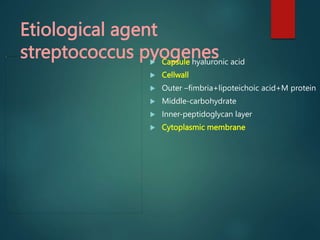
Etiological agent
streptococcus pyogenes
 Capsule hyaluronic acid
 Cellwall
 Outer –fimbria+lipoteichoic acid+M protein
 Middle-carbohydrate
 Inner-peptidoglycan layer
 Cytoplasmic membrane
GABHS Rheumatogenic serotypes 1,3,5,6,14,12,18,19,24,27,29
Nephritogenic serotypes 12 & 49
Pathogenesis
 RF develops following streptococcal
tonsillopharyngeal infection only, but not after
infection at other sites
 Autoimmune disease-Antigenic mimicry
 Antibodies against these antigens result in a
hyperactive immune response
 Crossreactivity- cytoskeleton, tropomyosin and
myosin
PATHOLOGY
 RF is a multisystem connective tissue disease
 Inflammatory lesions in the heart, joints &
subcutaneous tissue
Microscopy
 Aschoff granuloma is the pathological hallmark
of RF(seen in only 30-40% of suspected carditis).
It consists of central fibrinoid necrosis
surrounded by histiocytes (Anitschkow cells) with

a typical “owl-eye” nucleus.
Aschoff body
Anitschkow or Caterpillar cell:
Gross appearance
 Valves appear dull & thickened
 Verrucous pinhead vegetations on the atrial
surface of the mitral valve, chordae, ventricular
surface of aortic valve with edema or
hemorrhage in the leaflet tissue
 Serofibrinous pericarditis- bread and butter
appearance
 Scar in LA – McCallums patch due to
regurgitation jet.
Epidemiology of group A
streptococci
 Most pharyngitis (80%) is viral in
etiology, GABHS is isolated in up to
75% of cases from children with
symptoms of severe bacterial
pharyngitis.
Gerber MA et al: Prevention of rheumatic fever and
diagnosis and treatment of acute Streptococcal
pharyngitis:. Circulation 2009; 119:1541
Epidemiology of group A
streptococci
 Antistreptolysin O titers more than 200
Todd units are found in up to 50% of
asymptomatic children 6 to 15 years old,
the prime age group for RF. This reflects
the frequent occurrence of pharyngitis in
this age group (estimated to be once
yearly), approximately 15% to 20% of
which is caused by GABHS
Rheumatic fever and rheumatic heart disease. World
Health Organ Tech Rep Ser 2004; 923:1.
Cont...
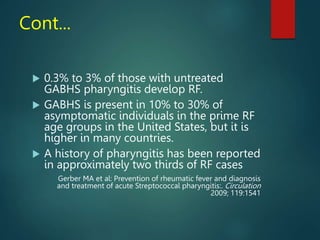
 0.3% to 3% of those with untreated
GABHS pharyngitis develop RF.
 GABHS is present in 10% to 30% of
asymptomatic individuals in the prime RF
age groups in the United States, but it is
higher in many countries.
 A history of pharyngitis has been reported
in approximately two thirds of RF cases
Gerber MA et al: Prevention of rheumatic fever and diagnosis
and treatment of acute Streptococcal pharyngitis:. Circulation
2009; 119:1541
EPIDEMIOLOGY OF RF
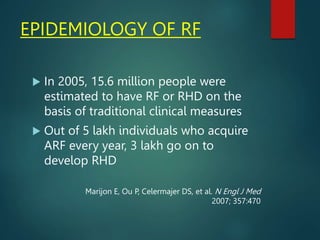
 In 2005, 15.6 million people were
estimated to have RF or RHD on the
basis of traditional clinical measures
 Out of 5 lakh individuals who acquire
ARF every year, 3 lakh go on to
develop RHD
Marijon E, Ou P, Celermajer DS, et al. N Engl J Med
2007; 357:470
Incidence
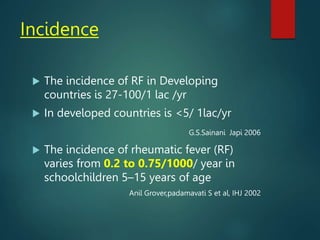
 The incidence of RF in Developing
countries is 27-100/1 lac /yr
 In developed countries is <5/ 1lac/yr
G.S.Sainani Japi 2006
 The incidence of rheumatic fever (RF)
varies from 0.2 to 0.75/1000/ year in
schoolchildren 5–15 years of age
Anil Grover,padamavati S et al, IHJ 2002
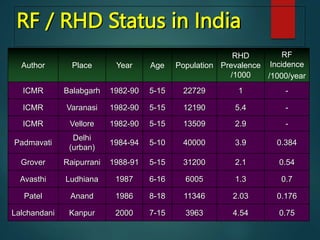
RF / RHD Status in India
Author Place Year Age Population
RHD
Prevalence
/1000
RF
Incidence
/1000/year
ICMR Balabgarh 1982-90 5-15 22729 1 -
ICMR Varanasi 1982-90 5-15 12190 5.4 -
ICMR Vellore 1982-90 5-15 13509 2.9 -
Padmavati
Delhi
(urban)
1984-94 5-10 40000 3.9 0.384
Grover Raipurrani 1988-91 5-15 31200 2.1 0.54
Avasthi Ludhiana 1987 6-16 6005 1.3 0.7
Patel Anand 1986 8-18 11346 2.03 0.176
Lalchandani Kanpur 2000 7-15 3963 4.54 0.75
 Etiology
 Epidemiology
 Pathogenesis and Pathology
 Evolution of jones criteria
 Clinical manifestations & Laboratory
findings
 Natural history of RF
 Treatment & Prevention
JONES CRITERIA
 In 1944 , Dr. T. Duckett Jones, Research
Director at the House of Good Samaritan,
Boston, in an article titled “The diagnosis of
rheumatic fever” in JAMA (1944;126:481-484)
presented a set of rules for the diagnosis of
rheumatic fever. He drew on his experience of
over 2 decades of over 1000 patients.
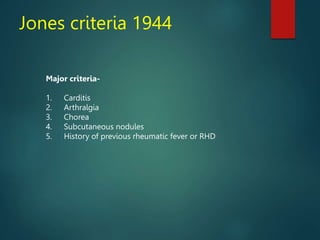
Jones criteria 1944
Major criteria-
1. Carditis
2. Arthralgia
3. Chorea
4. Subcutaneous nodules
5. History of previous rheumatic fever or RHD
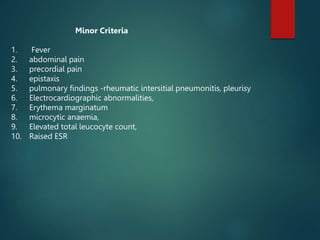
Minor Criteria
1. Fever
2. abdominal pain
3. precordial pain
4. epistaxis
5. pulmonary findings -rheumatic intersitial pneumonitis, pleurisy
6. Electrocardiographic abnormalities,
7. Erythema marginatum
8. microcytic anaemia,
9. Elevated total leucocyte count,
10. Raised ESR
The Original Jones Criteria 1944
 The combination of 2 major OR 1 major and 2
minor criteria constitute reasonably certain
diagnostic criteria,
 The presence of RHD increases the diagnostic
significance of the minor manifestations when no
other cause exists for the same,
 These criteria were meant to avoid over-
diagnosis,
 He further stated that these diagnostic criteria
were subject to change as the knowledge
increases.
The Modified Jones Criteria-1956 [Circulation, 1956, 13:
617–620]
MAJOR CRITERIA
 Carditis
 Polyarthritis
 Chorea
 Subcutaneous nodules
 Erythema marginatum
MINOR CRITERIA
 Fever
 Arthralgia
 Prolonged PR interval
 Increased ESR,Leuco-
cytosis,presence of CRP
 History of previous
definite ARF or RHD
 E/O preceding beta-
hemolytic streptococcal
infection
The Revised Jones Criteria-1965 [Circulation,
1965, 32:664–668]
MAJOR CRITERIA
 Carditis
 Polyarthritis
 Chorea
 Subcutaneous
nodules
 Erythema marginatum
MINOR CRITERIA
 Fever
 Arthralgia
 Prolonged PR interval
 Increased ESR,
Leucocytosis,presence
of CRP
 History of previous
definite ARF or RHD
The Revised Jones Criteria-1965
 Plus supporting evidence of preceding
streptococcal infection: h/o scarlet fever;positive
throat culture for group A streptococcus;increased
ASLO titer or other streptococcal antibodies,
 Chorea and chronic carditis [when presenting as
the only major manifestation] were exempted
from this requirement,
 The WHO expert committee on rheumatic fever
did not accept the revised criteria as at that time
there were insufficient laboratory facilities in the
developing countries to provide the necessary
supportive evidence.
The Revised Jones Criteria-1984 [Circulation,1984, 70:204A–
208A]
 No major changes,
 Avoid premature administration of anti-
inflammatory drugs when s/s are ill-defined,
 Role of echo to diagnose MVP
 Minor changes: history of a sore throat is not
considered adequate evidence of streptococcal
infection,
 Necessity to exclude non-rheumatic causes of
chorea highlighted,
 ASLO can be high in non-group-A strep.
infections and strep. skin infections.
Jones Criteria, Updated 1992 [JAMA, 1992, 268:2069–
2073]
Jones Criteria, Updated 1992
 The diagnosis of the initial attack of acute rheumatic fever,
 Clinical history of sore throat or of scarlet fever
unsubstantiated by laboratory data is not adequate
evidence of recent group A streptococcal infection,
 A throat culture or rapid antigen test does not distinguish
between recent infection and chronic pharyngeal carriage,
 Only about 25% of patients have throat cultures positive for
group A streptococci,
Jones Criteria, Updated 1992
Rising or elevated streptococcal antibody titer,
 A significant antibody increase is usually defined
as a rise in titer of two or more dilution
increments between the acute-phase and
convalescent-phase specimens[2-4 weeks apart],
regardless of the actual height of the antibody
titer,
 Extracellular antigens: streptolysin O,
deoxyribonuclease B, nicotinamide adenine
dinucleotidase, hyaluronidase, or streptokinase
The most commonly used antibody assays have
been antistreptolysin O and antistreptokinase,
and more recently anti-deoxyribonuclease B.
Jones Criteria, Updated 1992
 Exceptions to the rule: diagnosis of RF can be
made without strictly adhering to the Jones
criteria.
 isolated chorea, or
 indolent carditis , or
 recurrent attacks of rheumatic fever: if a single
major or several minor manifestations are present
in a patient with a reliable history of RF or
established RHD, provided there is supporting
evidence of a recent group A streptococcal
infection.
Indian Perspective
 Many authors [Roy, Mathur, Cherian etc] have argued that
arthralgia be used as a major criteria in India
 These studies were retrospective, did not diff. an initial attack
from recurrences and many patients presented late in the
course of illness when the joint s/s had subsided,
 Prospective studies by Sanyal et al [Circulation 1974;49: 7-14]
and Padmavati et al [N Z Med J. 1988 Jun 8;101(847 Pt 2):391-
2] showed that the frequency of polyarthritis in India [67%]
were similar to western data,
 Concluded that Jones criteria were applicable equally to
developing countries as well.
 Etiology
 Epidemiology
 Pathogenesis and Pathology
 Evolution of jones criteria
 Clinical manifestations & Laboratory
findings
 Natural history of RF
 Treatment & Prevention
Carditis
 Wide variation in frequency in various studies
-first/recurrent
-community/hospital
-prospective/retrospective
-echo/clinical
 Seen in 33-46% of patients with acute RF in
prospective studies
(sanyal et al circ 1974;49:7-12)
 Mode of onset variable-
subclinical/indolent/subacute/ acute/fulminant
CHF
 Younger age more likely as carditis
 80% of patients who develop carditis do so
within the first 2 wks of onset of RF
(massel NEJM 1988;318;280-6)
 Patients who have significant arthritis less
commonly have severe carditis
 Rheumatic carditis is a pancarditis
affecting the endocardium,
myocardium & pericardium to various
degrees
 Carditis typically is manifested as
valvulitis; predominant effect is
scarring of the heart valves
Endocarditis
 Most commonly affects mitral & aortic valves
 Mitral valve involvement alone in 70-75% pts
 Mitral + Aortic valve disease 20-25%
 Isolated Aortic valve disease 5-8%
 Tricuspid valve involvement in 30-50% at autopsy;
uncommon clinically
(Kinare S G Aiams 1972)
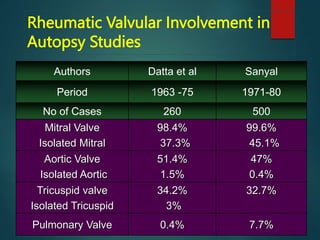
Rheumatic Valvular Involvement in
Autopsy Studies
Authors Datta et al Sanyal
Period 1963 -75 1971-80
No of Cases 260 500
Mitral Valve
Isolated Mitral
98.4%
37.3%
99.6%
45.1%
Aortic Valve
Isolated Aortic
51.4%
1.5%
47%
0.4%
Tricuspid valve
Isolated Tricuspid
34.2%
3%
32.7%
Pulmonary Valve 0.4% 7.7%
 Relative frequency with which each valve is affected depends on the
degree of stress to which each valve was subjected.
 In a child of 10 yrs the systemic blood pressure is about 100/60, the
pulmonary about 15/6. Thus the load against which the mitral,
aortic, tricuspid, and pulmonary valves have to work is in the
proportion of 100, 60, 15, and 6 mm. Hg respectively. If the mitral
valve was involved in 80% of cases the expected frequency of aortic,
tricuspid, and pulmonary valve involvement would be 48, 12, and
5% respectively
 Clinically most common manifestation is MR (GR
I –IV), causes blowing pansystolic murmur
radiating to axilla associated with mid diastolic
murmur (Carey Coombs murmur) without
presystolic accentuation.
 Caused by valvulitis ,valve prolapse, annular
dysfunction.
 Severity of MR has prognostic significance
 AR is mild to moderate
Myocarditis
 Due to severe myocardial inflammation
 Clinically- Soft S1, gallop sounds,
cardiomegaly , CCF
 CCF is mostly due to severe MR
 Myocardial necrosis is rare.
 Troponin levels are not elevated
Pericarditis
 Occurs in 6-15% pts of RF
 Indicates active carditis, no correlation with
severity of carditis
 Always associated with valvulitis
 Clinically frictional pericardial rub
 May be associated with
serosanguinous/haemorrhagic effusion
 Effusion resolves without any sequelae
 Rare case reports of constrictive pericarditis
Przybojewski JZS Afr Med J. 1981 May 2;59(19):682-6
Conduction abnormalities
 Prolonged PR interval in 25-40%
 Mechanism not endo/myocarditis probable increased
vagal activity
Silent carditis
 Occurs in 2-8% of ARF
 No clinical evidence of carditis,only have histological
evidence of carditis
 In one study, clinical carditis was seen in 72% whereas
ECHO detected carditis was seen in 91%
(Veasy GL NEJM 1987:316;421-7)
 Recently Echocardiographic evidence of valvular
nodules has been proposed to diagnose silent carditis
LATE ONSET /INSIDIOUS
CARDITIS
 Vague symptoms- malaise, lethargy
 P/E- mitral/aortic valve disease /CCF
 Elevated ESR/CRP
 WHO exempts such patients from stringent jones
criteria
RECURRENT CARDITIS
 Manifestations of RF in second attacks mimics the first- if previous
carditis then active carditis likely
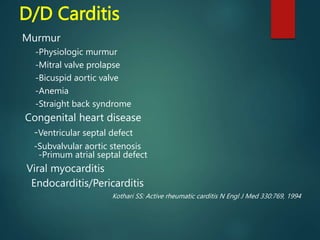
D/D Carditis
Murmur
-Physiologic murmur
-Mitral valve prolapse
-Bicuspid aortic valve
-Anemia
-Straight back syndrome
Congenital heart disease
-Ventricular septal defect
-Subvalvular aortic stenosis
-Primum atrial septal defect
Viral myocarditis
Endocarditis/Pericarditis
Kothari SS: Active rheumatic carditis N Engl J Med 330:769, 1994
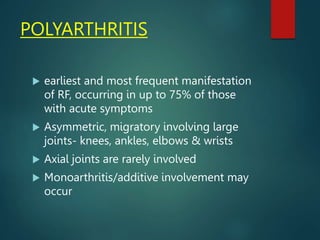
POLYARTHRITIS
 earliest and most frequent manifestation
of RF, occurring in up to 75% of those
with acute symptoms
 Asymmetric, migratory involving large
joints- knees, ankles, elbows & wrists
 Axial joints are rarely involved
 Monoarthritis/additive involvement may
occur
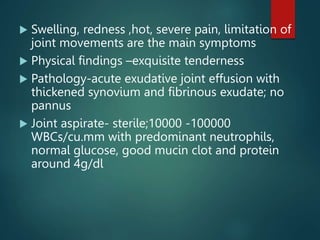
 Swelling, redness ,hot, severe pain, limitation of
joint movements are the main symptoms
 Physical findings –exquisite tenderness
 Pathology-acute exudative joint effusion with
thickened synovium and fibrinous exudate; no
pannus
 Joint aspirate- sterile;10000 -100000
WBCs/cu.mm with predominant neutrophils,
normal glucose, good mucin clot and protein
around 4g/dl
 Inflammation in individual joints lasts 1 to
2 weeks, and the polyarthritis as a whole
resolves in 1 month or less
 Striking inverse relationship between
severity of arthritis and carditis
FEINSTEIN et al.Medicine: 1962 - Volume 41. Clinical Patterns of
Acute Rheumatic Fever: A Reappraisal
 Dramatic response to aspirin –improves
within 48hrs
 Rheumatic arthritis is typically not deforming
 Jaccoud’s arthritis- unusual periarticular fibrosis of
the metacarpophalangeal joints
Post streptococcal reactive
arthritis (PSRA)
 occurs early (usually within 10 days)after
streptococcal pharyngitis without other
manifestations of RF
 may affect the small joints of the upper extremities
 much less responsive to salicylates
 has longer duration of weeks to months.
 patients should be monitored for the development
of RHD(5-7%), and secondary prophylaxis is
recommended for children. Barash J, et al: Differentiation of post-
streptococcal reactive arthritis from acute rheumatic fever. J Pediatr 2008; 153:696
CHOREA (St.Vitus dance)
 First described by
Sir Thomas
Sydenham in late
17th century
 Osler in 1894
established link
with RF
 It is a series of jerky, nonrepetative,
quasipurposive involuntary movements
involving the face & extremities with emotional
lability.
 wide range in reported incidence between 5%
and 35%
 occurs as the sole manifestation of RF in 20%
and in conjunction with arthritis in 30%.
 Concomitant subclinical carditis detected by
echocardiography appears to be as high as 70%.
(Demiroren K, et al: Sydenham's chorea: A clinical follow-up of 65 patientsJ Child
Neurol 2007; 22:550).
 Most cases in children 5 to 15 yrs, rare
after 20
 More common in females
 Late manifestation after several weeks
(3mths or longer) after RF due to long
latent phase
 Due to rheumatic inflammation of
basal ganglia & caudate nucleus
 Neuropsychiatric disorder
 neurologic signs (choreic movement and hypotonia)
 psychiatric signs (e.g., emotional lability, hyperactivity, poor school
performance, incoordination, separation anxiety, obsessions and
compulsions
 Movements disappear during sleep, decrease with rest and sedation
 Facial grimacing, frowns and grins
 Tongue “bag of worms”
 Speech staccato and jerky
 Pronator sign
 Extended hands have a spoon configuration
 Milkmaids grip
 Generally by the time a patient manifests chorea, the signs of inflammation
in the form of ESR have returned to normal
 EEG paroxysmal 3 Hz slow wave complex
 Untreated, it has a self – limiting course of two to six weeks
 Long term neurological and psychological sequelae of the disease, including
short- and long-term emotional lability, obsessive-compulsive behavior,
attention deficit/hyperactivity disorder, and other central nervous system
manifestations such as seizures and chronic migraine
d/d
 substantial risk of subsequent RHD in
these patients, found in one study to
be more than 50%.
Carapetis JR, McDonald M, Wilson NJ: Acute rheumatic fever.
Lancet 2005; 366:155
 Secondary prophylaxis is must
SUBCUTANEOUS NODULES
 Variable occurance (1 to 21%)
 Late manifestation of RF
 Indicate presence of underlying carditis, usually
severe
 Firm, painless, mobile 0.5 to 2 cm in size
 On bony prominence, extensor tendons (elbows
,knees ,wrists,ankles), vertebral spinous
process,suboccipital region,medial border of scapulae
 Appear in crops, disappear in 8 to 12wks
 Pathology- central zone of fibrinoid necrosis with
peripheral histiocytes and fibroblasts
Erythema Marginatum
Erythema Marginatum
 Early or late manifestation
 Incidence 10-15 %
 Indicate presence of underlying carditis, not
necessarily severe unlike SN
 Serpiginous erythematous macular/papular
nonpruritic rash
 On trunk & proximal extremities, never on the
face
 Rash extends outwards with central clearing
 No residual scarring
 May appear or disappear in mins-hrs
 Differential diagnosis
-sepsis, drug reactions, and
glomerulonephritis
-other toxic erythemas in febrile patients
-rash of juvenile rheumatoid arthritis.
-circinate rash of Lyme disease (erythema
chronicum migrans)
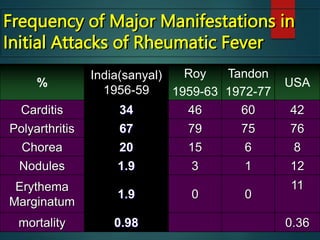
Frequency of Major Manifestations in
Initial Attacks of Rheumatic Fever
%
India(sanyal)
1956-59
Roy
1959-63
Tandon
1972-77
USA
Carditis 34 46 60 42
Polyarthritis 67 79 75 76
Chorea 20 15 6 8
Nodules 1.9 3 1 12
Erythema
Marginatum
1.9 0 0
11
mortality 0.98 0.36
Minor manifestations
 Fever and arthralgia as per jones
criteria
 Minor not because of less frequency
but due to lack of diagnostic
specificity
 others –epistaxis and abdominal pain,
only in about 5% ; often appear days
before major manifestations
Arthralgia
 Joint pain without objective signs of
inflammation
 Migratory polyarthralgia
 Not considered a minor criteria in presence of
arthritis
Fever
 Usually 101-104◦F
 No characteristic pattern although
diurnal variations common
Markowitz M. rheumatic fever.2nd edition. Philadelphia.1972
 Children with mild carditis without
arthritis have low grade fever and
those with pure chorea are afebrile
 Rarely lasts more than several weeks
Lab manifestations
 Acute phase reactants :
-Raised ESR (6 wks-3mths)
Diana Lennon pediatr drugs 2004;6(6):363
-Elevated CRP
 ESR may be elevated in anemia and
decreased in CHF; CRP remains
unaffected
 Leukocytosis (1oooo – 15000/cmm)
 Anemia –usually NcNc type
- suppresion of erythropoiesis (chronic inflammatory
state)
Laboratory Diagnosis
 diagnosis of RF requires evidence of a prior
streptococcal infection
 3 methods
Positive Throat Culture
Positive antigen test
Elevated/ rising Antibody Titre
 Throat Culture
 Throat swabs to be inoculated on
culture media within 5 hours
 Does not differentiate carrier from
active infection
 One third do not give history of sore
throat
Eggenberger .paediatrician 1980
 Rapid antigen detection
 Latex agglutination/ELISA
 Specificity over 95%
 Sensitivity varies from 60-90%
 Prudent to confirm negative test with
throat culture
Streptococcal Antibody Tests
 Antigens for antibody testing
o Streptolysin O
o Streptokinase
o DNAase
o NADase
o Hyaluronidase
o Streptococcal esterase
 ASLO Titer
 Slide agglutination test
 Newborns 100-160TU
 School age >200 todd units in over 50%
 Titers alter with age, geographical area, season
and genetic factors
 elevated if the titre exceeds the upper limit of
the normal titre range for a community, where
upper limit is defined as the titre exceeded by no
more than 20% of the population
ASLO Titer in RF
 Elevated in 80% patients with ARF
 Rise during the first month, plateau for 3-
6mths & disappear in the next 6-12mths
Ayoub EM. Streptococcal antibody tests in rheumatic fever. Clinical
Immunology Newsletter, 1982, 3:107-1 1
 ASO titer >240 Todd units in adults and >320
Todd units in children is used for diagnosis
Burdash NM, Teti G, Hund P: Streptococcal antibody tests in rheumatic fever,
Ann Clin Lab Sci 16:163
 Rising titer is more specific ,second sample 7 to
10 days.
 Results alter with antibiotics, steroids, liver
disease & bacterial contamination
 Sensitivity 66% and specificity 82%
Gray GC et al. Interpreting a single antistreptolysin O test; Journal of Clinical
Epidemiology, 1993, 46:1181–1185
AntiDNAse B
 Done when ASO is nondiagnostic
 Elevated in 70% pts of RF
 Levels remain elevated for several mths
 Less affected by antibiotics and steroids
 Titer >120 Todd units in adults and >240 Todd
units in children is used for diagnosis
 If two antistreptococcal antibody
tests(antistreptolysin O and
antideoxyribonuclease B or
antihyaluronidase tests) are obtained, a
titer for at least one antibody test is
elevated in over 90% of patients
 If all three are obtained, a titer for at least
one antibody test is elevated in over 95%
of patients
Park: Pediatric Cardiology for Practitioners
5th ed.
Streptozyme test
 detects antibodies, is a relatively simple slide
agglutination test, but it is less standardized and
less reproducible than the other antibody tests.
It should not be used as a diagnostic test for
evidence of antecedent group A streptococcal
infection
Other newer methods
 Higher values of IgA,C3 and C4
 Artificial subcutaneous nodule
development
 Rapid test for B cell marker(D8/17)
Artificial subcutaneous nodule test
 1.5 ml subcut inj of autologous blood on
elbow – subcutaneous nodule 4-7 days –
active carditis
Massel et al 1937
 Vasan modified the test and used only the
white cell concentrate
 It is a simple, inexpensive, safe, and
sensitive investigation
 sensitivity 86% and specificity 94%
Raj Tandon dec 2005 IHJ
ECG
 Prolonged PR interval
 Tachycardia
 AV block
 QRS-T changes s/o Myocarditis
NEWER MODALITIES
 ECHOCARDIOGRAPHY
 ENDOMYOCARDIAL BIOPSY
 RADIONUCLIDE IMAGING
ECHOCARDIOGRAPHY
ADVANTAGES
 More sensitive than routine clinical
auscultation to pick up valvular
regurgitation [esp. with declining
auscultatory skills]
 detects subclinical carditis more often and
earlier
 Detects valve structure and excludes non-
rheumatic causes [MVP,BAV, innocent
murmurs]
 ECHO equivalents of verrucae -3-5 mm size focal
nodular thickening situated on tips and bodies
of leaflets, having a different echogenecity , no
bizarre motion of a vegetation, and tending to
disappear on follow up
 Mechanism of MR
• Valvular thickening
• Leaflet prolapse [esp AML]
• Annular dilatation/Vent enlargement
• rupture of chordae
To Differentiate Physiological From
Pathological Regurgitation
MR
 a regurgitant jet >1cm in length;
 a regurgitant jet in at least two planes;
 a mosaic colour jet with a peak velocity >2.5 m/s;
 the jet persists throughout systole.
AR
 Holodiastolic,
 Extend 1 cm into the LV,
 Seen in at least 2 planes.
Vijayalakshmi et al. cardiol young 2005 dec
 81% sensitivity and 93% specificity
Figueroa FE et al.Heart, 2001, 85:407–410.
 35 patients of RF evaluated clinically and by echo,
32 pts at 1 year and 17 pts at 5 years,
 15 patients had carditis clinically at admission,
 At admission, MR/AR by Doppler found in 25/35
patients vs. 5/35 by clinical exam
 10 [30%] of 20 patients of ARF WITHOUT carditis
had doppler e/o regurgitation but no murmur.
These were taken as subclinical carditis,
 3 of the subclinical and 3 of the clinical carditis
still had the lesions at 5 years
Veasy LG,et al, NEJM 1987; 316:421–427
 Out of 74 children with acute RF, clinical
carditis
was present in 53 (71.6%) and by
echocardiogram in an additional 14 (18.9%)
cases giving a total of 90.5% with carditis.
Thus 18.9% patients had subclinical carditis.
In another report from the same
group,asymptomatic cardiac involvement was
detected in 47% of RF patients presenting
with polyarthritis.
Should echo be made a
major criteria ?
Vasan RS et al, Circulation, 1996, 94:73–82
 Concluded that no incremental role of
echocardiography in the diagnosis of carditis
in rheumatic fever without clinical evidence
of carditis.
 Reason may be that that patients in
developing countries seek medical attention
in relatively late phase of disease, when
clinical valvular involvement is well
manifested.
ECHOCARDIOGRAPHY
DISADVANTAGES
 Availability restricted
 Will not detect recurrences unless previous echo
data available to satisfy interval change
 physiological valvular regurgitation in normal
people : MR 2.4–45% , AR in 0–33% ,TR in 6.3–
95% ,and PR in 21.9–92% of normal individuals
[WHO Technical Report Series 923]
 Management of subclinical carditis will not
change.The data of benign prognosis in patients
without carditis have essentially come from
clinical studies.
“At present there is insufficient
information to allow the use of
echocardiography, including Doppler,
to document valvular regurgitation
without accompanying auscultatory
findings as the sole criterion for
valvulitis in acute rheumatic fever”
Jones Criteria, Updated 1992
ENDOMYOCARDIAL BIOPSY
 Myocarditis is an obligatory component of
cardiac involvement in RF
 Aschoff body is diagnostic of RF
 Central area of fibrinoid necrosis surrounded
by anitschkow cells
Narula J et al. Circulation, 1993, 88:2198–2205.
 RV Em Bx in 54 pts of clinical RF and quiescent RHD
 Interstitial inflammation that ranged from perivascular
mononuclear cellular infiltration, to histiocytic aggregates and
Aschoff nodule formation.
 myocarditis was virtually absent as defined by the Dallas
criteria [only one specimen].
Concluded
 Endomyocardial biopsy does not provide additional
diagnostic information where clinical consensus is certain
about diagnosis of carditis
 cannot recommend endomyocardial biopsy as a routine
diagnostic or prognostic tool
RADIONUCLIDE IMAGING
1. Gallium-67 imaging
2. Leukocytes labelled with Indium-111 or
technetium-99m
3. In-111-labeled antimyosin antibodies
 Gallium-67 imaging most promising
[Sensitivity 86 %, specificity 100%]
 Superior to antimyosin antibody imaging
 Insufficient data and not enough experience
with such methods to allow them to be used
for the routine diagnosis
 Etiology
 Epidemiology
 Pathogenesis and Pathology
 Evolution of jones criteria
 Clinical manifestations & Laboratory
findings
 Natural history of RF
 Treatment & Prevention
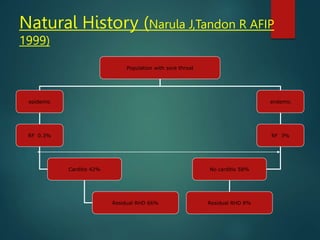
Natural History (Narula J,Tandon R AFIP
1999)
Population with sore throat
epidemic endemic
RF 0.3% RF 3%
Carditis 42% No carditis 58%
Residual RHD 66% Residual RHD 8%
Interval between First Attack
of RF and onset of
Symptoms
PAUL WOOD,AN APPRECIATION OF MITRAL STENOSISPART I. BRITISH MEDICAL JOURNAL 1954
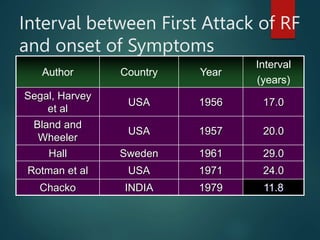
Interval between First Attack of RF
and onset of Symptoms
Author Country Year
Interval
(years)
Segal, Harvey
et al
USA 1956 17.0
Bland and
Wheeler
USA 1957 20.0
Hall Sweden 1961 29.0
Rotman et al USA 1971 24.0
Chacko INDIA 1979 11.8
Mortality of RF in pre-
chemoprophylactic era
(n=1000) 1 yr 5 yr 10 yrs 2o yrs
Mortality Bland and
jones
8.1 17.3 24.4 48.6
1921-41
Out comes of RF in post
chemoprophylactic era
Outcome Authors 5yrs 10yrs
Mortality (%) Uk & US 3.2% 5.4%
Sanyal 5.7%
Prevalence of RHD among all
cases of RF
Uk & US 31.2% 28.7%
Sanyal 39%
Tompkin 30.4%
Delayed appearance of RHD
in unaffected cases
Uk & US 8%
Sanyal 8%
 Etiology
 Epidemiology
 Pathogenesis and Pathology
 Evolution of jones criteria
 Clinical manifestations & Laboratory
findings
 Natural history of RF
 Treatment & Prevention
Treatment and Prevention
 Treatment of Rheumatic Fever
 Primary Prevention
 Secondary Prevention
 Primordial Prevention
TREATMENT
 General measures
• Hospital admission
• In patients with carditis, a rest period of
at least four weeks is recommended
• Patients with chorea must be placed in
a protective environment so they do
not injure themselves
Suppression of the
inflammatory process
 first line of symptomatic therapy has
traditionally been anti-inflammatory
agents, ranging from salicylates to
steroids, although the course of the
disease is not influenced by anti-
inflammatory therapy.
 Aspirin 100 mg/kg-day divided into 4–5
doses, is the first line of therapy
 generally adequate for achieving a clinical
response.
 In children, the dose may be increased to
125 mg/kg-day, and to 6–8g/day in adults
 After 2 weeks dosage can be decreased to
60–70mg/kg-day for an additional 3–6
weeks
NSAIDS - Naproxen
 Prospective, randomized, open-label equivalence study comparing the use of
naproxen to aspirin in 33 patients with rheumatic fever
 Mean time until resolution of arthritis was 2.9+/-2.9 days in both groups
 Liver enzyme elevations were more frequent in the aspirin group (P=.002)
Hashkes PJ et al. J Pediatr. 2003 Sep
Steroids
 Steroids do not prevent long-term complications
 Could be life saving in severe carditis and CHF.
 Prednisone (1–2mg/kg-day, to a maximum of
80mg/day given once daily, or in divided doses)
is usually the drug of choice.
 In life-threatening circumstances, initiation with
IV methyl prednisolone may help.
 After 2–3 weeks of therapy the dosage may be
decreased by 20–25% each week
 Aspirin is started during the tapering course of
Corticosteroids and is continued for 4 wks or
until there is sufficient clinical &laboratory
evidence of reduced rheumatic activity
 It is given to reduce the rebound activity after
stopping of steroids.
 5% of patients of ARF continue to have
rheumatic activity for >6mths
IAP,IJOP 2002 Saxena A recommend aspirin for minimum
12 wks
 there is no evidence that aspirin or
corticosteroid therapy affects the
course of carditis or reduces the
incidence of subsequent heart disease
 the duration of anti-inflammatory
therapy is based upon the clinical
response to therapy and normalization
of acute phase reactants
SEVERE CASES
 Anti failure therapy
 restricted sodium diet
 diuretics, angiotensin converting enzyme inhibitors,
and digoxin may be used
 SURGICAL THERAPY
 Mitral valve repair
 Mitral valve replacement
Role of surgery in active
rheumatic carditis
 repair or replacement surgery with a high rate
of in hospital mortality.
 Of 304 instances of mitral valve replacement
or repair in patients with mitral valve disease
of rheumatic etiology, the total hospital
mortality rate was 3.2%, but was as high as
19.2% if valve replacement was performed
after a failed attempt at repair.
Duran CM, Gometza B, de Vol EB. Valve repair in rheumatic mitral
disease. Circulation, 1991, 84(5 Suppl.):III125–132.
 Essop et al in their series treated 32 patients with
medically refractory acute carditis and congestive
heart failure (CHF) with mitral or mitral and aortic
valve replacement.
 no operative mortality and significant decrease in the
heart size and resolution of heart failure.
 Ventricular contractile function was preserved,.
 This study established that surgery was a preferred
option over the long-term use of high-dose
corticosteroids for severe refractory acute carditis
Journal of the American College of Cardiology, 1993, 22(3):826–829
Skoularigis J et al. Evaluation of the long-term results of
mitral valve repair in 254 young patients with rheumatic
mitral regurgitation. Circulation, 1994,90(5 Pt 2):II167–174.
 254 patients (aged 6–52 years) with pure rheumatic regurgitant
lesion and CHF (96% in NYHA class III or IV). Of the 254 patients,
76 showed acute rheumatic activity. The patients were followed
for 60 +35 months after surgery.
 The acute mortality rate for the patients was 2.6% and the five-
year mortality rate was 15%. There was a high incidence of valve
failure, which necessitated reoperation (27%).
 The presence of acute carditis correlated with reoperations, and
patients undergoing “early” reoperations were more likely to
have rheumatic activity (47%) compared to those with “late”
reoperations. The mean event free survival at five years was 73%.
Thus, surgical valve repair during
 active carditis was associated with an acceptable survival rate,
but reoperations were frequent.
 Surgery can be safely performed during
active carditis and, in refractory cases of
active carditis, may be preferable to the
long-term use of corticosteroids.
 Valve repair during active carditis may
not constitute the best surgical option if
there is macroscopic evidence of valvular
inflammation, because valve repair is
associated with significant reoperation
rates
Management of chorea
 rest in a quiet room
 Drugs
 phenobarbital (16–32 mg every 6–8 hr PO)
is the drug of choice
 haloperidol (0.01–0.03 mg/kg/24 hr
divided bid PO
 chlorpromazine (0.5 mg/kg every 4–6 hr
PO)
 Carbamazepine and valproate may be
used
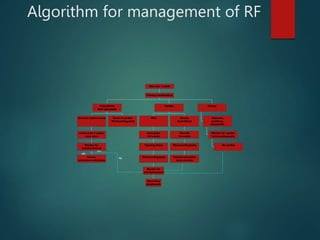
Algorithm for management of RF
yes
yes
No
Severe,
reintroduce salicylates
Monitor for
activity/rebound
continue for 2 weeks,
taper dose
Dramatic improvement Onset of carditis
?Echocardiography
Polyarthritis
Start salicylates
Secondary
prophylaxis
Monitor for
activity/rebound
?Echocardiography
Tapering doses
Salicylates
4-6 weeks
Mild
Overlap salicylates
taper steroids
?Echocardiography
Steroids
2-4 weeks
Severe,
heart failure
Carditis
No carditis
Monitor for carditis
?echocardiography
Valproate,
sedatives,
haloperidol
Chorea
Primary manifestation
Bed rest, ? admit
PRIMARY PREVENTION
Involves effective recognition & treatment of GABHS sore throat & in
turn prevent the development of RF
Detection of Streptococcal sore throat
 Sore throat with fever
 Painful deglutition
 Headache, abd pain, nausea, vomiting
Definitive diagnosis
 Throat culture
Primary prevention of RF
Gerber MA, Baltimore RS, Eaton CB, et al: Circulation 2009; 119:1541.
Penicillin still going strong
 Penicillin is still the drug of choice.
 Patients are considered noncontagious 24 hours after
the initiation of therapy
 Penicillin, even when started as long as 9 days after
the onset of acute illness, effectively prevents primary
attacks of rheumatic fever
 Failure to eradicate GAS from the throat occurs more
frequently after the administration of oral penicillin
than after administration of intramuscular benzathine
penicillin G.
 hypersensitivity reactions reported with penicillin
range from skin rashes to immediate anaphylaxis
which may be fatal.
 The overall incidence of hypersensitivity
reactions is 2 to 5 %.
 Anaphylaxis is very rare and occurs in about 1/10
000 injections.
 Death has been reported in about 1/30 - 50 000
injections.
 no evidence of teratogenicity, safe in pregnancy.
GABHS Pharyngitis
Cephalosporin Vs Penicillin
 Meta-analysis of 9 trials involving 2113 patients
 Bacteriological cure rates favoured
cephalosporins (OR, 1.83; 95% CI, 1.37-2.44)
 2 times higher bacteriological failure rates with
penicillin therapy ( P – .00004)
 Clinical cure rate significantly favoured
cephalosporins (P - < .00001) (OR -2.29)
 Absolute difference in bacteriological failure
rates was 5.4%
Casey J R et al. Clin Infect Dis, 2004
Role of Antibiotics
 Systematic review included twenty-six studies,
covering 12,669 cases of sore throat.
 There was a trend for protection against acute
glomerulonephritis by antibiotics, but insufficient
cases were recorded to be sure of this effect.
 Several studies found that antibiotics reduced
acute rheumatic fever to less than one third
(odds ratio (OR) = 0.30; 95% confidence interval
(CI) = 0.20 to 0.45).
Del Mar C B et al. The Cochrane Database of Systematic Reviews 2004.
SECONDARY PREVENTION
 Involves prevention of streptococcal sore throat in patients with
episodes of RF & thereby prevent recurrent cardiac damage
Secondary Prevention
WHO Technical Report Series 2004
Penicillin for secondary
prevention of rheumatic fever
The Cochrane Database of Systematic Reviews.
2002, Issue 3
 Systematic review of nine studies (n=3008).
 Four trials (n=1098) compared intramuscular with oral
penicillin and all showed that intramuscular penicillin is better.
 One trial (n= 360) compared 2-weekly with 4-weekly
intramuscular penicillin regimen. Penicillin given 2-weekly was
better at reducing rheumatic fever recurrence (RR 0.52, 95%
CI 0.33 to 0.83) and streptococcal throat infections (RR 0.60,
95% CI 0.42 to 0.85).
 One trial (n= 249) showed 3-weekly intramuscular penicillin
injections reduced streptococcal throat infections (RR 0.67,
95% CI 0.48 to 0.92) compared to 4-weekly intramuscular
Duration of secondary
prophylaxis
Factors influencing the duration of secondary prevention
 Presence of RHD
 Time elapsed from the last attack
 Number of previous attacks
 Degree of crowding in the family
 Family history of RF/RHD
 The socioeconomic and educational status of the
individual
 Risk of streptococcal infection in the area
 Age of the patient
Contd….
IAP & IJP
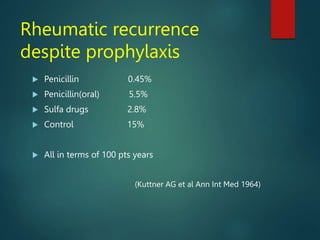
Rheumatic recurrence
despite prophylaxis
 Penicillin 0.45%
 Penicillin(oral) 5.5%
 Sulfa drugs 2.8%
 Control 15%
 All in terms of 100 pts years
(Kuttner AG et al Ann Int Med 1964)
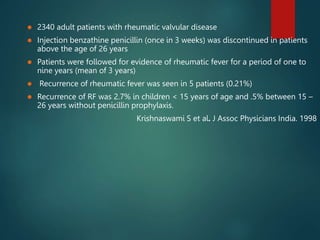
 2340 adult patients with rheumatic valvular disease
 Injection benzathine penicillin (once in 3 weeks) was discontinued in patients
above the age of 26 years
 Patients were followed for evidence of rheumatic fever for a period of one to
nine years (mean of 3 years)
 Recurrence of rheumatic fever was seen in 5 patients (0.21%)
 Recurrence of RF was 2.7% in children < 15 years of age and .5% between 15 –
26 years without penicillin prophylaxis.
Krishnaswami S et al. J Assoc Physicians India. 1998
PRIMODIAL PREVENTION
 Involves measures to prevent the occurrence of a GABHS sore throat
 Clean & Healthy environment.
 Mass chemoprophylaxis can work in some high risk situations
 Vaccines are in experimental phase
 Not feasible in all situations
Primordial Prevention:
Streptococcal Vaccine
 M protein vaccines
 M type specific vaccines
 Vaccines utilizing conserved M antigens
 Non-M protein vaccine candidates
 GAS carbohydrate
 C5a Peptidase (SCPA)
 Cysteine Protease – Streptococcal pyrogenic exotoxin B
 Adhesins – sfb1, FBP 54
 Lipoteichoic acid (LTA)
 Hyaluronic acid capsule
Type-Specific Vaccine
 M-protein antibodies persist for 30 years
 Early Obstacles
 Extracted, purified M-protein contaminated with toxins
 Overcome by – pepsin extracts M-protein
 Cross react with myocardium
 Overcome by using N-terminal fragments
 Type- specific immunity
 Overcome by using multivalent vaccines
 First vaccine 1969 with 3 M proteins-Failed
 Streptococcal C5a peptidase (SCPA) vaccine -Dr Pat
Cleary and colleagues
 Streptococcal cysteine protease, also known as
Streptococcal pyrogenic exotoxin B vaccine -
Professor Musser
 The streptococcal adhesin, fibronectin-binding
protein 1 (Sfb1) GAS vaccine
 Professor Singh Chhatwal’s group in Germany
intranasal spray vaccine
Recombinant multivalent M-
protein vaccine – Phase I trial
 Combination of type specific epitopes of 6 M
serotypes
 28 healthy adult volunteers aged 18 to 50 years
recruited
 3 spaced intramuscular injections of 50 µg (n=8),100
µg (n=10), or 200 µg (n=10) were administered
 Vaccine well tolerated at the end of one year
 No evidence of cross reactive antibodies
 Significant increase in antibody levels to all 6
component M antigens
Kotloff KL et al. JAMA, August 2004
 multivalent N-terminal vaccine Strategy-Dr Jim Dale &
Canadian biotechnology company ID Biomedical.-
StreptAvax.
 The vaccine - sequence of short peptides from the N
terminal region of 26 different GAS emm type
strains.Only vaccine in phase II trial
CONCLUSION
 It is now 100yrs that we know about RHD,still it
continues to be a major problem in developing
countries
 Jones criteria are guidelines to assist practitioners
and not a substitute to sound clinical judgement
and wisdom
 Role of echocardiography needs to be better
defined
 Eradication of RF is still a distant dream
 In future an effective antistreptococcal vaccine
may alter the epidemiology of RF/RHD
RHEUMATIC FEVER
“Licks the joints and bites the heart”
Benzathine penicillin
 Throat ,skin ,URTI
 Isolated from 10-50% throat culture of healthy school children

acute rheumatic fever .pptx

  • 1.
    RHEUMATIC FEVER NATURAL HISTORY DIAGNOSISAND MANAGEMENT DR AWADHESH SHARMA
  • 2.
    Acute rheumatic feveris a non- infectious delayed complication of streptococcal sore throat due to Group A Beta hemolytic streptococcus (GABHS)
  • 3.
     Etiology  Epidemiology Pathogenesis and Pathology  Evolution of jones criteria  Clinical manifestations & Laboratory findings  Natural history of RF  Treatment & Prevention
  • 4.
    Etiological agent streptococcus pyogenes Capsule hyaluronic acid  Cellwall  Outer –fimbria+lipoteichoic acid+M protein  Middle-carbohydrate  Inner-peptidoglycan layer  Cytoplasmic membrane
  • 6.
    GABHS Rheumatogenic serotypes1,3,5,6,14,12,18,19,24,27,29 Nephritogenic serotypes 12 & 49
  • 7.
    Pathogenesis  RF developsfollowing streptococcal tonsillopharyngeal infection only, but not after infection at other sites  Autoimmune disease-Antigenic mimicry  Antibodies against these antigens result in a hyperactive immune response  Crossreactivity- cytoskeleton, tropomyosin and myosin
  • 8.
    PATHOLOGY  RF isa multisystem connective tissue disease  Inflammatory lesions in the heart, joints & subcutaneous tissue Microscopy  Aschoff granuloma is the pathological hallmark of RF(seen in only 30-40% of suspected carditis). It consists of central fibrinoid necrosis surrounded by histiocytes (Anitschkow cells) with a typical “owl-eye” nucleus.
  • 9.
  • 10.
  • 11.
    Gross appearance  Valvesappear dull & thickened  Verrucous pinhead vegetations on the atrial surface of the mitral valve, chordae, ventricular surface of aortic valve with edema or hemorrhage in the leaflet tissue  Serofibrinous pericarditis- bread and butter appearance  Scar in LA – McCallums patch due to regurgitation jet.
  • 13.
    Epidemiology of groupA streptococci  Most pharyngitis (80%) is viral in etiology, GABHS is isolated in up to 75% of cases from children with symptoms of severe bacterial pharyngitis. Gerber MA et al: Prevention of rheumatic fever and diagnosis and treatment of acute Streptococcal pharyngitis:. Circulation 2009; 119:1541
  • 14.
    Epidemiology of groupA streptococci  Antistreptolysin O titers more than 200 Todd units are found in up to 50% of asymptomatic children 6 to 15 years old, the prime age group for RF. This reflects the frequent occurrence of pharyngitis in this age group (estimated to be once yearly), approximately 15% to 20% of which is caused by GABHS Rheumatic fever and rheumatic heart disease. World Health Organ Tech Rep Ser 2004; 923:1.
  • 15.
    Cont...  0.3% to3% of those with untreated GABHS pharyngitis develop RF.  GABHS is present in 10% to 30% of asymptomatic individuals in the prime RF age groups in the United States, but it is higher in many countries.  A history of pharyngitis has been reported in approximately two thirds of RF cases Gerber MA et al: Prevention of rheumatic fever and diagnosis and treatment of acute Streptococcal pharyngitis:. Circulation 2009; 119:1541
  • 16.
    EPIDEMIOLOGY OF RF In 2005, 15.6 million people were estimated to have RF or RHD on the basis of traditional clinical measures  Out of 5 lakh individuals who acquire ARF every year, 3 lakh go on to develop RHD Marijon E, Ou P, Celermajer DS, et al. N Engl J Med 2007; 357:470
  • 17.
    Incidence  The incidenceof RF in Developing countries is 27-100/1 lac /yr  In developed countries is <5/ 1lac/yr G.S.Sainani Japi 2006  The incidence of rheumatic fever (RF) varies from 0.2 to 0.75/1000/ year in schoolchildren 5–15 years of age Anil Grover,padamavati S et al, IHJ 2002
  • 18.
    RF / RHDStatus in India Author Place Year Age Population RHD Prevalence /1000 RF Incidence /1000/year ICMR Balabgarh 1982-90 5-15 22729 1 - ICMR Varanasi 1982-90 5-15 12190 5.4 - ICMR Vellore 1982-90 5-15 13509 2.9 - Padmavati Delhi (urban) 1984-94 5-10 40000 3.9 0.384 Grover Raipurrani 1988-91 5-15 31200 2.1 0.54 Avasthi Ludhiana 1987 6-16 6005 1.3 0.7 Patel Anand 1986 8-18 11346 2.03 0.176 Lalchandani Kanpur 2000 7-15 3963 4.54 0.75
  • 19.
     Etiology  Epidemiology Pathogenesis and Pathology  Evolution of jones criteria  Clinical manifestations & Laboratory findings  Natural history of RF  Treatment & Prevention
  • 20.
    JONES CRITERIA  In1944 , Dr. T. Duckett Jones, Research Director at the House of Good Samaritan, Boston, in an article titled “The diagnosis of rheumatic fever” in JAMA (1944;126:481-484) presented a set of rules for the diagnosis of rheumatic fever. He drew on his experience of over 2 decades of over 1000 patients.
  • 21.
    Jones criteria 1944 Majorcriteria- 1. Carditis 2. Arthralgia 3. Chorea 4. Subcutaneous nodules 5. History of previous rheumatic fever or RHD
  • 22.
    Minor Criteria 1. Fever 2.abdominal pain 3. precordial pain 4. epistaxis 5. pulmonary findings -rheumatic intersitial pneumonitis, pleurisy 6. Electrocardiographic abnormalities, 7. Erythema marginatum 8. microcytic anaemia, 9. Elevated total leucocyte count, 10. Raised ESR
  • 23.
    The Original JonesCriteria 1944  The combination of 2 major OR 1 major and 2 minor criteria constitute reasonably certain diagnostic criteria,  The presence of RHD increases the diagnostic significance of the minor manifestations when no other cause exists for the same,  These criteria were meant to avoid over- diagnosis,  He further stated that these diagnostic criteria were subject to change as the knowledge increases.
  • 24.
    The Modified JonesCriteria-1956 [Circulation, 1956, 13: 617–620] MAJOR CRITERIA  Carditis  Polyarthritis  Chorea  Subcutaneous nodules  Erythema marginatum MINOR CRITERIA  Fever  Arthralgia  Prolonged PR interval  Increased ESR,Leuco- cytosis,presence of CRP  History of previous definite ARF or RHD  E/O preceding beta- hemolytic streptococcal infection
  • 25.
    The Revised JonesCriteria-1965 [Circulation, 1965, 32:664–668] MAJOR CRITERIA  Carditis  Polyarthritis  Chorea  Subcutaneous nodules  Erythema marginatum MINOR CRITERIA  Fever  Arthralgia  Prolonged PR interval  Increased ESR, Leucocytosis,presence of CRP  History of previous definite ARF or RHD
  • 26.
    The Revised JonesCriteria-1965  Plus supporting evidence of preceding streptococcal infection: h/o scarlet fever;positive throat culture for group A streptococcus;increased ASLO titer or other streptococcal antibodies,  Chorea and chronic carditis [when presenting as the only major manifestation] were exempted from this requirement,  The WHO expert committee on rheumatic fever did not accept the revised criteria as at that time there were insufficient laboratory facilities in the developing countries to provide the necessary supportive evidence.
  • 27.
    The Revised JonesCriteria-1984 [Circulation,1984, 70:204A– 208A]  No major changes,  Avoid premature administration of anti- inflammatory drugs when s/s are ill-defined,  Role of echo to diagnose MVP  Minor changes: history of a sore throat is not considered adequate evidence of streptococcal infection,  Necessity to exclude non-rheumatic causes of chorea highlighted,  ASLO can be high in non-group-A strep. infections and strep. skin infections.
  • 28.
    Jones Criteria, Updated1992 [JAMA, 1992, 268:2069– 2073]
  • 29.
    Jones Criteria, Updated1992  The diagnosis of the initial attack of acute rheumatic fever,  Clinical history of sore throat or of scarlet fever unsubstantiated by laboratory data is not adequate evidence of recent group A streptococcal infection,  A throat culture or rapid antigen test does not distinguish between recent infection and chronic pharyngeal carriage,  Only about 25% of patients have throat cultures positive for group A streptococci,
  • 30.
    Jones Criteria, Updated1992 Rising or elevated streptococcal antibody titer,  A significant antibody increase is usually defined as a rise in titer of two or more dilution increments between the acute-phase and convalescent-phase specimens[2-4 weeks apart], regardless of the actual height of the antibody titer,  Extracellular antigens: streptolysin O, deoxyribonuclease B, nicotinamide adenine dinucleotidase, hyaluronidase, or streptokinase The most commonly used antibody assays have been antistreptolysin O and antistreptokinase, and more recently anti-deoxyribonuclease B.
  • 31.
    Jones Criteria, Updated1992  Exceptions to the rule: diagnosis of RF can be made without strictly adhering to the Jones criteria.  isolated chorea, or  indolent carditis , or  recurrent attacks of rheumatic fever: if a single major or several minor manifestations are present in a patient with a reliable history of RF or established RHD, provided there is supporting evidence of a recent group A streptococcal infection.
  • 34.
    Indian Perspective  Manyauthors [Roy, Mathur, Cherian etc] have argued that arthralgia be used as a major criteria in India  These studies were retrospective, did not diff. an initial attack from recurrences and many patients presented late in the course of illness when the joint s/s had subsided,  Prospective studies by Sanyal et al [Circulation 1974;49: 7-14] and Padmavati et al [N Z Med J. 1988 Jun 8;101(847 Pt 2):391- 2] showed that the frequency of polyarthritis in India [67%] were similar to western data,  Concluded that Jones criteria were applicable equally to developing countries as well.
  • 35.
     Etiology  Epidemiology Pathogenesis and Pathology  Evolution of jones criteria  Clinical manifestations & Laboratory findings  Natural history of RF  Treatment & Prevention
  • 36.
    Carditis  Wide variationin frequency in various studies -first/recurrent -community/hospital -prospective/retrospective -echo/clinical  Seen in 33-46% of patients with acute RF in prospective studies (sanyal et al circ 1974;49:7-12)
  • 37.
     Mode ofonset variable- subclinical/indolent/subacute/ acute/fulminant CHF  Younger age more likely as carditis  80% of patients who develop carditis do so within the first 2 wks of onset of RF (massel NEJM 1988;318;280-6)  Patients who have significant arthritis less commonly have severe carditis
  • 38.
     Rheumatic carditisis a pancarditis affecting the endocardium, myocardium & pericardium to various degrees  Carditis typically is manifested as valvulitis; predominant effect is scarring of the heart valves
  • 39.
    Endocarditis  Most commonlyaffects mitral & aortic valves  Mitral valve involvement alone in 70-75% pts  Mitral + Aortic valve disease 20-25%  Isolated Aortic valve disease 5-8%  Tricuspid valve involvement in 30-50% at autopsy; uncommon clinically (Kinare S G Aiams 1972)
  • 40.
    Rheumatic Valvular Involvementin Autopsy Studies Authors Datta et al Sanyal Period 1963 -75 1971-80 No of Cases 260 500 Mitral Valve Isolated Mitral 98.4% 37.3% 99.6% 45.1% Aortic Valve Isolated Aortic 51.4% 1.5% 47% 0.4% Tricuspid valve Isolated Tricuspid 34.2% 3% 32.7% Pulmonary Valve 0.4% 7.7%
  • 41.
     Relative frequencywith which each valve is affected depends on the degree of stress to which each valve was subjected.  In a child of 10 yrs the systemic blood pressure is about 100/60, the pulmonary about 15/6. Thus the load against which the mitral, aortic, tricuspid, and pulmonary valves have to work is in the proportion of 100, 60, 15, and 6 mm. Hg respectively. If the mitral valve was involved in 80% of cases the expected frequency of aortic, tricuspid, and pulmonary valve involvement would be 48, 12, and 5% respectively
  • 42.
     Clinically mostcommon manifestation is MR (GR I –IV), causes blowing pansystolic murmur radiating to axilla associated with mid diastolic murmur (Carey Coombs murmur) without presystolic accentuation.  Caused by valvulitis ,valve prolapse, annular dysfunction.  Severity of MR has prognostic significance  AR is mild to moderate
  • 43.
    Myocarditis  Due tosevere myocardial inflammation  Clinically- Soft S1, gallop sounds, cardiomegaly , CCF  CCF is mostly due to severe MR  Myocardial necrosis is rare.  Troponin levels are not elevated
  • 44.
    Pericarditis  Occurs in6-15% pts of RF  Indicates active carditis, no correlation with severity of carditis  Always associated with valvulitis  Clinically frictional pericardial rub  May be associated with serosanguinous/haemorrhagic effusion  Effusion resolves without any sequelae  Rare case reports of constrictive pericarditis Przybojewski JZS Afr Med J. 1981 May 2;59(19):682-6
  • 46.
    Conduction abnormalities  ProlongedPR interval in 25-40%  Mechanism not endo/myocarditis probable increased vagal activity
  • 48.
    Silent carditis  Occursin 2-8% of ARF  No clinical evidence of carditis,only have histological evidence of carditis
  • 49.
     In onestudy, clinical carditis was seen in 72% whereas ECHO detected carditis was seen in 91% (Veasy GL NEJM 1987:316;421-7)  Recently Echocardiographic evidence of valvular nodules has been proposed to diagnose silent carditis
  • 50.
    LATE ONSET /INSIDIOUS CARDITIS Vague symptoms- malaise, lethargy  P/E- mitral/aortic valve disease /CCF  Elevated ESR/CRP  WHO exempts such patients from stringent jones criteria
  • 51.
    RECURRENT CARDITIS  Manifestationsof RF in second attacks mimics the first- if previous carditis then active carditis likely
  • 53.
    D/D Carditis Murmur -Physiologic murmur -Mitralvalve prolapse -Bicuspid aortic valve -Anemia -Straight back syndrome Congenital heart disease -Ventricular septal defect -Subvalvular aortic stenosis -Primum atrial septal defect Viral myocarditis Endocarditis/Pericarditis Kothari SS: Active rheumatic carditis N Engl J Med 330:769, 1994
  • 54.
    POLYARTHRITIS  earliest andmost frequent manifestation of RF, occurring in up to 75% of those with acute symptoms  Asymmetric, migratory involving large joints- knees, ankles, elbows & wrists  Axial joints are rarely involved  Monoarthritis/additive involvement may occur
  • 55.
     Swelling, redness,hot, severe pain, limitation of joint movements are the main symptoms  Physical findings –exquisite tenderness  Pathology-acute exudative joint effusion with thickened synovium and fibrinous exudate; no pannus  Joint aspirate- sterile;10000 -100000 WBCs/cu.mm with predominant neutrophils, normal glucose, good mucin clot and protein around 4g/dl
  • 56.
     Inflammation inindividual joints lasts 1 to 2 weeks, and the polyarthritis as a whole resolves in 1 month or less  Striking inverse relationship between severity of arthritis and carditis FEINSTEIN et al.Medicine: 1962 - Volume 41. Clinical Patterns of Acute Rheumatic Fever: A Reappraisal  Dramatic response to aspirin –improves within 48hrs
  • 57.
     Rheumatic arthritisis typically not deforming  Jaccoud’s arthritis- unusual periarticular fibrosis of the metacarpophalangeal joints
  • 58.
    Post streptococcal reactive arthritis(PSRA)  occurs early (usually within 10 days)after streptococcal pharyngitis without other manifestations of RF  may affect the small joints of the upper extremities  much less responsive to salicylates  has longer duration of weeks to months.  patients should be monitored for the development of RHD(5-7%), and secondary prophylaxis is recommended for children. Barash J, et al: Differentiation of post- streptococcal reactive arthritis from acute rheumatic fever. J Pediatr 2008; 153:696
  • 62.
    CHOREA (St.Vitus dance) First described by Sir Thomas Sydenham in late 17th century  Osler in 1894 established link with RF
  • 63.
     It isa series of jerky, nonrepetative, quasipurposive involuntary movements involving the face & extremities with emotional lability.  wide range in reported incidence between 5% and 35%  occurs as the sole manifestation of RF in 20% and in conjunction with arthritis in 30%.  Concomitant subclinical carditis detected by echocardiography appears to be as high as 70%. (Demiroren K, et al: Sydenham's chorea: A clinical follow-up of 65 patientsJ Child Neurol 2007; 22:550).
  • 64.
     Most casesin children 5 to 15 yrs, rare after 20  More common in females  Late manifestation after several weeks (3mths or longer) after RF due to long latent phase  Due to rheumatic inflammation of basal ganglia & caudate nucleus
  • 65.
     Neuropsychiatric disorder neurologic signs (choreic movement and hypotonia)  psychiatric signs (e.g., emotional lability, hyperactivity, poor school performance, incoordination, separation anxiety, obsessions and compulsions  Movements disappear during sleep, decrease with rest and sedation
  • 66.
     Facial grimacing,frowns and grins  Tongue “bag of worms”  Speech staccato and jerky  Pronator sign  Extended hands have a spoon configuration  Milkmaids grip
  • 67.
     Generally bythe time a patient manifests chorea, the signs of inflammation in the form of ESR have returned to normal  EEG paroxysmal 3 Hz slow wave complex  Untreated, it has a self – limiting course of two to six weeks  Long term neurological and psychological sequelae of the disease, including short- and long-term emotional lability, obsessive-compulsive behavior, attention deficit/hyperactivity disorder, and other central nervous system manifestations such as seizures and chronic migraine
  • 68.
  • 69.
     substantial riskof subsequent RHD in these patients, found in one study to be more than 50%. Carapetis JR, McDonald M, Wilson NJ: Acute rheumatic fever. Lancet 2005; 366:155  Secondary prophylaxis is must
  • 70.
  • 71.
     Variable occurance(1 to 21%)  Late manifestation of RF  Indicate presence of underlying carditis, usually severe  Firm, painless, mobile 0.5 to 2 cm in size  On bony prominence, extensor tendons (elbows ,knees ,wrists,ankles), vertebral spinous process,suboccipital region,medial border of scapulae  Appear in crops, disappear in 8 to 12wks  Pathology- central zone of fibrinoid necrosis with peripheral histiocytes and fibroblasts
  • 72.
  • 73.
    Erythema Marginatum  Earlyor late manifestation  Incidence 10-15 %  Indicate presence of underlying carditis, not necessarily severe unlike SN  Serpiginous erythematous macular/papular nonpruritic rash  On trunk & proximal extremities, never on the face  Rash extends outwards with central clearing
  • 74.
     No residualscarring  May appear or disappear in mins-hrs  Differential diagnosis -sepsis, drug reactions, and glomerulonephritis -other toxic erythemas in febrile patients -rash of juvenile rheumatoid arthritis. -circinate rash of Lyme disease (erythema chronicum migrans)
  • 75.
    Frequency of MajorManifestations in Initial Attacks of Rheumatic Fever % India(sanyal) 1956-59 Roy 1959-63 Tandon 1972-77 USA Carditis 34 46 60 42 Polyarthritis 67 79 75 76 Chorea 20 15 6 8 Nodules 1.9 3 1 12 Erythema Marginatum 1.9 0 0 11 mortality 0.98 0.36
  • 76.
    Minor manifestations  Feverand arthralgia as per jones criteria  Minor not because of less frequency but due to lack of diagnostic specificity  others –epistaxis and abdominal pain, only in about 5% ; often appear days before major manifestations
  • 77.
    Arthralgia  Joint painwithout objective signs of inflammation  Migratory polyarthralgia  Not considered a minor criteria in presence of arthritis
  • 78.
    Fever  Usually 101-104◦F No characteristic pattern although diurnal variations common Markowitz M. rheumatic fever.2nd edition. Philadelphia.1972  Children with mild carditis without arthritis have low grade fever and those with pure chorea are afebrile  Rarely lasts more than several weeks
  • 79.
    Lab manifestations  Acutephase reactants : -Raised ESR (6 wks-3mths) Diana Lennon pediatr drugs 2004;6(6):363 -Elevated CRP  ESR may be elevated in anemia and decreased in CHF; CRP remains unaffected
  • 80.
     Leukocytosis (1oooo– 15000/cmm)  Anemia –usually NcNc type - suppresion of erythropoiesis (chronic inflammatory state)
  • 81.
    Laboratory Diagnosis  diagnosisof RF requires evidence of a prior streptococcal infection  3 methods Positive Throat Culture Positive antigen test Elevated/ rising Antibody Titre
  • 82.
     Throat Culture Throat swabs to be inoculated on culture media within 5 hours  Does not differentiate carrier from active infection  One third do not give history of sore throat Eggenberger .paediatrician 1980
  • 83.
     Rapid antigendetection  Latex agglutination/ELISA  Specificity over 95%  Sensitivity varies from 60-90%  Prudent to confirm negative test with throat culture
  • 85.
    Streptococcal Antibody Tests Antigens for antibody testing o Streptolysin O o Streptokinase o DNAase o NADase o Hyaluronidase o Streptococcal esterase
  • 86.
     ASLO Titer Slide agglutination test  Newborns 100-160TU  School age >200 todd units in over 50%  Titers alter with age, geographical area, season and genetic factors  elevated if the titre exceeds the upper limit of the normal titre range for a community, where upper limit is defined as the titre exceeded by no more than 20% of the population
  • 89.
    ASLO Titer inRF  Elevated in 80% patients with ARF  Rise during the first month, plateau for 3- 6mths & disappear in the next 6-12mths Ayoub EM. Streptococcal antibody tests in rheumatic fever. Clinical Immunology Newsletter, 1982, 3:107-1 1  ASO titer >240 Todd units in adults and >320 Todd units in children is used for diagnosis Burdash NM, Teti G, Hund P: Streptococcal antibody tests in rheumatic fever, Ann Clin Lab Sci 16:163
  • 90.
     Rising titeris more specific ,second sample 7 to 10 days.  Results alter with antibiotics, steroids, liver disease & bacterial contamination  Sensitivity 66% and specificity 82% Gray GC et al. Interpreting a single antistreptolysin O test; Journal of Clinical Epidemiology, 1993, 46:1181–1185
  • 91.
    AntiDNAse B  Donewhen ASO is nondiagnostic  Elevated in 70% pts of RF  Levels remain elevated for several mths  Less affected by antibiotics and steroids  Titer >120 Todd units in adults and >240 Todd units in children is used for diagnosis
  • 93.
     If twoantistreptococcal antibody tests(antistreptolysin O and antideoxyribonuclease B or antihyaluronidase tests) are obtained, a titer for at least one antibody test is elevated in over 90% of patients  If all three are obtained, a titer for at least one antibody test is elevated in over 95% of patients Park: Pediatric Cardiology for Practitioners 5th ed.
  • 94.
    Streptozyme test  detectsantibodies, is a relatively simple slide agglutination test, but it is less standardized and less reproducible than the other antibody tests. It should not be used as a diagnostic test for evidence of antecedent group A streptococcal infection
  • 95.
    Other newer methods Higher values of IgA,C3 and C4  Artificial subcutaneous nodule development  Rapid test for B cell marker(D8/17)
  • 96.
    Artificial subcutaneous noduletest  1.5 ml subcut inj of autologous blood on elbow – subcutaneous nodule 4-7 days – active carditis Massel et al 1937  Vasan modified the test and used only the white cell concentrate  It is a simple, inexpensive, safe, and sensitive investigation  sensitivity 86% and specificity 94% Raj Tandon dec 2005 IHJ
  • 97.
    ECG  Prolonged PRinterval  Tachycardia  AV block  QRS-T changes s/o Myocarditis
  • 98.
    NEWER MODALITIES  ECHOCARDIOGRAPHY ENDOMYOCARDIAL BIOPSY  RADIONUCLIDE IMAGING
  • 99.
    ECHOCARDIOGRAPHY ADVANTAGES  More sensitivethan routine clinical auscultation to pick up valvular regurgitation [esp. with declining auscultatory skills]  detects subclinical carditis more often and earlier  Detects valve structure and excludes non- rheumatic causes [MVP,BAV, innocent murmurs]
  • 100.
     ECHO equivalentsof verrucae -3-5 mm size focal nodular thickening situated on tips and bodies of leaflets, having a different echogenecity , no bizarre motion of a vegetation, and tending to disappear on follow up  Mechanism of MR • Valvular thickening • Leaflet prolapse [esp AML] • Annular dilatation/Vent enlargement • rupture of chordae
  • 101.
    To Differentiate PhysiologicalFrom Pathological Regurgitation MR  a regurgitant jet >1cm in length;  a regurgitant jet in at least two planes;  a mosaic colour jet with a peak velocity >2.5 m/s;  the jet persists throughout systole. AR  Holodiastolic,  Extend 1 cm into the LV,  Seen in at least 2 planes.
  • 103.
    Vijayalakshmi et al.cardiol young 2005 dec
  • 105.
     81% sensitivityand 93% specificity
  • 106.
    Figueroa FE etal.Heart, 2001, 85:407–410.  35 patients of RF evaluated clinically and by echo, 32 pts at 1 year and 17 pts at 5 years,  15 patients had carditis clinically at admission,  At admission, MR/AR by Doppler found in 25/35 patients vs. 5/35 by clinical exam  10 [30%] of 20 patients of ARF WITHOUT carditis had doppler e/o regurgitation but no murmur. These were taken as subclinical carditis,  3 of the subclinical and 3 of the clinical carditis still had the lesions at 5 years
  • 107.
    Veasy LG,et al,NEJM 1987; 316:421–427  Out of 74 children with acute RF, clinical carditis was present in 53 (71.6%) and by echocardiogram in an additional 14 (18.9%) cases giving a total of 90.5% with carditis. Thus 18.9% patients had subclinical carditis. In another report from the same group,asymptomatic cardiac involvement was detected in 47% of RF patients presenting with polyarthritis.
  • 108.
    Should echo bemade a major criteria ?
  • 109.
    Vasan RS etal, Circulation, 1996, 94:73–82  Concluded that no incremental role of echocardiography in the diagnosis of carditis in rheumatic fever without clinical evidence of carditis.  Reason may be that that patients in developing countries seek medical attention in relatively late phase of disease, when clinical valvular involvement is well manifested.
  • 110.
    ECHOCARDIOGRAPHY DISADVANTAGES  Availability restricted Will not detect recurrences unless previous echo data available to satisfy interval change  physiological valvular regurgitation in normal people : MR 2.4–45% , AR in 0–33% ,TR in 6.3– 95% ,and PR in 21.9–92% of normal individuals [WHO Technical Report Series 923]  Management of subclinical carditis will not change.The data of benign prognosis in patients without carditis have essentially come from clinical studies.
  • 111.
    “At present thereis insufficient information to allow the use of echocardiography, including Doppler, to document valvular regurgitation without accompanying auscultatory findings as the sole criterion for valvulitis in acute rheumatic fever” Jones Criteria, Updated 1992
  • 112.
    ENDOMYOCARDIAL BIOPSY  Myocarditisis an obligatory component of cardiac involvement in RF  Aschoff body is diagnostic of RF  Central area of fibrinoid necrosis surrounded by anitschkow cells
  • 113.
    Narula J etal. Circulation, 1993, 88:2198–2205.  RV Em Bx in 54 pts of clinical RF and quiescent RHD  Interstitial inflammation that ranged from perivascular mononuclear cellular infiltration, to histiocytic aggregates and Aschoff nodule formation.  myocarditis was virtually absent as defined by the Dallas criteria [only one specimen]. Concluded  Endomyocardial biopsy does not provide additional diagnostic information where clinical consensus is certain about diagnosis of carditis  cannot recommend endomyocardial biopsy as a routine diagnostic or prognostic tool
  • 114.
    RADIONUCLIDE IMAGING 1. Gallium-67imaging 2. Leukocytes labelled with Indium-111 or technetium-99m 3. In-111-labeled antimyosin antibodies  Gallium-67 imaging most promising [Sensitivity 86 %, specificity 100%]  Superior to antimyosin antibody imaging  Insufficient data and not enough experience with such methods to allow them to be used for the routine diagnosis
  • 115.
     Etiology  Epidemiology Pathogenesis and Pathology  Evolution of jones criteria  Clinical manifestations & Laboratory findings  Natural history of RF  Treatment & Prevention
  • 118.
    Natural History (NarulaJ,Tandon R AFIP 1999) Population with sore throat epidemic endemic RF 0.3% RF 3% Carditis 42% No carditis 58% Residual RHD 66% Residual RHD 8%
  • 119.
    Interval between FirstAttack of RF and onset of Symptoms PAUL WOOD,AN APPRECIATION OF MITRAL STENOSISPART I. BRITISH MEDICAL JOURNAL 1954
  • 120.
    Interval between FirstAttack of RF and onset of Symptoms Author Country Year Interval (years) Segal, Harvey et al USA 1956 17.0 Bland and Wheeler USA 1957 20.0 Hall Sweden 1961 29.0 Rotman et al USA 1971 24.0 Chacko INDIA 1979 11.8
  • 121.
    Mortality of RFin pre- chemoprophylactic era (n=1000) 1 yr 5 yr 10 yrs 2o yrs Mortality Bland and jones 8.1 17.3 24.4 48.6 1921-41
  • 122.
    Out comes ofRF in post chemoprophylactic era Outcome Authors 5yrs 10yrs Mortality (%) Uk & US 3.2% 5.4% Sanyal 5.7% Prevalence of RHD among all cases of RF Uk & US 31.2% 28.7% Sanyal 39% Tompkin 30.4% Delayed appearance of RHD in unaffected cases Uk & US 8% Sanyal 8%
  • 123.
     Etiology  Epidemiology Pathogenesis and Pathology  Evolution of jones criteria  Clinical manifestations & Laboratory findings  Natural history of RF  Treatment & Prevention
  • 124.
    Treatment and Prevention Treatment of Rheumatic Fever  Primary Prevention  Secondary Prevention  Primordial Prevention
  • 125.
    TREATMENT  General measures •Hospital admission • In patients with carditis, a rest period of at least four weeks is recommended • Patients with chorea must be placed in a protective environment so they do not injure themselves
  • 126.
    Suppression of the inflammatoryprocess  first line of symptomatic therapy has traditionally been anti-inflammatory agents, ranging from salicylates to steroids, although the course of the disease is not influenced by anti- inflammatory therapy.
  • 127.
     Aspirin 100mg/kg-day divided into 4–5 doses, is the first line of therapy  generally adequate for achieving a clinical response.  In children, the dose may be increased to 125 mg/kg-day, and to 6–8g/day in adults  After 2 weeks dosage can be decreased to 60–70mg/kg-day for an additional 3–6 weeks
  • 128.
    NSAIDS - Naproxen Prospective, randomized, open-label equivalence study comparing the use of naproxen to aspirin in 33 patients with rheumatic fever  Mean time until resolution of arthritis was 2.9+/-2.9 days in both groups  Liver enzyme elevations were more frequent in the aspirin group (P=.002) Hashkes PJ et al. J Pediatr. 2003 Sep
  • 129.
    Steroids  Steroids donot prevent long-term complications  Could be life saving in severe carditis and CHF.  Prednisone (1–2mg/kg-day, to a maximum of 80mg/day given once daily, or in divided doses) is usually the drug of choice.  In life-threatening circumstances, initiation with IV methyl prednisolone may help.
  • 130.
     After 2–3weeks of therapy the dosage may be decreased by 20–25% each week  Aspirin is started during the tapering course of Corticosteroids and is continued for 4 wks or until there is sufficient clinical &laboratory evidence of reduced rheumatic activity  It is given to reduce the rebound activity after stopping of steroids.  5% of patients of ARF continue to have rheumatic activity for >6mths
  • 131.
    IAP,IJOP 2002 SaxenaA recommend aspirin for minimum 12 wks
  • 132.
     there isno evidence that aspirin or corticosteroid therapy affects the course of carditis or reduces the incidence of subsequent heart disease  the duration of anti-inflammatory therapy is based upon the clinical response to therapy and normalization of acute phase reactants
  • 134.
    SEVERE CASES  Antifailure therapy  restricted sodium diet  diuretics, angiotensin converting enzyme inhibitors, and digoxin may be used  SURGICAL THERAPY  Mitral valve repair  Mitral valve replacement
  • 135.
    Role of surgeryin active rheumatic carditis  repair or replacement surgery with a high rate of in hospital mortality.  Of 304 instances of mitral valve replacement or repair in patients with mitral valve disease of rheumatic etiology, the total hospital mortality rate was 3.2%, but was as high as 19.2% if valve replacement was performed after a failed attempt at repair. Duran CM, Gometza B, de Vol EB. Valve repair in rheumatic mitral disease. Circulation, 1991, 84(5 Suppl.):III125–132.
  • 136.
     Essop etal in their series treated 32 patients with medically refractory acute carditis and congestive heart failure (CHF) with mitral or mitral and aortic valve replacement.  no operative mortality and significant decrease in the heart size and resolution of heart failure.  Ventricular contractile function was preserved,.  This study established that surgery was a preferred option over the long-term use of high-dose corticosteroids for severe refractory acute carditis Journal of the American College of Cardiology, 1993, 22(3):826–829
  • 137.
    Skoularigis J etal. Evaluation of the long-term results of mitral valve repair in 254 young patients with rheumatic mitral regurgitation. Circulation, 1994,90(5 Pt 2):II167–174.  254 patients (aged 6–52 years) with pure rheumatic regurgitant lesion and CHF (96% in NYHA class III or IV). Of the 254 patients, 76 showed acute rheumatic activity. The patients were followed for 60 +35 months after surgery.  The acute mortality rate for the patients was 2.6% and the five- year mortality rate was 15%. There was a high incidence of valve failure, which necessitated reoperation (27%).  The presence of acute carditis correlated with reoperations, and patients undergoing “early” reoperations were more likely to have rheumatic activity (47%) compared to those with “late” reoperations. The mean event free survival at five years was 73%. Thus, surgical valve repair during  active carditis was associated with an acceptable survival rate, but reoperations were frequent.
  • 138.
     Surgery canbe safely performed during active carditis and, in refractory cases of active carditis, may be preferable to the long-term use of corticosteroids.  Valve repair during active carditis may not constitute the best surgical option if there is macroscopic evidence of valvular inflammation, because valve repair is associated with significant reoperation rates
  • 139.
    Management of chorea rest in a quiet room  Drugs  phenobarbital (16–32 mg every 6–8 hr PO) is the drug of choice  haloperidol (0.01–0.03 mg/kg/24 hr divided bid PO  chlorpromazine (0.5 mg/kg every 4–6 hr PO)  Carbamazepine and valproate may be used
  • 140.
    Algorithm for managementof RF yes yes No Severe, reintroduce salicylates Monitor for activity/rebound continue for 2 weeks, taper dose Dramatic improvement Onset of carditis ?Echocardiography Polyarthritis Start salicylates Secondary prophylaxis Monitor for activity/rebound ?Echocardiography Tapering doses Salicylates 4-6 weeks Mild Overlap salicylates taper steroids ?Echocardiography Steroids 2-4 weeks Severe, heart failure Carditis No carditis Monitor for carditis ?echocardiography Valproate, sedatives, haloperidol Chorea Primary manifestation Bed rest, ? admit
  • 141.
    PRIMARY PREVENTION Involves effectiverecognition & treatment of GABHS sore throat & in turn prevent the development of RF Detection of Streptococcal sore throat  Sore throat with fever  Painful deglutition  Headache, abd pain, nausea, vomiting Definitive diagnosis  Throat culture
  • 143.
    Primary prevention ofRF Gerber MA, Baltimore RS, Eaton CB, et al: Circulation 2009; 119:1541.
  • 144.
    Penicillin still goingstrong  Penicillin is still the drug of choice.  Patients are considered noncontagious 24 hours after the initiation of therapy  Penicillin, even when started as long as 9 days after the onset of acute illness, effectively prevents primary attacks of rheumatic fever  Failure to eradicate GAS from the throat occurs more frequently after the administration of oral penicillin than after administration of intramuscular benzathine penicillin G.
  • 145.
     hypersensitivity reactionsreported with penicillin range from skin rashes to immediate anaphylaxis which may be fatal.  The overall incidence of hypersensitivity reactions is 2 to 5 %.  Anaphylaxis is very rare and occurs in about 1/10 000 injections.  Death has been reported in about 1/30 - 50 000 injections.  no evidence of teratogenicity, safe in pregnancy.
  • 146.
    GABHS Pharyngitis Cephalosporin VsPenicillin  Meta-analysis of 9 trials involving 2113 patients  Bacteriological cure rates favoured cephalosporins (OR, 1.83; 95% CI, 1.37-2.44)  2 times higher bacteriological failure rates with penicillin therapy ( P – .00004)  Clinical cure rate significantly favoured cephalosporins (P - < .00001) (OR -2.29)  Absolute difference in bacteriological failure rates was 5.4% Casey J R et al. Clin Infect Dis, 2004
  • 147.
    Role of Antibiotics Systematic review included twenty-six studies, covering 12,669 cases of sore throat.  There was a trend for protection against acute glomerulonephritis by antibiotics, but insufficient cases were recorded to be sure of this effect.  Several studies found that antibiotics reduced acute rheumatic fever to less than one third (odds ratio (OR) = 0.30; 95% confidence interval (CI) = 0.20 to 0.45). Del Mar C B et al. The Cochrane Database of Systematic Reviews 2004.
  • 148.
    SECONDARY PREVENTION  Involvesprevention of streptococcal sore throat in patients with episodes of RF & thereby prevent recurrent cardiac damage
  • 149.
  • 150.
    Penicillin for secondary preventionof rheumatic fever The Cochrane Database of Systematic Reviews. 2002, Issue 3  Systematic review of nine studies (n=3008).  Four trials (n=1098) compared intramuscular with oral penicillin and all showed that intramuscular penicillin is better.  One trial (n= 360) compared 2-weekly with 4-weekly intramuscular penicillin regimen. Penicillin given 2-weekly was better at reducing rheumatic fever recurrence (RR 0.52, 95% CI 0.33 to 0.83) and streptococcal throat infections (RR 0.60, 95% CI 0.42 to 0.85).  One trial (n= 249) showed 3-weekly intramuscular penicillin injections reduced streptococcal throat infections (RR 0.67, 95% CI 0.48 to 0.92) compared to 4-weekly intramuscular
  • 151.
    Duration of secondary prophylaxis Factorsinfluencing the duration of secondary prevention  Presence of RHD  Time elapsed from the last attack  Number of previous attacks  Degree of crowding in the family  Family history of RF/RHD  The socioeconomic and educational status of the individual  Risk of streptococcal infection in the area  Age of the patient
  • 152.
  • 154.
  • 155.
    Rheumatic recurrence despite prophylaxis Penicillin 0.45%  Penicillin(oral) 5.5%  Sulfa drugs 2.8%  Control 15%  All in terms of 100 pts years (Kuttner AG et al Ann Int Med 1964)
  • 156.
     2340 adultpatients with rheumatic valvular disease  Injection benzathine penicillin (once in 3 weeks) was discontinued in patients above the age of 26 years  Patients were followed for evidence of rheumatic fever for a period of one to nine years (mean of 3 years)  Recurrence of rheumatic fever was seen in 5 patients (0.21%)  Recurrence of RF was 2.7% in children < 15 years of age and .5% between 15 – 26 years without penicillin prophylaxis. Krishnaswami S et al. J Assoc Physicians India. 1998
  • 157.
    PRIMODIAL PREVENTION  Involvesmeasures to prevent the occurrence of a GABHS sore throat  Clean & Healthy environment.  Mass chemoprophylaxis can work in some high risk situations  Vaccines are in experimental phase  Not feasible in all situations
  • 158.
    Primordial Prevention: Streptococcal Vaccine M protein vaccines  M type specific vaccines  Vaccines utilizing conserved M antigens  Non-M protein vaccine candidates  GAS carbohydrate  C5a Peptidase (SCPA)  Cysteine Protease – Streptococcal pyrogenic exotoxin B  Adhesins – sfb1, FBP 54  Lipoteichoic acid (LTA)  Hyaluronic acid capsule
  • 159.
    Type-Specific Vaccine  M-proteinantibodies persist for 30 years  Early Obstacles  Extracted, purified M-protein contaminated with toxins  Overcome by – pepsin extracts M-protein  Cross react with myocardium  Overcome by using N-terminal fragments  Type- specific immunity  Overcome by using multivalent vaccines
  • 160.
     First vaccine1969 with 3 M proteins-Failed  Streptococcal C5a peptidase (SCPA) vaccine -Dr Pat Cleary and colleagues  Streptococcal cysteine protease, also known as Streptococcal pyrogenic exotoxin B vaccine - Professor Musser  The streptococcal adhesin, fibronectin-binding protein 1 (Sfb1) GAS vaccine  Professor Singh Chhatwal’s group in Germany intranasal spray vaccine
  • 161.
    Recombinant multivalent M- proteinvaccine – Phase I trial  Combination of type specific epitopes of 6 M serotypes  28 healthy adult volunteers aged 18 to 50 years recruited  3 spaced intramuscular injections of 50 µg (n=8),100 µg (n=10), or 200 µg (n=10) were administered  Vaccine well tolerated at the end of one year  No evidence of cross reactive antibodies  Significant increase in antibody levels to all 6 component M antigens Kotloff KL et al. JAMA, August 2004
  • 162.
     multivalent N-terminalvaccine Strategy-Dr Jim Dale & Canadian biotechnology company ID Biomedical.- StreptAvax.  The vaccine - sequence of short peptides from the N terminal region of 26 different GAS emm type strains.Only vaccine in phase II trial
  • 163.
    CONCLUSION  It isnow 100yrs that we know about RHD,still it continues to be a major problem in developing countries  Jones criteria are guidelines to assist practitioners and not a substitute to sound clinical judgement and wisdom  Role of echocardiography needs to be better defined  Eradication of RF is still a distant dream  In future an effective antistreptococcal vaccine may alter the epidemiology of RF/RHD
  • 164.
    RHEUMATIC FEVER “Licks thejoints and bites the heart”
  • 165.
  • 166.
     Throat ,skin,URTI  Isolated from 10-50% throat culture of healthy school children