
Manual Thrombus Aspiration Is Not
Associated With Reduced Mortality
in Patients Treated With Primary
Percutaneous Coronary Intervention
An Observational Study of 10,929 Patients With
ST-Segment Elevation Myocardial Infarction
From the London Heart Attack Group
J A C C : C A R D I OV A S C U L A R I N T E R V E N T IO N S
VOL. 8 , N O . 4 , 2 0 1 5
A P R I L 2 0 , 2 0 1 5 : 5 7 5 – 8 4
DR. Pavankumar P Rasalkar
INTRODUCTION
• The clinical effect of routine intracoronary
thrombus aspiration before primary PCI in
patients with ST-segment elevation
myocardial infarction is uncertain.
• TAPAS study: a single center trial involving
1,071 patients, which demonstrated not only
an improvement in the primary outcome of
myocardial blush grade but a nearly 50%
reduction in mortality at 1 year
INTRODUCTION
• TASTE (Thrombus Aspiration During ST-Segment
Elevation Myocardial Infarction) study, which
randomized over 7,000 patients to thrombus
aspiration or PCI alone, suggested that routine
aspiration does not reduce either 30-day or 1-
year mortality in patients undergoing PPCI
• This study aimed to assess the impact of
thrombus aspiration on mortality in patients with
ST-segment elevation myocardial infarction
treated with primary percutaneous coronary
intervention (PCI).
MATERIALS AND METHODS
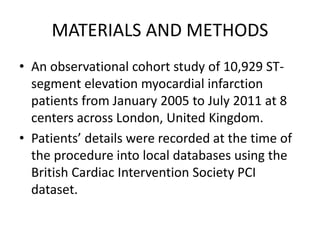
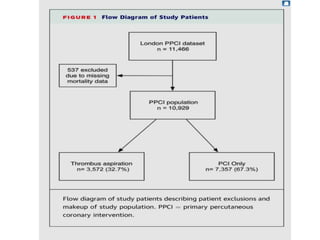
• An observational cohort study of 10,929 ST-
segment elevation myocardial infarction
patients from January 2005 to July 2011 at 8
centers across London, United Kingdom.
• Patients’ details were recorded at the time of
the procedure into local databases using the
British Cardiac Intervention Society PCI
dataset.
THROMBUS ASPIRATION
• Patients were classified into thrombus aspiration or non–
thrombus aspiration groups.
• The thrombus aspiration group included all patients in
whom thrombus aspiration was attempted.
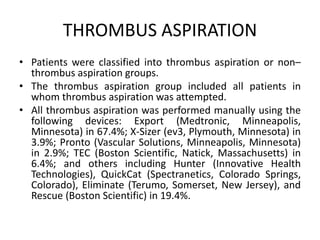
• All thrombus aspiration was performed manually using the
following devices: Export (Medtronic, Minneapolis,
Minnesota) in 67.4%; X-Sizer (ev3, Plymouth, Minnesota) in
3.9%; Pronto (Vascular Solutions, Minneapolis, Minnesota)
in 2.9%; TEC (Boston Scientific, Natick, Massachusetts) in
6.4%; and others including Hunter (Innovative Health
Technologies), QuickCat (Spectranetics, Colorado Springs,
Colorado), Eliminate (Terumo, Somerset, New Jersey), and
Rescue (Boston Scientific) in 19.4%.
OUTCOME
• Primary outcome was all cause mortality at a
median follow-up of 3.0 years (interquartile
range: 1.2 to 4.6 years).
• Following discharge, long-term all-cause
mortality was obtained by linkage to the
Office of National Statistics.
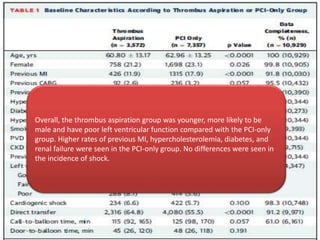
Overall, the thrombus aspiration group was younger, more likely to be
male and have poor left ventricular function compared with the PCI-only
group. Higher rates of previous MI, hypercholesterolemia, diabetes, and
renal failure were seen in the PCI-only group. No differences were seen in
the incidence of shock.
RESULTS
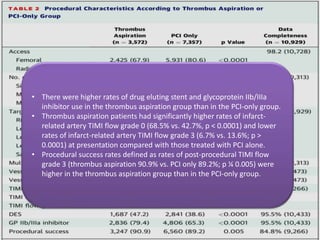
• There were higher rates of drug eluting stent and glycoprotein IIb/IIIa
inhibitor use in the thrombus aspiration group than in the PCI-only group.
• Thrombus aspiration patients had significantly higher rates of infarct-
related artery TIMI flow grade 0 (68.5% vs. 42.7%, p < 0.0001) and lower
rates of infarct-related artery TIMI flow grade 3 (6.7% vs. 13.6%; p >
0.0001) at presentation compared with those treated with PCI alone.
• Procedural success rates defined as rates of post-procedural TIMI flow
grade 3 (thrombus aspiration 90.9% vs. PCI only 89.2%; p ¼ 0.005) were
higher in the thrombus aspiration group than in the PCI-only group.
PROPENSITY SCORE MATCHING
• To further account for confounding variables and bias,
propensity score matching was performed to adjust for
differences in demographic and procedural variables
producing a total of 6,912 patients (3,456 in the thrombus
aspiration group and 3,456 in the PCI-alone group).
• Following matching, the baseline demographics and
procedural variables were well balanced in the 2
propensity-matched cohorts.
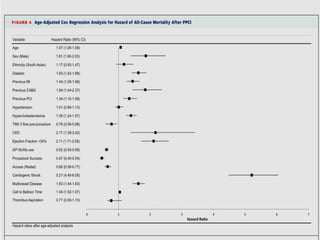
• In the propensity matched cohorts, Cox regression analysis
revealed that the use of thrombectomy during PPCI was not
a predictor of all-cause mortality (HR: 0.82, 95% CI: 0.60 to
1.13).
DISCUSSION
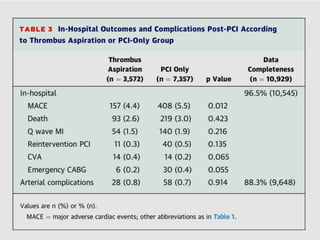
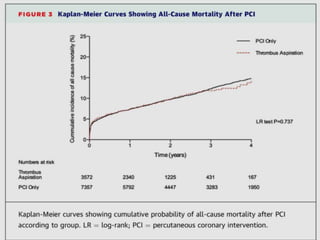
• Despite a greater rate of procedural success and lower
inhospital MACE, in-hospital mortality and long-term
survival were similar for the patients who underwent
thrombus aspiration to those who received PCI only.
• As thrombus characteristics and composition vary
according to the type of acute coronary syndromes and
time to presentation, it is likely that different subsets of
acute coronary syndrome patients may respond differently
to thrombus aspiration. As our database does not have
detailed morphological characterization of lesion and
thrombus morphology or thrombus burden, we are unable
to explore whether there are subsets of patients who may
respond better than others to aspiration.
DISCUSSION
• Theoretically, thrombectomy appears to be a
valuable approach to improve outcomes after
PPCI. In this study, improved procedural
outcomes and in-hospital MACE rates with
manual thrombectomy were seen; however,
these improvements were not associated with
a long-term mortality benefit.
CONCLUSIONS
• In this cohort of nearly 11,000 patients,
routine thrombus aspiration was not
associated with a reduction in long-term
mortality in patients undergoing primary PCI,
although procedural success and in-hospital
major adverse cardiac event rates were
improved.
LIMITATIONS
• First, our study only applies to patients with STEMI who received
PPCI.
• In addition, this study has all the limitations of a registry and all the
potential bias and unmeasured confounding associated with
nonrandomized studies.
• In addition, we cannot exclude the possibility of under-reporting of
complications, although the tracking of mortality is robust and we
only included the 95.3% of patients who had definitive mortality
data in our study cohort.
• Despite the very large size of our population studied, our cohort
does not have the power to detect a small but important difference
in mortality related to thrombectomy use.
Thank you

Thrombus aspiration in ppci

  • 1.
    Manual Thrombus AspirationIs Not Associated With Reduced Mortality in Patients Treated With Primary Percutaneous Coronary Intervention An Observational Study of 10,929 Patients With ST-Segment Elevation Myocardial Infarction From the London Heart Attack Group J A C C : C A R D I OV A S C U L A R I N T E R V E N T IO N S VOL. 8 , N O . 4 , 2 0 1 5 A P R I L 2 0 , 2 0 1 5 : 5 7 5 – 8 4 DR. Pavankumar P Rasalkar
  • 2.
    INTRODUCTION • The clinicaleffect of routine intracoronary thrombus aspiration before primary PCI in patients with ST-segment elevation myocardial infarction is uncertain. • TAPAS study: a single center trial involving 1,071 patients, which demonstrated not only an improvement in the primary outcome of myocardial blush grade but a nearly 50% reduction in mortality at 1 year
  • 3.
    INTRODUCTION • TASTE (ThrombusAspiration During ST-Segment Elevation Myocardial Infarction) study, which randomized over 7,000 patients to thrombus aspiration or PCI alone, suggested that routine aspiration does not reduce either 30-day or 1- year mortality in patients undergoing PPCI • This study aimed to assess the impact of thrombus aspiration on mortality in patients with ST-segment elevation myocardial infarction treated with primary percutaneous coronary intervention (PCI).
  • 4.
    MATERIALS AND METHODS •An observational cohort study of 10,929 ST- segment elevation myocardial infarction patients from January 2005 to July 2011 at 8 centers across London, United Kingdom. • Patients’ details were recorded at the time of the procedure into local databases using the British Cardiac Intervention Society PCI dataset.
  • 6.
    THROMBUS ASPIRATION • Patientswere classified into thrombus aspiration or non– thrombus aspiration groups. • The thrombus aspiration group included all patients in whom thrombus aspiration was attempted. • All thrombus aspiration was performed manually using the following devices: Export (Medtronic, Minneapolis, Minnesota) in 67.4%; X-Sizer (ev3, Plymouth, Minnesota) in 3.9%; Pronto (Vascular Solutions, Minneapolis, Minnesota) in 2.9%; TEC (Boston Scientific, Natick, Massachusetts) in 6.4%; and others including Hunter (Innovative Health Technologies), QuickCat (Spectranetics, Colorado Springs, Colorado), Eliminate (Terumo, Somerset, New Jersey), and Rescue (Boston Scientific) in 19.4%.
  • 7.
    OUTCOME • Primary outcomewas all cause mortality at a median follow-up of 3.0 years (interquartile range: 1.2 to 4.6 years). • Following discharge, long-term all-cause mortality was obtained by linkage to the Office of National Statistics.
  • 8.
    Overall, the thrombusaspiration group was younger, more likely to be male and have poor left ventricular function compared with the PCI-only group. Higher rates of previous MI, hypercholesterolemia, diabetes, and renal failure were seen in the PCI-only group. No differences were seen in the incidence of shock.
  • 9.
    RESULTS • There werehigher rates of drug eluting stent and glycoprotein IIb/IIIa inhibitor use in the thrombus aspiration group than in the PCI-only group. • Thrombus aspiration patients had significantly higher rates of infarct- related artery TIMI flow grade 0 (68.5% vs. 42.7%, p < 0.0001) and lower rates of infarct-related artery TIMI flow grade 3 (6.7% vs. 13.6%; p > 0.0001) at presentation compared with those treated with PCI alone. • Procedural success rates defined as rates of post-procedural TIMI flow grade 3 (thrombus aspiration 90.9% vs. PCI only 89.2%; p ¼ 0.005) were higher in the thrombus aspiration group than in the PCI-only group.
  • 13.
    PROPENSITY SCORE MATCHING •To further account for confounding variables and bias, propensity score matching was performed to adjust for differences in demographic and procedural variables producing a total of 6,912 patients (3,456 in the thrombus aspiration group and 3,456 in the PCI-alone group). • Following matching, the baseline demographics and procedural variables were well balanced in the 2 propensity-matched cohorts. • In the propensity matched cohorts, Cox regression analysis revealed that the use of thrombectomy during PPCI was not a predictor of all-cause mortality (HR: 0.82, 95% CI: 0.60 to 1.13).
  • 14.
    DISCUSSION • Despite agreater rate of procedural success and lower inhospital MACE, in-hospital mortality and long-term survival were similar for the patients who underwent thrombus aspiration to those who received PCI only. • As thrombus characteristics and composition vary according to the type of acute coronary syndromes and time to presentation, it is likely that different subsets of acute coronary syndrome patients may respond differently to thrombus aspiration. As our database does not have detailed morphological characterization of lesion and thrombus morphology or thrombus burden, we are unable to explore whether there are subsets of patients who may respond better than others to aspiration.
  • 15.
    DISCUSSION • Theoretically, thrombectomyappears to be a valuable approach to improve outcomes after PPCI. In this study, improved procedural outcomes and in-hospital MACE rates with manual thrombectomy were seen; however, these improvements were not associated with a long-term mortality benefit.
  • 16.
    CONCLUSIONS • In thiscohort of nearly 11,000 patients, routine thrombus aspiration was not associated with a reduction in long-term mortality in patients undergoing primary PCI, although procedural success and in-hospital major adverse cardiac event rates were improved.
  • 17.
    LIMITATIONS • First, ourstudy only applies to patients with STEMI who received PPCI. • In addition, this study has all the limitations of a registry and all the potential bias and unmeasured confounding associated with nonrandomized studies. • In addition, we cannot exclude the possibility of under-reporting of complications, although the tracking of mortality is robust and we only included the 95.3% of patients who had definitive mortality data in our study cohort. • Despite the very large size of our population studied, our cohort does not have the power to detect a small but important difference in mortality related to thrombectomy use.
  • 18.