JOINTS AND MUCLES
For research :
The Development of Biology Instructional
Media Based Joomla! Software


                   By : Anshar Mansabadi   1
Do you ever think how our
          body can move?


[Divider Picture]


                                      2
Joints

The connection between two
or more bones is called a joint
or articulation. Muscle and
bones are connected by
connective     tissue    called
tendons. Joint enable bones to
moved.
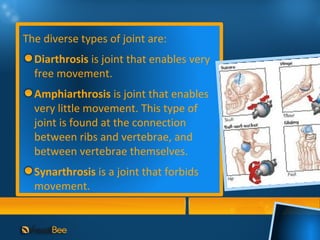
The diverse types of joint are:
  Diarthrosis is joint that enables very
  free movement.
  Amphiarthrosis is joint that enables
  very little movement. This type of
  joint is found at the connection
  between ribs and vertebrae, and
  between vertebrae themselves.
  Synarthrosis is a joint that forbids
  movement.
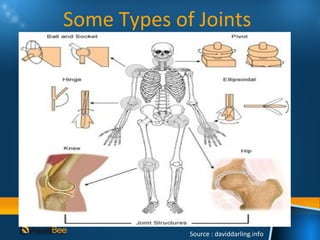
Some Types of Joints


             Source : daviddarling.info
Diarthrosis
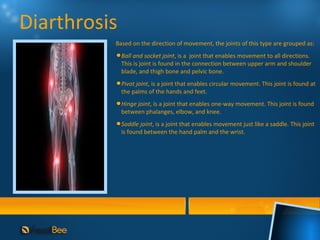
          Based on the direction of movement, the joints of this type are grouped as:
              Ball and socket joint, is a joint that enables movement to all directions.
              This is joint is found in the connection between upper arm and shoulder
              blade, and thigh bone and pelvic bone.
              Pivot joint, is a joint that enables circular movement. This joint is found at
              the palms of the hands and feet.
              Hinge joint, is a joint that enables one-way movement. This joint is found
              between phalanges, elbow, and knee.
              Saddle joint, is a joint that enables movement just like a saddle. This joint
              is found between the hand palm and the wrist.
Synarthrosis
            There are two types of synarthrosis:
• Sinchondroses where bones are connected by cartilage.
  Cartilage is positioned at the two tips of the neighboring
  bones. The example is the connection between vertebrae.
• Sinfibrosis where the bone connector is fibers. Fibers are
  positioned at the two tips of the neighboring bones. The
  example is the connection of frontal bone and the skull.
  The two bones are strengthened by coronal suture.
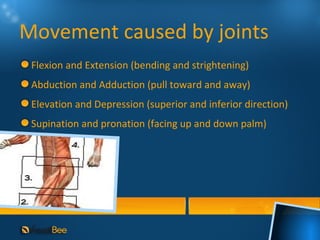
Movement caused by joints
 Flexion and Extension (bending and strightening)
 Abduction and Adduction (pull toward and away)
 Elevation and Depression (superior and inferior direction)
 Supination and pronation (facing up and down palm)
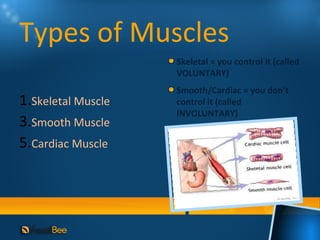
Types of Muscles
                    Skeletal = you control it (called
                    VOLUNTARY)
                    Smooth/Cardiac = you don’t
1.Skeletal Muscle   control it (called
                    INVOLUNTARY)
3.Smooth Muscle
5.Cardiac Muscle
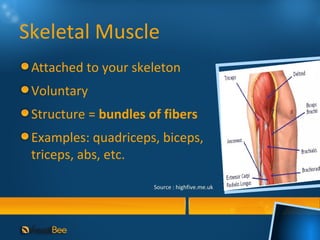
Skeletal Muscle
 Attached to your skeleton
 Voluntary
 Structure = bundles of fibers
 Examples: quadriceps, biceps,
 triceps, abs, etc.

                      Source : highfive.me.uk
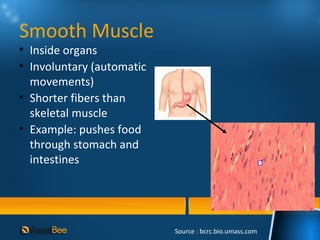
Smooth Muscle
• Inside organs
• Involuntary (automatic
  movements)
• Shorter fibers than
  skeletal muscle
• Example: pushes food
  through stomach and
  intestines


                           Source : bcrc.bio.umass.com
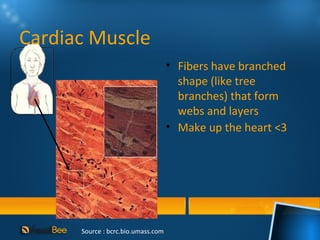
Cardiac Muscle
                                    • Fibers have branched
                                      shape (like tree
                                      branches) that form
                                      webs and layers
                                    • Make up the heart <3


      Source : bcrc.bio.umass.com
To be continue at abnormalities
    of movement system…


[Divider Picture]


                                      13

Joints and muscles

  • 1.
    JOINTS AND MUCLES Forresearch : The Development of Biology Instructional Media Based Joomla! Software By : Anshar Mansabadi 1
  • 2.
    Do you everthink how our body can move? [Divider Picture] 2
  • 3.
    Joints The connection betweentwo or more bones is called a joint or articulation. Muscle and bones are connected by connective tissue called tendons. Joint enable bones to moved.
  • 4.
    The diverse typesof joint are: Diarthrosis is joint that enables very free movement. Amphiarthrosis is joint that enables very little movement. This type of joint is found at the connection between ribs and vertebrae, and between vertebrae themselves. Synarthrosis is a joint that forbids movement.
  • 5.
    Some Types ofJoints Source : daviddarling.info
  • 6.
    Diarthrosis Based on the direction of movement, the joints of this type are grouped as: Ball and socket joint, is a joint that enables movement to all directions. This is joint is found in the connection between upper arm and shoulder blade, and thigh bone and pelvic bone. Pivot joint, is a joint that enables circular movement. This joint is found at the palms of the hands and feet. Hinge joint, is a joint that enables one-way movement. This joint is found between phalanges, elbow, and knee. Saddle joint, is a joint that enables movement just like a saddle. This joint is found between the hand palm and the wrist.
  • 7.
    Synarthrosis There are two types of synarthrosis: • Sinchondroses where bones are connected by cartilage. Cartilage is positioned at the two tips of the neighboring bones. The example is the connection between vertebrae. • Sinfibrosis where the bone connector is fibers. Fibers are positioned at the two tips of the neighboring bones. The example is the connection of frontal bone and the skull. The two bones are strengthened by coronal suture.
  • 8.
    Movement caused byjoints Flexion and Extension (bending and strightening) Abduction and Adduction (pull toward and away) Elevation and Depression (superior and inferior direction) Supination and pronation (facing up and down palm)
  • 9.
    Types of Muscles Skeletal = you control it (called VOLUNTARY) Smooth/Cardiac = you don’t 1.Skeletal Muscle control it (called INVOLUNTARY) 3.Smooth Muscle 5.Cardiac Muscle
  • 10.
    Skeletal Muscle Attachedto your skeleton Voluntary Structure = bundles of fibers Examples: quadriceps, biceps, triceps, abs, etc. Source : highfive.me.uk
  • 11.
    Smooth Muscle • Insideorgans • Involuntary (automatic movements) • Shorter fibers than skeletal muscle • Example: pushes food through stomach and intestines Source : bcrc.bio.umass.com
  • 12.
    Cardiac Muscle • Fibers have branched shape (like tree branches) that form webs and layers • Make up the heart <3 Source : bcrc.bio.umass.com
  • 13.
    To be continueat abnormalities of movement system… [Divider Picture] 13