Eleven Systems:
One Body
Health Class “Intro to the
human body systems”
9th&10th Grade Health
Objectives







Identify & compare tissues, organs, and
organ systems.
Describe the functions of all the body system
& parts.
Research diseases related to all the different
body systems.
Be able to fully explain at least one system,
listing organs and function.
Understanding the systems and how they
work to maintain homeostasis within the body.
The Circulatory System
 The

transportation system of the body. The
circulatory system is responsible for
making sure your body get's the fuel it
needs everyday, to transport wastes your
body doesn't need anymore, and even to
transport cells and hormones that
someone needs to grow and fight off
disease.
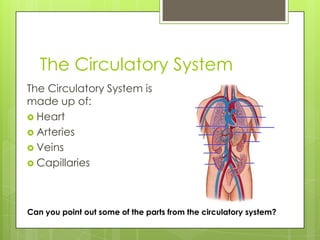
The Circulatory System
The Circulatory System is
made up of:
 Heart
 Arteries
 Veins
 Capillaries

Can you point out some of the parts from the circulatory system?
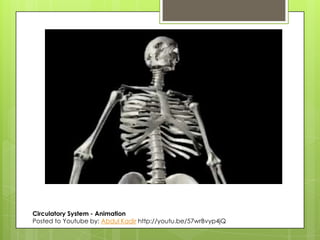
Circulatory System - Animation
Posted to Youtube by: Abdul Kadir http://youtu.be/57wrBvyp4jQ
The Circulatory System
Problems in the Circulatory System:
 Anemia
 Leukemia
 Hemophilia
 Arteriosclerosis
 Stroke
 High Blood Pressure
The Circulatory System
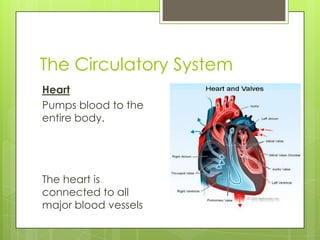
Heart
Pumps blood to the
entire body.

The heart is
connected to all
major blood vessels
Arteries
The largest blood vessels, responsible for
carrying oxygenated blood away from the
heart, to the rest of the body.
Veins
Responsible for carrying unoxygenated
blood to the heart, from the rest of the
body.
Capillaries
The Smallest Blood Vessels. They carry the
blood from the Arteries to the body's cells
and then back to the Veins. Nutrients,
gasses, and wastes are exchanged through
the capillaries.
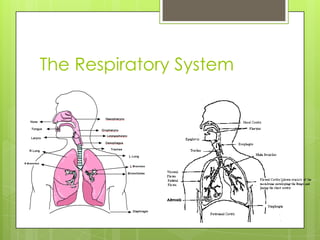
The Respiratory System
The respiratory system is responsible for us all
breathing. Split into two parts, known as the
upper and lower respiratory tracts. They're
made up of the Nose and Mouth, and the
Lungs, respectively.
Problems in the Respiratory System:
The Common Cold
Pneumonia
Bronchitis
Asthma
Emphysema
Cancer
The Respiratory System
Posted to Youtube by: EducationWithVision http://youtu.be/hc1YtXc_84A
The Respiratory System
The Skeletal System
Made of 206 bones, the Skeletal System is
the foundation of your body.
Problems in the Skeletal System:
Scoliosis
Bursitis
Arthritis
Osteoporosis
Injuries:
Fractures
Dislocation
Sprain
Schoolhouse Rock- Them Not-So-Dry Bones
Posted to Youtube by MrRiggyRiggs http://youtu.be/ICwLlrQKVcg
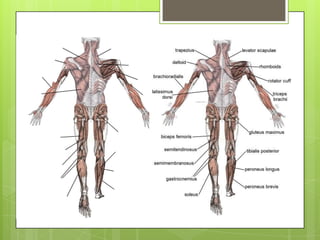
The Muscular System
The group of tissues that makes body parts
move.
Problems in the Muscular System:
Strain
Cramp
Bruise
Pulled or Torn Muscle
Muscular Fatigue
The Digestive System
The Organs that take in food and break it down
into a chemical form that can be absorbed into
the body.
Problems in the Digestive System:
Indigestion and Heartburn
Nausea and Vomiting
Ulcers
Gallstones
Cirrhosis of the Liver
Halitosis or Bad Breath
The digestive system - an animation
Posted to Youtube by: worldswonders http://youtu.be/P5lyQUtq1KQ
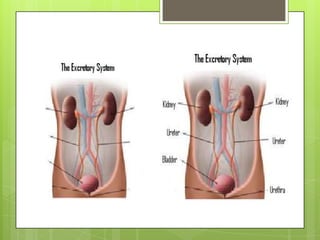
The Excretory System
The purpose of the Excretory system is to provide a way
for your body to expel the waste from it.
The Excretory system is made up of the Large intestine
(The Colon) and the Kidneys (The Urinary Tract)
Problems in the Excretory System:
Constipation
Diarrhea
Flatulence or Gas
Kidney Stones
Urinary Tract Infections
Cancer
The Integumentary System
The Integumentary System is made up of mainly your
Skin, but includes the hair, nails, sweat glands and oil
glands.
Your integumentary system plays a vital role in everyday
living, providing you protection from water and germs,
regulation of body temperature, and allowing you to
feel things like pressure, touch, heat, cold and pain.
Problems with the Skin:
Warts
Calluses and Corns
Cold Sores or Fever Blisters
Skin Cancer
Integumentary System Song
Posted to Youtube by: ParrMr http://youtu.be/MeTaBniB0ok
The Immune System
The function of the Immune System is to protect
your body from germs and bacteria. Without
these naturally born defenses, you'd be sick all the
time at at a high risk for life-threatening diseases.

Problems with the Immune System:
Immunodeficiency Disorders
Autoimmune Diseases
Allergies
HIV
How the Immune System works
Posted to Youtube by: draculauren14 http://youtu.be/TxU8c4vEHWk
The Immune System
 The

Immune System has 2 main defense
mechanisms, Natural Immunity and Acquired
Immunity.

 Natural

Immunity is something you're born with,
to resist or be immune to certain diseases.

 Acquired

Immunity is your body remembering
a disease, so it's better prepared to fight it off
the next time you get it.
The Nervous System













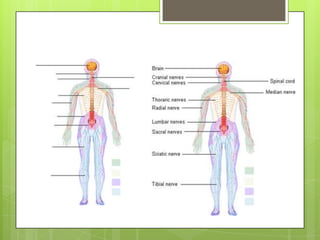
The single job of your nervous system, is to maintain
Homeostasis (A stable internal Environment). The
Nervous system controls and coordinates everything
in your body, to make sure it works as one flowing
unit.
The Nervous system does this by sending messages to
the muscles and glands via nerve impulses.
Problems in the Nervous System:
Pinched Nerve
Infections
Epilepsy
Tumors
Cerebral Palsy
Multiple Sclerosis
The Endocrine System
 The

Endocrine System works with the nervous
system, helping to accomplish their mutual goals
with different methods. The Endocrine system
secretes hormones to send messages to the cells
in the body via the blood.

 Hormones

help maintain a person's flow, helping
the nervous system with body parts that it can't
message through nerve impulses. Hormones can
have various effects on a person, such as energy
control, sugar and insulin balance, water and salt
balance, and even affecting emotions.
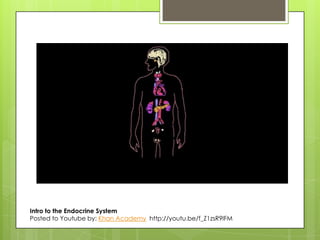
Intro to the Endocrine System
Posted to Youtube by: Khan Academy http://youtu.be/f_Z1zsR9lFM
The Endocrine System
Problems with the Endocrine System:
The Pituitary Gland
The Thyroid Gland
Diabetes
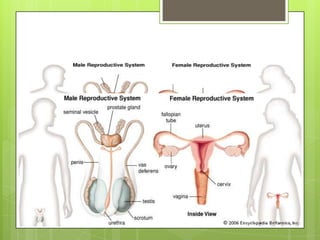
The Reproductive System
 The

reproductive system is responsible for the
continuation of the human race.
 Males and Females each have unique
reproductive systems, that together can create
life.
Male Reproductive Problems:
Testicular Cancer
Inguinal Hernia
Female Reproductive Problems:
Premenstrual Syndrome
Vaginitis
Cancer of the Female Organs
Assessment
Students will pair off and pick one of the
body systems to prepare a presentation.
You have the option to use any creative
form to represent your information but you
must hand in a written plan to me al least
one week before your group presentation.
A further description of the project and the
rubric for evaluation have been posted on
engrade for you.
Image References
 www.medicinenet.com
 Giunti

Editorial Group 2006, Atlas of
Anatomy, TAJ books Ltd, Surrey
Works Cited
 Miller

, K. & Levine, J. (2003). Biology ,
Pearson Education Inc.

 Innerbody.

2013 Retrieved 10/29/2013
http://www.innerbody.com/

Body systems

  • 1.
    Eleven Systems: One Body HealthClass “Intro to the human body systems” 9th&10th Grade Health
  • 2.
    Objectives      Identify & comparetissues, organs, and organ systems. Describe the functions of all the body system & parts. Research diseases related to all the different body systems. Be able to fully explain at least one system, listing organs and function. Understanding the systems and how they work to maintain homeostasis within the body.
  • 3.
    The Circulatory System The transportation system of the body. The circulatory system is responsible for making sure your body get's the fuel it needs everyday, to transport wastes your body doesn't need anymore, and even to transport cells and hormones that someone needs to grow and fight off disease.
  • 4.
    The Circulatory System TheCirculatory System is made up of:  Heart  Arteries  Veins  Capillaries Can you point out some of the parts from the circulatory system?
  • 5.
    Circulatory System -Animation Posted to Youtube by: Abdul Kadir http://youtu.be/57wrBvyp4jQ
  • 6.
    The Circulatory System Problemsin the Circulatory System:  Anemia  Leukemia  Hemophilia  Arteriosclerosis  Stroke  High Blood Pressure
  • 7.
    The Circulatory System Heart Pumpsblood to the entire body. The heart is connected to all major blood vessels
  • 8.
    Arteries The largest bloodvessels, responsible for carrying oxygenated blood away from the heart, to the rest of the body. Veins Responsible for carrying unoxygenated blood to the heart, from the rest of the body. Capillaries The Smallest Blood Vessels. They carry the blood from the Arteries to the body's cells and then back to the Veins. Nutrients, gasses, and wastes are exchanged through the capillaries.
  • 9.
    The Respiratory System Therespiratory system is responsible for us all breathing. Split into two parts, known as the upper and lower respiratory tracts. They're made up of the Nose and Mouth, and the Lungs, respectively. Problems in the Respiratory System: The Common Cold Pneumonia Bronchitis Asthma Emphysema Cancer
  • 10.
    The Respiratory System Postedto Youtube by: EducationWithVision http://youtu.be/hc1YtXc_84A
  • 11.
  • 12.
    The Skeletal System Madeof 206 bones, the Skeletal System is the foundation of your body. Problems in the Skeletal System: Scoliosis Bursitis Arthritis Osteoporosis Injuries: Fractures Dislocation Sprain
  • 13.
    Schoolhouse Rock- ThemNot-So-Dry Bones Posted to Youtube by MrRiggyRiggs http://youtu.be/ICwLlrQKVcg
  • 14.
    The Muscular System Thegroup of tissues that makes body parts move. Problems in the Muscular System: Strain Cramp Bruise Pulled or Torn Muscle Muscular Fatigue
  • 16.
    The Digestive System TheOrgans that take in food and break it down into a chemical form that can be absorbed into the body. Problems in the Digestive System: Indigestion and Heartburn Nausea and Vomiting Ulcers Gallstones Cirrhosis of the Liver Halitosis or Bad Breath
  • 17.
    The digestive system- an animation Posted to Youtube by: worldswonders http://youtu.be/P5lyQUtq1KQ
  • 18.
    The Excretory System Thepurpose of the Excretory system is to provide a way for your body to expel the waste from it. The Excretory system is made up of the Large intestine (The Colon) and the Kidneys (The Urinary Tract) Problems in the Excretory System: Constipation Diarrhea Flatulence or Gas Kidney Stones Urinary Tract Infections Cancer
  • 20.
    The Integumentary System TheIntegumentary System is made up of mainly your Skin, but includes the hair, nails, sweat glands and oil glands. Your integumentary system plays a vital role in everyday living, providing you protection from water and germs, regulation of body temperature, and allowing you to feel things like pressure, touch, heat, cold and pain. Problems with the Skin: Warts Calluses and Corns Cold Sores or Fever Blisters Skin Cancer
  • 21.
    Integumentary System Song Postedto Youtube by: ParrMr http://youtu.be/MeTaBniB0ok
  • 22.
    The Immune System Thefunction of the Immune System is to protect your body from germs and bacteria. Without these naturally born defenses, you'd be sick all the time at at a high risk for life-threatening diseases. Problems with the Immune System: Immunodeficiency Disorders Autoimmune Diseases Allergies HIV
  • 23.
    How the ImmuneSystem works Posted to Youtube by: draculauren14 http://youtu.be/TxU8c4vEHWk
  • 24.
    The Immune System The Immune System has 2 main defense mechanisms, Natural Immunity and Acquired Immunity.  Natural Immunity is something you're born with, to resist or be immune to certain diseases.  Acquired Immunity is your body remembering a disease, so it's better prepared to fight it off the next time you get it.
  • 25.
    The Nervous System          Thesingle job of your nervous system, is to maintain Homeostasis (A stable internal Environment). The Nervous system controls and coordinates everything in your body, to make sure it works as one flowing unit. The Nervous system does this by sending messages to the muscles and glands via nerve impulses. Problems in the Nervous System: Pinched Nerve Infections Epilepsy Tumors Cerebral Palsy Multiple Sclerosis
  • 27.
    The Endocrine System The Endocrine System works with the nervous system, helping to accomplish their mutual goals with different methods. The Endocrine system secretes hormones to send messages to the cells in the body via the blood.  Hormones help maintain a person's flow, helping the nervous system with body parts that it can't message through nerve impulses. Hormones can have various effects on a person, such as energy control, sugar and insulin balance, water and salt balance, and even affecting emotions.
  • 28.
    Intro to theEndocrine System Posted to Youtube by: Khan Academy http://youtu.be/f_Z1zsR9lFM
  • 29.
    The Endocrine System Problemswith the Endocrine System: The Pituitary Gland The Thyroid Gland Diabetes
  • 30.
    The Reproductive System The reproductive system is responsible for the continuation of the human race.  Males and Females each have unique reproductive systems, that together can create life. Male Reproductive Problems: Testicular Cancer Inguinal Hernia Female Reproductive Problems: Premenstrual Syndrome Vaginitis Cancer of the Female Organs
  • 32.
    Assessment Students will pairoff and pick one of the body systems to prepare a presentation. You have the option to use any creative form to represent your information but you must hand in a written plan to me al least one week before your group presentation. A further description of the project and the rubric for evaluation have been posted on engrade for you.
  • 33.
    Image References  www.medicinenet.com Giunti Editorial Group 2006, Atlas of Anatomy, TAJ books Ltd, Surrey
  • 34.
    Works Cited  Miller ,K. & Levine, J. (2003). Biology , Pearson Education Inc.  Innerbody. 2013 Retrieved 10/29/2013 http://www.innerbody.com/