Human Locomotion
BY JEFFREY KURUVILLA
6-B
IIS
Human Locomotion
• Involves the
movement of
– Bones
– Cartilage
– Muscles
– Tendons
– Ligaments
• It allows humans to
move from place to
place
Human Skeletal System
• It contains bones of
many different shapes
and sizes
– Purposes
• Support and protection
of body structure
• Anchors muscle action
• Leverage fo body
movement
• Produces blood cells in
the marrow
Cartilage
• Connective tissues
– It is flexible and elastic
– It give support
– Flexibility of joints
– Cushions effects in joints
• It makes up most of the body’s
skeleton
• By adulthood most of the
cartilage is taken over by
bones
– Found:
• End of ribs
• Nose
• Ears
• bronchi
• Trachea
Human Muscular System
• There are three types
of muscles in the
human body
– Visceral
• Smooth in appearance
• Involuntary in action
Human Muscular System
• Cardiac muscles
– Involuntary in action
– Striped in appearance
• Heart
etc………………
Human Muscular System
• Skeletal Muscle
– Appearance
• Voluntary in action
• Striped in appearance
– Controlled by the central
nervous system
– They are used to move bones
in a coordinated manner
– Muscles usually operate in
pairs
• Which “pull” on the bones on
either side
– INCLUDE
» Extenders- which
extend the limbs
» Flexors – return the
limbs (bend the joints)
Tendons
• Made up of
connective tissues
• They are tough,
inelastic
• They connect the
muscle to the bone
Ligaments
• Made up of tough
elastic connective
tissue
• Able to stretch slightly
during joint movement
• Connect bones at
joints such as
– Elbows fingers knees
Problems that effect the Skeletal
System
- Arthritis
- Tendonitis
Arthritis
• Inflammation of the
joints causing
swelling an horrible
pain
– Cam occur at a young
age
– Usually occurs when
old
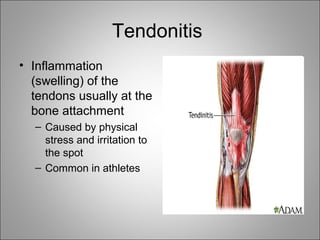
Tendonitis
• Inflammation
(swelling) of the
tendons usually at the
bone attachment
– Caused by physical
stress and irritation to
the spot
– Common in athletes
THANK
YOU!

Locomotion

  • 1.
    Human Locomotion BY JEFFREYKURUVILLA 6-B IIS
  • 2.
    Human Locomotion • Involvesthe movement of – Bones – Cartilage – Muscles – Tendons – Ligaments • It allows humans to move from place to place
  • 3.
    Human Skeletal System •It contains bones of many different shapes and sizes – Purposes • Support and protection of body structure • Anchors muscle action • Leverage fo body movement • Produces blood cells in the marrow
  • 4.
    Cartilage • Connective tissues –It is flexible and elastic – It give support – Flexibility of joints – Cushions effects in joints • It makes up most of the body’s skeleton • By adulthood most of the cartilage is taken over by bones – Found: • End of ribs • Nose • Ears • bronchi • Trachea
  • 5.
    Human Muscular System •There are three types of muscles in the human body – Visceral • Smooth in appearance • Involuntary in action
  • 6.
    Human Muscular System •Cardiac muscles – Involuntary in action – Striped in appearance • Heart etc………………
  • 7.
    Human Muscular System •Skeletal Muscle – Appearance • Voluntary in action • Striped in appearance – Controlled by the central nervous system – They are used to move bones in a coordinated manner – Muscles usually operate in pairs • Which “pull” on the bones on either side – INCLUDE » Extenders- which extend the limbs » Flexors – return the limbs (bend the joints)
  • 8.
    Tendons • Made upof connective tissues • They are tough, inelastic • They connect the muscle to the bone
  • 9.
    Ligaments • Made upof tough elastic connective tissue • Able to stretch slightly during joint movement • Connect bones at joints such as – Elbows fingers knees
  • 10.
    Problems that effectthe Skeletal System - Arthritis - Tendonitis
  • 11.
    Arthritis • Inflammation ofthe joints causing swelling an horrible pain – Cam occur at a young age – Usually occurs when old
  • 12.
    Tendonitis • Inflammation (swelling) ofthe tendons usually at the bone attachment – Caused by physical stress and irritation to the spot – Common in athletes
  • 13.