Joints and Muscles
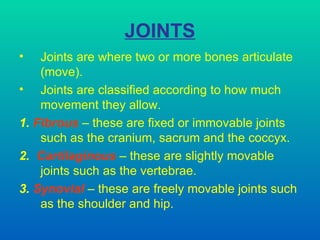
JOINTS Joints are where two or more bones articulate (move). Joints are classified according to how much movement they allow.  1.  Fibrous  – these are fixed or immovable joints such as the cranium, sacrum and the coccyx. 2.  Cartilaginous  – these are slightly movable joints such as the vertebrae. 3.  Synovial   – these are freely movable joints such as the shoulder and hip.
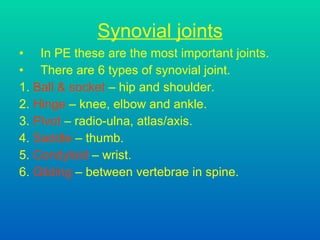
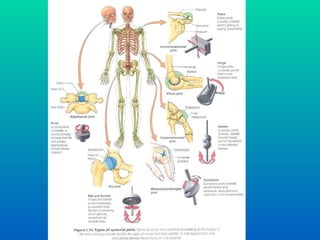
Synovial joints In PE these are the most important joints. There are 6 types of synovial joint.  1.  Ball & socket  – hip and shoulder. 2.  Hinge  – knee, elbow and ankle. 3.  Pivot  – radio-ulna, atlas/axis.  4.  Saddle  – thumb. 5.  Condyloid  – wrist. 6.  Gliding  – between vertebrae in spine.
 
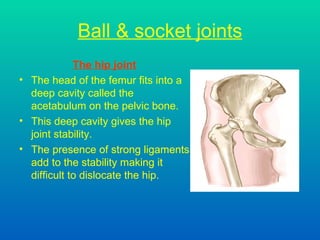
Ball & socket joints The hip joint The head of the femur fits into a deep cavity called the acetabulum on the pelvic bone. This deep cavity gives the hip joint stability.  The presence of strong ligaments add to the stability making it difficult to dislocate the hip.
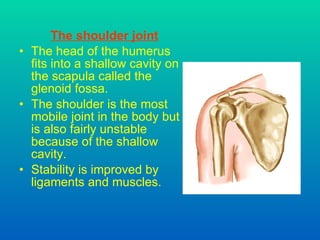
The shoulder joint The head of the humerus fits into a shallow cavity on the scapula called the glenoid fossa. The shoulder is the most mobile joint in the body but is also fairly unstable because of the shallow cavity. Stability is improved by ligaments and muscles.
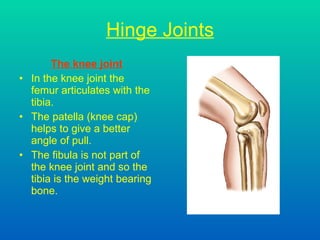
Hinge Joints The knee joint In the knee joint the femur articulates with the tibia. The patella (knee cap) helps to give a better angle of pull. The fibula is not part of the knee joint and so the tibia is the weight bearing bone.
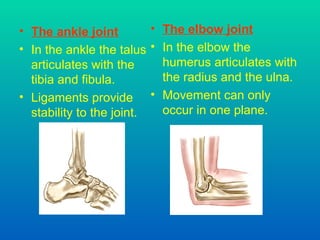
The ankle joint In the ankle the talus articulates with the tibia and fibula. Ligaments provide stability to the joint. The elbow joint In the elbow the humerus articulates with the radius and the ulna. Movement can only occur in one plane.
The pivot joint The radio-ulna   In this joint the radius and ulna articulate within the elbow joint. This joint allows the elbow some twisting movement (pronation & supination. Atlas/axis In this joint the atlas and axis bones articulate to allow a rotation movement as in shaking your head.
Condyloid and gliding joints The wrist In this joint the radius and ulna bones articulate with 3 of the carpal bones. The spine The spine has five areas and has to fulfil many functions such as weight bearing stability and support. There are three type of joint in the spine but for A level the main one to know is the gliding joints between the vertebral arches.
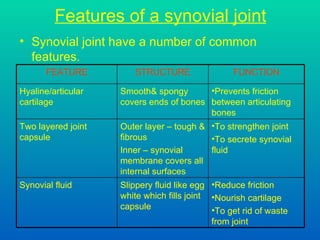
Features of a synovial joint Synovial joint have a number of common features. Reduce friction Nourish cartilage To get rid of waste from joint Slippery fluid like egg white which fills joint capsule Synovial fluid To strengthen joint To secrete synovial fluid Outer layer – tough & fibrous Inner – synovial membrane covers all internal surfaces Two layered joint capsule Prevents friction between articulating bones Smooth& spongy covers ends of bones Hyaline/articular cartilage FUNCTION STRUCTURE FEATURE
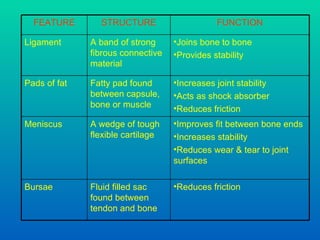
FUNCTION STRUCTURE FEATURE Reduces friction Fluid filled sac found between tendon and bone Bursae Improves fit between bone ends Increases stability Reduces wear & tear to joint surfaces A wedge of tough flexible cartilage  Meniscus Increases joint stability Acts as shock absorber Reduces friction Fatty pad found between capsule, bone or muscle Pads of fat Joins bone to bone Provides stability A band of strong fibrous connective material  Ligament
Movements around a joint All  synovial joints  can move freely but the amount and type of movements which occur at each joint varies. Many of the movements occur in pairs – they are the opposite of each other. Technical terms to describe the  movements you need to know include:-
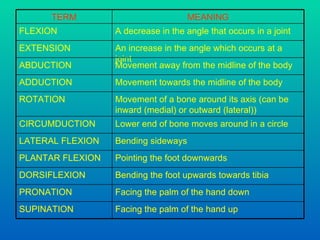
Facing the palm of the hand up SUPINATION Facing the palm of the hand down PRONATION Bending the foot upwards towards tibia DORSIFLEXION Pointing the foot downwards PLANTAR FLEXION Bending sideways LATERAL FLEXION Lower end of bone moves around in a circle CIRCUMDUCTION Movement of a bone around its axis (can be inward (medial) or outward (lateral)) ROTATION Movement towards the midline of the body ADDUCTION Movement away from the midline of the body ABDUCTION An increase in the angle which occurs at a joint EXTENSION A decrease in the angle that occurs in a joint FLEXION MEANING TERM
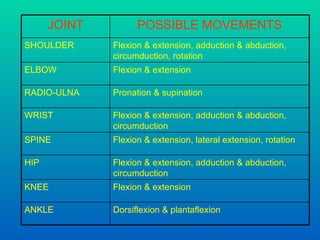
Dorsiflexion & plantaflexion ANKLE Flexion & extension KNEE Flexion & extension, adduction & abduction, circumduction HIP Flexion & extension, lateral extension, rotation SPINE Flexion & extension, adduction & abduction, circumduction WRIST Pronation & supination RADIO-ULNA Flexion & extension ELBOW Flexion & extension, adduction & abduction, circumduction , rotation SHOULDER POSSIBLE MOVEMENTS JOINT
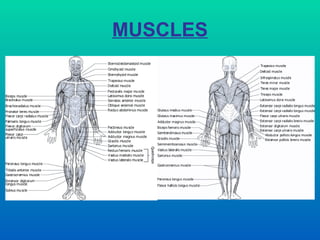
MUSCLES
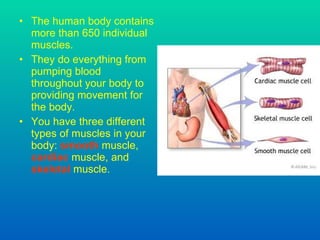
The human body contains more than 650 individual muscles . They do everything from pumping blood throughout your body to provid ing  movement for the body. You have three different types of muscles in your body:  smooth  muscle,  cardiac  muscle, and  skeletal   muscle .
Smooth Muscle Smooth muscles are  involuntary  muscles. You can't control this type of muscle. Your brain and body  (nervous system and hormones)  tell these muscles what to do without you even thinking about it. Much of our internal organs is made up of smooth muscles. They are found in the urinary bladder, gallbladder, arteries, and veins. Also the digestive tract is made up of smooth muscle as well.
Cardiac Muscle This is t he muscle that makes up the heart . It is also known as the  myocardium . The thick muscles of the heart contract to pump  blood  out and then relax to let blood back in after it has circulated through the body. Cardiac muscles are also  involuntary  muscles.
Skeletal Muscle  Skeletal muscles are  voluntary  muscles . These muscles help to make up the  musculoskeletal   system . T he skeletal muscles work with your bones to give your body power and strength.   S keletal muscle is attached to one end of a bone ,  stretches all the way across a joint ,   and then attaches again to another bone . Skeletal muscles are held to the bones with the help of  tendons . Together, this system allows you to do many amazing things with your body in terms of movement.
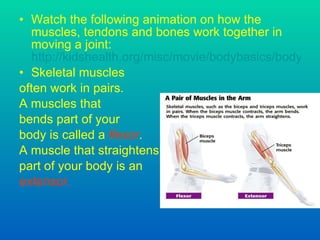
Watch the following animation on how the muscles, tendons and bones work together in moving a joint:  http://kidshealth.org/misc/movie/bodybasics/bodybasics_knee.html Skeletal muscles often work in pairs. A muscles that  bends part of your  body is called a  flexor . A muscle that straightens part of your body is an extensor .
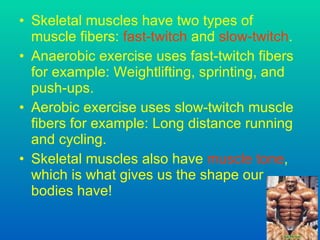
Skeletal muscles have two types of muscle fibers:  fast-twitch  and  slow-twitch .  Anaerobic exercise uses fast-twitch fibers  for example:  Weightlifting, sprinting, and push-ups . Aerobic exercise uses slow-twitch muscle fibers  for example:  Long distance running and cycling . Skeletal muscles also have  muscle tone , which is what gives us the shape our bodies have!
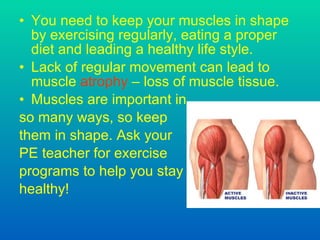
You need to keep your muscles in shape by exercising regularly, eating a proper diet and leading a healthy life style. Lack of regular movement can lead to muscle  atrophy  – loss of muscle tissue.  Muscles are important in so many ways, so keep them in shape. Ask your PE teacher for exercise programs to help you stay healthy!

Gr8 lesson3

  • 1.
  • 2.
    JOINTS Joints arewhere two or more bones articulate (move). Joints are classified according to how much movement they allow. 1. Fibrous – these are fixed or immovable joints such as the cranium, sacrum and the coccyx. 2. Cartilaginous – these are slightly movable joints such as the vertebrae. 3. Synovial – these are freely movable joints such as the shoulder and hip.
  • 3.
    Synovial joints InPE these are the most important joints. There are 6 types of synovial joint. 1. Ball & socket – hip and shoulder. 2. Hinge – knee, elbow and ankle. 3. Pivot – radio-ulna, atlas/axis. 4. Saddle – thumb. 5. Condyloid – wrist. 6. Gliding – between vertebrae in spine.
  • 4.
  • 5.
    Ball & socketjoints The hip joint The head of the femur fits into a deep cavity called the acetabulum on the pelvic bone. This deep cavity gives the hip joint stability. The presence of strong ligaments add to the stability making it difficult to dislocate the hip.
  • 6.
    The shoulder jointThe head of the humerus fits into a shallow cavity on the scapula called the glenoid fossa. The shoulder is the most mobile joint in the body but is also fairly unstable because of the shallow cavity. Stability is improved by ligaments and muscles.
  • 7.
    Hinge Joints Theknee joint In the knee joint the femur articulates with the tibia. The patella (knee cap) helps to give a better angle of pull. The fibula is not part of the knee joint and so the tibia is the weight bearing bone.
  • 8.
    The ankle jointIn the ankle the talus articulates with the tibia and fibula. Ligaments provide stability to the joint. The elbow joint In the elbow the humerus articulates with the radius and the ulna. Movement can only occur in one plane.
  • 9.
    The pivot jointThe radio-ulna In this joint the radius and ulna articulate within the elbow joint. This joint allows the elbow some twisting movement (pronation & supination. Atlas/axis In this joint the atlas and axis bones articulate to allow a rotation movement as in shaking your head.
  • 10.
    Condyloid and glidingjoints The wrist In this joint the radius and ulna bones articulate with 3 of the carpal bones. The spine The spine has five areas and has to fulfil many functions such as weight bearing stability and support. There are three type of joint in the spine but for A level the main one to know is the gliding joints between the vertebral arches.
  • 11.
    Features of asynovial joint Synovial joint have a number of common features. Reduce friction Nourish cartilage To get rid of waste from joint Slippery fluid like egg white which fills joint capsule Synovial fluid To strengthen joint To secrete synovial fluid Outer layer – tough & fibrous Inner – synovial membrane covers all internal surfaces Two layered joint capsule Prevents friction between articulating bones Smooth& spongy covers ends of bones Hyaline/articular cartilage FUNCTION STRUCTURE FEATURE
  • 12.
    FUNCTION STRUCTURE FEATUREReduces friction Fluid filled sac found between tendon and bone Bursae Improves fit between bone ends Increases stability Reduces wear & tear to joint surfaces A wedge of tough flexible cartilage Meniscus Increases joint stability Acts as shock absorber Reduces friction Fatty pad found between capsule, bone or muscle Pads of fat Joins bone to bone Provides stability A band of strong fibrous connective material Ligament
  • 13.
    Movements around ajoint All synovial joints can move freely but the amount and type of movements which occur at each joint varies. Many of the movements occur in pairs – they are the opposite of each other. Technical terms to describe the movements you need to know include:-
  • 14.
    Facing the palmof the hand up SUPINATION Facing the palm of the hand down PRONATION Bending the foot upwards towards tibia DORSIFLEXION Pointing the foot downwards PLANTAR FLEXION Bending sideways LATERAL FLEXION Lower end of bone moves around in a circle CIRCUMDUCTION Movement of a bone around its axis (can be inward (medial) or outward (lateral)) ROTATION Movement towards the midline of the body ADDUCTION Movement away from the midline of the body ABDUCTION An increase in the angle which occurs at a joint EXTENSION A decrease in the angle that occurs in a joint FLEXION MEANING TERM
  • 15.
    Dorsiflexion & plantaflexionANKLE Flexion & extension KNEE Flexion & extension, adduction & abduction, circumduction HIP Flexion & extension, lateral extension, rotation SPINE Flexion & extension, adduction & abduction, circumduction WRIST Pronation & supination RADIO-ULNA Flexion & extension ELBOW Flexion & extension, adduction & abduction, circumduction , rotation SHOULDER POSSIBLE MOVEMENTS JOINT
  • 16.
  • 17.
    The human bodycontains more than 650 individual muscles . They do everything from pumping blood throughout your body to provid ing movement for the body. You have three different types of muscles in your body: smooth muscle, cardiac muscle, and skeletal muscle .
  • 18.
    Smooth Muscle Smoothmuscles are involuntary muscles. You can't control this type of muscle. Your brain and body (nervous system and hormones) tell these muscles what to do without you even thinking about it. Much of our internal organs is made up of smooth muscles. They are found in the urinary bladder, gallbladder, arteries, and veins. Also the digestive tract is made up of smooth muscle as well.
  • 19.
    Cardiac Muscle Thisis t he muscle that makes up the heart . It is also known as the myocardium . The thick muscles of the heart contract to pump blood out and then relax to let blood back in after it has circulated through the body. Cardiac muscles are also involuntary muscles.
  • 20.
    Skeletal Muscle Skeletal muscles are voluntary muscles . These muscles help to make up the musculoskeletal system . T he skeletal muscles work with your bones to give your body power and strength. S keletal muscle is attached to one end of a bone , stretches all the way across a joint , and then attaches again to another bone . Skeletal muscles are held to the bones with the help of tendons . Together, this system allows you to do many amazing things with your body in terms of movement.
  • 21.
    Watch the followinganimation on how the muscles, tendons and bones work together in moving a joint: http://kidshealth.org/misc/movie/bodybasics/bodybasics_knee.html Skeletal muscles often work in pairs. A muscles that bends part of your body is called a flexor . A muscle that straightens part of your body is an extensor .
  • 22.
    Skeletal muscles havetwo types of muscle fibers: fast-twitch and slow-twitch . Anaerobic exercise uses fast-twitch fibers for example: Weightlifting, sprinting, and push-ups . Aerobic exercise uses slow-twitch muscle fibers for example: Long distance running and cycling . Skeletal muscles also have muscle tone , which is what gives us the shape our bodies have!
  • 23.
    You need tokeep your muscles in shape by exercising regularly, eating a proper diet and leading a healthy life style. Lack of regular movement can lead to muscle atrophy – loss of muscle tissue. Muscles are important in so many ways, so keep them in shape. Ask your PE teacher for exercise programs to help you stay healthy!