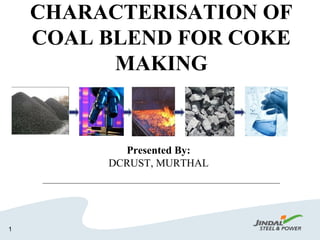
CHARACTERISATION OF
COAL BLEND FOR COKE
MAKING
1
Presented By:
DCRUST, MURTHAL
2
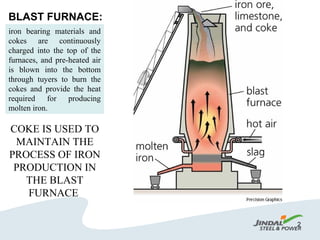
iron bearing materials and
cokes are continuously
charged into the top of the
furnaces, and pre-heated air
is blown into the bottom
through tuyers to burn the
cokes and provide the heat
required for producing
molten iron.
BLAST FURNACE:
COKE IS USED TO
MAINTAIN THE
PROCESS OF IRON
PRODUCTION IN
THE BLAST
FURNACE
3
• Fuel: Provides heat for the endothermic requirements of chemical reactions and
the melting of slag and metal;
• Chemical reducing agent: Produces gases for the reduction of iron oxides; and
• Permeable support: supports the iron bearing burden and provides a permeable
matrix necessary for slag and metal to pass down into the hearth and for hot gases
to pass upwards into the stack.
High quality coals
are advantageous
to make better
quality cokes
ROLE OF COKE IN BLAST FURNACE:
4
1. About Coal:
a. Coal Formation
b. Coalification
c. Coal Components
2. Testing methods of coal and coke:
Proximate / Ultimate/ Coal Petrography / other important tests of coal and coke
3. Coal Blending / Carbonization
CONTENTS:
COAL:
Coal is a valuable and plentiful natural global resource
Coal is a fossil fuel and is the altered remains of prehistoric vegetation that
originally accumulated in swamps and peat bogs
Coal is a combustible, sedimentary, organic rock, which is composed mainly of
carbon, hydrogen and oxygen
COAL FORMATION:
COALIFICATION:
The degree of change undergone by a coal as it matures from peat to anthracite
is known as Coalification.
Coalification has an important bearing on coal's physical and chemical properties
and is referred to as the 'rank' of the coal.
Ranking is determined by the degree of transformation of the original plant
material to carbon.
The ranks of coals, from those with the least carbon to those with the most
carbon, are lignite, sub-bituminous, bituminous and anthracite
In addition to carbon, coals contain hydrogen, oxygen, nitrogen and varying
amounts of sulphur. High-rank coals are high in carbon and therefore heat value,
but low in hydrogen and oxygen. Low-rank coals are low in carbon but high in
hydrogen and oxygen content.
8
Variation of selected coal properties with coal rank
COAL RANK:
9
PROXIMATE ANALYSIS:
Volatile matter:
• consists of aliphatic carbon atoms (linked in open chains) or aromatic
hydrocarbons (one or more six-carbon rings characteristic of benzene series)
and mineral matter.
• The main constituents of volatile matter include hydrogen, oxygen, carbon
monoxide, methane, moisture and hydrocarbons.
• Since volatile matter in coal is almost completely expelled during coke making,
low volatile coals yield higher amounts of coke from the same amount of coal.
• Coal with extremely less or high volatile matter is not desirable, since such coals
either do not coke at all or make coke of poor quality with very low fixed
carbon.
10
Ash:
• Ash, to a very large extent, decides the physical characteristics of coke, and this,
in turn, has a major impact on blast furnace performance .
• The use of high ash coke increases the coke rate and the slag volume in blast
furnaces, both of which are detrimental.
• High ash in coke lowers the carbon content and also demands the use of more
fluxes and hence consumes more energy for slagging.
• It has been established that1%increase in ash content in coke leads to an
increase of 1.5 – 2% in coke rate, 1.5% in the flux rate and lowers blast furnace
efficiency by 3 – 5%.
PROXIMATE ANALYSIS:
11
The ultimate analysis indicates the chemical composition of coal in terms of:
Hydrogen, Carbon, Oxygen, Nitrogen, phosphorus and sulphur contents.
• Sulphur and phosphorus are harmful impurities for steel and have to be removed
during iron making or steelmaking.
Sulphur:
• Sulphur is present in coal, both as organic and inorganic (pyritic) sulphur.
• 70% of the sulphur is in inorganic form and 30% is organic sulphur.
• Inorganic sulphur decomposes completely to hydrogen sulphide and ferrous
sulphide during coke making, while only half of the organic sulphur
decomposes to hydrogen sulphide.
• Approximately 75-80% of the sulphur in coal thus ends-up in coke.
ULTIMATE ANALYSIS:
12
Sulphur (Contd..):
• Sulphur in coke has a detrimental effect on blast furnace operation.
• Increased slag volume is required to remove it as a sulphur bearing compound in
blast furnace slag.
• This automatically reduces the productivity and increases the coke rate.
Phosphorus:
• The entire amount of phosphorus that enters a blast furnace through the burden
materials gets reduced under the conditions used, and is present in the hot metal.
• Removal of phosphorus is carried out during steel making.
ULTIMATE ANALYSIS:
13
FREE SWELLING INDEX
PETROGRAPHIC CHARECTERISTICS OF COAL:
Macerals and Mineral Matter:
• Macerals are the microscopically recognisable individual organic constituents of
coal.
• They are distinguishable under a microscope on the basis of their reflectance.
• There are three main macerals groups:
Vitrinite, Liptinite and Inertinite
• Mineral Matter comprises the inorganic components of coal.
COAL PETROGRAPHY:
•Petrography study of coal plays an important role for coke making.
•Coal petrography is the study of coal entities (Called Macerals) under microscope, as
its indication to various subject, such as mode of origin and commercial process of
coal.
•Petrography study helps in selecting the proper blend of coking coal.
COAL CONSTITUENTS:
SN Macerals Characteristics
1 Vitrinite (Originates from Stem,
trunks, roots, branches of tree)
Reactive, produce plastic mass and principle
binder phase producer during carbonization,
2 Inertinite (Non reactive
components of the coal)
Displays no plasticity and behaves like
an inert, philler phases
3 Liptinite (resin and waxy part
of tree))
Reactive
4 Mineral Matter (organic and
inorganic constituents of the
coal)
Non reactive, philler phases
Vitrinite is generally the most
frequent and most important
macerals group. The reflectivity or
reflectance of the light source of
Vitrinite depicts the maturity or rank
of the coal.
PETROGRAPHY MICROSCOPE (LEICA DM 4500P)
EYE PIECE
Objective
turret with
objectives
Specimen
stage with
specimen
holder
LCD
Operating/
Functions
buttons
Focus
wheel with
coarse &
fine
adjustment
Lamp
MACERALS
The smallest constituents of coals are called macerals.
The macerals are distinguished from one another microscopically on the basis of
their optical characteristics of colour, reflectance etc..
Parameters Property Desirable range
Ash(%)
Measures the residual ash of a coal after
Combustion
Values less than 15% are desirable
Volatile
Matter (%)
Measures the proportion of volatile
Matter content in the coal
20 – 25 %
Moisture (%) Measures moisture in coal Values <10% as received are desirable
MMR
Of vitrinite (%)
Measures the rank of coal
The reflectance of Vitrinite in the
group of 0.8-1.3 is ideal for coke
making
Crucible
Swell Number
Measures the caking behaviour of coal
When heated
High values >5 are prime coking coals;
Low values<2 are weak or non-coking
Coals
Sulphur (%)
Measures the total sulphur content of
coal
Low values are desirable
Phosphorus (%)
Measures the phosphorous content of
coal
Values less than 0.008 are desirable.
Maceral
Composition (%)
Identifies the presence and proportion
Of Vitrinite, Inertinite, Liptinite & Min
Matt contents of Coal
High Vitrinite (%) and low
Inertinite (%) Are Desirable.
Max fluidity
(DDPM)
Measures the fluid properties of coal
When heated
Fluidity >100ddpm is desirable
Hardgrove
Grindability
Index
Hardness test soft coals are >60; hard coals are <50
Major parameters for determining coking characteristics of coal:
22
COAL BLENDING
• Selection of coals is the most important factor for coke qualities.
• Controlling rank and agglomerating properties of coal blending by choosing the
coals to use is the first step to make cokes.
• A rank parameter can be Volatile Matter, Reflectance and Strength Index.
• A rheological parameter can Fluidity and Free Swelling Index.
• High rank coals are usually weak in agglomerating properties and low rank
coals are weak in rank.
• Both insufficient and excessive fluidity are known to decrease coke quality.
• Maintaining the certain range of fluidity increasing coal rank can make better
cokes.
• Blended coals which have the same average rank can have quite different coke
qualities.
CARBONIZATION
Coking coals are those varieties of coal which on heating in the absence of air
(process known as Carbonization) undergo transformation into plastic state, swell
and then re-solidify to give a Cake. On quenching the cake results in a strong and
porous mass called coke.
COKE MAKING:
THANK YOU…….
28
I welcome any questions, comments, or
criticisms.

Jindal Steel Training

  • 1.
    CHARACTERISATION OF COAL BLENDFOR COKE MAKING 1 Presented By: DCRUST, MURTHAL
  • 2.
    2 iron bearing materialsand cokes are continuously charged into the top of the furnaces, and pre-heated air is blown into the bottom through tuyers to burn the cokes and provide the heat required for producing molten iron. BLAST FURNACE: COKE IS USED TO MAINTAIN THE PROCESS OF IRON PRODUCTION IN THE BLAST FURNACE
  • 3.
    3 • Fuel: Providesheat for the endothermic requirements of chemical reactions and the melting of slag and metal; • Chemical reducing agent: Produces gases for the reduction of iron oxides; and • Permeable support: supports the iron bearing burden and provides a permeable matrix necessary for slag and metal to pass down into the hearth and for hot gases to pass upwards into the stack. High quality coals are advantageous to make better quality cokes ROLE OF COKE IN BLAST FURNACE:
  • 4.
    4 1. About Coal: a.Coal Formation b. Coalification c. Coal Components 2. Testing methods of coal and coke: Proximate / Ultimate/ Coal Petrography / other important tests of coal and coke 3. Coal Blending / Carbonization CONTENTS:
  • 5.
    COAL: Coal is avaluable and plentiful natural global resource Coal is a fossil fuel and is the altered remains of prehistoric vegetation that originally accumulated in swamps and peat bogs Coal is a combustible, sedimentary, organic rock, which is composed mainly of carbon, hydrogen and oxygen
  • 6.
  • 7.
    COALIFICATION: The degree ofchange undergone by a coal as it matures from peat to anthracite is known as Coalification. Coalification has an important bearing on coal's physical and chemical properties and is referred to as the 'rank' of the coal. Ranking is determined by the degree of transformation of the original plant material to carbon. The ranks of coals, from those with the least carbon to those with the most carbon, are lignite, sub-bituminous, bituminous and anthracite In addition to carbon, coals contain hydrogen, oxygen, nitrogen and varying amounts of sulphur. High-rank coals are high in carbon and therefore heat value, but low in hydrogen and oxygen. Low-rank coals are low in carbon but high in hydrogen and oxygen content.
  • 8.
    8 Variation of selectedcoal properties with coal rank COAL RANK:
  • 9.
    9 PROXIMATE ANALYSIS: Volatile matter: •consists of aliphatic carbon atoms (linked in open chains) or aromatic hydrocarbons (one or more six-carbon rings characteristic of benzene series) and mineral matter. • The main constituents of volatile matter include hydrogen, oxygen, carbon monoxide, methane, moisture and hydrocarbons. • Since volatile matter in coal is almost completely expelled during coke making, low volatile coals yield higher amounts of coke from the same amount of coal. • Coal with extremely less or high volatile matter is not desirable, since such coals either do not coke at all or make coke of poor quality with very low fixed carbon.
  • 10.
    10 Ash: • Ash, toa very large extent, decides the physical characteristics of coke, and this, in turn, has a major impact on blast furnace performance . • The use of high ash coke increases the coke rate and the slag volume in blast furnaces, both of which are detrimental. • High ash in coke lowers the carbon content and also demands the use of more fluxes and hence consumes more energy for slagging. • It has been established that1%increase in ash content in coke leads to an increase of 1.5 – 2% in coke rate, 1.5% in the flux rate and lowers blast furnace efficiency by 3 – 5%. PROXIMATE ANALYSIS:
  • 11.
    11 The ultimate analysisindicates the chemical composition of coal in terms of: Hydrogen, Carbon, Oxygen, Nitrogen, phosphorus and sulphur contents. • Sulphur and phosphorus are harmful impurities for steel and have to be removed during iron making or steelmaking. Sulphur: • Sulphur is present in coal, both as organic and inorganic (pyritic) sulphur. • 70% of the sulphur is in inorganic form and 30% is organic sulphur. • Inorganic sulphur decomposes completely to hydrogen sulphide and ferrous sulphide during coke making, while only half of the organic sulphur decomposes to hydrogen sulphide. • Approximately 75-80% of the sulphur in coal thus ends-up in coke. ULTIMATE ANALYSIS:
  • 12.
    12 Sulphur (Contd..): • Sulphurin coke has a detrimental effect on blast furnace operation. • Increased slag volume is required to remove it as a sulphur bearing compound in blast furnace slag. • This automatically reduces the productivity and increases the coke rate. Phosphorus: • The entire amount of phosphorus that enters a blast furnace through the burden materials gets reduced under the conditions used, and is present in the hot metal. • Removal of phosphorus is carried out during steel making. ULTIMATE ANALYSIS:
  • 13.
  • 15.
  • 16.
    PETROGRAPHIC CHARECTERISTICS OFCOAL: Macerals and Mineral Matter: • Macerals are the microscopically recognisable individual organic constituents of coal. • They are distinguishable under a microscope on the basis of their reflectance. • There are three main macerals groups: Vitrinite, Liptinite and Inertinite • Mineral Matter comprises the inorganic components of coal.
  • 17.
    COAL PETROGRAPHY: •Petrography studyof coal plays an important role for coke making. •Coal petrography is the study of coal entities (Called Macerals) under microscope, as its indication to various subject, such as mode of origin and commercial process of coal. •Petrography study helps in selecting the proper blend of coking coal.
  • 18.
    COAL CONSTITUENTS: SN MaceralsCharacteristics 1 Vitrinite (Originates from Stem, trunks, roots, branches of tree) Reactive, produce plastic mass and principle binder phase producer during carbonization, 2 Inertinite (Non reactive components of the coal) Displays no plasticity and behaves like an inert, philler phases 3 Liptinite (resin and waxy part of tree)) Reactive 4 Mineral Matter (organic and inorganic constituents of the coal) Non reactive, philler phases Vitrinite is generally the most frequent and most important macerals group. The reflectivity or reflectance of the light source of Vitrinite depicts the maturity or rank of the coal.
  • 19.
    PETROGRAPHY MICROSCOPE (LEICADM 4500P) EYE PIECE Objective turret with objectives Specimen stage with specimen holder LCD Operating/ Functions buttons Focus wheel with coarse & fine adjustment Lamp
  • 20.
    MACERALS The smallest constituentsof coals are called macerals. The macerals are distinguished from one another microscopically on the basis of their optical characteristics of colour, reflectance etc..
  • 21.
    Parameters Property Desirablerange Ash(%) Measures the residual ash of a coal after Combustion Values less than 15% are desirable Volatile Matter (%) Measures the proportion of volatile Matter content in the coal 20 – 25 % Moisture (%) Measures moisture in coal Values <10% as received are desirable MMR Of vitrinite (%) Measures the rank of coal The reflectance of Vitrinite in the group of 0.8-1.3 is ideal for coke making Crucible Swell Number Measures the caking behaviour of coal When heated High values >5 are prime coking coals; Low values<2 are weak or non-coking Coals Sulphur (%) Measures the total sulphur content of coal Low values are desirable Phosphorus (%) Measures the phosphorous content of coal Values less than 0.008 are desirable. Maceral Composition (%) Identifies the presence and proportion Of Vitrinite, Inertinite, Liptinite & Min Matt contents of Coal High Vitrinite (%) and low Inertinite (%) Are Desirable. Max fluidity (DDPM) Measures the fluid properties of coal When heated Fluidity >100ddpm is desirable Hardgrove Grindability Index Hardness test soft coals are >60; hard coals are <50 Major parameters for determining coking characteristics of coal:
  • 22.
    22 COAL BLENDING • Selectionof coals is the most important factor for coke qualities. • Controlling rank and agglomerating properties of coal blending by choosing the coals to use is the first step to make cokes. • A rank parameter can be Volatile Matter, Reflectance and Strength Index. • A rheological parameter can Fluidity and Free Swelling Index. • High rank coals are usually weak in agglomerating properties and low rank coals are weak in rank. • Both insufficient and excessive fluidity are known to decrease coke quality. • Maintaining the certain range of fluidity increasing coal rank can make better cokes. • Blended coals which have the same average rank can have quite different coke qualities.
  • 23.
    CARBONIZATION Coking coals arethose varieties of coal which on heating in the absence of air (process known as Carbonization) undergo transformation into plastic state, swell and then re-solidify to give a Cake. On quenching the cake results in a strong and porous mass called coke.
  • 24.
  • 25.
    THANK YOU……. 28 I welcomeany questions, comments, or criticisms.