DEPARTMENT OF CHEMICALENGINEERING
CHAPTER-2,3 & 4
“Soild Fuel”
PROF. DEVARSHI P. TADVI
ASSISTANT PROFESSOR
CHEMICAL ENGINEERING
DEPARTMENT
S S AGRAWAL INSTITUTE OF
ENGINEERING & TECHNOLOGY,
NAVSARI
What is fuel?
5
 Fuel it is any artificial or naturally occurring
substances which often burning /react with
oxygen/ release a large amount of energy
which can be used for domestic and
industrial process.
Where do we get energy from?
energy from the food we eat. A
substance that produces energy
on burning is called a fuel.
Hence, food can be thought of as
a fuel for our body.
Types of fuels
 Fuels are available in solid , liquid or gaseous form.
 Solid fuels: Wood, coal, coke and cow dung cakes
 Liquid fuels: Kerosene, petrol and diesel
 Gaseous fuels: Liquefied Petroleum Gas (LPG),
Compressed Natural Gas (CNG), Natural gas and biogas
Solid fuels
7
 Solid fuel refers to various forms of solid material that can
be burnt to release energy, providing heat and light through
the process of combustion.
 Solid fuels can be contrasted with liquid fuels and gaseous
fuels.
 Common examples of solid fuels include wood, charcoal,
peat, coal, Hexamine fuel tablets, wood pellets, corn,
wheat, rye and other grains.
 Solid fuels are extensively used in rocketry as solid
propellants.
 Solid fuels have been used throughout human history to
create fire and solid fuel is still in widespread use
throughout the world in the present day.
Classification of solid fuels
8
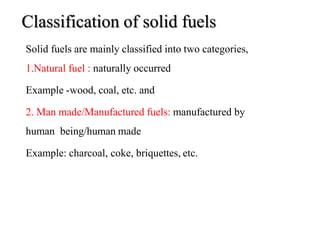
Solid fuels are mainly classified into two categories,
1.Natural fuel : naturally occurred
Example -wood, coal, etc. and
2. Man made/Manufactured fuels: manufactured by
human being/human made
Example: charcoal, coke, briquettes, etc.
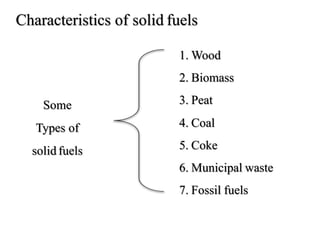
Characteristics of solid fuels
Some
Types of
solid fuels
1. Wood
2. Biomass
3. Peat
4. Coal
5. Coke
6. Municipal waste
7. Fossil fuels
Woods and their Characteristics
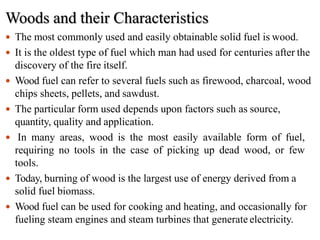
 The most commonly used and easily obtainable solid fuel is wood.
 It is the oldest type of fuel which man had used for centuries after the
discovery of the fire itself.
 Wood fuel can refer to several fuels such as firewood, charcoal, wood
chips sheets, pellets, and sawdust.
 The particular form used depends upon factors such as source,
quantity, quality and application.
 In many areas, wood is the most easily available form of fuel,
requiring no tools in the case of picking up dead wood, or few
tools.
 Today, burning of wood is the largest use of energy derived from a
solid fuel biomass.
 Wood fuel can be used for cooking and heating, and occasionally for
fueling steam engines and steam turbines that generate electricity.
Constituents of Wood
11
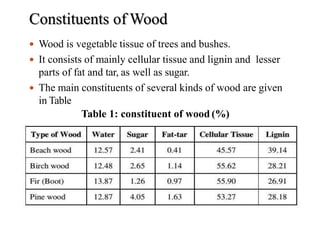
 Wood is vegetable tissue of trees and bushes.
 It consists of mainly cellular tissue and lignin and lesser
parts of fat and tar, as well as sugar.
 The main constituents of several kinds of wood are given
in Table
Table 1: constituent of wood (%)
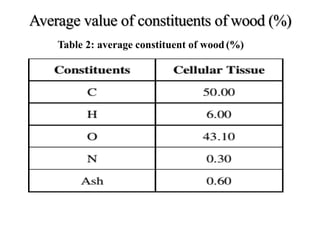
Average value of constituents of wood (%)
12
Table 2: average constituent of wood (%)
Ash
13
 The ash content of wood is negligible.
 The ash consists of mineral water that is found in the wood
itself, with an admixture of some impurities which occur
during transportation, etc.
 The mineral matter is distributed in the tree rather irregularly.
 The ash consists of mainly potassium carbonate with varying
degrees
of calcium, magnesium and sodium carbonate, as well as
minute quantities of iron oxides, alumina and silica.
 Pure ash is white in color.
Coals and their Characteristics
 Coal is a combustible black or brownish-black sedimentary rock
usually occurring in rock strata in layers or veins called coal
beds or coal seams.
 Throughout history, coal has been used as an energy resource,
primarily burned for the production of electricity and heat, and
is also used for industrial purposes, such as refining metals.
 Coal is the largest source of energy for the generation of
electricity worldwide, as well as one of the largest worldwide
anthropogenic sources of carbon dioxide releases.
 The extraction of coal, its use in energy production and its by
products are all associated with environmental and health effects
including climate change.
Analysis of Coal
• To as certain the commercial value of coal Certain tests
regarding its buring properties are performed before it is
commercially marketed. Two commonly used tests are :
Proximate analysis and Ultimate analysis of coal.
• Calorific value of coal is defined as the quantity of heat
given out by burning one unit weight of coal in a
calorimeter.
Proximate Analysis of Coal
 This analysis of coal gives good indication about heating and
burning properties of coal.
 The test gives the composition of coal in respect of moisture,
volatile matter, ash and fixed carbon.
 The moisture test is performed by heating 1 gm of coal sample at
104˚C to 110˚C for 1 hour in an oven and finding the loss in
weight.
 The volatile matter is determined by heating 1 gm of coal sample in
a covered crucible at 950˚C for 7 minutes and determining loss in
weight, from which the moisture content as found from moisture
test is deducted. Ash content is found by completely burning.
 the sample of coal in a muffled furnace at 700˚C to 750˚C and
1
w6
eighing the residue.
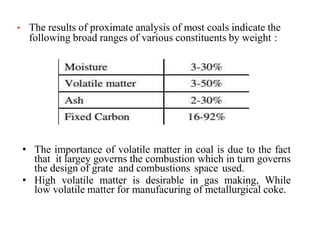
• The results of proximate analysis of most coals indicate the
following broad ranges of various constituents by weight :
• The importance of volatile matter in coal is due to the fact
that it largey governs the combustion which in turn governs
the design of grate and combustions space used.
• High volatile matter is desirable in gas making, While
low volatile matter for manufacuring of metallurgical coke.
Ultimate Analysis of Coal
18
 This analysis of coal is more precise way to find the chemical
composition of coal with respect to the elements like carbon,
hydrogen, oxygen, nitrogen, Sulphur and ash.
 Sine the content of carbon and hydrogen that is already combined
with oxygen to form carbon dioxide and water is of no value for
combustion, the chemical analysis of coal alone is not enough to
predict the suitability of coal for purpose of heating.
 However, the chemical composition is very useful in combustion
calculations and in finding the composition of flue gas.
Formation of Coal
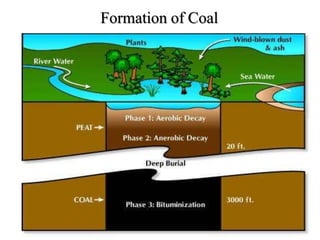
• The formation of coal begins in a water logged environment
(swamps and bogs) where plant debris accumulated.
• In such an environment, the accumulation of plant debris
exceeds the rate of bacterial decay of the debris.
• The bacterial decay rate is reduced because the available
oxygen in organic-rich water is completely used up by the
decaying process.
• Anaerobic (without oxygen) decay is much slower than aerobic
decay.
Formation of Coal
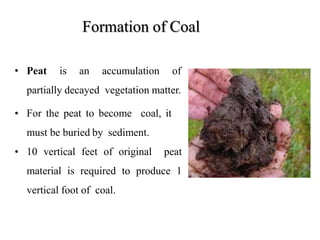
• Peat is an accumulation of
partially decayed vegetation matter.
• For the peat to become coal, it
must be buried by sediment.
• 10 vertical feet of original peat
material is required to produce 1
vertical foot of coal.
Phase 1. Aerobic decay
• In the first few inches of peat, aerobic (oxygen needing) bacterial decay
reduces the volume by as much as 50%.
• Because the water is stagnant and the peat is almost impermeable, the
bacteria soon use up all the available oxygen and die, ending the first stage of
decay.
Phase 2. Anerobic decay
• A second type of bacteria exists in the swamp that requires no oxygen.
These anerobic bacteria continue the decay process reducing the volume
still further.
• Anerobic decay produces more acids and when the acidity gets too high, it
kills off the remaining bacteria ending all decay.
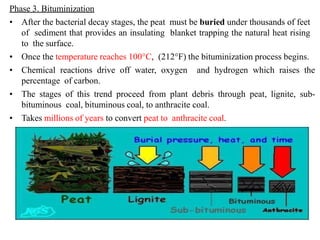
Phase 3. Bituminization
• After the bacterial decay stages, the peat must be buried under thousands of feet
of sediment that provides an insulating blanket trapping the natural heat rising
to the surface.
• Once the temperature reaches 100°C, (212°F) the bituminization process begins.
• Chemical reactions drive off water, oxygen and hydrogen which raises the
percentage of carbon.
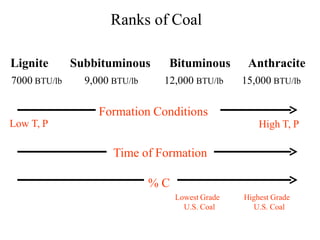
• The stages of this trend proceed from plant debris through peat, lignite, sub-
bituminous coal, bituminous coal, to anthracite coal.
• Takes millions of years to convert peat to anthracite coal.
Ranks of Coal
Time of Formation
% C
Lignite
7000 BTU/lb
Subbituminous
9,000 BTU/lb
Bituminous
12,000 BTU/lb
Anthracite
15,000 BTU/lb
Low T, P High T, P
Formation Conditions
Lowest Grade
U.S. Coal
Highest Grade
U.S. Coal
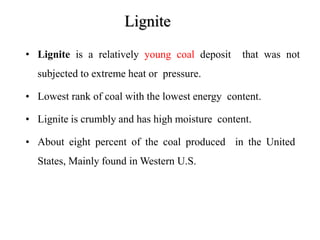
Lignite
• Lignite is a relatively young coal deposit that was not
subjected to extreme heat or pressure.
• Lowest rank of coal with the lowest energy content.
• Lignite is crumbly and has high moisture content.
• About eight percent of the coal produced in the United
States, Mainly found in Western U.S.
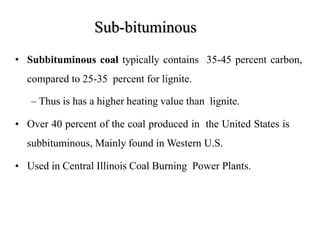
Sub-bituminous
• Subbituminous coal typically contains 35-45 percent carbon,
compared to 25-35 percent for lignite.
– Thus is has a higher heating value than lignite.
• Over 40 percent of the coal produced in the United States is
subbituminous, Mainly found in Western U.S.
• Used in Central Illinois Coal Burning Power Plants.
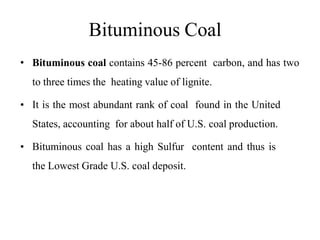
Bituminous Coal
• Bituminous coal contains 45-86 percent carbon, and has two
to three times the heating value of lignite.
• It is the most abundant rank of coal found in the United
States, accounting for about half of U.S. coal production.
• Bituminous coal has a high Sulfur content and thus is
the Lowest Grade U.S. coal deposit.
Anthracite
• Anthracite contains 86-97 percent carbon and its heating value
is slightly higher than bituminous coal.
• Highest Grade Coal in U.S.
• Low amount of Sulfur makes this a clean buring coal.
• Anthracite is very rare in the United States (2% of overall
production).
• The only anthracite mines in the United States are located in
northeastern Pennsylvania.
Advantages and disadvantages of solid fuels
 Advantages
(a)They are easy to transport.
(b)They are convenient to store without any risk of spontaneous
explosion.
(c)Their cost of production is low.
(d)They posses moderate ignition temperature.
 Disadvantages
(a)Their ash content is high.
(b)Their large proportion of heat is wasted.
(c)They burn with clinker formation.
(d)Their combustion operation cannot be controlled easily.
(e)Their cost of handling is high.
CAA and Coal Production
• The Clean Air Act (CAA) was established in 1971 to respond
to the high levels of air pollution in the United States.
• CAA regulations required coal burning power plants to use coal
with a lower sulfur content.
• Production in the western coal region increased dramatically in
1970’s due the higher demand for cleaner-burning, sub-
bituminous coal.
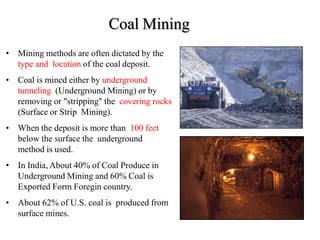
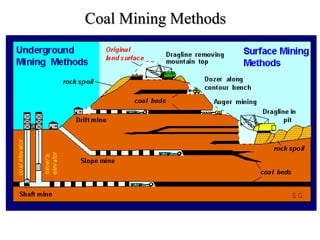
Coal Mining
• Mining methods are often dictated by the
type and location of the coal deposit.
• Coal is mined either by underground
tunneling (Underground Mining) or by
removing or "stripping" the covering rocks
(Surface or Strip Mining).
• When the deposit is more than 100 feet
below the surface the underground
method is used.
• In India, About 40% of Coal Produce in
Underground Mining and 60% Coal is
Exported Form Foregin country.
• About 62% of U.S. coal is produced from
surface mines.
Coal Mining Methods
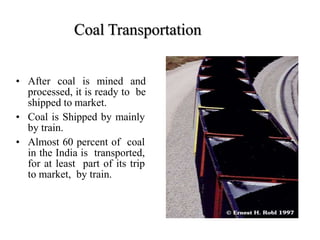
Coal Transportation
• After coal is mined and
processed, it is ready to be
shipped to market.
• Coal is Shipped by mainly
by train.
• Almost 60 percent of coal
in the India is transported,
for at least part of its trip
to market, by train.
Coal Transportation
• The typical coal train is 100 to 110 cars long-a mile of
coal.
• Each car holds 100 tons of coal which lasts only 20
minutes fueling a power plant.
• One unit train can keep a city of 3,000 households
(10,000 people) in electricity for a year.
• Coal in Wyoming is worth about $5 M per ton. By the
time it gets to Illinois, the cost is $30 M per ton.
• For the user, up to 80% of the cost of the coal is in the
transportation.
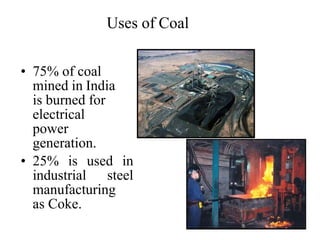
Uses of Coal
• 75% of coal
mined in India
is burned for
electrical
power
generation.
• 25% is used in
industrial steel
manufacturing
as Coke.
Coke
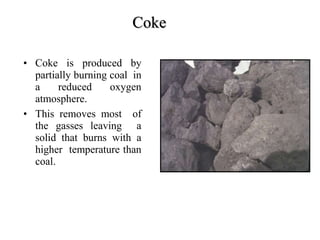
COKE
• Coke is produced by
partially burning coal in
a reduced oxygen
atmosphere.
• This removes most of
the gasses leaving a
solid that burns with a
higher temperature than
coal.
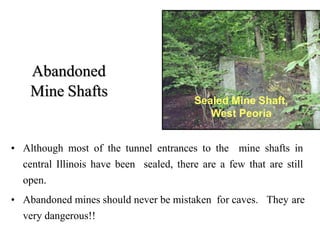
Abandoned
Mine Shafts
• Although most of the tunnel entrances to the mine shafts in
central Illinois have been sealed, there are a few that are still
open.
• Abandoned mines should never be mistaken for caves. They are
very dangerous!!
Sealed Mine Shaft,
West Peoria
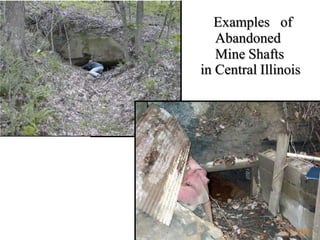
Examples of
Abandoned
Mine Shafts
in Central Illinois
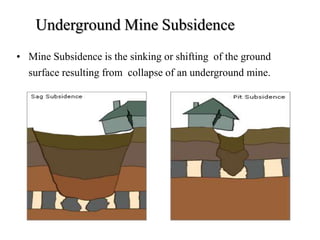
Underground Mine Subsidence
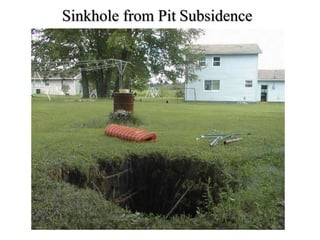
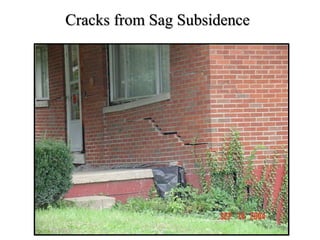
• Mine Subsidence is the sinking or shifting of the ground
surface resulting from collapse of an underground mine.
Sinkhole from Pit Subsidence
Cracks from Sag Subsidence
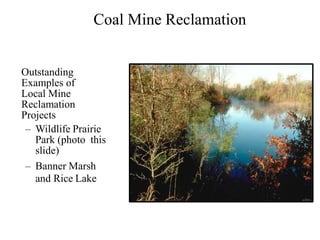
Coal Mine Reclamation
Outstanding
Examples of
Local Mine
Reclamation
Projects
– Wildlife Prairie
Park (photo this
slide)
– Banner Marsh
and Rice Lake
Thnak
You

Ch 2,3 & 4 soild fuels

  • 1.
    DEPARTMENT OF CHEMICALENGINEERING CHAPTER-2,3& 4 “Soild Fuel” PROF. DEVARSHI P. TADVI ASSISTANT PROFESSOR CHEMICAL ENGINEERING DEPARTMENT S S AGRAWAL INSTITUTE OF ENGINEERING & TECHNOLOGY, NAVSARI
  • 2.
    What is fuel? 5 Fuel it is any artificial or naturally occurring substances which often burning /react with oxygen/ release a large amount of energy which can be used for domestic and industrial process. Where do we get energy from? energy from the food we eat. A substance that produces energy on burning is called a fuel. Hence, food can be thought of as a fuel for our body.
  • 3.
    Types of fuels Fuels are available in solid , liquid or gaseous form.  Solid fuels: Wood, coal, coke and cow dung cakes  Liquid fuels: Kerosene, petrol and diesel  Gaseous fuels: Liquefied Petroleum Gas (LPG), Compressed Natural Gas (CNG), Natural gas and biogas
  • 4.
    Solid fuels 7  Solidfuel refers to various forms of solid material that can be burnt to release energy, providing heat and light through the process of combustion.  Solid fuels can be contrasted with liquid fuels and gaseous fuels.  Common examples of solid fuels include wood, charcoal, peat, coal, Hexamine fuel tablets, wood pellets, corn, wheat, rye and other grains.  Solid fuels are extensively used in rocketry as solid propellants.  Solid fuels have been used throughout human history to create fire and solid fuel is still in widespread use throughout the world in the present day.
  • 5.
    Classification of solidfuels 8 Solid fuels are mainly classified into two categories, 1.Natural fuel : naturally occurred Example -wood, coal, etc. and 2. Man made/Manufactured fuels: manufactured by human being/human made Example: charcoal, coke, briquettes, etc.
  • 6.
    Characteristics of solidfuels Some Types of solid fuels 1. Wood 2. Biomass 3. Peat 4. Coal 5. Coke 6. Municipal waste 7. Fossil fuels
  • 7.
    Woods and theirCharacteristics  The most commonly used and easily obtainable solid fuel is wood.  It is the oldest type of fuel which man had used for centuries after the discovery of the fire itself.  Wood fuel can refer to several fuels such as firewood, charcoal, wood chips sheets, pellets, and sawdust.  The particular form used depends upon factors such as source, quantity, quality and application.  In many areas, wood is the most easily available form of fuel, requiring no tools in the case of picking up dead wood, or few tools.  Today, burning of wood is the largest use of energy derived from a solid fuel biomass.  Wood fuel can be used for cooking and heating, and occasionally for fueling steam engines and steam turbines that generate electricity.
  • 8.
    Constituents of Wood 11 Wood is vegetable tissue of trees and bushes.  It consists of mainly cellular tissue and lignin and lesser parts of fat and tar, as well as sugar.  The main constituents of several kinds of wood are given in Table Table 1: constituent of wood (%)
  • 9.
    Average value ofconstituents of wood (%) 12 Table 2: average constituent of wood (%)
  • 10.
    Ash 13  The ashcontent of wood is negligible.  The ash consists of mineral water that is found in the wood itself, with an admixture of some impurities which occur during transportation, etc.  The mineral matter is distributed in the tree rather irregularly.  The ash consists of mainly potassium carbonate with varying degrees of calcium, magnesium and sodium carbonate, as well as minute quantities of iron oxides, alumina and silica.  Pure ash is white in color.
  • 11.
    Coals and theirCharacteristics  Coal is a combustible black or brownish-black sedimentary rock usually occurring in rock strata in layers or veins called coal beds or coal seams.  Throughout history, coal has been used as an energy resource, primarily burned for the production of electricity and heat, and is also used for industrial purposes, such as refining metals.  Coal is the largest source of energy for the generation of electricity worldwide, as well as one of the largest worldwide anthropogenic sources of carbon dioxide releases.  The extraction of coal, its use in energy production and its by products are all associated with environmental and health effects including climate change.
  • 12.
    Analysis of Coal •To as certain the commercial value of coal Certain tests regarding its buring properties are performed before it is commercially marketed. Two commonly used tests are : Proximate analysis and Ultimate analysis of coal. • Calorific value of coal is defined as the quantity of heat given out by burning one unit weight of coal in a calorimeter.
  • 13.
    Proximate Analysis ofCoal  This analysis of coal gives good indication about heating and burning properties of coal.  The test gives the composition of coal in respect of moisture, volatile matter, ash and fixed carbon.  The moisture test is performed by heating 1 gm of coal sample at 104˚C to 110˚C for 1 hour in an oven and finding the loss in weight.  The volatile matter is determined by heating 1 gm of coal sample in a covered crucible at 950˚C for 7 minutes and determining loss in weight, from which the moisture content as found from moisture test is deducted. Ash content is found by completely burning.  the sample of coal in a muffled furnace at 700˚C to 750˚C and 1 w6 eighing the residue.
  • 14.
    • The resultsof proximate analysis of most coals indicate the following broad ranges of various constituents by weight : • The importance of volatile matter in coal is due to the fact that it largey governs the combustion which in turn governs the design of grate and combustions space used. • High volatile matter is desirable in gas making, While low volatile matter for manufacuring of metallurgical coke.
  • 15.
    Ultimate Analysis ofCoal 18  This analysis of coal is more precise way to find the chemical composition of coal with respect to the elements like carbon, hydrogen, oxygen, nitrogen, Sulphur and ash.  Sine the content of carbon and hydrogen that is already combined with oxygen to form carbon dioxide and water is of no value for combustion, the chemical analysis of coal alone is not enough to predict the suitability of coal for purpose of heating.  However, the chemical composition is very useful in combustion calculations and in finding the composition of flue gas.
  • 16.
  • 17.
    • The formationof coal begins in a water logged environment (swamps and bogs) where plant debris accumulated. • In such an environment, the accumulation of plant debris exceeds the rate of bacterial decay of the debris. • The bacterial decay rate is reduced because the available oxygen in organic-rich water is completely used up by the decaying process. • Anaerobic (without oxygen) decay is much slower than aerobic decay.
  • 18.
    Formation of Coal •Peat is an accumulation of partially decayed vegetation matter. • For the peat to become coal, it must be buried by sediment. • 10 vertical feet of original peat material is required to produce 1 vertical foot of coal.
  • 19.
    Phase 1. Aerobicdecay • In the first few inches of peat, aerobic (oxygen needing) bacterial decay reduces the volume by as much as 50%. • Because the water is stagnant and the peat is almost impermeable, the bacteria soon use up all the available oxygen and die, ending the first stage of decay. Phase 2. Anerobic decay • A second type of bacteria exists in the swamp that requires no oxygen. These anerobic bacteria continue the decay process reducing the volume still further. • Anerobic decay produces more acids and when the acidity gets too high, it kills off the remaining bacteria ending all decay.
  • 20.
    Phase 3. Bituminization •After the bacterial decay stages, the peat must be buried under thousands of feet of sediment that provides an insulating blanket trapping the natural heat rising to the surface. • Once the temperature reaches 100°C, (212°F) the bituminization process begins. • Chemical reactions drive off water, oxygen and hydrogen which raises the percentage of carbon. • The stages of this trend proceed from plant debris through peat, lignite, sub- bituminous coal, bituminous coal, to anthracite coal. • Takes millions of years to convert peat to anthracite coal.
  • 21.
    Ranks of Coal Timeof Formation % C Lignite 7000 BTU/lb Subbituminous 9,000 BTU/lb Bituminous 12,000 BTU/lb Anthracite 15,000 BTU/lb Low T, P High T, P Formation Conditions Lowest Grade U.S. Coal Highest Grade U.S. Coal
  • 22.
    Lignite • Lignite isa relatively young coal deposit that was not subjected to extreme heat or pressure. • Lowest rank of coal with the lowest energy content. • Lignite is crumbly and has high moisture content. • About eight percent of the coal produced in the United States, Mainly found in Western U.S.
  • 23.
    Sub-bituminous • Subbituminous coaltypically contains 35-45 percent carbon, compared to 25-35 percent for lignite. – Thus is has a higher heating value than lignite. • Over 40 percent of the coal produced in the United States is subbituminous, Mainly found in Western U.S. • Used in Central Illinois Coal Burning Power Plants.
  • 24.
    Bituminous Coal • Bituminouscoal contains 45-86 percent carbon, and has two to three times the heating value of lignite. • It is the most abundant rank of coal found in the United States, accounting for about half of U.S. coal production. • Bituminous coal has a high Sulfur content and thus is the Lowest Grade U.S. coal deposit.
  • 25.
    Anthracite • Anthracite contains86-97 percent carbon and its heating value is slightly higher than bituminous coal. • Highest Grade Coal in U.S. • Low amount of Sulfur makes this a clean buring coal. • Anthracite is very rare in the United States (2% of overall production). • The only anthracite mines in the United States are located in northeastern Pennsylvania.
  • 26.
    Advantages and disadvantagesof solid fuels  Advantages (a)They are easy to transport. (b)They are convenient to store without any risk of spontaneous explosion. (c)Their cost of production is low. (d)They posses moderate ignition temperature.  Disadvantages (a)Their ash content is high. (b)Their large proportion of heat is wasted. (c)They burn with clinker formation. (d)Their combustion operation cannot be controlled easily. (e)Their cost of handling is high.
  • 27.
    CAA and CoalProduction • The Clean Air Act (CAA) was established in 1971 to respond to the high levels of air pollution in the United States. • CAA regulations required coal burning power plants to use coal with a lower sulfur content. • Production in the western coal region increased dramatically in 1970’s due the higher demand for cleaner-burning, sub- bituminous coal.
  • 28.
    Coal Mining • Miningmethods are often dictated by the type and location of the coal deposit. • Coal is mined either by underground tunneling (Underground Mining) or by removing or "stripping" the covering rocks (Surface or Strip Mining). • When the deposit is more than 100 feet below the surface the underground method is used. • In India, About 40% of Coal Produce in Underground Mining and 60% Coal is Exported Form Foregin country. • About 62% of U.S. coal is produced from surface mines.
  • 30.
  • 31.
    Coal Transportation • Aftercoal is mined and processed, it is ready to be shipped to market. • Coal is Shipped by mainly by train. • Almost 60 percent of coal in the India is transported, for at least part of its trip to market, by train.
  • 32.
    Coal Transportation • Thetypical coal train is 100 to 110 cars long-a mile of coal. • Each car holds 100 tons of coal which lasts only 20 minutes fueling a power plant. • One unit train can keep a city of 3,000 households (10,000 people) in electricity for a year. • Coal in Wyoming is worth about $5 M per ton. By the time it gets to Illinois, the cost is $30 M per ton. • For the user, up to 80% of the cost of the coal is in the transportation.
  • 33.
    Uses of Coal •75% of coal mined in India is burned for electrical power generation. • 25% is used in industrial steel manufacturing as Coke.
  • 34.
    Coke COKE • Coke isproduced by partially burning coal in a reduced oxygen atmosphere. • This removes most of the gasses leaving a solid that burns with a higher temperature than coal.
  • 35.
    Abandoned Mine Shafts • Althoughmost of the tunnel entrances to the mine shafts in central Illinois have been sealed, there are a few that are still open. • Abandoned mines should never be mistaken for caves. They are very dangerous!! Sealed Mine Shaft, West Peoria
  • 36.
  • 37.
    Underground Mine Subsidence •Mine Subsidence is the sinking or shifting of the ground surface resulting from collapse of an underground mine.
  • 38.
  • 39.
    Cracks from SagSubsidence
  • 40.
    Coal Mine Reclamation Outstanding Examplesof Local Mine Reclamation Projects – Wildlife Prairie Park (photo this slide) – Banner Marsh and Rice Lake
  • 41.