CHEMICAL
PROPERTIES
Elemental Analysis
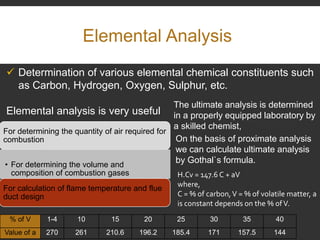
 Determination of various elemental chemical constituents such
as Carbon, Hydrogen, Oxygen, Sulphur, etc.
Elemental analysis is very useful
For determining the quantity of air required for
combustion
• For determining the volume and
composition of combustion gases
For calculation of flame temperature and flue
duct design
The ultimate analysis is determined
in a properly equipped laboratory by
a skilled chemist,
On the basis of proximate analysis
we can calculate ultimate analysis
by Gothal`s formula.
H.Cv = 147.6 C + aV
where,
C = % of carbon,V = % of volatile matter, a
is constant depends on the % ofV.
% of V 1-4 10 15 20 25 30 35 40
Value of a 270 261 210.6 196.2 185.4 171 157.5 144
Elemental Analysis
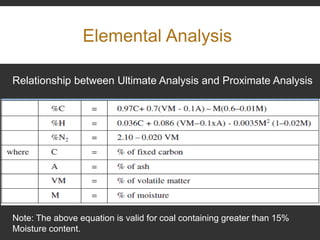
Relationship between Ultimate Analysis and Proximate Analysis
Note: The above equation is valid for coal containing greater than 15%
Moisture content.
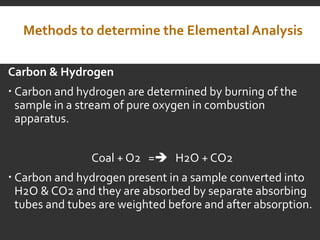
Carbon & Hydrogen
 Carbon and hydrogen are determined by burning of the
sample in a stream of pure oxygen in combustion
apparatus.
Coal + O2 = H2O + CO2
 Carbon and hydrogen present in a sample converted into
H2O & CO2 and they are absorbed by separate absorbing
tubes and tubes are weighted before and after absorption.
Methods to determine the Elemental Analysis
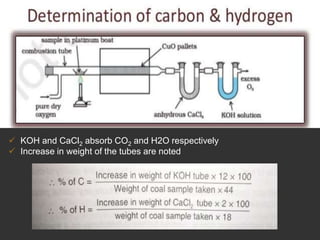
 KOH and CaCl2 absorb CO2 and H2O respectively
 Increase in weight of the tubes are noted
Methods to determine the Elemental Analysis
Nitrogen
 Nitrogen estimation is done by Kjeldahl’s method.
 A known amount of powdered coal is heated with con.
H2SO4 and K2SO4in a long necked flask (called Kjeldahl’s
flask), there by converting nitrogen of coal to ammonium
sulphate.
 Thus the nitrogen present in the coal is converted into
common salts, those salts are further distilled with acid
NaOH
 Therefore the percentage of nitrogen is calculated from
the coal.
Sulfur
 Sulfur is determined by bomb washing obtained from the
combustion of a known mass of coal in bomb calorimeter.
 Oxygen
 Determined as follow
 % of O = 100-C-H-N-S-ash
Ash
 Ash is determined as by proximate analysis.
Methods to determine the Elemental Analysis
SIGNIFICANCE OF
ELEMENTAL ANALYSIS
Significance of Ultimate Analysis
Carbon and hydrogen
Higher the % of carbon and hydrogen,
better the quality of coal and higher is
its calorific value
The % of carbon is helpful in the
classification of coal
Higher the % of carbon in coal reduces
the size of combustion chamber
required.
Nitrogen
Nitrogen does not have any calorific
value, and its presence in coal is
undesirable.
Good quality coal should have very little
nitrogen content
Hydrogen is volatile matter and affect
adversely
Sulphur
Affects clinkering and slagging
tendencies
Corrodes chimney and other equipment
such as air heaters and economizers
Limits exit flue gas temperature
Oxygen
Lower is the oxygen content better is
the coal
Significance of Ultimate Analysis
The combustion products of sulphur, i.e,
SO2 and SO3 are harmful for the
environment
Oxygen content increases the volatile
matter and is associated with moisture,
low heating value and low coking power
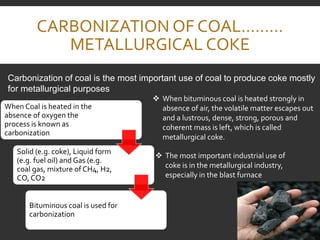
CARBONIZATION OF COAL………
METALLURGICAL COKE
When Coal is heated in the
absence of oxygen the
process is known as
carbonization
Solid (e.g. coke), Liquid form
(e.g. fuel oil) and Gas (e.g.
coal gas, mixture of CH4, H2,
CO, CO2
Bituminous coal is used for
carbonization
Carbonization of coal is the most important use of coal to produce coke mostly
for metallurgical purposes
 When bituminous coal is heated strongly in
absence of air, the volatile matter escapes out
and a lustrous, dense, strong, porous and
coherent mass is left, which is called
metallurgical coke.
 The most important industrial use of
coke is in the metallurgical industry,
especially in the blast furnace
METALLURGICAL COKE
 When bituminous coal is heated strongly in the absence of air,
the volatile matter escapes out and the mass becomes hard,
porous and coherent which is called Metallurgical coke
 There are three types of Carbonization
1. Low temperature carbonization
2. Medium temperature carbonization
3. High temperature carbonization
LOWTEMPERATURE CARBONIZATION
500-700ºC
 For manufacture of domestic fuel.
 Low quality coke of about 75-80 yield is produced.
 Coke produced contains 5-15% volatile matters. It is easily ignitable
valuable smokeless domestic fuel.
 Not suitable for metallurgical purpose.
 The gas produced as a by product is richer than high temperature
carbonization having calorific value of 6300 to 9300 Kcal/m3.
 Its yield is about 150-330m3/ton of coal carbonized.
 This process may be done with coking and non-coking coals.
 When coke is too friable to use, it may be briquetted or pulverized.
 A problem associated is poor transmission of heat through the coal
charge which may be overcome by modern techniques and methods.
MEDIUMTEMPERATURE CARBONIZATION
700-900ºC
 Gas yield is lower.
 Amount of NH3 produced is same as in high temperature carbonization.
 Yield of tar is more and its properties are different from High temperature
carbonization.
 Yield of light oils and phenols (particularly cresol) are more and these light
oils contains more paraffinic and di-olefenic hydrocarbons.
 It is used to gain more byproduct
MEDIUMTEMPERATURE CARBONIZATION
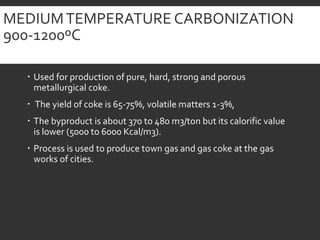
900-1200ºC
 Used for production of pure, hard, strong and porous
metallurgical coke.
 The yield of coke is 65-75%, volatile matters 1-3%,
 The byproduct is about 370 to 480 m3/ton but its calorific value
is lower (5000 to 6000 Kcal/m3).
 Process is used to produce town gas and gas coke at the gas
works of cities.
PREPARATION (OTTO HOFF MAN’S
METHOD)
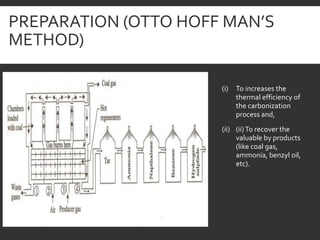
(i) To increases the
thermal efficiency of
the carbonization
process and,
(ii) (ii)To recover the
valuable by products
(like coal gas,
ammonia, benzyl oil,
etc).
PREPARATION (OTTO HOFF MAN’S
METHOD)
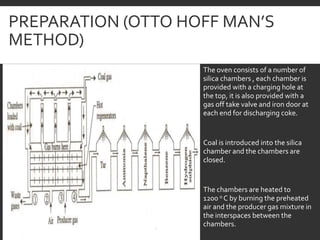
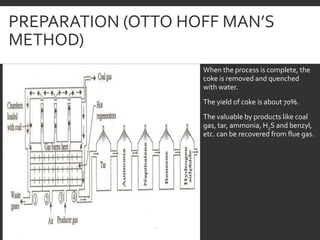
The oven consists of a number of
silica chambers , each chamber is
provided with a charging hole at
the top, it is also provided with a
gas off take valve and iron door at
each end for discharging coke.
Coal is introduced into the silica
chamber and the chambers are
closed.
The chambers are heated to
1200 o C by burning the preheated
air and the producer gas mixture in
the interspaces between the
chambers.
PREPARATION (OTTO HOFF MAN’S
METHOD)
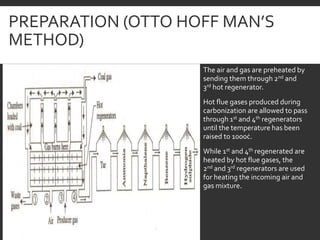
The air and gas are preheated by
sending them through 2nd and
3rd hot regenerator.
Hot flue gases produced during
carbonization are allowed to pass
through 1st and 4th regenerators
until the temperature has been
raised to 1000ċ.
While 1st and 4th regenerated are
heated by hot flue gases, the
2nd and 3rd regenerators are used
for heating the incoming air and
gas mixture.
PREPARATION (OTTO HOFF MAN’S
METHOD)
When the process is complete, the
coke is removed and quenched
with water.
The yield of coke is about 70%.
The valuable by products like coal
gas, tar, ammonia, H2S and benzyl,
etc. can be recovered from flue gas.
RECOVERY OF BY-PRODUCTS
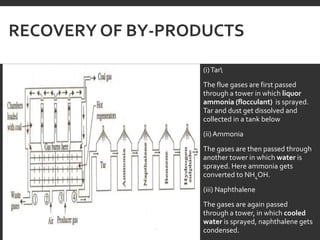
(i)Tar
The flue gases are first passed
through a tower in which liquor
ammonia (flocculant) is sprayed.
Tar and dust get dissolved and
collected in a tank below
(ii) Ammonia
The gases are then passed through
another tower in which water is
sprayed. Here ammonia gets
converted to NH4OH.
(iii) Naphthalene
The gases are again passed
through a tower, in which cooled
water is sprayed, naphthalene gets
condensed.
RECOVERY OF BY-PRODUCTS
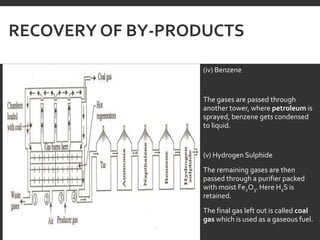
(iv) Benzene
The gases are passed through
another tower, where petroleum is
sprayed, benzene gets condensed
to liquid.
(v) Hydrogen Sulphide
The remaining gases are then
passed through a purifier packed
with moist Fe2O3. Here H2S is
retained.
The final gas left out is called coal
gas which is used as a gaseous fuel.
ADVANTAGES OF OTTO HOFFMAN’S
PROCESS
 Valuable by products like ammonia, coal gas, Naphthalene etc.
are recovered.
 The carbonization time is less.
 Heating is done externally by producer gas.
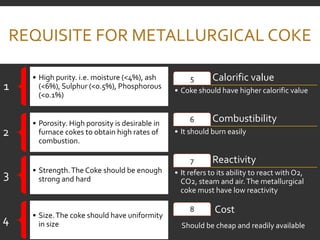
REQUISITE FOR METALLURGICAL COKE
1
• High purity. i.e. moisture (<4%), ash
(<6%), Sulphur (<0.5%), Phosphorous
(<0.1%)
2
• Porosity. High porosity is desirable in
furnace cokes to obtain high rates of
combustion.
3 • Strength.The Coke should be enough
strong and hard
4 • Size.The coke should have uniformity
in size
Calorific value
5
• Coke should have higher calorific value
Combustibility
6
• It should burn easily
Reactivity
7
• It refers to its ability to react with O2,
CO2, steam and air.The metallurgical
coke must have low reactivity
8 Cost
Should be cheap and readily available
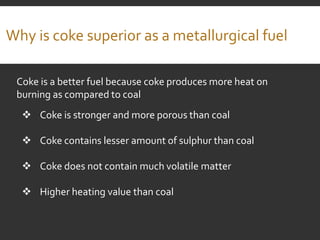
Why is coke superior as a metallurgical fuel
 Coke is stronger and more porous than coal
 Coke contains lesser amount of sulphur than coal
 Coke does not contain much volatile matter
 Higher heating value than coal
Coke is a better fuel because coke produces more heat on
burning as compared to coal

Ultimate analysis.ppt

  • 1.
  • 2.
    Elemental Analysis  Determinationof various elemental chemical constituents such as Carbon, Hydrogen, Oxygen, Sulphur, etc. Elemental analysis is very useful For determining the quantity of air required for combustion • For determining the volume and composition of combustion gases For calculation of flame temperature and flue duct design The ultimate analysis is determined in a properly equipped laboratory by a skilled chemist, On the basis of proximate analysis we can calculate ultimate analysis by Gothal`s formula. H.Cv = 147.6 C + aV where, C = % of carbon,V = % of volatile matter, a is constant depends on the % ofV. % of V 1-4 10 15 20 25 30 35 40 Value of a 270 261 210.6 196.2 185.4 171 157.5 144
  • 3.
    Elemental Analysis Relationship betweenUltimate Analysis and Proximate Analysis Note: The above equation is valid for coal containing greater than 15% Moisture content.
  • 4.
    Carbon & Hydrogen Carbon and hydrogen are determined by burning of the sample in a stream of pure oxygen in combustion apparatus. Coal + O2 = H2O + CO2  Carbon and hydrogen present in a sample converted into H2O & CO2 and they are absorbed by separate absorbing tubes and tubes are weighted before and after absorption. Methods to determine the Elemental Analysis
  • 5.
     KOH andCaCl2 absorb CO2 and H2O respectively  Increase in weight of the tubes are noted
  • 6.
    Methods to determinethe Elemental Analysis Nitrogen  Nitrogen estimation is done by Kjeldahl’s method.  A known amount of powdered coal is heated with con. H2SO4 and K2SO4in a long necked flask (called Kjeldahl’s flask), there by converting nitrogen of coal to ammonium sulphate.  Thus the nitrogen present in the coal is converted into common salts, those salts are further distilled with acid NaOH  Therefore the percentage of nitrogen is calculated from the coal.
  • 7.
    Sulfur  Sulfur isdetermined by bomb washing obtained from the combustion of a known mass of coal in bomb calorimeter.  Oxygen  Determined as follow  % of O = 100-C-H-N-S-ash Ash  Ash is determined as by proximate analysis. Methods to determine the Elemental Analysis
  • 8.
  • 9.
    Significance of UltimateAnalysis Carbon and hydrogen Higher the % of carbon and hydrogen, better the quality of coal and higher is its calorific value The % of carbon is helpful in the classification of coal Higher the % of carbon in coal reduces the size of combustion chamber required. Nitrogen Nitrogen does not have any calorific value, and its presence in coal is undesirable. Good quality coal should have very little nitrogen content Hydrogen is volatile matter and affect adversely
  • 10.
    Sulphur Affects clinkering andslagging tendencies Corrodes chimney and other equipment such as air heaters and economizers Limits exit flue gas temperature Oxygen Lower is the oxygen content better is the coal Significance of Ultimate Analysis The combustion products of sulphur, i.e, SO2 and SO3 are harmful for the environment Oxygen content increases the volatile matter and is associated with moisture, low heating value and low coking power
  • 11.
    CARBONIZATION OF COAL……… METALLURGICALCOKE When Coal is heated in the absence of oxygen the process is known as carbonization Solid (e.g. coke), Liquid form (e.g. fuel oil) and Gas (e.g. coal gas, mixture of CH4, H2, CO, CO2 Bituminous coal is used for carbonization Carbonization of coal is the most important use of coal to produce coke mostly for metallurgical purposes  When bituminous coal is heated strongly in absence of air, the volatile matter escapes out and a lustrous, dense, strong, porous and coherent mass is left, which is called metallurgical coke.  The most important industrial use of coke is in the metallurgical industry, especially in the blast furnace
  • 12.
    METALLURGICAL COKE  Whenbituminous coal is heated strongly in the absence of air, the volatile matter escapes out and the mass becomes hard, porous and coherent which is called Metallurgical coke  There are three types of Carbonization 1. Low temperature carbonization 2. Medium temperature carbonization 3. High temperature carbonization
  • 13.
    LOWTEMPERATURE CARBONIZATION 500-700ºC  Formanufacture of domestic fuel.  Low quality coke of about 75-80 yield is produced.  Coke produced contains 5-15% volatile matters. It is easily ignitable valuable smokeless domestic fuel.  Not suitable for metallurgical purpose.  The gas produced as a by product is richer than high temperature carbonization having calorific value of 6300 to 9300 Kcal/m3.  Its yield is about 150-330m3/ton of coal carbonized.  This process may be done with coking and non-coking coals.  When coke is too friable to use, it may be briquetted or pulverized.  A problem associated is poor transmission of heat through the coal charge which may be overcome by modern techniques and methods.
  • 14.
    MEDIUMTEMPERATURE CARBONIZATION 700-900ºC  Gasyield is lower.  Amount of NH3 produced is same as in high temperature carbonization.  Yield of tar is more and its properties are different from High temperature carbonization.  Yield of light oils and phenols (particularly cresol) are more and these light oils contains more paraffinic and di-olefenic hydrocarbons.  It is used to gain more byproduct
  • 15.
    MEDIUMTEMPERATURE CARBONIZATION 900-1200ºC  Usedfor production of pure, hard, strong and porous metallurgical coke.  The yield of coke is 65-75%, volatile matters 1-3%,  The byproduct is about 370 to 480 m3/ton but its calorific value is lower (5000 to 6000 Kcal/m3).  Process is used to produce town gas and gas coke at the gas works of cities.
  • 16.
    PREPARATION (OTTO HOFFMAN’S METHOD) (i) To increases the thermal efficiency of the carbonization process and, (ii) (ii)To recover the valuable by products (like coal gas, ammonia, benzyl oil, etc).
  • 17.
    PREPARATION (OTTO HOFFMAN’S METHOD) The oven consists of a number of silica chambers , each chamber is provided with a charging hole at the top, it is also provided with a gas off take valve and iron door at each end for discharging coke. Coal is introduced into the silica chamber and the chambers are closed. The chambers are heated to 1200 o C by burning the preheated air and the producer gas mixture in the interspaces between the chambers.
  • 18.
    PREPARATION (OTTO HOFFMAN’S METHOD) The air and gas are preheated by sending them through 2nd and 3rd hot regenerator. Hot flue gases produced during carbonization are allowed to pass through 1st and 4th regenerators until the temperature has been raised to 1000ċ. While 1st and 4th regenerated are heated by hot flue gases, the 2nd and 3rd regenerators are used for heating the incoming air and gas mixture.
  • 19.
    PREPARATION (OTTO HOFFMAN’S METHOD) When the process is complete, the coke is removed and quenched with water. The yield of coke is about 70%. The valuable by products like coal gas, tar, ammonia, H2S and benzyl, etc. can be recovered from flue gas.
  • 20.
    RECOVERY OF BY-PRODUCTS (i)Tar Theflue gases are first passed through a tower in which liquor ammonia (flocculant) is sprayed. Tar and dust get dissolved and collected in a tank below (ii) Ammonia The gases are then passed through another tower in which water is sprayed. Here ammonia gets converted to NH4OH. (iii) Naphthalene The gases are again passed through a tower, in which cooled water is sprayed, naphthalene gets condensed.
  • 21.
    RECOVERY OF BY-PRODUCTS (iv)Benzene The gases are passed through another tower, where petroleum is sprayed, benzene gets condensed to liquid. (v) Hydrogen Sulphide The remaining gases are then passed through a purifier packed with moist Fe2O3. Here H2S is retained. The final gas left out is called coal gas which is used as a gaseous fuel.
  • 22.
    ADVANTAGES OF OTTOHOFFMAN’S PROCESS  Valuable by products like ammonia, coal gas, Naphthalene etc. are recovered.  The carbonization time is less.  Heating is done externally by producer gas.
  • 23.
    REQUISITE FOR METALLURGICALCOKE 1 • High purity. i.e. moisture (<4%), ash (<6%), Sulphur (<0.5%), Phosphorous (<0.1%) 2 • Porosity. High porosity is desirable in furnace cokes to obtain high rates of combustion. 3 • Strength.The Coke should be enough strong and hard 4 • Size.The coke should have uniformity in size Calorific value 5 • Coke should have higher calorific value Combustibility 6 • It should burn easily Reactivity 7 • It refers to its ability to react with O2, CO2, steam and air.The metallurgical coke must have low reactivity 8 Cost Should be cheap and readily available
  • 24.
    Why is cokesuperior as a metallurgical fuel  Coke is stronger and more porous than coal  Coke contains lesser amount of sulphur than coal  Coke does not contain much volatile matter  Higher heating value than coal Coke is a better fuel because coke produces more heat on burning as compared to coal