ALTERNATIVE SR PROCESSESS FOR IRON
MAKING: RELEVANCE TO INDIA
ƒ
ƒ
ƒ
ƒ

V.MOHAN 1011207008
Y.S.R. ENGINEERING COLLEGE OF
YOGI VEMANA UNIVERSITY

VISHNUMAHANTHY

1
FUTURE CHALLENGES
RESOURCE
DEPLETION

RISING ENERGY
DEMAND

ENVIRONMENTAL
CARE

TOPICS, IRON MAKERS SHOULD CONSIDER.

2
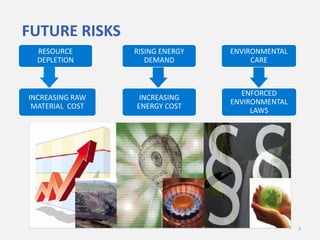
FUTURE RISKS
RESOURCE
DEPLETION

RISING ENERGY
DEMAND

ENVIRONMENTAL
CARE

INCREASING RAW
MATERIAL COST

INCREASING
ENERGY COST

ENFORCED
ENVIRONMENTAL
LAWS

3
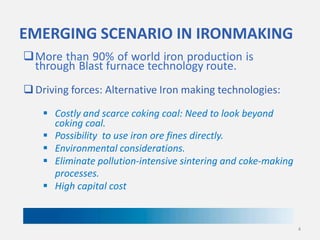
EMERGING SCENARIO IN IRONMAKING
More than 90% of world iron production is
through Blast furnace technology route.
 Driving forces: Alternative Iron making technologies:
 Costly and scarce coking coal: Need to look beyond
coking coal.
 Possibility to use iron ore fines directly.
 Environmental considerations.
 Eliminate pollution-intensive sintering and coke-making
processes.
 High capital cost

4
Possible Solutions
 Direct Reduced Iron (DRI)
 Reduction of ferrous oxide in solid state.
 SL/RN, MIDREX, ITmk3 etc.

 Smelting Reduction of Iron
 COREX, FINEX, Hismelt etc.
 using non-coking coal.
 Obviating the need for coke oven batteries and
sinter plants.

5
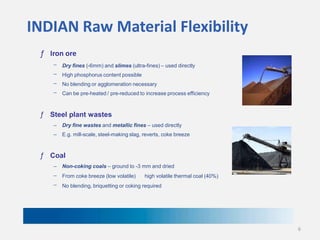
INDIAN Raw Material Flexibility
ƒ Iron ore
–

Dry fines (-6mm) and slimes (ultra-fines) – used directly

–

High phosphorus content possible

–

No blending or agglomeration necessary

–

Can be pre-heated / pre-reduced to increase process efficiency

ƒ Steel plant wastes
–

Dry fine wastes and metallic fines – used directly

–

E.g. mill-scale, steel-making slag, reverts, coke breeze

ƒ Coal
–

Non-coking coals – ground to -3 mm and dried

–

From coke breeze (low volatile)

–

No blending, briquetting or coking required

high volatile thermal coal (40%)

6
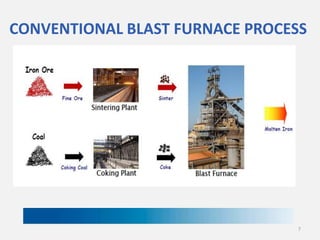
CONVENTIONAL BLAST FURNACE PROCESS

7
Characteristics of Blast furnace process
 STRENGTHS
 High energy efficiency
 High productivity
 Long service life

 LIMITATIONS
 Use of high grade raw materials
 Coke and sinter making processes required
 Generation of air pollutant such as Sox, Nox, Dioxin
and
dust.

8
Available Smelting Reduction (SR)
Processes
SR technologies currently commercially exploited or ready for
commercial exploitation.

 COREX (Two stage): Operating commercially
 FINEX (Two stage): Operating commercially
 HISMELT (Single stage):Not being Operating commercially
at present.

• Single stage: Reduction & melting in the same vessel
• Two stage : Reduction in one vessel; melting in the 2nd vessel.

9
COREX TECHNOLOGY

10
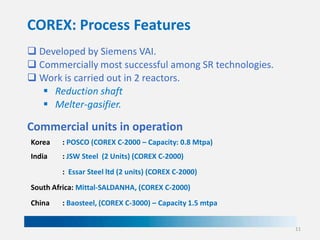
COREX: Process Features
 Developed by Siemens VAI.
 Commercially most successful among SR technologies.
 Work is carried out in 2 reactors.
 Reduction shaft
 Melter-gasifier.

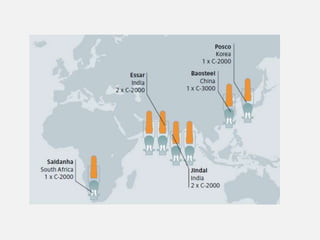
Commercial units in operation
Korea

: POSCO (COREX C-2000 – Capacity: 0.8 Mtpa)

India

: JSW Steel (2 Units) (COREX C-2000)
: Essar Steel ltd (2 units) (COREX C-2000)

South Africa: Mittal-SALDANHA, (COREX C-2000)
China

: Baosteel, (COREX C-3000) – Capacity 1.5 mtpa
11
COREX PROCESS

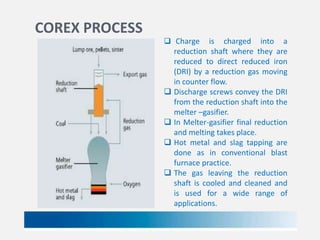
 Charge

is charged into a
reduction shaft where they are
reduced to direct reduced iron
(DRI) by a reduction gas moving
in counter flow.
 Discharge screws convey the DRI
from the reduction shaft into the
melter –gasifier.
 In Melter-gasifier final reduction
and melting takes place.
 Hot metal and slag tapping are
done as in conventional blast
furnace practice.
 The gas leaving the reduction
shaft is cooled and cleaned and
is used for a wide range of
applications.
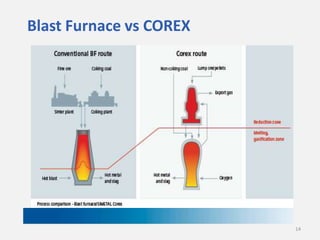
Blast Furnace vs COREX

14
COREX: Process Features
 Strengths







Hot metal quality.
Economic benefit .
Ecological benefit.
non-coking coal can be used.
generation of highly valuable export gas.

 Limitations

 Can't use ore fines directly.
 Restriction on non-coking coal.
VM of carbonaceous material to be maintained at 25% .
 Net export gas (CV:1800 Kcal/Nm3) to be utilised very
economically, the process becomes un-viable.

15
FINEX TECHNOLOGY

© HIsmelt Corporation
2008

16
FINEX PROCESS
 Siemens VAI and POSCO jointly developed
the process.
 FINEX R&D since 1992.
 FINEX demo of 600 Kt/y since June 2003.
 FINEX of 1.5 Mt/y in May 2007 (1st
commercial plant).

 Based on the direct use of non-coking coal
and fine ore.
 Most exciting iron making technology on the
market today.
17
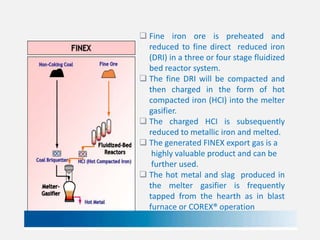
 Fine iron ore is preheated and
reduced to fine direct reduced iron
(DRI) in a three or four stage fluidized
bed reactor system.
 The fine DRI will be compacted and
then charged in the form of hot
compacted iron (HCI) into the melter
gasifier.
 The charged HCI is subsequently
reduced to metallic iron and melted.
 The generated FINEX export gas is a
highly valuable product and can be
further used.
 The hot metal and slag produced in
the melter gasifier is frequently
tapped from the hearth as in blast
furnace or COREX® operation
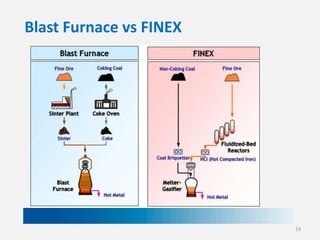
Blast Furnace vs FINEX

19
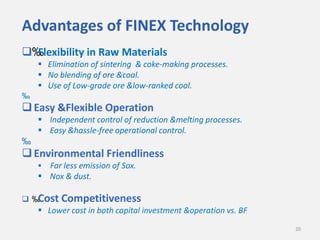
Advantages of FINEX Technology
‰
Flexibility in Raw Materials
 Elimination of sintering & coke-making processes.
 No blending of ore &coal.
 Use of Low-grade ore &low-ranked coal.
‰

 Easy &Flexible Operation
 Independent control of reduction &melting processes.
 Easy &hassle-free operational control.
‰

 Environmental Friendliness


Far less emission of Sox.
 Nox & dust.
‰
Cost

Competitiveness

 Lower cost in both capital investment &operation vs. BF
20
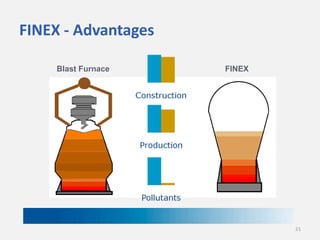
FINEX - Advantages
Blast Furnace

FINEX

production
pollutants

21
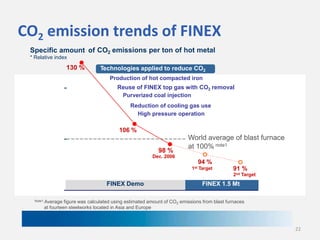
CO2 emission trends of FINEX
Specific amount of CO2 emissions per ton of hot metal
* Relative index

130 %

Technologies applied to reduce CO2
Production of hot compacted iron

Reuse of FINEX top gas with CO2 removal
Purverized coal injection
Reduction of cooling gas use
High pressure operation

106 %

98 %

World average of blast furnace
at 100% note1

Dec. 2006

94 %
1st Target

91 %
2nd Target

FINEX Demo

FINEX 1.5 Mt

Note1 Average

figure was calculated using estimated amount of CO2 emissions from blast furnaces
at fourteen steelworks located in Asia and Europe

22
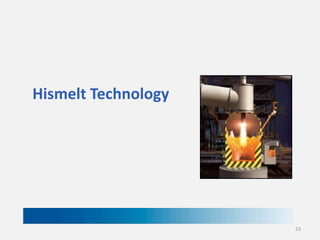
Hismelt Technology

23
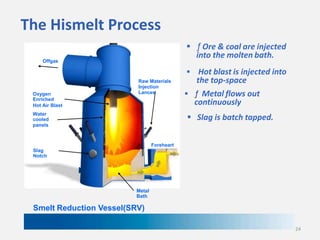
The Hismelt Process
 ƒ Ore & coal are injected
into the molten bath.

Offgas


Oxygen
Enriched
Hot Air Blast

Raw Materials
Injection
Lances

Hot blast is injected into
the top-space

 ƒ Metal flows out

continuously

 Slag is batch tapped.

Water
cooled
panels

Foreheart
h

Slag
Notch

Metal
Bath

Smelt Reduction Vessel(SRV)
24
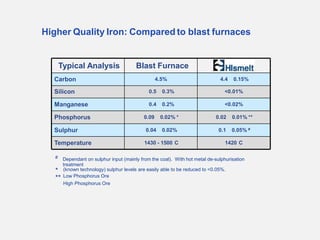
Higher Quality Iron: Compared to blast furnaces

Typical Analysis

Blast Furnace

Carbon

4.5%

4.4

0.15%

Silicon

0.5

0.3%

<0.01%

Manganese

0.4

0.2%

<0.02%

Phosphorus
Sulphur
Temperature
#

*
**

0.09
0.04

0.02% *

0.02

0.01% **

0.02%

0.1

0.05% #

1430 - 1500 C

1420 C

Dependant on sulphur input (mainly from the coal). With hot metal de-sulphurisation
treatment
(known technology) sulphur levels are easily able to be reduced to <0.05%.
Low Phosphorus Ore
High Phosphorus Ore
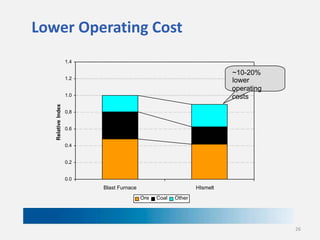
Lower Operating Cost
1.4

~10-20%
lower
operating
costs

1.2

Relative Index

1.0
0.8
0.6
0.4
0.2
0.0

Blast Furnace

HIsmelt
Ore

Coal

Other

26
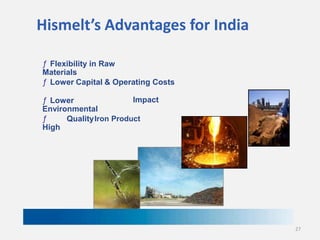
Hismelt’s Advantages for India
ƒ Flexibility in Raw
Materials
ƒ Lower Capital & Operating Costs
Impact
ƒ Lower
Environmental
ƒ
Quality Iron Product
High

27
Final conclusion
Developing markets mainly led by china and India
pulling the global steel demand.
Restricting growth factors are:
 Scarcity of high grade raw materials.
 Global environment problems and concerns.
Development of innovative alternative iron-making
process technologies.
Low grade, low cost resources and to reduce the
level of air pollution.

28
QUESTIONS?

29
THANK YOU

30

Alternative Iron making processess

  • 1.
    ALTERNATIVE SR PROCESSESSFOR IRON MAKING: RELEVANCE TO INDIA ƒ ƒ ƒ ƒ V.MOHAN 1011207008 Y.S.R. ENGINEERING COLLEGE OF YOGI VEMANA UNIVERSITY VISHNUMAHANTHY 1
  • 2.
  • 3.
    FUTURE RISKS RESOURCE DEPLETION RISING ENERGY DEMAND ENVIRONMENTAL CARE INCREASINGRAW MATERIAL COST INCREASING ENERGY COST ENFORCED ENVIRONMENTAL LAWS 3
  • 4.
    EMERGING SCENARIO INIRONMAKING More than 90% of world iron production is through Blast furnace technology route.  Driving forces: Alternative Iron making technologies:  Costly and scarce coking coal: Need to look beyond coking coal.  Possibility to use iron ore fines directly.  Environmental considerations.  Eliminate pollution-intensive sintering and coke-making processes.  High capital cost 4
  • 5.
    Possible Solutions  DirectReduced Iron (DRI)  Reduction of ferrous oxide in solid state.  SL/RN, MIDREX, ITmk3 etc.  Smelting Reduction of Iron  COREX, FINEX, Hismelt etc.  using non-coking coal.  Obviating the need for coke oven batteries and sinter plants. 5
  • 6.
    INDIAN Raw MaterialFlexibility ƒ Iron ore – Dry fines (-6mm) and slimes (ultra-fines) – used directly – High phosphorus content possible – No blending or agglomeration necessary – Can be pre-heated / pre-reduced to increase process efficiency ƒ Steel plant wastes – Dry fine wastes and metallic fines – used directly – E.g. mill-scale, steel-making slag, reverts, coke breeze ƒ Coal – Non-coking coals – ground to -3 mm and dried – From coke breeze (low volatile) – No blending, briquetting or coking required high volatile thermal coal (40%) 6
  • 7.
  • 8.
    Characteristics of Blastfurnace process  STRENGTHS  High energy efficiency  High productivity  Long service life  LIMITATIONS  Use of high grade raw materials  Coke and sinter making processes required  Generation of air pollutant such as Sox, Nox, Dioxin and dust. 8
  • 9.
    Available Smelting Reduction(SR) Processes SR technologies currently commercially exploited or ready for commercial exploitation.  COREX (Two stage): Operating commercially  FINEX (Two stage): Operating commercially  HISMELT (Single stage):Not being Operating commercially at present. • Single stage: Reduction & melting in the same vessel • Two stage : Reduction in one vessel; melting in the 2nd vessel. 9
  • 10.
  • 11.
    COREX: Process Features Developed by Siemens VAI.  Commercially most successful among SR technologies.  Work is carried out in 2 reactors.  Reduction shaft  Melter-gasifier. Commercial units in operation Korea : POSCO (COREX C-2000 – Capacity: 0.8 Mtpa) India : JSW Steel (2 Units) (COREX C-2000) : Essar Steel ltd (2 units) (COREX C-2000) South Africa: Mittal-SALDANHA, (COREX C-2000) China : Baosteel, (COREX C-3000) – Capacity 1.5 mtpa 11
  • 13.
    COREX PROCESS  Charge ischarged into a reduction shaft where they are reduced to direct reduced iron (DRI) by a reduction gas moving in counter flow.  Discharge screws convey the DRI from the reduction shaft into the melter –gasifier.  In Melter-gasifier final reduction and melting takes place.  Hot metal and slag tapping are done as in conventional blast furnace practice.  The gas leaving the reduction shaft is cooled and cleaned and is used for a wide range of applications.
  • 14.
  • 15.
    COREX: Process Features Strengths      Hot metal quality. Economic benefit . Ecological benefit. non-coking coal can be used. generation of highly valuable export gas.  Limitations  Can't use ore fines directly.  Restriction on non-coking coal. VM of carbonaceous material to be maintained at 25% .  Net export gas (CV:1800 Kcal/Nm3) to be utilised very economically, the process becomes un-viable. 15
  • 16.
    FINEX TECHNOLOGY © HIsmeltCorporation 2008 16
  • 17.
    FINEX PROCESS  SiemensVAI and POSCO jointly developed the process.  FINEX R&D since 1992.  FINEX demo of 600 Kt/y since June 2003.  FINEX of 1.5 Mt/y in May 2007 (1st commercial plant).  Based on the direct use of non-coking coal and fine ore.  Most exciting iron making technology on the market today. 17
  • 18.
     Fine ironore is preheated and reduced to fine direct reduced iron (DRI) in a three or four stage fluidized bed reactor system.  The fine DRI will be compacted and then charged in the form of hot compacted iron (HCI) into the melter gasifier.  The charged HCI is subsequently reduced to metallic iron and melted.  The generated FINEX export gas is a highly valuable product and can be further used.  The hot metal and slag produced in the melter gasifier is frequently tapped from the hearth as in blast furnace or COREX® operation
  • 19.
  • 20.
    Advantages of FINEXTechnology ‰ Flexibility in Raw Materials  Elimination of sintering & coke-making processes.  No blending of ore &coal.  Use of Low-grade ore &low-ranked coal. ‰  Easy &Flexible Operation  Independent control of reduction &melting processes.  Easy &hassle-free operational control. ‰  Environmental Friendliness  Far less emission of Sox.  Nox & dust. ‰ Cost Competitiveness  Lower cost in both capital investment &operation vs. BF 20
  • 21.
    FINEX - Advantages BlastFurnace FINEX production pollutants 21
  • 22.
    CO2 emission trendsof FINEX Specific amount of CO2 emissions per ton of hot metal * Relative index 130 % Technologies applied to reduce CO2 Production of hot compacted iron Reuse of FINEX top gas with CO2 removal Purverized coal injection Reduction of cooling gas use High pressure operation 106 % 98 % World average of blast furnace at 100% note1 Dec. 2006 94 % 1st Target 91 % 2nd Target FINEX Demo FINEX 1.5 Mt Note1 Average figure was calculated using estimated amount of CO2 emissions from blast furnaces at fourteen steelworks located in Asia and Europe 22
  • 23.
  • 24.
    The Hismelt Process ƒ Ore & coal are injected into the molten bath. Offgas  Oxygen Enriched Hot Air Blast Raw Materials Injection Lances Hot blast is injected into the top-space  ƒ Metal flows out continuously  Slag is batch tapped. Water cooled panels Foreheart h Slag Notch Metal Bath Smelt Reduction Vessel(SRV) 24
  • 25.
    Higher Quality Iron:Compared to blast furnaces Typical Analysis Blast Furnace Carbon 4.5% 4.4 0.15% Silicon 0.5 0.3% <0.01% Manganese 0.4 0.2% <0.02% Phosphorus Sulphur Temperature # * ** 0.09 0.04 0.02% * 0.02 0.01% ** 0.02% 0.1 0.05% # 1430 - 1500 C 1420 C Dependant on sulphur input (mainly from the coal). With hot metal de-sulphurisation treatment (known technology) sulphur levels are easily able to be reduced to <0.05%. Low Phosphorus Ore High Phosphorus Ore
  • 26.
    Lower Operating Cost 1.4 ~10-20% lower operating costs 1.2 RelativeIndex 1.0 0.8 0.6 0.4 0.2 0.0 Blast Furnace HIsmelt Ore Coal Other 26
  • 27.
    Hismelt’s Advantages forIndia ƒ Flexibility in Raw Materials ƒ Lower Capital & Operating Costs Impact ƒ Lower Environmental ƒ Quality Iron Product High 27
  • 28.
    Final conclusion Developing marketsmainly led by china and India pulling the global steel demand. Restricting growth factors are:  Scarcity of high grade raw materials.  Global environment problems and concerns. Development of innovative alternative iron-making process technologies. Low grade, low cost resources and to reduce the level of air pollution. 28
  • 29.
  • 30.

Editor's Notes

  • #20 First, iron ore fines are reduced (de-oxidized) step by step in fluidized reduction furnace, and become bigger particles by HCI roller. Coking coals are processed to coal fines using special technology, and these fine particles are where the word FINEX comes from. Mixing these processed iron ores and coal fines in melting furnace completes FINEX process.