Wood Joints & Carpentary Tools 
Presented by: 
DCRUST, Murthal
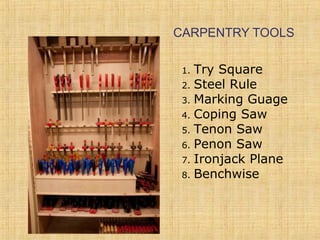
CARPENTRY TOOLS 
1. Try Square 
2. Steel Rule 
3. Marking Guage 
4. Coping Saw 
5. Tenon Saw 
6. Penon Saw 
7. Ironjack Plane 
8. Benchwise
Name that tool 
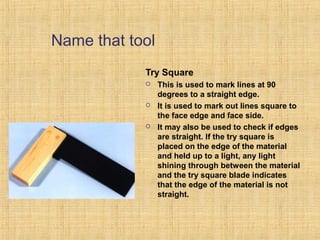
Try Square 
 This is used to mark lines at 90 
degrees to a straight edge. 
 It is used to mark out lines square to 
the face edge and face side. 
 It may also be used to check if edges 
are straight. If the try square is 
placed on the edge of the material 
and held up to a light, any light 
shining through between the material 
and the try square blade indicates 
that the edge of the material is not 
straight.
Name that tool 
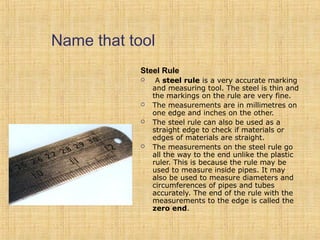
Steel Rule 
 A steel rule is a very accurate marking 
and measuring tool. The steel is thin and 
the markings on the rule are very fine. 
 The measurements are in millimetres on 
one edge and inches on the other. 
 The steel rule can also be used as a 
straight edge to check if materials or 
edges of materials are straight. 
 The measurements on the steel rule go 
all the way to the end unlike the plastic 
ruler. This is because the rule may be 
used to measure inside pipes. It may 
also be used to measure diameters and 
circumferences of pipes and tubes 
accurately. The end of the rule with the 
measurements to the edge is called the 
zero end.
Name that tool 
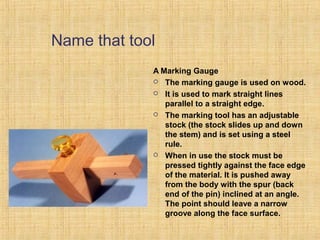
A Marking Gauge 
 The marking gauge is used on wood. 
 It is used to mark straight lines 
parallel to a straight edge. 
 The marking tool has an adjustable 
stock (the stock slides up and down 
the stem) and is set using a steel 
rule. 
 When in use the stock must be 
pressed tightly against the face edge 
of the material. It is pushed away 
from the body with the spur (back 
end of the pin) inclined at an angle. 
The point should leave a narrow 
groove along the face surface.
Name that tool 
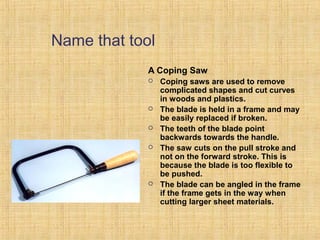
A Coping Saw 
 Coping saws are used to remove 
complicated shapes and cut curves 
in woods and plastics. 
 The blade is held in a frame and may 
be easily replaced if broken. 
 The teeth of the blade point 
backwards towards the handle. 
 The saw cuts on the pull stroke and 
not on the forward stroke. This is 
because the blade is too flexible to 
be pushed. 
 The blade can be angled in the frame 
if the frame gets in the way when 
cutting larger sheet materials.
Name that tool 
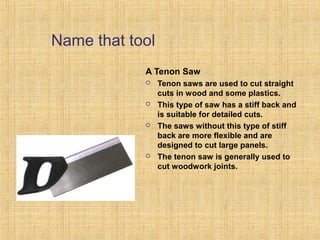
A Tenon Saw 
 Tenon saws are used to cut straight 
cuts in wood and some plastics. 
 This type of saw has a stiff back and 
is suitable for detailed cuts. 
 The saws without this type of stiff 
back are more flexible and are 
designed to cut large panels. 
 The tenon saw is generally used to 
cut woodwork joints.
Name that tool 
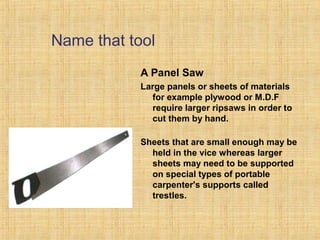
A Panel Saw 
Large panels or sheets of materials 
for example plywood or M.D.F 
require larger ripsaws in order to 
cut them by hand. 
Sheets that are small enough may be 
held in the vice whereas larger 
sheets may need to be supported 
on special types of portable 
carpenter's supports called 
trestles.
WOOD JOINTS AND TOOLS 
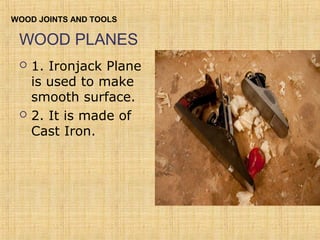
WOOD PLANES 
 1. Ironjack Plane 
is used to make 
smooth surface. 
 2. It is made of 
Cast Iron.
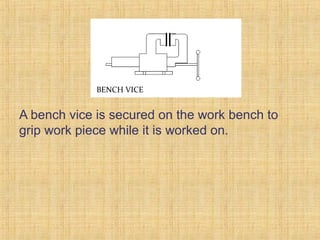
BENCH VICE 
A bench vice is secured on the work bench to 
grip work piece while it is worked on.
Common 
Woodworking Joints 
Beginning Woodworking 
Joints
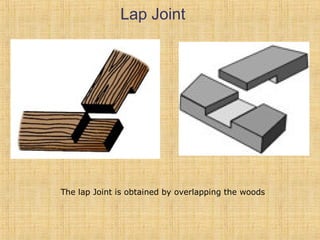
Lap Joint 
The lap Joint is obtained by overlapping the woods
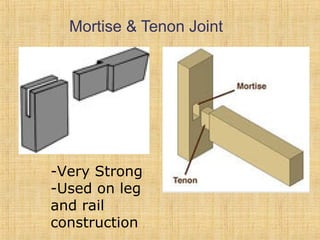
Mortise & Tenon Joint 
-Very Strong 
-Used on leg 
and rail 
construction
Thanks!!!

PPT ON WOOD JOINTS AND CARPENTRY TOOLS

  • 1.
    Wood Joints &Carpentary Tools Presented by: DCRUST, Murthal
  • 2.
    CARPENTRY TOOLS 1.Try Square 2. Steel Rule 3. Marking Guage 4. Coping Saw 5. Tenon Saw 6. Penon Saw 7. Ironjack Plane 8. Benchwise
  • 3.
    Name that tool Try Square  This is used to mark lines at 90 degrees to a straight edge.  It is used to mark out lines square to the face edge and face side.  It may also be used to check if edges are straight. If the try square is placed on the edge of the material and held up to a light, any light shining through between the material and the try square blade indicates that the edge of the material is not straight.
  • 4.
    Name that tool Steel Rule  A steel rule is a very accurate marking and measuring tool. The steel is thin and the markings on the rule are very fine.  The measurements are in millimetres on one edge and inches on the other.  The steel rule can also be used as a straight edge to check if materials or edges of materials are straight.  The measurements on the steel rule go all the way to the end unlike the plastic ruler. This is because the rule may be used to measure inside pipes. It may also be used to measure diameters and circumferences of pipes and tubes accurately. The end of the rule with the measurements to the edge is called the zero end.
  • 5.
    Name that tool A Marking Gauge  The marking gauge is used on wood.  It is used to mark straight lines parallel to a straight edge.  The marking tool has an adjustable stock (the stock slides up and down the stem) and is set using a steel rule.  When in use the stock must be pressed tightly against the face edge of the material. It is pushed away from the body with the spur (back end of the pin) inclined at an angle. The point should leave a narrow groove along the face surface.
  • 6.
    Name that tool A Coping Saw  Coping saws are used to remove complicated shapes and cut curves in woods and plastics.  The blade is held in a frame and may be easily replaced if broken.  The teeth of the blade point backwards towards the handle.  The saw cuts on the pull stroke and not on the forward stroke. This is because the blade is too flexible to be pushed.  The blade can be angled in the frame if the frame gets in the way when cutting larger sheet materials.
  • 7.
    Name that tool A Tenon Saw  Tenon saws are used to cut straight cuts in wood and some plastics.  This type of saw has a stiff back and is suitable for detailed cuts.  The saws without this type of stiff back are more flexible and are designed to cut large panels.  The tenon saw is generally used to cut woodwork joints.
  • 8.
    Name that tool A Panel Saw Large panels or sheets of materials for example plywood or M.D.F require larger ripsaws in order to cut them by hand. Sheets that are small enough may be held in the vice whereas larger sheets may need to be supported on special types of portable carpenter's supports called trestles.
  • 9.
    WOOD JOINTS ANDTOOLS WOOD PLANES  1. Ironjack Plane is used to make smooth surface.  2. It is made of Cast Iron.
  • 10.
    BENCH VICE Abench vice is secured on the work bench to grip work piece while it is worked on.
  • 11.
    Common Woodworking Joints Beginning Woodworking Joints
  • 12.
    Lap Joint Thelap Joint is obtained by overlapping the woods
  • 13.
    Mortise & TenonJoint -Very Strong -Used on leg and rail construction
  • 14.