FUELS AND COMBUSTION
By
Dr. Dharmendra Kumar Bal
Solid FUEL
Carbonization of Coal (Manufacture of Coke)
It is the process of heating the coal in absence of air to a
sufficiently high temperature, so that the coal undergoes
decomposition and yields a residue which is richer in
carbon content than the original fuel.
Caking and coking of coals: some coals have a
tendency to soften and swell at higher temperatures, to
form a solid coherent mass with porous structure. Such
coals are called caking coals. The residue formed is called
coke. If the coke is hard, porous and strong, than the coal,
from which it is formed, it is called coking coal.
This property is found only in bituminous type of coal.
Coals with a high percentage of volatile matter are not fit
for coking and are used for gas making. The coals
having 20-30 % volatile matter are good coking coals.
Process of carbonization:
First moisture and chocked gases are driven off.
At about 260-270oC, carbon, water, H2S, some low
molecular alkenes and alkanes are evolved.
At about 350oC the decomposition of coal is
accompanied by evolution of gases and elimination of
vapor takes place.
At about 400oC, caking coal becomes soft and plastic.
At about 700oC, hydrogen is evolved.
Above 800oC, main gaseous products are evolved
Gases evolved from the plastic mass, expand it to give
foam like appearance.
At further high temperatures this foam like mass solidifies
to form a solid mass with porous structure called coke.
Types of carbonization
(i) Low temperature carbonization
(ii) High temperature carbonization
(i) Low temperature carbonization: When the destructive
distillation of coal is carried out at temperatures
between 500-700oC.
It is practiced for the production of semi coke,which is also
called soft coke.
The yield of coke is about 75-80 %.
The coke thus produced contains 5 to 15 % volatile
matter.
The various products of low temperature carbonization are
semi coke, low temperature tar, crude low temperature
spirit and gas.
LTC plants normally use low rank coals. These low rank
coals produce excessive smoke on burning.
Semi coke from LTC is highly reactive and can be easily
ignited into a smokeless flame.
The gas which is obtained as a byproduct has higher
calorific value of about 6500-9500 kcal/m3.
(ii) High temperature carbonization: It is carried out at
900-1200oC. HTC is used for the production of pure, hard,
strong and porous metallurgical coke containing 1-3 %
volatile matter. The yield of the coke is 65-75%.
The byproducts-gas and tar have greater amounts of
aromatic hydrocarbons. The gas which is obtained has
lower calorific value of about 5000-6000 kcal/m3 than that
produced in LTC; but the yield of the gas is higher.
The coke obtained is very much harder than the coke
obtained from LTC process and hence is called hard coke.
Metallurgical coke: The properties of coke depend on
porosity, reactivity and the amount of volatile matter
retained by coke during carbonization. Coke is mainly
used as a heat source and reducing agent in
metallurgy. A good coke in metallurgical process
should possess the following characteristics:
(i) Purity: The metallurgical coke should contain lower
percentage of moisture, ash, sulphur and
phosphorous.
(ii) Porosity: The coke should be porous so as to provide
contact between carbon and oxygen.
(iii)Strength: The coke used in metallurgical process
should have high strength so as to withstand the
weight of the ore, flux etc. in the furnace.
(iv) Size: Metallurgical coke should be of medium size.
(v) Combustibility: Coke should burn easily. The
combustibility of coke depends on the nature of the coal,
carbonization temperature and reaction temperature.
(vi) Calorific value: It should be high.
(vii) Reactivity: Reactivity of coke is its ability to react
with CO2, steam, air and oxygen. The reactivity should not
be too high. The reactivity toward CO2 represent the
reduction of CO2
)
(
2
)
(
)
(
2
g
CO
s
C
g
CO 

Cost: Coke should be cheap and easily available.
Manufacture of Metallurgical Coke:
(i) Beehive Oven
(ii) Otto Hoffmann oven
(i) Beehive oven: A beehive oven is a fire-brick chamber
having a dome-shaped structure. The dimensions of a
typical oven are 4m and 2.5m high. The roof is provided
with a hole for charging the coal from the top. Another
hole, the discharging hole is provided in the
circumference of the lower part of the wall. A number of
ovens are built in a row with common walls between
neighboring ovens.
Beehive coke oven
Demerits of Beehive ovens: The demerits are
•No recovery of byproducts, which are useful chemicals
and are allowed to escape.
•Lower coke yield due to partial combustion
•Lack of flexibility of operation
(ii) Otto-Hoffmann’s oven or By-product Oven: The
beehive ovens have been replaced by chamber ovens
which works on regenerative principle of heat economy. All
the valuable products are recovered from the outgoing flue
gases.
Construction: It consists of no. of narrow rectangular
chambers made of silica bricks.
A single chamber of Otto Hoffmann’s oven
Working: Coal is charged into the chamber.
The coke ovens are heated to 1200oC by burning
gaseous fuels.
The process of carbonization takes place layer by layer
in the coal charge.
As the coal adjacent to the oven walls gets heated, a
plastic zone is formed which moves away from the walls
towards the central zone.
As the coal is converted into coke, there is decrease in
volume. This is because of the removal of volatile matter
in the form of tar and gas at about 500oC. At further high
temperature, the plastic mass solidifies into hard and
porous mass called coke.
Regenerative principle is employed to achieve as
economical heating as possible.
Regenerators are built underneath the ovens. The flue
gases pass the heat to the checker brick work of
regenerators until the temperature rises to 1000oC.
Regenerators work on the principle of alternate
heating and cooling cycles. This is achieved by
periodically changing the direction of flow of gases
through the vertical flues every 30 min or so.
Carbonization of a charge of coal takes about 11-18
hours. After the process is complete, red hot coke is
pushed outside by means of a ram which is electrically
driven. The coke falls into a quenching car. The yield is
75 % of coal.
Recovery of byproducts: The gases and vapours
evolved on carbonization in coke ovens are not
allowed to mix with the combustion and are collected
separately. The coke oven gas is treated separately
for the recovery of the valuable byproducts.
Fig. 8: Coke-Oven gas treatment plant
(i) Recovery of Tar: The gas from the coke ovens is
passed through a tower in which liquor ammonia is
sprayed. Tar and dust get collected in a tank. The tank
is provided with a heating coils to recover back
ammonia.
(ii) Recovery of ammonia: The gases are then passed
through a tower where water is sprayed to recover
ammonia. The ammonia can also be recovered by
dissolving it in H2SO4 to form (NH4) 2SO4, which is
then used as a fertilizer.
(iii) Recovery of Naphthalene: The gases are passed
through a cooling tower, where water at a low
temperature is sprayed. The gas is scrubbed with
water until its temp. reduces.
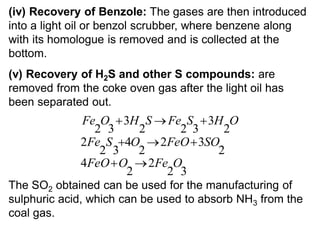
(iv) Recovery of Benzole: The gases are then introduced
into a light oil or benzol scrubber, where benzene along
with its homologue is removed and is collected at the
bottom.
(v) Recovery of H2S and other S compounds: are
removed from the coke oven gas after the light oil has
been separated out.
The SO2 obtained can be used for the manufacturing of
sulphuric acid, which can be used to absorb NH3 from the
coal gas.
O
H
S
Fe
S
H
O
Fe
2
3
3
2
2
3
3
2



3
2
2
2
4
2
3
2
2
4
3
2
2
O
Fe
O
FeO
SO
FeO
O
S
Fe





Coal Washing
Washing of Coal
 Most of the coals when mined contain
impurities associated with it. Impurities are
removed by washing.
 Fixed impurities:
-Originate from the coal forming plants
- Can not be removed by washing
 Free impurities:
-Adhering to the surface
-Can be removed by washing of coal
Objectives of Coal Washing
To reduce its ash content
To reduce transportation and storage costs
To increase its heating value
To increase the fusion point of its ash by
removing alkali chlorides
To reduce its clinkering tendency
To increase its efficiency in use
To reduce its sulphur and phosphorous
contents
Coal Washing Processes
• Types of Coal washing/cleaning plants
• Dense Medium Separators
• Jigs
• Cyclone Washers
• Froth Floatation
Dense Medium Washers
 Properties of the Medium
The medium used to float the coal from its impurities must
be of low viscosity
The medium must also have stability so that it has effective
uniform density
High specific gravity of the medium containing solid (the
grains suspended in water) is also desirable to have effective
medium densities upto or over 2.0
Mixture of sand and water can be used as washing medium
Dense Medium Washers
 Many designs have been employed; not possible
to generalize
 Mainly there are two processes under this
heading
(i) Chance Process
(ii) Tromp Process
Chance Process
• Washing medium is a mixture of sand and water
• A deep bath of sand and water having
intermediate specific gravity between clean coal
and ash is used
• Clean coal floats and dirt sinks and removed
Tromp Process
• A shallow bath instead of deep bath of sand
and water is used
• Clean coal floats and dirt sinks which is
removed by scraper conveyor
• Requires much lesser volume of fluid
• Requires lesser building height
Jig Washers
• A coal bed is maintained on a perforated plate
• Coal bed is subjected to action of upward and
downward current of water
• Clean coal being the lighter is concentrated at the top
while the dirt sinks and removed from the bottom of
the washer
Baum Jig
• This is the most common type of Jig Washers
• Baum Jig is U-shaped vessel divided into washing and air
compartments
• Compressed air is used to create the pulsating movement
of water
Advantages of Jig Washers
• Better separation efficiency for finer sizes
of coal (25-200mm)
Cyclone Washer
 The cyclone washer employs the same principle as
cyclone dust collector except that the coal is fed in
a STREAM OF WATER (or dense medium) instead in
air
 It is a settling chamber in which settling force is
replaced by centrifugal force
 The clean coal is obtained as an overflow from the
cyclone
 The underflow from the cyclone contains the
heavier material or impurities
Advantages
 Efficient for small sized coal
 High flexibility of operation with respect to near
gravity material, coal size and feed size
Disadvantages :
 Higher power consumption
 Higher maintenance cost
Cyclone Washer
Froth Floatation process
 Froth is made in a floatation cell by bubbling
air through water in presence of frothing
agents
 Frothing agents used are normally cresol,
pine oil or alcohols
 When dirty coal powder is added to cell, the
pure coal particles adhere to the bubbles of
the froth
 Dirt particles sink in the cell
 The clean coal is recovered by filtration
Froth Floatation process
Advantages:
 It can produce ultra pure coal
 It is suitable for fine coals
Disadvantages:
 High capital and running cost
 Coal must be grinded to less than 0.5 mm
Coal Storage and Handling
• Solid fuels are stored in bunkers-normally a
quantity equivalent to 100 hours at peak firing
rate is the target storage capacity, with a
minimum amount of 20 tonnes.
• Coal is usually conveyed into storage from the
delivery vehicle by tipping or by pneumatic
conveyance along pipes.
35

Module 2__solid_fuel

  • 1.
    FUELS AND COMBUSTION By Dr.Dharmendra Kumar Bal
  • 2.
  • 3.
    Carbonization of Coal(Manufacture of Coke) It is the process of heating the coal in absence of air to a sufficiently high temperature, so that the coal undergoes decomposition and yields a residue which is richer in carbon content than the original fuel. Caking and coking of coals: some coals have a tendency to soften and swell at higher temperatures, to form a solid coherent mass with porous structure. Such coals are called caking coals. The residue formed is called coke. If the coke is hard, porous and strong, than the coal, from which it is formed, it is called coking coal. This property is found only in bituminous type of coal.
  • 4.
    Coals with ahigh percentage of volatile matter are not fit for coking and are used for gas making. The coals having 20-30 % volatile matter are good coking coals. Process of carbonization: First moisture and chocked gases are driven off. At about 260-270oC, carbon, water, H2S, some low molecular alkenes and alkanes are evolved. At about 350oC the decomposition of coal is accompanied by evolution of gases and elimination of vapor takes place. At about 400oC, caking coal becomes soft and plastic. At about 700oC, hydrogen is evolved.
  • 5.
    Above 800oC, maingaseous products are evolved Gases evolved from the plastic mass, expand it to give foam like appearance. At further high temperatures this foam like mass solidifies to form a solid mass with porous structure called coke. Types of carbonization (i) Low temperature carbonization (ii) High temperature carbonization (i) Low temperature carbonization: When the destructive distillation of coal is carried out at temperatures between 500-700oC.
  • 6.
    It is practicedfor the production of semi coke,which is also called soft coke. The yield of coke is about 75-80 %. The coke thus produced contains 5 to 15 % volatile matter. The various products of low temperature carbonization are semi coke, low temperature tar, crude low temperature spirit and gas. LTC plants normally use low rank coals. These low rank coals produce excessive smoke on burning. Semi coke from LTC is highly reactive and can be easily ignited into a smokeless flame.
  • 7.
    The gas whichis obtained as a byproduct has higher calorific value of about 6500-9500 kcal/m3. (ii) High temperature carbonization: It is carried out at 900-1200oC. HTC is used for the production of pure, hard, strong and porous metallurgical coke containing 1-3 % volatile matter. The yield of the coke is 65-75%. The byproducts-gas and tar have greater amounts of aromatic hydrocarbons. The gas which is obtained has lower calorific value of about 5000-6000 kcal/m3 than that produced in LTC; but the yield of the gas is higher. The coke obtained is very much harder than the coke obtained from LTC process and hence is called hard coke.
  • 8.
    Metallurgical coke: Theproperties of coke depend on porosity, reactivity and the amount of volatile matter retained by coke during carbonization. Coke is mainly used as a heat source and reducing agent in metallurgy. A good coke in metallurgical process should possess the following characteristics: (i) Purity: The metallurgical coke should contain lower percentage of moisture, ash, sulphur and phosphorous. (ii) Porosity: The coke should be porous so as to provide contact between carbon and oxygen. (iii)Strength: The coke used in metallurgical process should have high strength so as to withstand the
  • 9.
    weight of theore, flux etc. in the furnace. (iv) Size: Metallurgical coke should be of medium size. (v) Combustibility: Coke should burn easily. The combustibility of coke depends on the nature of the coal, carbonization temperature and reaction temperature. (vi) Calorific value: It should be high. (vii) Reactivity: Reactivity of coke is its ability to react with CO2, steam, air and oxygen. The reactivity should not be too high. The reactivity toward CO2 represent the reduction of CO2 ) ( 2 ) ( ) ( 2 g CO s C g CO  
  • 10.
    Cost: Coke shouldbe cheap and easily available. Manufacture of Metallurgical Coke: (i) Beehive Oven (ii) Otto Hoffmann oven (i) Beehive oven: A beehive oven is a fire-brick chamber having a dome-shaped structure. The dimensions of a typical oven are 4m and 2.5m high. The roof is provided with a hole for charging the coal from the top. Another hole, the discharging hole is provided in the circumference of the lower part of the wall. A number of ovens are built in a row with common walls between neighboring ovens.
  • 11.
  • 12.
    Demerits of Beehiveovens: The demerits are •No recovery of byproducts, which are useful chemicals and are allowed to escape. •Lower coke yield due to partial combustion •Lack of flexibility of operation (ii) Otto-Hoffmann’s oven or By-product Oven: The beehive ovens have been replaced by chamber ovens which works on regenerative principle of heat economy. All the valuable products are recovered from the outgoing flue gases. Construction: It consists of no. of narrow rectangular chambers made of silica bricks.
  • 13.
    A single chamberof Otto Hoffmann’s oven
  • 14.
    Working: Coal ischarged into the chamber. The coke ovens are heated to 1200oC by burning gaseous fuels. The process of carbonization takes place layer by layer in the coal charge. As the coal adjacent to the oven walls gets heated, a plastic zone is formed which moves away from the walls towards the central zone. As the coal is converted into coke, there is decrease in volume. This is because of the removal of volatile matter in the form of tar and gas at about 500oC. At further high temperature, the plastic mass solidifies into hard and porous mass called coke.
  • 15.
    Regenerative principle isemployed to achieve as economical heating as possible. Regenerators are built underneath the ovens. The flue gases pass the heat to the checker brick work of regenerators until the temperature rises to 1000oC. Regenerators work on the principle of alternate heating and cooling cycles. This is achieved by periodically changing the direction of flow of gases through the vertical flues every 30 min or so. Carbonization of a charge of coal takes about 11-18 hours. After the process is complete, red hot coke is pushed outside by means of a ram which is electrically driven. The coke falls into a quenching car. The yield is 75 % of coal.
  • 16.
    Recovery of byproducts:The gases and vapours evolved on carbonization in coke ovens are not allowed to mix with the combustion and are collected separately. The coke oven gas is treated separately for the recovery of the valuable byproducts. Fig. 8: Coke-Oven gas treatment plant
  • 17.
    (i) Recovery ofTar: The gas from the coke ovens is passed through a tower in which liquor ammonia is sprayed. Tar and dust get collected in a tank. The tank is provided with a heating coils to recover back ammonia. (ii) Recovery of ammonia: The gases are then passed through a tower where water is sprayed to recover ammonia. The ammonia can also be recovered by dissolving it in H2SO4 to form (NH4) 2SO4, which is then used as a fertilizer. (iii) Recovery of Naphthalene: The gases are passed through a cooling tower, where water at a low temperature is sprayed. The gas is scrubbed with water until its temp. reduces.
  • 18.
    (iv) Recovery ofBenzole: The gases are then introduced into a light oil or benzol scrubber, where benzene along with its homologue is removed and is collected at the bottom. (v) Recovery of H2S and other S compounds: are removed from the coke oven gas after the light oil has been separated out. The SO2 obtained can be used for the manufacturing of sulphuric acid, which can be used to absorb NH3 from the coal gas. O H S Fe S H O Fe 2 3 3 2 2 3 3 2    3 2 2 2 4 2 3 2 2 4 3 2 2 O Fe O FeO SO FeO O S Fe     
  • 19.
  • 20.
    Washing of Coal Most of the coals when mined contain impurities associated with it. Impurities are removed by washing.  Fixed impurities: -Originate from the coal forming plants - Can not be removed by washing  Free impurities: -Adhering to the surface -Can be removed by washing of coal
  • 21.
    Objectives of CoalWashing To reduce its ash content To reduce transportation and storage costs To increase its heating value To increase the fusion point of its ash by removing alkali chlorides To reduce its clinkering tendency To increase its efficiency in use To reduce its sulphur and phosphorous contents
  • 22.
    Coal Washing Processes •Types of Coal washing/cleaning plants • Dense Medium Separators • Jigs • Cyclone Washers • Froth Floatation
  • 23.
    Dense Medium Washers Properties of the Medium The medium used to float the coal from its impurities must be of low viscosity The medium must also have stability so that it has effective uniform density High specific gravity of the medium containing solid (the grains suspended in water) is also desirable to have effective medium densities upto or over 2.0 Mixture of sand and water can be used as washing medium
  • 24.
    Dense Medium Washers Many designs have been employed; not possible to generalize  Mainly there are two processes under this heading (i) Chance Process (ii) Tromp Process
  • 25.
    Chance Process • Washingmedium is a mixture of sand and water • A deep bath of sand and water having intermediate specific gravity between clean coal and ash is used • Clean coal floats and dirt sinks and removed
  • 26.
    Tromp Process • Ashallow bath instead of deep bath of sand and water is used • Clean coal floats and dirt sinks which is removed by scraper conveyor • Requires much lesser volume of fluid • Requires lesser building height
  • 27.
    Jig Washers • Acoal bed is maintained on a perforated plate • Coal bed is subjected to action of upward and downward current of water • Clean coal being the lighter is concentrated at the top while the dirt sinks and removed from the bottom of the washer
  • 28.
    Baum Jig • Thisis the most common type of Jig Washers • Baum Jig is U-shaped vessel divided into washing and air compartments • Compressed air is used to create the pulsating movement of water
  • 29.
    Advantages of JigWashers • Better separation efficiency for finer sizes of coal (25-200mm)
  • 30.
    Cyclone Washer  Thecyclone washer employs the same principle as cyclone dust collector except that the coal is fed in a STREAM OF WATER (or dense medium) instead in air  It is a settling chamber in which settling force is replaced by centrifugal force  The clean coal is obtained as an overflow from the cyclone  The underflow from the cyclone contains the heavier material or impurities
  • 31.
    Advantages  Efficient forsmall sized coal  High flexibility of operation with respect to near gravity material, coal size and feed size Disadvantages :  Higher power consumption  Higher maintenance cost Cyclone Washer
  • 32.
    Froth Floatation process Froth is made in a floatation cell by bubbling air through water in presence of frothing agents  Frothing agents used are normally cresol, pine oil or alcohols  When dirty coal powder is added to cell, the pure coal particles adhere to the bubbles of the froth  Dirt particles sink in the cell  The clean coal is recovered by filtration
  • 34.
    Froth Floatation process Advantages: It can produce ultra pure coal  It is suitable for fine coals Disadvantages:  High capital and running cost  Coal must be grinded to less than 0.5 mm
  • 35.
    Coal Storage andHandling • Solid fuels are stored in bunkers-normally a quantity equivalent to 100 hours at peak firing rate is the target storage capacity, with a minimum amount of 20 tonnes. • Coal is usually conveyed into storage from the delivery vehicle by tipping or by pneumatic conveyance along pipes. 35