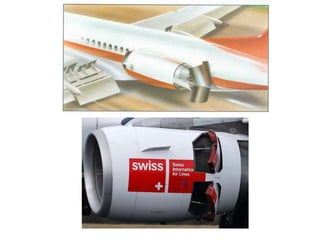
Jet Propulsion
Recap Quiz
• What does the compressor do?
• What is the difference between Rotor Blades and
Stator Blades?
• How is the Turbine driven?
• Name the 3 types of Combustion Chambers?
• Briefly explain what happens to the temperature
and pressure as the air goes through the engine?
• Name 2 different types of jet engines?
• What is a Compressor Surge and how is it solved?
• What does the compressor do?
The function of the compressor in a jet engine is to
increase the pressure of airflow through the
engine.
• What is the difference between Rotor Blades
and Stator Blades?
Rotor blades push the air back to the Stator blades.
These then compress the air increasing its
pressure.
• How is the Compressor driven?
By the Turbine
• Name the 3 types of Combustion Chambers?
Can, Cannular and Annular.
• Briefly explain what happens to the temperature and
pressure as the air goes through the engine
Pressure: As the air goes through the compressors, it
increases. Once it is ignited, the pressure drops and
continues to drop as the air goes out the exhaust.
Temperature: As the air goes through the compressors
the temperature increases slowly. Once it is ignited in
the combustion chamber, there is a rapid increase. IT
then slowly decreases as it leaves the exhaust.
• Name 2 different types of jet engines?
Turbojet, Turboshaft, Turboprop, Turbofan,
• What is a Compressor Surge and how is it solved?
A compressor surge (stall) is a situation of abnormal
airflow resulting from a stall of the airfoil within
the compressor of a jet engine. The compressors
are unable to cope with the amount of air entering
the engine.
This is solved by having a bleed valve.
A double shaft.
Intakes
• An engine’s air inlet duct is normally
considered an airframe part, and not a part of
the engine. However, the duct, itself, is so
important to engine performance.
The inlet duct has two engine functions:
• It must be able to recover as much of the total
pressure of the free air-stream as possible and
deliver this pressure to the front of the engine
with minimum loss.
• The duct must deliver air to the compressor
inlet under all flight conditions with as little
turbulence and pressure variation as possible.
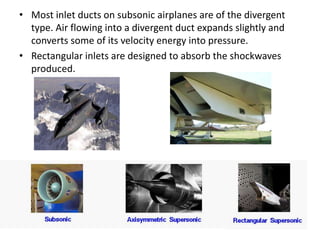
• Most inlet ducts on subsonic airplanes are of the divergent
type. Air flowing into a divergent duct expands slightly and
converts some of its velocity energy into pressure.
• Rectangular inlets are designed to absorb the shockwaves
produced.
Compressors
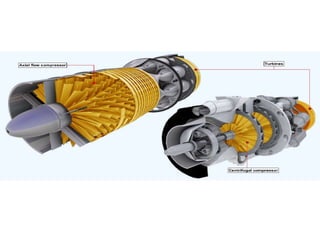
Centrifugal flow
• Centrifugal compressors were used on many
of the earliest gas turbine engines because of
their ruggedness, light weight and high
pressure ratio for each stage of compression.
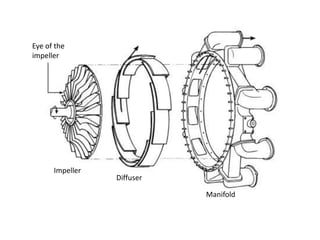
• A typical centrifugal compressor consists of
three components: the impeller, the diffuser,
and the manifold.
Eye of the
impeller
Impeller
Diffuser
Manifold
• Air enters the eye of the fast-rotating impeller and is
accelerated to a high velocity as it is slung to the outer
edge by centrifugal force. The high-velocity air then
flows into the diffuser, which fits closely around the
outside edge of the impeller.
• There it flows through divergent ducts where some of
the velocity energy is changed into pressure energy.
• The air, which has slowed down and has had its
pressure increased, flows into the manifold through a
series of turning vanes.
• From the manifold, the air flows into the combustion
section of the engine.
Axial flow compressor
• Axial-flow are compressors in which the air passes
axially or straight through the compressor.
• They are heavier than a centrifugal compressor, but
they are capable of a much higher overall compression
ratio, and they have a smaller cross-sectional area,
which makes them easier to streamline.
• Axial-flow compressors have therefore become the
standard for large gas turbine engines and are also used
on many small engines.
• Axial-flow compressors are made up of a
number of stages of rotor blades that are
driven by the turbine, and that rotate
between stages of fixed stator vanes.
• Both the rotor blades and stator vanes have
airfoil shapes and are mounted so that they
form a series of divergent ducts through which
the air flows.
Combustion
Air distribution
• Approximately 82% of the air from the
compressor passes around the outside of the
inner flame tube.
• This air is then passes into the flame tube via a
number of large and small ‘dilution’ holes into
the inside of the flame tube where it is heated
by the combustion flame
• Approximately 18% of the air passes immediately
into the flame tube where it is split into another
two main flows: -
• A. Approximately half of the air passes around
and through the end baffle plate and swirls into
the flame tube. It can be seen that this air flow
produces a forward flow right at the point where
the fuel is sprayed in.
• B. Approximately half the airflow passes through
swirl vanes situated around the fuel jet. This swirl
air hits the forward flow to produce what is
known as a ‘Re-Circulating Vortex’.
Afterburners
• An afterburner is an additional component on
some jet engines. Its purpose is to provide an
increase in thrust.
• Afterburning is achieved by injecting
additional fuel into the jet pipe downstream of
the turbine. It is burnt using the remaining
oxygen.
• This heats and expands the exhaust gases further,
and can increase the thrust of a jet engine by 50%
or more.
Reverse Thrust
• Modern aircraft are normally so heavy to land at
such a high speed that the aircraft brakes cannot
be depended upon for complete speed control.
• Thrust reversal is the temporary diversion of
an aircraft engine's exhaust so that the exhaust
produced is directed forward, rather than
rearwards.
• This acts against the forward travel of the aircraft,
providing deceleration
CLAM SHELL
DOORS
FORWARD THRUSTREVERSE THRUST
TARGET
DOORS
FORWARD THRUSTREVERSE THRUST
Jet Propulsion: Recap, Intake, Types of compressor, and More

Jet Propulsion: Recap, Intake, Types of compressor, and More

  • 1.
  • 2.
    Recap Quiz • Whatdoes the compressor do? • What is the difference between Rotor Blades and Stator Blades? • How is the Turbine driven? • Name the 3 types of Combustion Chambers? • Briefly explain what happens to the temperature and pressure as the air goes through the engine? • Name 2 different types of jet engines? • What is a Compressor Surge and how is it solved?
  • 3.
    • What doesthe compressor do? The function of the compressor in a jet engine is to increase the pressure of airflow through the engine. • What is the difference between Rotor Blades and Stator Blades? Rotor blades push the air back to the Stator blades. These then compress the air increasing its pressure. • How is the Compressor driven? By the Turbine
  • 4.
    • Name the3 types of Combustion Chambers? Can, Cannular and Annular. • Briefly explain what happens to the temperature and pressure as the air goes through the engine Pressure: As the air goes through the compressors, it increases. Once it is ignited, the pressure drops and continues to drop as the air goes out the exhaust. Temperature: As the air goes through the compressors the temperature increases slowly. Once it is ignited in the combustion chamber, there is a rapid increase. IT then slowly decreases as it leaves the exhaust.
  • 5.
    • Name 2different types of jet engines? Turbojet, Turboshaft, Turboprop, Turbofan, • What is a Compressor Surge and how is it solved? A compressor surge (stall) is a situation of abnormal airflow resulting from a stall of the airfoil within the compressor of a jet engine. The compressors are unable to cope with the amount of air entering the engine. This is solved by having a bleed valve. A double shaft.
  • 6.
    Intakes • An engine’sair inlet duct is normally considered an airframe part, and not a part of the engine. However, the duct, itself, is so important to engine performance.
  • 7.
    The inlet ducthas two engine functions: • It must be able to recover as much of the total pressure of the free air-stream as possible and deliver this pressure to the front of the engine with minimum loss. • The duct must deliver air to the compressor inlet under all flight conditions with as little turbulence and pressure variation as possible.
  • 8.
    • Most inletducts on subsonic airplanes are of the divergent type. Air flowing into a divergent duct expands slightly and converts some of its velocity energy into pressure. • Rectangular inlets are designed to absorb the shockwaves produced.
  • 9.
    Compressors Centrifugal flow • Centrifugalcompressors were used on many of the earliest gas turbine engines because of their ruggedness, light weight and high pressure ratio for each stage of compression. • A typical centrifugal compressor consists of three components: the impeller, the diffuser, and the manifold.
  • 10.
  • 11.
    • Air entersthe eye of the fast-rotating impeller and is accelerated to a high velocity as it is slung to the outer edge by centrifugal force. The high-velocity air then flows into the diffuser, which fits closely around the outside edge of the impeller. • There it flows through divergent ducts where some of the velocity energy is changed into pressure energy. • The air, which has slowed down and has had its pressure increased, flows into the manifold through a series of turning vanes. • From the manifold, the air flows into the combustion section of the engine.
  • 12.
    Axial flow compressor •Axial-flow are compressors in which the air passes axially or straight through the compressor. • They are heavier than a centrifugal compressor, but they are capable of a much higher overall compression ratio, and they have a smaller cross-sectional area, which makes them easier to streamline. • Axial-flow compressors have therefore become the standard for large gas turbine engines and are also used on many small engines.
  • 13.
    • Axial-flow compressorsare made up of a number of stages of rotor blades that are driven by the turbine, and that rotate between stages of fixed stator vanes. • Both the rotor blades and stator vanes have airfoil shapes and are mounted so that they form a series of divergent ducts through which the air flows.
  • 15.
    Combustion Air distribution • Approximately82% of the air from the compressor passes around the outside of the inner flame tube. • This air is then passes into the flame tube via a number of large and small ‘dilution’ holes into the inside of the flame tube where it is heated by the combustion flame
  • 16.
    • Approximately 18%of the air passes immediately into the flame tube where it is split into another two main flows: - • A. Approximately half of the air passes around and through the end baffle plate and swirls into the flame tube. It can be seen that this air flow produces a forward flow right at the point where the fuel is sprayed in. • B. Approximately half the airflow passes through swirl vanes situated around the fuel jet. This swirl air hits the forward flow to produce what is known as a ‘Re-Circulating Vortex’.
  • 18.
    Afterburners • An afterburneris an additional component on some jet engines. Its purpose is to provide an increase in thrust. • Afterburning is achieved by injecting additional fuel into the jet pipe downstream of the turbine. It is burnt using the remaining oxygen. • This heats and expands the exhaust gases further, and can increase the thrust of a jet engine by 50% or more.
  • 19.
    Reverse Thrust • Modernaircraft are normally so heavy to land at such a high speed that the aircraft brakes cannot be depended upon for complete speed control. • Thrust reversal is the temporary diversion of an aircraft engine's exhaust so that the exhaust produced is directed forward, rather than rearwards. • This acts against the forward travel of the aircraft, providing deceleration
  • 20.
  • 21.